The Unterland's most populous municipality
Eschen, the village that acts as the north's capital
Eschen is the most populous municipality in Liechtenstein's Unterland, with 4,781 residents on 31 December 2025 across 10.4 km², and it takes in the village of Eschen and the hamlet of Nendeln. It hosted the court of the old lordship of Schellenberg until 1808. What I'd see is the 1778 mill, the Pfrundbauten beside St Martin's church and the Rofenberg chapel.
In 30 seconds
Full read: 3 min
- Eschen is the Unterland's most populous municipality, with 4,781 residents at the end of 2025.
- It's made up of Eschen village and the hamlet of Nendeln, which has the railway stop.
- The 1778 mill can be toured by appointment from April to October.
- The Pfrundbauten beside St Martin's are the village's emblem.
I wouldn't give Eschen a whole day, but I would fold it into a morning in the Unterland. Between April and October, book the tour of the 1778 mill in advance, as it only opens by appointment, and add the Rofenberg chapel, which sits right on the Eschnerberg path.

On the calendar
The date at a glance
-
Eschen Fair (Jahrmarkt)
Eschen
Before you go
What I would keep in mind
-
01 Most beautiful
A 1778 wine press that still grinds maize
The Eschen mill began life as the lord's wine press, became an electric mill in 1912 and still works today. It ground the pale Rhine maize known as «Tüargga» for Rebel, the valley's staple dish.
Liechtenstein food -
02 My tip
The mill is by appointment only
The municipal website offers guided tours on request from 1 April to 31 October, with the mill shut from November to March. There's also an open milling day every spring.
-
03 Getting there
Nendeln is your station
Eschen itself has no train, but its hamlet of Nendeln has a stop on the ÖBB line. By bus, route 13 links Balzers with Eschen and Schaanwald, and routes 31 and 32 run on to Ruggell.
Nendeln and its Roman villa -
04 To save money
The indoor pool is on the day pass
The ALL INCLUSIVE Adventure Pass, CHF 25 a day for an adult, covers the Schulzentrum Unterland indoor pool near Eschen's centre. Note that it's shut from 5 to 16 October 2026 for repairs.
swimming pools in Liechtenstein
What I would book
My ranking, scored
What I'd see in Eschen
My own scores out of 10, based on how much each place tells you about the Unterland's past, how easy it is to see and how different it feels from Vaduz.
0 of 5 seen
-
Eschen mill (1778)
A lord's wine press turned electric mill in 1912, listed and still running. The guided tour shows you what the valley lived on until about seventy years ago.
8.4 out of 10
-
Pfrundbauten and St Martin's
The old rectory and chaplain's house, dating back to the 15th century, are the village's emblem alongside the neo-Gothic church. They host exhibitions and concerts.
8.0 out of 10
-
Rofenberg chapel
A small early 16th-century chapel where the old pilgrim path to Einsiedeln and Santiago crossed two other routes. The lordship's court met in front of it until 1808.
7.6 out of 10
-
Nendeln Roman villa
The foundations of a 2nd-century Roman country house above Nendeln's primary school. A short walk is all it takes.
7.2 out of 10
-
Eschnerberg sites
The Schneller and the Malanser, high on the hill, were a settlement and an offering site in prehistory. You need to enjoy walking and reading panels.
6.8 out of 10
Eschen never makes it onto Liechtenstein’s postcards, and that’s precisely why I find it interesting. For centuries it was the north’s capital in all but name, with its court, its cattle market and its main church, and today it’s the most populous municipality in the Unterland. If you want to see that the country isn’t just Vaduz and Malbun, it’s a good place to stop.
Where the old lordship met
Eschen spreads over the southern slope of the Eschnerberg and two hills in front of it, with the hamlet of Nendeln to the south-east across a damp stretch of flat land drained by the Esche stream. The name appears as early as 842/43 as «Essane», and the Historisches Lexikon links it to a Celtic root meaning water.
Until 1808 the court of the lordship of Schellenberg sat here, and the Lexikon calls Eschen the centre of the Unterland. That history explains why the church and square feel bigger than you’d expect. The rest of the region is summed up on the Unterland of Liechtenstein.
What can you see in Eschen in a morning?
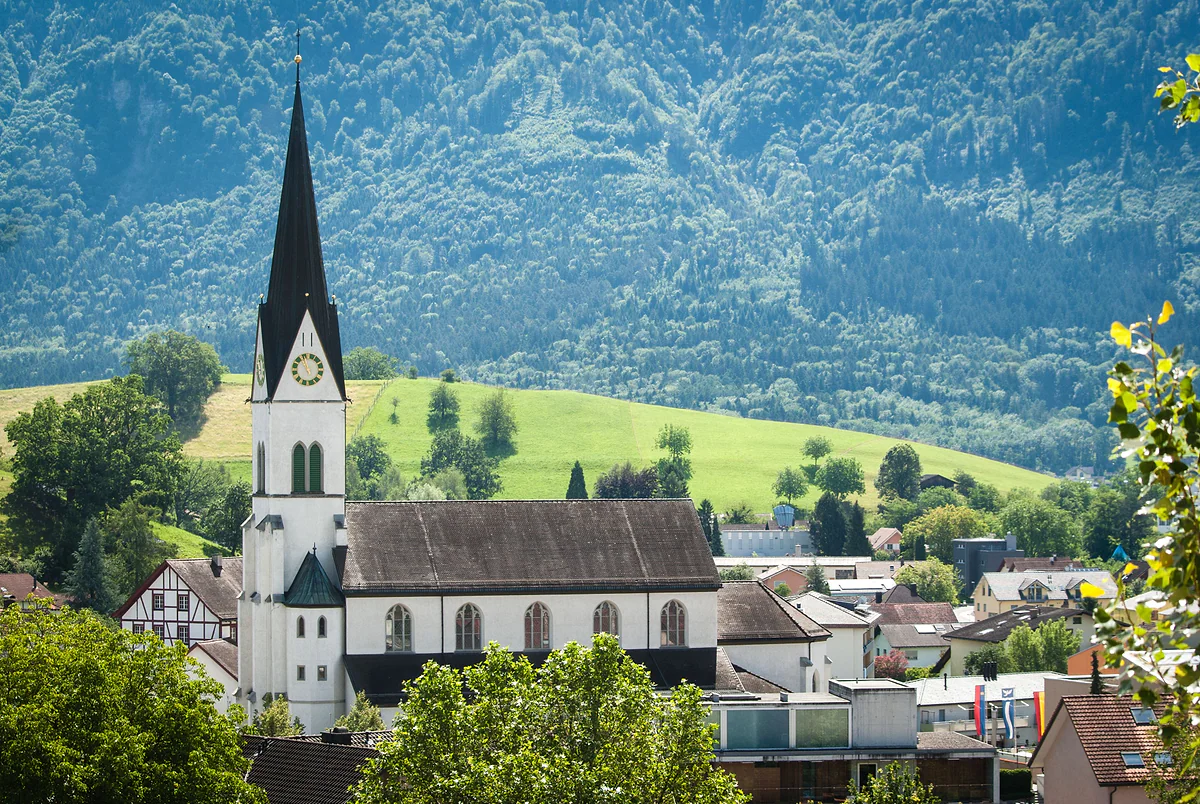
I’d start on the village square. That’s where you’ll find the Pfrundbauten, the former rectory and chaplain’s house, which the municipality describes as Eschen’s landmark together with St Martin’s church. They go back to the 15th century, have been listed since 1974 and contain a hall locals call the «Rittersaal», used for exhibitions and concerts. If one is on when you pass, go in.
St Martin’s is neo-Gothic, from 1893-94, and comes with an odd story. The Stuttgart architects behind it recycled the plans for a church that was never built in Rankweil, just over the border. A church stood on this spot as early as the 8th or 9th century, and next door you can see the foundations of its predecessor, uncovered in 1979-80.
The third stop is the Holy Cross chapel, which everyone calls the Rofenberg chapel. It’s small, probably early 16th century, and stands where the old route used by Vorarlberg pilgrims heading for Einsiedeln and Santiago met two other paths. The lordship’s court sat in front of it, or in the inn next door, until 1808.
The mill, the best thing in the village
Above the mill door there’s a year carved in Roman numerals, MDCCLXXVIII, which is 1778. The building started out as the lord’s wine press, and when wine stopped paying in the early 20th century a farmers’ cooperative bought it and fitted an electric mill in 1912. During the Second World War it ground over 400 tonnes. The municipality bought it in 1980, restored it and keeps it ready in case it’s ever needed.
What it mostly ground was the big, pale Rhine valley maize called «Tüargga», used for Rebel, the valley’s everyday food until the mid-20th century. Guided tours can be booked from 1 April to 31 October, and there’s an open milling day in spring. For me it’s what makes the detour worthwhile. What people eat today is covered on Liechtenstein food.
Nendeln, the other half
The hamlet of Nendeln belongs to Eschen and has what the village lacks, a railway stop and a Roman past. Above its school you can see the foundations of a 2nd-century country house beside the old road from Bregenz to Milan. It has its own page, Nendeln, because it deserves more than a couple of lines.
The Liechtenstein Trail also passes through Nendeln. Stage three ends at the station and stage four sets off from there towards Eschen, Bendern and Ruggell, so if you walk the whole country you’ll cross Eschen whether you plan to or not.
Up top, the Eschnerberg
Behind the village rises the Eschnerberg, the isolated hill that shapes the whole Unterland. The part belonging to Eschen holds two prehistoric sites, the Schneller, an Iron Age burnt offering site, and the Malanser, a small settlement that produced one of the oldest Neolithic adzes in the Rhine valley. Neither is much to look at, but the panels on the ridge path bring them to life. It’s all on the Eschnerberg.
Come in October if you can
If you can pick your dates, October has its charm. The Eschen fair runs from 9 to 11 October in 2026, and around the same days, a week after Vaduz, the village holds its autumn cattle show. The cows and the return from the Alps are explained on the Alpine cattle drive. And one detail I like, the municipal website says its restaurants pour wine from growers on the Eschnerberg itself.
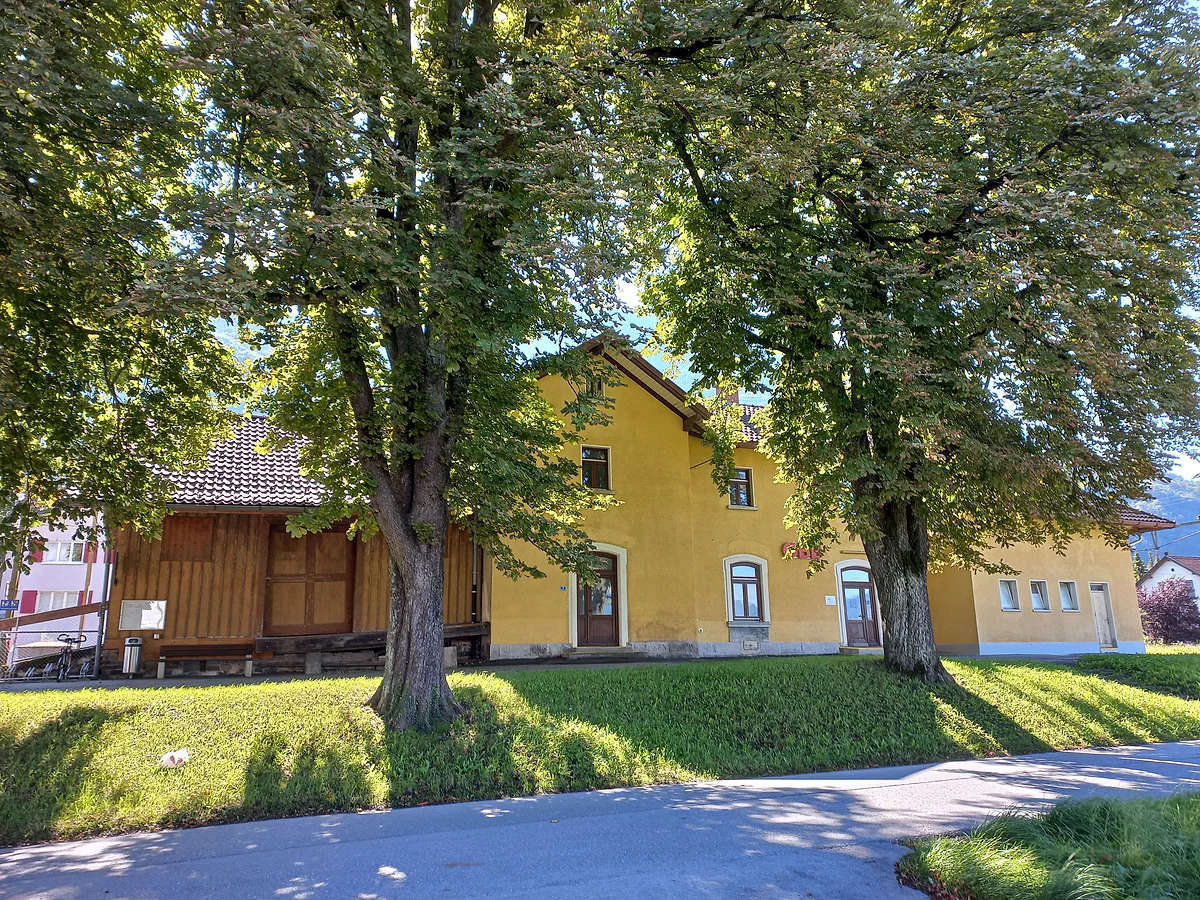
The old Nendeln railway station, with its yellow façade, in the shade of two large trees.
Eschen in figures
| Fact | Figure |
|---|---|
| Residents on 31-12-2025 | 4,781 |
| Area | 10.4 km² |
| Density (2024) | 455 per km² |
| Reference altitude | 457 m |
| First recorded | 842/43, as «Essane» |
Population and area from the Office of Statistics; first record from the Historisches Lexikon.
Eschen mill, visiting
| Period | How to visit |
|---|---|
| 1 April to 31 October | Guided tour, booked in advance |
| 1 November to 31 March | Closed |
| Spring | Annual open milling day |
Eschen municipal website. The exact milling day for 2027 hasn't been published yet.
Test yourself
True or false?
0/4 Pick before you peek.
-
Eschen has more residents than any other municipality in the Unterland.
See the answer
True. It had 4,781 residents on 31 December 2025, slightly more than Mauren with 4,663.
-
The Eschen mill was built as a mill.
See the answer
False. It started out as the lord's wine press. The farmers' cooperative that bought it installed an electric mill in 1912.
-
St Martin's church was built to plans drawn up for another village.
See the answer
True. The Historisches Lexikon says the Stuttgart architects reused a design for Rankweil, in Vorarlberg, that was never built.
-
Eschen owns its own Alpine pastures.
See the answer
False. The Lexikon is clear that Eschen has no Alps. It does own steep forests east of Nendeln that climb to 1,659 metres.
- Residents on 31-12-2025
- 4,781
- Year carved above the mill door
- 1778
- Last year as seat of the lordship's court
- 1808
- Area of the municipality
- 10.4 km²
Map
Where Eschen is
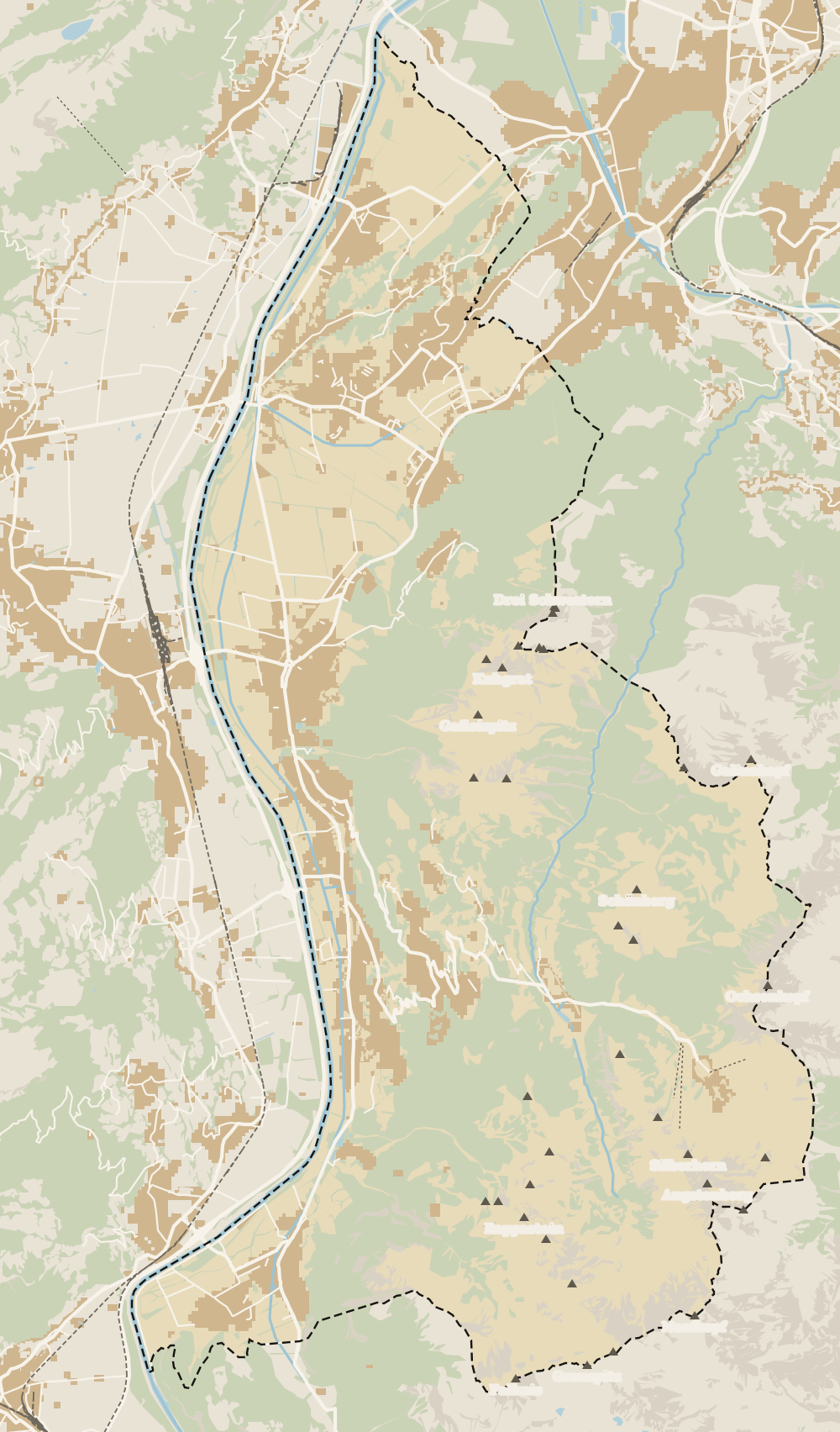
The dashed line is the border: Switzerland across the Rhine, Austria to the north and east. Every number opens its guide.
What to see
What to see in Eschen
0 of 168 Liechtenstein guides
Your next stamp
- Unterland
- Nendeln
- Triesen
- Balzers
- Stage 4: Nendeln - Ruggell
- Mauren
- Things to do
- Schellenberg
- One day
- Two days
- Municipalities
- Oberland
- Map
- Vaduz
- Städtle
- Mitteldorf
- Vaduz Castle
- Vaduz Cathedral
- Parliament
- Government Building
- Vaduz Town Hall
- Red House
- Prince's Winery
- Old Rhine Bridge
- Schaan
- Schalun Castle Ruin
- Citytrain
- Triesenberg
- Walser Museum
- Planken
- Gutenberg Castle
- The Rhine
- Schaan Roman fort
- Dux
- St Mamertus chapel
- Lawena valley
- Mäls
- DoMuS
- TAK Theatre
- Castles
- Churches and chapels
- Viewpoints
- Mountains
- Museums
- Kunstmuseum
- Mountain huts
- Hilti Art Foundation
- Pfälzerhütte
- Gafadura hut
- National Museum
- Treasure Chamber
- Postage Stamp Museum
- Kunstraum Engländerbau
- Masescha
- Gaflei
- Silum
- Rotenboden
- Schaanwald
- Gamprin
- Wangerberg
- Bendern
- Steg
- Ruggell
- Samina valley
- Schellenberg Farmhouse Museum
- Cross-country skiing at Steg
- Küefer-Martis-Huus
- Ruggeller Riet
- Hinterschellenberg
- Fürstensteig
- Is it a country?
- Liechtenstein Trail
- Malbun
- Schellenberg castles
- Eschnerberg
- Malbun in summer
- Population
- Stage 1: Balzers - Triesenberg
- Lakes
- Sareis
- Size
- Stage 2: Triesenberg - Vaduz
- Malbun Peace Chapel
- Political system
- Stage 3: Vaduz - Nendeln
- Swimming pools
- Language
- Skiing in Malbun
- Dialect
- Malbun ski pass
- Stage 5: Ruggell - Schaanwald
- Hotels in Malbun
- Stamps
- Princess Gina Trail
- Hut-to-hut Route 66
- Hiking
- Getting there
- In winter
- Weather
- Airport
- Best time to visit
- In summer
- Events
- With kids
- Zurich to Liechtenstein
- National day
- Sargans to Vaduz
- Christmas
- Feldkirch to Vaduz
- By train
- Traditions
- Carnival
- Getting around
- Buses
- Funken Sunday
- Alpine cattle drive
- Driving and vignette
- Parking
- Bike hire
- Cycling
- EU and Schengen
- Entry requirements
- Borders and customs
- The prince
- The princely house
- The flag
- The coat of arms
- The national anthem
- History
- Second World War
- No army
- Facts
- Why so rich?
- Banks and tax haven
- Where to stay
- Hilti
- Hotels in Vaduz
- False teeth
- Hostel and camping
- Rent the country?
- Where to eat
- Restaurants in Vaduz
- Swiss invasions
- Bars and nightlife
- Food
- Käsknöpfle
- Wine
- Casinos
- Adventure Pass
- Rainy days
- Guided tours
- Tourist office
- Day trips
- Passport stamp
- Music festivals
- Phone and roaming
- Currency and payments
- Prices and budget
- Tipping
- Plugs and sockets
- Tap water
- Opening hours
- Public holidays
- Safety
- Accessibility
- With a dog
- Shopping and souvenirs
Frequently asked questions
What is there to see in Eschen, Liechtenstein?
The 1778 mill, the Pfrundbauten next to St Martin's church, the Rofenberg chapel and, in its hamlet of Nendeln, the foundations of a Roman villa. Up on the Eschnerberg there are prehistoric sites too.
How many people live in Eschen?
4,781 residents on 31 December 2025, according to the Office of Statistics. That makes it the most populous municipality in the Unterland, just ahead of Mauren.
Does Eschen have a railway station?
The village doesn't, but its hamlet of Nendeln has a stop on the ÖBB line between Feldkirch and Buchs. Check the timetable on oebb.at before you go, because the service in autumn 2026 is unclear.
Can you visit the Eschen mill?
Yes, on a guided tour booked in advance between 1 April and 31 October. From November to March it's closed, according to the municipality.
What are the Pfrundbauten in Eschen?
The former rectory and chaplain's house beside St Martin's church, with origins in the 15th century. They've been listed since 1974 and used by the municipality for exhibitions and concerts since 1976.
When is the Eschen fair?
In 2026 it runs from 9 to 11 October. The same week Eschen holds its autumn cattle show, a week after Vaduz has its own.
By
Tourism graduate with a master’s in Tourism Management and Planning from the University of Málaga, who has travelled across Europe. He writes every guide from official sources and his own judgement.
Published on . Facts checked on .
Sources
Photos: Clemens v. Vogelsang from Liechtenstein (CC BY 2.0); Asurnipal (CC BY-SA 4.0), via Wikimedia Commons.