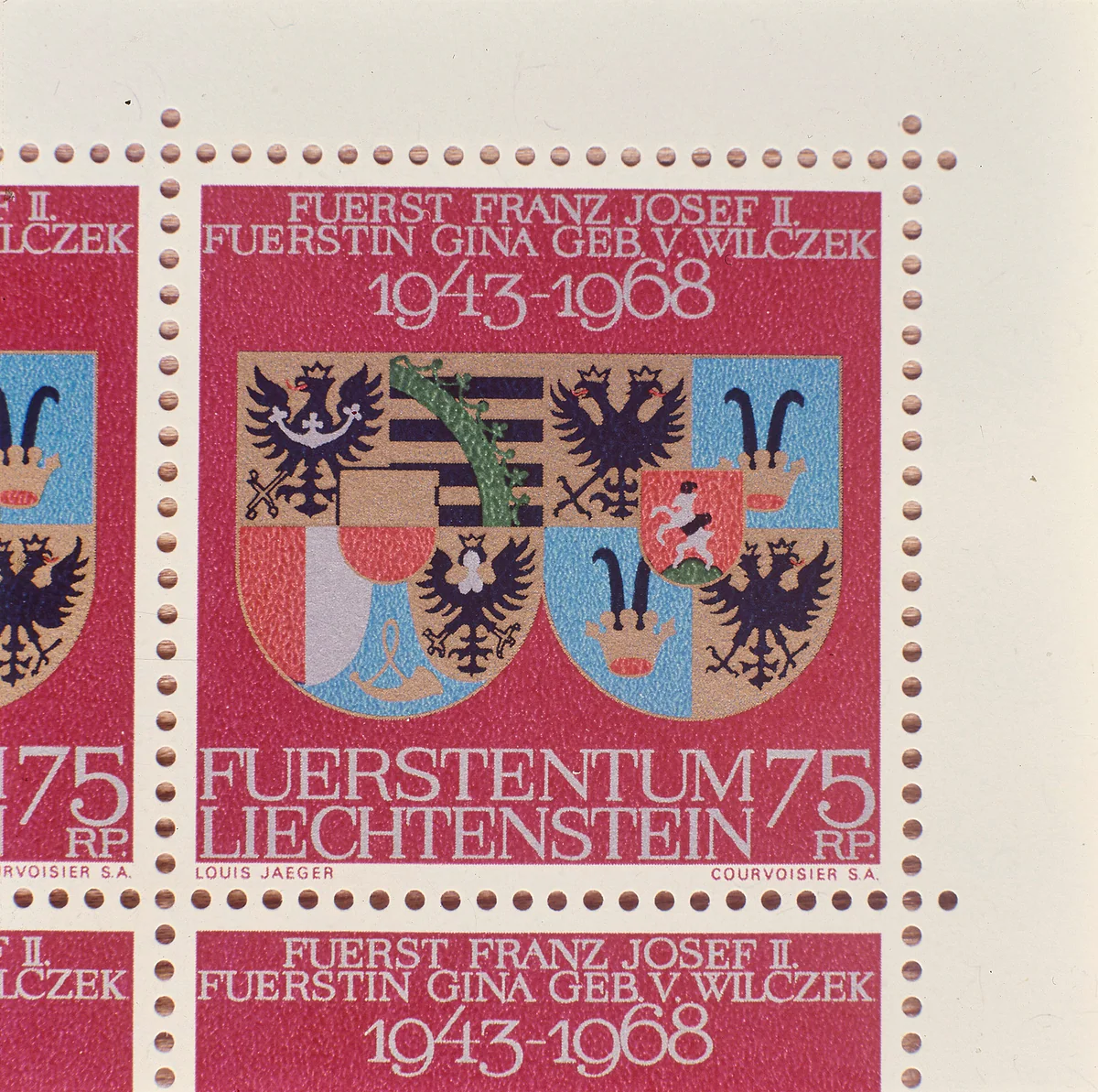
State arms since 1719
The Liechtenstein coat of arms, quarter by quarter
Liechtenstein's coat of arms is that of the princely house, as Article 5 of the constitution lays down. The great arms carry six emblems, with the family's gold-and-red shield in the centre and quarters for Silesia, the Kuenrings, the Duchy of Troppau, East Frisia and the Duchy of Jägerndorf. The lesser arms are just the gold-and-red shield under the princely crown.
In 30 seconds
Full read: 3 min
- Liechtenstein's coat of arms is its princely family's, as the constitution states.
- The great arms carry six emblems, with the family's gold-and-red shield at the centre.
- The quarters refer to Silesia, the Kuenrings, Troppau, East Frisia and Jägerndorf.
- The lesser arms are just the gold-and-red shield under the princely crown.
The cheapest way to take the arms home, to my mind, is on a stamp. The tourist office in Vaduz sells them, and it's an official object rather than a souvenir-shop copy.

Before you go
What I would keep in mind
-
01 To save money
The arms on a postage stamp
The Liechtenstein Center in Vaduz sells postage stamps. It's the cheapest way to bring the country's symbols home, and stamps are one of its longest-running traditions.
Liechtenstein stamps and where to buy them -
02 My tip
The eagle with a woman's head is a real person
The black eagle with a maiden's head, the princely house says, commemorates Agnes of East Frisia, first wife of Prince Gundaker, who gave the arms their present form.
Liechtenstein royal family -
03 Most beautiful
Every municipality has its own arms
Between 1932 and 1958 the prince granted arms, flags and colours to all eleven municipalities. Vaduz's, settled in 1978, pairs a red princely hat with a silver church banner.
Vaduz, the capital of Liechtenstein
What I would book
The first odd thing about Liechtenstein’s coat of arms is that it says nothing about Liechtenstein. No Rhine, no mountain, no Vaduz. Instead you get Silesian eagles, a hunting horn from a long-gone duchy and a tribute to a 17th-century prince’s wife. It’s a family’s coat of arms, and the country uses it because for centuries the country belonged to that family. Once that clicks, half of Liechtenstein makes sense.
A family shield that became the state’s
The constitution is blunt about it in Article 5, where it says the state’s arms are those of the princely house of Liechtenstein. The Historisches Lexikon adds that this has been written into the constitution since 1921, but that in practice it goes back much further. After the purchases of Schellenberg (1699) and Vaduz (1712), the family’s arms stood for the territory as well, and the house dates them as the great state arms from 1719, when the principality was created. If that leap from private estate to country interests you, it’s all in my history of Liechtenstein.
The core is very old. The family shield, divided gold over red, is recorded from the 13th century, and the oldest known colour version dates from 1409, in the register of a confraternity at the Arlberg pass. When the Liechtenstein brothers became princes from 1608 onwards, they wanted arms to match their new rank. The version you see today was created by Prince Gundaker, raised to princely rank in 1623.
How to read it, emblem by emblem
The great arms are divided into four quarters, with a pointed base at the bottom and a small shield in the middle. That centre is the family’s gold and red. Around it, each emblem recalls a possession or a title.
The first quarter shows a crowned black eagle on gold, with a silver crescent and a cross on its breast, for Silesia. The second, with bars of gold and black and a green crown of lozenges running across them, is the Kuenrings’. The third, divided red and silver, stands for the Duchy of Troppau. The fourth is my favourite, a crowned black eagle with a woman’s head, which the princely house says commemorates Agnes of East Frisia, Gundaker’s first wife. Below, in the blue base, a gold hunting horn hangs from a cord, and that’s the Duchy of Jägerndorf.
None of those places is in Liechtenstein, and that’s the point. The Historisches Lexikon explains that the quarters refer to the prince’s possessions and his most prestigious claims to title in central Europe. In other words, the arms work as the family’s calling card before the Holy Roman Empire, not as a portrait of the Rhine valley.
Around it all sits a purple mantle with an ermine lining and, above, the princely crown, the same crown that the Liechtenstein flag has carried on its blue stripe since 1937. The third symbol of the state, the Liechtenstein national anthem, has a story every bit as odd.
Great arms or lesser arms?
Liechtenstein uses two versions. The great arms are the ones I’ve just described, with all six emblems. The lesser arms are far simpler, just the family’s gold-and-red shield with the same crown on top.
Who may use them is set out in the Wappengesetz of 1982. Members of the princely house and the state authorities can, while a private individual needs the government’s permission. So if you spot the arms on a product, there’s normally a permit behind it. Today’s family and the rules of succession are covered on the princely house of Liechtenstein page.
The municipalities’ arms
As well as the national arms, each of the eleven municipalities has its own, received from the prince in the quarter-century up to 1958, along with a flag and colours. Those of Vaduz, approved on 26 July 1978, combine the prince’s hat in red with a silvery church banner that comes from the counts of Werdenberg-Sargans. The capital itself is covered in my guide to Vaduz.
Where to see it, and how to take it home
The arms appear on official documents and on stamps, such as a 1968 issue showing the arms of Franz Joseph II and Princess Gina. To me a stamp is the most honest souvenir you can buy, because it’s an official object rather than a copy made for tourists. The Liechtenstein Center, the tourist office in the middle of Vaduz, sells postage stamps, and the country’s long relationship with philately is on my page about Liechtenstein stamps.
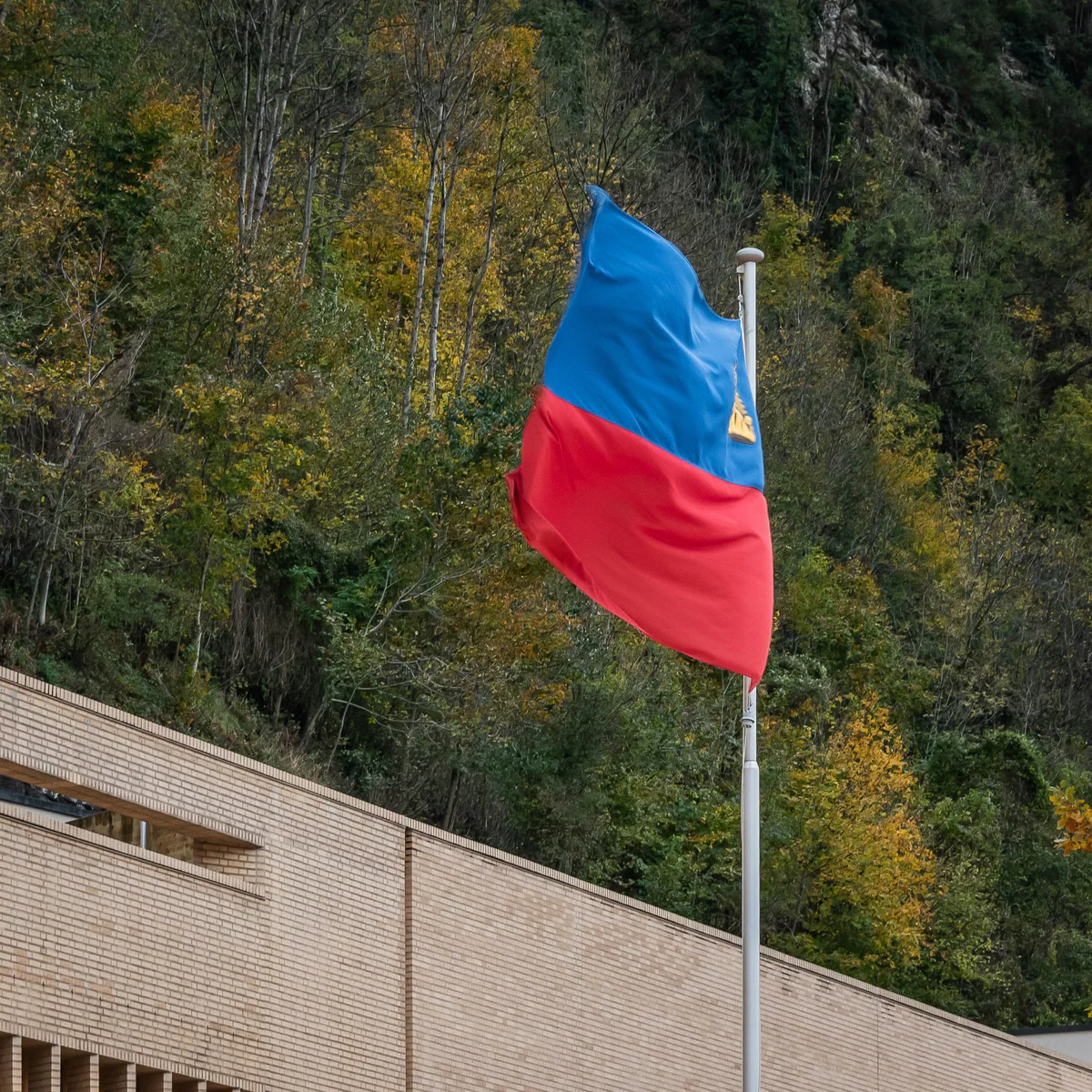
The blue and red flag of Liechtenstein, with its golden crown, flying against the wooded slope of Vaduz.
The six emblems of the great arms
| Position | What you see | What it refers to |
|---|---|---|
| Centre | Shield divided gold and red | The Liechtenstein family |
| First quarter | Crowned black eagle on gold, with a silver crescent and cross | Silesia |
| Second quarter | Bars of gold and black crossed by a green crown of lozenges | The Kuenrings |
| Third quarter | Divided red and silver | Duchy of Troppau |
| Fourth quarter | Crowned black eagle with a maiden's head, on gold | East Frisia or Rietberg |
| Base | Gold hunting horn on blue | Duchy of Jägerndorf |
Sources: the princely house, 'Die Hoheitszeichen', and the Historisches Lexikon, 'Staatswappen'.
Great arms and lesser arms
| Version | Design | Who uses it |
|---|---|---|
| Great arms | All six emblems, with an ermine-lined purple mantle and the princely crown | The princely house and state authorities |
| Lesser arms | Just the gold-and-red shield under the princely crown | Likewise; private individuals need government permission |
Sources: the 1982 Wappengesetz (gesetze.li) and the Historisches Lexikon.
Test yourself
True or false?
0/4 Pick before you peek.
-
Liechtenstein's state arms differ from its princely family's arms.
See the answer
False. They're the same. The constitution says the state's coat of arms is that of the princely house of Liechtenstein.
-
The hunting horn on the arms refers to the Duchy of Jägerndorf.
See the answer
True. A gold hunting horn hangs in the blue base of the shield, and the princely house links it to the Duchy of Jägerndorf.
-
Anyone can put the state arms on their products.
See the answer
False. They're for the princely house and the authorities. A private individual needs government permission under the 1982 law.
-
The family's gold-and-red shield was already being painted in the early 15th century.
See the answer
True. According to the Historisches Lexikon, its first known colour depiction is in the Arlberg brotherhood book of 1409.
- Emblems on the great state arms
- 6
- Earliest colour painting of the family shield
- 1409
- State arms since the principality was created
- 1719
- Law on arms, flags and emblems
- 1982
0 of 168 Liechtenstein guides
Your next stamp
- The princely house
- Facts
- Political system
- Traditions
- Things to do
- Is it a country?
- One day
- Two days
- Municipalities
- Oberland
- Unterland
- Map
- Vaduz
- Städtle
- Mitteldorf
- Vaduz Castle
- Vaduz Cathedral
- Parliament
- Government Building
- Vaduz Town Hall
- Red House
- Prince's Winery
- Old Rhine Bridge
- Schaan
- Schalun Castle Ruin
- Balzers
- Citytrain
- Triesen
- Triesenberg
- Walser Museum
- Planken
- Gutenberg Castle
- The Rhine
- Schaan Roman fort
- Dux
- St Mamertus chapel
- Lawena valley
- Mäls
- DoMuS
- TAK Theatre
- Castles
- Churches and chapels
- Viewpoints
- Mountains
- Museums
- Kunstmuseum
- Mountain huts
- Hilti Art Foundation
- Pfälzerhütte
- Gafadura hut
- National Museum
- Treasure Chamber
- Postage Stamp Museum
- Kunstraum Engländerbau
- Eschen
- Masescha
- Gaflei
- Nendeln
- Mauren
- Silum
- Rotenboden
- Schaanwald
- Gamprin
- Wangerberg
- Bendern
- Steg
- Ruggell
- Samina valley
- Schellenberg Farmhouse Museum
- Cross-country skiing at Steg
- Küefer-Martis-Huus
- Ruggeller Riet
- Schellenberg
- Hinterschellenberg
- Fürstensteig
- Liechtenstein Trail
- Malbun
- Schellenberg castles
- Eschnerberg
- Malbun in summer
- Population
- Stage 1: Balzers - Triesenberg
- Lakes
- Sareis
- Size
- Stage 2: Triesenberg - Vaduz
- Malbun Peace Chapel
- Stage 3: Vaduz - Nendeln
- Swimming pools
- Language
- Skiing in Malbun
- Stage 4: Nendeln - Ruggell
- Dialect
- Malbun ski pass
- Stage 5: Ruggell - Schaanwald
- Hotels in Malbun
- Stamps
- Princess Gina Trail
- Hut-to-hut Route 66
- Hiking
- Getting there
- In winter
- Weather
- Airport
- Best time to visit
- In summer
- Events
- With kids
- Zurich to Liechtenstein
- National day
- Sargans to Vaduz
- Christmas
- Feldkirch to Vaduz
- By train
- Carnival
- Getting around
- Buses
- Funken Sunday
- Alpine cattle drive
- Driving and vignette
- Parking
- Bike hire
- Cycling
- EU and Schengen
- Entry requirements
- Borders and customs
- The prince
- The flag
- The national anthem
- History
- Second World War
- No army
- Why so rich?
- Banks and tax haven
- Where to stay
- Hilti
- Hotels in Vaduz
- False teeth
- Hostel and camping
- Rent the country?
- Where to eat
- Restaurants in Vaduz
- Swiss invasions
- Bars and nightlife
- Food
- Käsknöpfle
- Wine
- Casinos
- Adventure Pass
- Rainy days
- Guided tours
- Tourist office
- Day trips
- Passport stamp
- Music festivals
- Phone and roaming
- Currency and payments
- Prices and budget
- Tipping
- Plugs and sockets
- Tap water
- Opening hours
- Public holidays
- Safety
- Accessibility
- With a dog
- Shopping and souvenirs
Frequently asked questions
What does the Liechtenstein coat of arms mean?
It's the princely family's coat of arms, and its quarters refer to the house's lands and titles. The centre is the family shield in gold and red; around it are Silesia, the Kuenrings, Troppau, East Frisia and, at the base, the hunting horn of Jägerndorf.
Why are Liechtenstein's state arms the prince's family arms?
Because the country began as that family's property. Since it bought Schellenberg and Vaduz in 1699 and 1712, its arms have doubled as the state's, and the constitution has said so since 1921.
What's the difference between the great and lesser arms?
The great arms show all six emblems, wrapped in an ermine-lined purple mantle beneath the princely crown. The lesser arms are simply the family shield, divided gold and red, with the crown on top.
Who is allowed to use the Liechtenstein coat of arms?
Members of the princely house and the state authorities. A private individual needs permission from the government, under the 1982 law on arms, flags and emblems.
How are the coat of arms and the flag connected?
They share the princely crown. The blue-and-red flag has carried it in gold since 1937, and it's the same crown that sits above the mantle on the arms.
By
Tourism graduate with a master’s in Tourism Management and Planning from the University of Málaga, who has travelled across Europe. He writes every guide from official sources and his own judgement.
Published on . Facts checked on .
Sources
Photos: hg, Comet Photo AG (Zürich) (CC BY-SA 4.0); Tournasol7 (CC BY 4.0), via Wikimedia Commons.