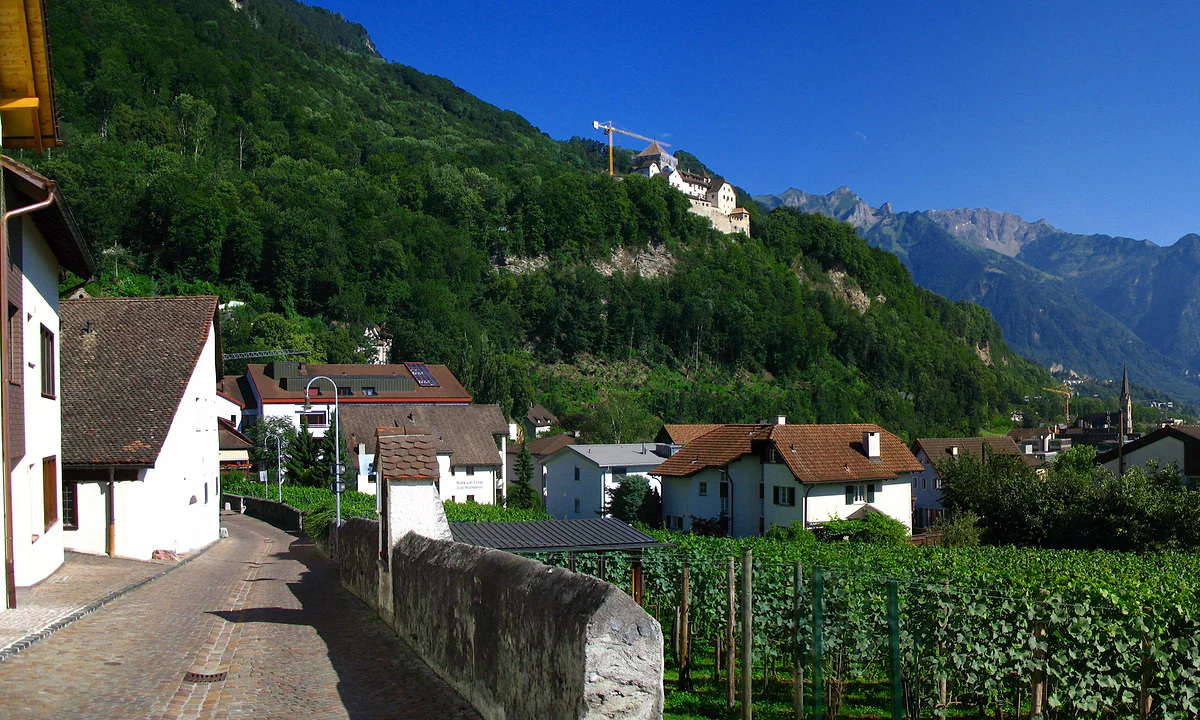
10 banks, CHF 217.3 billion managed (2024)
Liechtenstein and its tax haven reputation, for the curious traveller
For decades Liechtenstein had a reputation as a tax haven, built on low taxes, letterbox companies and banking secrecy. After a scandal over stolen client data in 2008, it announced in March 2009 that it would meet the OECD tax standard, signed a FATCA agreement with the United States in 2014 and has automatically exchanged account information since 2016. Today it has 10 banks.
In 30 seconds
Full read: 3 min
- Liechtenstein earned a tax haven reputation through low taxes, foreign-owned companies and banking secrecy.
- After the 2008 LGT data scandal, it announced in 2009 that it would meet the OECD tax standard.
- It has shared account data automatically since 2016 and has had a FATCA deal with the US since 2014.
- Today it has 10 banks, and banking weighs far less than industry.
If you're arriving with a film-set image of briefcases and secret accounts, you're in for a surprise. I'd look at Liechtenstein for what it is now, an industrial country with a tightly regulated banking sector, and save the curiosity for the history, which is the good bit.

Before you go
What I would keep in mind
-
01 My tip
The prince's bank
LGT began in 1920 as the Bank in Liechtenstein, and the princely house bought over 90% of it in 1930. The Historisches Lexikon describes it as the core of the family's fortune today.
Liechtenstein royal family -
02 Money
For visitors, it's francs and cards
None of this affects your trip, where what matters is that the currency is the Swiss franc. How to pay, and what happens with euros and cash, is on its own page.
Liechtenstein's currency -
03 My tip
Banking matters less than you think
Financial services and insurance make up 10.1% of the country's value added; industry makes up 40.4%. Liechtenstein's wealth owes more to the factory floor than the vault.
why Liechtenstein is so rich
What I would book
Few labels have stuck to a country as firmly as “tax haven” has to Liechtenstein. For decades its name came up in any conversation about secret accounts and shell companies. This page isn’t about opening an account or paying less tax, which isn’t my field. It’s about where the reputation came from, how much of it still holds, and why, if you’re travelling, something else entirely matters.
How the reputation was earned
The story begins in the 1920s. After the First World War the government went looking for outside money with low taxes, a very liberal 1926 law on persons and companies and a 1928 trust law. The Historisches Lexikon describes how this gave rise to a trust industry that set up and ran foreign-owned companies registered in the country, the notorious letterbox firms. By the 1990s there were seventy times as many as in the 1930s, and in 1995 half of them were family foundations.
The banks grew alongside. The first, today’s Liechtensteinische Landesbank, opened in 1861 as a savings bank for a population of small farmers and craftsmen. The Bank in Liechtenstein was founded in 1920 and bought by the princely house in 1930, which still owns it under the LGT name; more on the family at the princely house of Liechtenstein. The third, VP Bank, followed in 1956. The 1960 banking act put banking secrecy into law for the first time, and the Lexikon adds a telling detail, that the government deliberately kept the number of banks low so as not to draw foreign attention.
2008, the turning point
International pressure built from around 2000, with the OECD and the European Union accusing Liechtenstein of harmful tax competition and of doing too little against money laundering. The country tightened supervision and in 2005 set up an independent financial regulator, the FMA. Some steps came much earlier. As far back as 1977 the banks signed a due diligence agreement with the government, promising not to help clients move capital illegally, a law followed in 1996, and in 2004 Liechtenstein agreed with the EU to tax cross-border interest payments.
The decisive blow came in February 2008. Stolen data on clients of LGT, the princely family’s bank, ended up with the German tax authorities thanks to Germany’s intelligence service. LGT announced that from then on it would only manage money declared in its clients’ home countries, and in March 2009 the government committed to meeting the OECD tax standard. It has since signed a long list of information-exchange and double taxation agreements.
Is it still a tax haven?
What I can tell you, with sources, is what has changed. Liechtenstein has had a FATCA agreement with the United States since 16 May 2014 and has applied the OECD automatic exchange of tax information since early 2016, which means data on foreigners’ accounts flows to their home tax authorities without anyone asking. In October 2018 the EU’s economic and finance ministers certified that its legislation met the minimum standards against aggressive tax planning by multinationals. I haven’t been able to read the EU’s current list of non-cooperative jurisdictions, so I won’t tell you whether it appears on it or not.
In numbers, the sector is now smaller in headcount of banks and bigger in money. In 2024 there were 10 banks, against 16 in 2010, with 2,985 staff and CHF 217.3 billion under management. It’s worth keeping in proportion, though. Financial services and insurance make up 10.1% of the country’s value added, while industry makes up 40.4%. The full breakdown of the economy is in why Liechtenstein is so rich.
What matters if you’re just visiting
None of this changes your trip. What does affect you is that the currency is the Swiss franc, thanks to the 1924 union with Switzerland, and that the country belongs to the EEA and Schengen without being an EU member. How to pay and what happens with euros is on my page about currency and payments in Liechtenstein, and how it fits with Europe is on the page about Liechtenstein, the EU and Schengen.
What I find most striking in all this is the speed of the change. The Lexikon stresses that the 2009 shift happened quickly and without major political upheaval at home, despite resistance from parts of the trust industry. For a country that lived with that reputation for decades, that’s no small thing.
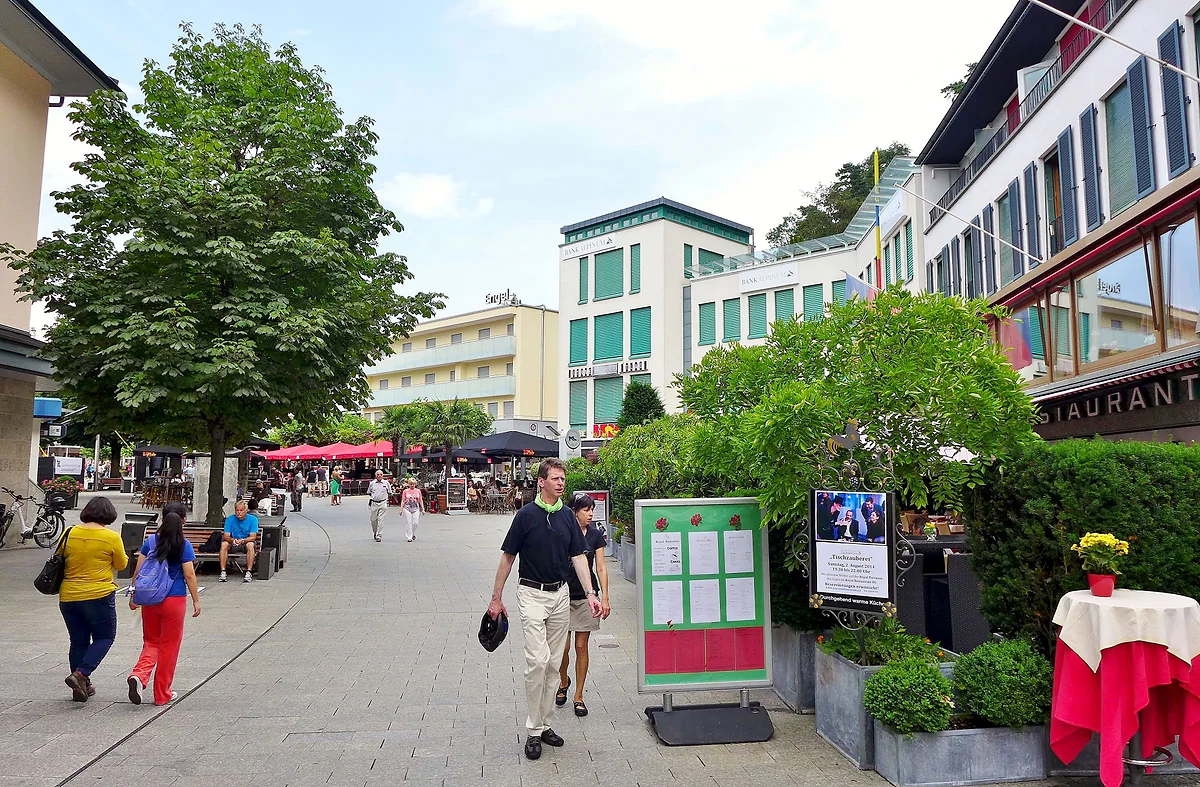
The pedestrian Städtle in Vaduz with strollers, trees, terraces and modern buildings at the foot of the slope.
From secrecy to data sharing
| Year | What happened |
|---|---|
| 1861 | The first savings bank opens, today's Liechtensteinische Landesbank |
| 1926 and 1928 | Company and trust laws designed to attract foreign capital |
| 1930 | The princely house buys the Bank in Liechtenstein, now LGT |
| 1960 | First banking act, putting banking secrecy on a legal footing |
| 2005 | Financial Market Authority (FMA) set up |
| February 2008 | Stolen LGT client data reaches the German tax authorities |
| March 2009 | Government announces it will meet the OECD tax standard |
| 16 May 2014 | FATCA agreement with the United States |
| 2016 | Automatic exchange of tax information begins |
| October 2018 | ECOFIN certifies compliance with the BEPS minimum standards |
Sources: Historisches Lexikon ('Banken', 'Finanzdienstleistungen', 'LGT Bank') and the Liechtenstein Bankers Association.
Banking in numbers
| Item | 2010 | 2024 |
|---|---|---|
| Banks | 16 | 10 |
| Total balance sheet | CHF 52.5 billion | CHF 84.8 billion |
| Staff in Liechtenstein | 2,177 | 2,985 |
Source: Office of Statistics, Liechtenstein in Zahlen 2026.
Test yourself
True or false?
0/4 Pick before you peek.
-
Liechtenstein's princely house owns a bank.
See the answer
True. It bought over 90% of the Bank in Liechtenstein, now LGT, in 1930, and has controlled it through a family foundation since 1970.
-
Liechtenstein has more banks now than in 2010.
See the answer
False. It had 16 in 2010 and 10 in 2024, according to the Office of Statistics, although banking jobs rose from 2,177 to 2,985.
-
Since 2016 Liechtenstein has automatically shared account data with other countries.
See the answer
True. It has applied the OECD automatic exchange of tax information since early 2016, according to the Bankers Association.
-
Banks generate most of Liechtenstein's wealth.
See the answer
False. Financial services and insurance make up 10.1% of value added, industry 40.4%.
- Banks in 2024 (16 in 2010)
- 10
- CHF billion managed in 2024
- 217.3
- Commitment to the OECD tax standard
- 2009
- Automatic data exchange begins
- 2016
0 of 168 Liechtenstein guides
Your next stamp
- Is it a country?
- Facts
- EU and Schengen
- Stamps
- Currency and payments
- The princely house
- Rent the country?
- Things to do
- One day
- Two days
- Municipalities
- Oberland
- Unterland
- Map
- Vaduz
- Städtle
- Mitteldorf
- Vaduz Castle
- Vaduz Cathedral
- Parliament
- Government Building
- Vaduz Town Hall
- Red House
- Prince's Winery
- Old Rhine Bridge
- Schaan
- Schalun Castle Ruin
- Balzers
- Citytrain
- Triesen
- Triesenberg
- Walser Museum
- Planken
- Gutenberg Castle
- The Rhine
- Schaan Roman fort
- Dux
- St Mamertus chapel
- Lawena valley
- Mäls
- DoMuS
- TAK Theatre
- Castles
- Churches and chapels
- Viewpoints
- Mountains
- Museums
- Kunstmuseum
- Mountain huts
- Hilti Art Foundation
- Pfälzerhütte
- Gafadura hut
- National Museum
- Treasure Chamber
- Postage Stamp Museum
- Kunstraum Engländerbau
- Eschen
- Masescha
- Gaflei
- Nendeln
- Mauren
- Silum
- Rotenboden
- Schaanwald
- Gamprin
- Wangerberg
- Bendern
- Steg
- Ruggell
- Samina valley
- Schellenberg Farmhouse Museum
- Cross-country skiing at Steg
- Küefer-Martis-Huus
- Ruggeller Riet
- Schellenberg
- Hinterschellenberg
- Fürstensteig
- Liechtenstein Trail
- Malbun
- Schellenberg castles
- Eschnerberg
- Malbun in summer
- Population
- Stage 1: Balzers - Triesenberg
- Lakes
- Sareis
- Size
- Stage 2: Triesenberg - Vaduz
- Malbun Peace Chapel
- Political system
- Stage 3: Vaduz - Nendeln
- Swimming pools
- Language
- Skiing in Malbun
- Stage 4: Nendeln - Ruggell
- Dialect
- Malbun ski pass
- Stage 5: Ruggell - Schaanwald
- Hotels in Malbun
- Princess Gina Trail
- Hut-to-hut Route 66
- Hiking
- Getting there
- In winter
- Weather
- Airport
- Best time to visit
- In summer
- Events
- With kids
- Zurich to Liechtenstein
- National day
- Sargans to Vaduz
- Christmas
- Feldkirch to Vaduz
- By train
- Traditions
- Carnival
- Getting around
- Buses
- Funken Sunday
- Alpine cattle drive
- Driving and vignette
- Parking
- Bike hire
- Cycling
- Entry requirements
- Borders and customs
- The prince
- The flag
- The coat of arms
- The national anthem
- History
- Second World War
- No army
- Why so rich?
- Where to stay
- Hilti
- Hotels in Vaduz
- False teeth
- Hostel and camping
- Where to eat
- Restaurants in Vaduz
- Swiss invasions
- Bars and nightlife
- Food
- Käsknöpfle
- Wine
- Casinos
- Adventure Pass
- Rainy days
- Guided tours
- Tourist office
- Day trips
- Passport stamp
- Music festivals
- Phone and roaming
- Prices and budget
- Tipping
- Plugs and sockets
- Tap water
- Opening hours
- Public holidays
- Safety
- Accessibility
- With a dog
- Shopping and souvenirs
Frequently asked questions
Is Liechtenstein a tax haven?
It had that reputation for decades. Since March 2009 it has committed to the OECD tax standard, in 2014 it signed a FATCA agreement with the US, and since 2016 it has automatically shared account data with other countries.
Why did Liechtenstein become known as a tax haven?
From the 1920s it drew in foreign capital with low taxes and very liberal company law, and thousands of foreign-owned companies were registered there. The 1960 banking act also put banking secrecy into law.
What happened in Liechtenstein in 2008?
In February 2008 stolen data on clients of LGT, the princely family's bank, reached the German tax authorities via Germany's intelligence service. The affair sped up the country's change of tax policy.
How many banks are there in Liechtenstein?
Ten in 2024, down from 16 in 2010, according to the Office of Statistics. They employed 2,985 people in the country and managed CHF 217.3 billion.
Does Liechtenstein still have banking secrecy?
It has been regulated by law since 1960, but it no longer shields clients from foreign tax authorities as it once did. Since 2016 Liechtenstein has automatically exchanged financial account information with countries signed up to the OECD standard.
Who owns LGT bank?
The princely house of Liechtenstein, which bought more than 90% of it in 1930 and has held it through a family foundation since 1970. The Historisches Lexikon calls it the core of the family's fortune.
By
Tourism graduate with a master’s in Tourism Management and Planning from the University of Málaga, who has travelled across Europe. He writes every guide from official sources and his own judgement.
Published on . Facts checked on .
Sources
Photos: Andrew Bossi (CC BY-SA 2.5); Bahnfrend (CC BY-SA 4.0), via Wikimedia Commons.