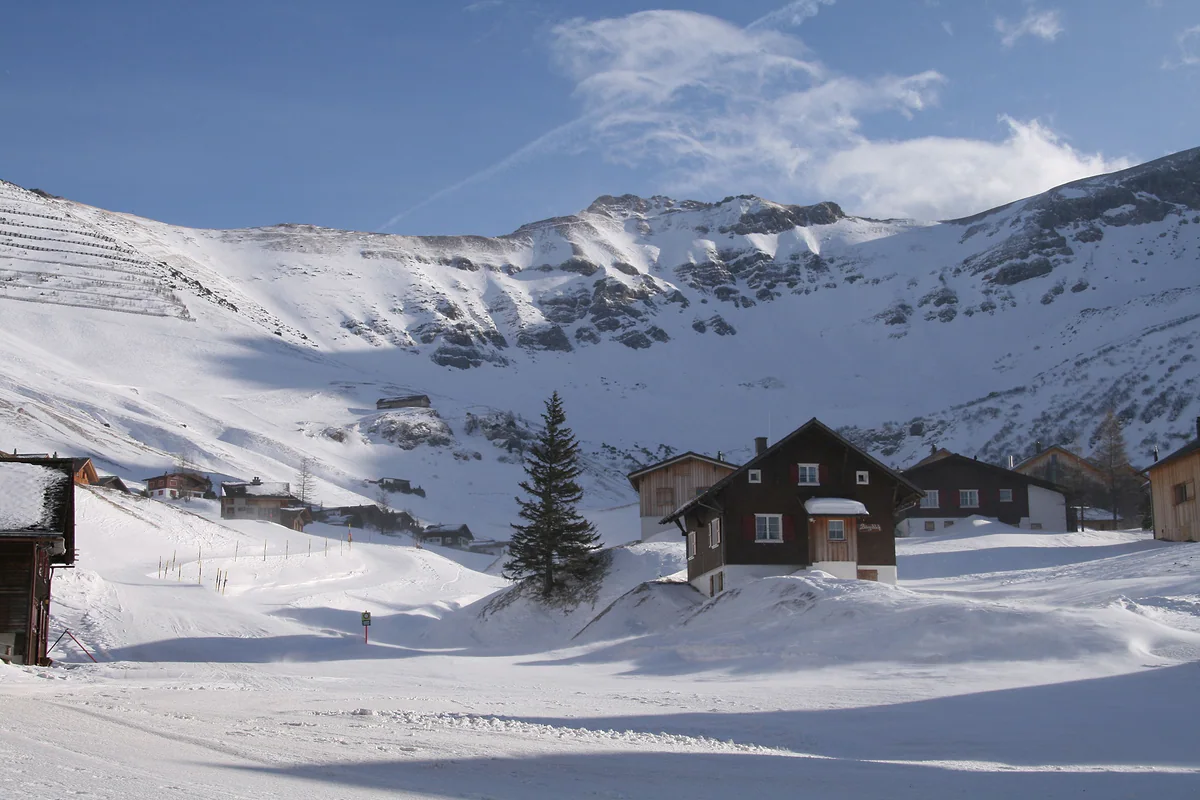
Consecrated in 1951, at 1,627 m
The Peace Chapel in Malbun, a stone thank-you for 1945
The Friedenskapelle, or Peace Chapel, is a small stone church in Malbun at 1,627 m, built in 1950-1951 to give thanks that Liechtenstein was spared the Second World War. Johannes Hugentobler designed it, round stained-glass window included, and it's dedicated to the Virgin Mary and Saint Nicholas of Flüe. It's a few minutes' walk from the village centre.
In 30 seconds
Full read: 3 min
- Malbun's Friedenskapelle dates from 1950-1951 and stands at 1,627 m.
- It was built as a thank-you for escaping the Second World War.
- Johannes Hugentobler designed it, and it has a mosaic of the herdsmen's Ave.
- The footpath from Malbun up to Sareis passes it.
I wouldn't drive up to Malbun just for the chapel, but I wouldn't leave without seeing it. I'd take it in on the walk up to Sareis, which goes right past the door, and stop five minutes for the mosaic.

Before you go
What I would keep in mind
-
01 Most beautiful
The herdsmen's Ave mosaic
Inside, a mosaic by Hermann Bauch from sketches by Josef Seger shows the «Sennen-Ave», the prayer of the alpine herdsmen, surrounded by saints such as Theodul, Sebastian and Wendelin.
-
02 My tip
The walking route to Sareis passes here
The tourist board describes the walk up to the Sareis top station from the Malbun, Jöraboda bus stop via the chapel, in about an hour. It's your plan B if the chairlift isn't running.
Sareis chairlift -
03 To save money
Free sledging outside the door
In winter Bergbahnen Malbun prepares a safe sledging run of about 200 m for small children in front of the chapel. It costs nothing.
Liechtenstein in winter
My ranking, scored
What I'd look at in the chapel
My own scores out of 10. I weigh what sets this chapel apart from others in the Alps and what you can take in on a short visit.
0 of 4 seen
-
The Sennen-Ave mosaic
The herdsmen's prayer ringed by very mountain-minded saints. It sums up life in this valley better than any information board.
8.6 out of 10
-
The round choir window
Designed by Hugentobler, who also drew up the building. Morning sun shows it best, if you find the door open.
8.0 out of 10
-
The stonework outside
Natural stone walls, a single nave and a bell gable on the roof. Plain post-war architecture that suits the valley.
7.4 out of 10
-
The setting
The footpath to Sareis and the children's explorers' trail start here, and in winter so does the little sledging run.
7.2 out of 10
Some mountain chapels were built after a plague, an avalanche or a vow. Malbun’s was built because of a war that never came. It’s small, it’s stone and it carries more meaning than it lets on, and it sits on the path most people take to walk up to Sareis. Here’s its story and what to look out for.
A thank-you with a date on it
On 30 August 1939 Liechtenstein declared itself neutral, and, according to the Historisches Lexikon, the moment of greatest danger came in May and June 1940, when German plans against Switzerland included occupying the country. It never happened. In 1950, with the war over, the parish priest of Triesenberg, Engelbert Bucher, pushed for a chapel in Malbun to give thanks for being spared, and it was consecrated in 1951. The Lexikon puts it at 1,627 metres.
It feels very true to this country. Back in March 1940 Prince Franz Joseph II had already placed Liechtenstein under the protection of the Virgin Mary in the chapel at Dux, in Schaan, and a decade later the mountain villagers completed the circle with a church of their own. If that period interests you, I cover it at more length on my page on the Second World War in Liechtenstein.
What to see inside and out
The chapel is the work of Johannes Hugentobler, who drew up the plans and also designed the round window in the choir. It’s built of natural stone, with a single nave, a square-ended choir and a bell gable perched on the ridge of the roof. No frills, and that’s exactly why it fits the valley.
What I’d look for inside is the mosaic in the nave. Hermann Bauch made it from sketches by Josef Seger, and it shows the «Sennen-Ave», the Hail Mary of the alpine herdsmen, alongside the Virgin, Saint Peter and a line of very mountain-minded saints. There’s Theodul, the saint of the first Walser church in the country at Masescha, then Sebastian, Cyprian, Wendelin, Vitus and the Trinity. Read slowly, it’s a portrait of the people who came up here every summer with their cows.
The chapel is dedicated to two patrons of peace, the Virgin Mary and Bruder Klaus, that is, Saint Nicholas of Flüe, the Swiss hermit saint. I like that a post-war chapel in a country without an army put itself under two patrons of peace rather than a warrior saint.
Can you go in?
The chapel belongs to the parish of Triesenberg, but I couldn’t find published opening hours on either the lift company’s site or the tourist board’s. So I won’t promise anything. Assume you’ll only see the outside and, if the door’s open, stepping in for five minutes to see the mosaic and the window.
Getting there and fitting it into your day
It’s in Malbun itself, a stroll from the centre. Three plans go right past it. The first is the walk up to Sareis, which the tourist board describes from the Malbun, Jöraboda bus stop via the chapel to the top station in about an hour, handy if the chairlift isn’t running. The second is the Forscherweg, the children’s explorers’ trail from Malbun to the chapel and the little Sass lake, which takes about two hours. And in winter Bergbahnen Malbun prepares a safe sledging run of around 200 metres for small children right outside the door, free of charge.
When to call in
I’d see it in summer, early in the day, when the path to Sareis is still empty and the meadows around it are in flower. Malbun has been a plant protection area since 1952, according to the Lexikon, so that setting is no accident. Winter has its own charm, with snow up to the door and children sledging past, but the chapel takes a back seat. It’s worth remembering, too, that 1951, the year it was consecrated, was a hard one in the valley, as avalanches destroyed nine huts. Up here the mountain has always had the final say.
One last fact to close the circle
2026 marks 75 years since its consecration, and the valley around it has changed beyond recognition. The Lexikon records 85 hay huts in Malbun in 1880 and 210 buildings by 2008, nearly all of them holiday homes. The chapel is one of the few things left that remind you this was a herdsmen’s meadow before it was a ski resort.
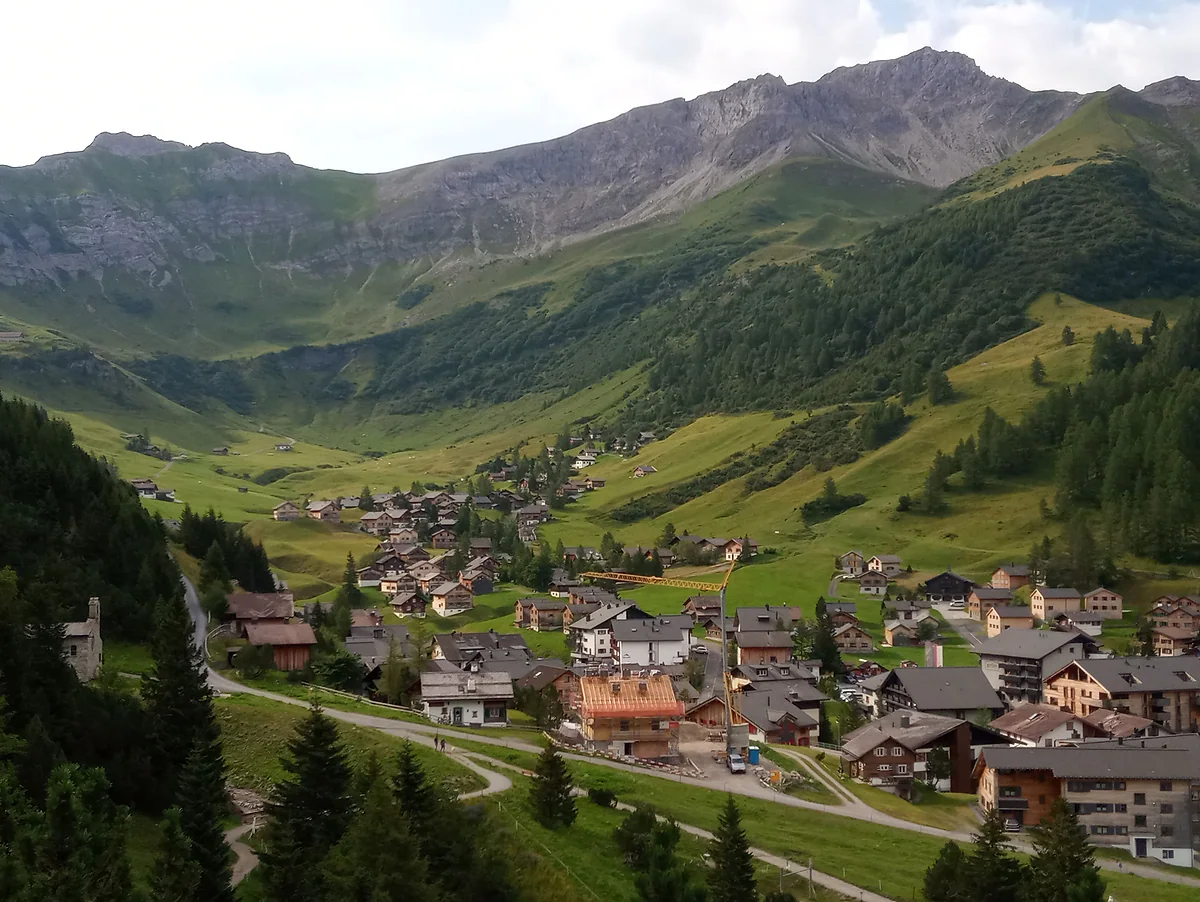
Malbun in summer, with the chalet village on the valley floor, green meadows and rocky peaks above.
The chapel at a glance
| Fact | Detail |
|---|---|
| Dedicated to | The Virgin Mary and Saint Nicholas of Flüe (Bruder Klaus), patrons of peace |
| Instigated by | Engelbert Bucher, parish priest of Triesenberg |
| Design and window | Johannes Hugentobler |
| Mosaic | Hermann Bauch, from sketches by Josef Seger |
| Building | Natural stone, single nave, square-ended choir, bell gable on the roof |
| Parish | Triesenberg |
From the Historisches Lexikon (entry dated 31 Dec 2011). I couldn't find published opening hours.
Test yourself
True or false?
0/4 Pick before you peek.
-
Malbun's Peace Chapel is medieval.
See the answer
False. It was built in 1950-1951, according to the Historisches Lexikon, and consecrated in 1951.
-
One of its two patrons is a Swiss saint.
See the answer
True. It's dedicated to the Virgin Mary and Bruder Klaus, that is, Saint Nicholas of Flüe, the Swiss hermit saint the chapel honours as a patron of peace.
-
Liechtenstein declared itself neutral in the Second World War.
See the answer
True. The Historisches Lexikon dates the declaration of neutrality to 30 August 1939. The chapel gives thanks that the country was spared.
-
The architect who designed the chapel also designed its window.
See the answer
True. Johannes Hugentobler drew up the plans and designed the round window in the choir.
- Year of consecration
- 1951
- Altitude
- 1,627 m
- Children's sledging run by the chapel
- 200 m
Map
Where Malbun Peace Chapel is
The dashed line is the border: Switzerland across the Rhine, Austria to the north and east. Every number opens its guide.
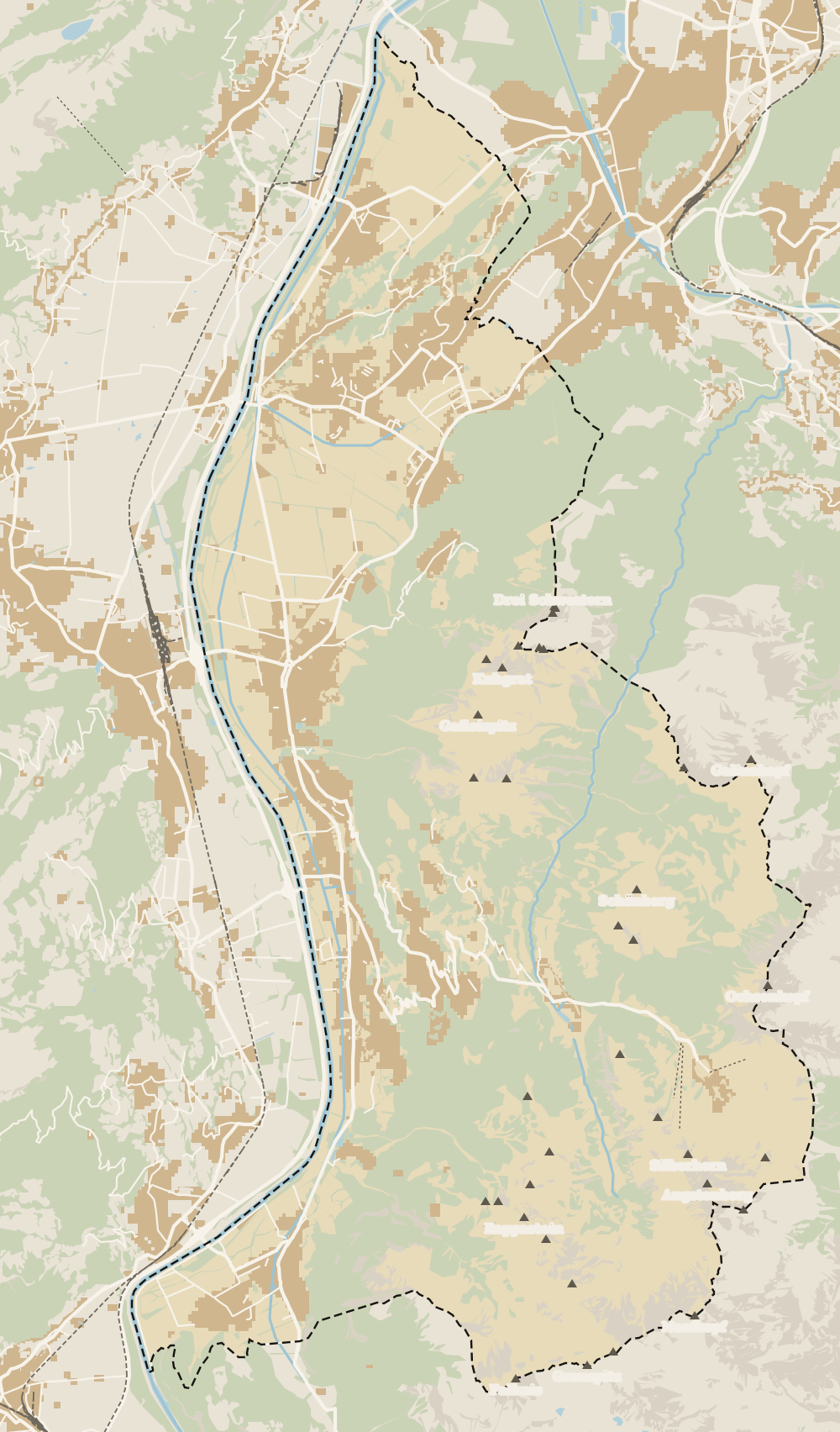
0 of 168 Liechtenstein guides
Your next stamp
- Malbun
- Skiing in Malbun
- Sareis
- Hotels in Malbun
- Things to do
- Hut-to-hut Route 66
- St Mamertus chapel
- Triesen
- One day
- Two days
- Municipalities
- Oberland
- Unterland
- Map
- Vaduz
- Städtle
- Mitteldorf
- Vaduz Castle
- Vaduz Cathedral
- Parliament
- Government Building
- Vaduz Town Hall
- Red House
- Prince's Winery
- Old Rhine Bridge
- Schaan
- Schalun Castle Ruin
- Balzers
- Citytrain
- Triesenberg
- Walser Museum
- Planken
- Gutenberg Castle
- The Rhine
- Schaan Roman fort
- Dux
- Lawena valley
- Mäls
- DoMuS
- TAK Theatre
- Castles
- Churches and chapels
- Viewpoints
- Mountains
- Museums
- Kunstmuseum
- Mountain huts
- Hilti Art Foundation
- Pfälzerhütte
- Gafadura hut
- National Museum
- Treasure Chamber
- Postage Stamp Museum
- Kunstraum Engländerbau
- Eschen
- Masescha
- Gaflei
- Nendeln
- Mauren
- Silum
- Rotenboden
- Schaanwald
- Gamprin
- Wangerberg
- Bendern
- Steg
- Ruggell
- Samina valley
- Schellenberg Farmhouse Museum
- Cross-country skiing at Steg
- Küefer-Martis-Huus
- Ruggeller Riet
- Schellenberg
- Hinterschellenberg
- Fürstensteig
- Is it a country?
- Liechtenstein Trail
- Schellenberg castles
- Eschnerberg
- Malbun in summer
- Population
- Stage 1: Balzers - Triesenberg
- Lakes
- Size
- Stage 2: Triesenberg - Vaduz
- Political system
- Stage 3: Vaduz - Nendeln
- Swimming pools
- Language
- Stage 4: Nendeln - Ruggell
- Dialect
- Malbun ski pass
- Stage 5: Ruggell - Schaanwald
- Stamps
- Princess Gina Trail
- Hiking
- Getting there
- In winter
- Weather
- Airport
- Best time to visit
- In summer
- Events
- With kids
- Zurich to Liechtenstein
- National day
- Sargans to Vaduz
- Christmas
- Feldkirch to Vaduz
- By train
- Traditions
- Carnival
- Getting around
- Buses
- Funken Sunday
- Alpine cattle drive
- Driving and vignette
- Parking
- Bike hire
- Cycling
- EU and Schengen
- Entry requirements
- Borders and customs
- The prince
- The princely house
- The flag
- The coat of arms
- The national anthem
- History
- Second World War
- No army
- Facts
- Why so rich?
- Banks and tax haven
- Where to stay
- Hilti
- Hotels in Vaduz
- False teeth
- Hostel and camping
- Rent the country?
- Where to eat
- Restaurants in Vaduz
- Swiss invasions
- Bars and nightlife
- Food
- Käsknöpfle
- Wine
- Casinos
- Adventure Pass
- Rainy days
- Guided tours
- Tourist office
- Day trips
- Passport stamp
- Music festivals
- Phone and roaming
- Currency and payments
- Prices and budget
- Tipping
- Plugs and sockets
- Tap water
- Opening hours
- Public holidays
- Safety
- Accessibility
- With a dog
- Shopping and souvenirs
Frequently asked questions
Why is it called the Peace Chapel?
Because it was built in 1950-1951 to give thanks that Liechtenstein escaped the Second World War, and it was dedicated to the Virgin Mary and Saint Nicholas of Flüe as patrons of peace, according to the Historisches Lexikon.
Where is the Friedenskapelle in Malbun?
In Malbun itself, at 1,627 m, beside the footpath that climbs towards the Sareis top station. It's a few minutes' walk from the village centre.
Who built the chapel in Malbun?
It was the idea of Engelbert Bucher, parish priest of Triesenberg, and Johannes Hugentobler designed it, along with the round window in the choir. The mosaic is by Hermann Bauch from sketches by Josef Seger.
Can you go inside the Peace Chapel?
It belongs to the parish of Triesenberg, but I couldn't find published opening hours. Assume you'll see the outside only, and, if the door's open, popping in for the mosaic.
How long is the walk from the chapel to Sareis?
The tourist board reckons about an hour on foot from the Malbun, Jöraboda bus stop to the Sareis top station, passing the chapel.
By
Tourism graduate with a master’s in Tourism Management and Planning from the University of Málaga, who has travelled across Europe. He writes every guide from official sources and his own judgement.
Published on . Facts checked on .
Sources
Photos: böhringer friedrich (CC BY-SA 2.5); Mislep (CC BY 4.0), via Wikimedia Commons.