Cheese, maize and crispy onions
What people eat in Liechtenstein, dish by dish

- National dish
- Käsknöpfle
- Historic staple
- Ribel, made with maize flour
- Game season
- Autumn, Triesenberger Wochen
Liechtenstein food is mountain cooking. The best-known dish is Käsknöpfle, egg pasta with plenty of cheese, crispy onions and apple sauce. After that come Ribel, a maize dish that was once the staple, barley soup and carnival doughnuts. To drink, local beer brewed again since 2007 and Rhine valley Pinot Noir.
My ranking, scored
What I'd try, in order
My order of priority for someone spending one or two days. I weigh how distinctively Liechtenstein it is and how easy it is to find on a menu.
0 of 5 seen
-
Käsknöpfle
The dish the tourist board calls the country's best-known speciality. It's on plenty of menus, from the valley to Malbun.
9.4 out of 10
-
Autumn game (Triesenberg)
Venison stew with spätzli during the Triesenberger Wochen, and a game buffet at Masescha from 24 September to 29 October 2026.
8.8 out of 10
-
Ribel
Toasted maize semolina that was once daily bread. Harder to find, which is why I find it more interesting.
8.2 out of 10
-
Fasnachtsküachle
The fried carnival pastry, eaten in February; its cousin, Funkaküachle, turns up on bonfire Sunday.
7.6 out of 10
-
Gerstensuppe
Barley soup from the official recipes, proper mountain winter food. Just the thing on a cold day in Malbun.
7.2 out of 10
If I only tried two things, they'd be Käsknöpfle with apple sauce and a Ribel, because that's what the country really ate. And if I came in autumn, I'd head up to Triesenberg for its weeks of Walser cooking, the best time to eat here.
My verdict
Yes
Yes, if you like honest mountain food. It's not a cuisine of big names, but Käsknöpfle and Ribel justify a meal in a village restaurant.
Who I would recommend it to
Yes, if…
- Anyone after cheesy mountain dishes
- Autumn visitors, with the Triesenberger Wochen
- Fans of local wine and beer
Better not, if…
- Anyone avoiding dairy
- Anyone hoping for light food
If you only read this
Full read: 3 min
- Liechtenstein's best-known dish is Käsknöpfle, with crispy onions and apple sauce.
- Ribel, made with maize flour, was the staple for centuries.
- In autumn, Triesenberg holds weeks of Walser cooking and game.
- The country has brewed its own beer since 2007 and grows Pinot Noir and Chardonnay.
Notebook
What the official sites leave out
-
01 Most beautiful
The dish everyone orders
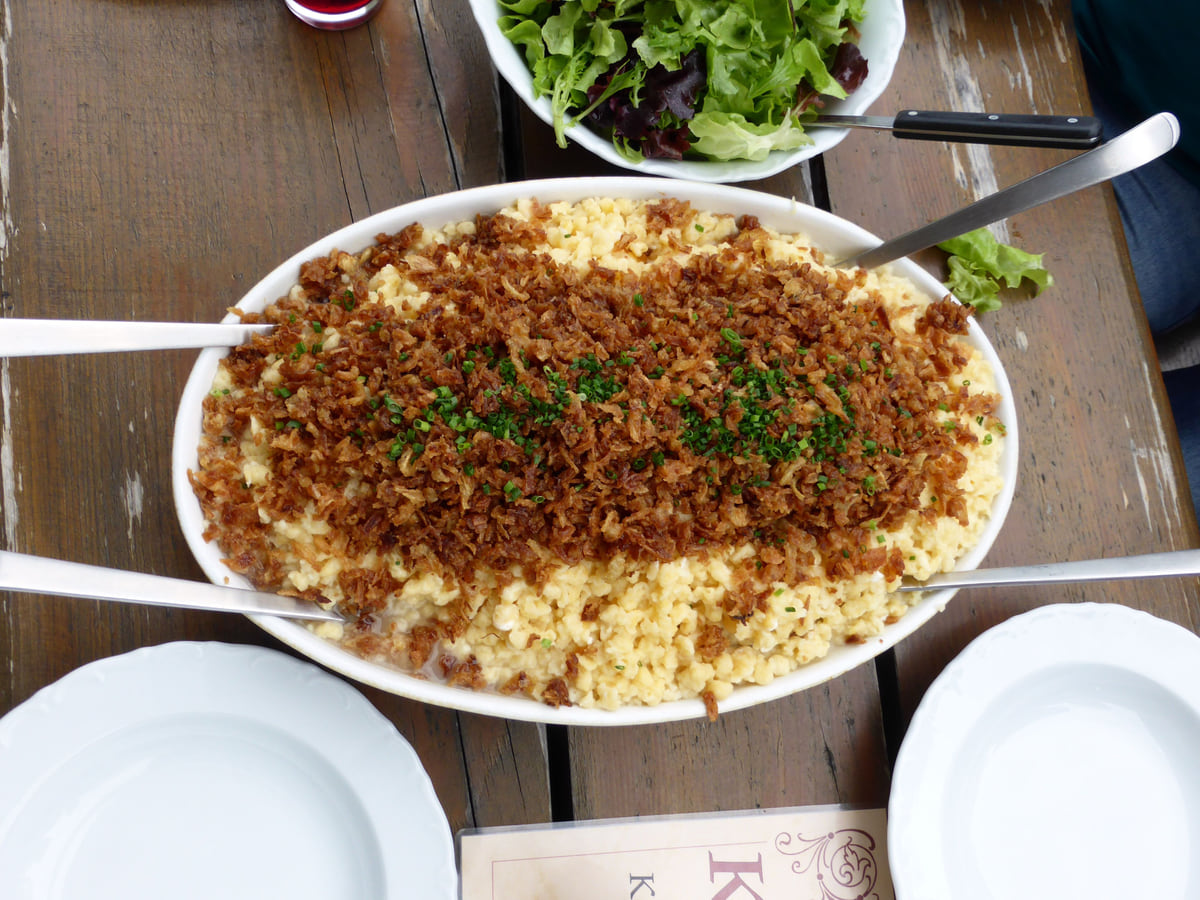
Käsknöpfle are made with flour, egg, plenty of grated hard cheese and, if you like, a little «Sauerkäse», topped with floured, fried onions. They come with apple sauce, salad or creamed spinach.
Käsknöpfle, Liechtenstein's national dish -
02 My tip
Ask about Ribel
The tourist board points out that Ribel, made with maize flour, was long the country's staple food. The Unterland has its own version, Tüarggarebl.
-
03 Worth the splurge
Game weeks in Triesenberg
Every year, from mid-October to mid-November, Triesenberg's restaurants serve a Walser menu with Chääs-Chnöpfli, venison stew with spätzli and Sulzbrata.
Triesenberg, the Walser mountain village -
04 To save money
Take the flavours home
According to the national portal, the country makes beers, cheeses, spirits and wines from small estates. The Braumarkt at the Liechtensteiner Brauhaus in Schaan sells beer, wine, gin and regional produce.
shopping and souvenirs in Liechtenstein
Liechtenstein’s cooking isn’t trying to impress anyone. It’s mountain food built to get you through a day in the fields, with cheese, maize, flour and onions, and I think that’s its best quality. Eat here and you realise the dishes belong to an Alpine farming valley, not to the banking image most visitors arrive with.
Käsknöpfle, Liechtenstein’s signature dish
The tourist board calls them the country’s best-known speciality, and fair enough. They’re little pieces of egg pasta, boiled and layered with grated hard cheese, sometimes with a bit of «Sauerkäse», a sour cheese. On top go floured onions fried until dark and crisp. On the side, apple sauce, which sounds odd until you try it. You’ll find them on plenty of menus, from the valley up to Malbun, and I’ve given them a page of their own with the recipe and where to eat them, Käsknöpfle in Liechtenstein.
What else do people eat in Liechtenstein?
The dish that interests me most is Ribel. The tourist board is plain about it, a maize-flour dish that was for a long time the country’s staple food. The Unterland has its own version, Tüarggarebl, and the flour also makes a soup, Ribelmais. It’s humble food, a farmer’s breakfast and supper, and precisely for that reason I think it says more about where Liechtenstein comes from than anything else on the table.
The official recipes also include barley soup, Holdrsaft, a black elderberry jam, and Hafalääb, which the tourist board describes as an old Balzers dish that’s almost forgotten. On the sweet side there are Zwätschgaknedl, plum dumplings, and the list is rounded off by Kratzate. Don’t expect every menu to have them all; Käsknöpfle, yes, the rest depends a lot on the kitchen and the season.
To sleep close to everything, search places to stay in Vaduz on Expedia and filter by area before price.
Autumn and Triesenberg’s Walser cooking
If I had to pick a month to eat in Liechtenstein, it would be October. Every year Triesenberg holds its Triesenberger Wochen, from mid-October to mid-November, when its restaurants serve a Walser menu. On it you’ll find Chääs-Chnöpfli, Wildalertäller, a venison stew with spätzli, and Sulzbrata. In 2025 they ran from 10 October to 23 November, and at the time of writing the 2026 dates hadn’t been announced. Separately, the Berggasthaus Masescha runs a weekly game buffet from 24 September to 29 October 2026. The Walser villages themselves are in my guide to Triesenberg.
Carnival and bonfire sweets
The sweets most tied to the calendar are fried. Fasnachtsküachle appear at carnival in February, and the following Sunday, at the bonfire festival, it’s Funkaküachle, which the tourist board describes as a pastry fried in fat. If you’re here then, ask at any bakery. The festival itself is covered in my guide to carnival in Liechtenstein.
If you still need a way in, check train and coach tickets to Vaduz from where you are.
Coffee roasted in Schaan
A small surprise I like sharing. Schaan has a coffee roastery, Demmel Kaffee, whose owner, Peter Demmel, is a qualified coffee sommelier, and the tourist board offers a visit to watch him at work. You needn’t go that far to try it, as the Brasserie Burg on the Städtle in Vaduz serves the same coffee, roasted in Liechtenstein. For a country of 160 km², having its own beer, wine and coffee strikes me as a charming touch.
What to drink, beer and wine
The country has had its own beer again since 2007, when the Liechtensteiner Brauhaus opened in Schaan, with traditional top- and bottom-fermented beers and a craft range; it has a shop and runs tours with a tasting. The national portal mentions local beers, cheeses and spirits, and wines from small estates spread from the Eschnerberg to Gutenberg hill in Balzers. The grapes are Pinot Noir and Chardonnay, and the best-known winery belongs to the Prince himself. It’s all in my guide to Liechtenstein wine.
If you are short on time, see the best tours in Vaduz and pick one that fits your day.
Where to try Liechtenstein food
My advice is to mix it up. One day, Käsknöpfle up the mountain, at Masescha or one of the restaurants in Malbun, where the view does half the work. The next, dinner in Vaduz, home to the country’s only Michelin-starred restaurant, set in the Prince’s old wine press. Just watch the calendar, as a surprising number of places close on Sundays, Mondays or even whole weekends. Opening hours, prices and closing days are all in where to eat in Liechtenstein, which is where I’d start before booking anything.
Where the bus does not go, a car does: compare car hire in Zurich before you arrive rather than at the desk.
To sleep close to everything, search places to stay in Vaduz on Booking.com and filter by area before price.
Dishes from Liechtenstein's official recipes
| Dish | What it is |
|---|---|
| Käsknöpfle | Egg pasta with cheese, crispy onions and apple sauce |
| Ribel | Maize-flour dish, once the staple food |
| Tüarggarebl | The Unterland version of Ribel |
| Gerstensuppe | Barley soup |
| Holdrsaft | Black elderberry jam |
| Hafalääb | An old Balzers dish, almost forgotten |
| Fasnachtsküachle | Fried carnival pastry |
| Zwätschgaknedl | Plum dumplings |
From the tourist board's recipes page (archive.org copy of 31-07-2026).
Test yourself
True or false?
0/3 Pick before you peek.
-
Käsknöpfle are traditionally served with apple sauce.
See the answer
True. The tourist board says they're eaten with crispy onions and apple sauce, or with salad or creamed spinach.
-
Liechtenstein's historic staple food was rice.
See the answer
False. It was Ribel, a maize-flour dish, according to the tourist board's recipes.
-
Beer has been brewed in Liechtenstein since 2007.
See the answer
True. The Liechtensteiner Brauhaus says brewing returned to the country in 2007.
- Year local brewing returned
- 2007
- Of vineyards in 2024
- 23 ha
- Restaurants in the MICHELIN Guide
- 4
0 of 170 Liechtenstein guides
Your next stamp
- Where to eat
- Käsknöpfle
- Traditions
- Events
- Things to do
- Carnival
- Stage 1: Balzers - Triesenberg
- One day
- Two days
- Municipalities
- Oberland
- Unterland
- Map
- Vaduz
- Städtle
- Mitteldorf
- Vaduz Castle
- Vaduz Cathedral
- Parliament
- Government Building
- Vaduz Town Hall
- Red House
- Prince's Winery
- Old Rhine Bridge
- Schaan
- Schalun Castle Ruin
- Balzers
- Citytrain
- Triesen
- Triesenberg
- Walser Museum
- Planken
- Gutenberg Castle
- The Rhine
- Schaan Roman fort
- Dux
- St Mamertus chapel
- Lawena valley
- Mäls
- DoMuS
- TAK Theatre
- Castles
- Churches and chapels
- Viewpoints
- Mountains
- Museums
- Kunstmuseum
- Mountain huts
- Hilti Art Foundation
- Pfälzerhütte
- Gafadura hut
- National Museum
- Treasure Chamber
- Postage Stamp Museum
- Kunstraum Engländerbau
- Eschen
- Masescha
- Gaflei
- Nendeln
- Mauren
- Silum
- Rotenboden
- Schaanwald
- Gamprin
- Wangerberg
- Bendern
- Steg
- Ruggell
- Samina valley
- Schellenberg Farmhouse Museum
- Cross-country skiing at Steg
- Küefer-Martis-Huus
- Ruggeller Riet
- Schellenberg
- Hinterschellenberg
- Fürstensteig
- Is it a country?
- Liechtenstein Trail
- Malbun
- Schellenberg castles
- Eschnerberg
- Malbun in summer
- Population
- Lakes
- Sareis
- Size
- Stage 2: Triesenberg - Vaduz
- Malbun Peace Chapel
- Political system
- Stage 3: Vaduz - Nendeln
- Swimming pools
- Language
- Skiing in Malbun
- Stage 4: Nendeln - Ruggell
- Dialect
- Malbun ski pass
- Stage 5: Ruggell - Schaanwald
- Hotels in Malbun
- Stamps
- Princess Gina Trail
- Hut-to-hut Route 66
- Naafkopf
- Hiking
- Getting there
- In winter
- Weather
- Airport
- Best time to visit
- In summer
- Is it worth it?
- With kids
- Zurich to Liechtenstein
- National day
- Sargans to Vaduz
- Christmas
- Feldkirch to Vaduz
- By train
- Getting around
- Buses
- Funken Sunday
- Alpine cattle drive
- Driving and vignette
- Parking
- Bike hire
- Cycling
- EU and Schengen
- Entry requirements
- Borders and customs
- The prince
- The princely house
- The flag
- The coat of arms
- The national anthem
- History
- Second World War
- No army
- Facts
- Why so rich?
- Banks and tax haven
- Where to stay
- Hilti
- Hotels in Vaduz
- False teeth
- Hostel and camping
- Rent the country?
- Restaurants in Vaduz
- Swiss invasions
- Bars and nightlife
- Wine
- Casinos
- Adventure Pass
- Rainy days
- Guided tours
- Tourist office
- Day trips
- Passport stamp
- Music festivals
- Phone and roaming
- Currency and payments
- Prices and budget
- Tipping
- Plugs and sockets
- Tap water
- Opening hours
- Public holidays
- Safety
- Accessibility
- With a dog
- Shopping and souvenirs
Liechtenstein food: questions and answers
What is traditional food in Liechtenstein?
Käsknöpfle, egg pasta with cheese, crispy onions and apple sauce, which the tourist board calls the country's best-known speciality. Also maize Ribel, barley soup and, in autumn, game.
What is the national dish of Liechtenstein?
Käsknöpfle, which the tourist board presents as the country's best-known speciality and which almost everyone orders at their first meal here.
What desserts are typical of Liechtenstein?
Fasnachtsküachle at carnival, Funkaküachle on bonfire Sunday and Zwätschgaknedl, dumplings filled with plum. Up at Masescha they're proud of their covered apple pie.
Is Liechtenstein food like Swiss or Austrian food?
It's Alpine cooking built on cheese, maize and flour, like the valleys around it. What's distinctive lies in the dialect names and local recipes such as Hafalääb from Balzers or Tüarggarebl from the Unterland.
Does Liechtenstein brew its own beer?
Yes. The Liechtensteiner Brauhaus in Schaan has brewed in the country since 2007, with traditional top- and bottom-fermented beers and a craft line, and runs tours with a tasting.
Where can I try local food in Liechtenstein?
At the Berggasthaus Masescha above Triesenberg, the Wirtschaft zum Löwen in Schellenberg or the Restaurant Adler in Vaduz, among others. My where-to-eat guide has opening hours and closing days.

Questions about Liechtenstein? Write to me
If your question is not answered here, write to me and I will look it up in the official sources.
My email sergiolepone@gmail.com
By
Tourism graduate with a master’s in Tourism Management and Planning from the University of Málaga, who has travelled across Europe. He writes every guide from official sources and his own judgement.
Published on . Updated on . Facts checked on .
Sources
Some links in this guide are affiliate links: if you book through them, the site earns a commission at no extra cost to you. Affiliate disclosure
Photos: © 1971markus (CC BY-SA 4.0), via Wikimedia Commons.