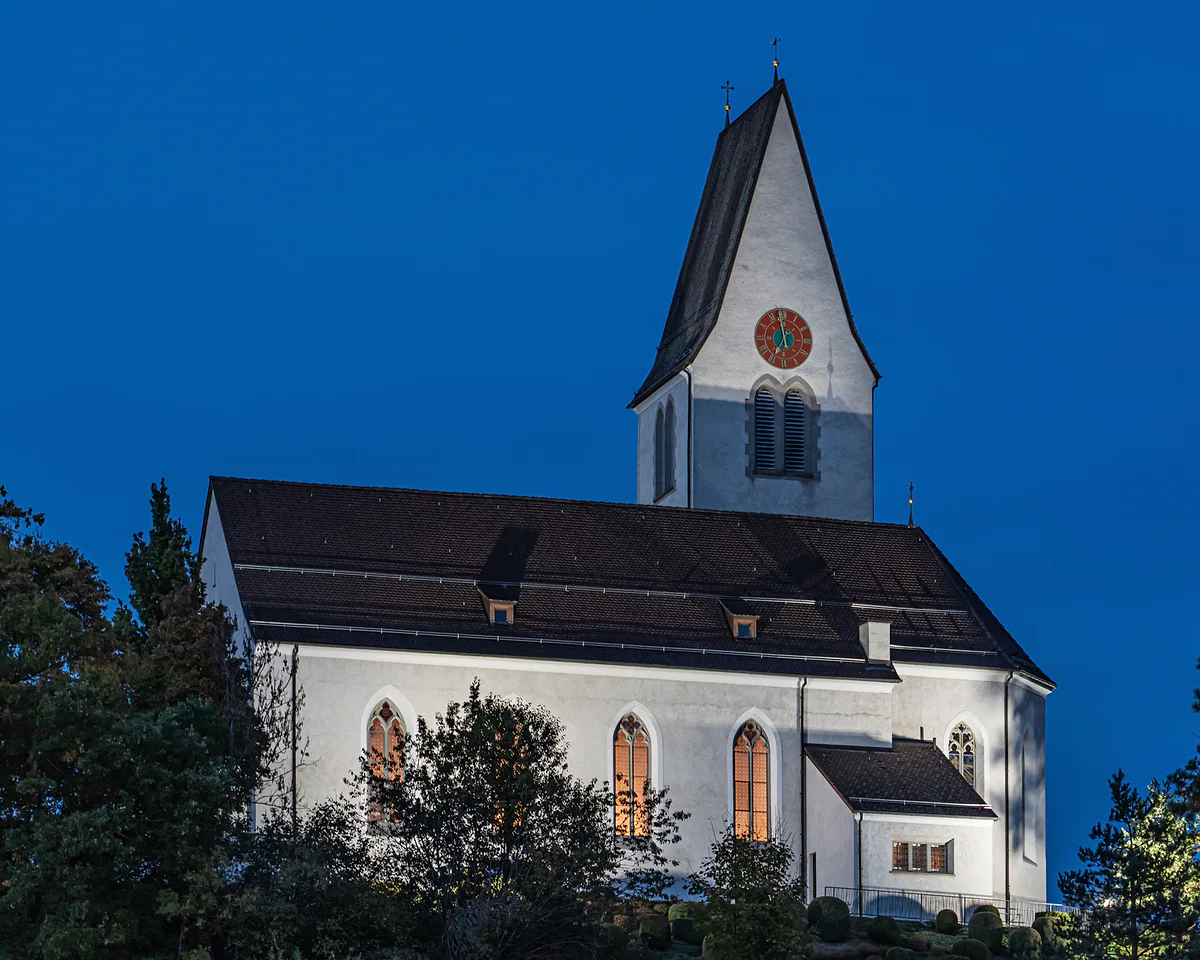
Gamprin's hamlet above the Rhine
Bendern, the hill where modern Liechtenstein began
Bendern is a hamlet in the municipality of Gamprin, in Liechtenstein's Unterland, beside the Rhine. On the square of its hill, below the old rectory, the subjects of the lordship of Schellenberg swore allegiance to the Prince on 16 March 1699, and the municipality calls it the birthplace of the country. Up top are the Church of the Assumption, with old foundations on show, and the Liechtenstein-Institut.
In 30 seconds
Full read: 4 min
- Bendern is a hamlet of Gamprin, in the Unterland, beside the Rhine.
- Allegiance was sworn to the Prince on its hill on 16 March 1699.
- The Church of the Assumption has a basement showing the foundations of earlier churches.
- The Lourdes grotto was consecrated on 7 August 1898.
I'd climb Bendern's hill before a good many of Vaduz's sights. It's short, it's free and it tells you in one spot why the country exists. If you can, go into the church outside Mass times and head down to the basement, where the foundations of the earlier churches are on show.

Before you go
What I would keep in mind
-
01 Most beautiful
The oath that started the country
On 16 March 1699 the Unterland's subjects swore allegiance to Prince Johann Adam Andreas on the square below the rectory, today's Bongertplatz. A 1980 fountain by Georg Malin marks the spot.
history of Liechtenstein -
02 My tip
Head down to the church basement
The Historisches Lexikon says the church has a walk-in basement showing the foundations of the earlier buildings. Avoid Mass time, 09:00 on Sundays.
-
03 Getting there
Four bus routes stop here
Bendern is served by route 11 towards Feldkirch, 35 towards Hinterschellenberg, 36 from Vaduz and Schaan to Ruggell and 37 to Sennwald in Switzerland. There's a LIEbike station at Gamprin-Bendern.
Liechtenstein's buses -
04 To save money
All outdoors, all free
The hill, the oath square, the Lourdes grotto and the church outside services cost nothing to see. Pair it with the Gampriner Seelein, a short stroll away.
lakes in Liechtenstein
What I would book
If I could show only one place in the Unterland to someone trying to understand Liechtenstein, it would be Bendern’s hill. It isn’t spectacular, just a rise with a church, a rectory and a square with a fountain, but this is where the gesture that began the country we know took place. The views over the Rhine are rather good, too.
Why is Bendern the country’s birthplace?
In 1699 Prince Johann Adam Andreas of Liechtenstein bought the lordship of Schellenberg, today’s Unterland. On 16 March that year, on the square below the old rectory, his new subjects pledged their loyalty, now called Bongertplatz. The municipality of Gamprin calls the hill the birthplace of Liechtenstein, and the tourist board sees the spot as the starting point of today’s Liechtenstein. Thirteen years later came the purchase of Vaduz and, in 1719, the union of the two halves. The whole story is on the history of Liechtenstein.
From 1699 the Landammann, the highest local office, was also elected here, having previously been chosen at the Rofenberg in Eschen. In 1980 a fountain by Georg Malin was set up on the square to mark the oath, and in 1999 the hill hosted the Unterland’s 300th anniversary celebrations with a play, «Der Ritter vom Eschnerberg».
What stood here before the oath
Long before 1699, the hill already had a very long past. Excavations between 1969 and 1977 found Bronze Age pottery, a 6th- and 7th-century manor complex of roughly 30 by 25 metres and, built on its walls, the first church, from the 8th or 9th century. The site has been lived on ever since.
The Church of the Assumption is recorded in 1045, when half of it belonged to the convent at Schänis, and in 1194 it passed to the Premonstratensians of St Luzi in Chur. The Gothic chancel was consecrated in 1481 and the tower finished around 1509, and the Lexikon says it formed part of a Vorarlberg warning line because of its exposed position. What you see outside comes from two makeovers, a neo-Gothic one in 1875-79 and another in 1969-70 that stripped much of that ornament away.
Inside, the basement is what would draw me in. The Lexikon says you can walk through it and see the foundations of the earlier churches. The paintings in the window reveals of the south wall are also among the oldest in Liechtenstein, and there’s a Madonna from around 1480 and a copy of a Lenten veil from 1612. The country’s other churches are covered on churches and chapels in Liechtenstein.
The monks’ house and the institute
The rectory, known as the Statthalterei, was finished around 1532. Between 1538 and 1636 it was the headquarters of the St Luzi canons, who had fled Chur during the Reformation. The old parish barn has housed the Liechtenstein-Institut since 1997, a research centre based in Bendern since 1986 that publishes the Historisches Lexikon, the reference work I quote so often.
On the western slope of the hill is the Lourdes grotto, cut into the rock between 1896 and 1898 at the suggestion of the parish priest Franz Xaver Häusle and consecrated on 7 August 1898. The municipality describes it as a regional centre of Marian devotion and a stop on several processions.
A Rhine crossing with a past
Bendern owes a great deal to the river. From the late 14th century, or the 16th at the latest, a ferry crossed to Haag in Switzerland on the road from Feldkirch to the Toggenburg, used by pilgrims from Tyrol and Vorarlberg heading for Einsiedeln and Santiago. A wooden bridge arrived in 1868, burnt down in 1894, was rebuilt and finally collapsed after another fire in 1974. Alongside it, the country’s first prestressed concrete bridge had gone up in 1963-64. What the river border looks like today is on the Rhine in Liechtenstein.
It wasn’t always peaceful. In 1499 Swiss confederates burnt Bendern during the Swabian War, and on 6 March 1799 French troops crossed the Rhine here and plundered houses and church. The flood of 25 September 1927 swept away the customs house. And a titbit for the curious, in 1784 Bendern was said to make the best wine in the lordship.
Getting there
The hill sits beside the Bendern bus stops, served by route 11 towards Feldkirch, 35 towards Hinterschellenberg, 36 from Vaduz and Schaan to Ruggell and 37 across to Sennwald. Walkers reach the hill on stage 4 of the Liechtenstein Trail, Nendeln to Ruggell, between Eschen and the Grossabünt bathing lake. Bendern is also home to the Grand Casino, which I compare with the others in casinos in Liechtenstein.
Bendern's hill through time
| Date | What happened |
|---|---|
| Bronze Age | First pottery finds on the hill |
| 6th-7th centuries | A manor complex of about 30 × 25 m |
| 8th-9th centuries | First church, built on its walls |
| 1045 | First record of Bendern and its church |
| 1481 and c. 1509 | Gothic chancel and tower |
| 16-03-1699 | Oath of allegiance to the Prince |
| 1898 | The Lourdes grotto is consecrated |
| 1980 | Memorial fountain by Georg Malin |
| 1997 | The Liechtenstein-Institut moves into the old parish barn |
Historisches Lexikon, entries «Bendern (Kirchhügel)», «Bendern (Siedlung)» and «Pfarrkirche Mariä Himmelfahrt»; Gamprin municipality.
Mass times at Bendern church
| Day | Time |
|---|---|
| Sunday | 09:00 |
| Saturday (vigil) | 18:00 |
| Tuesday and Friday | 19:00 |
| Wednesday and Thursday | 09:00 |
Bendern parish, on the Gamprin municipal website. Best not to sightsee during services.
Test yourself
True or false?
0/4 Pick before you peek.
-
The 1699 oath was sworn at Vaduz Castle.
See the answer
False. It was sworn on Bendern's hill, on the square below the rectory. The county of Vaduz wasn't bought until 1712.
-
Bendern's church predates the arrival of the Princes of Liechtenstein.
See the answer
True. The first church dates from the 8th or 9th century and is recorded in 1045. The Liechtenstein princes bought the lordship in 1699.
-
All of Liechtenstein's waste water is treated at Bendern.
See the answer
False. Almost all. The Lexikon notes that the Bendern plant treats the whole country's except Hinterschellenberg's.
-
Pilgrims bound for Santiago crossed the Rhine at Bendern.
See the answer
True. The ferry from Bendern to Haag, on the road from Feldkirch to the Toggenburg, was used by pilgrims from Tyrol and Vorarlberg heading for Einsiedeln and Santiago.
- Oath of allegiance to the Prince
- 1699
- First record of Bendern
- 1045
- Lourdes grotto
- 1898
- Altitude of the church
- 472 m
Map
Where Bendern is
The dashed line is the border: Switzerland across the Rhine, Austria to the north and east. Every number opens its guide.
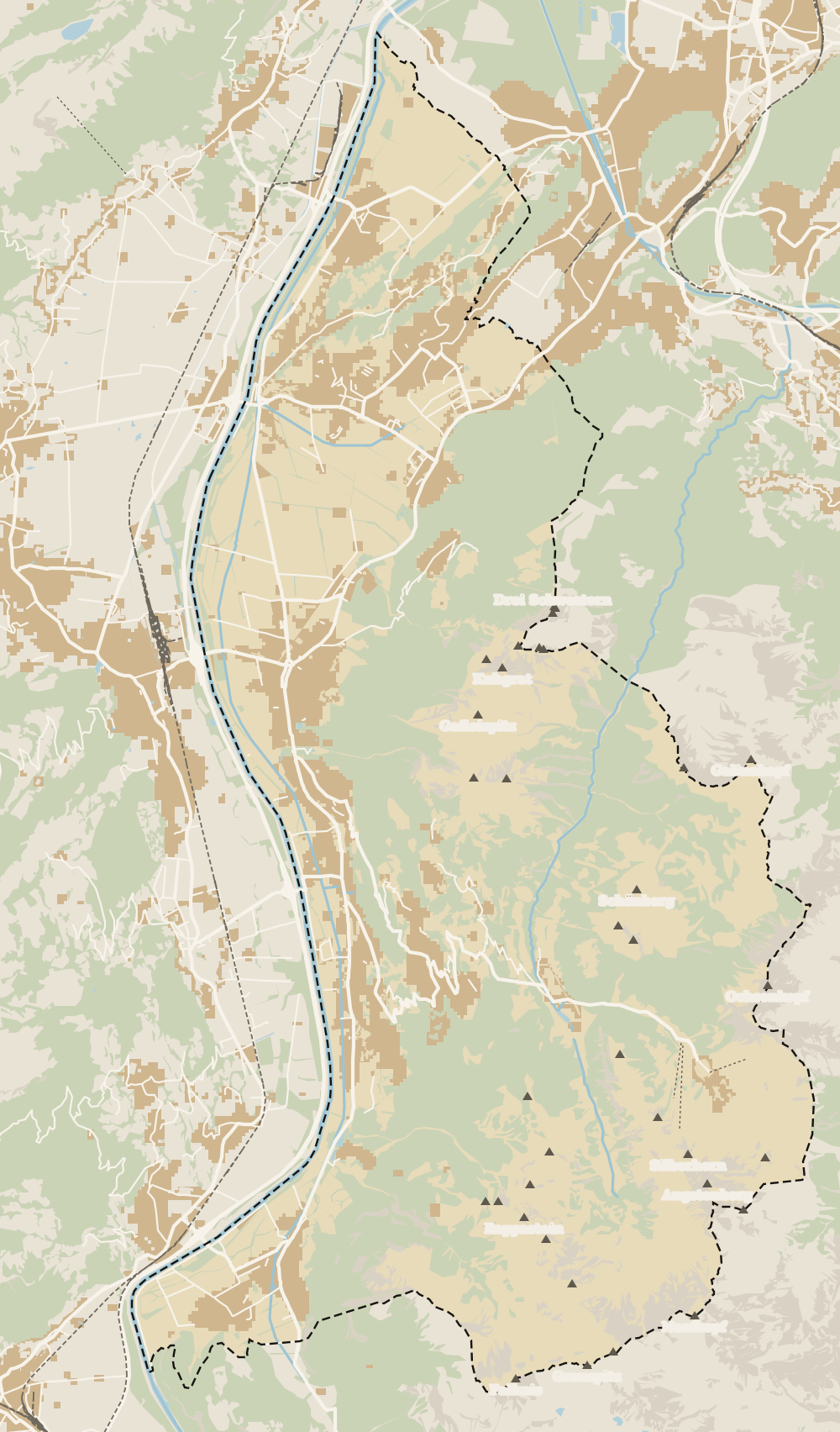
0 of 168 Liechtenstein guides
Your next stamp
- Eschen
- Stage 4: Nendeln - Ruggell
- The princely house
- The Rhine
- The national anthem
- The prince
- Is it a country?
- Churches and chapels
- Things to do
- One day
- Two days
- Municipalities
- Oberland
- Unterland
- Map
- Vaduz
- Städtle
- Mitteldorf
- Vaduz Castle
- Vaduz Cathedral
- Parliament
- Government Building
- Vaduz Town Hall
- Red House
- Prince's Winery
- Old Rhine Bridge
- Schaan
- Schalun Castle Ruin
- Balzers
- Citytrain
- Triesen
- Triesenberg
- Walser Museum
- Planken
- Gutenberg Castle
- Schaan Roman fort
- Dux
- St Mamertus chapel
- Lawena valley
- Mäls
- DoMuS
- TAK Theatre
- Castles
- Viewpoints
- Mountains
- Museums
- Kunstmuseum
- Mountain huts
- Hilti Art Foundation
- Pfälzerhütte
- Gafadura hut
- National Museum
- Treasure Chamber
- Postage Stamp Museum
- Kunstraum Engländerbau
- Masescha
- Gaflei
- Nendeln
- Mauren
- Silum
- Rotenboden
- Schaanwald
- Gamprin
- Wangerberg
- Steg
- Ruggell
- Samina valley
- Schellenberg Farmhouse Museum
- Cross-country skiing at Steg
- Küefer-Martis-Huus
- Ruggeller Riet
- Schellenberg
- Hinterschellenberg
- Fürstensteig
- Liechtenstein Trail
- Malbun
- Schellenberg castles
- Eschnerberg
- Malbun in summer
- Population
- Stage 1: Balzers - Triesenberg
- Lakes
- Sareis
- Size
- Stage 2: Triesenberg - Vaduz
- Malbun Peace Chapel
- Political system
- Stage 3: Vaduz - Nendeln
- Swimming pools
- Language
- Skiing in Malbun
- Dialect
- Malbun ski pass
- Stage 5: Ruggell - Schaanwald
- Hotels in Malbun
- Stamps
- Princess Gina Trail
- Hut-to-hut Route 66
- Hiking
- Getting there
- In winter
- Weather
- Airport
- Best time to visit
- In summer
- Events
- With kids
- Zurich to Liechtenstein
- National day
- Sargans to Vaduz
- Christmas
- Feldkirch to Vaduz
- By train
- Traditions
- Carnival
- Getting around
- Buses
- Funken Sunday
- Alpine cattle drive
- Driving and vignette
- Parking
- Bike hire
- Cycling
- EU and Schengen
- Entry requirements
- Borders and customs
- The flag
- The coat of arms
- History
- Second World War
- No army
- Facts
- Why so rich?
- Banks and tax haven
- Where to stay
- Hilti
- Hotels in Vaduz
- False teeth
- Hostel and camping
- Rent the country?
- Where to eat
- Restaurants in Vaduz
- Swiss invasions
- Bars and nightlife
- Food
- Käsknöpfle
- Wine
- Casinos
- Adventure Pass
- Rainy days
- Guided tours
- Tourist office
- Day trips
- Passport stamp
- Music festivals
- Phone and roaming
- Currency and payments
- Prices and budget
- Tipping
- Plugs and sockets
- Tap water
- Opening hours
- Public holidays
- Safety
- Accessibility
- With a dog
- Shopping and souvenirs
Frequently asked questions
What happened in Bendern in 1699?
On 16 March 1699, after Prince Johann Adam Andreas bought the lordship of Schellenberg, his new subjects swore allegiance to him on the square on Bendern's hill. The tourist board says the spot symbolises the start of today's Liechtenstein.
Where is Bendern?
In the west of the Unterland, in the municipality of Gamprin, beside the Rhine and opposite Haag in Switzerland. The church stands on a hill at the western tip of the Eschnerberg.
Can you visit Bendern church?
It's the parish church and opens for worship. The Lexikon describes a walk-in basement with the foundations of earlier churches. I'd go outside Mass times.
What is the Liechtenstein-Institut in Bendern?
A research institute on the country, based in Bendern since 1986 and in the old parish barn on the hill since 1997. It publishes the Historisches Lexikon.
What does the name Bendern mean?
The Lexikon says it's Celtic. The second part, -duro, means gate or fortress, while the first hasn't been reliably explained. It was first recorded in 1045 as «Beneduro».
By
Tourism graduate with a master’s in Tourism Management and Planning from the University of Málaga, who has travelled across Europe. He writes every guide from official sources and his own judgement.
Published on . Facts checked on .
Sources