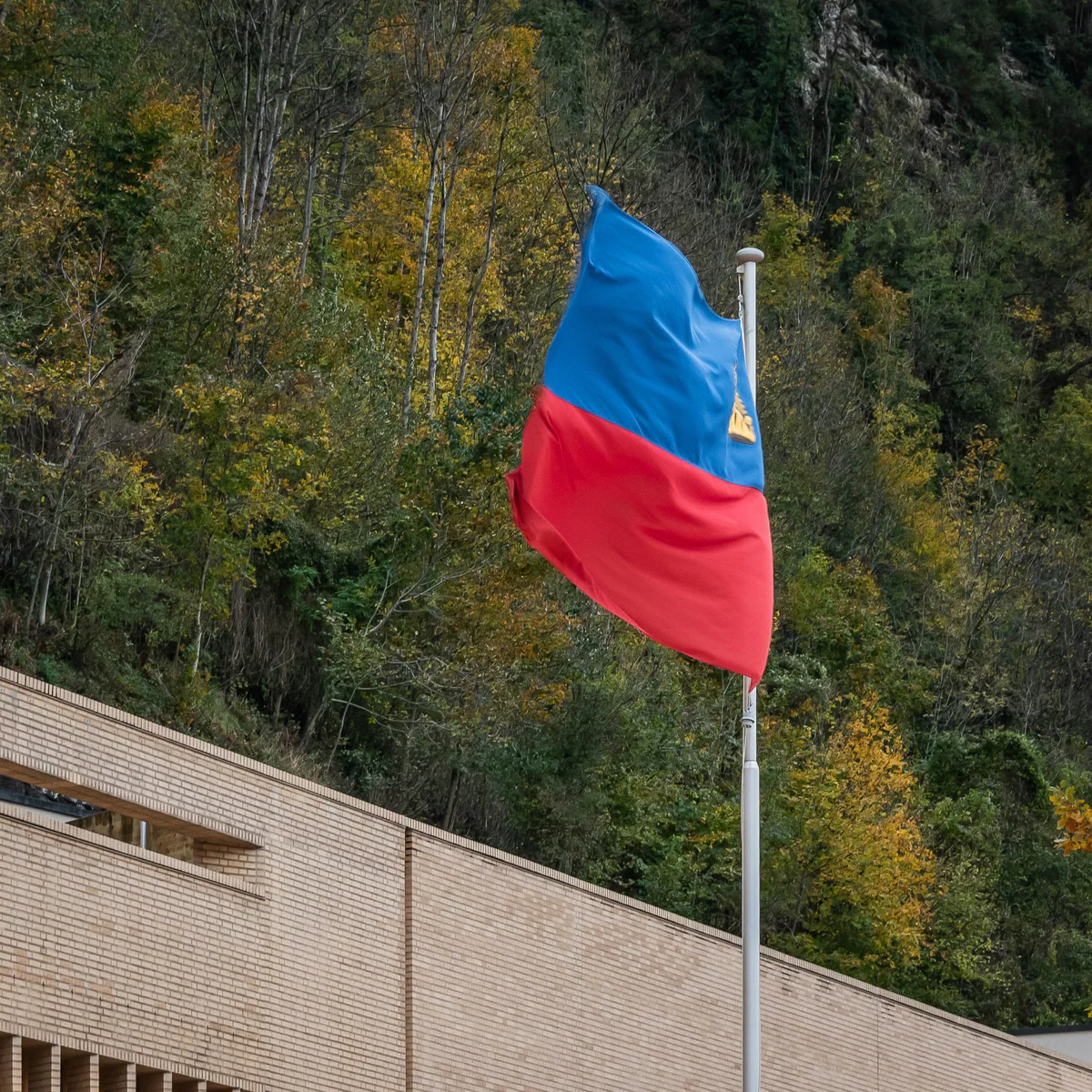
Blue and red, crowned since 1937
The flag of Liechtenstein and the crown it owes to Haiti
Liechtenstein's flag has two equal horizontal stripes, blue over red, with the princely crown in gold on the blue stripe next to the hoist. The crown was added in 1937, after the 1936 Berlin Olympics, because the flag matched Haiti's. Its proportions are 3 by 5 and it's governed by a 1982 law.
In 30 seconds
Full read: 3 min
- Liechtenstein's flag is blue over red, with a gold princely crown on the blue stripe.
- The crown was added in 1937, after the 1936 Berlin Olympics, because the flag was identical to Haiti's.
- Its proportions are 3 by 5 and it's governed by the 1982 law on arms and flags.
- The gold-and-red flag isn't the national one; it belongs to the princely family.
If you want a photo with flags everywhere, come on 15 August, an official flag day. And don't mix up the blue-and-red with the gold-and-red, which belongs to the princely family and only comes out when the occasion involves them.

Before you go
What I would keep in mind
-
01 My tip
Blue and red is the country; gold and red is the family
The 1982 law distinguishes two flags. One in the national colours, blue and red, and one in the prince's colours, gold and red, which is only hoisted when there's a direct link to the princely house.
Liechtenstein royal family -
02 Most beautiful
On 15 August the whole country dresses up
National day is one of the official flag days. Public buildings fly the national colours and private householders are asked to do the same.
Liechtenstein National Day on 15 August -
03 My tip
The castle flags are up almost every day
The princely house explains that the flags over Vaduz Castle are hoisted daily unless it's very windy, so they tell you nothing about whether the prince is at home.
Vaduz Castle
What I would book
Liechtenstein’s flag has one of the more endearing back stories in Europe. For decades it was plain blue and red, exactly like another country’s, and the clash came to light with an Olympic Games in the background. The fix was to add a crown. Look around Vaduz and you’ll notice that almost everything official carries that little golden hat in the corner.
What it looks like, exactly
Article 5 of the constitution says the national colours are blue and red. The detail is in the Wappengesetz, the 1982 act on state symbols, which describes two horizontal stripes of equal width, blue on top and red underneath. On the blue stripe, at the hoist end, sits the princely crown in gold, known in German as the Fürstenhut. The proportions are 3 by 5.
The blue and red didn’t come from nowhere. The Historisches Lexikon explains that they were secondary colours of the princely family, used on liveries and uniforms, and that they first appear as the country’s colours in 1793, on a design for a standard. The family’s own colours are different, gold and red, recorded in colour since the early 15th century.
Why the crown? The Haiti mix-up
This is the story most people are looking for. Liechtenstein’s flag, blue and red in horizontal stripes, was the same as Haiti’s. The Lexikon calls it, quite literally, a colour collision, and places the response straight after the 1936 Olympic Games in Berlin. The following year, 1937, the princely crown was added to the blue stripe to set the two apart.
I love it because it sums the country up. It didn’t change its colours or commission a new design; it added the emblem of its own monarchy and got on with things. The crown you see today is the same one that tops the Liechtenstein coat of arms, so flag and arms tell the same tale, of a country that identifies closely with its ruling family. The other state symbol worth knowing is the Liechtenstein national anthem, which shares its melody with the British one.
The other flag, gold and red
Wander round Vaduz and you’ll sometimes spot a yellow-and-red flag with no crown. It isn’t a mistake. It’s the princely family’s flag, which the 1982 law keeps separate from the national one. It only goes up when there’s a direct link to the house, and private individuals may fly it only at local festivities. For who the family are and where the name comes from, see the princely house of Liechtenstein.
The national flag, on the other hand, anyone may fly without asking, unless it’s for commercial use. Each of the eleven municipalities also has its own, striped in the colours of its coat of arms and handed out by the prince from the 1930s to the late 1950s. If you’re after the flag of Vaduz, it’s one of these and nothing like the national flag. The Vaduz arms date from 1978 and pair the prince’s hat with a church banner inherited from the old counts of Werdenberg-Sargans, and the town’s stripes follow those colours.
When you’ll see the most flags
The law sets official flag days. They are national day, constitution day, the anniversary of the prince’s accession, his birthday, his name day and Corpus Christi. On those dates public buildings fly the blue and red and householders are asked to follow suit. Parliament also flies the flag whenever it’s sitting, and the flag flies at the country’s borders too. The government building raises it for high-ranking foreign visitors and, on certain days of mourning, at half-mast with a black ribbon.
The best day to see them all at once is 15 August. Houses are hung with flags, there’s a state ceremony by the castle and a party in the streets. Everything that happens that day, including why there were no fireworks in 2026, is on my page for Liechtenstein National Day.
A castle myth
Plenty of people glance at the flags on Vaduz Castle to work out whether the prince is in residence. Here it doesn’t work. According to the princely house they’re raised each morning and lowered only in heavy wind, so they fly whoever is at home. For me the best photo of the flag in its natural setting is from the Städtle, with the castle up on its rock behind it.

Fireworks over Vaduz on a national holiday night in an earlier year, with flags and buildings in the foreground.
The flag as the law describes it
| Element | Detail |
|---|---|
| Stripes | Two horizontal stripes of equal width, blue on top and red below |
| Crown | The princely crown (Fürstenhut) in gold, on the blue stripe by the hoist |
| Proportions | 3 by 5 |
| Legal basis | Constitution, Art. 5, and the 1982 Wappengesetz, Art. 5 |
| Family flag | Gold over red, flown only for occasions linked to the princely house |
Sources: the constitution and the Wappengesetz (gesetze.li); Historisches Lexikon, 'Fahnen'.
Official flag days
| Occasion | What flies the flag |
|---|---|
| National day (15 August) | Public buildings; householders are asked to join in |
| Constitution day | Public buildings |
| Anniversary of the prince's accession | Public buildings |
| The prince's birthday and name day | Public buildings |
| Corpus Christi | Public buildings |
| Sittings of parliament | The parliament building |
Source: Historisches Lexikon, 'Fahnen' (text as of 2011).
Test yourself
True or false?
0/4 Pick before you peek.
-
The Liechtenstein flag has always carried a crown.
See the answer
False. The crown was only added in 1937, after the 1936 Berlin Olympics. Until then the flag was plain blue and red, just like Haiti's.
-
The blue stripe is on top and the red one below.
See the answer
True. The 1982 law describes two horizontal stripes of equal width, blue above and red below, with the gold crown on the blue.
-
The gold-and-red flag is Liechtenstein's national flag.
See the answer
False. It's the princely family's flag. The national flag is blue and red; the gold-and-red one only goes up when there's a direct link to the house.
-
Blue and red were already the country's colours in the 18th century.
See the answer
True. The Historisches Lexikon records them as national colours for the first time on a design for a standard dated 1793.
- Blue and red first used as national colours
- 1793
- Berlin Olympics, just before the change
- 1936
- Year the crown was added
- 1937
- Proportions of the flag
- 3:5
0 of 168 Liechtenstein guides
Your next stamp
- Facts
- Hilti
- The Rhine
- Political system
- Castles
- Currency and payments
- The coat of arms
- Things to do
- One day
- Two days
- Municipalities
- Oberland
- Unterland
- Map
- Vaduz
- Städtle
- Mitteldorf
- Vaduz Castle
- Vaduz Cathedral
- Parliament
- Government Building
- Vaduz Town Hall
- Red House
- Prince's Winery
- Old Rhine Bridge
- Schaan
- Schalun Castle Ruin
- Balzers
- Citytrain
- Triesen
- Triesenberg
- Walser Museum
- Planken
- Gutenberg Castle
- Schaan Roman fort
- Dux
- St Mamertus chapel
- Lawena valley
- Mäls
- DoMuS
- TAK Theatre
- Churches and chapels
- Viewpoints
- Mountains
- Museums
- Kunstmuseum
- Mountain huts
- Hilti Art Foundation
- Pfälzerhütte
- Gafadura hut
- National Museum
- Treasure Chamber
- Postage Stamp Museum
- Kunstraum Engländerbau
- Eschen
- Masescha
- Gaflei
- Nendeln
- Mauren
- Silum
- Rotenboden
- Schaanwald
- Gamprin
- Wangerberg
- Bendern
- Steg
- Ruggell
- Samina valley
- Schellenberg Farmhouse Museum
- Cross-country skiing at Steg
- Küefer-Martis-Huus
- Ruggeller Riet
- Schellenberg
- Hinterschellenberg
- Fürstensteig
- Is it a country?
- Liechtenstein Trail
- Malbun
- Schellenberg castles
- Eschnerberg
- Malbun in summer
- Population
- Stage 1: Balzers - Triesenberg
- Lakes
- Sareis
- Size
- Stage 2: Triesenberg - Vaduz
- Malbun Peace Chapel
- Stage 3: Vaduz - Nendeln
- Swimming pools
- Language
- Skiing in Malbun
- Stage 4: Nendeln - Ruggell
- Dialect
- Malbun ski pass
- Stage 5: Ruggell - Schaanwald
- Hotels in Malbun
- Stamps
- Princess Gina Trail
- Hut-to-hut Route 66
- Hiking
- Getting there
- In winter
- Weather
- Airport
- Best time to visit
- In summer
- Events
- With kids
- Zurich to Liechtenstein
- National day
- Sargans to Vaduz
- Christmas
- Feldkirch to Vaduz
- By train
- Traditions
- Carnival
- Getting around
- Buses
- Funken Sunday
- Alpine cattle drive
- Driving and vignette
- Parking
- Bike hire
- Cycling
- EU and Schengen
- Entry requirements
- Borders and customs
- The prince
- The princely house
- The national anthem
- History
- Second World War
- No army
- Why so rich?
- Banks and tax haven
- Where to stay
- Hotels in Vaduz
- False teeth
- Hostel and camping
- Rent the country?
- Where to eat
- Restaurants in Vaduz
- Swiss invasions
- Bars and nightlife
- Food
- Käsknöpfle
- Wine
- Casinos
- Adventure Pass
- Rainy days
- Guided tours
- Tourist office
- Day trips
- Passport stamp
- Music festivals
- Phone and roaming
- Prices and budget
- Tipping
- Plugs and sockets
- Tap water
- Opening hours
- Public holidays
- Safety
- Accessibility
- With a dog
- Shopping and souvenirs
Frequently asked questions
What does the Liechtenstein flag look like?
Two equal horizontal stripes, blue over red, with a gold princely crown on the blue stripe near the flagpole. The law sets its proportions at 3 by 5.
Why is there a crown on the Liechtenstein flag?
Because the plain blue-and-red flag matched Haiti's. According to the Historisches Lexikon, the gold princely crown was added in 1937, after the 1936 Berlin Olympics, to tell the two apart.
Why were the flags of Liechtenstein and Haiti the same?
Both used blue and red in horizontal stripes. The Historisches Lexikon describes it as a clash of colours dealt with after the Berlin Games of 1936, and Liechtenstein settled it by adding its crown in 1937.
What do the colours of the Liechtenstein flag mean?
The constitution simply says the national colours are blue and red. They were secondary colours of the princely house, used for liveries and uniforms, and first appear as the country's colours in 1793.
What is the yellow and red flag in Liechtenstein?
That's the princely family's flag, gold over red. The 1982 law keeps it separate from the national flag; it's only raised when there's a direct link to the house, and private individuals may fly it only at local festivities.
Can I fly a Liechtenstein flag?
Yes. According to the Historisches Lexikon, private individuals can use the blue-and-red flag freely; using it for commercial purposes needs a permit.
By
Tourism graduate with a master’s in Tourism Management and Planning from the University of Málaga, who has travelled across Europe. He writes every guide from official sources and his own judgement.
Published on . Facts checked on .
Sources
Photos: Tournasol7 (CC BY 4.0); Casssch (CC BY-SA 4.0), via Wikimedia Commons.