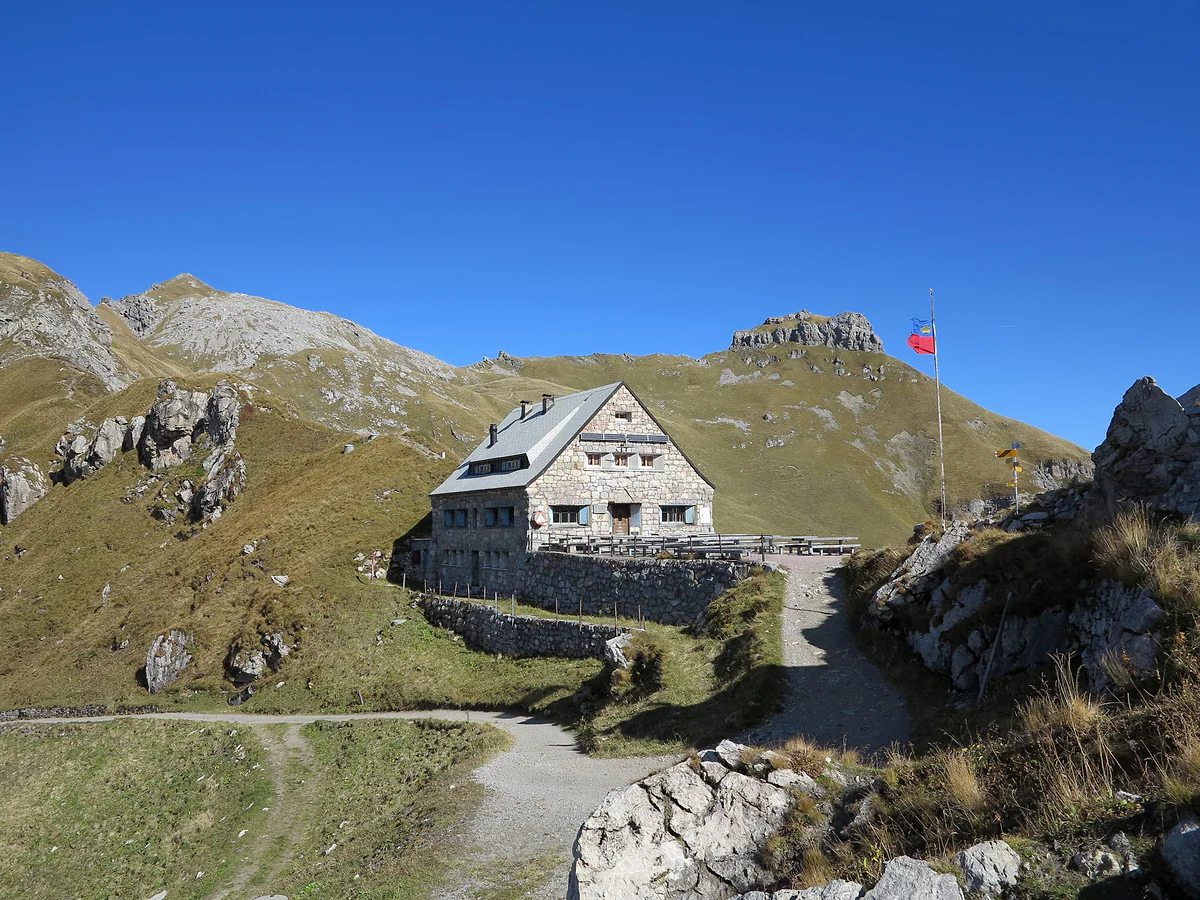
2,108 m, on the Austrian border
Pfälzerhütte, the stone hut on the Bettlerjoch
The Pfälzerhütte is Liechtenstein's highest mountain hut, at 2,108 m on the Bettlerjoch pass, right on the Austrian border and north of the Naafkopf. It belongs to the Liechtenstein Alpine Club, it's two to three hours' walk from Malbun, and half board costs CHF 68 for Alpine club members and CHF 75 for everyone else, cash only.
In 30 seconds
Full read: 3 min
- The Pfälzerhütte is Liechtenstein's highest hut, at 2,108 m on the Bettlerjoch.
- It opened in 1928 and has belonged to the Liechtenstein Alpine Club since 1950.
- It's two to three hours from Malbun and two to three from Steg.
- Half board costs CHF 68 or 75, and it's cash only.
- In winter it closes and the Adlerhorst shelter opens.
I'd go up over the Augstenberg and come down through the Vaduzer Täli, so it's a loop rather than an out-and-back. I'd only sleep up there if I was climbing the Naafkopf the next morning, because that's when the night really pays off.

Before you go
What I would keep in mind
-
01 Most beautiful
Built from the mountain's own stone
The Historisches Lexikon holds it up as an example of modern Alpine architecture, with walls of rock blasted on the spot and terraces facing south and west. It opened on 5 August 1928.
-
02 Money
Cash only, and euros at the day's rate
The Alpine Club's website is clear that you can only pay in cash at the hut. They take euros, but at that day's exchange rate, so I'd bring francs.
Liechtenstein's currency -
03 Getting there
Three ways up from Liechtenstein
From Malbun over the Augstenberg, about 3 hours; from Malbun via the Vaduzer Täli, about 2; and from Steg up the Valüna valley, 2 to 3. All three are white-red-white mountain paths.
Malbun -
04 My tip
The Naafkopf, two hours there and back
From the hut you can climb the Naafkopf, the tripoint of Liechtenstein, Switzerland and Austria, in about two hours there and back. On the way there's a small crag with routes from grade IV to VII.
mountains in Liechtenstein
What I would book
The Pfälzerhütte is Liechtenstein’s proper mountain hut. It stands alone on a saddle at 2,108 m, among alpine meadows and rock, built from the mountain’s own stone, and from its door you can climb the summit where three countries meet. If you’re spending one night in the country’s mountains, for me this is the place.
Where it is and how it got its name
The hut sits on the Bettlerjoch, a border pass at 2,108 m between the Augstenberg and the Naafkopf, in Schaan’s territory, which drops down to the Nenzinger Himmel in Austria’s Vorarlberg. The tourist board places it at the very top of the Naaf valley on the Austrian frontier. The pass takes its name, according to the Historisches Lexikon, from the «Schmalzbettler», the butter beggars who, as legend and probably reality have it, crossed over from Austria to ask for handouts on Liechtenstein’s alps. Smugglers used it too.
The hut’s own name has a different story. It was built in 1927-1928 by nine sections of the German and Austrian Alpine Club grouped as the Verband der Pfälzischen Sektionen, the Palatinate sections, after the Gritsch alp cooperative gave them the land. The architect Ernst Sommerlad won the competition, the build took 113 days and cost over CHF 93,000, and it opened on 5 August 1928, named the Pfälzerhütte in their honour.
A hut that survived the war
What happened next is one of the oddest stories I’ve read about an Alpine hut. Eleven years after it opened, the Second World War broke out and, according to the Liechtenstein Alpine Club, the hut stood empty from 1939, broken into and looted several times. After the war it got caught up in Switzerland’s freeze on German assets. In 1946 the government asked the Liechtenstein club to take it over, and after a long process it bought it under a contract dated 28 April 1950 for CHF 8,000. It reopened that same year after repairs. In 1963 the club signed an agreement with the Palatinate sections to keep the name.
Why I like the building
The Lexikon calls it a fine example of modern Alpine architecture expressed in archaic forms and local materials, in the tradition of the German architect Heinrich Tessenow. The outer walls are rubble masonry from stone blasted on site and hand-dressed, and it has terraces facing south and west. The annex, called Adler, was added in 1935. To me it sits in the landscape as if it had always been there, which is the hardest thing to pull off with a mountain hut.
How to get to the Pfälzerhütte
The Alpine Club gives three routes from Liechtenstein, all white-red-white mountain paths. From Malbun over the Sareiserhöhi, the Princess Gina Trail and the 2,359 m Augstenberg in about three hours, which you can shorten with the Sareis chairlift when it’s running. From Malbun via the Vaduzer Täli, the Tälihöhi and the Gritsch alp in about two. And from Steg up the Samina valley and the Valüna in two to three. From Austria, it’s about two hours up from the Nenzinger Himmel.
A word on the chairlift. Its summer season ends on 18 October 2026 and Bergbahnen Malbun posts its live status, so I wouldn’t count on it without checking on the day.
Sleeping, paying and what’s nearby
Half board includes a vegetarian three-course dinner and a breakfast buffet, and costs CHF 68 for members of Alpine clubs with reciprocal rights, CHF 75 for everyone else and CHF 40 for children up to 12. It’s cash only, and euros are taken at the day’s rate. You book through the online system linked from the Alpine Club’s site, and neither the club nor the tourist board publishes the 2026 season dates. In winter the hut closes and the Adlerhorst stays open, with 21 places at CHF 20, a compost toilet outside since October 2025 and no emergency phone. The club also warned in 2026 that the solar lighting wasn’t working properly, so pack a head torch.
From the door, the obvious outing is the Naafkopf, 2,570 m, the tripoint with Switzerland and Austria, about two hours there and back, with a small crag along the way. Stronger walkers carry on along the Liechtensteiner Höhenweg towards the Mannheimer Hütte or the Schesaplana. For how it stacks up against the others, see Liechtenstein’s mountain huts.
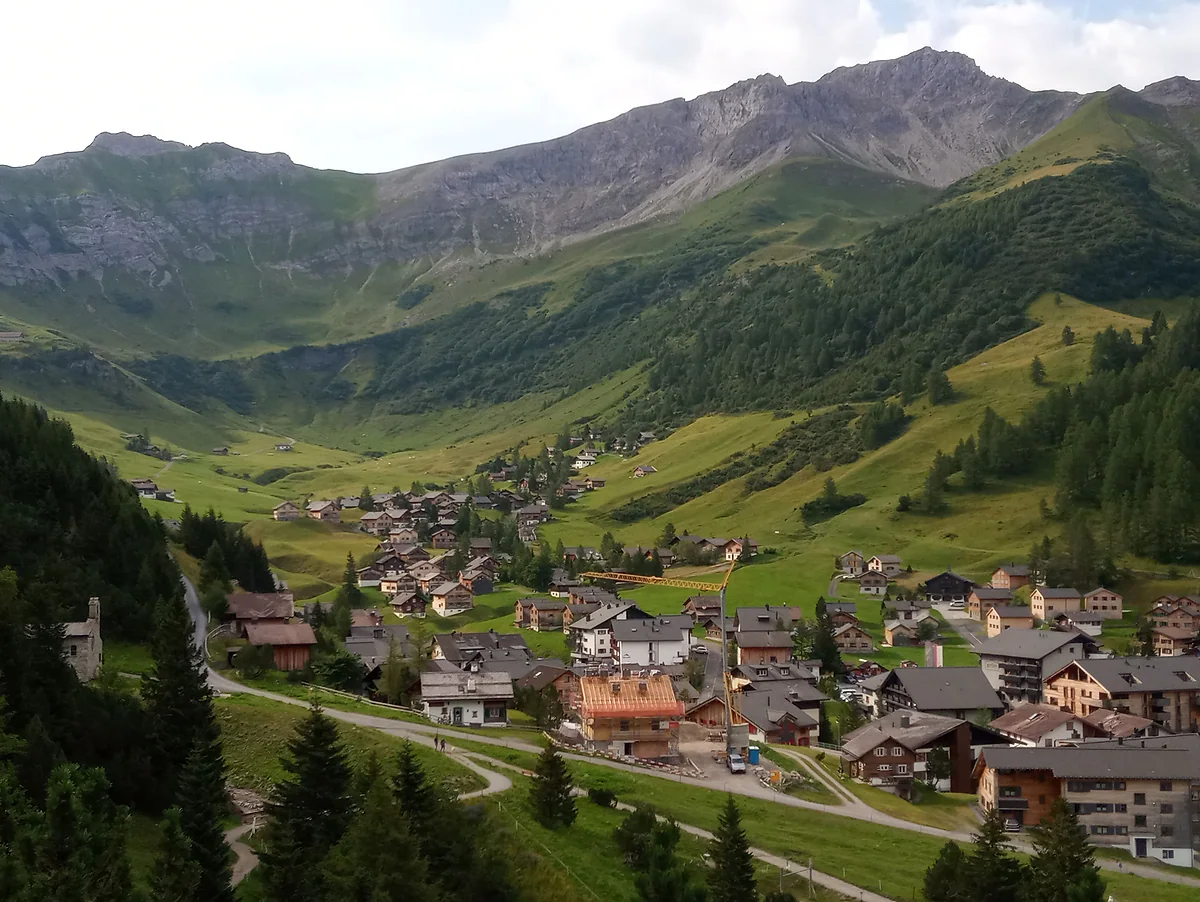
Malbun in summer, with the chalet village on the valley floor, green meadows and rocky peaks above.
Summer-season prices
| Rate | Members | Non-members | Children to 12 |
|---|---|---|---|
| Half board | CHF 68 | CHF 75 | CHF 40 |
| Breakfast only | CHF 38 | CHF 45 | CHF 20 |
Liechtenstein Alpine Club website, checked on 27 September 2026. Half board includes a vegetarian three-course dinner and a breakfast buffet. Members means card-carrying members of Alpine clubs with reciprocal rights.
Getting there on foot
| From | Via | Time |
|---|---|---|
| Malbun | Sareiserhöhi, Princess Gina Trail and Augstenberg | About 3 h |
| Malbun | Vaduzer Täli, Tälihöhi and Gritsch alp | About 2 h |
| Steg | Valüna valley and Gritsch alp or the Naaftal | 2 to 3 h |
| Nenzinger Himmel (Austria) | Güfel alp | About 2 h |
Times from the Liechtenstein Alpine Club. The first stretch from Malbun can be shortened with the Sareis chairlift when it's running.
Test yourself
True or false?
0/3 Pick before you peek.
-
The Liechtenstein Alpine Club built the Pfälzerhütte.
See the answer
False. It was built in 1927-1928 by the Palatinate sections of the German and Austrian Alpine Club. The Liechtenstein club bought it in 1950 for CHF 8,000.
-
The Bettlerjoch is named after beggars.
See the answer
True. According to the Historisches Lexikon, after the «Schmalzbettler» who, as legend and probably reality have it, crossed from the Nenzinger Himmel to beg for butter on Liechtenstein's alps.
-
There's no shelter at all on the Bettlerjoch in winter.
See the answer
False. The hut closes, but the Adlerhorst next door stays open with 21 places, a wood stove and a cooker, at CHF 20 a night.
- Altitude of the Bettlerjoch
- 2,108 m
- Opened on 5 August
- 1928
- How long it took to build
- 113 days
- What the Alpine Club paid in 1950
- CHF 8,000
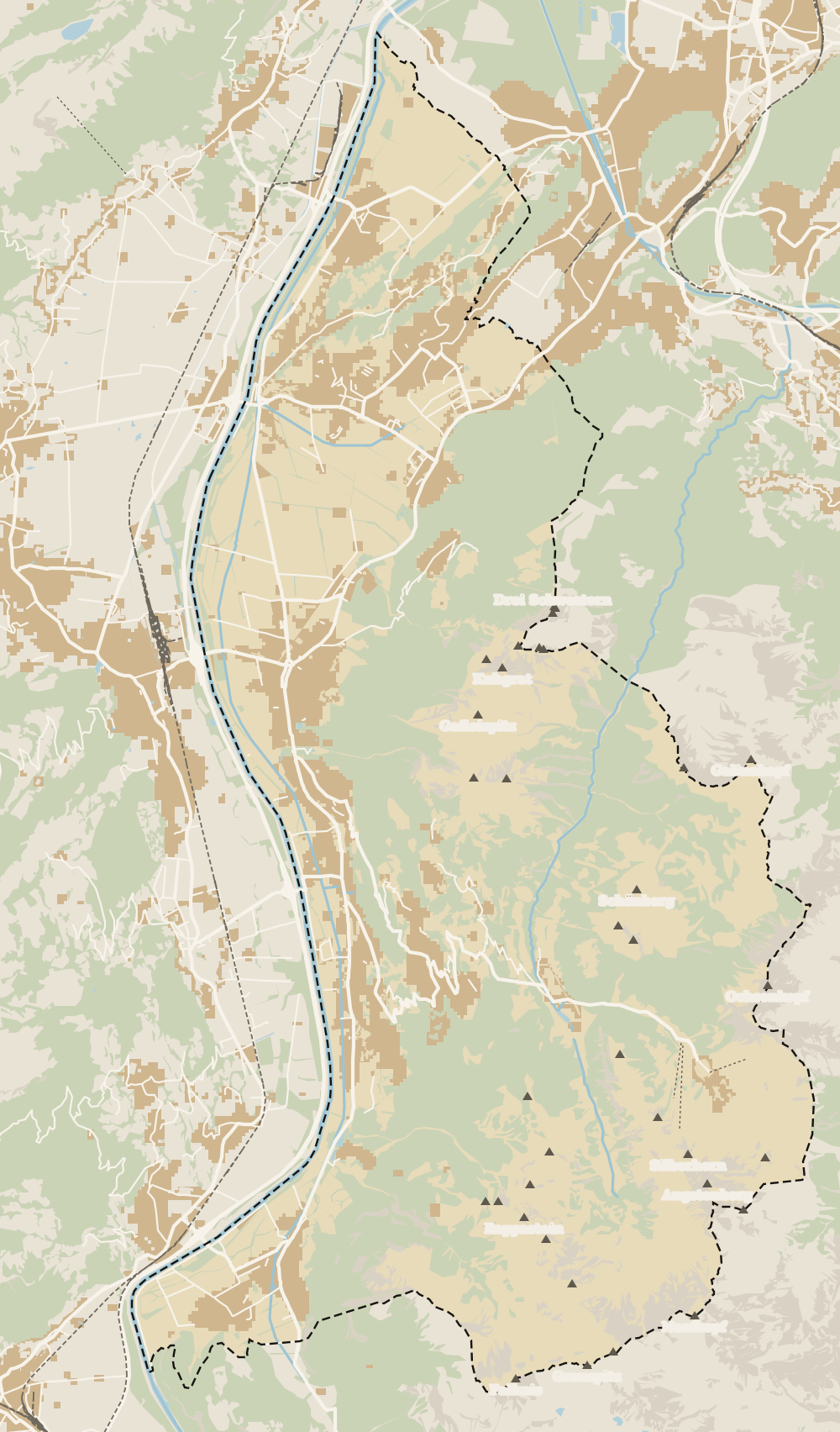
Map
Where Pfälzerhütte is
The dashed line is the border: Switzerland across the Rhine, Austria to the north and east. Every number opens its guide.
0 of 168 Liechtenstein guides
Your next stamp
- Mountain huts
- Hut-to-hut Route 66
- Steg
- Things to do
- Mountains
- Gafadura hut
- Malbun
- Princess Gina Trail
- One day
- Two days
- Municipalities
- Oberland
- Unterland
- Map
- Vaduz
- Städtle
- Mitteldorf
- Vaduz Castle
- Vaduz Cathedral
- Parliament
- Government Building
- Vaduz Town Hall
- Red House
- Prince's Winery
- Old Rhine Bridge
- Schaan
- Schalun Castle Ruin
- Balzers
- Citytrain
- Triesen
- Triesenberg
- Walser Museum
- Planken
- Gutenberg Castle
- The Rhine
- Schaan Roman fort
- Dux
- St Mamertus chapel
- Lawena valley
- Mäls
- DoMuS
- TAK Theatre
- Castles
- Churches and chapels
- Viewpoints
- Museums
- Kunstmuseum
- Hilti Art Foundation
- National Museum
- Treasure Chamber
- Postage Stamp Museum
- Kunstraum Engländerbau
- Eschen
- Masescha
- Gaflei
- Nendeln
- Mauren
- Silum
- Rotenboden
- Schaanwald
- Gamprin
- Wangerberg
- Bendern
- Ruggell
- Samina valley
- Schellenberg Farmhouse Museum
- Cross-country skiing at Steg
- Küefer-Martis-Huus
- Ruggeller Riet
- Schellenberg
- Hinterschellenberg
- Fürstensteig
- Is it a country?
- Liechtenstein Trail
- Schellenberg castles
- Eschnerberg
- Malbun in summer
- Population
- Stage 1: Balzers - Triesenberg
- Lakes
- Sareis
- Size
- Stage 2: Triesenberg - Vaduz
- Malbun Peace Chapel
- Political system
- Stage 3: Vaduz - Nendeln
- Swimming pools
- Language
- Skiing in Malbun
- Stage 4: Nendeln - Ruggell
- Dialect
- Malbun ski pass
- Stage 5: Ruggell - Schaanwald
- Hotels in Malbun
- Stamps
- Hiking
- Getting there
- In winter
- Weather
- Airport
- Best time to visit
- In summer
- Events
- With kids
- Zurich to Liechtenstein
- National day
- Sargans to Vaduz
- Christmas
- Feldkirch to Vaduz
- By train
- Traditions
- Carnival
- Getting around
- Buses
- Funken Sunday
- Alpine cattle drive
- Driving and vignette
- Parking
- Bike hire
- Cycling
- EU and Schengen
- Entry requirements
- Borders and customs
- The prince
- The princely house
- The flag
- The coat of arms
- The national anthem
- History
- Second World War
- No army
- Facts
- Why so rich?
- Banks and tax haven
- Where to stay
- Hilti
- Hotels in Vaduz
- False teeth
- Hostel and camping
- Rent the country?
- Where to eat
- Restaurants in Vaduz
- Swiss invasions
- Bars and nightlife
- Food
- Käsknöpfle
- Wine
- Casinos
- Adventure Pass
- Rainy days
- Guided tours
- Tourist office
- Day trips
- Passport stamp
- Music festivals
- Phone and roaming
- Currency and payments
- Prices and budget
- Tipping
- Plugs and sockets
- Tap water
- Opening hours
- Public holidays
- Safety
- Accessibility
- With a dog
- Shopping and souvenirs
Frequently asked questions
Where is the Pfälzerhütte?
On the Bettlerjoch at 2,108 m, a pass between the Augstenberg and the Naafkopf on the Austrian border. It lies in Schaan's territory at the head of the Naaf valley.
How do I get to the Pfälzerhütte?
On foot from Malbun, about 3 hours over the Augstenberg or 2 via the Vaduzer Täli, or from Steg up the Valüna valley in 2 to 3 hours. Bus route 21 runs from Vaduz to both Steg and Malbun.
How much does it cost to stay at the Pfälzerhütte?
Half board is CHF 68 for members of Alpine clubs with reciprocal rights, CHF 75 for everyone else and CHF 40 for children up to 12. Breakfast only is CHF 38, 45 and 20.
Can I pay by card at the Pfälzerhütte?
No. The Alpine Club says payment at the hut is cash only. Euros are accepted at the day's rate.
Is the Pfälzerhütte open in winter?
No, it closes in winter. The Adlerhorst self-service shelter next door stays open, with a wood stove, a cooker and 21 places at CHF 20 a night, but no emergency phone.
What walks start from the Pfälzerhütte?
The Naafkopf, about two hours there and back; the Liechtensteiner Höhenweg towards the Mannheimer Hütte, about four and a half hours; and the descent over the Augstenberg and the Princess Gina Trail to the Nenzinger Himmel, about four.
By
Tourism graduate with a master’s in Tourism Management and Planning from the University of Málaga, who has travelled across Europe. He writes every guide from official sources and his own judgement.
Published on . Updated on . Facts checked on .
Sources
Photos: 1-Byte (CC BY-SA 4.0); Mislep (CC BY 4.0), via Wikimedia Commons.