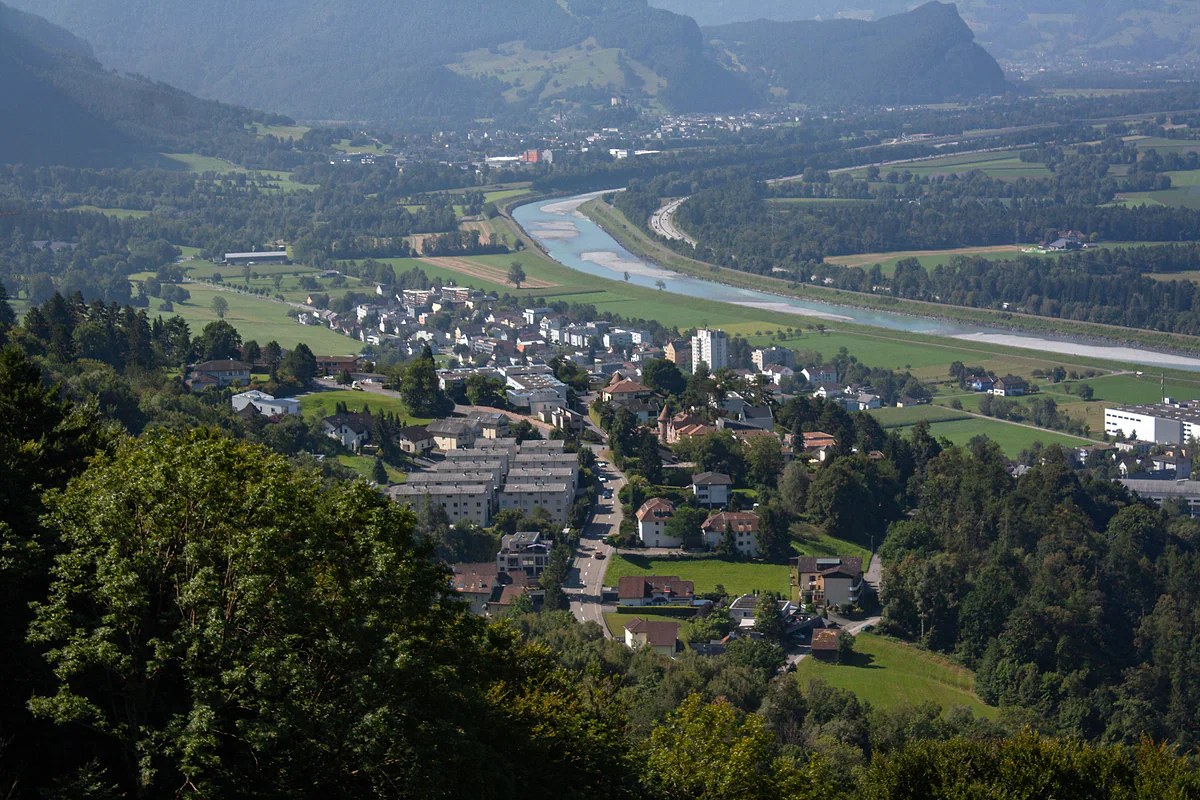
The highest peak belongs to Triesen too
Triesen, the old village among the vines south of Vaduz
Triesen is Liechtenstein's third most populous municipality, with 5,785 residents on 31 December 2025, and lies just south of Vaduz. Its old centre, among vineyards, holds St Mamertus chapel, one of the oldest in the country, and a textile mill from 1863, while its land runs up to the Lawena valley and the Grauspitz, the country's highest point.
In 30 seconds
Full read: 4 min
- Triesen is Liechtenstein's third most populous municipality, with 5,785 residents on 31 December 2025.
- Its old centre has St Mamertus chapel, the Marienkapelle and a listed textile mill from 1863.
- Both chapels open for visitors who ask the council in advance.
- Its land includes the Lawena valley and the Grauspitz, the country's highest point.
I'd see Triesen on foot, not from a car window. I'd climb to the Oberdorf through the vines, look at St Mamertus from outside and ask the council in advance to open it if I wanted the frescoes. With a spare day, I'd spend it in Lawena.

Before you go
What I would keep in mind
-
01 Most beautiful
St Mamertus, on a ledge above the village
A bare stone tower, shingle roofs and mid-15th-century frescoes. The council dates it probably to the 9th century, and the tourist board calls it the oldest chapel in the country.
St Mamertus chapel in Triesen -
02 My tip
Both chapels open if you ask ahead
The council website says St Mamertus and the Marienkapelle open their doors to visitors who request it in advance. I'd email the town hall a few days before.
churches and chapels in Liechtenstein -
03 To save money
The indoor pool is on the pass
The ALL INCLUSIVE Erlebnispass, CHF 25 a day for an adult, covers the indoor pools in Triesen, Balzers and Eschen as well as buses and the Vaduz museums.
the Liechtenstein Adventure Pass -
04 Getting there
Stage 1 of the Liechtenstein Trail runs through
Balzers to Triesenberg, 15.7 km. It passes the old Jenny, Spörry & Cie. mill, the Gasometer and St Mamertus before climbing the hillside.
stage 1 of the Liechtenstein Trail, Balzers to Triesenberg
What I would book
My ranking, scored
What I'd see in Triesen
My own scores out of 10. They weigh what's unique in the country, what you can see without booking, and how much it gives someone coming from Vaduz with half a day.
0 of 5 seen
-
St Mamertus chapel
A tower whose timber dates to 1347, 15th-century frescoes and a raised setting above the village. One of the oldest chapels in Liechtenstein.
8.8 out of 10
-
The Oberdorf and its timber-framed houses
The council talks of a romantic old centre with old houses, vineyards and two chapels. It's the walk that makes the visit.
8.3 out of 10
-
Lawena valley
The country's only high valley that opens straight onto the Rhine. Not an afternoon stroll, but the wildest corner of Triesen's land.
8.2 out of 10
-
Old textile mill and Gasometer
A listed complex from 1863, now with a small stage and the Gasometer arts centre. It tells the story of industrial Liechtenstein.
7.6 out of 10
-
St Gallus parish church
Built 1841 to 1843 and remodelled 1991 to 1994. It keeps the Gothic altarpiece of 1492 that came from St Mamertus.
7.3 out of 10
Triesen is the village most people drive straight through between Vaduz and Balzers, and in my view that’s an error. It has the loveliest old centre in the south of the country, one of its oldest chapels and, if you look at a map, land that climbs from the vineyards to the highest point in Liechtenstein. Here’s how I’d see it in half a day.
Third in the country, and still growing fast
On 31 December 2025 Triesen had 5,785 residents, which puts it third behind Schaan and Vaduz. Provisional figures show it grew 1.5% in 2025, one of the biggest rises of the year. It covers 26.5 km² and its parish church stands at 512 m, at the foot of the slope up to Triesenberg. Just above sits Wangerberg, the Triesenberg hamlet above Triesen, whose people came down here for Mass until 1768.
The name is old and nobody’s quite sure what it means. The Historisches Lexikon records «Trisun» in a register from 1094 to 1101 and dismisses a supposed mention from 1153 as a forgery. The geography is clearer. The village sits on the fan of a huge post-glacial rockfall and, oddly, has no Rhine bridge of its own and no direct link to the Swiss motorway. To cross into Switzerland you go via Vaduz or Balzers.
What would I see in Triesen with half a day?
I’d start in the Oberdorf. The council describes a romantic old centre of old houses, flanked by vines and two stylish chapels, and mentions timber-framed houses on the upper slope that give you a feel for farming life as it was. Up here are the St Gallus parish church, St Mamertus chapel and the Lindenplatz.
St Mamertus is the reason to come. It stands on a ledge above the village at 561 m, with a bare stone tower and shingle roofs. The Lexikon dates the tower’s timber to 1347 and says frescoes from the mid-15th century came to light in 1967 and 1968. The council goes further and dates it probably to the 9th century. The sources don’t agree on which is the country’s oldest chapel, so I’ll call it one of the oldest and leave it there.
Then I’d drop down to the Unterdorf and the Marienkapelle, where a recent restoration uncovered baroque frescoes. A practical point that few people know. According to the council website, both chapels open for visitors who ask in advance, so I’d email the town hall with a few days’ notice.
The mill that changed the village
The other Triesen is the industrial one. In 1863 a cotton weaving mill went up in the Unterdorf and, as the Lexikon puts it, has defined that part of the village ever since. Today it’s a listed complex with a small stage, the Kleinkunstbühne Alte Weberei, and the Gasometer arts centre, which the council opened on the old factory site in 2006. Since 2001 Triesen has also been home to the Literaturhaus Liechtenstein.
St Gallus is worth five minutes too. Built from 1841 to 1843 and reworked between 1991 and 1994, it keeps the Gothic altarpiece of 1492 that came from St Mamertus and a font of Balzers marble dated 1678.
From valley floor to the roof of the country
What I like best about Triesen is what you can’t see from the village. Its land climbs to the Lawena and Wang alps and includes the Valüna alp on the far side of the ridge. The Lawena valley is, according to the Lexikon, the only high valley in the country that opens straight onto the Rhine, and the Grauspitz, at about 2,600 m and the highest point in Liechtenstein, belongs to Triesen as well. It’s not something to improvise, but it shows you that this valley village is really half mountain.
Fitting it into your trip
Triesen lies on the natural route between Vaduz and Balzers, so the easiest way to see it is by bus or on foot from the capital. I’d check the exact line and stop on LIEmobil’s timetable, and remember that the buses don’t take cash. If you’re walking, stage 1 of the Liechtenstein Trail, Balzers to Triesenberg, crosses the village past the old mill, the Gasometer and St Mamertus before climbing the hillside. On a tight budget, the Camping Mittagspitze is here too, 7 km from Vaduz, and I cover it in the youth hostel and campsite in Liechtenstein.
For a wet day, there’s an indoor pool by the school centre, and it’s included in the CHF 25 ALL INCLUSIVE Erlebnispass along with the pools in Balzers and Eschen. For a night out, Triesen also has the Casino Admiral, one of the four I compare in casinos in Liechtenstein.
Triesen in figures
| Figure | Value | Source |
|---|---|---|
| Residents on 31 Dec 2025 | 5,785 | Office of Statistics |
| Area | 26.5 km² | Liechtenstein in Figures 2026 |
| Reference altitude | 512 m | Liechtenstein in Figures 2026 |
| Growth in 2025 | +1.5% (provisional) | Office of Statistics |
| Highest point | Grauspitz, about 2,600 m | Office of Statistics |
The Historisches Lexikon gives 2,599 m for the Grauspitz; the Office of Statistics rounds to 2,600.
The old village, part by part
| Area | What's there |
|---|---|
| Oberdorf | St Gallus parish church, St Mamertus chapel and the Lindenplatz |
| Unterdorf | The Marienkapelle and the 1863 textile mill |
| Säga | Hamlet to the south, at the mouth of the Lawena gorge |
| Mountains | Lawena and Wang alps, plus Valüna in the Samina valley |
From the Historisches Lexikon and Triesen council's website.
Test yourself
True or false?
0/4 Pick before you peek.
-
Triesen has its own bridge across the Rhine into Switzerland.
See the answer
False. It has no Rhine crossing and no direct link to the Swiss A13 motorway, according to the Historisches Lexikon. You cross at Vaduz or Balzers.
-
Liechtenstein's highest point lies within Triesen.
See the answer
True. The Grauspitz, at about 2,600 m, belongs to Triesen. The lowest point in the country, by contrast, is in the Ruggeller Riet in the north.
-
Triesen is the country's most populous municipality.
See the answer
False. It's third, with 5,785 residents. Schaan, on 6,294, and Vaduz, on 6,108, are ahead.
-
Triesen's textile mill dates from 1863.
See the answer
True. It's a listed complex that has shaped the lower village ever since. Today it houses a small stage and the Gasometer arts centre.
- Residents on 31 December 2025
- 5,785
- Tree-ring date of the St Mamertus tower
- 1347
- Year the textile mill was built
- 1863
- The Grauspitz, highest point, in Triesen (rounded)
- 2,600 m
Map
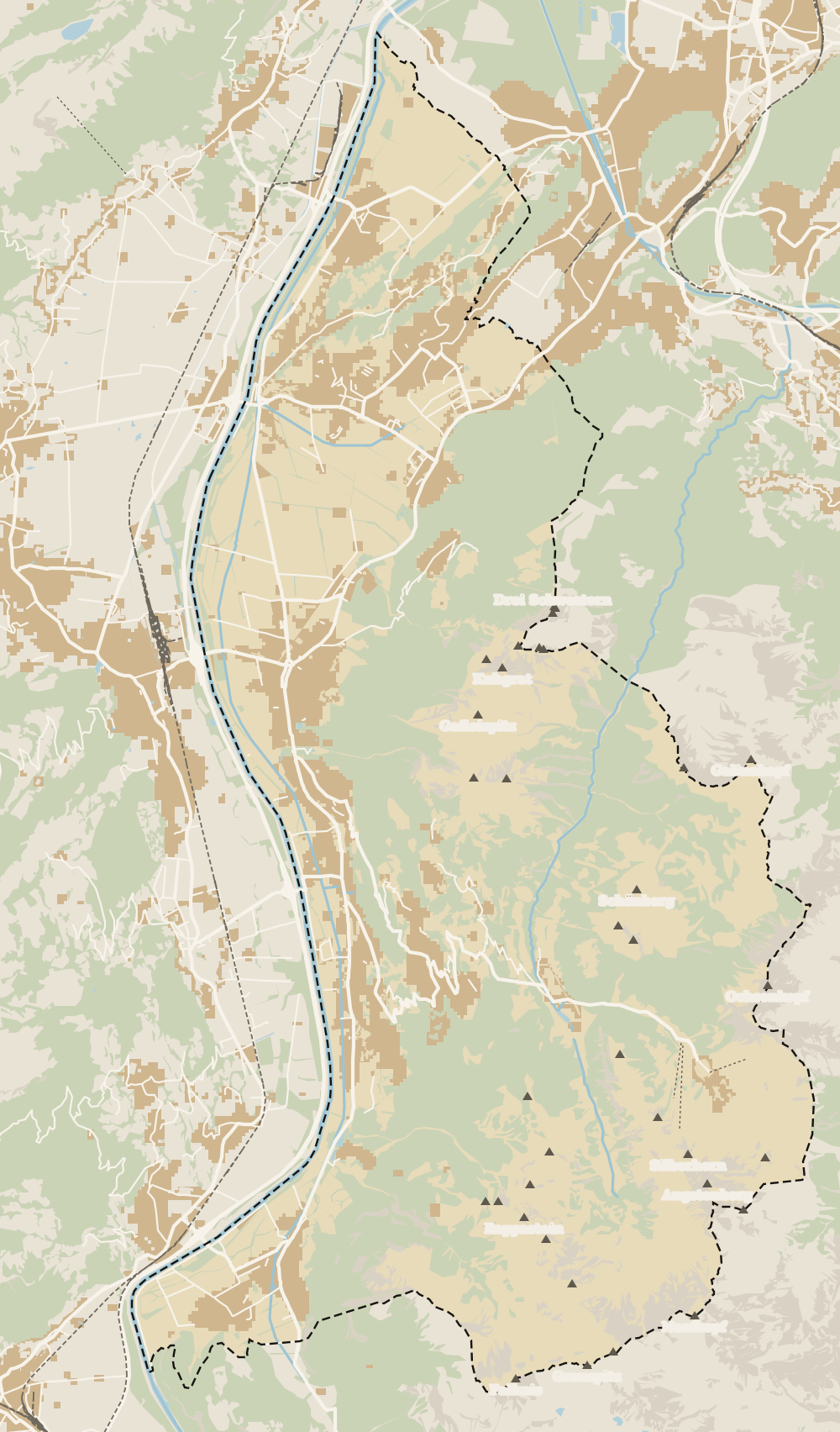
Where Triesen is
The dashed line is the border: Switzerland across the Rhine, Austria to the north and east. Every number opens its guide.
What to see
What to see in Triesen
0 of 168 Liechtenstein guides
Your next stamp
- Triesenberg
- St Mamertus chapel
- Balzers
- Stage 1: Balzers - Triesenberg
- Lawena valley
- Eschen
- Mauren
- Churches and chapels
- Things to do
- One day
- Two days
- Municipalities
- Oberland
- Unterland
- Map
- Vaduz
- Städtle
- Mitteldorf
- Vaduz Castle
- Vaduz Cathedral
- Parliament
- Government Building
- Vaduz Town Hall
- Red House
- Prince's Winery
- Old Rhine Bridge
- Schaan
- Schalun Castle Ruin
- Citytrain
- Walser Museum
- Planken
- Gutenberg Castle
- The Rhine
- Schaan Roman fort
- Dux
- Mäls
- DoMuS
- TAK Theatre
- Castles
- Viewpoints
- Mountains
- Museums
- Kunstmuseum
- Mountain huts
- Hilti Art Foundation
- Pfälzerhütte
- Gafadura hut
- National Museum
- Treasure Chamber
- Postage Stamp Museum
- Kunstraum Engländerbau
- Masescha
- Gaflei
- Nendeln
- Silum
- Rotenboden
- Schaanwald
- Gamprin
- Wangerberg
- Bendern
- Steg
- Ruggell
- Samina valley
- Schellenberg Farmhouse Museum
- Cross-country skiing at Steg
- Küefer-Martis-Huus
- Ruggeller Riet
- Schellenberg
- Hinterschellenberg
- Fürstensteig
- Is it a country?
- Liechtenstein Trail
- Malbun
- Schellenberg castles
- Eschnerberg
- Malbun in summer
- Population
- Lakes
- Sareis
- Size
- Stage 2: Triesenberg - Vaduz
- Malbun Peace Chapel
- Political system
- Stage 3: Vaduz - Nendeln
- Swimming pools
- Language
- Skiing in Malbun
- Stage 4: Nendeln - Ruggell
- Dialect
- Malbun ski pass
- Stage 5: Ruggell - Schaanwald
- Hotels in Malbun
- Stamps
- Princess Gina Trail
- Hut-to-hut Route 66
- Hiking
- Getting there
- In winter
- Weather
- Airport
- Best time to visit
- In summer
- Events
- With kids
- Zurich to Liechtenstein
- National day
- Sargans to Vaduz
- Christmas
- Feldkirch to Vaduz
- By train
- Traditions
- Carnival
- Getting around
- Buses
- Funken Sunday
- Alpine cattle drive
- Driving and vignette
- Parking
- Bike hire
- Cycling
- EU and Schengen
- Entry requirements
- Borders and customs
- The prince
- The princely house
- The flag
- The coat of arms
- The national anthem
- History
- Second World War
- No army
- Facts
- Why so rich?
- Banks and tax haven
- Where to stay
- Hilti
- Hotels in Vaduz
- False teeth
- Hostel and camping
- Rent the country?
- Where to eat
- Restaurants in Vaduz
- Swiss invasions
- Bars and nightlife
- Food
- Käsknöpfle
- Wine
- Casinos
- Adventure Pass
- Rainy days
- Guided tours
- Tourist office
- Day trips
- Passport stamp
- Music festivals
- Phone and roaming
- Currency and payments
- Prices and budget
- Tipping
- Plugs and sockets
- Tap water
- Opening hours
- Public holidays
- Safety
- Accessibility
- With a dog
- Shopping and souvenirs
Frequently asked questions
What is there to do in Triesen, Liechtenstein?
See St Mamertus chapel on its ledge above the village, wander the Oberdorf with its old houses among the vines, visit the Marienkapelle and the 1863 textile mill with the Gasometer arts centre and, with a full day, head up to the Lawena valley.
How many people live in Triesen?
5,785 residents on 31 December 2025, according to the Office of Statistics. It's the third most populous municipality after Schaan and Vaduz.
Can you go inside the chapels in Triesen?
Yes, by arrangement. The council website says St Mamertus and the Marienkapelle open for interested visitors who ask in advance.
Where is Triesen?
In the Oberland, directly south of Vaduz and north of Balzers, at the foot of the slope that climbs to Triesenberg. Across the Rhine to the west is the Swiss municipality of Wartau.
Is there a Rhine bridge at Triesen?
No. The Historisches Lexikon points out that Triesen has no Rhine crossing of its own and no direct link to the Swiss A13 motorway, so you cross into Switzerland at Vaduz or Balzers.
Is Liechtenstein's highest point in Triesen?
Yes, the Grauspitz, at about 2,600 m, lies within Triesen, at the far end of its mountain land. It's a serious mountain, not a walk from the village.
By
Tourism graduate with a master’s in Tourism Management and Planning from the University of Málaga, who has travelled across Europe. He writes every guide from official sources and his own judgement.
Published on . Facts checked on .
Sources
Photos: Lucas Kendall (CC BY-SA 4.0), via Wikimedia Commons.