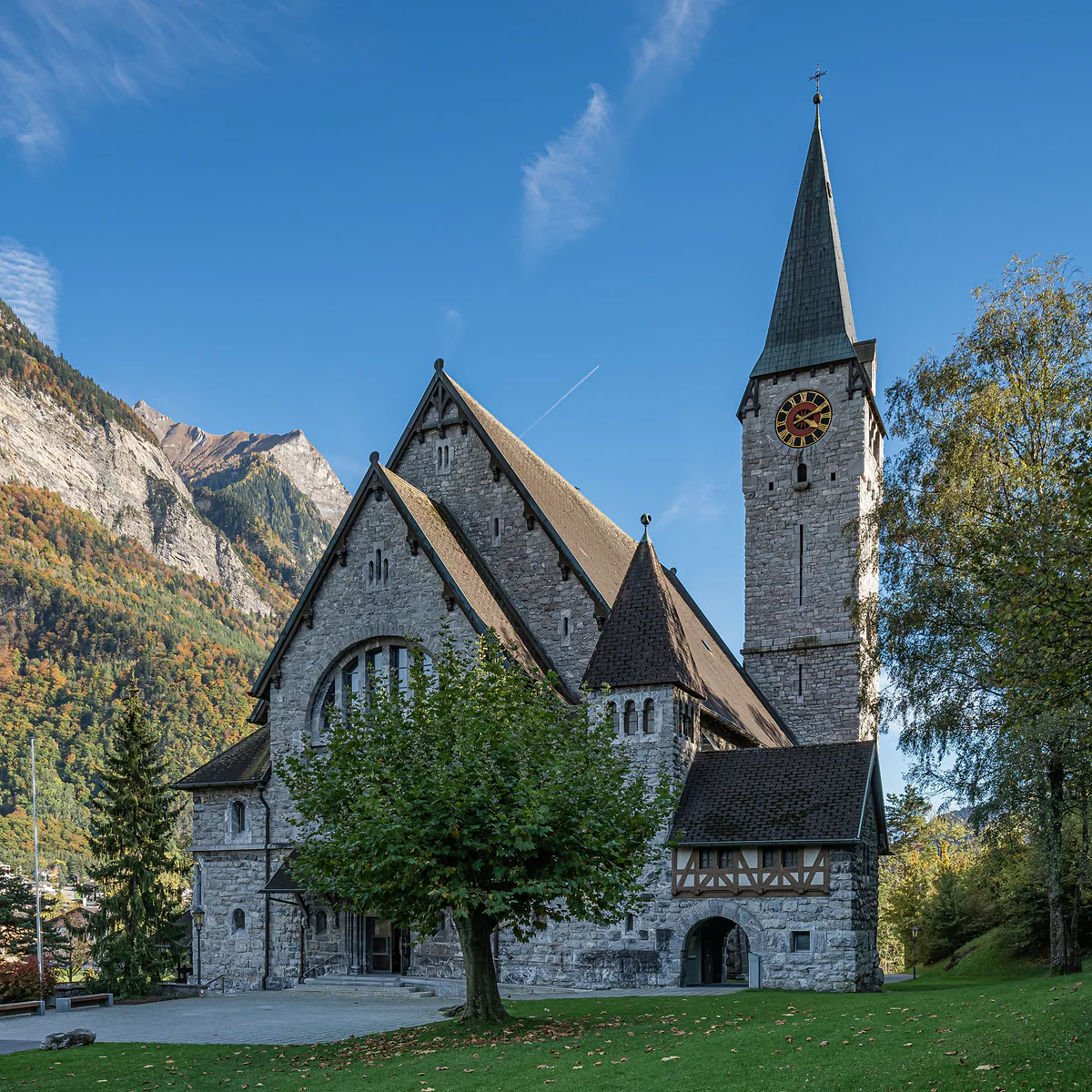
Older than Balzers, say the locals
Mäls, the other half of Balzers by the Rhine
Mäls is the old village that, together with the main settlement, makes up Balzers, at 476 m between the Rhine and the Fläscherberg. It merged with Balzers in the early 20th century but keeps its own character and two chapels, St Peter's from around 1300 with a Gothic altarpiece of about 1516, and baroque Mariahilf, linked by legend to a battle in 1289.
In 30 seconds
Full read: 3 min
- Mäls is the old village that, with the main settlement, makes up Balzers, between the Rhine and the Fläscherberg.
- St Peter's chapel dates from around 1300 and holds a Gothic winged altarpiece from about 1516.
- Mariahilf is baroque, and legend ties it to a battle on 5 January 1289.
- A 1975 footbridge crosses the Rhine into Switzerland where the old bridge used to be.
Mäls is for a quiet hour after Gutenberg. I'd walk down from the castle, see St Peter's and its tower house, then Mariahilf, and if I felt like it I'd cross the Rhine footbridge just for the pleasure of walking into Switzerland.

Before you go
What I would keep in mind
-
01 Most beautiful
St Peter's and the tower house, side by side
The chapel, from around 1300, and the medieval tower house next door were the heart of a lordly estate. The Historisches Lexikon reckons this is the oldest part of the village.
churches and chapels in Liechtenstein -
02 My tip
Watch who builds the taller bonfire
According to the Lexikon, the rivalry between Mäls and Balzers still shows on Funken Sunday, when the two compete over the height of their bonfires.
the Funken Sunday bonfires in Liechtenstein -
03 Getting there
Into Switzerland on a footbridge
In 1975 a footbridge went up where the old Rhine bridge stood until it burnt in 1972. For centuries people crossed here by ferry, until the first bridge of 1871.
the Rhine in Liechtenstein -
04 To save money
Everything in Mäls is free to see
The chapels and village are seen on foot, and Gutenberg's outer bailey, a short walk away, is free all year. The Mälsner Dorf stop on bus line 11 is in the centre.
Gutenberg Castle in Balzers
Almost everyone who comes to Balzers looks up at Gutenberg Castle and leaves. I’m more interested in what lies below, towards the Rhine, because that’s where Mäls is, the old village that merged with Balzers but, according to the Historisches Lexikon, still has a pride of its own. In an hour you can see both its chapels and understand why this corner was a border crossing for centuries.
A village that won’t be swallowed up
Mäls sits at 476 m between the Rhine and the Fläscherberg and since the early 20th century has formed a single built-up area with Balzers. The name is probably Celtic and nobody has fully explained it. It has been linked to a Meilis recorded around 842/43, though it’s unclear whether that meant Mäls or Mels across the Rhine.
What I enjoy is the nuance the Lexikon records. Mäls, which claims to be older than Balzers, keeps a sense of its own identity, especially among older residents, and the rivalry between the two halves still shows on Funken Sunday, when they compete over the height of their bonfires. The earliest traces of settlement in its area date from the 3rd century.
St Peter’s and the tower house, the old heart
The oldest part of the village, according to the Lexikon, is the area around St Peter’s chapel and a medieval tower house from around 1300. Together they were the centre of a lordly estate. The chapel is no earlier than 1300, gained a choir around 1510 and its bell tower in 1578, and has been listed since 1951. For the tourist board, it’s one of Liechtenstein’s oldest churches.
Inside is what makes the stop worthwhile for me, a Gothic winged altarpiece from about 1516, with carved figures of St John the Evangelist, St Peter and St Paul and wings painted on both sides. There’s also a wooden enthroned Virgin from around 1410 or 1420. Its hours aren’t published anywhere official that I know of, so I’d expect to see it from outside and count myself lucky if it’s open.
Mariahilf and the battle of 1289
The other chapel comes with a legend. According to the Lexikon, Mariahilf was supposedly built to commemorate the battle of 5 January 1289 between the Bishop of Chur, Friedrich von Montfort, and his cousin Hugo II of Werdenberg-Heiligenberg. What is documented is a new chapel recorded in 1690 and early 18th-century works that gave it the apse, extra height and its onion-domed tower.
It’s baroque and beautifully complete. There are wooden altars from around 1720 or 1730, stained glass from 1945 and an organ by Silvester Walpen from 1824, bought in 1869. The high altar painting is a copy of Lucas Cranach’s Mariahilf Madonna from Innsbruck Cathedral, which I think is a lovely touch in such a small place. I compare them with the rest of the country’s in churches and chapels in Liechtenstein.
A border crossing with plenty of history
For centuries Mäls was a Rhine crossing. There was a ford, a temporary bridge was laid in winter and, until the first bridge to Trübbach in 1871, a ferry. French troops crossed here on 6 March 1799, and that October 16,000 Russian soldiers under General Suvorov camped in Balzers and Mäls. During the customs union with Austria, from 1852 to 1919, smugglers’ paths into Switzerland started here.
The ground here has been worked for a long time as well. Since 1860, according to the Lexikon, the Altneugut quarry has produced so-called Balzers marble, a limestone that was being carved long before that, as the 1678 font in Triesen’s parish church shows. Mäls got its own schoolhouse in 1838, mains water in 1903 and electricity in 1921.
Today it’s peaceful. The Gagoz bypass took almost all through traffic away in 1968, and in 1975 a footbridge went up where the old bridge had stood until it burnt in 1972. Walking across it is about the simplest way to step into Switzerland, and I cover it with the other crossings in my guide to the Rhine in Liechtenstein.
Pairing it with Gutenberg
The Mälsner Dorf stop on LIEmobil line 11 is the one the castle association recommends for Gutenberg, so Mäls is on your way. I’d go up to Gutenberg Castle first, walk down to St Peter’s and Mariahilf, and catch the bus back from the village centre.
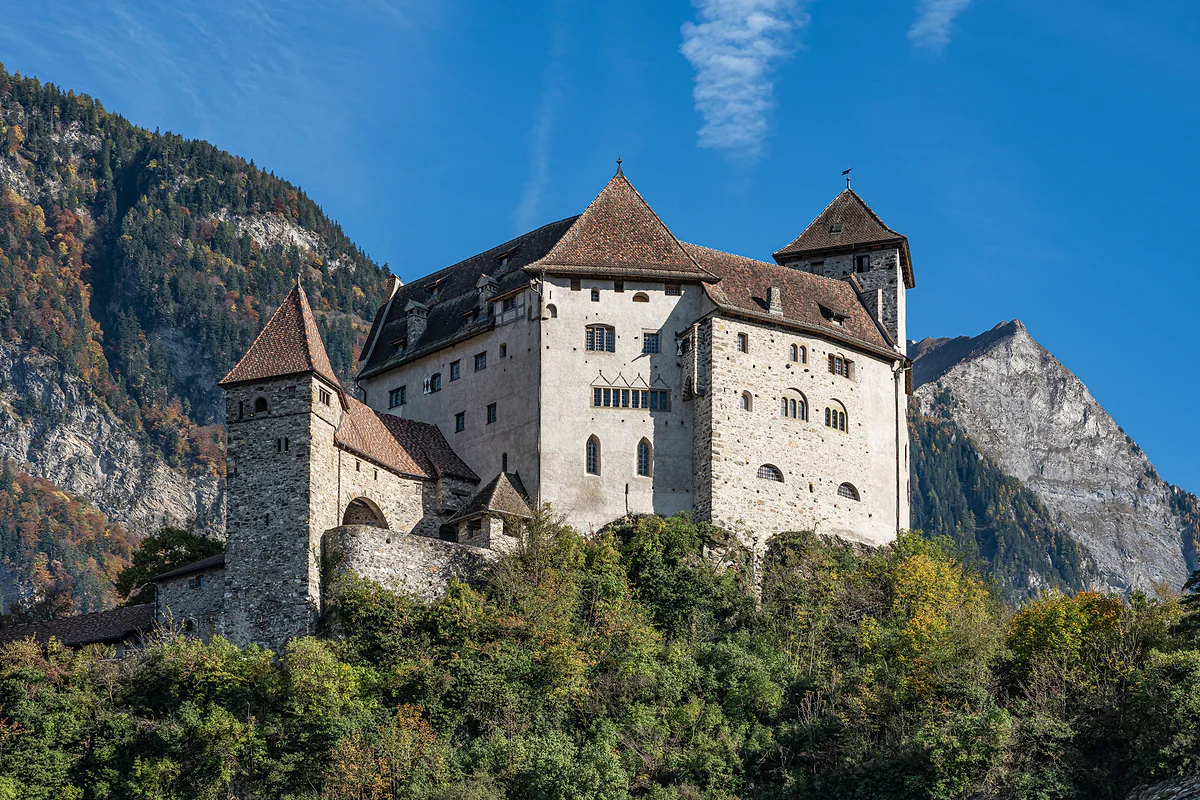
Gutenberg Castle in Balzers, with its towers and white walls on the wooded hill and a rocky peak behind.
The two chapels of Mäls
| Chapel | Date | Highlights |
|---|---|---|
| St Peter's | Around 1300; choir around 1510; tower 1578 | Gothic winged altarpiece from about 1516 and an enthroned Virgin from around 1410/20 |
| Mariahilf | New chapel recorded in 1690; apse and tower early 18th century | Copy of Cranach's Mariahilf Madonna, altars from around 1720/30 and an 1824 organ |
According to the Historisches Lexikon. None of the official sources I've read gives opening hours.
Mäls through time
| Date | What happened |
|---|---|
| 5 Jan 1289 | Battle that Mariahilf commemorates, according to legend |
| 6 Mar 1799 | French troops cross the Rhine at Mäls |
| October 1799 | 16,000 Russian soldiers under Suvorov camp in Balzers and Mäls |
| 1871 | First Rhine bridge to Trübbach |
| 1949 | Present Swiss border after the Ellhorn is ceded |
| 1968 | The Gagoz bypass takes through traffic away |
| 1975 | Footbridge over the Rhine |
Dates from the Historisches Lexikon.
Test yourself
True or false?
0/4 Pick before you peek.
-
The high altar painting in Mariahilf is an original Cranach.
See the answer
False. It's a copy of Lucas Cranach's Mariahilf Madonna, which hangs in Innsbruck Cathedral.
-
In 1799, 16,000 Russian soldiers camped in Balzers and Mäls.
See the answer
True. It was October 1799, under General Suvorov, according to the Historisches Lexikon. In March that year French troops had crossed the Rhine at Mäls.
-
Liechtenstein handed the Ellhorn hill near Mäls to Switzerland.
See the answer
True. Ceding the Ellhorn led in 1949 to a border adjustment from the Rhine to the Würznerhorn, which gives today's line.
-
Mäls and Balzers were always one village.
See the answer
False. Mäls was a hamlet in its own right. The political municipality of Balzers was created in 1808, and the two settlements grew together in the early 20th century.
- Altitude of Mäls
- 476 m
- St Peter's chapel
- c. 1300
- Russian soldiers camped here in 1799
- 16,000
- Footbridge over the Rhine
- 1975
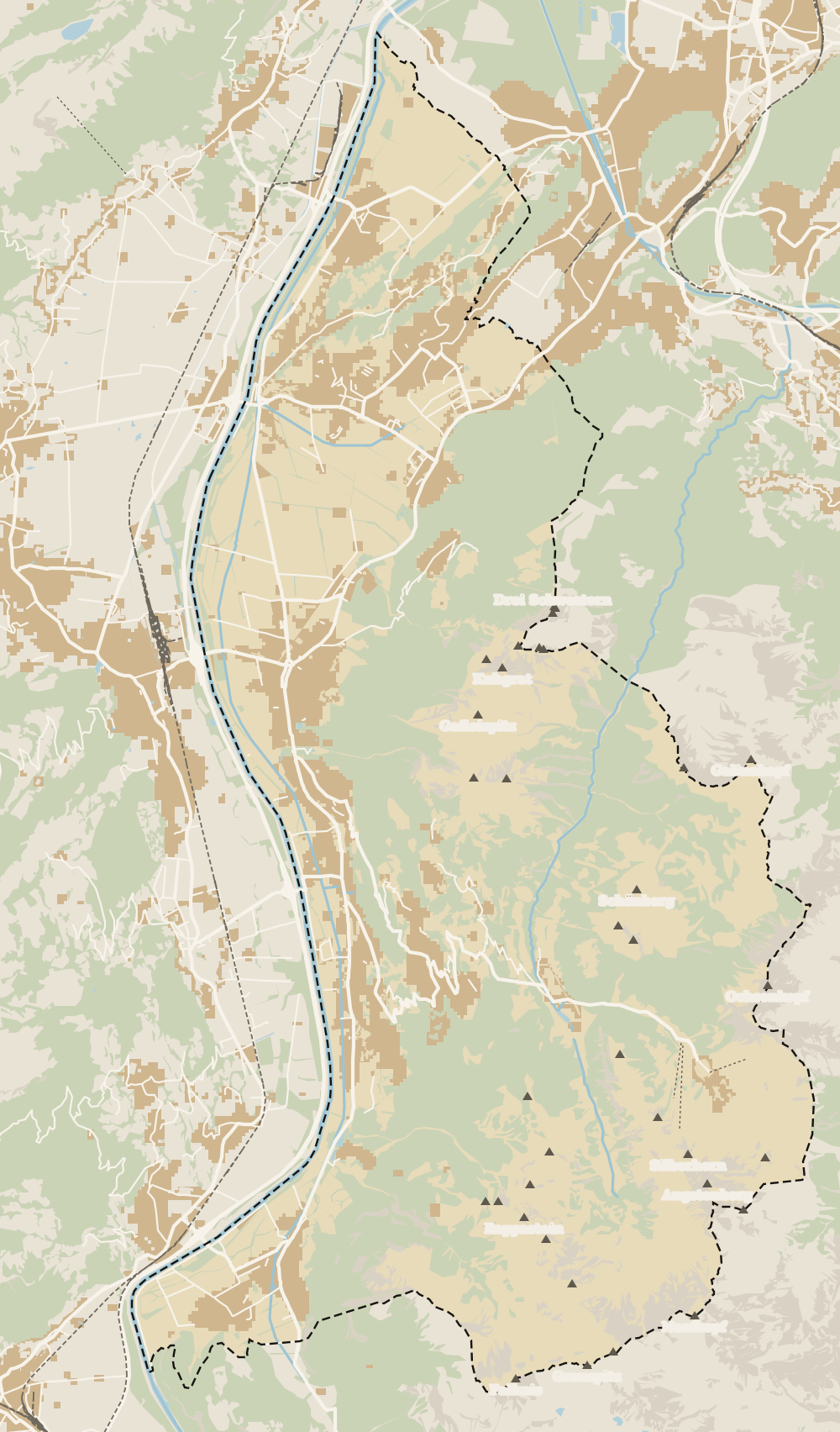
Map
Where Mäls is
The dashed line is the border: Switzerland across the Rhine, Austria to the north and east. Every number opens its guide.
0 of 168 Liechtenstein guides
Your next stamp
- Balzers
- Churches and chapels
- Triesen
- Stage 1: Balzers - Triesenberg
- St Mamertus chapel
- The Rhine
- Schaanwald
- Städtle
- Things to do
- One day
- Two days
- Municipalities
- Oberland
- Unterland
- Map
- Vaduz
- Mitteldorf
- Vaduz Castle
- Vaduz Cathedral
- Parliament
- Government Building
- Vaduz Town Hall
- Red House
- Prince's Winery
- Old Rhine Bridge
- Schaan
- Schalun Castle Ruin
- Citytrain
- Triesenberg
- Walser Museum
- Planken
- Gutenberg Castle
- Schaan Roman fort
- Dux
- Lawena valley
- DoMuS
- TAK Theatre
- Castles
- Viewpoints
- Mountains
- Museums
- Kunstmuseum
- Mountain huts
- Hilti Art Foundation
- Pfälzerhütte
- Gafadura hut
- National Museum
- Treasure Chamber
- Postage Stamp Museum
- Kunstraum Engländerbau
- Eschen
- Masescha
- Gaflei
- Nendeln
- Mauren
- Silum
- Rotenboden
- Gamprin
- Wangerberg
- Bendern
- Steg
- Ruggell
- Samina valley
- Schellenberg Farmhouse Museum
- Cross-country skiing at Steg
- Küefer-Martis-Huus
- Ruggeller Riet
- Schellenberg
- Hinterschellenberg
- Fürstensteig
- Is it a country?
- Liechtenstein Trail
- Malbun
- Schellenberg castles
- Eschnerberg
- Malbun in summer
- Population
- Lakes
- Sareis
- Size
- Stage 2: Triesenberg - Vaduz
- Malbun Peace Chapel
- Political system
- Stage 3: Vaduz - Nendeln
- Swimming pools
- Language
- Skiing in Malbun
- Stage 4: Nendeln - Ruggell
- Dialect
- Malbun ski pass
- Stage 5: Ruggell - Schaanwald
- Hotels in Malbun
- Stamps
- Princess Gina Trail
- Hut-to-hut Route 66
- Hiking
- Getting there
- In winter
- Weather
- Airport
- Best time to visit
- In summer
- Events
- With kids
- Zurich to Liechtenstein
- National day
- Sargans to Vaduz
- Christmas
- Feldkirch to Vaduz
- By train
- Traditions
- Carnival
- Getting around
- Buses
- Funken Sunday
- Alpine cattle drive
- Driving and vignette
- Parking
- Bike hire
- Cycling
- EU and Schengen
- Entry requirements
- Borders and customs
- The prince
- The princely house
- The flag
- The coat of arms
- The national anthem
- History
- Second World War
- No army
- Facts
- Why so rich?
- Banks and tax haven
- Where to stay
- Hilti
- Hotels in Vaduz
- False teeth
- Hostel and camping
- Rent the country?
- Where to eat
- Restaurants in Vaduz
- Swiss invasions
- Bars and nightlife
- Food
- Käsknöpfle
- Wine
- Casinos
- Adventure Pass
- Rainy days
- Guided tours
- Tourist office
- Day trips
- Passport stamp
- Music festivals
- Phone and roaming
- Currency and payments
- Prices and budget
- Tipping
- Plugs and sockets
- Tap water
- Opening hours
- Public holidays
- Safety
- Accessibility
- With a dog
- Shopping and souvenirs
Frequently asked questions
What is Mäls?
The old village that, together with Balzers, forms the municipality of Balzers. It lies at 476 m between the Rhine and the Fläscherberg and has been joined to the main village since the early 20th century.
What is there to see in Mäls?
St Peter's chapel, from around 1300, with its Gothic altarpiece of about 1516 and the medieval tower house next door, and the baroque Mariahilf chapel, with a copy of Cranach's Madonna and an organ from 1824.
Is Mäls older than Balzers?
That's what they say locally. The Historisches Lexikon records that Mäls, which is said to be older than Balzers, keeps a sense of identity of its own, especially among older residents. The earliest traces of settlement in its area date from the 3rd century.
Can you walk into Switzerland from Mäls?
Yes, over the footbridge built in 1975 where the old Rhine bridge stood until it burnt in 1972. Liechtenstein and Switzerland have had no customs border between them since 1924.
How do I get to Mäls?
Take LIEmobil line 11 to the Mälsner Dorf stop, which the Gutenberg Castle association also recommends for the castle. The buses don't take cash.
By
Tourism graduate with a master’s in Tourism Management and Planning from the University of Málaga, who has travelled across Europe. He writes every guide from official sources and his own judgement.
Published on . Facts checked on .
Sources
Photos: A.Savin (FAL); A.Savin (FAL), via Wikimedia Commons.