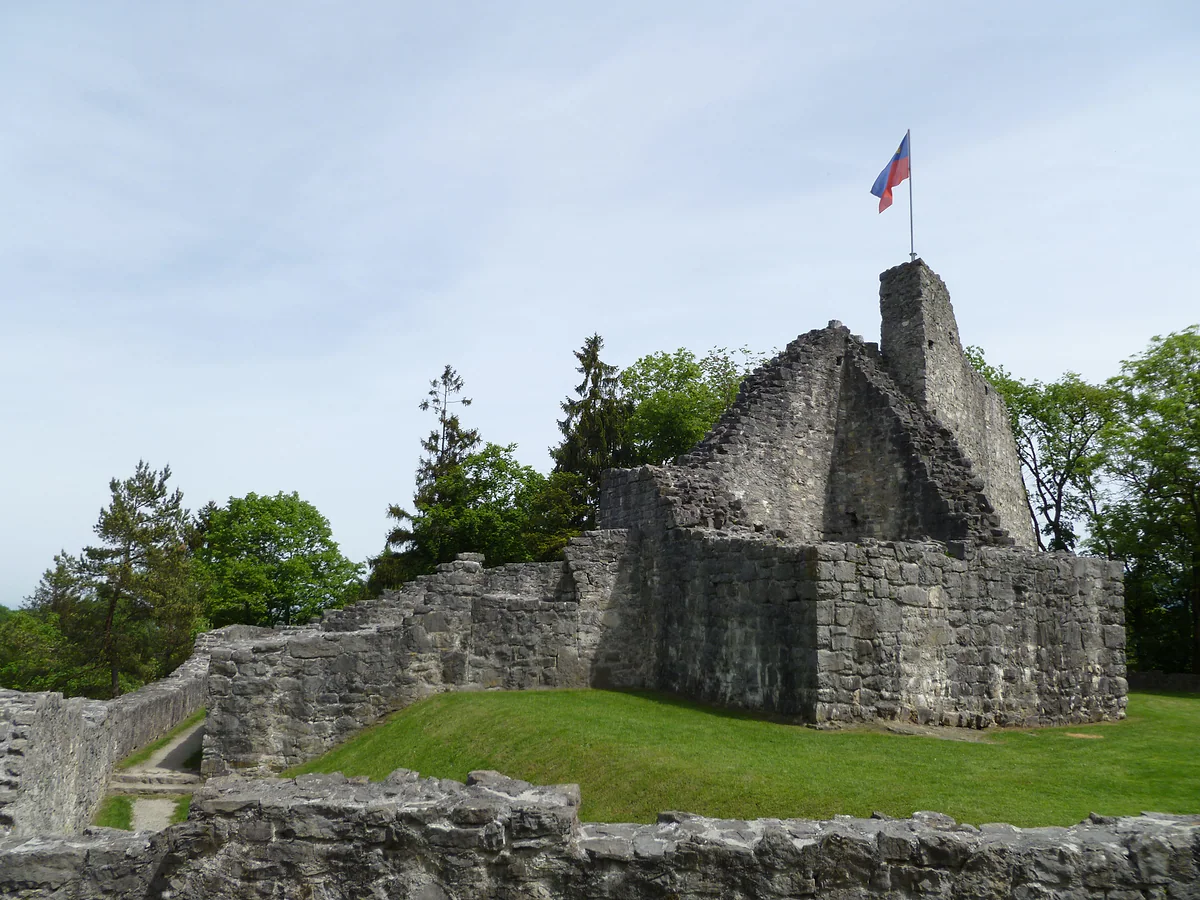
12th-century ruins on the Eschnerberg
The Schellenberg castles, two ruins with swapped names
The Schellenberg castles are two medieval ruins in the municipality of Schellenberg, on top of the Eschnerberg in northern Liechtenstein. The lords of Schellenberg built them from the late 12th century to guard the road to Italy. The upper one, at 668 metres, is the more complete and a short walk away; the lower one, at 595 metres, has a reconstructed bread oven.
In 30 seconds
Full read: 4 min
- They're two medieval ruins on top of the Eschnerberg, in Schellenberg.
- The lords of Schellenberg built them from the late 12th century.
- The Obere Burg, at 668 m, is the more complete; the Untere Burg, at 595 m, has a rebuilt oven.
- They've belonged to the Historischer Verein since 1956 and are seen on foot, in the open air.
I'd do both on one walk, the upper one first because it's the one that impresses, then the lower one on the way back down towards the church. A good hour is plenty. If it's the first or last Sunday of the month between April and October, I'd finish at the village's rural museum, which sits between the two.

Before you go
What I would keep in mind
-
01 Most beautiful
The upper one is the one to see
The Obere Burg keeps remains of its shield wall, keep, great hall and cistern, guarded to the south by a broad ditch. The tourist board singles it out as one of the country's favourite outings.
-
02 My tip
Many maps have the names the wrong way round
The upper castle was called «Alt» and the lower «Neu», and in the 18th century the names got swapped. Archaeology sorted it out, but OpenStreetMap still labels the upper one Neu-Schellenberg.
-
03 To save money
Open-air ruins
Neither the tourist board nor the Historisches Lexikon gives them opening hours or a price. They're ruins in the hillside woods that you see on a walk, as part of the last stage of the Liechtenstein Trail.
stage 5 of the Liechtenstein Trail, Ruggell to Schaanwald -
04 Getting there
Take route 33 up
LIEmobil route 33 climbs from Mauren to Schellenberg. The Obere Burg is about 700 metres north-east of the parish church and the Untere Burg about 400 metres north.
Liechtenstein's buses
What I would book
Two ruins on top of an isolated hill, a few hundred metres apart, with views over the Rhine valley and into Austria. The Schellenberg castles don’t have the fame of Vaduz or the silhouette of Gutenberg, but to me they’re the most rewarding ruins in the country, because you walk up to them, you can make sense of what you’re looking at and there’s hardly anyone about.
The lords who named a lordship
The lords of Schellenberg settled on the Eschnerberg before 1180 and from the late 12th century built their two castles here to watch over the road to Italy. In 1317 Marquard of Schellenberg sold them with all their rights to the counts of Werdenberg-Heiligenberg, and they passed through the Montfort-Tettnangs, the Brandis, the Sulz and the Hohenems families before reaching the House of Liechtenstein in 1699, along with the lordship. So it was the lords who gave their name to the territory, not the other way round, and that lordship is today’s Unterland. The village they stand in is covered on Schellenberg.
In the early 16th century at least one was still standing, because in 1505 Ludwig von Brandis promised to keep a Schellenberg castle open to Austria in time of war. By 1616 the Hohenems chronicle described them as broken. Their fate changed in 1956, when Prince Franz Josef II handed them to the Historischer Verein, and the society set about digging and consolidating both sites.
Why are the names the wrong way round?
This is my favourite thing about the pair. The upper castle was originally the old one, Alt-Schellenberg, and the lower one the new, Neu-Schellenberg, and excavation has confirmed that’s right. But in the 18th century someone swapped the names, and for a long time the upper one was taken to be the newer. The archaeologist Jakob Bill suggested simply calling them the Obere Burg and Untere Burg, upper and lower, and that’s how they’re known today. The mistake lives on in OpenStreetMap, which still labels the upper ruin Neu-Schellenberg.
The Obere Burg, up top
It stands about 700 metres north-east of the parish church, at 668 metres. It’s first recorded in 1348, and David Beck excavated and conserved it between 1960 and 1964. The layout is triangular, protected to the south by a wide ditch and a drystone wall, and it keeps remains of the outer ward, the shield wall, the keep, the great hall and other buildings, as well as the cistern.
Beck attributed the core walls and part of the curtain to the first phase, in the late 12th century. Burn layers have been linked to the Appenzell War of 1405, and the finds run from before the mid-12th century to the 16th, mostly from the 13th and 14th. The tourist board presents it as one of the country’s favourite outings, reached on a short walk.
The Untere Burg, lower down
It lies about 400 metres north of the church, at 595 metres, and is first recorded in 1364. Jakob Bill excavated it between 1978 and 1980. Part of the keep in the north-east, the curtain wall with rooms built against it and an outwork beyond a ditch to the south-west were conserved, and a bread oven was rebuilt inside. The building changes that could be dated run from the second half of the 13th century to the 15th, and there’s no trace here of the 1405 fire. Prehistoric objects turned up on the same knoll, though no signs of a settlement.
Before the castles
The hill was lived on long before the lords of Schellenberg. The Lexikon says Bronze Age remains turned up on the Untere Burg’s knoll and on the nearby Borscht, where pits and hut hearths were found, and that the settlements by both hills stayed in use in later periods because they were so well protected. The medieval lords didn’t invent the spot, they inherited it.
How to see them
They’re open-air ruins and no official source gives them opening hours or a price. I’d take route 33 up to Schellenberg, head to the upper ruin first and then drop down to the lower one, a good hour without rushing. Between the two sits the village’s rural museum, open two Sundays a month from April to October, which I cover on the Schellenberg farmhouse museum.
Both ruins also lie on the historic ridge path of the Eschnerberg and on stage 5 of the Liechtenstein Trail, which climbs up from the Ruggeller Riet. If you’re curious about the country’s other castles, from Vaduz to Gutenberg, I compare them on castles in Liechtenstein.
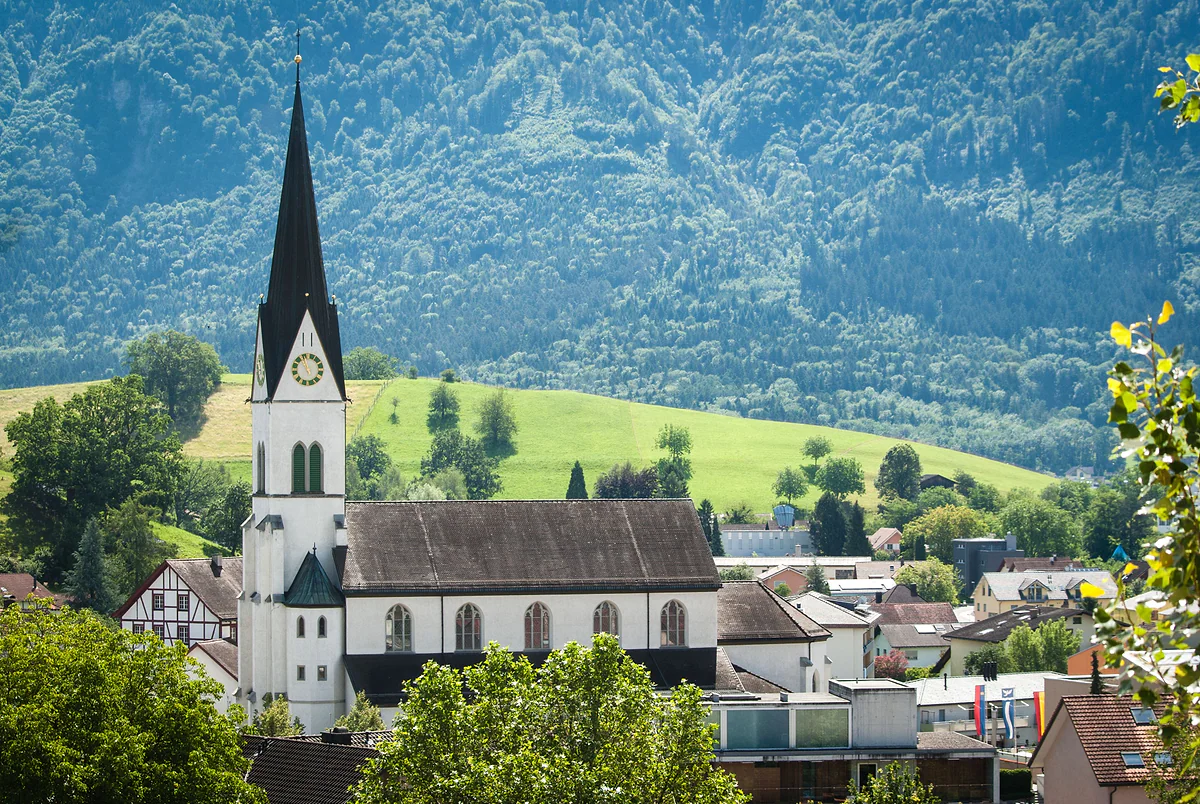
St Martin Church in Eschen, with its black spire, among houses and trees with the green mountain behind.
The two ruins side by side
| Fact | Obere Burg (upper) | Untere Burg (lower) |
|---|---|---|
| Altitude | 668 m | 595 m |
| Where | About 700 m north-east of the church | About 400 m north of the church |
| First recorded | 1348 | 1364 |
| Excavated | 1960-64, David Beck | 1978-80, Jakob Bill |
| What you see | Ditch, outer ward, shield wall, keep, hall, cistern | Part of the keep, curtain wall with rooms, rebuilt oven, outwork |
| Original name | Alt-Schellenberg | Neu-Schellenberg |
Historisches Lexikon, entry «Schellenberg (Burgen)». The names «alt» and «neu» were swapped in the 18th century.
Who owned the castles
| From | Owner |
|---|---|
| Late 12th century | Lords of Schellenberg |
| 1317 | Counts of Werdenberg-Heiligenberg |
| 1412 | Count Wilhelm of Montfort-Tettnang |
| 1437 | Barons of Brandis |
| 1507 | Counts of Sulz |
| 1613 | Counts of Hohenems |
| 1699 | House of Liechtenstein |
| 1956 | Historischer Verein für das Fürstentum Liechtenstein |
Historisches Lexikon, entry «Schellenberg (Burgen)».
Test yourself
True or false?
0/3 Pick before you peek.
-
The Obere Burg is older than the Untere Burg.
See the answer
True. Its excavator dated the first building work to the late 12th century, and the Lexikon accepts that the upper castle was originally the old one, Alt-Schellenberg.
-
The Schellenberg castles were destroyed in the Appenzell War of 1405.
See the answer
False. The Obere Burg has burn layers linked to that war, but in 1505 at least one was still in use. By 1616 they were described as broken, and the Untere Burg shows no sign of the 1405 fire.
-
The castles still belong to the princely family.
See the answer
False. Prince Franz Josef II gave them in 1956 to the Historischer Verein, the country's historical society.
- Altitude of the Obere Burg
- 668 m
- Altitude of the Untere Burg
- 595 m
- Already described as broken
- 1616
- Given to the Historischer Verein
- 1956
Map
Where Schellenberg castles is
The dashed line is the border: Switzerland across the Rhine, Austria to the north and east. Every number opens its guide.
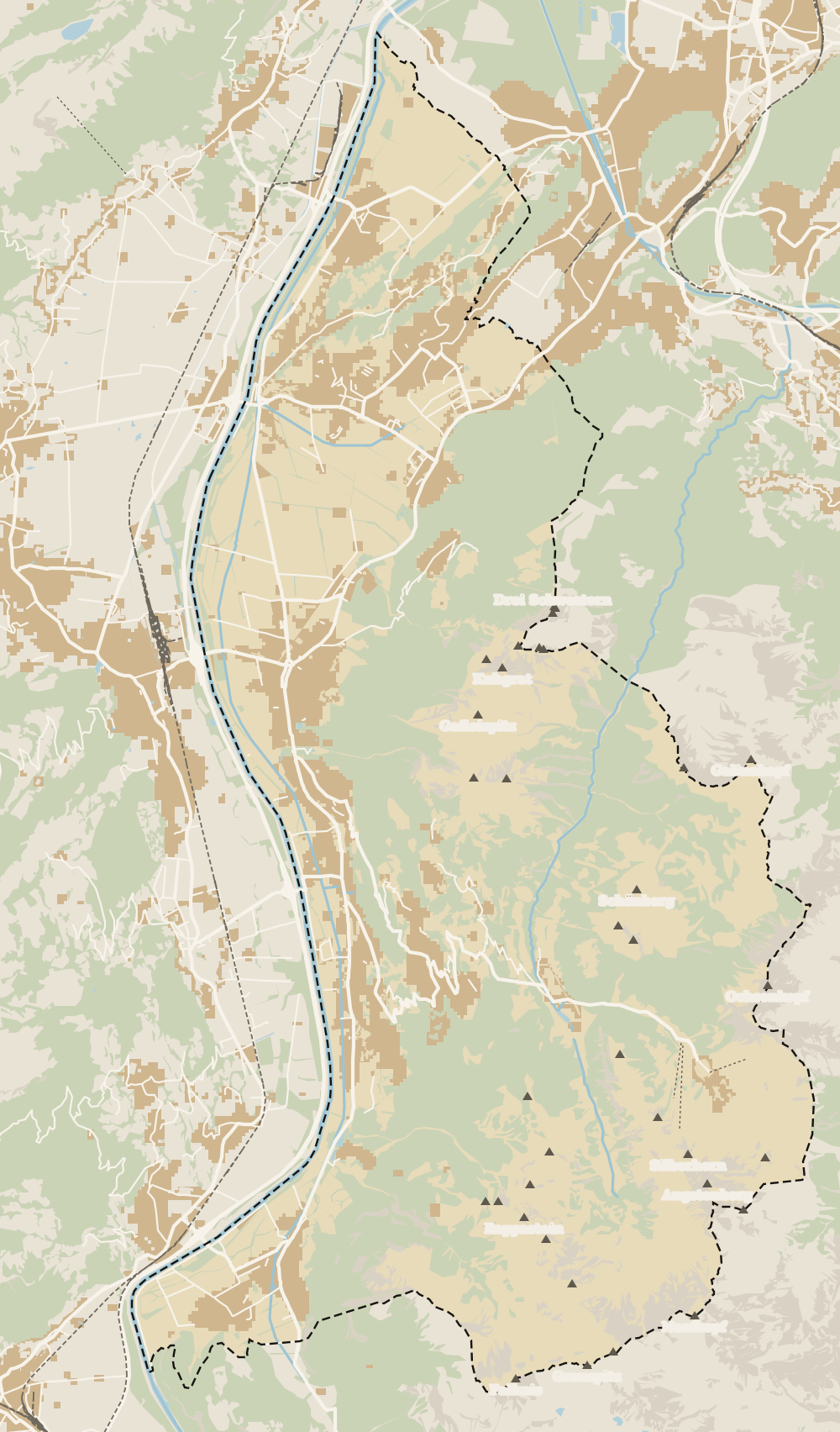 1Schellenberg Farmhouse Museum 2Schellenberg 3Hinterschellenberg 4Schellenberg castles
 Map data © OpenStreetMap contributors (ODbL)
0 of 168 Liechtenstein guides
Your next stamp
- Schalun Castle Ruin
- Eschnerberg
- Schellenberg
- Stage 2: Triesenberg - Vaduz
- Castles
- Unterland
- Two days
- Schellenberg Farmhouse Museum
- Things to do
- One day
- Municipalities
- Oberland
- Map
- Vaduz
- Städtle
- Mitteldorf
- Vaduz Castle
- Vaduz Cathedral
- Parliament
- Government Building
- Vaduz Town Hall
- Red House
- Prince's Winery
- Old Rhine Bridge
- Schaan
- Balzers
- Citytrain
- Triesen
- Triesenberg
- Walser Museum
- Planken
- Gutenberg Castle
- The Rhine
- Schaan Roman fort
- Dux
- St Mamertus chapel
- Lawena valley
- Mäls
- DoMuS
- TAK Theatre
- Churches and chapels
- Viewpoints
- Mountains
- Museums
- Kunstmuseum
- Mountain huts
- Hilti Art Foundation
- Pfälzerhütte
- Gafadura hut
- National Museum
- Treasure Chamber
- Postage Stamp Museum
- Kunstraum Engländerbau
- Eschen
- Masescha
- Gaflei
- Nendeln
- Mauren
- Silum
- Rotenboden
- Schaanwald
- Gamprin
- Wangerberg
- Bendern
- Steg
- Ruggell
- Samina valley
- Cross-country skiing at Steg
- Küefer-Martis-Huus
- Ruggeller Riet
- Hinterschellenberg
- Fürstensteig
- Is it a country?
- Liechtenstein Trail
- Malbun
- Malbun in summer
- Population
- Stage 1: Balzers - Triesenberg
- Lakes
- Sareis
- Size
- Malbun Peace Chapel
- Political system
- Stage 3: Vaduz - Nendeln
- Swimming pools
- Language
- Skiing in Malbun
- Stage 4: Nendeln - Ruggell
- Dialect
- Malbun ski pass
- Stage 5: Ruggell - Schaanwald
- Hotels in Malbun
- Stamps
- Princess Gina Trail
- Hut-to-hut Route 66
- Hiking
- Getting there
- In winter
- Weather
- Airport
- Best time to visit
- In summer
- Events
- With kids
- Zurich to Liechtenstein
- National day
- Sargans to Vaduz
- Christmas
- Feldkirch to Vaduz
- By train
- Traditions
- Carnival
- Getting around
- Buses
- Funken Sunday
- Alpine cattle drive
- Driving and vignette
- Parking
- Bike hire
- Cycling
- EU and Schengen
- Entry requirements
- Borders and customs
- The prince
- The princely house
- The flag
- The coat of arms
- The national anthem
- History
- Second World War
- No army
- Facts
- Why so rich?
- Banks and tax haven
- Where to stay
- Hilti
- Hotels in Vaduz
- False teeth
- Hostel and camping
- Rent the country?
- Where to eat
- Restaurants in Vaduz
- Swiss invasions
- Bars and nightlife
- Food
- Käsknöpfle
- Wine
- Casinos
- Adventure Pass
- Rainy days
- Guided tours
- Tourist office
- Day trips
- Passport stamp
- Music festivals
- Phone and roaming
- Currency and payments
- Prices and budget
- Tipping
- Plugs and sockets
- Tap water
- Opening hours
- Public holidays
- Safety
- Accessibility
- With a dog
- Shopping and souvenirs
Frequently asked questions
Can you visit the Schellenberg castles?
Yes, they're open-air ruins on the Eschnerberg. The tourist board says the Obere Burg is a short walk away, and no official source lists opening hours or an entry charge.
What's the difference between the Obere and Untere Burg?
The Obere Burg is higher, at 668 metres, older and better preserved. The Untere Burg, at 595 metres, is smaller and has a reconstructed oven inside its walls.
Who built the Schellenberg castles?
The lords of Schellenberg, from the late 12th century, to secure the through route to Italy. In 1317 Marquard of Schellenberg sold them along with the lordship.
Why are Alt and Neu Schellenberg the wrong way round?
In the 18th century the names were swapped and the upper castle came to be called the new one when it was the old. Excavations cleared it up, and today they're known as the Obere and Untere Burg, terms coined by archaeologist Jakob Bill.
How do you get to the Schellenberg ruins?
Take bus route 33 to Schellenberg and walk from the church, about 700 metres to the upper castle. The fifth stage of the Liechtenstein Trail passes both.
What happened to the Schellenberg castles?
The Hohenems chronicle already described them as broken in 1616. After centuries as ruins, Prince Franz Josef II gave them in 1956 to the country's historical society, which excavated and stabilised them.
By
Tourism graduate with a master’s in Tourism Management and Planning from the University of Málaga, who has travelled across Europe. He writes every guide from official sources and his own judgement.
Published on . Facts checked on .
Sources
Photos: SchuetzeZH (CC BY-SA 4.0); Clemens v. Vogelsang from Liechtenstein (CC BY 2.0), via Wikimedia Commons.