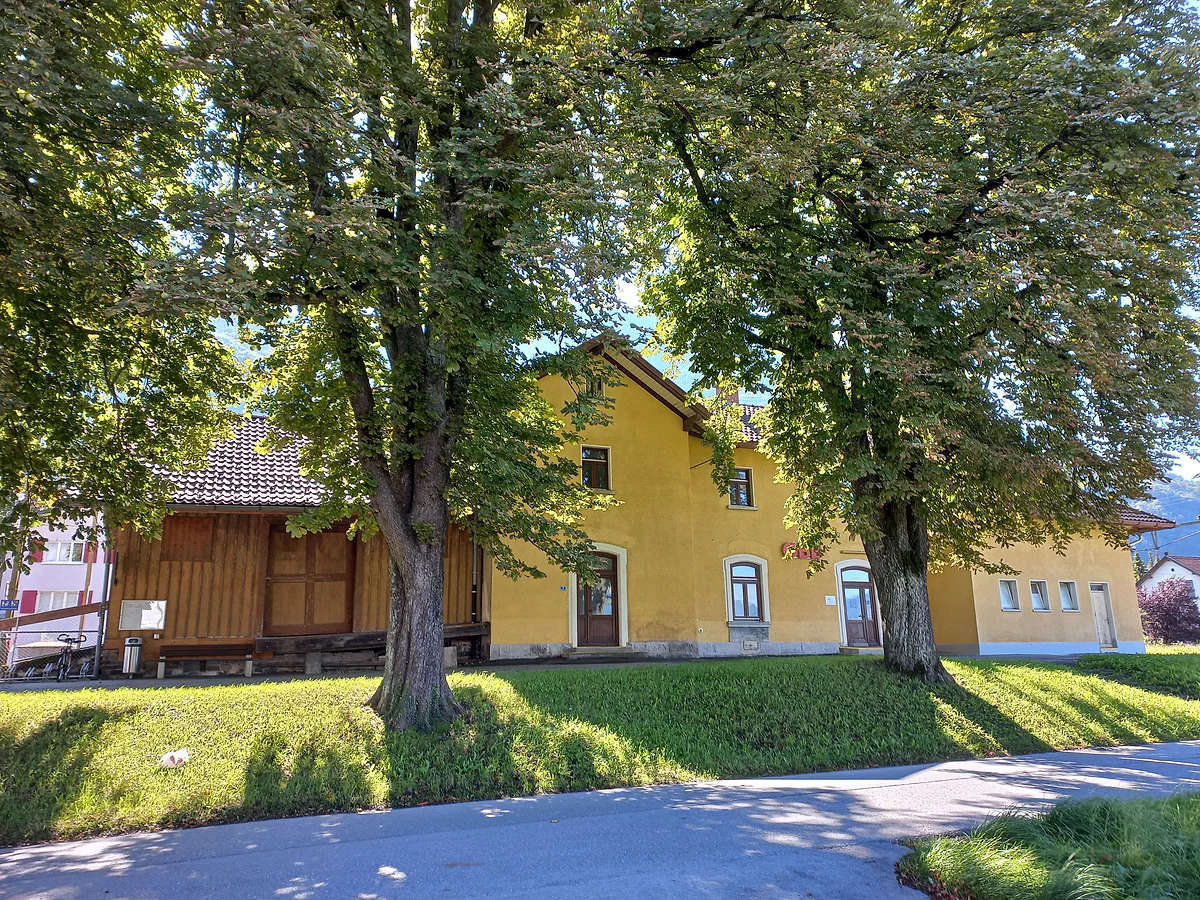
Eschen's hamlet below the Drei Schwestern
Nendeln, a hamlet on the old Roman road
Nendeln is a hamlet in the municipality of Eschen, in Liechtenstein's Unterland, at the foot of the Drei Schwestern massif. It has one of the country's three railway stops, the foundations of a Roman villa built around the mid-2nd century, and the chapel of St Sebastian and St Roch, rebuilt in 1935. Two stages of the Liechtenstein Trail start or finish here.
In 30 seconds
Full read: 3 min
- Nendeln is a hamlet of Eschen, in the Unterland, at the foot of the Drei Schwestern.
- It has one of the country's three railway stops, on the Feldkirch-Buchs line.
- Above the school you can see the foundations of a 2nd-century Roman villa.
- St Sebastian's chapel, from 1935, keeps a crucifix from 1639.
Nendeln is really a well-used place to pass through. If you arrive or leave on foot along the Liechtenstein Trail, I'd take the five minutes up to the Roman villa above the school and pop into St Sebastian's to see the 1639 crucifix. That covers the hamlet's story.

Before you go
What I would keep in mind
-
01 Most beautiful
A Roman house facing the Rhine
The Nendeln villa had its portico facing north-west over the Rhine valley, and in its final phase a bath heated from under the floor was added. Its foundations are still visible above the school.
-
02 Getting there
Check the train before you go
Nendeln is one of the three ÖBB stops in the country, but the open timetable shows no trains between September and November 2026. I'd take bus 14, which links Vaduz, Schaan, Nendeln and Feldkirch.
Liechtenstein by train -
03 My tip
Where the stages hand over
Stage 3 of the Liechtenstein Trail finishes in Nendeln after passing the Roman villa, and stage 4 leaves from the station towards Eschen, Bendern and Ruggell.
stage 4 of the Liechtenstein Trail, Nendeln to Ruggell -
04 To save money
An e-bike from CHF 2
Nendeln has had a LIEbike station since 2024. Half an hour costs CHF 2 and a day CHF 20, and on the flat you'll reach Eschen or Schaan without breaking a sweat.
bike hire in Liechtenstein
What I would book
Nendeln is one of those places almost everyone passes straight through, by train, by bus or on foot along the Liechtenstein Trail. I think it deserves ten minutes more, because in a few streets it packs a Roman villa, a chapel born of a vow against the plague and the station that connected the north with the wider world in 1872.
A hamlet below the Drei Schwestern
Nendeln belongs to the municipality of Eschen and sits on a fan of scree at the foot of the Drei Schwestern massif, separated from the village by slightly lower ground, at 438 metres, crossed by the Esche stream. It first appears in writing in 1395 as «Nendlen», and the Historisches Lexikon thinks the name is Celtic, from nantu-ialo, roughly a clearing in the valley.
Its long, strung-out shape comes from the road. The Roman road from Bregenz to Milan ran through here, later becoming the imperial route from Lindau to Milan. Two inns grew up beside it, the «Engel», mentioned around 1660, and the «Löwen», around 1720, both living off the carrying trade. Between 1821 and 1834 Nendeln was also a customs and toll post.
What’s left of the Roman villa?
The oldest finds in Nendeln are Iron Age, but the real draw is the Roman villa. It was built around the middle of the 2nd century at the spot now called «Im Feld» and abandoned at the end of the 3rd, judging by the coins found there. The main house measured roughly 17 by 23 metres, had its portico facing the Rhine valley and, in its third phase, a bath with a hypocaust, the Roman underfloor heating.
It was first excavated between 1893 and 1896, and a fresh dig in 1973-75 revealed a small outbuilding and a farm building. Eschen municipality says the foundations can be seen above the primary school. Don’t expect a museum, it’s a patch of low walls, but if Roman Liechtenstein appeals I’d pair it with the Roman fort at Schaan, which is later and larger. The Unterland’s other major Roman remains are at Schaanwald.
The plague chapel
In 1639, a year of plague and war, a local man, Wolf Senti, and his wife, Maria Öhri, paid for a chapel dedicated to the Virgin, St Sebastian and St Roch, the saints people prayed to against epidemics. In 1694 the villagers set up a St Sebastian confraternity, and the Lexikon says its feast, the «Brudertag», is still kept as a village holiday on the Monday after 20 January.
The chapel you see today isn’t that one. The new building was consecrated on 10 November 1935, a little to the north, and the old one came down in 1941 to widen the road. Inside hangs the original chapel’s crucifix from 1639, and that’s what would get me through the door.
Pottery, trains and a Hilti warehouse
Nendeln always had an industrious streak, thanks to the streams tumbling down the slope. There was a sawmill, an oil mill and a brickworks. In 1836, opposite the lord’s brickworks, Albert Philipp Schädler opened a pottery that the Lexikon considers Liechtenstein’s first sizeable business, and the building is still part of the Schaedler ceramics firm. I haven’t found any official information about visits, so I’m not suggesting it as a stop.
The Feldkirch-Buchs line has run through since 1872 with its own station, and Nendeln is now one of the country’s three stops, alongside Forst Hilti and Schaan-Vaduz. Hilti, the big Schaan company, built a logistics centre here in 2005-07 on buildings once used by an American publisher. The rail details, with the warning about autumn 2026, are on getting to Liechtenstein by train.
Nendeln on foot
If you’re walking the country, Nendeln is a hinge. Stage three of the Liechtenstein Trail comes up from Vaduz via Schaan, the Dux tower and Planken, and ends here after dropping down to the Roman villa. Stage four leaves the station for Eschen, Bendern, the Grossabünt bathing lake and Ruggell. That second one, the flattest of the lot, is on stage 4 of the Liechtenstein Trail.
To get around without the train, bus 14 links Vaduz, Schaan, Nendeln and Feldkirch, and the N2 night bus also calls here. Since 2024 there’s been a LIEbike station too, LIEmobil’s shared e-bikes.
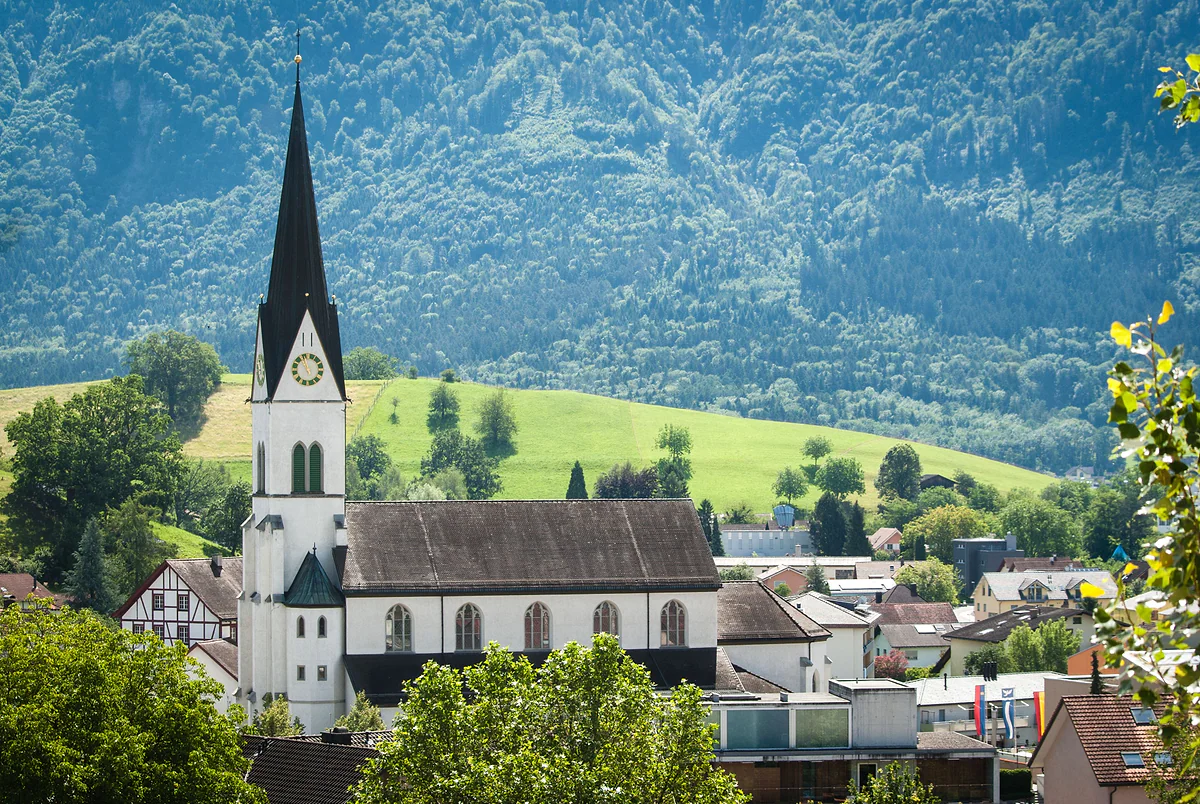
St Martin Church in Eschen, with its black spire, among houses and trees with the green mountain behind.
Nendeln through time
| Date | What happened |
|---|---|
| 2nd century | The Roman villa is built at the spot called «Im Feld» |
| Late 3rd century | The villa is abandoned |
| 1395 | First written record, as «Nendlen» |
| 1639 | First chapel of St Sebastian and St Roch, in a plague year |
| 1836 | Albert Philipp Schädler's pottery workshop opens |
| 1872 | The Feldkirch-Buchs railway arrives, with a station |
| 1935 | Today's chapel is consecrated |
Historisches Lexikon, entries «Nendeln», «Römische Villen» and «Kapelle St. Sebastian».
Getting to Nendeln
| How | Details |
|---|---|
| Train | Stop on the ÖBB Feldkirch-Buchs line; check the service on oebb.at |
| Bus | Route 14 Vaduz-Schaan-Nendeln-Feldkirch; night bus N2 |
| Bike | LIEbike station, CHF 2 per half hour |
| On foot | End of stage 3 and start of stage 4 of the Liechtenstein Trail |
LIEmobil and ÖBB timetable 430. The open timetable shows no trains at Nendeln between September and November 2026.
Test yourself
True or false?
0/3 Pick before you peek.
-
Nendeln is one of Liechtenstein's municipalities.
See the answer
False. It's a hamlet within the municipality of Eschen. Liechtenstein has eleven municipalities and Nendeln isn't one of them.
-
The Nendeln Roman villa was first excavated in the 19th century.
See the answer
True. It was dug between 1893 and 1896, and a second campaign in 1973-75 uncovered two further buildings.
-
The St Sebastian's chapel you see today dates from 1639.
See the answer
False. The 1639 chapel was pulled down in 1941 to widen the road. Today's was consecrated on 10 November 1935 and keeps the old one's crucifix.
- Roman villa built
- 2nd c.
- First record of Nendeln
- 1395
- Railway arrives
- 1872
Map
Where Nendeln is
The dashed line is the border: Switzerland across the Rhine, Austria to the north and east. Every number opens its guide.
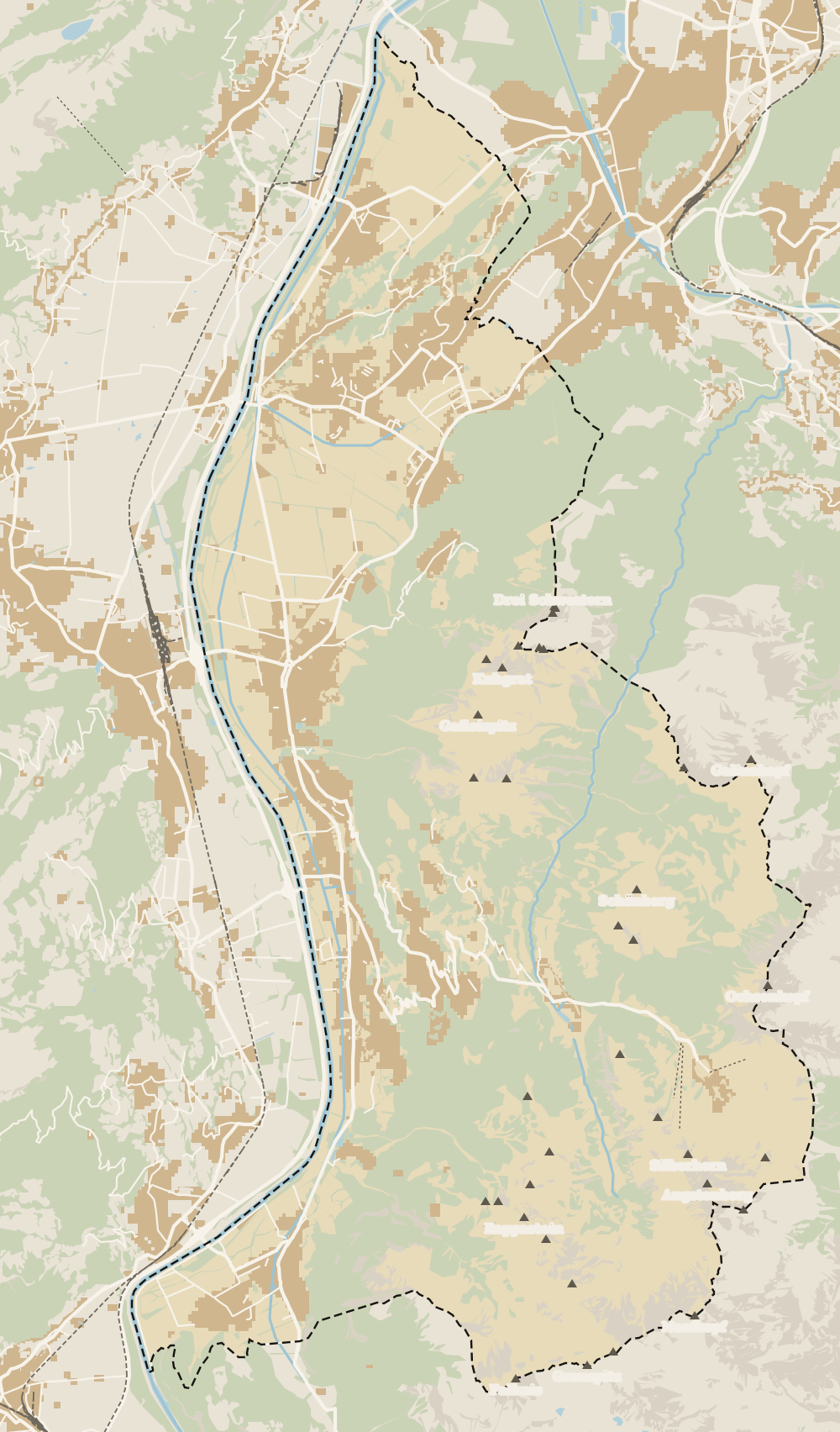
0 of 168 Liechtenstein guides
Your next stamp
- Eschen
- Stage 3: Vaduz - Nendeln
- Stage 4: Nendeln - Ruggell
- Masescha
- Schaanwald
- Triesen
- Churches and chapels
- Fürstensteig
- Things to do
- One day
- Two days
- Municipalities
- Oberland
- Unterland
- Map
- Vaduz
- Städtle
- Mitteldorf
- Vaduz Castle
- Vaduz Cathedral
- Parliament
- Government Building
- Vaduz Town Hall
- Red House
- Prince's Winery
- Old Rhine Bridge
- Schaan
- Schalun Castle Ruin
- Balzers
- Citytrain
- Triesenberg
- Walser Museum
- Planken
- Gutenberg Castle
- The Rhine
- Schaan Roman fort
- Dux
- St Mamertus chapel
- Lawena valley
- Mäls
- DoMuS
- TAK Theatre
- Castles
- Viewpoints
- Mountains
- Museums
- Kunstmuseum
- Mountain huts
- Hilti Art Foundation
- Pfälzerhütte
- Gafadura hut
- National Museum
- Treasure Chamber
- Postage Stamp Museum
- Kunstraum Engländerbau
- Gaflei
- Mauren
- Silum
- Rotenboden
- Gamprin
- Wangerberg
- Bendern
- Steg
- Ruggell
- Samina valley
- Schellenberg Farmhouse Museum
- Cross-country skiing at Steg
- Küefer-Martis-Huus
- Ruggeller Riet
- Schellenberg
- Hinterschellenberg
- Is it a country?
- Liechtenstein Trail
- Malbun
- Schellenberg castles
- Eschnerberg
- Malbun in summer
- Population
- Stage 1: Balzers - Triesenberg
- Lakes
- Sareis
- Size
- Stage 2: Triesenberg - Vaduz
- Malbun Peace Chapel
- Political system
- Swimming pools
- Language
- Skiing in Malbun
- Dialect
- Malbun ski pass
- Stage 5: Ruggell - Schaanwald
- Hotels in Malbun
- Stamps
- Princess Gina Trail
- Hut-to-hut Route 66
- Hiking
- Getting there
- In winter
- Weather
- Airport
- Best time to visit
- In summer
- Events
- With kids
- Zurich to Liechtenstein
- National day
- Sargans to Vaduz
- Christmas
- Feldkirch to Vaduz
- By train
- Traditions
- Carnival
- Getting around
- Buses
- Funken Sunday
- Alpine cattle drive
- Driving and vignette
- Parking
- Bike hire
- Cycling
- EU and Schengen
- Entry requirements
- Borders and customs
- The prince
- The princely house
- The flag
- The coat of arms
- The national anthem
- History
- Second World War
- No army
- Facts
- Why so rich?
- Banks and tax haven
- Where to stay
- Hilti
- Hotels in Vaduz
- False teeth
- Hostel and camping
- Rent the country?
- Where to eat
- Restaurants in Vaduz
- Swiss invasions
- Bars and nightlife
- Food
- Käsknöpfle
- Wine
- Casinos
- Adventure Pass
- Rainy days
- Guided tours
- Tourist office
- Day trips
- Passport stamp
- Music festivals
- Phone and roaming
- Currency and payments
- Prices and budget
- Tipping
- Plugs and sockets
- Tap water
- Opening hours
- Public holidays
- Safety
- Accessibility
- With a dog
- Shopping and souvenirs
Frequently asked questions
What is there in Nendeln, Liechtenstein?
The foundations of a 2nd-century Roman villa above the school, the chapel of St Sebastian and St Roch, a railway stop and two stages of the Liechtenstein Trail passing through.
Is Nendeln part of Eschen?
Yes. It's a hamlet in the municipality of Eschen, separated from the village by a flat, damp stretch of land, the Riet, drained by the Esche stream.
Is there a train station in Nendeln?
It has had a stop on the ÖBB Feldkirch-Buchs line since 1872. The open timetable shows no trains between September and November 2026, so I'd check oebb.at or take bus 14.
Can you see the Roman villa at Nendeln?
Yes, its foundations are visible above Nendeln's primary school, according to Eschen municipality. It's a short walk from the main road.
Where does the name Nendeln come from?
The Historisches Lexikon suggests it's probably Celtic, from nantu-ialo, meaning a clearing in the valley. It was first written down in 1395.
By
Tourism graduate with a master’s in Tourism Management and Planning from the University of Málaga, who has travelled across Europe. He writes every guide from official sources and his own judgement.
Published on . Facts checked on .
Sources
Photos: Asurnipal (CC BY-SA 4.0); Clemens v. Vogelsang from Liechtenstein (CC BY 2.0), via Wikimedia Commons.