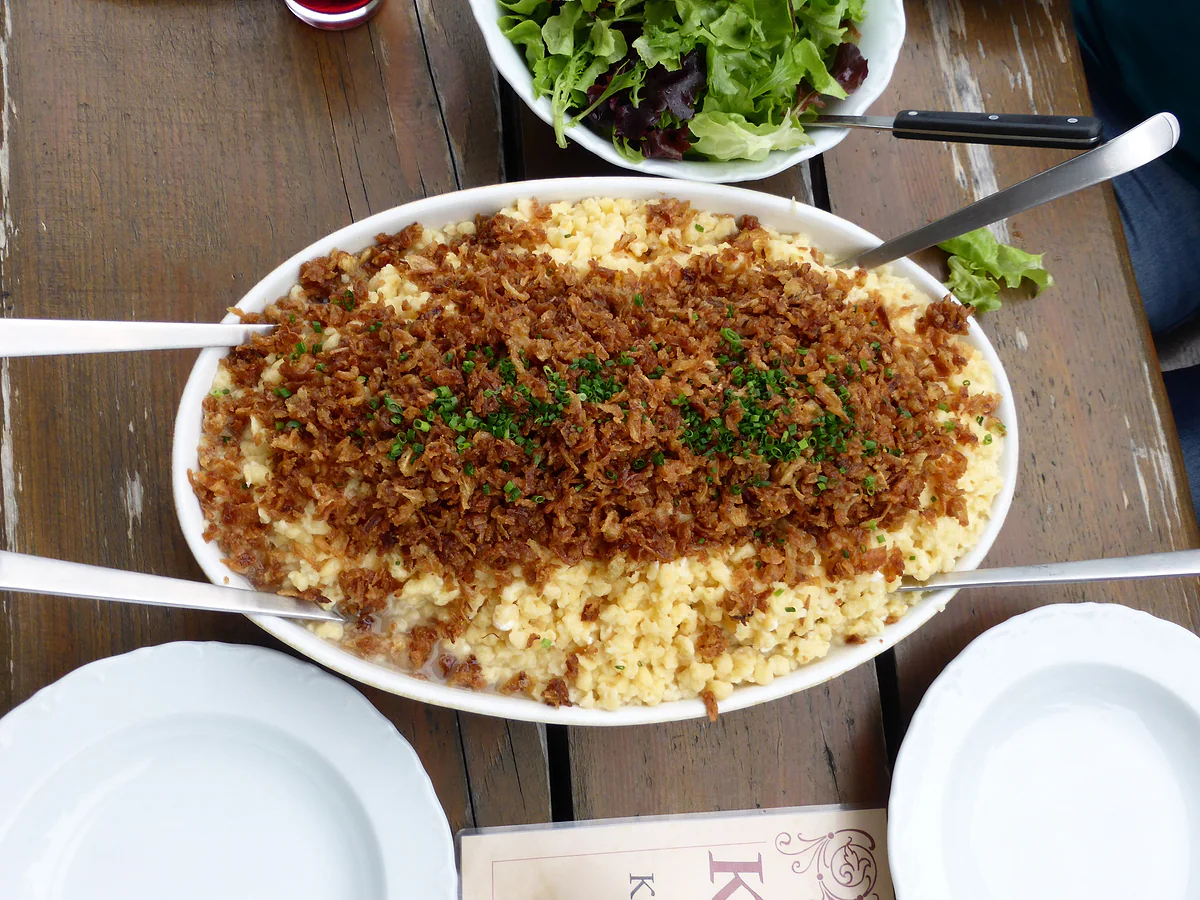
Cheese, crispy onions and apple sauce
Käsknöpfle, Liechtenstein's recipe and where I'd order it
Käsknöpfle are Liechtenstein's most famous dish, egg pasta layered with grated hard cheese, topped with floured fried onions and served with apple sauce. The official recipe uses 600 g of flour, 6 eggs, about 300 g of cheese and four onions. Places to eat them include the Berggasthaus Masescha, the Wirtschaft zum Löwen in Schellenberg and the Adler in Vaduz.
In 30 seconds
Full read: 3 min
- Käsknöpfle are egg pasta with grated cheese and crispy fried onions.
- They're served with apple sauce, or with salad or spinach.
- The official recipe uses 600 g of flour, 6 eggs and about 300 g of cheese.
- Masescha, Schellenberg, Vaduz and Malbun all have places serving them.
I'd order them up at Masescha, with the apple sauce even if the pairing sounds odd, and skip pudding, because it's a filling plate. If it's a Thursday and you're over 60, the Sareis seniors' deal includes them with the chairlift for CHF 33.

Before you go
What I would keep in mind
-
01 My tip
Have the apple sauce, however odd it sounds
The official recipe says to serve them with apple sauce, or with salad or creamed spinach. The sweetness cuts through the cheese and onions, and it's how locals eat them.
-
02 To save money
Chairlift and Käsknöpfle for CHF 33 on Thursdays
Bergbahnen Malbun's «Seniorentag», for over-60s, includes a return trip to Sareis and a lunch of Käseknöpfli or Knöpfli with goulash and water at the top, 11:30 to 14:00.
Sareis chairlift -
03 Most beautiful
Eat them at 1,200 m above the Rhine
The Berggasthaus Masescha, at about 1,200 m above Triesenberg with the Rhine valley below, holds 13 Gault Millau points. It opens Wednesday to Sunday.
Masescha and its Walser chapel -
04 Watch out
Friday to Sunday, the Wirtschaft zum Löwen is shut
It's the inn the tourist board singles out for Käsknöpfle, but it only opens Monday to Thursday. Head up to Schellenberg on a Saturday and you'll find the door locked.
Schellenberg, the smallest municipality
My ranking, scored
Where I'd order Käsknöpfle, in my order
My own scores out of 10 among the restaurants the tourist board lists for this dish that have an up-to-date website. I weigh the setting, recognised cooking and how easy they are to find open.
0 of 5 seen
-
Berggasthaus Masescha (Triesenberg)
13 Gault Millau points, the Fehr family since 1929 and views over the Rhine. Wednesday to Saturday 11:00 to 22:00, Sunday until 16:00.
9.2 out of 10
-
Wirtschaft zum Löwen (Schellenberg)
A family inn run by Myriam and Othmar Oehri-Biedermann, known for this dish. Kitchen 11:30 to 20:30, Monday to Thursday only.
8.7 out of 10
-
Restaurant Adler (Vaduz)
Regional Alpine cooking in a 1908 house in the centre. Monday to Friday 08:00 to 17:30, ideal for lunch.
8.1 out of 10
-
Sareis restaurant (Malbun)
At 2,000 m, at the top of the chairlift, open daily until 18 October 2026. Thursdays bring the over-60s deal.
7.9 out of 10
-
Chapter Two (Vaduz)
The Hotel Residence restaurant reinterprets the country's cooking, and the tourist board lists it for this dish. Open all week.
7.7 out of 10
If you only eat one local thing, make it Käsknöpfle. It isn’t the most refined food in the Alps and doesn’t pretend to be, but it sums up this small mountain country better than anything else. Flour, egg, cheese and onion, four things everyone has at home, which done properly become a plate you remember. This page is the official recipe explained and, more to the point, the places where I’d order it.
What goes in
The recipe published by the tourist board calls for 600 g of knöpfle flour, though plain flour works, six eggs, a teaspoon of salt and 200 to 250 ml of half milk, half water. The cheese is what matters, 300 g of mixed grated hard cheeses and, if you like a sharp edge, 50 g of Sauerkäse in small cubes. For the onions, four large ones cut into thin strips, a tablespoon of flour and two of butter.
The onions get their flour by being shaken in a closed container, then they’re fried slowly in butter, and they’re meant to end up dark and crunchy. That’s half the dish. The other half is what goes alongside, apple sauce, or salad, or creamed spinach. The first time, I’d go with the apple sauce, which is how people here eat it.
How are they made, step by step?
Mix the flour, salt and eggs, then add the milk and water bit by bit until you have a thick, slightly lumpy batter. It can rest for 10 to 20 minutes, though the recipe says that’s optional. Bring a big pan of well-salted water to the boil, turn it down to a bare simmer, and grate the batter straight in with a spätzle maker.
Here’s the trick that makes the difference. As the knöpfle float up, lift them out with a slotted spoon into a bowl, layering them with cheese as you go, until the batter’s finished. Then add the rest of the cheese with one or two spoonfuls of the hot cooking water and mix, so the cheese turns elastic and stringy. The onions go on top just before serving.
There’s no meat in the official recipe, so it suits vegetarians, though I’d still ask how a restaurant makes its own version. And be warned about portions. With 600 g of flour and 300 g of cheese for a family, this is a main course that fills you until dinner, so plan the afternoon’s walk accordingly.
Where I’d order them
The tourist board keeps its own list of restaurants serving them. From it, I’ve kept those with an up-to-date website and clear hours. First is the Berggasthaus Masescha above Triesenberg, at about 1,200 m, with 13 Gault Millau points and the Fehr family in charge since 1929. It serves from 11:00 to 22:00, Wednesday to Saturday, and until 16:00 on Sundays, closing Mondays and Tuesdays.
Second is the Wirtschaft zum Löwen, at Winkel 5 in Schellenberg, which the tourist board describes as known for exactly this dish. It’s a family business, open 10:00 to 23:00 from Monday to Thursday, with food served non-stop 11:30 to 20:30. It’s closed Friday to Sunday, and in September 2026 it shut from the 7th to the 24th for holidays. Schellenberg is the village of the Schellenberg castles, so lunch fits neatly with a walk to the ruins.
In Vaduz, the tourist board lists the Restaurant Adler, a 1908 house with regional cooking that opens on weekdays until 17:30, and Chapter Two at the Hotel Residence, which reinterprets the country’s cooking. Hours for both are in restaurants in Vaduz.
In the mountains, chairlift included
At the top of the Sareis chairlift, at 2,000 m, the restaurant opens daily until 18 October 2026 and runs a «Seniorentag» on Thursdays. For CHF 33, over-60s ride the chairlift up and down and have a lunch of Käseknöpfli or Knöpfli with goulash and water, 11:30 to 14:00. The chairlift stops in strong wind, though, so I’d check its status on the lift company’s website on the day. Everything about the ride up is in my guide to Sareis.
And in autumn, Triesenberg calls them Chääs-Chnöpfli and serves them on the Walser menu of the village’s food weeks, from mid-October to mid-November. The rest of the country’s cooking is in my guide to Liechtenstein food.
Official Käsknöpfle recipe (roughly four people)
| Ingredient | Quantity |
|---|---|
| Knöpfle flour (or plain flour) | 600 g |
| Eggs | 6 |
| Salt | 1 teaspoon |
| Half milk, half water | 200-250 ml |
| Hard cheese mix | 300 g |
| Sauerkäse (optional) | 50 g |
| Butter | 2 tablespoons |
| Large onions, plus 1 tablespoon of flour | 4 |
Recipe from Liechtenstein's official tourist board (archive.org copy of 04-01-2026). It gives no serving count; the four people is my estimate.
Test yourself
True or false?
0/4 Pick before you peek.
-
Käsknöpfle are traditionally eaten with apple sauce.
See the answer
True. The official recipe serves them with apple sauce, or with salad or creamed spinach.
-
The recipe uses cream to melt the cheese.
See the answer
False. The cheese is melted with one or two spoonfuls of the hot pasta water, according to the official recipe.
-
The Wirtschaft zum Löwen in Schellenberg opens at weekends.
See the answer
False. It opens Monday to Thursday, 10:00 to 23:00, and closes Friday to Sunday.
-
In Triesenberg's Walser dialect they're called Chääs-Chnöpfli.
See the answer
True. That's how they appear on the autumn Triesenberger Wochen menu, according to the tourist board.
- Flour in the official recipe
- 600 g
- Grated hard cheese
- 300 g
- Chairlift and lunch on Thursdays at Sareis, over-60s
- CHF 33
0 of 168 Liechtenstein guides
Your next stamp
- Food
- Tipping
- Where to eat
- Mountain huts
- Things to do
- Hiking
- Treasure Chamber
- One day
- Two days
- Municipalities
- Oberland
- Unterland
- Map
- Vaduz
- Städtle
- Mitteldorf
- Vaduz Castle
- Vaduz Cathedral
- Parliament
- Government Building
- Vaduz Town Hall
- Red House
- Prince's Winery
- Old Rhine Bridge
- Schaan
- Schalun Castle Ruin
- Balzers
- Citytrain
- Triesen
- Triesenberg
- Walser Museum
- Planken
- Gutenberg Castle
- The Rhine
- Schaan Roman fort
- Dux
- St Mamertus chapel
- Lawena valley
- Mäls
- DoMuS
- TAK Theatre
- Castles
- Churches and chapels
- Viewpoints
- Mountains
- Museums
- Kunstmuseum
- Hilti Art Foundation
- Pfälzerhütte
- Gafadura hut
- National Museum
- Postage Stamp Museum
- Kunstraum Engländerbau
- Eschen
- Masescha
- Gaflei
- Nendeln
- Mauren
- Silum
- Rotenboden
- Schaanwald
- Gamprin
- Wangerberg
- Bendern
- Steg
- Ruggell
- Samina valley
- Schellenberg Farmhouse Museum
- Cross-country skiing at Steg
- Küefer-Martis-Huus
- Ruggeller Riet
- Schellenberg
- Hinterschellenberg
- Fürstensteig
- Is it a country?
- Liechtenstein Trail
- Malbun
- Schellenberg castles
- Eschnerberg
- Malbun in summer
- Population
- Stage 1: Balzers - Triesenberg
- Lakes
- Sareis
- Size
- Stage 2: Triesenberg - Vaduz
- Malbun Peace Chapel
- Political system
- Stage 3: Vaduz - Nendeln
- Swimming pools
- Language
- Skiing in Malbun
- Stage 4: Nendeln - Ruggell
- Dialect
- Malbun ski pass
- Stage 5: Ruggell - Schaanwald
- Hotels in Malbun
- Stamps
- Princess Gina Trail
- Hut-to-hut Route 66
- Getting there
- In winter
- Weather
- Airport
- Best time to visit
- In summer
- Events
- With kids
- Zurich to Liechtenstein
- National day
- Sargans to Vaduz
- Christmas
- Feldkirch to Vaduz
- By train
- Traditions
- Carnival
- Getting around
- Buses
- Funken Sunday
- Alpine cattle drive
- Driving and vignette
- Parking
- Bike hire
- Cycling
- EU and Schengen
- Entry requirements
- Borders and customs
- The prince
- The princely house
- The flag
- The coat of arms
- The national anthem
- History
- Second World War
- No army
- Facts
- Why so rich?
- Banks and tax haven
- Where to stay
- Hilti
- Hotels in Vaduz
- False teeth
- Hostel and camping
- Rent the country?
- Restaurants in Vaduz
- Swiss invasions
- Bars and nightlife
- Wine
- Casinos
- Adventure Pass
- Rainy days
- Guided tours
- Tourist office
- Day trips
- Passport stamp
- Music festivals
- Phone and roaming
- Currency and payments
- Prices and budget
- Plugs and sockets
- Tap water
- Opening hours
- Public holidays
- Safety
- Accessibility
- With a dog
- Shopping and souvenirs
Frequently asked questions
What are Käsknöpfle?
Small pieces of egg pasta, boiled and layered with grated cheese, topped with floured fried onions. They're served with apple sauce, salad or creamed spinach.
How do you make Liechtenstein Käsknöpfle?
Make a thick batter with flour, eggs, salt and milk-and-water, grate it through a spätzle maker into simmering salted water, and layer the knöpfle that float up with cheese in a bowl. Finish with a splash of cooking water so the cheese turns stringy, then add the fried onions on top.
What cheese goes into Käsknöpfle?
The official recipe calls for 300 g of mixed hard cheeses and, if you like, 50 g of Sauerkäse, a sour cheese cut into small cubes.
Where can I eat Käsknöpfle in Liechtenstein?
The tourist board lists, among others, the Berggasthaus Masescha, the Wirtschaft zum Löwen in Schellenberg, the Adler and Chapter Two in Vaduz, and several places in Malbun, including the Sareis restaurant.
What do you eat with Käsknöpfle?
Traditionally, apple sauce. The official recipe also suggests salad or creamed spinach.
Does the Käsknöpfle batter need to rest?
It's optional. The official recipe says it can rest for 10 to 20 minutes to become smoother, but you can grate it straight into the water.
By
Tourism graduate with a master’s in Tourism Management and Planning from the University of Málaga, who has travelled across Europe. He writes every guide from official sources and his own judgement.
Published on . Updated on . Facts checked on .
Sources
Photos: © 1971markus (CC BY-SA 4.0), via Wikimedia Commons.