Opened on 28 December 1905
The «Grosses Haus», the palace that cost a year's budget
Liechtenstein's government building, the Regierungsgebäude, stands on Peter-Kaiser-Platz in Vaduz. The Viennese architect Gustav Ritter von Neumann designed it, it went up between 1903 and 1905 and it cost roughly a year of the state's income at the time. Locals call it the «Grosses Haus» and it has been listed since 1992. You see it from outside.
In 30 seconds
Full read: 3 min
- Liechtenstein's government building went up in 1903-1905 to plans by Gustav Ritter von Neumann.
- It cost roughly a year of state income and was the first building in the country with central heating.
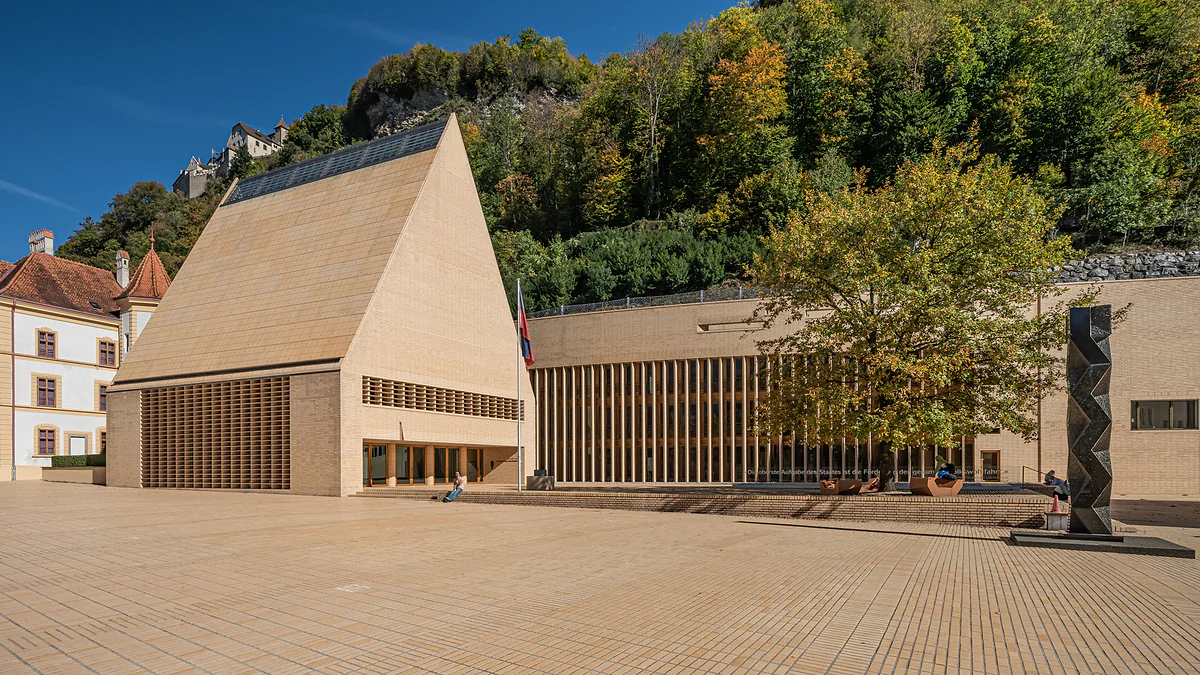
- It stands on Peter-Kaiser-Platz in Vaduz, beside the parliament and the National Archives, and is seen from outside.
I'd spend five minutes in front of the façade, picking out the two mosaics and the great state coat of arms on its starry sky, then turn round to look at the parliament. Together they explain the country better than plenty of museums.

Before you go
What I would keep in mind
-
01 Most beautiful
Two mosaics and a crest on a blue sky
On the second floor, two female figures in mosaic stand for Administration and Justice, and above them is the great state coat of arms on a blue background scattered with stars. Free to see from the square.
Liechtenstein coat of arms -
02 My tip
It isn't a house museum
The government, its staff units and the press office work inside. The official sources I've read mention no tours of the interior, so I'd plan it as an outside stop.
-
03 Getting there
Vaduz, Post stop, on the same square
The Vaduz, Post bus stop is in the government quarter. If you're driving, the tourist board points you to Äulestrasse, the Parkhaus Zentrum and the Parkhaus Marktplatz.
parking in Vaduz
Of all the buildings on Peter-Kaiser-Platz, this is the one I’d take my time over. Not because it’s pretty, though it is in its way, but because of what it meant. In 1903 a country of farmers and winegrowers decided to spend roughly everything the state earned in a year on a home for its administration. The result is still in use and has become the official face of the country.
A palace for a state with nowhere to work
At the start of the 20th century the state’s offices were scattered across several buildings in Vaduz, and the Historical Lexicon describes a genuine shortage of space. Since 1865 the government had been housed in the old lordly tavern of the quarter, and the parliament had its own building on the Städtli. The answer was a new building between the Verweserhaus and St Florin’s church that would bring everything together.
The court architect Gustav Ritter von Neumann of Vienna designed it, and Emil Zollinger of Zurich managed the site. It rose between 1903 and 1905 on piled foundations and opened on 28 December 1905. The government’s website says the cost came to about a year of the state’s income at the time, and that the decision showed real political foresight, because it outclassed anything else being built in the country. Locals call it the «Grosses Haus», the big house.
What you see from the square
The style looks to late Renaissance palaces, with an orderly, formal façade. My favourite detail is on the second floor. Two female figures in mosaic represent Administration on the left and Justice on the right, and above the central windows the great state coat of arms sits on a blue background studded with stars. If you’d like to read that shield quarter by quarter, I explain it in the guide to Liechtenstein’s coat of arms.
For its day it was an advanced building. According to the Lexicon it had the country’s first central heating, an internal telephone system and modern bathrooms. There were works in 1969, 1985-1986 and 1991-1992, and after the last of these it was listed as a monument.
The chamber of the Viennese artists
The heart of the building was the parliamentary chamber. Prince Johann II commissioned its decoration from Viennese artists, the sculptor Josef Beyer and the painters Eduard Gerisch, Rudolf Sagmeister, Maria Schöffmann and Raimund von Stillfried. The Lexicon calls the result traditional in taste, Vienna around 1900 seen from its conservative side. Parliament sat there from 1905 until 2007, when it moved into the brick building next door, the Parliament of Liechtenstein.
Can you go inside?
The government, its staff units and the press and information office work inside. The official sources I’ve read mention no tours of the interior, so I’d treat it as a building to admire from outside. If you want to sit in a debating chamber, the Landtag does offer guided tours, requested by email and held outside its sitting weeks.
Who governs from here
The government is collegiate, with five members proposed by the Landtag and appointed by the Prince for four years, at least two from the Oberland and two from the Unterland. For the 2025-2029 term it’s a coalition of the Vaterländische Union and the Fortschrittliche Bürgerpartei, and Brigitte Haas has been Head of Government since 10 April 2025. How all that fits with the Prince and the referendums is explained in the guide on Liechtenstein’s political system.
Seeing it on your walk around Vaduz
It sits at the southern end of the centre, with St Florin’s Cathedral on one side and the parliament on the other, and the old Verweserhaus, now part of the National Museum of Liechtenstein, in the same row. I’d begin a visit to Vaduz here, while the square is still quiet, before heading up the Städtle.
The square deserves a last look before you go. It’s named after Peter Kaiser, born in Mauren in 1793, who published his «Geschichte des Fürstenthums Liechtenstein» in 1847 and is regarded as the father of the country’s historical writing. The government’s website describes the parliament, the National Archives and this building as a harmonious whole, and I agree, even though a century separates them. Buses stop at Vaduz, Post, in the same district.
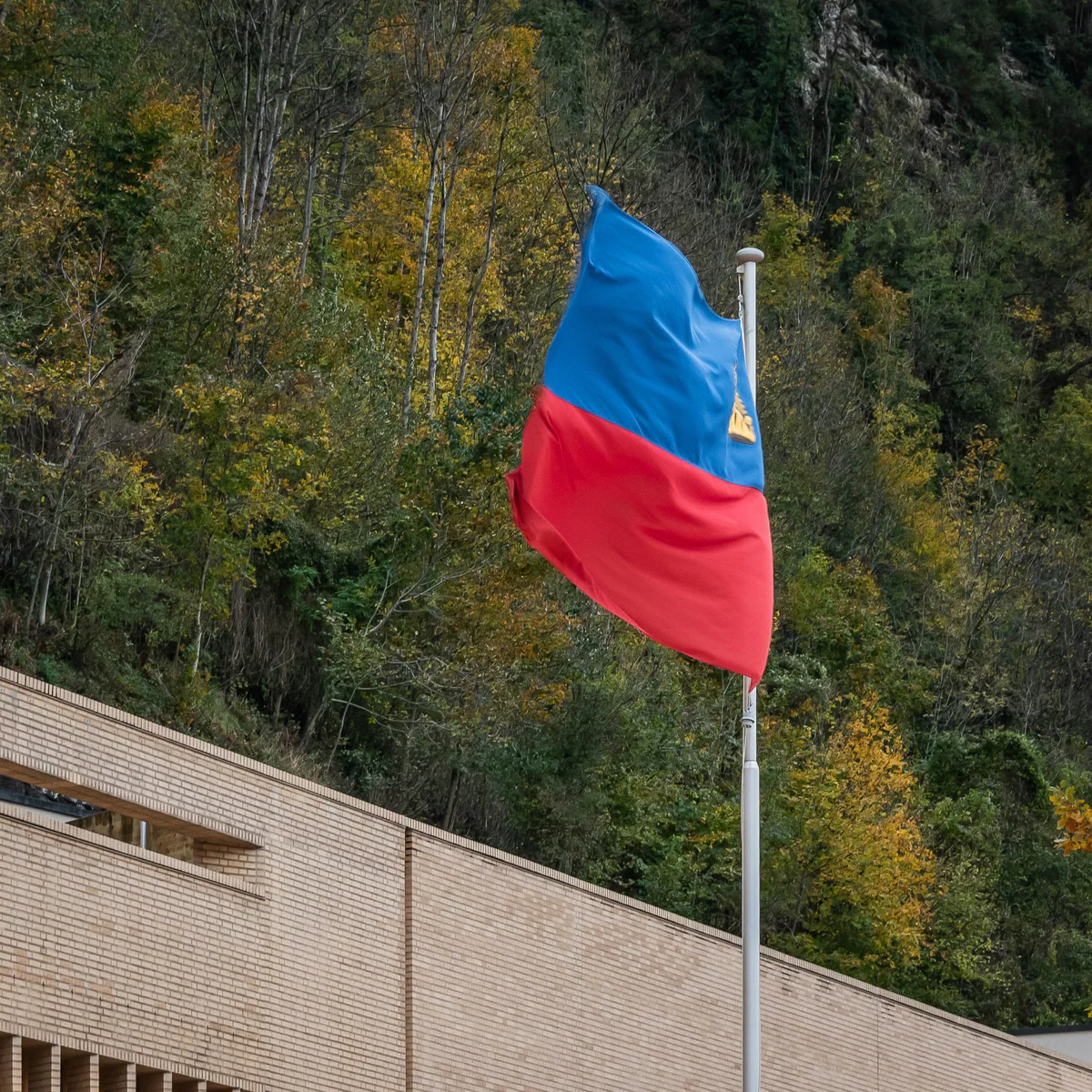
The blue and red flag of Liechtenstein, with its golden crown, flying against the wooded slope of Vaduz.
The building in figures
| Fact | Detail |
|---|---|
| Built | 1903-1905 |
| Opened | 28 December 1905 |
| Architect | Gustav Ritter von Neumann, court architect, Vienna |
| Site manager | Emil Zollinger, Zurich |
| Cost | Roughly one year of state revenue at the time |
| Works | 1969, 1985-1986 and 1991-1992 |
| Protection | Listed monument since 1992 |
| Altitude | 457 m |
Figures from the Government of Liechtenstein (regierung.li) and the Historical Lexicon.
The government working inside (2025-2029 term)
| Post | Who |
|---|---|
| Head of Government | Brigitte Haas (VU), since 10 April 2025 |
| Deputy Head | Sabine Monauni (FBP) |
| Ministers | Daniel Oehry (FBP), Hubert Büchel (VU) and Emanuel Schädler (VU) |
A five-member coalition government, proposed by the Landtag and appointed by the Prince for four years.
Test yourself
True or false?
0/4 Pick before you peek.
-
The government building in Vaduz cost roughly a year of state revenue.
See the answer
True. The government's website says the cost was about one year of public income at the time, and presents it as a far-sighted decision.
-
Parliament still meets in the chamber of the government building.
See the answer
False. It met there from 1905 to 2007. Since 2008 it has had its own building next door, designed by Hansjörg Göritz.
-
It was the first building in Liechtenstein with central heating.
See the answer
True. The Historical Lexicon says it had the country's first central heating, along with an internal telephone system and modern bathrooms.
-
Liechtenstein's government has seven members.
See the answer
False. It has five, proposed by the Landtag and appointed by the Prince, with at least two from the Oberland and two from the Unterland.
- Year it opened, on 28 December
- 1905
- Year it was listed as a monument
- 1992
- Government members who work there
- 5
Map
Where Government Building is
The dashed line is the border: Switzerland across the Rhine, Austria to the north and east. Every number opens its guide.
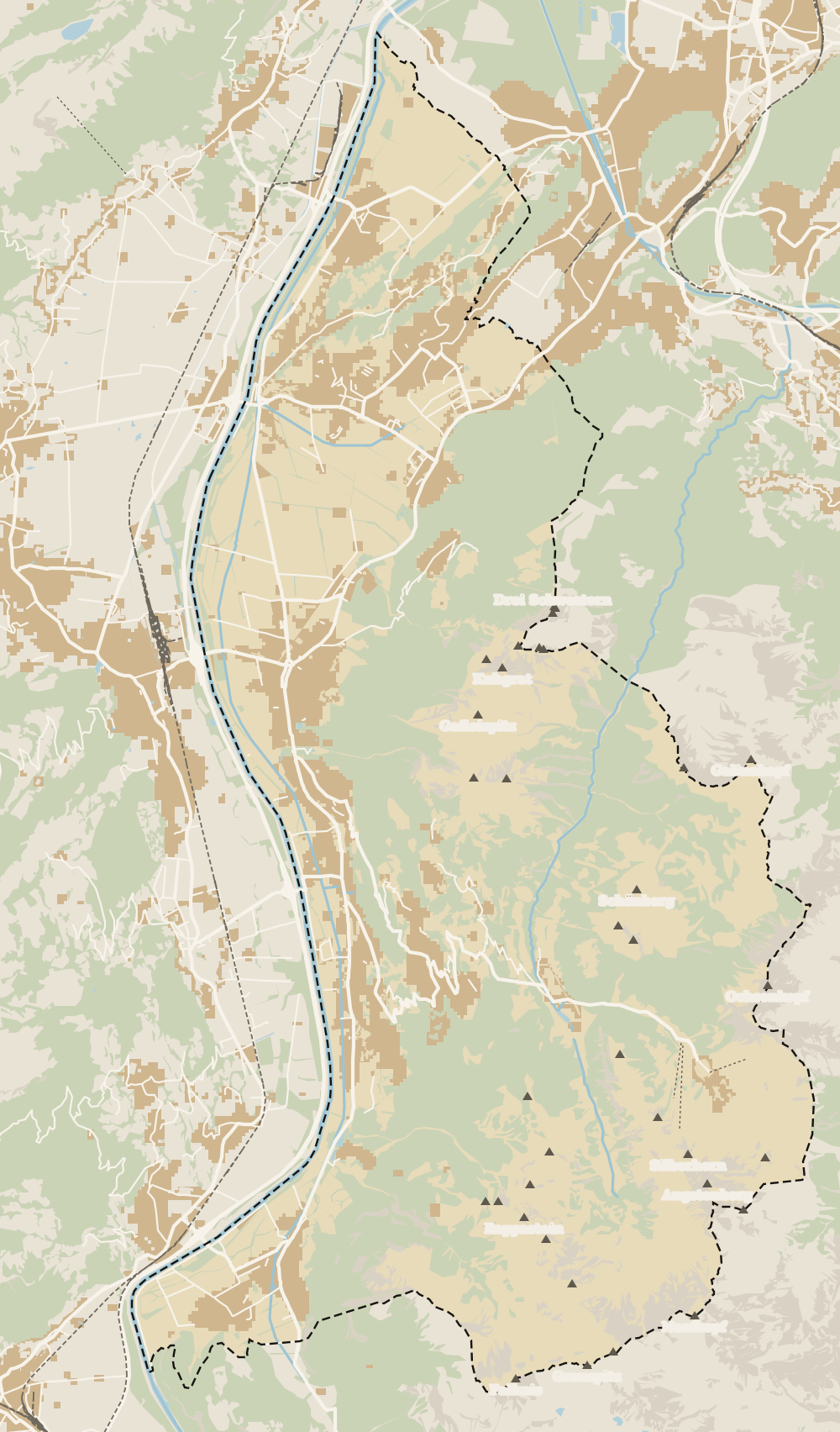 1Vaduz 2Städtle 3Mitteldorf 4Vaduz Castle 5Vaduz Cathedral 6Parliament 7Government Building 8Vaduz Town Hall 9Prince's Winery 10Old Rhine Bridge 11Schalun Castle Ruin 12Citytrain
 Map data © OpenStreetMap contributors (ODbL)
- 1VaduzA capital since 1719, home to 6,108 people
- 2StädtleCar-free since 28 June 2004
- 3MitteldorfVineyards protected until 2081
- 4Vaduz CastleThe Prince's residence, closed to visitors
- 5Vaduz CathedralA cathedral since 2 December 1997
- 6ParliamentNext sitting, 30 September to 2 October
- 7Government BuildingOpened on 28 December 1905
- 8Vaduz Town HallOpened on 19 November 1933
- 9Prince's WineryDaily tasting at 15:00, Saturdays at 14:00
- 10Old Rhine BridgeThe last wooden bridge on the Rhine
- 11Schalun Castle RuinAt 862 m, an hour's walk from Vaduz
- 12Citytrain2026 season runs until 31 October
0 of 168 Liechtenstein guides
Your next stamp
- Parliament
- Kunstmuseum
- Political system
- Vaduz
- National Museum
- Things to do
- Churches and chapels
- Rent the country?
- One day
- Two days
- Municipalities
- Oberland
- Unterland
- Map
- Städtle
- Mitteldorf
- Vaduz Castle
- Vaduz Cathedral
- Vaduz Town Hall
- Red House
- Prince's Winery
- Old Rhine Bridge
- Schaan
- Schalun Castle Ruin
- Balzers
- Citytrain
- Triesen
- Triesenberg
- Walser Museum
- Planken
- Gutenberg Castle
- The Rhine
- Schaan Roman fort
- Dux
- St Mamertus chapel
- Lawena valley
- Mäls
- DoMuS
- TAK Theatre
- Castles
- Viewpoints
- Mountains
- Museums
- Mountain huts
- Hilti Art Foundation
- Pfälzerhütte
- Gafadura hut
- Treasure Chamber
- Postage Stamp Museum
- Kunstraum Engländerbau
- Eschen
- Masescha
- Gaflei
- Nendeln
- Mauren
- Silum
- Rotenboden
- Schaanwald
- Gamprin
- Wangerberg
- Bendern
- Steg
- Ruggell
- Samina valley
- Schellenberg Farmhouse Museum
- Cross-country skiing at Steg
- Küefer-Martis-Huus
- Ruggeller Riet
- Schellenberg
- Hinterschellenberg
- Fürstensteig
- Is it a country?
- Liechtenstein Trail
- Malbun
- Schellenberg castles
- Eschnerberg
- Malbun in summer
- Population
- Stage 1: Balzers - Triesenberg
- Lakes
- Sareis
- Size
- Stage 2: Triesenberg - Vaduz
- Malbun Peace Chapel
- Stage 3: Vaduz - Nendeln
- Swimming pools
- Language
- Skiing in Malbun
- Stage 4: Nendeln - Ruggell
- Dialect
- Malbun ski pass
- Stage 5: Ruggell - Schaanwald
- Hotels in Malbun
- Stamps
- Princess Gina Trail
- Hut-to-hut Route 66
- Hiking
- Getting there
- In winter
- Weather
- Airport
- Best time to visit
- In summer
- Events
- With kids
- Zurich to Liechtenstein
- National day
- Sargans to Vaduz
- Christmas
- Feldkirch to Vaduz
- By train
- Traditions
- Carnival
- Getting around
- Buses
- Funken Sunday
- Alpine cattle drive
- Driving and vignette
- Parking
- Bike hire
- Cycling
- EU and Schengen
- Entry requirements
- Borders and customs
- The prince
- The princely house
- The flag
- The coat of arms
- The national anthem
- History
- Second World War
- No army
- Facts
- Why so rich?
- Banks and tax haven
- Where to stay
- Hilti
- Hotels in Vaduz
- False teeth
- Hostel and camping
- Where to eat
- Restaurants in Vaduz
- Swiss invasions
- Bars and nightlife
- Food
- Käsknöpfle
- Wine
- Casinos
- Adventure Pass
- Rainy days
- Guided tours
- Tourist office
- Day trips
- Passport stamp
- Music festivals
- Phone and roaming
- Currency and payments
- Prices and budget
- Tipping
- Plugs and sockets
- Tap water
- Opening hours
- Public holidays
- Safety
- Accessibility
- With a dog
- Shopping and souvenirs
Frequently asked questions
Where is the Liechtenstein government building?
On Peter-Kaiser-Platz in Vaduz, in the government quarter, between the old Verweserhaus and St Florin's Cathedral. It forms a group with the parliament and the National Archives.
Who built the government building in Vaduz?
It was designed by the court architect Gustav Ritter von Neumann of Vienna, with Emil Zollinger of Zurich running the site. It went up between 1903 and 1905 and opened on 28 December 1905.
Can you visit the Liechtenstein government building?
It's the government's working headquarters and the official sources I've checked list no interior tours. You see it from the square, and what you can tour with a guide, outside sitting weeks, is the parliament next door.
Why is it called the «Grosses Haus»?
That's the popular nickname quoted on the government's own website, the «big house». In 1905 it was a huge building for a small country, and it cost about as much as the state took in over a year.
Who governs Liechtenstein today?
A five-member VU and FBP coalition government for 2025-2029, led by Brigitte Haas (VU), Head of Government since 10 April 2025. The head of state is Prince Hans-Adam II, with Hereditary Prince Alois acting as regent since 2004.
By
Tourism graduate with a master’s in Tourism Management and Planning from the University of Málaga, who has travelled across Europe. He writes every guide from official sources and his own judgement.
Published on . Facts checked on .
Sources
Photos: A.Savin (FAL); Tournasol7 (CC BY 4.0), via Wikimedia Commons.