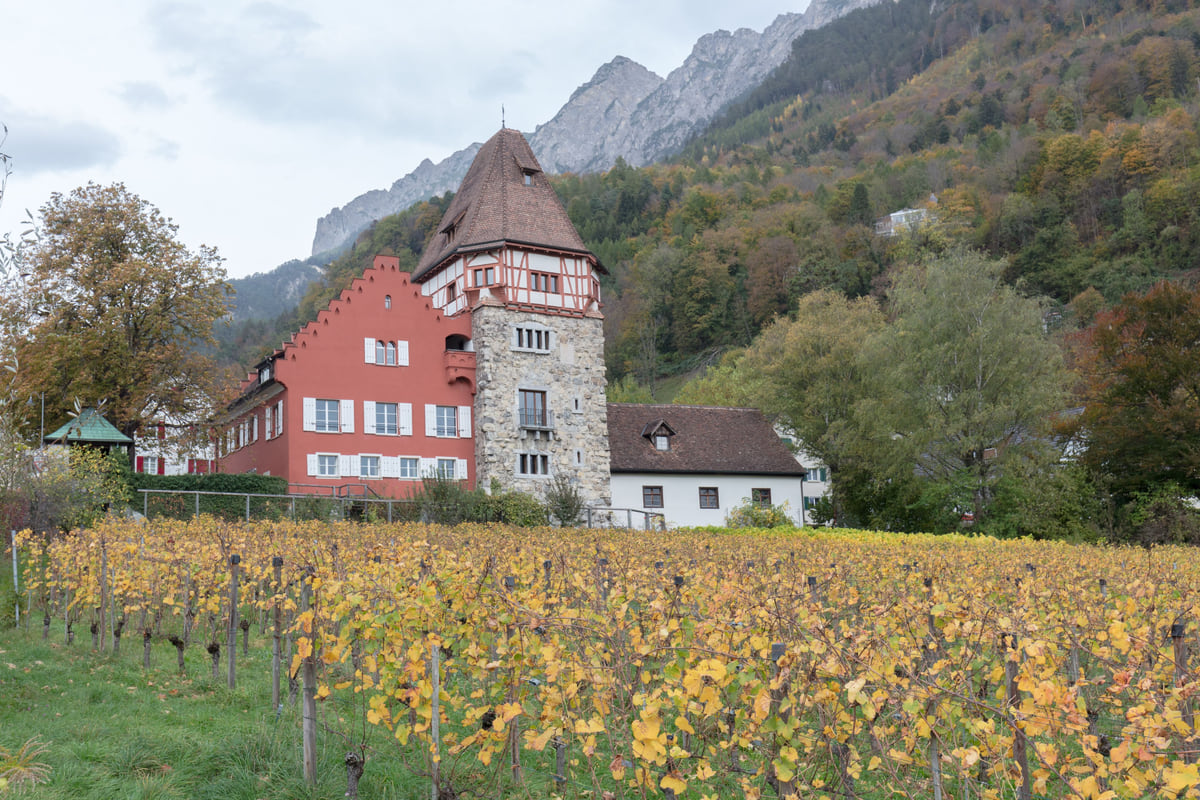
23 ha of vines and about 115,000 bottles a year
Liechtenstein wine, a vineyard the size of a village

- Vineyard area (2024)
- 23 ha
- Red and white
- 16 ha and 7 ha
- Bottles a year
- About 115,000 on average
Liechtenstein wine comes from just 23 ha of vines in 2024, 15 in the Oberland and 8 in the Unterland, down from about 300 around 1900. It averages about 115,000 bottles a year, mostly Pinot Noir and Chardonnay, all picked by hand. You can taste it at the Prince's winery in Vaduz, at Weinbau Hoop and Weingut Castellum in Eschen, or at the WY Weinbar in Schaan.
My ranking, scored
Where to taste wine in Liechtenstein, in my order
My own scores out of 10 for a visitor without a car who wants to try local wine. I weigh how easy it is to turn up, what you learn and what it costs.
0 of 4 seen
-
Hofkellerei, the Prince's winery (Vaduz)
Tasting with a tour Monday to Saturday, CHF 19, no booking for up to six, beside the Herawingert vineyard. The easiest and most complete.
9.3 out of 10
-
Weingut Castellum (Eschen)
Family estate of winemaker Hubert Gstöhl on the Eschnerberg since 1983. Sales on Saturday mornings.
8.4 out of 10
-
WY Weinbar (Schaan)
Vaulted cellar with a long list and a tasting room for ten, Thursday to Saturday evenings. For tasting without winery hours.
8.1 out of 10
-
Weinbau Hoop (Eschen)
Wine and sparkling wine estate with Parker and Falstaff scores. It has a shop and a virtual tour; ask about visiting in person.
7.9 out of 10
I wouldn't leave without trying a local Pinot Noir, and I'd do it where it's made, at the 15:00 tasting at the Prince's winery or on a Saturday morning at Castellum. As a souvenir, a bottle from here beats any fridge magnet, since hardly any of it leaves the country.
My verdict
Yes
Yes, it deserves a tasting. There's little of it and almost none is exported, so tasting it here is the only real way to know it.
Is it for you?
Yes, if…
- Pinot Noir and Chardonnay fans
- Anyone after a souvenir you can't find elsewhere
Better not, if…
- Anyone driving that day
- Anyone who doesn't drink alcohol
Liechtenstein wine: the quick answer
Full read: 3 min
- Liechtenstein had 23 ha of vines in 2024, down from about 300 around 1900.
- It makes about 115,000 bottles a year on average, mostly Pinot Noir and Chardonnay.
- The Prince's winery in Vaduz runs a tasting with a tour Monday to Saturday for CHF 19.
- In Eschen, Weingut Castellum sells wine on Saturday mornings.
Notebook
What the official sites leave out
-
01 To save money
Two free wines with the tourist pass
The ALL INCLUSIVE Adventure Pass, from CHF 25 a day, includes a tasting of two wines at the Hofkellerei, the Prince's winery, on top of buses and museums.
the Liechtenstein Adventure Pass -
02 Most beautiful
A wine trail through the Prince's vines
The Herawingert vineyard in Vaduz has an educational wine trail whose panels reproduce Martha Giebler's stamp series «Das Jahr des Winzers», the winegrower's year.
the Prince's winery in Vaduz (Hofkellerei) -
03 My tip
Castellum sells on Saturday mornings only
Weingut Castellum in Eschen opens every Saturday 09:00 to 12:00 or by phone appointment. In December 2026 it stays open until 17:00 on the 5th, 12th and 19th.
-
04 Worth the splurge
A 94-point Parker Chardonnay
In March 2026 Weinbau Hoop in Eschen received 94 Parker points for its «Pfarrhof» 2023 Chardonnay and 91 for its «Torkel» 2023 Pinot Noir.
The figure that surprised me most while writing this wasn’t the Prince’s wine, which I knew about. It’s that around 1900 Liechtenstein had roughly 300 hectares of vines, and wine was once its leading cultural and export product, according to the Weinbauverband itself. Today 23 remain. That’s a vineyard the size of a village, scattered along the Rhine slopes, which is exactly why tasting it here is fun. Hardly anyone abroad has drunk it.
How much wine Liechtenstein makes, and from which grapes
According to the Weinbauverband, the growers’ association founded in November 2021, the country had 23 ha of vines in 2024, 15 in the Oberland and 8 in the Unterland. Of those, 16 are red and 7 white, and output averages about 115,000 bottles a year. Harvests swing a lot from year to year. In 2022 growers picked 128,000 kg of grapes, in 2023 117,000 and in 2024 only 74,000, with red always around two thirds. The first appellation law dates from 2005.
The grapes you’ll see most are Pinot Noir and Chardonnay. The tourist board credits the climate, kept mild by the föhn, the warm wind that pushes up temperatures in autumn, and centuries of know-how. The Weinbauverband gives an annual average of 11 °C and about 1,600 hours of sunshine. And one detail I love, every grape in Liechtenstein is still picked by hand.
A 2,000-year story
The tourist board says the Romans brought the first vines more than 2,000 years ago, and the Weinbauverband documents vineyards with certainty from the 7th century. What changed the landscape was industry. The Weinbauverband points to the building of the Arlberg tunnel, industrialisation and both world wars, which steadily ate into the vineyards until the present map was left, with plots spread, as the tourist board puts it, from Balzers to the Eschnerberg. The princely family’s own story with wine, which their winery dates back to 1436, is in my guide to the Prince’s winery in Vaduz.
Once your dates are set, check which hotels are still free in Vaduz before prices climb.
The wineries I’d visit
The easiest is the Prince’s own, the Hofkellerei, at Feldstrasse 4 in Vaduz, with a tasting and tour at 15:00 on weekdays and 14:00 on Saturdays, for CHF 19 and no booking needed for groups of six or fewer. With the ALL INCLUSIVE Adventure Pass, two wines are free.
In the Unterland, the tourist board recommends two wineries in Eschen. Weingut Castellum is a family estate that has spent more than 40 years on the Eschnerberg, run by Hubert Gstöhl, a qualified master winegrower and oenologist. It sells every Saturday 09:00 to 12:00 or by phone appointment, and in December 2026 opens on the 5th, 12th and 19th from 09:00 to 17:00; it closes from 25 December to 6 January. Weinbau Hoop makes still and sparkling wine, and in March 2026 received 94 Parker points for its «Pfarrhof» 2023 Chardonnay. If that island hill in the north appeals, it’s in my guide to the Eschnerberg.
The third recommendation, Harry Zech in Schaanwald, farms biodynamically with Demeter certification from the 2017 vintage, according to the tourist board. I couldn’t find an active website of his own, so I can’t give you opening times.
Tasting without winery hours
For a glass in the evening, the WY Weinbar in Schaan has a historic vaulted cellar with a long list, opens Thursday to Saturday from 17:00 and, since autumn 2024, has a tasting room for ten with its sommelier. I cover it with the other bars in bars and nightlife in Vaduz.
So you do not pay over the odds, look at trains, coaches and flights to Vaduz on Omio and pick the one that suits you.
Taking a bottle home
Wine sits on the tourist board’s list of typical souvenirs, alongside stamps, ceramics and confectionery, and I think it’s the best of the lot. In Vaduz, the Hofkellerei shop is open on Saturdays between 10:00 and 17:00 and from 9:00 on weekdays, shutting at 18:00 or 19:00 (its own website says both), Castellum sells on Saturday mornings, and the Braumarkt at the brewery in Schaan stocks regional wines too. More ideas in shopping and souvenirs in Liechtenstein.
Wine festivals
Autumn is the season. In Vaduz, the Liechtenstein winegrowers’ festival took place on 19 September 2026 on the town hall square, and the next is announced for 18 September 2027. The tourist board also mentions the Triesen wine cooperative’s festival beside St Mamertus chapel, and the Unterland festival with the crowning of the wine queen, without published dates. And if you’re wandering on your own, the Prince’s vineyard has a wine trail whose panels reproduce a series of stamps about the winegrower’s year. Few things feel more Liechtenstein than that.
If you would rather have a local show you round, book a guided tour in Vaduz and choose by the reviews.
A car frees you from timetables: search car hire in Zurich on DiscoverCars and compare companies.
Once your dates are set, check which hotels are still free in Vaduz before prices climb.
Liechtenstein's vineyard in figures
| Figure | Value |
|---|---|
| Vines around 1900 | About 300 ha |
| Vines in 2024 | 23 ha (15 Oberland, 8 Unterland) |
| Red and white | 16 ha and 7 ha |
| Bottles a year | About 115,000 on average |
| Grapes harvested 2022 | 128,000 kg |
| Grapes harvested 2023 | 117,000 kg |
| Grapes harvested 2024 | 74,000 kg |
| Sunshine a year | About 1,600 hours |
Figures from the Weinbauverband Liechtenstein. In all three years, red grapes made up around two thirds of the harvest.
Wineries and bars for tasting
| Place | Where | When |
|---|---|---|
| Hofkellerei | Feldstrasse 4, Vaduz | Tasting Mon-Fri 15:00, Sat 14:00 |
| Weingut Castellum | Gastelun 16, Eschen | Saturdays 09:00-12:00 or by appointment |
| WY Weinbar | Schaan | Thu 17-23, Fri and Sat 17-24 |
| Weinbau Hoop | Eschen | Shop and visits, ask ahead |
Test yourself
True or false?
0/3 Pick before you peek.
-
Liechtenstein has more vineyards today than a century ago.
See the answer
False. Around 1900 it had about 300 ha; in 2024, 23 ha, according to the Weinbauverband.
-
Grapes in Liechtenstein are still picked by hand.
See the answer
True. The tourist board says every harvest in the country is still done by hand.
-
Liechtenstein wine is almost all white.
See the answer
False. Of 23 ha of vines, 16 are red grapes and 7 white, and red makes up around two thirds of the harvest.
- Vineyards in 2024
- 23 ha
- Bottles a year, on average
- 115,000
- First appellation law
- 2005
0 of 170 Liechtenstein guides
Your next stamp
- Prince's Winery
- Rainy days
- Things to do
- One day
- Two days
- Municipalities
- Oberland
- Unterland
- Map
- Vaduz
- Städtle
- Mitteldorf
- Vaduz Castle
- Vaduz Cathedral
- Parliament
- Government Building
- Vaduz Town Hall
- Red House
- Old Rhine Bridge
- Schaan
- Schalun Castle Ruin
- Balzers
- Citytrain
- Triesen
- Triesenberg
- Walser Museum
- Planken
- Gutenberg Castle
- The Rhine
- Schaan Roman fort
- Dux
- St Mamertus chapel
- Lawena valley
- Mäls
- DoMuS
- TAK Theatre
- Castles
- Churches and chapels
- Viewpoints
- Mountains
- Museums
- Kunstmuseum
- Mountain huts
- Hilti Art Foundation
- Pfälzerhütte
- Gafadura hut
- National Museum
- Treasure Chamber
- Postage Stamp Museum
- Kunstraum Engländerbau
- Eschen
- Masescha
- Gaflei
- Nendeln
- Mauren
- Silum
- Rotenboden
- Schaanwald
- Gamprin
- Wangerberg
- Bendern
- Steg
- Ruggell
- Samina valley
- Schellenberg Farmhouse Museum
- Cross-country skiing at Steg
- Küefer-Martis-Huus
- Ruggeller Riet
- Schellenberg
- Hinterschellenberg
- Fürstensteig
- Is it a country?
- Liechtenstein Trail
- Malbun
- Schellenberg castles
- Eschnerberg
- Malbun in summer
- Population
- Stage 1: Balzers - Triesenberg
- Lakes
- Sareis
- Size
- Stage 2: Triesenberg - Vaduz
- Malbun Peace Chapel
- Political system
- Stage 3: Vaduz - Nendeln
- Swimming pools
- Language
- Skiing in Malbun
- Stage 4: Nendeln - Ruggell
- Dialect
- Malbun ski pass
- Stage 5: Ruggell - Schaanwald
- Hotels in Malbun
- Stamps
- Princess Gina Trail
- Hut-to-hut Route 66
- Naafkopf
- Hiking
- Getting there
- In winter
- Weather
- Airport
- Best time to visit
- In summer
- Events
- Is it worth it?
- With kids
- Zurich to Liechtenstein
- National day
- Sargans to Vaduz
- Christmas
- Feldkirch to Vaduz
- By train
- Traditions
- Carnival
- Getting around
- Buses
- Funken Sunday
- Alpine cattle drive
- Driving and vignette
- Parking
- Bike hire
- Cycling
- EU and Schengen
- Entry requirements
- Borders and customs
- The prince
- The princely house
- The flag
- The coat of arms
- The national anthem
- History
- Second World War
- No army
- Facts
- Why so rich?
- Banks and tax haven
- Where to stay
- Hilti
- Hotels in Vaduz
- False teeth
- Hostel and camping
- Rent the country?
- Where to eat
- Restaurants in Vaduz
- Swiss invasions
- Bars and nightlife
- Food
- Käsknöpfle
- Casinos
- Adventure Pass
- Guided tours
- Tourist office
- Day trips
- Passport stamp
- Music festivals
- Phone and roaming
- Currency and payments
- Prices and budget
- Tipping
- Plugs and sockets
- Tap water
- Opening hours
- Public holidays
- Safety
- Accessibility
- With a dog
- Shopping and souvenirs
Liechtenstein wine: questions and answers
Does Liechtenstein make wine?
Yes. The country had 23 ha of vines in 2024 and makes about 115,000 bottles a year on average, mostly Pinot Noir and Chardonnay. According to the tourist board, every grape is still picked by hand.
What grapes grow in Liechtenstein?
Mainly Pinot Noir for red and Chardonnay for white. Of the 23 ha, 16 are red and 7 white, according to the Weinbauverband.
Where can I taste wine in Liechtenstein?
At the Hofkellerei in Vaduz, the Prince's winery, with tastings Monday to Saturday for CHF 19. Also at Weingut Castellum in Eschen on Saturday mornings and at the WY Weinbar in Schaan, Thursday to Saturday.
How long has wine been made in Liechtenstein?
The tourist board says the Romans brought the first vines more than 2,000 years ago, and the Weinbauverband documents vineyards with certainty from the 7th century.
Is Liechtenstein wine any good?
Some of it scores well with critics. Weinbau Hoop received 94 Parker points in 2026 for a 2023 Chardonnay, and since 2024 the Prince's winery has belonged to Austria's association of traditional wine estates.
Where can I buy Liechtenstein wine?
At the wineries themselves, such as the Hofkellerei shop in Vaduz (weekdays from 9:00, closing at 18:00 or 19:00 depending on where you look on its website, Saturday 10:00 to 17:00) or Castellum in Eschen on Saturday mornings. The Braumarkt at the brewery in Schaan also sells wines from the region.

Questions about Liechtenstein? Write to me
If your question is not answered here, write to me and I will look it up in the official sources.
My email sergiolepone@gmail.com
By
Tourism graduate with a master’s in Tourism Management and Planning from the University of Málaga, who has travelled across Europe. He writes every guide from official sources and his own judgement.
Published on . Updated on . Facts checked on .
Sources
Some links in this guide are affiliate links: if you book through them, the site earns a commission at no extra cost to you. Affiliate disclosure
Photos: Diego Delso (CC BY-SA 4.0), via Wikimedia Commons.