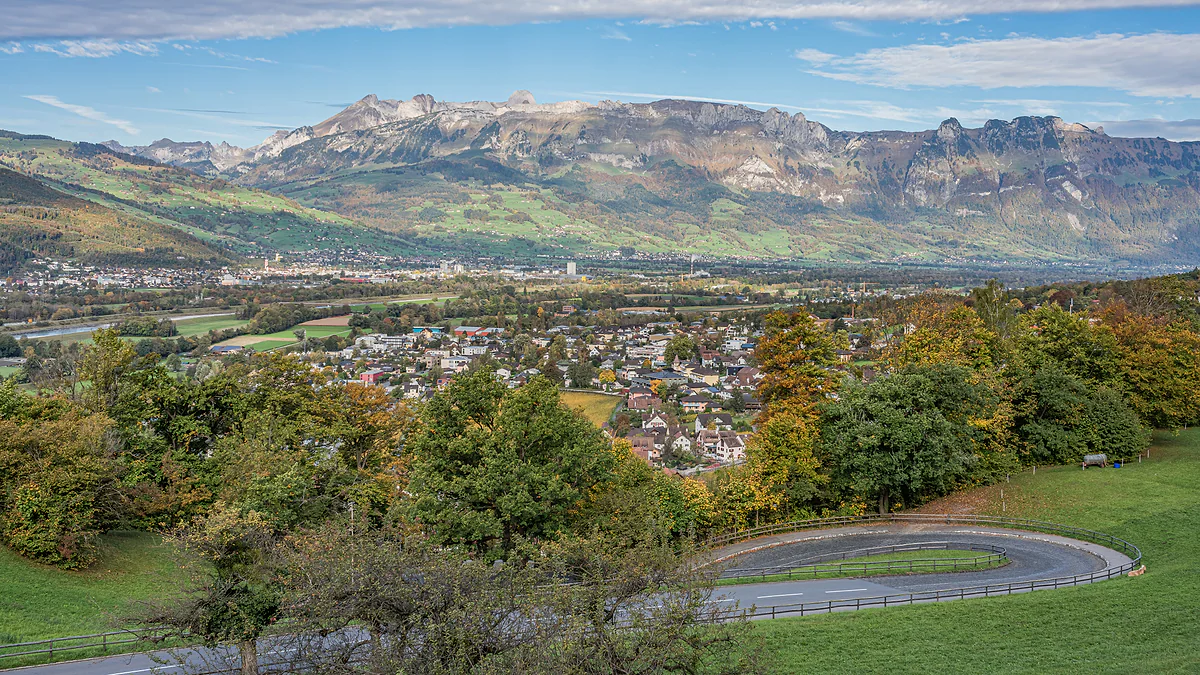
525 m up, above central Schaan
Dux, Schaan's pilgrimage chapel and its tower above the Rhine
Dux is a hillside quarter of Schaan at 525 m, home to the baroque chapel of Maria zum Trost, built around 1716 and listed since 1951. Its votive panels speak of a busy pilgrimage, Pope John Paul II visited on 8 August 1985, and nearby stands the Dux tower, which the tourist board says looks over the Rhine valley and the slopes of the Three Sisters.
In 30 seconds
Full read: 3 min
- Dux is a hillside quarter of Schaan at 525 m, with the baroque chapel of Maria zum Trost.
- The chapel dates from around 1716, was consecrated in 1743 and has been listed since 1951.
- It has pilgrims' votive panels, 14 Stations of the Cross from 1943 and memories of a papal visit in 1985.
- The nearby Dux tower looks over the Rhine valley and the slopes of the Three Sisters.
I'd walk up to Dux early or late in the day, when the light slants across the valley, and pair it with Schaan's Roman fort on the same stroll. It's one of the few viewpoints in the country you can reach on foot from a town centre.

Before you go
What I would keep in mind
-
01 Most beautiful
A pilgrimage told in painted panels
The walls carry dozens of votive panels, and the nave has a copy of a painting showing an Austrian regiment, the Breis, camped at Dux in 1796. The original is in the LandesMuseum.
churches and chapels in Liechtenstein -
02 To save money
A Rhine view with no chairlift and no ticket
The Dux tower gives you the Rhine valley and the slopes of the Three Sisters without going up to Malbun. For me it's the easiest viewpoint in the whole Oberland.
viewpoints in Liechtenstein -
03 Getting there
On stage 3 of the Liechtenstein Trail
The Vaduz to Nendeln stage passes Schaan's Roman ruins and the Dux lookout tower before heading on towards Planken.
stage 3 of the Liechtenstein Trail, Vaduz to Nendeln -
04 My tip
A playground right next door
The Dux leisure area has a children's playground, a Vita-Parcours fitness trail, a woodchip running track and a Kneipp water-treading pool, according to the Historisches Lexikon. Handy if you're up there with children.
Liechtenstein with kids
If I had to show someone the Rhine valley without a car or a chairlift, I’d take them up to Dux. It’s a hillside quarter of Schaan with a pilgrimage chapel, a park full of sculptures and a tower that looks out over the valley. It doesn’t feature on the country’s greatest hits, and to me that’s part of the appeal.
A country chapel with a national story
The chapel’s official name is Maria zum Trost, Our Lady of Consolation, and it stands at 525 m. According to the Historisches Lexikon it was built around 1716 on the site of a smaller chapel and consecrated in 1743. The tower came in 1789 and the west porch in 1829. The tourist board gives 1716 as the date and notes that it has been listed since 1951.
From outside it’s plain, an east-facing nave under a half-hipped roof. The good stuff is inside. The high altar holds a dressed figure of the Virgin and Child from around 1740, the side altars show St Mary Magdalene and St George fighting the dragon, and the nave has a coffered ceiling with Régence ornament. The gallery has rosary paintings by Josef Walser, dated 1746.
What the votive panels tell you
The panels are what I like most about Dux. The Lexikon says the many votive offerings point to a lively pilgrimage, and one of them is special. On the south wall hangs a copy of a painting of an Austrian regiment, the Breis, camped at Dux in 1796, at the height of the wars against revolutionary France. The original is in the LandesMuseum in Vaduz.
The chapel has a 20th-century chapter too. On 25 March 1940, with Europe at war, Prince Franz Josef II consecrated the country and his family to Our Lady of Dux. The chapel was renamed Our Lady of Liechtenstein, a name that never stuck. And on 8 August 1985 John Paul II visited during his stay in the country, as a plaque over the door and a bronze memorial to the north record. To see how it compares, I’ve gathered them all in my round-up of churches and chapels in Liechtenstein.
What do you see from the Dux tower?
Don’t get the two towers mixed up. The chapel has its own belfry, but the lookout is a separate structure close by, the Turm auf Dux. The tourist board says it gives you the Rhine valley and the wild landscape below the Three Sisters massif. It’s nowhere near the highest viewpoint in the country, but I find it the most rewarding for the effort, because you walk up from a town centre and it doesn’t depend on a lift or on snow.
If you’re after bigger views, from Gaflei or Sareis, I compare them in my list of viewpoints in Liechtenstein. Dux is the one I’d do on day one, to get my bearings.
A park with fourteen stations
In 1943 the grounds were reshaped into parkland with fourteen Stations of the Cross sculptures by Gottfried Hilti. Next door is the Dux leisure area which, according to the Lexikon, has a children’s playground, a Vita-Parcours fitness trail, a woodchip running track and a Kneipp water-treading pool. Schaan council also signposts a trail called Fuchs auf Dux.
That makes Dux a good family outing. Adults get a chapel and a view, children get swings, and nobody needs a ticket. It’s also a sensible warm-up if you’re planning a proper hike later in the trip, because you’ll see from here how steeply the Three Sisters rise behind Schaan and Planken. There are more ideas like this in my guide to Liechtenstein with kids.
The walk up and what else is nearby
The chapel is station 9 on Schaan’s Kulturweg, the loop of about six kilometres that the council reckons takes an hour. I’d start at the bottom at Schaan’s Roman fort, climb to Dux and come back through the upper village. Anyone crossing Liechtenstein on foot meets the tower too, because stage 3 of the Liechtenstein Trail climbs to it before heading on towards Planken. I couldn’t find chapel opening hours on any official website, so I’d go in daylight and not bank on getting in at a set time.
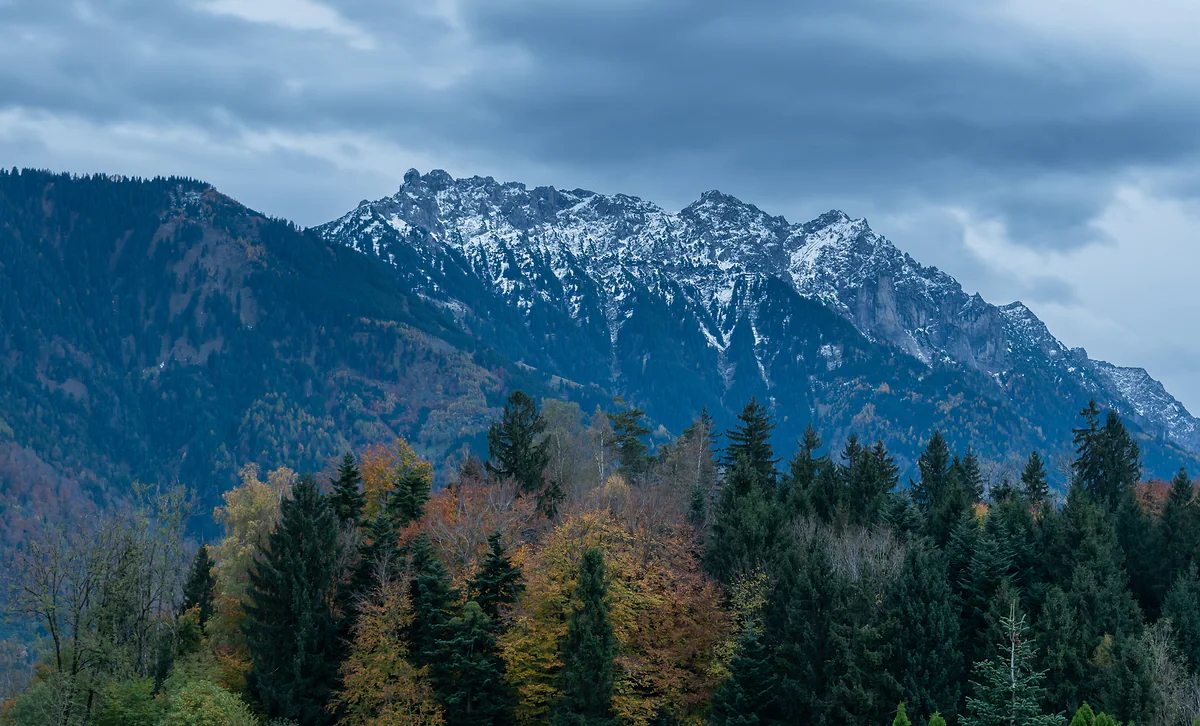
The Three Sisters, rocky snow-dusted peaks above the autumn forest, under grey clouds.
The Dux chapel through time
| Year | What happened |
|---|---|
| Around 1716 | Built to replace a smaller chapel |
| 1743 | Consecrated to Maria zum Trost |
| 1789 | Tower added |
| 1829 | West porch added |
| 25 Mar 1940 | Franz Josef II consecrates the country to Our Lady of Dux |
| 1943 | Fourteen Stations of the Cross by Gottfried Hilti |
| 8 Aug 1985 | Visit by Pope John Paul II |
| 1996 to 1997 | Restoration back to the original paintwork |
Dates from the Historisches Lexikon. The tourist board gives 1716 as the build date and 1951 as the year it was listed.
Test yourself
True or false?
0/4 Pick before you peek.
-
The Dux chapel is a 14th-century Gothic building.
See the answer
False. It's baroque. It was built around 1716 to replace a smaller chapel and consecrated in 1743.
-
Pope John Paul II visited the Dux chapel.
See the answer
True. He came on 8 August 1985. There's a plaque above the door and a bronze memorial on the north side.
-
In 1940 the prince consecrated the country to Our Lady of Dux.
See the answer
True. Franz Josef II did so on 25 March 1940, in the middle of the Second World War. The chapel was renamed Our Lady of Liechtenstein, though the name never caught on.
-
The chapel's tower was built at the same time as the nave.
See the answer
False. The tower was added in 1789, more than seventy years after the chapel went up, and the west porch in 1829.
- Approximate year it was built
- 1716
- Altitude of the chapel
- 525 m
- Stations of the Cross sculptures from 1943
- 14
- Visit by John Paul II
- 1985
Map
Where Dux is
The dashed line is the border: Switzerland across the Rhine, Austria to the north and east. Every number opens its guide.
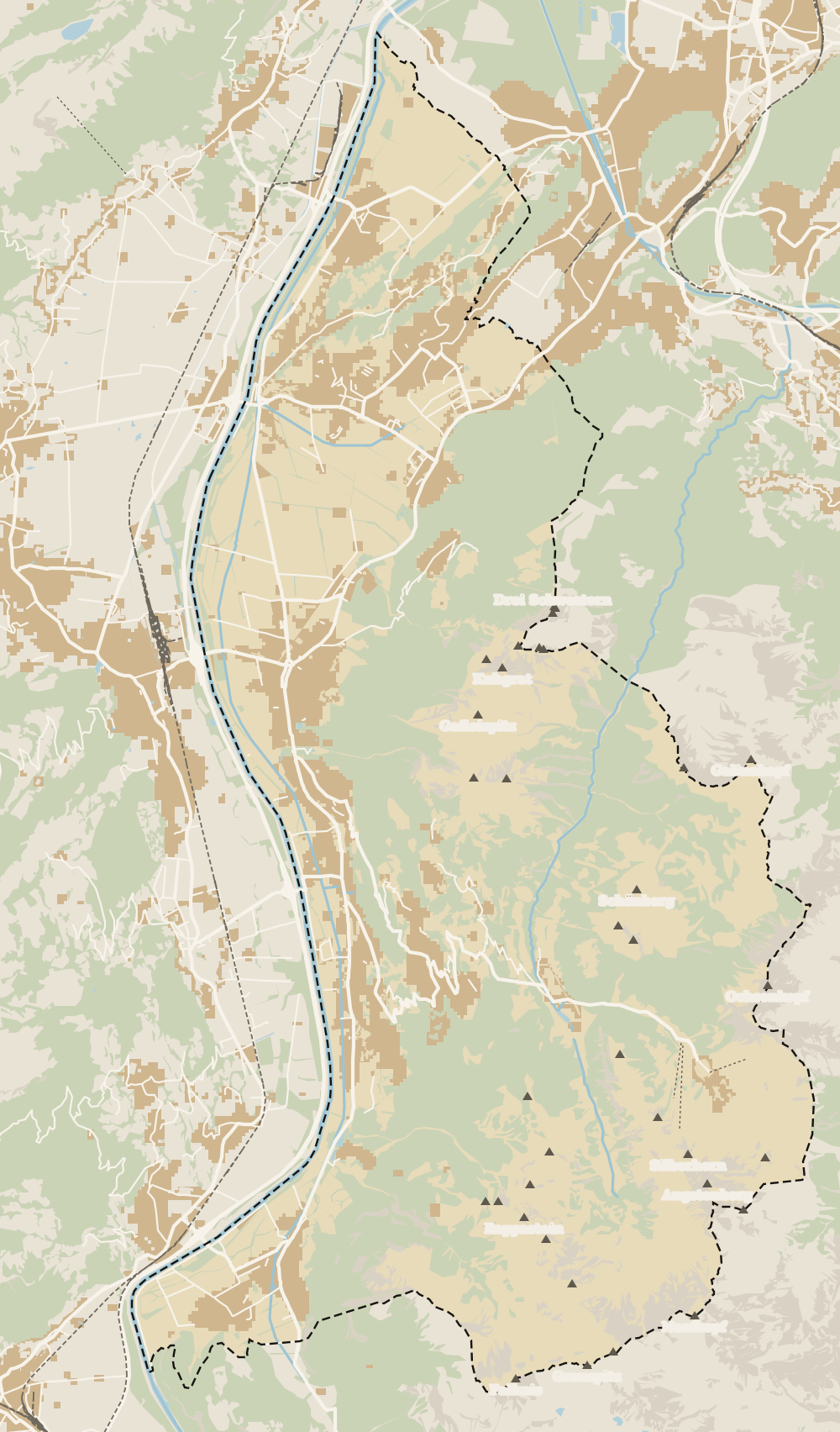
0 of 168 Liechtenstein guides
Your next stamp
- Schaan
- Schaan Roman fort
- Churches and chapels
- St Mamertus chapel
- Carnival
- DoMuS
- Things to do
- One day
- Two days
- Municipalities
- Oberland
- Unterland
- Map
- Vaduz
- Städtle
- Mitteldorf
- Vaduz Castle
- Vaduz Cathedral
- Parliament
- Government Building
- Vaduz Town Hall
- Red House
- Prince's Winery
- Old Rhine Bridge
- Schalun Castle Ruin
- Balzers
- Citytrain
- Triesen
- Triesenberg
- Walser Museum
- Planken
- Gutenberg Castle
- The Rhine
- Lawena valley
- Mäls
- TAK Theatre
- Castles
- Viewpoints
- Mountains
- Museums
- Kunstmuseum
- Mountain huts
- Hilti Art Foundation
- Pfälzerhütte
- Gafadura hut
- National Museum
- Treasure Chamber
- Postage Stamp Museum
- Kunstraum Engländerbau
- Eschen
- Masescha
- Gaflei
- Nendeln
- Mauren
- Silum
- Rotenboden
- Schaanwald
- Gamprin
- Wangerberg
- Bendern
- Steg
- Ruggell
- Samina valley
- Schellenberg Farmhouse Museum
- Cross-country skiing at Steg
- Küefer-Martis-Huus
- Ruggeller Riet
- Schellenberg
- Hinterschellenberg
- Fürstensteig
- Is it a country?
- Liechtenstein Trail
- Malbun
- Schellenberg castles
- Eschnerberg
- Malbun in summer
- Population
- Stage 1: Balzers - Triesenberg
- Lakes
- Sareis
- Size
- Stage 2: Triesenberg - Vaduz
- Malbun Peace Chapel
- Political system
- Stage 3: Vaduz - Nendeln
- Swimming pools
- Language
- Skiing in Malbun
- Stage 4: Nendeln - Ruggell
- Dialect
- Malbun ski pass
- Stage 5: Ruggell - Schaanwald
- Hotels in Malbun
- Stamps
- Princess Gina Trail
- Hut-to-hut Route 66
- Hiking
- Getting there
- In winter
- Weather
- Airport
- Best time to visit
- In summer
- Events
- With kids
- Zurich to Liechtenstein
- National day
- Sargans to Vaduz
- Christmas
- Feldkirch to Vaduz
- By train
- Traditions
- Getting around
- Buses
- Funken Sunday
- Alpine cattle drive
- Driving and vignette
- Parking
- Bike hire
- Cycling
- EU and Schengen
- Entry requirements
- Borders and customs
- The prince
- The princely house
- The flag
- The coat of arms
- The national anthem
- History
- Second World War
- No army
- Facts
- Why so rich?
- Banks and tax haven
- Where to stay
- Hilti
- Hotels in Vaduz
- False teeth
- Hostel and camping
- Rent the country?
- Where to eat
- Restaurants in Vaduz
- Swiss invasions
- Bars and nightlife
- Food
- Käsknöpfle
- Wine
- Casinos
- Adventure Pass
- Rainy days
- Guided tours
- Tourist office
- Day trips
- Passport stamp
- Music festivals
- Phone and roaming
- Currency and payments
- Prices and budget
- Tipping
- Plugs and sockets
- Tap water
- Opening hours
- Public holidays
- Safety
- Accessibility
- With a dog
- Shopping and souvenirs
Frequently asked questions
What is Dux in Schaan?
A hillside quarter of Schaan at 525 m, with the baroque chapel of Maria zum Trost, a park with 14 Stations of the Cross sculptures, a leisure area and, close by, the Dux lookout tower.
How old is the Dux chapel?
It was built around 1716 to replace a smaller chapel and consecrated in 1743. The tower dates from 1789 and the porch from 1829. It has been a listed building since 1951.
What can you see from the Dux tower?
According to the tourist board, the Rhine valley and the wild country below the Three Sisters massif. It isn't a high viewpoint, but it's very easy, since you can walk up from Schaan.
Did the Pope really visit the Dux chapel?
Yes. John Paul II visited on 8 August 1985 during his stay in Liechtenstein. A plaque over the door and a bronze memorial to the north of the chapel mark the occasion.
How do you get up to Dux?
On foot from the centre of Schaan. The chapel is station 9 of the council's Kulturweg heritage walk, and the tower is on stage 3 of the Liechtenstein Trail from Vaduz to Nendeln.
By
Tourism graduate with a master’s in Tourism Management and Planning from the University of Málaga, who has travelled across Europe. He writes every guide from official sources and his own judgement.
Published on . Facts checked on .
Sources
Photos: A.Savin (FAL); Tournasol7 (CC BY 4.0), via Wikimedia Commons.