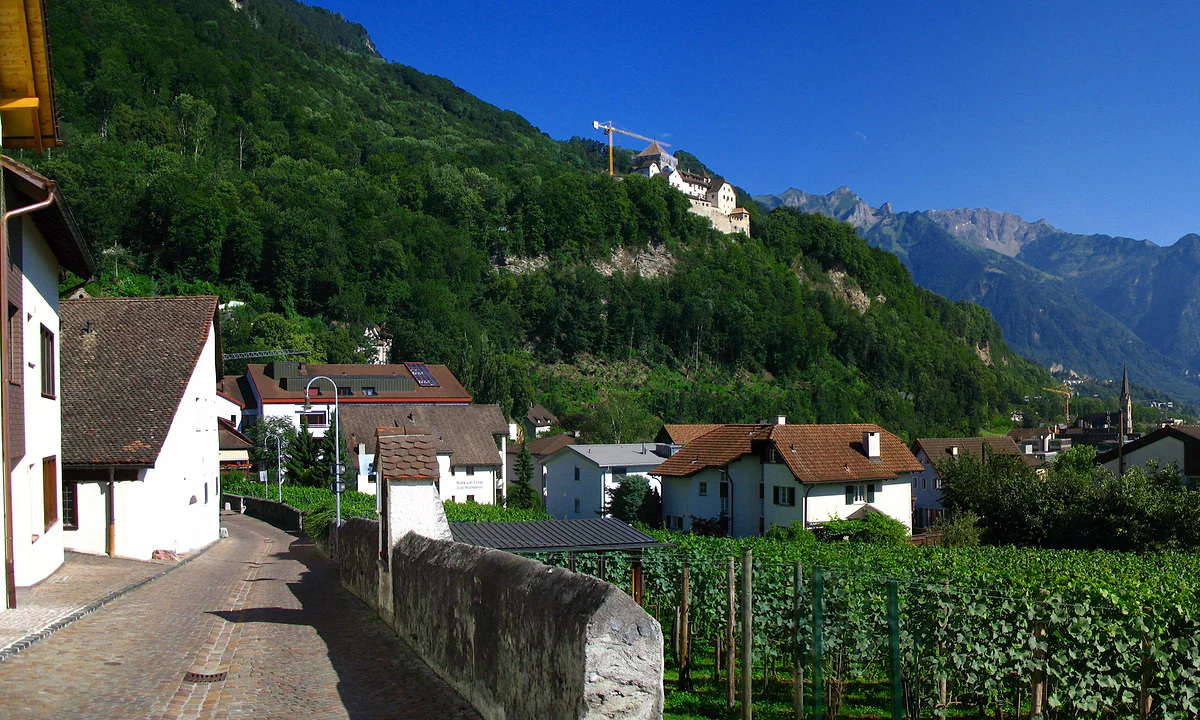
Vineyards protected until 2081
The Mitteldorf, the winegrowers' village still inside Vaduz
The Mitteldorf is the old quarter of Vaduz, north of the Städtle, where winegrowers' houses lined the lanes between the vines. It has the Red House, the loveliest view of the castle and vineyards where building has been banned for 99 years since 1982. You can walk it for free or ride through on the Citytrain.
In 30 seconds
Full read: 3 min
- The Mitteldorf is the old winegrowers' quarter of Vaduz, north of the Städtle.
- It's home to the Red House, which with the castle behind gives the capital's finest view.
- Since 1982 most of the vineyards have been under a 99-year building ban.
- Walk it for free, or ride through on the 13:00 or 16:30 Citytrain between April and October.
With just one afternoon in Vaduz, I'd swap a museum for this walk. I'd climb the lanes between the vines to the Red House, line up the photo with the castle behind and come down past the Prince's winery in time for the tasting.

Before you go
What I would keep in mind
-
01 Most beautiful
The Red House is Vaduz's second landmark
The Historical Lexicon ranks it second only to the castle. A 16th-century house with a stepped gable and a tower added by Egon Rheinberger in 1902-1905, wrapped in vines. Free to look at from outside, at any hour.
the Red House in Vaduz (Rotes Haus) -
02 Worth the splurge
Finish the walk with a tasting
The Prince's Hofkellerei runs a tasting with a tour Monday to Friday at 15:00 and Saturday at 14:00, for CHF 19. It fits neatly at the end of a loop through the vineyards.
the Prince's winery in Vaduz (Hofkellerei) -
03 Getting there
The Citytrain climbs through twice a day
From 1 April to 31 October the little train leaves the town hall at 13:00 and 16:30, runs through the Mitteldorf and stops below the Red House for photos. It costs CHF 12.
the Vaduz Citytrain -
04 My tip
The vines are private, the lanes are not
The Mitteldorf vineyards belong to private owners, the Prince's winery or the cooperative. I'd stick to the lanes and streets rather than wander between the rows, especially at harvest time.
My ranking, scored
What I'd look for in the Mitteldorf
My own scores out of 10. I weigh how beautiful each spot is and what it says about farming Vaduz. It's all visible from the street and free, except the tasting.
0 of 4 seen
-
The Red House from the lane below
House, tower and vines in the foreground, the castle clinging to its rock behind. It's my favourite picture of Vaduz.
9.3 out of 10
-
The lanes between the vines
White houses, garden walls and vines on both sides, with the Swiss Alps opposite. It's the Vaduz that existed before the office capital.
8.6 out of 10
-
The Prince's vineyard and wine trail
In the Herawingert, north of the centre, a teaching trail explains the winegrower's year with pictures from a stamp series.
8.0 out of 10
-
Hofstätte Hintergass 35/37
Up in the Oberdorf, a winegrower's house from 1494, among the oldest farmhouses in the country, restored by the municipality. Seen from outside.
7.4 out of 10
Most people passing through Vaduz never make it up here, which is a shame, because the Mitteldorf is what makes sense of the capital. This is the winegrowers’ village Vaduz was until the 20th century, with its garden walls, white houses and vines right up to the front door, only a few steps from the museum street.
The Vaduz that came before the banks
The Historical Lexicon describes old Vaduz as three pieces. The castle above. The lordly quarter below, where the government sits today. And in between, the farming village with its parts, the Städtli, Altabach, Metteldorf and Oberdorf. On the Städtli the houses lined the main road, but in the Metteldorf, the Mitteldorf of today’s maps, they lined the lanes that cut through the vineyards. That pattern is still there.
Wine was the village economy for centuries. The first written mention of a vineyard in Vaduz dates from 1249, and in 1808 there were about 16 ha of vines, with 113 of the 160 households owning a plot. The municipality sums it up by saying Vaduz was a farming village known for its wine before it became the office capital you see down the hill.
Why nobody builds here
What strikes me most about the Mitteldorf is a political decision. In the 1973 to 1976 town plan, most of the vineyards were moved from building land into a protected zone, despite objections, and since 1982 most of the vineyard has been under a 99-year building ban to preserve the look of the village. In a capital where land costs what it costs, that says a lot about what residents want to keep. It’s the reason you still see vines a few hundred metres from the centre. Back in 1808 the Prince’s estate was the largest vineyard owner, followed by the landlord of the Löwen inn, and the old court chaplaincies had plots too.
The Red House, the reason for the climb
In the middle of the quarter stands the Red House in Vaduz, the stepped-gable house with a tower that the Lexicon calls the capital’s second landmark. Its current look dates from 1902-1905, when Egon Rheinberger added the tower and linked it to the old wine press. It’s a private home, still lived in by the Rheinberger family, so you admire it from outside. From the lane below, with the vines in front, you get the postcard picture, castle on its rock behind.
On foot, by little train or on the Liechtenstein Trail
I’d walk it, heading up from the northern end of the Städtle, by Vaduz Town Hall, through the vineyard lanes. There’s no ticket office, no opening hours and no marked route, and that’s part of the appeal. I’d follow whichever lane climbs, keep the castle in view as a reference point and come back down a different way. Late in the afternoon, with the sun sinking over the Rhine valley, is when I’d most like to be here.
If you’d rather not walk, the Vaduz Citytrain runs through the Mitteldorf between 1 April and 31 October, at 13:00 and 16:30, stopping below the Red House for photos.
For keen walkers, stage 3 of the Liechtenstein Trail, from Vaduz to Nendeln, passes the Hofkellerei and the Red House before carrying on to Schaan. It’s a good way to leave Vaduz on foot without retracing your steps.
The wine that remains and where to taste it
For centuries the vines were mostly white, the Elbling, until the grape known locally as Blauburgunder, Pinot Noir, arrived in the 17th century and red gained ground. By 1875, 81.1% of the must was red. North of the centre, in the Herawingert, the Prince’s winery makes Pinot Noir and Chardonnay, and the municipality looks after a wine teaching trail there whose panels reproduce a set of stamps. I’d round off the walk with a tasting at the Prince’s winery in Vaduz, at 15:00 on weekdays or 14:00 on Saturdays. For the bigger picture there’s my guide to Liechtenstein wine.
A little higher, in the Oberdorf, the municipality has restored the Hofstätte Hintergass 35/37, a winegrower’s house from 1494 counted among the oldest farmhouses in the country. It’s now let as a holiday home and its vaulted cellar is used by the Vaduz winegrowers’ cooperative, so I’d admire it from outside.
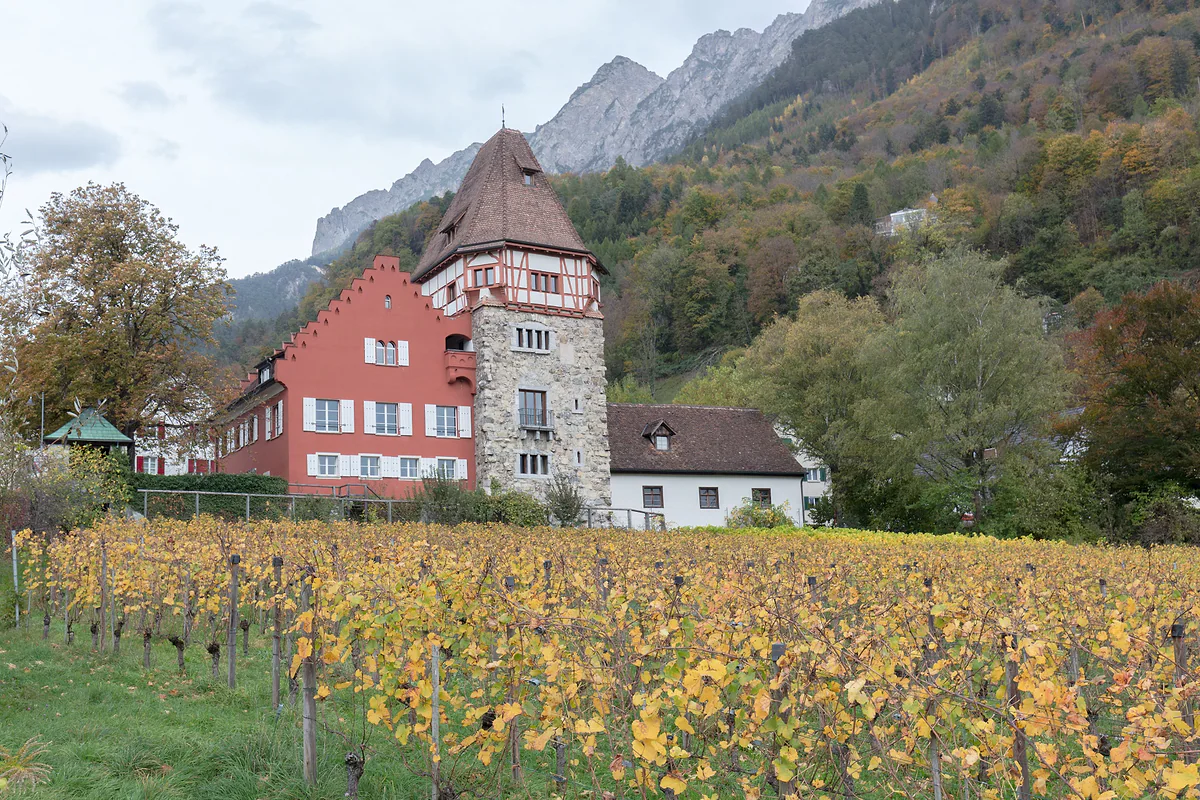
The Rotes Haus, a red house with a stone tower and half-timbered top, behind an autumn vineyard with the mountains behind.
The vineyards of Vaduz in figures
| Year | Area under vines | What was happening |
|---|---|---|
| 1808 | About 16 ha | 113 of Vaduz's 160 households owned vines |
| 1922 | 18.4 ha | Crisis sets in and the vineyards shrink |
| 1950 | 9.3 ha | The low point of the 20th century |
| 1976 | 9.8 ha | The vineyard zone is protected in the town plan |
| 1982 | Most of the vineyard | Building banned for 99 years to protect the townscape |
Figures from the Historical Lexicon (Vaduz entry). By 1875, 81.1% of Vaduz's must was already red.
Ways to explore the Mitteldorf
| How | Details | Price |
|---|---|---|
| On foot | Up from the northern end of the Städtle through the vineyard lanes | Free |
| Citytrain | 1 April to 31 October, at 13:00 and 16:30, 35 minutes | CHF 12, children CHF 5 |
| Liechtenstein Trail, stage 3 | Passes the Hofkellerei and the Red House on the way to Schaan | Free |
Test yourself
True or false?
0/3 Pick before you peek.
-
The Mitteldorf vineyards can be rezoned for housing whenever the council likes.
See the answer
False. Since 1982 most of the Vaduz vineyard has been under a 99-year building ban, set to preserve the look of the village.
-
By the 19th century most Vaduz wine was already red.
See the answer
True. Red must made up 81.1% of the total in 1875 and 97.4% in 1946, according to the Historical Lexicon.
-
In the early 19th century most households in Vaduz owned vines.
See the answer
True. In 1808, 113 of Vaduz's 160 households had their own vineyard, across about 16 ha in total.
Map
Where Mitteldorf is
The dashed line is the border: Switzerland across the Rhine, Austria to the north and east. Every number opens its guide.
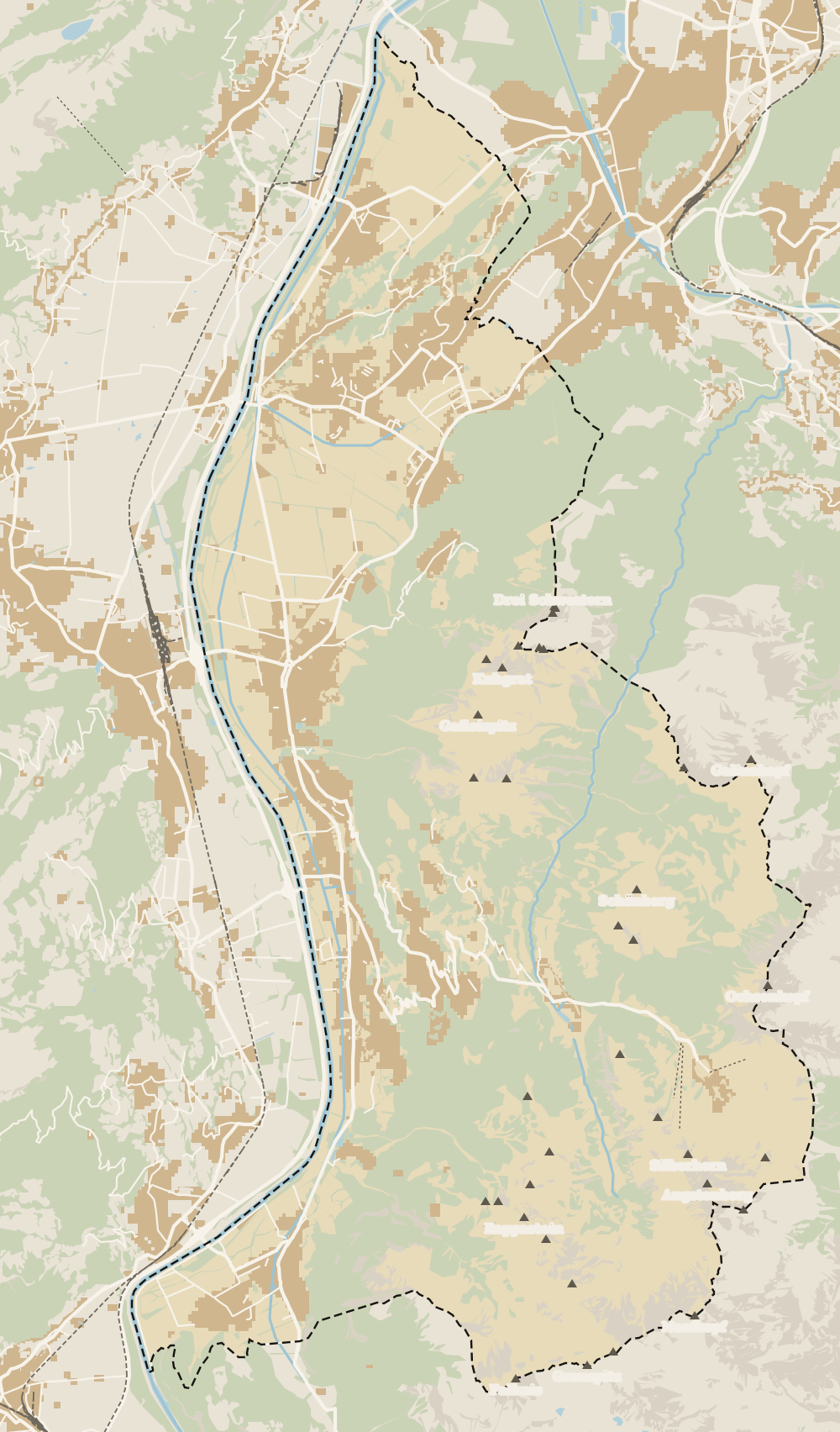 1Vaduz 2Städtle 3Mitteldorf 4Vaduz Castle 5Vaduz Cathedral 6Parliament 7Government Building 8Vaduz Town Hall 9Prince's Winery 10Old Rhine Bridge 11Schalun Castle Ruin 12Citytrain
 Map data © OpenStreetMap contributors (ODbL)
- 1VaduzA capital since 1719, home to 6,108 people
- 2StädtleCar-free since 28 June 2004
- 3MitteldorfVineyards protected until 2081
- 4Vaduz CastleThe Prince's residence, closed to visitors
- 5Vaduz CathedralA cathedral since 2 December 1997
- 6ParliamentNext sitting, 30 September to 2 October
- 7Government BuildingOpened on 28 December 1905
- 8Vaduz Town HallOpened on 19 November 1933
- 9Prince's WineryDaily tasting at 15:00, Saturdays at 14:00
- 10Old Rhine BridgeThe last wooden bridge on the Rhine
- 11Schalun Castle RuinAt 862 m, an hour's walk from Vaduz
- 12Citytrain2026 season runs until 31 October
What to see
What to see in Mitteldorf
0 of 168 Liechtenstein guides
Your next stamp
- Red House
- Städtle
- Vaduz Town Hall
- Vaduz
- Stage 3: Vaduz - Nendeln
- Government Building
- Schalun Castle Ruin
- Things to do
- One day
- Two days
- Municipalities
- Oberland
- Unterland
- Map
- Vaduz Castle
- Vaduz Cathedral
- Parliament
- Prince's Winery
- Old Rhine Bridge
- Schaan
- Balzers
- Citytrain
- Triesen
- Triesenberg
- Walser Museum
- Planken
- Gutenberg Castle
- The Rhine
- Schaan Roman fort
- Dux
- St Mamertus chapel
- Lawena valley
- Mäls
- DoMuS
- TAK Theatre
- Castles
- Churches and chapels
- Viewpoints
- Mountains
- Museums
- Kunstmuseum
- Mountain huts
- Hilti Art Foundation
- Pfälzerhütte
- Gafadura hut
- National Museum
- Treasure Chamber
- Postage Stamp Museum
- Kunstraum Engländerbau
- Eschen
- Masescha
- Gaflei
- Nendeln
- Mauren
- Silum
- Rotenboden
- Schaanwald
- Gamprin
- Wangerberg
- Bendern
- Steg
- Ruggell
- Samina valley
- Schellenberg Farmhouse Museum
- Cross-country skiing at Steg
- Küefer-Martis-Huus
- Ruggeller Riet
- Schellenberg
- Hinterschellenberg
- Fürstensteig
- Is it a country?
- Liechtenstein Trail
- Malbun
- Schellenberg castles
- Eschnerberg
- Malbun in summer
- Population
- Stage 1: Balzers - Triesenberg
- Lakes
- Sareis
- Size
- Stage 2: Triesenberg - Vaduz
- Malbun Peace Chapel
- Political system
- Swimming pools
- Language
- Skiing in Malbun
- Stage 4: Nendeln - Ruggell
- Dialect
- Malbun ski pass
- Stage 5: Ruggell - Schaanwald
- Hotels in Malbun
- Stamps
- Princess Gina Trail
- Hut-to-hut Route 66
- Hiking
- Getting there
- In winter
- Weather
- Airport
- Best time to visit
- In summer
- Events
- With kids
- Zurich to Liechtenstein
- National day
- Sargans to Vaduz
- Christmas
- Feldkirch to Vaduz
- By train
- Traditions
- Carnival
- Getting around
- Buses
- Funken Sunday
- Alpine cattle drive
- Driving and vignette
- Parking
- Bike hire
- Cycling
- EU and Schengen
- Entry requirements
- Borders and customs
- The prince
- The princely house
- The flag
- The coat of arms
- The national anthem
- History
- Second World War
- No army
- Facts
- Why so rich?
- Banks and tax haven
- Where to stay
- Hilti
- Hotels in Vaduz
- False teeth
- Hostel and camping
- Rent the country?
- Where to eat
- Restaurants in Vaduz
- Swiss invasions
- Bars and nightlife
- Food
- Käsknöpfle
- Wine
- Casinos
- Adventure Pass
- Rainy days
- Guided tours
- Tourist office
- Day trips
- Passport stamp
- Music festivals
- Phone and roaming
- Currency and payments
- Prices and budget
- Tipping
- Plugs and sockets
- Tap water
- Opening hours
- Public holidays
- Safety
- Accessibility
- With a dog
- Shopping and souvenirs
Frequently asked questions
What is the Mitteldorf in Vaduz?
It's one of the cores of the old farming village of Vaduz, the Metteldorf in dialect, where houses lined the lanes through the vineyards. Today it's the neighbourhood around the Red House, north of the centre.
Where is the Red House in Vaduz?
In the Mitteldorf, among the vines, north of the Städtle. You can walk there through the lanes of the quarter or take the Citytrain, which stops below it for photos.
Can you walk through the vineyards in Vaduz?
Along the lanes and paths of the quarter, yes. The vines belong to private owners, the Prince's winery or the cooperative, so I wouldn't walk between the rows. The Prince's vineyard also has a wine teaching trail.
Why is there no building on the Vaduz vineyards?
Since 1982 most of the vineyard zone has been under a 99-year building ban to preserve the look of the village. The 1973-1976 town plan had already moved it from building land to protected vineyard.
What wine is made in Vaduz?
Mostly red from Pinot Noir. By 1875, 81.1% of Vaduz's must was red, and some white came back from the 1950s with Riesling x Sylvaner. The Prince's Hofkellerei makes Pinot Noir and Chardonnay in the Herawingert.
By
Tourism graduate with a master’s in Tourism Management and Planning from the University of Málaga, who has travelled across Europe. He writes every guide from official sources and his own judgement.
Published on . Facts checked on .
Sources
Photos: Andrew Bossi (CC BY-SA 2.5); Diego Delso (CC BY-SA 4.0), via Wikimedia Commons.