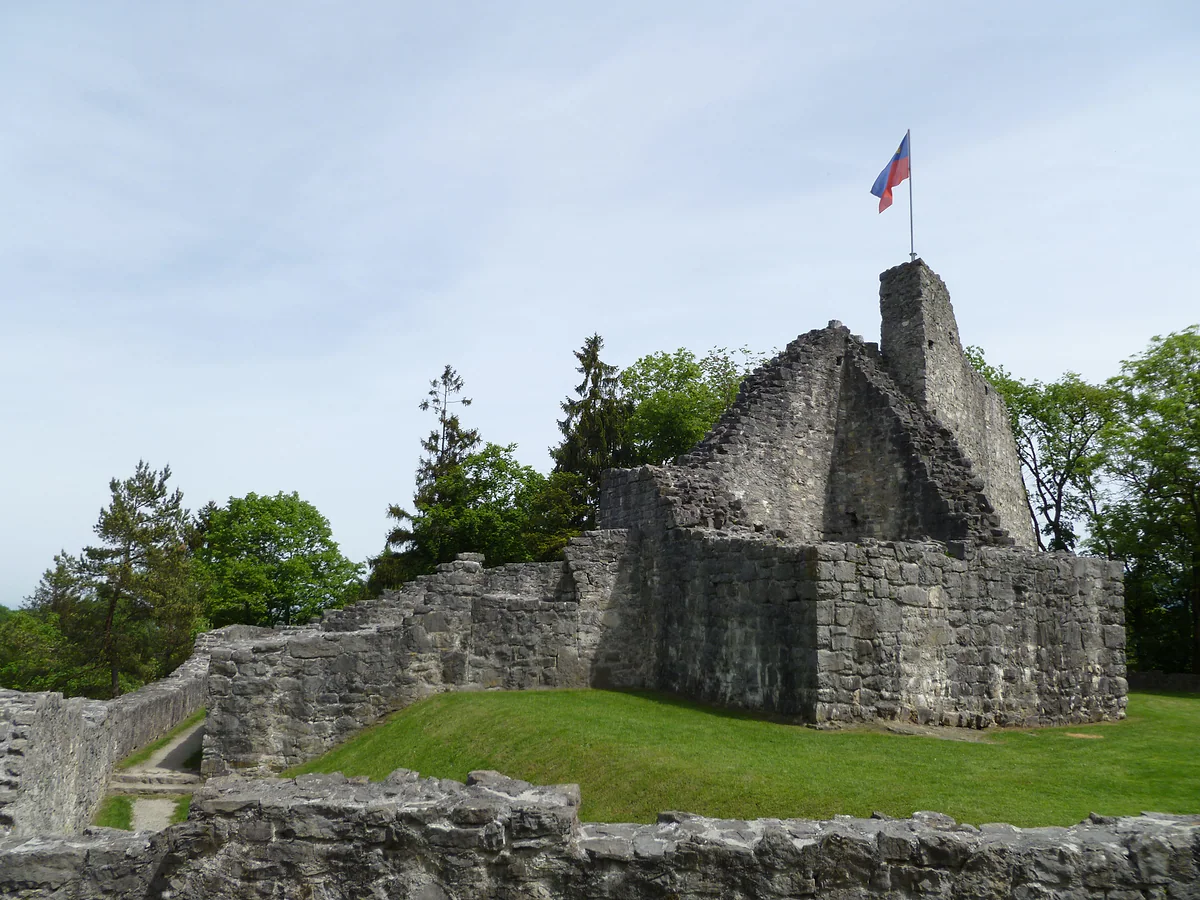
The country's smallest municipality
Schellenberg, the smallest municipality, up on the hill
Schellenberg is Liechtenstein's smallest municipality by area, at 3.6 km², and its second least populous, with 1,180 residents on 31 December 2025. It sits on top of the Eschnerberg, on the border with Feldkirch, and holds the ruins of the two castles of the lords of Schellenberg and a free rural museum in a log house from 1518.
In 30 seconds
Full read: 3 min
- Schellenberg is Liechtenstein's smallest municipality, 3.6 km² on top of the Eschnerberg.
- It has 1,180 residents, the second fewest in the country.
- It holds the ruins of two castles from the late 12th century.
- Its rural museum, in a 1518 house, opens free two Sundays a month from April to October.
Schellenberg is my favourite corner of the Unterland. I'd come up on route 33, take my time at the upper ruin, drop down to the lower one and, if it's the first or last Sunday of the month between April and October, pop into the rural museum for free between 14:00 and 17:00.

On the calendar
The dates at a glance
-
Bäuerliches WohnMuseum, open Sunday
Bäuerliches WohnMuseum, Schellenberg
-
Bäuerliches WohnMuseum, last Sunday of the season
Bäuerliches WohnMuseum, Schellenberg
Before you go
What I would keep in mind
-
01 Most beautiful
Two castles within a short walk
The lords of Schellenberg built two castles on the hill from the late 12th century. The tourist board says the upper one is a short stroll away and one of the country's best-loved outings.
the Schellenberg castle ruins -
02 To save money
A free museum in a house from 1518
The Bäuerliches WohnMuseum opens from April to October on the first and last Sunday of each month, 14:00 to 17:00, free of charge. In 2026 the remaining dates are 4 and 25 October.
the Schellenberg farmhouse museum (Bäuerliches WohnMuseum) -
03 Getting there
Take route 33 or 35
Route 33 climbs from Mauren to Schellenberg and route 35 runs from Nendeln to Hinterschellenberg via Bendern and Gamprin. There's a LIEbike station at the Schellenberg Post stop.
Liechtenstein's buses -
04 My tip
An hour's walk to Feldkirch
The Historisches Lexikon notes a medieval footpath linking the village with Feldkirch via St Corneli, Tosters and the Margarethenkapf in an hour.
day trips from Liechtenstein
What I would book
My ranking, scored
What I'd see in Schellenberg
My scores out of 10 for someone spending an afternoon here and looking for history, views and something you won't find elsewhere in the country.
0 of 5 seen
-
Upper castle (Obere Burg)
The more complete ruin, at 668 metres, with a ditch, keep and cistern. It's the one the tourist board singles out as a favourite outing.
8.7 out of 10
-
Rural museum (Bäuerliches WohnMuseum)
A 1518 log house showing how people lived around 1900. Free, but only two Sundays a month from April to October.
8.3 out of 10
-
Lower castle (Untere Burg)
Smaller, at 595 metres, with a reconstructed bread oven inside the walls. Easy to link on foot with the upper one.
7.6 out of 10
-
1960-63 parish church
Liechtenstein's first modern church, by Eduard Ladner, the result of the country's first international architecture competition.
7.0 out of 10
-
Hinterschellenberg and the 1945 stele
The hamlet where a small Russian army crossed in 1945, with a 1980 stele marking it and the chapel of St George.
6.9 out of 10
Schellenberg has the charm of small places that don’t try to look big. It’s the municipality with the least land in Liechtenstein, perched on top of the Eschnerberg looking across to Austria, and it holds two ruined castles and a log house from 1518. For a quiet afternoon in the Unterland, it’s the one that wins me over.
A village of five hamlets
Schellenberg covers 3.6 km², making it the smallest municipality in the country, and with 1,180 residents at the end of 2025 it’s the second least populous, after Planken. The village runs along the back of the Eschnerberg, between 432 metres in the Schellenberger Riet and 698 metres on the Gantenstein, its highest point. To the north and east its boundary is the border with Tisis, Tosters and Nofels, all part of Feldkirch.
The Historisches Lexikon explains that today’s village grew out of five hamlets, Loch and Platta on the Vorder-Schellenberg, Mittel-Schellenberg, Hinderschloss and Hinter-Schellenberg. It had no centre until a church was built in Mittel-Schellenberg in 1855-56 and nuns arrived to found a convent in 1858. Mittel-Schellenberg won that rivalry between hamlets, and Hinterschellenberg gets its own page, Hinterschellenberg, because it has plenty of story to tell.
Where does the name come from?
From the lords of Schellenberg, who settled on the Eschnerberg before 1180 and built their two castles there. The Lexikon says it’s the only municipality in Liechtenstein with a purely German name, and the place name appears around 1277-81. The lordship named after them is the one the Prince bought in 1699, and with it began what we now call the Unterland.
The two castles
The two ruins, upper and lower, are the main reason to come. They were built from the late 12th century to watch over the road to Italy, changed hands many times and were already described as broken by 1616. In 1956 Prince Franz Josef II gave them to the country’s historical society, which excavated and stabilised them. The tourist board says the upper one is a short walk away and among the country’s favourite outings. I go through them stone by stone on the Schellenberg castles.
A log house from 1518
The other big draw is the Bäuerliches WohnMuseum, a log house from 1518 that has been moved several times to save it and that since 1994 has shown how a farming family lived around 1900. It’s at Dorf 62 and run by the LandesMuseum. It opens from April to October on the first and last Sunday of each month, 14:00 to 17:00, with no entry charge. In 2026 there are two dates left, 4 and 25 October. Everything about the house is on the Schellenberg farmhouse museum.
A church that broke new ground
The parish church you see isn’t old, and that’s exactly what makes it interesting. It was built in 1960-63 to a design by Eduard Ladner, winner of the first international architecture competition held in Liechtenstein, and the Lexikon regards it as the country’s first modern church. It has been listed since 1992. Beside the convent, on the old cemetery, the little Maria Rast chapel went up in 1993.
A hill with a border and a memory
Schellenberg has always looked towards Feldkirch. A medieval footpath links the village with the Austrian town via St Corneli, Tosters and the Margarethenkapf in an hour, and at Hinter-Schellenberg there’s a border crossing that has been unstaffed since 1987. That’s where, in May 1945, what was left of a Russian army crossed over, an episode the village marked in 1980 with a memorial stone. I tell that story on the Hinterschellenberg page.
The hill had its religious life and its inns too. The convent’s nuns, who arrived in 1858, worked for decades as nursery teachers, sacristans and nurses here and in other villages, and in 1998 the Archbishop of Vaduz, Wolfgang Haas, took up residence in the convent. In 1883 the «Krone» and «Kreuz» inns opened in Mittel-Schellenberg, and that same year the first of them housed the village’s first grocery shop.
To get around, route 33 climbs from Mauren and route 35 reaches Hinterschellenberg from Nendeln, Bendern and Gamprin. The fifth stage of the Liechtenstein Trail comes up from the Ruggeller Riet, passes the ruins and the museum and carries on towards Mauren. And if you stay for lunch, the Wirtschaft zum Löwen in Hinterschellenberg is on the official list of Käsknöpfle houses.
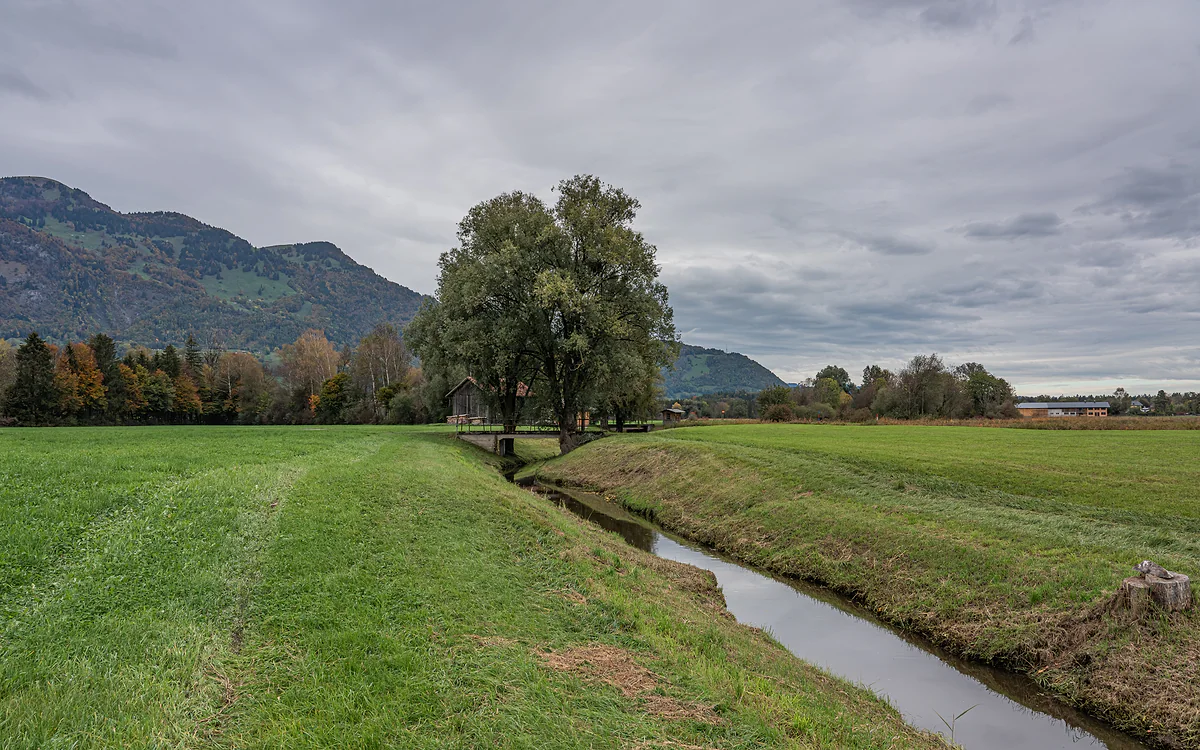
The Ruggeller Riet, with a ditch between meadows, a large tree and the mountains under a grey sky.
Schellenberg in figures
| Fact | Figure |
|---|---|
| Residents on 31-12-2025 | 1,180 |
| Area | 3.6 km², the country's smallest |
| Highest point | 698 m, on the Gantenstein |
| Lowest point | 432 m, in the Schellenberger Riet |
| Parish church | 626 m |
Population and area from the Office of Statistics; altitudes from the Historisches Lexikon.
Schellenberg rural museum, 2026
| What | Details |
|---|---|
| Address | Dorf 62 |
| Season | April to October |
| Days | First and last Sunday of each month |
| Hours | 14:00-17:00 |
| Dates left in 2026 | 4 and 25 October |
| Admission | Free |
LandesMuseum, which runs the museum.
Test yourself
True or false?
0/4 Pick before you peek.
-
Schellenberg has the fewest residents of any municipality in Liechtenstein.
See the answer
False. It's the smallest by area, but Planken has the fewest people. Schellenberg is second from bottom.
-
Schellenberg is the only municipality in the country with a purely German name.
See the answer
True. So says the Historisches Lexikon. The name comes from the lords of Schellenberg, who arrived before 1180.
-
Schellenberg's church is medieval.
See the answer
False. It dates from 1960-63, designed by Eduard Ladner, and the Lexikon counts it as Liechtenstein's first modern church.
-
The Schellenberg castles still belong to the princely house.
See the answer
False. Prince Franz Josef II gave them in 1956 to the country's historical society, the Historischer Verein.
- The country's smallest municipality
- 3.6 km²
- Residents on 31-12-2025
- 1,180
- Year of the rural museum's house
- 1518
- Gantenstein, its highest point
- 698 m
Map
Where Schellenberg is
The dashed line is the border: Switzerland across the Rhine, Austria to the north and east. Every number opens its guide.
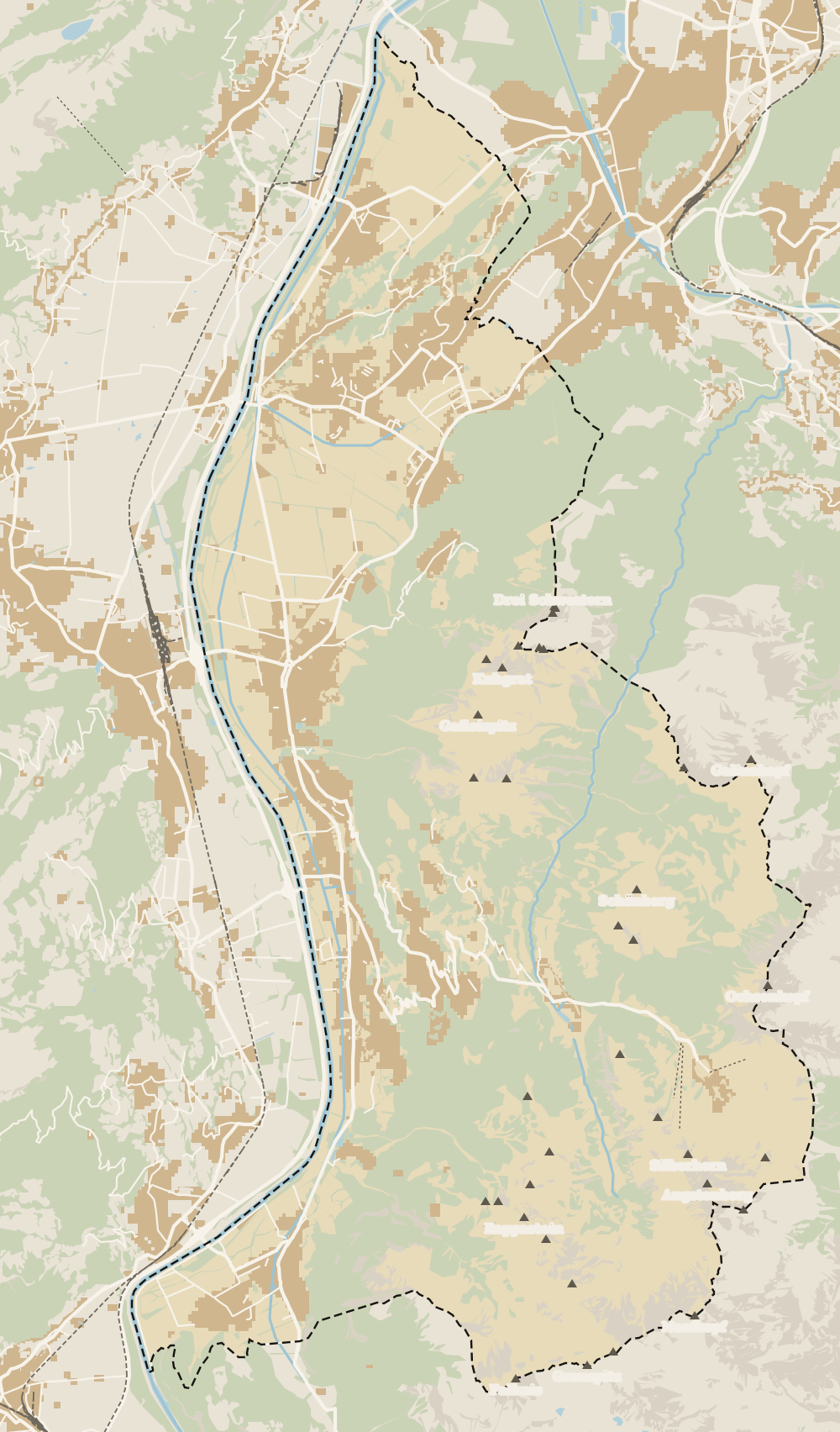 1Schellenberg Farmhouse Museum 2Schellenberg 3Hinterschellenberg 4Schellenberg castles
 Map data © OpenStreetMap contributors (ODbL)
What to see
What to see in Schellenberg
0 of 168 Liechtenstein guides
Your next stamp
- Schellenberg Farmhouse Museum
- Unterland
- Schellenberg castles
- Size
- Municipalities
- Balzers
- Eschen
- Things to do
- One day
- Two days
- Oberland
- Map
- Vaduz
- Städtle
- Mitteldorf
- Vaduz Castle
- Vaduz Cathedral
- Parliament
- Government Building
- Vaduz Town Hall
- Red House
- Prince's Winery
- Old Rhine Bridge
- Schaan
- Schalun Castle Ruin
- Citytrain
- Triesen
- Triesenberg
- Walser Museum
- Planken
- Gutenberg Castle
- The Rhine
- Schaan Roman fort
- Dux
- St Mamertus chapel
- Lawena valley
- Mäls
- DoMuS
- TAK Theatre
- Castles
- Churches and chapels
- Viewpoints
- Mountains
- Museums
- Kunstmuseum
- Mountain huts
- Hilti Art Foundation
- Pfälzerhütte
- Gafadura hut
- National Museum
- Treasure Chamber
- Postage Stamp Museum
- Kunstraum Engländerbau
- Masescha
- Gaflei
- Nendeln
- Mauren
- Silum
- Rotenboden
- Schaanwald
- Gamprin
- Wangerberg
- Bendern
- Steg
- Ruggell
- Samina valley
- Cross-country skiing at Steg
- Küefer-Martis-Huus
- Ruggeller Riet
- Hinterschellenberg
- Fürstensteig
- Is it a country?
- Liechtenstein Trail
- Malbun
- Eschnerberg
- Malbun in summer
- Population
- Stage 1: Balzers - Triesenberg
- Lakes
- Sareis
- Stage 2: Triesenberg - Vaduz
- Malbun Peace Chapel
- Political system
- Stage 3: Vaduz - Nendeln
- Swimming pools
- Language
- Skiing in Malbun
- Stage 4: Nendeln - Ruggell
- Dialect
- Malbun ski pass
- Stage 5: Ruggell - Schaanwald
- Hotels in Malbun
- Stamps
- Princess Gina Trail
- Hut-to-hut Route 66
- Hiking
- Getting there
- In winter
- Weather
- Airport
- Best time to visit
- In summer
- Events
- With kids
- Zurich to Liechtenstein
- National day
- Sargans to Vaduz
- Christmas
- Feldkirch to Vaduz
- By train
- Traditions
- Carnival
- Getting around
- Buses
- Funken Sunday
- Alpine cattle drive
- Driving and vignette
- Parking
- Bike hire
- Cycling
- EU and Schengen
- Entry requirements
- Borders and customs
- The prince
- The princely house
- The flag
- The coat of arms
- The national anthem
- History
- Second World War
- No army
- Facts
- Why so rich?
- Banks and tax haven
- Where to stay
- Hilti
- Hotels in Vaduz
- False teeth
- Hostel and camping
- Rent the country?
- Where to eat
- Restaurants in Vaduz
- Swiss invasions
- Bars and nightlife
- Food
- Käsknöpfle
- Wine
- Casinos
- Adventure Pass
- Rainy days
- Guided tours
- Tourist office
- Day trips
- Passport stamp
- Music festivals
- Phone and roaming
- Currency and payments
- Prices and budget
- Tipping
- Plugs and sockets
- Tap water
- Opening hours
- Public holidays
- Safety
- Accessibility
- With a dog
- Shopping and souvenirs
Frequently asked questions
What is there to see in Schellenberg, Liechtenstein?
The ruins of the two castles of the lords of Schellenberg, the rural museum in a 1518 log house, Eduard Ladner's modern church and, in Hinterschellenberg, St George's chapel and the 1945 stele.
What is the smallest municipality in Liechtenstein?
Schellenberg, at 3.6 km². Planken has the fewest residents, and Schellenberg, with 1,180 at the end of 2025, comes second.
How do you get to Schellenberg?
By bus, route 33 climbs from Mauren and route 35 reaches Hinterschellenberg from Nendeln, Bendern and Gamprin. On foot, the last stage of the Liechtenstein Trail crosses the village.
Why is it called Schellenberg?
After the lords of Schellenberg, who settled on the Eschnerberg before 1180 and built the two castles. The Lexikon says it's the only municipality in the country with a purely German name.
When is the Schellenberg rural museum open?
From April to October, on the first and last Sunday of each month, 14:00 to 17:00, with free admission. In 2026 the remaining dates are 4 and 25 October.
By
Tourism graduate with a master’s in Tourism Management and Planning from the University of Málaga, who has travelled across Europe. He writes every guide from official sources and his own judgement.
Published on . Facts checked on .
Sources
Photos: SchuetzeZH (CC BY-SA 4.0); A.Savin (FAL), via Wikimedia Commons.