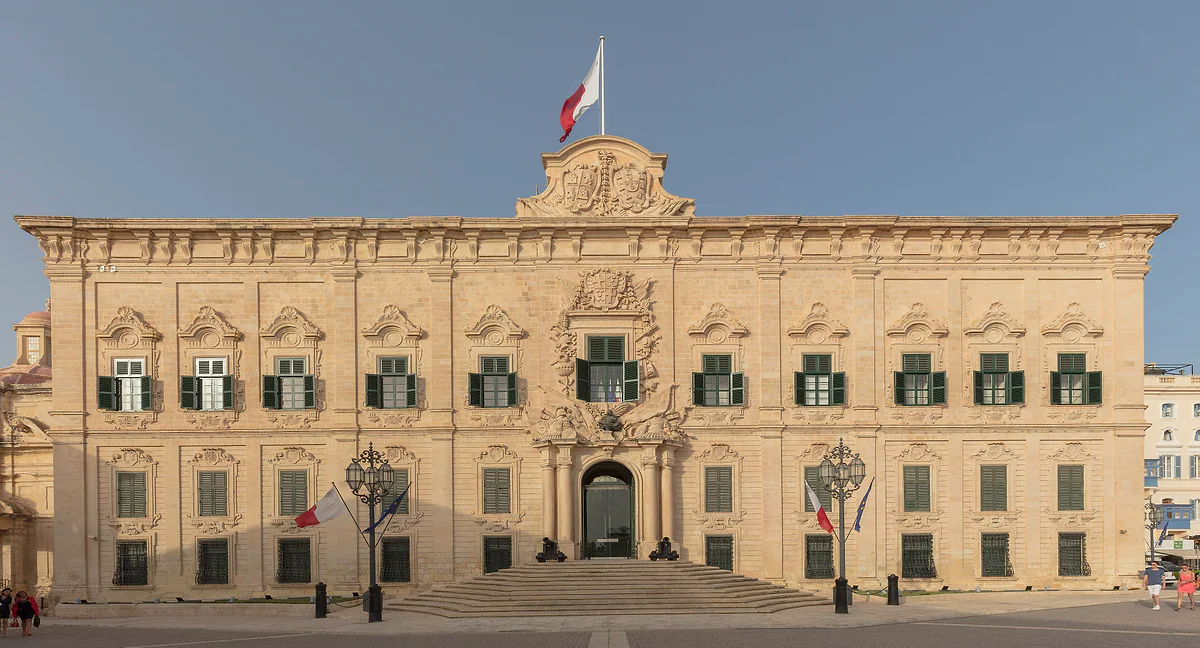
The emblem of the Republic of Malta
The Malta coat of arms, piece by piece, and how it differs from the Order's
Malta's coat of arms is a shield bearing the national flag, topped by a gold mural crown with eight turrets, five of them visible, which stand for the islands' fortifications and their status as a city state. An olive branch and a palm branch, symbols of peace, surround it, tied with a white ribbon reading 'Repubblika ta' Malta'. It's set out in the Emblem and Public Seal of Malta Act, Chapter 253.
In 30 seconds
Full read: 3 min
- Malta's coat of arms carries the national flag on its shield.
- The mural crown with eight turrets, five visible, stands for the fortifications and the city state.
- The olive and palm are symbols of peace traditionally associated with Malta.
- The ribbon reads 'Repubblika ta' Malta', and using the emblem in a design needs the Prime Minister's permission.
Of the whole emblem, the mural crown is my favourite piece. Eight turrets to say Malta is a walled city state strikes me as the most honest summary of the country, because its fortifications are what you'll see most on any trip.

Before you go
What I would keep in mind
-
01 Most beautiful
A crown of towers for an island of forts
The law explains that the eight-turreted mural crown represents Malta's fortifications and its status as a city state. Walking Valletta's bastions is the best way to understand it.
the forts of Malta -
02 My tip
It isn't the Order of Malta's coat of arms
The Order's arms show a white Latin cross on a red oval, with a rosary, princely mantle and crown. The Republic's shows the national flag with the George Cross.
the Knights of Malta -
03 My tip
Where you'll see it without looking
The President's flag, in use since 1988, carries the Malta coat of arms in the centre of a blue field. It flies at the President's residences and offices and wherever he or she is present.
the Malta flag
What I would book
Malta’s coat of arms reads almost like a sentence. It has four elements and each says something specific about the country, and handily, the law that governs it explains what each one means. Here it is piece by piece, how it differs from the Order of Malta’s arms, which is where most of the confusion lies, and where you’ll come across it on a trip.
What the Malta coat of arms looks like
It’s set out in the Emblem and Public Seal of Malta Act, Chapter 253, and the Government reproduces the wording on its flags and symbols page. At the centre is a shield with a heraldic representation of the national flag, white and red with the George Cross. Above it sits a gold mural crown with a sally port and eight turrets, only five of them visible. Around it are two branches, olive on the dexter side and palm on the sinister, in their natural colours. And at the base they’re tied with a white ribbon, backed in red, reading ‘Repubblika ta’ Malta’ in black capitals.
It’s a republican emblem through and through. The motto is simply the name of the state in Maltese, Republic of Malta, and the flag inside it is the one described in the Malta flag, with the 1942 medal in the canton.
What does each piece mean?
The crown carries the most meaning, and the law is blunt about it. The turrets represent Malta’s fortifications and the crown denotes a city state. I think that’s spot on, because if anything defines these islands’ landscape it’s the bastions, watchtowers and forts I cover in the forts of Malta. UNESCO’s Tentative List entry puts the harbour walls alone at some 25 km, and the crown sums it all up in eight turrets.
The branches are simpler. The law calls the olive and palm symbols of peace, traditionally associated with Malta. And the ribbon, white on the front and red on the back, repeats the colours of the flag.
It isn’t the Order of Malta’s coat of arms
This is where most people go wrong, because a search for the Malta coat of arms often throws up the Knights’ arms instead. They’re two separate things. The Order of Malta describes its arms as a white Latin cross on a red oval surrounded by a rosary, all set over a white eight-pointed cross and beneath a princely mantle and crown. For its medical and humanitarian work it uses another emblem, a red shield with the white eight-pointed cross.
The Republic’s arms carry neither a Latin cross nor an eight-pointed one. They carry the national flag, which in turn carries the George Cross. For more on the Knights and their symbols, see the Knights of Malta.
Where you’ll see it
The most visible place is the President’s flag. The Government explains that it was introduced by proclamation on 12 December 1988 and is blue, with the Malta coat of arms at its heart and a gold eight-pointed cross in every corner. It flies at the President’s residences and offices and wherever the President is present, so in Valletta you’ll see it at the Grandmaster’s Palace, home to the Office of the President. What the President actually does is covered in how Malta is governed. The merchant ensign and the naval jack don’t carry it, using the Maltese cross and the George Cross instead, which is one more reason the three symbols get muddled.
What the law protects, and Malta’s other symbols
The Emblem Act is fairly strict. It makes it unlawful to publicly vilify the flag or the emblem, by words, gestures, writing or pictures, or to deface them in any way. It also bans incorporating them, or Malta’s former emblems, into any design without the Prime Minister’s written authority. If you fancy a souvenir with the coat of arms on it, buy one from a shop rather than printing your own.
The coat of arms has company. The Government lists the other symbols of the state, the national anthem, ‘L-Innu Malti’, covered in the Malta national anthem; the Maltese cross as the national symbol; and the Republic’s two honours, the National Order of Merit, ‘Ġieħ ir-Repubblika’, and the ‘Midalja għall-Qadi tar-Repubblika’. Together with the flag and the coat of arms, they’re how Malta has presented itself as a republic since 1974.
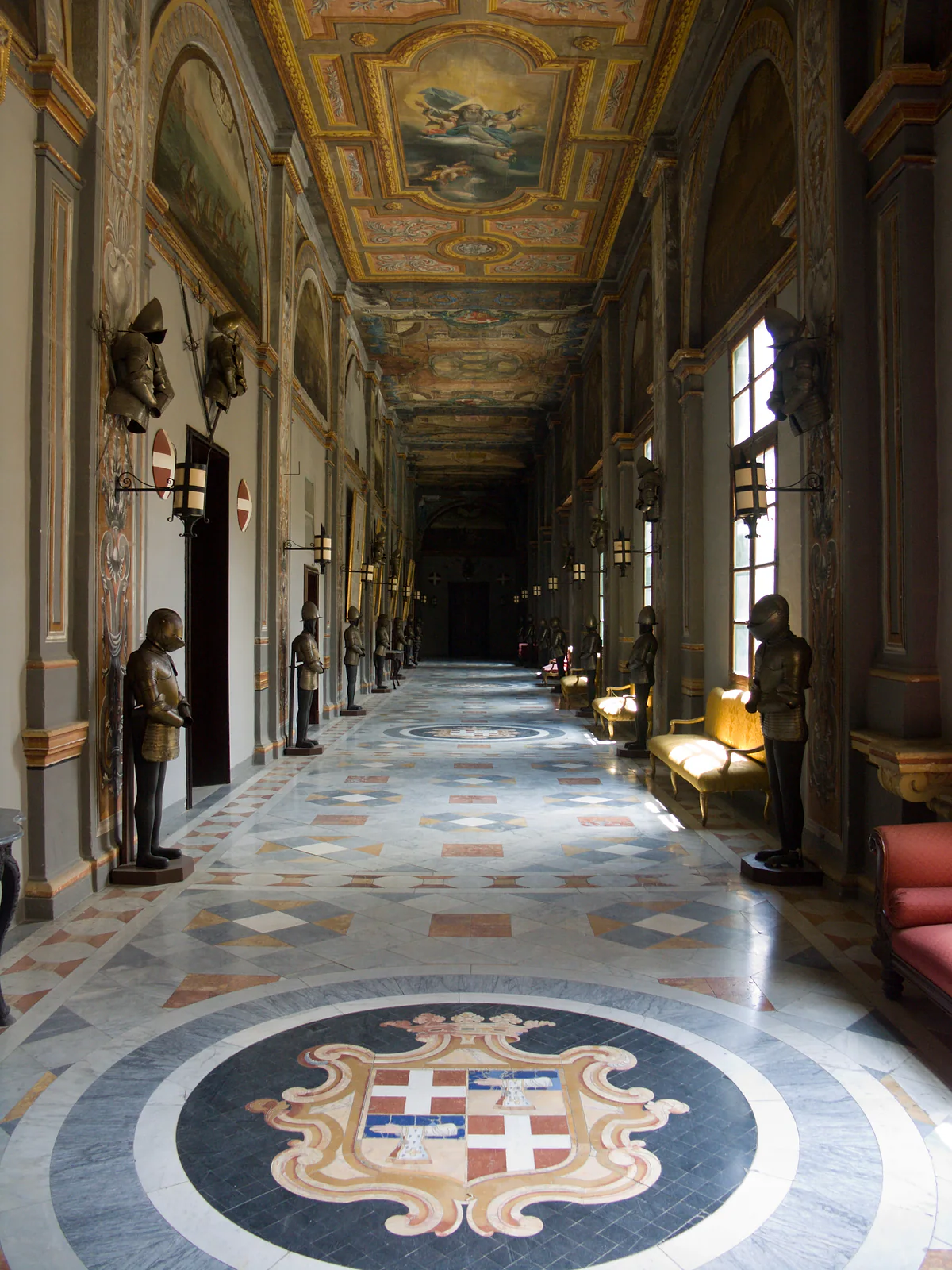
A corridor in the Grandmaster's Palace in Valletta, lined with suits of armour, with painted ceilings and the Order's arms in the marble floor.
The parts of the Malta coat of arms
| Part | What it looks like | What the law says it represents |
|---|---|---|
| Shield | A heraldic representation of the national flag | The flag of Malta |
| Mural crown | Gold, with a sally port and eight turrets, five of them visible | Malta's fortifications and its status as a city state |
| Olive branch | On the shield's dexter side | Peace, traditionally associated with Malta |
| Palm branch | On the shield's sinister side | Peace, traditionally associated with Malta |
| Ribbon | White, backed red, with black capital letters | The name of the state, Repubblika ta' Malta |
Description from the Emblem and Public Seal of Malta Act (Chapter 253), as given on the Government's flags and symbols page.
Malta's coat of arms and the Order of Malta's
| Republic of Malta | Order of Malta | |
|---|---|---|
| Centre | The national flag with the George Cross | White Latin cross on a red oval |
| Around it | Olive and palm | A rosary, over an eight-pointed cross |
| On top | Mural crown with eight turrets | Princely mantle and crown |
| Text | Repubblika ta' Malta | No motto in the official description |
Test yourself
True or false?
0/3 Pick before you peek.
-
Malta's coat of arms has the eight-pointed cross in the centre.
See the answer
False. It shows the national flag, white and red with the George Cross. The eight-pointed cross is on the Order of Malta's arms.
-
The crown on the coat of arms has eight turrets, but only five can be seen.
See the answer
True. That's how the law describes it, with a sally port and eight turrets of which five are visible, representing the fortifications.
-
Anyone can print Malta's coat of arms on a T-shirt without permission.
See the answer
False. The Emblem Act requires the Prime Minister's written permission to include the flag, the emblem or former emblems in any design.
- Turrets on the mural crown
- 8
- Turrets you can see
- 5
- Chapter number of the Emblem Act
- 253
- The emblem appears on the President's flag
- 1988
0 of 279 Malta guides
Your next stamp
- Maltese cross
- Flag
- Malta government
- Forts and fortifications
- Malta facts
- Things to do in Malta
- Gozo
- Most beautiful places
- Comino
- Prettiest villages
- UNESCO World Heritage Sites
- Where is Malta
- The Maltese islands
- Towns and villages
- Island of Malta
- Blue Lagoon
- Fort Rinella
- Fort St Angelo
- Gardjola Gardens
- Ħal Saflieni Hypogeum
- Is Malta a country?
- Popeye Village
- Tarxien Temples
- Things to do in Gozo
- Valletta
- Esplora
- Golden Bay
- Gozo day trip
- Inquisitor's Palace
- Population
- St John's Co-Cathedral
- St Mary's Tower
- Grandmaster's Palace
- How big is Malta
- Maritime Museum
- Mellieħa Bay
- Fort St Elmo
- Language
- Malta at War Museum
- Paradise Bay
- Barrakka Gardens
- Red Tower
- Religion
- Saluting Battery
- MUŻA
- National Museum of Archaeology
- Underground Valletta
- Lascaris War Rooms
- Casa Rocca Piccola
- Malta in one day
- Three Cities
- Victoria
- Birgu
- Manoel Theatre
- Weekend in Malta
- Xagħra
- City Gate and Parliament
- Malta in three days
- Nadur
- Senglea
- Cospicua
- Malta in four days
- Qala
- Valletta Waterfront
- Għajnsielem
- Kalkara
- Malta in five days
- Malta in a week
- Paola
- Xewkija
- Sannat
- Tarxien
- Munxar
- Żabbar
- Fgura
- Fontana
- Kerċem
- Luqa
- Floriana
- Marsa
- Mellieħa
- The Citadel, Gozo
- Żebbuġ (Gozo)
- Ġgantija Temples
- Marsalforn
- Santa Luċija
- Ramla Bay
- San Lawrenz
- Xgħajra
- Xwejni salt pans
- Calypso's Cave
- Għarb
- Żejtun
- Għasri
- Gudja
- San Blas Bay
- Għaxaq
- Ħondoq Bay
- Marsaxlokk
- Kirkop
- Marsaxlokk Fish Market
- Mqabba
- St Peter's Pool
- Marsaskala
- Qrendi
- Żurrieq
- Beaches
- Comino ferry
- EU, Schengen and the euro
- Ħaġar Qim and Mnajdra
- Mdina
- Mġarr (Gozo)
- Blue Grotto
- Diving
- Entry requirements
- Mdina Cathedral
- Xewkija Rotunda
- Birżebbuġa
- Money and payments
- Palazzo Falson
- Safi
- Shipwrecks
- Ta' Ċenċ Cliffs
- Għar Dalam
- Mdina Dungeons
- Mġarr ix-Xini
- Prices and budget
- Snorkelling
- Boat trips
- Malta on a budget
- Playmobil FunPark
- Rabat (Malta)
- Xlendi
- Dwejra
- Gozo beaches
- History
- Siġġiewi
- St Paul's Catacombs
- Tipping
- Azure Window
- Domvs Romana
- Għar Lapsi
- Great Siege of 1565
- Plugs
- Limestone Heritage Park
- Second World War
- St Paul's Grotto
- Ta' Pinu Basilica
- Time zone
- Buskett Gardens
- Knights of Malta
- Mobile and roaming
- Wied il-Għasri
- Dingli
- Dingli Cliffs
- Żebbuġ
- Mtarfa
- Balzan
- National anthem
- Lija
- Game of Thrones
- Iklin
- Attard
- Film locations
- San Anton Gardens
- Ta' Qali Crafts Village
- Victoria Lines
- Megalithic temples
- Catacombs
- Museums
- Where to eat
- Where to stay
- Churches
- Hotels in Valletta
- Restaurants in Valletta
- Hotels in Sliema
- Maltese food
- Restaurants in Marsaxlokk
- Viewpoints
- Hotels in St Julian's
- Pastizzi
- Walking and hiking
- Hotels in Buġibba and Qawra
- Maltese rabbit stew
- Safety
- Hotels in Mellieħa
- Kinnie and Cisk
- Scams
- Gozo hotels
- Nightlife
- Tap water
- Boat parties
- Holiday packages
- Tourist tax
- All inclusive
- Gay Malta
- Sightseeing passes
- Apartments
- Malta with kids
- Public holidays
- How to get there
- Luxury
- Malta for couples
- Taxis and ride-hailing
- Weather
- Best time to visit
- Cycling
- English schools
- Flights
- Flights from Madrid
- Sea temperature
- Shopping and souvenirs
- Airport
- Free walking tours
- In winter
- Airport transfers
- Day trips and tours
- In summer
- Ferry from Sicily
- In January
- Cruise stop
- In February
- In March
- In April
- In May
- Getting around
- In June
- Buses
- July
- August
- Hop on hop off
- Gozo ferry
- September
- Gozo fast ferry
- October
- November
- Valletta ferries
- Car hire
- December
- Driving
- Events
- St Paul's Bay
- Village feasts
- Buġibba
- Christmas
- Easter
- Qawra
- Carnival
- Xemxija
- Fireworks festival
- Malta National Aquarium
- Isle of MTV
- St Paul's Islands
- Mosta
- Mosta Rotunda
- Naxxar
- Palazzo Parisio
- Għargħur
- Mġarr (Malta)
- Sliema
- Ta' Ħaġrat and Skorba Temples
- Għajn Tuffieħa Bay
- Tigné Point
- Ġnejna Bay
- St Julian's
- Paceville
- St George's Bay
- Gżira
- Msida
- Ta' Xbiex
- Pietà
- Pembroke
- Swieqi
- San Ġwann
- Birkirkara
- Ħamrun
- Santa Venera
- Qormi
Frequently asked questions
What does the Malta coat of arms look like?
A shield showing the national flag, a gold mural crown with eight turrets above it, an olive and a palm branch around it and a white ribbon reading 'Repubblika ta' Malta' in black. It's described in the Emblem Act, Chapter 253.
What does the crown on Malta's coat of arms mean?
According to the law, the gold mural crown, with a sally port and eight turrets of which five are visible, represents Malta's fortifications and denotes a city state.
What does 'Repubblika ta' Malta' mean?
It's Maltese for Republic of Malta. It's written in black capitals on a white ribbon backed in red.
Why are there olive and palm branches?
The law describes them as symbols of peace traditionally associated with Malta. The olive is on the dexter side of the shield and the palm on the sinister.
Is the Malta coat of arms the same as the Knights of Malta's?
No. The Order's arms show a white Latin cross on a red oval surrounded by a rosary, over an eight-pointed cross and under a mantle and crown. The Republic's arms carry the national flag.
Can I use the Malta coat of arms on a design?
Not without the Prime Minister's written permission. The Emblem Act forbids it, as it does for the flag and Malta's former emblems, and bans insulting or defacing them.
By
Tourism graduate with a master’s in Tourism Management and Planning from the University of Málaga, who has travelled across Europe. He writes every guide from official sources and his own judgement.
Published on . Facts checked on .
Sources
Photos: Diego Delso (CC BY-SA 4.0); Jean-Christophe BENOIST (CC BY 2.5), via Wikimedia Commons.