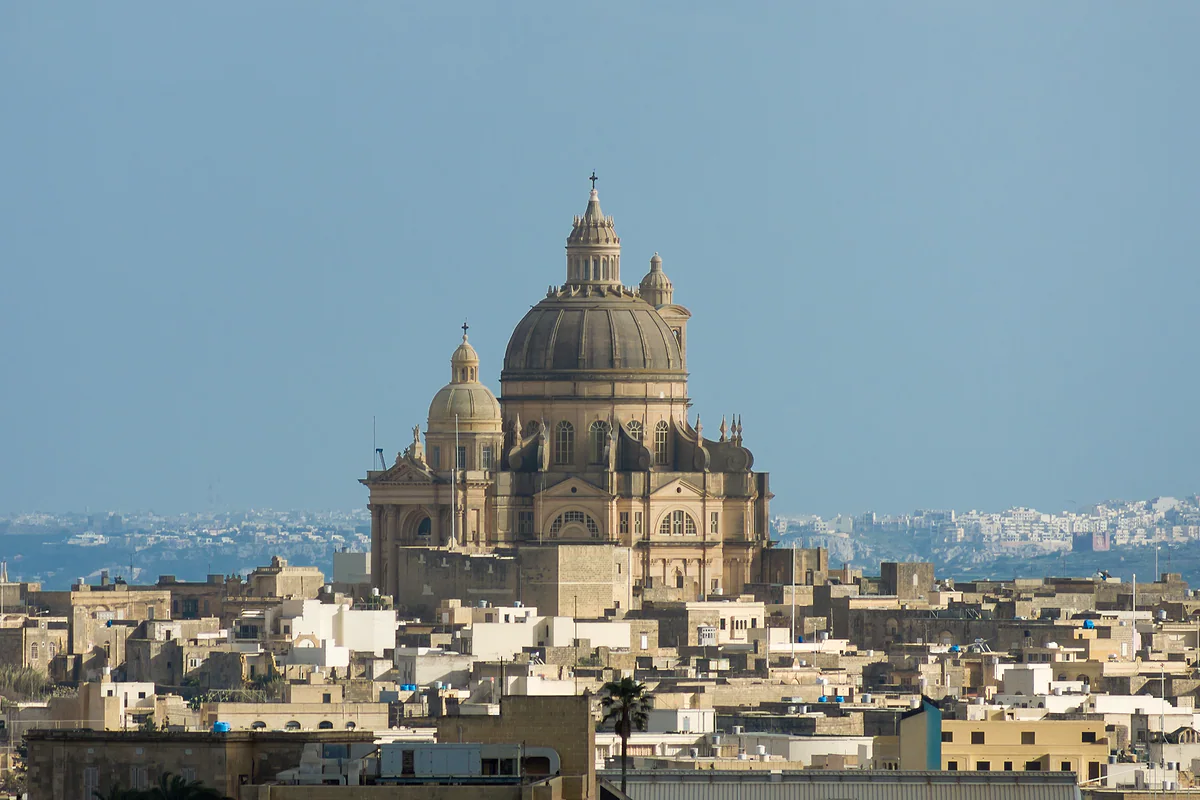
A village on Gozo
Xewkija, the stonemasons' village that built Gozo's great dome
Xewkija is a village of 3,790 people (NSO, 2025) between Mġarr harbour and Victoria. It has the Rotunda of St John the Baptist, Gozo's largest church, a Knights-era windmill with an octagonal ground floor and the road down to Mġarr ix-Xini. In 1678 it became Gozo's first parish outside Victoria.
In 30 seconds
Full read: 3 min
- Xewkija is a Gozo village of 3,790 people between Mġarr harbour and Victoria.
- It's home to the Rotunda of St John the Baptist, Gozo's largest church, with a dome 75 metres high.
- Its Knights-era windmill has an octagonal ground floor, unique on the island according to the Ministry for Gozo.
- The road down to the cove at Mġarr ix-Xini starts in the village.
Most people give Xewkija twenty minutes for the Rotunda and drive on. I'd give it a morning, because the windmill, the square and the walk down to Mġarr ix-Xini are what turn a photo stop into a proper visit.

Before you go
What I would keep in mind
-
01 Most beautiful
A dome you can see from half the island
The Rotunda stands 75 metres high and was built by the villagers themselves between the 1950s and the 1970s. Inside, the old church has been rebuilt stone by stone as a museum.
Xewkija Rotunda -
02 My tip
The windmill of the eight winds
The Knights-era windmill by the Mġarr road has an eight-sided ground floor, one face per wind. The Ministry for Gozo says no other mill on the island is built like it.
-
03 Getting there
From the square to the tower cove
A narrow, steep road drops from Xewkija to Mġarr ix-Xini. If you have the time, walk it, because the valley is the best part of the trip.
Mġarr ix-Xini -
04 To save money
A cheaper base near the ferry
You're minutes from Mġarr harbour and Victoria, with plenty of village houses and flats to let. After a late crossing it's a far easier first night than the coast.
Gozo hotels
What I would book
Xewkija is the first village you notice when you arrive on Gozo. Its dome rises above the fields as the road climbs away from the harbour, and plenty of people take the photo and carry on to Victoria. I think that’s a mistake, because there’s a good deal more here than the skyline.
Halfway between the ferry and the capital
The village sits on the south-eastern plateau, roughly halfway between Mġarr harbour and Victoria. The NSO counted 3,790 residents at the end of 2025, 735 of them foreign nationals. According to the Ministry for Gozo, no village on the island has been lived in for longer, and it backs that up with two facts. Megalithic ruins turned up here in 1647, and on 27 November 1678 Xewkija became the first parish on Gozo outside Victoria, and the first place with official village status.
The name comes from Arabic and describes thorny wasteland, which is hard to picture now. Today it ranks among the bigger villages on Gozo, and on its edges you’ll find the Gozo campus of the University of Malta, the island’s football stadium and its industrial estate.
The Rotunda, the reason most people stop
The Xewkija Rotunda, dedicated to St John the Baptist, is Gozo’s largest church. Villagers built it between the 1950s and the 1970s around the old parish church, which stayed in use throughout. The dome reaches 75 metres, and inside there’s a Sculpture Museum where the stones of the earlier church were numbered and put back together.
It has its own page, so I won’t retell the story here. The one thing I’d underline is that Xewkija is a village of stonemasons, and local families carved the Rotunda. Wander the back streets and you’ll see that craft on ordinary house fronts, and with luck a workshop open near the windmill.
An eight-sided windmill and two very old chapels
As you come in on the Mġarr road you pass the windmill from the time of Grand Master Perellos, who led the Order from 1697 to 1720. The Ministry for Gozo says it’s unique on the island because the ground floor is octagonal, one face for each of the eight principal winds. It’s been restored, takes visitors and still has its bread oven. Neither opening hours nor a price are published, so I’d call in briefly if you happen to find the door open.
Where the Qala and Mġarr roads cross stands the chapel of Madonna tal-Ħniena, also dedicated to St Bartholomew. The historian Achille Ferres placed a church on this spot in 1397, and the present one was rebuilt in 1643. On the village edge you’ll also find the tower and chapel of St Cecilia, which the Ministry reckons is the oldest chapel on Gozo.
What else is there to do in Xewkija?
The other big draw is down on the coast. A road leaves the village for the valley and Mġarr ix-Xini, the cove with a Knights’ tower guarding its entrance. It’s steep and single-track in places, so I’d walk it if I had the time. The valley, which separates Xewkija from Sannat, is good walking country and, in winter and spring, a spot for abseiling.
In the village itself, my favourite place is the square, with its band clubs, cafés and the odd old-fashioned bakery tucked away in the side streets. The Ministry even mentions a grocer’s that still has its vintage sign. It’s a good place to see how a Gozitan village ticks over at lunchtime, without the bustle of Victoria.
The giant umbrella, and where to stay
The feast of St John the Baptist is held on the Sunday nearest 24 June, which in 2026 was the 21st. According to the Ministry, a giant umbrella is hung over the street so that young people can dance to the band marches out of the sun. It’s one of the first festas of the Gozitan summer.
As a base, Xewkija puts you close to the ferry and the capital without the noise of either. The MTA register lists a single hotel in the village, and the Ministry counts it among the villages with small hotels near the square, but most of what’s on offer is houses and flats. If you’re coming over on a late Gozo ferry, it makes a very sensible first night.
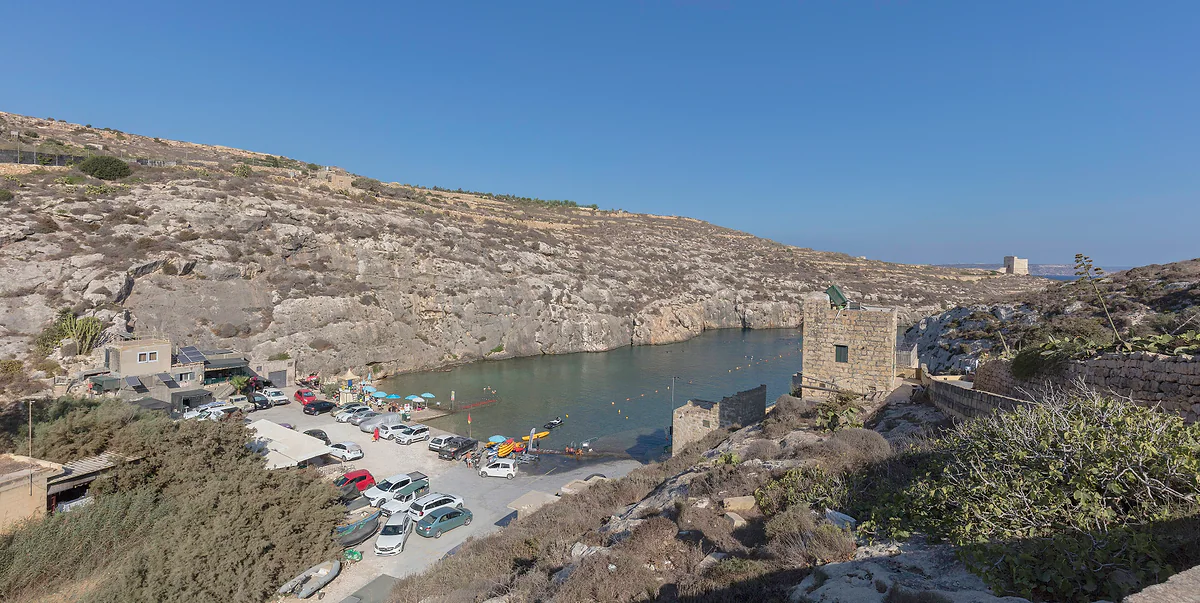
The Mġarr ix-Xini inlet in southern Gozo, a narrow creek between dry slopes with its watchtower at the mouth.
What to see in Xewkija
| Place | What it is | Visiting |
|---|---|---|
| Rotunda of St John the Baptist | Gozo's largest church | No published hours or prices |
| Sculpture Museum | The old church, numbered and rebuilt | Inside the Rotunda |
| Perellos-era windmill | Octagonal ground floor and a bread oven | Open to visitors, no published hours |
| Madonna tal-Ħniena | Chapel rebuilt in 1643 at a crossroads | Feasts on 24 Aug and 17 Sep |
| St Cecilia's Chapel | Gozo's oldest chapel, says the Ministry | On the edge of the village |
| Mġarr ix-Xini valley and cove | Gorge down to a cove with a tower | On foot, or by a narrow road |
Getting to Xewkija
| From | How |
|---|---|
| Mġarr harbour | Routes 303 and 323, or a few minutes by car |
| Victoria | Route 323 'Vapur' (Xewkija, Għajnsielem, Mġarr) |
| Mġarr ix-Xini | Narrow, steep road, or on foot through the valley |
Routes as listed by Malta Public Transport on 28-09-2026. Check live times in the tallinja app.
Test yourself
True or false?
0/3 Pick before you peek.
-
Xewkija was Gozo's first parish outside Victoria.
See the answer
True. It became one on 27 November 1678, according to the Ministry for Gozo, which also calls it the first place on the island to gain official village status.
-
Xewkija means 'dome' in Maltese.
See the answer
False. The name comes from Arabic and refers to thorny wasteland. The famous dome arrived nearly three centuries after the village became a parish.
-
Xewkija's windmill has an octagonal ground floor.
See the answer
True. Each side faces one of the eight principal winds. It dates from the time of Grand Master Perellos (1697-1720) and has been restored.
- Xewkija residents (NSO, 2025)
- 3,790
- First Gozo parish outside Victoria
- 1678
- Height of the Rotunda
- 75 m
- Sides of the windmill, one per wind
- 8
Map
Where Xewkija is
Gozo lies to the north-west, across the channel the ferry crosses from Ċirkewwa, with Comino between the two islands. Every number opens its guide.
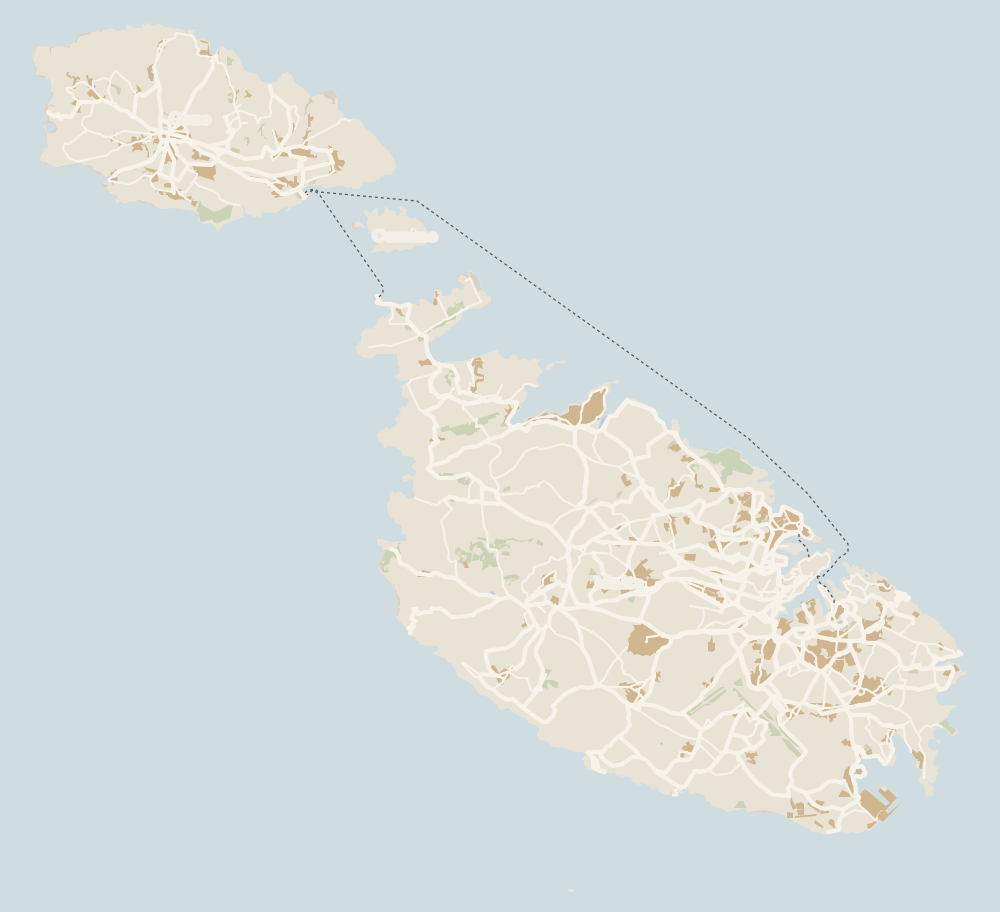 1Gozo 2Victoria 3Xagħra 4Nadur 5Qala 6Għajnsielem 7Xewkija 8Sannat 9Munxar 10Fontana 11Kerċem 12Żebbuġ (Gozo) 13San Lawrenz 14Għarb 15Għasri
 Map data © OpenStreetMap contributors (ODbL)
- 1GozoThe second island of the Maltese archipelago
- 2VictoriaThe capital of Gozo
- 3XagħraA village on Gozo
- 4NadurA village on Gozo
- 5QalaA village on Gozo
- 6GħajnsielemA village on Gozo
- 7XewkijaA village on Gozo
- 8SannatA village on Gozo
- 9MunxarA village on Gozo
- 10FontanaA village on Gozo
- 11KerċemA village on Gozo
- 12Żebbuġ (Gozo)A local council in northern Gozo
- 13San LawrenzA village on Gozo
- 14GħarbA village on Gozo
- 15Għasri519 residents between two hills
What to see
What to see in Xewkija
0 of 279 Malta guides
Your next stamp
- Xewkija Rotunda
- Xagħra
- Munxar
- Kerċem
- Victoria
- Fontana
- Żebbuġ (Gozo)
- Sannat
- Things to do in Malta
- Gozo
- Most beautiful places
- Comino
- Prettiest villages
- UNESCO World Heritage Sites
- Where is Malta
- The Maltese islands
- Towns and villages
- Island of Malta
- Blue Lagoon
- Fort Rinella
- Fort St Angelo
- Gardjola Gardens
- Ħal Saflieni Hypogeum
- Is Malta a country?
- Popeye Village
- Tarxien Temples
- Things to do in Gozo
- Valletta
- Esplora
- Golden Bay
- Gozo day trip
- Inquisitor's Palace
- Population
- St John's Co-Cathedral
- St Mary's Tower
- Grandmaster's Palace
- How big is Malta
- Maritime Museum
- Mellieħa Bay
- Fort St Elmo
- Language
- Malta at War Museum
- Paradise Bay
- Barrakka Gardens
- Red Tower
- Religion
- Malta government
- Saluting Battery
- MUŻA
- National Museum of Archaeology
- Underground Valletta
- Lascaris War Rooms
- Casa Rocca Piccola
- Malta in one day
- Three Cities
- Birgu
- Manoel Theatre
- Weekend in Malta
- City Gate and Parliament
- Malta in three days
- Nadur
- Senglea
- Cospicua
- Malta in four days
- Qala
- Valletta Waterfront
- Għajnsielem
- Kalkara
- Malta in five days
- Malta in a week
- Paola
- Tarxien
- Żabbar
- Fgura
- Luqa
- Floriana
- Marsa
- Mellieħa
- The Citadel, Gozo
- Ġgantija Temples
- Marsalforn
- Santa Luċija
- Ramla Bay
- San Lawrenz
- Xgħajra
- Xwejni salt pans
- Calypso's Cave
- Għarb
- Żejtun
- Għasri
- Gudja
- San Blas Bay
- Għaxaq
- Ħondoq Bay
- Marsaxlokk
- Kirkop
- Marsaxlokk Fish Market
- Mqabba
- St Peter's Pool
- Marsaskala
- Qrendi
- Żurrieq
- Beaches
- Comino ferry
- EU, Schengen and the euro
- Ħaġar Qim and Mnajdra
- Mdina
- Mġarr (Gozo)
- Blue Grotto
- Diving
- Entry requirements
- Mdina Cathedral
- Birżebbuġa
- Money and payments
- Palazzo Falson
- Safi
- Shipwrecks
- Ta' Ċenċ Cliffs
- Għar Dalam
- Mdina Dungeons
- Mġarr ix-Xini
- Prices and budget
- Snorkelling
- Boat trips
- Malta on a budget
- Playmobil FunPark
- Rabat (Malta)
- Xlendi
- Dwejra
- Gozo beaches
- History
- Siġġiewi
- St Paul's Catacombs
- Tipping
- Azure Window
- Domvs Romana
- Għar Lapsi
- Great Siege of 1565
- Plugs
- Limestone Heritage Park
- Second World War
- St Paul's Grotto
- Ta' Pinu Basilica
- Time zone
- Buskett Gardens
- Knights of Malta
- Mobile and roaming
- Wied il-Għasri
- Dingli
- Maltese cross
- Dingli Cliffs
- Flag
- Żebbuġ
- Coat of arms
- Mtarfa
- Balzan
- National anthem
- Lija
- Malta facts
- Game of Thrones
- Iklin
- Attard
- Film locations
- Forts and fortifications
- San Anton Gardens
- Ta' Qali Crafts Village
- Victoria Lines
- Megalithic temples
- Catacombs
- Museums
- Where to eat
- Where to stay
- Churches
- Hotels in Valletta
- Restaurants in Valletta
- Hotels in Sliema
- Maltese food
- Restaurants in Marsaxlokk
- Viewpoints
- Hotels in St Julian's
- Pastizzi
- Walking and hiking
- Hotels in Buġibba and Qawra
- Maltese rabbit stew
- Safety
- Hotels in Mellieħa
- Kinnie and Cisk
- Scams
- Gozo hotels
- Nightlife
- Tap water
- Boat parties
- Holiday packages
- Tourist tax
- All inclusive
- Gay Malta
- Sightseeing passes
- Apartments
- Malta with kids
- Public holidays
- How to get there
- Luxury
- Malta for couples
- Taxis and ride-hailing
- Weather
- Best time to visit
- Cycling
- English schools
- Flights
- Flights from Madrid
- Sea temperature
- Shopping and souvenirs
- Airport
- Free walking tours
- In winter
- Airport transfers
- Day trips and tours
- In summer
- Ferry from Sicily
- In January
- Cruise stop
- In February
- In March
- In April
- In May
- Getting around
- In June
- Buses
- July
- August
- Hop on hop off
- Gozo ferry
- September
- Gozo fast ferry
- October
- November
- Valletta ferries
- Car hire
- December
- Driving
- Events
- St Paul's Bay
- Village feasts
- Buġibba
- Christmas
- Easter
- Qawra
- Carnival
- Xemxija
- Fireworks festival
- Malta National Aquarium
- Isle of MTV
- St Paul's Islands
- Mosta
- Mosta Rotunda
- Naxxar
- Palazzo Parisio
- Għargħur
- Mġarr (Malta)
- Sliema
- Ta' Ħaġrat and Skorba Temples
- Għajn Tuffieħa Bay
- Tigné Point
- Ġnejna Bay
- St Julian's
- Paceville
- St George's Bay
- Gżira
- Msida
- Ta' Xbiex
- Pietà
- Pembroke
- Swieqi
- San Ġwann
- Birkirkara
- Ħamrun
- Santa Venera
- Qormi
Frequently asked questions
What is there to see in Xewkija?
The Rotunda of St John the Baptist and its Sculpture Museum, the eight-sided Knights-era windmill, the chapels of Madonna tal-Ħniena and St Cecilia, the village square and, heading for the coast, the cove at Mġarr ix-Xini.
Where is Xewkija on Gozo?
In the south-east of the island, roughly halfway between Mġarr harbour, where the Gozo Channel ferry comes in, and Victoria, the island's capital.
How many people live in Xewkija?
3,790 at the end of 2025, according to Malta's National Statistics Office. Of those, 735 are foreign nationals.
When is the Xewkija festa?
The feast of St John the Baptist falls on the Sunday nearest 24 June. In 2026 that was 21 June, and it's known for the giant umbrella strung across the street.
Is Xewkija a good place to stay on Gozo?
I think so, if you want to be close to the ferry and Victoria without sleeping in either. It's mostly village houses and flats, with the odd small hotel near the square.
Is Xewkija really Gozo's oldest village?
That's how the Ministry for Gozo describes it, pointing to megalithic ruins found there in 1647. What's dated for certain is that it was the first parish outside Victoria, in 1678.
By
Tourism graduate with a master’s in Tourism Management and Planning from the University of Málaga, who has travelled across Europe. He writes every guide from official sources and his own judgement.
Published on . Facts checked on .
Sources
Photos: CEphoto, Uwe Aranas (CC BY-SA 3.0); Diego Delso (CC BY-SA 4.0), via Wikimedia Commons.