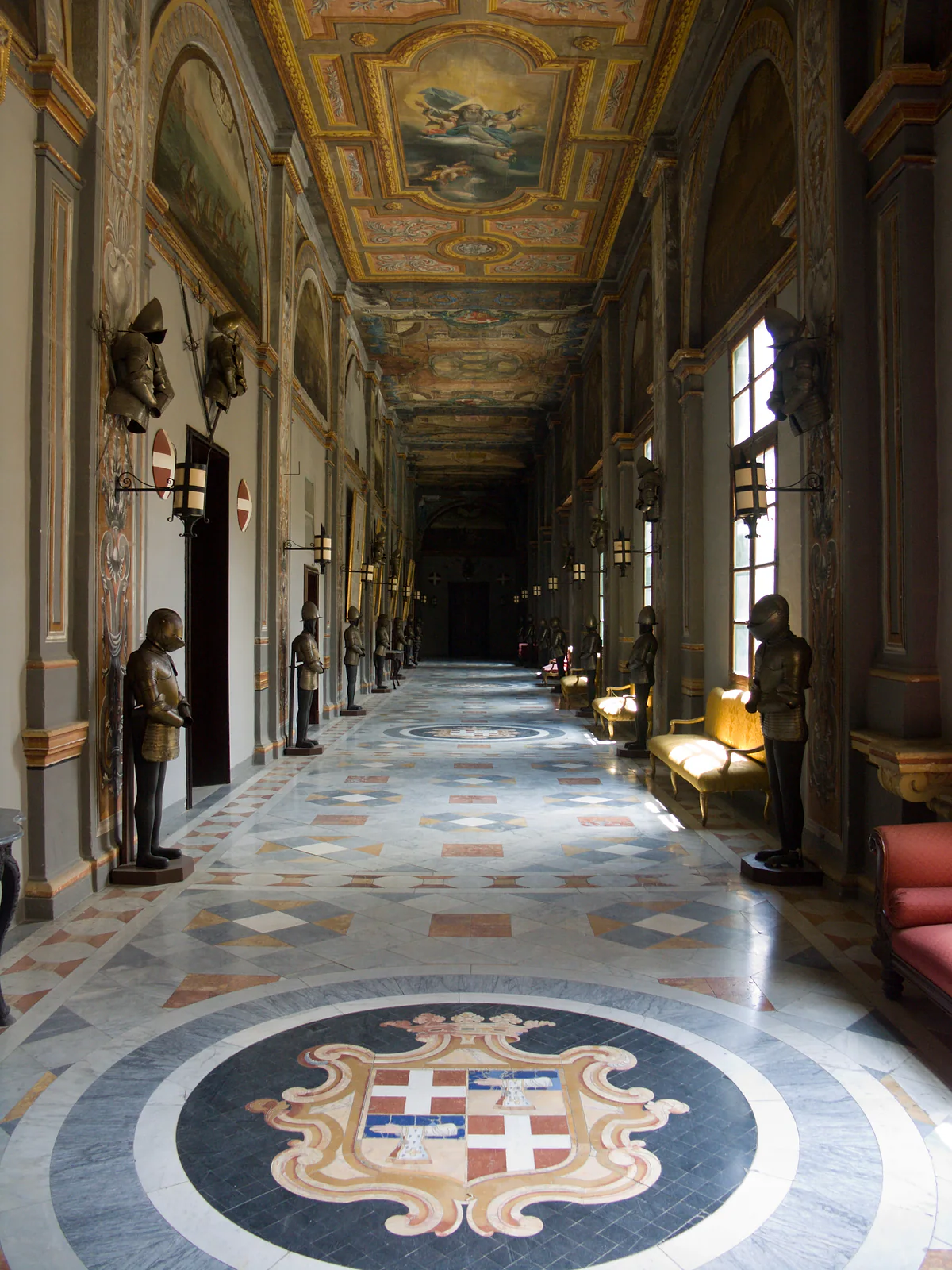
Malta's national symbol
The Maltese cross, what its eight points mean and where to spot it
The Maltese cross is the white eight-pointed cross of the Order of St John. According to the Order, its points stand for the eight Beatitudes, the eight virtues a knight had to have and the eight langues the knights were grouped into, England among them. It's Byzantine in origin, took Malta's name after 1530 and is now the country's national symbol and on its €1 and €2 coins.
In 30 seconds
Full read: 3 min
- The Maltese cross is the white eight-pointed cross of the Order of St John.
- Its points stand for the eight Beatitudes, the eight knightly virtues and the Order's eight langues.
- It's Byzantine in origin and was called the cross of St John until the Order reached Malta in 1530.
- It's Malta's national symbol and on its €1 and €2 coins, but not on the national flag.
My favourite thing to tell people about the Maltese cross is that it isn't on Malta's flag. The flag carries the George Cross; the eight-pointed one flies on the President's flag and the merchant ensign, and ends up in your pocket when you get change in Maltese coins.

Before you go
What I would keep in mind
-
01 My tip
The Maltese flag doesn't carry the Maltese cross
The national flag is white and red with the George Cross in the canton. The eight-pointed cross appears on the President's flag, the merchant ensign and the naval jack instead.
the Malta flag -
02 Money
It's on the €1 and €2 coins
Since 1 January 2008 the eight-pointed cross has been on the reverse of the €1 and €2 coins minted by Malta. Pay cash on the island and one will probably land in your change.
Malta currency -
03 Most beautiful
See it where the Knights put it
The Order says the cross appears on countless buildings, churches and works of art across the islands. For me the best place to see it in context is the Knights' own church, St John's Co-Cathedral.
St John's Co-Cathedral in Valletta
What I would book
The Maltese cross is one of those symbols everyone recognises and almost nobody can read. The Government of Malta names it the country’s national symbol, the Order of Malta has used it for more than nine centuries, and it has been taken up by orders of chivalry, regiments and towns across Europe. Here’s what the eight points mean, where the cross comes from and where you’ll see it on a trip to Malta.
What the eight points stand for
The official explanation is the Order’s, and it offers three readings that sit side by side. The first is the eight Beatitudes from St Matthew’s Gospel. The second is the eight virtues a member of the Order was meant to have.
- Loyalty.
- Piety.
- Honesty.
- Courage.
- Honour and glory.
- Contempt for death.
- Solidarity with the poor and the sick.
- Respect for the Church.
The third reading is the most historical, and the one British visitors tend to like. The points stand for the eight langues the knights were grouped into, Auvergne, Provence, France, Aragon, Castile and Portugal, Italy, Germany, and England with Scotland and Ireland. It helps me make sense of Malta, because each langue had its own auberge in Valletta and several are still standing. How the Order was organised is covered in the Knights of Malta.
Far older than Malta
The cross wasn’t born in Malta, which surprises people. The Order considers it Byzantine, probably from the sixth century, and says some scholars think the Normans brought it to Amalfi, where it appears on coins by 1080. The monks running Amalfi’s pilgrim hospital in Jerusalem adopted it, and it became known as the cross of St John. After Jerusalem came Rhodes in 1310 and Malta in 1530, and it was in Malta that it became the Maltese cross. The name stuck so firmly that the Order still carries Malta in its official title, more than two centuries after leaving the island, and its eight-pointed flag flies over its hospitals and 49 national associations worldwide.
Another detail from the Order that I enjoy is that the first clear depiction of an eight-pointed cross is on the coins of Grand Master Foulques de Villaret, between 1305 and 1319, and that its present shape is more than 400 years old.
Is the Maltese cross on the Maltese flag?
No, and it’s the most common mistake. The national flag is white and red with the George Cross, awarded by George VI in 1942, as I explain in the Malta flag. The eight-pointed cross turns up on other state flags instead. The Government gives the President’s flag four gold Maltese crosses, puts a white one in the middle of the merchant ensign, and adds four white crosses to the naval jack.
The Order doesn’t use a single flag either. Its state flag is red with a white Latin cross, while the eight-pointed version is the flag of its works, flown over its hospitals and embassies.
Where you’ll spot the cross in Malta
In your pocket, to begin with. Since 1 January 2008 the eight-pointed cross has been on the reverse of the €1 and €2 coins Malta mints, so if you pay cash you’ll almost certainly end up with one. The rest of the practicalities are in money in Malta.
Then in the stonework. The Order says the cross appears on countless buildings, churches and works of art across the islands, and in Valletta you’ll see it without looking. I’d start at St John’s Co-Cathedral, the Knights’ conventual church, and carry on to the Grandmaster’s Palace.
The keyhole that isn’t in Malta
Plenty of people look for the Order of Malta keyhole expecting to find it on the island, but it’s in Rome. It’s the gate of the Magistral Villa at number 3 Piazza dei Cavalieri di Malta, on the Aventine Hill. Through the keyhole you see the dome of St Peter’s framed by a laurel hedge, and the Order says it’s the only spot where you can see three states at once, the Vatican, Italy and the villa’s extraterritorial gardens. The gateway is Piranesi’s work from 1765, and the Order has owned the site since 1312.
If you’re in Rome, it’s worth the queue. In Malta you’ll find the cross everywhere with no queue at all.
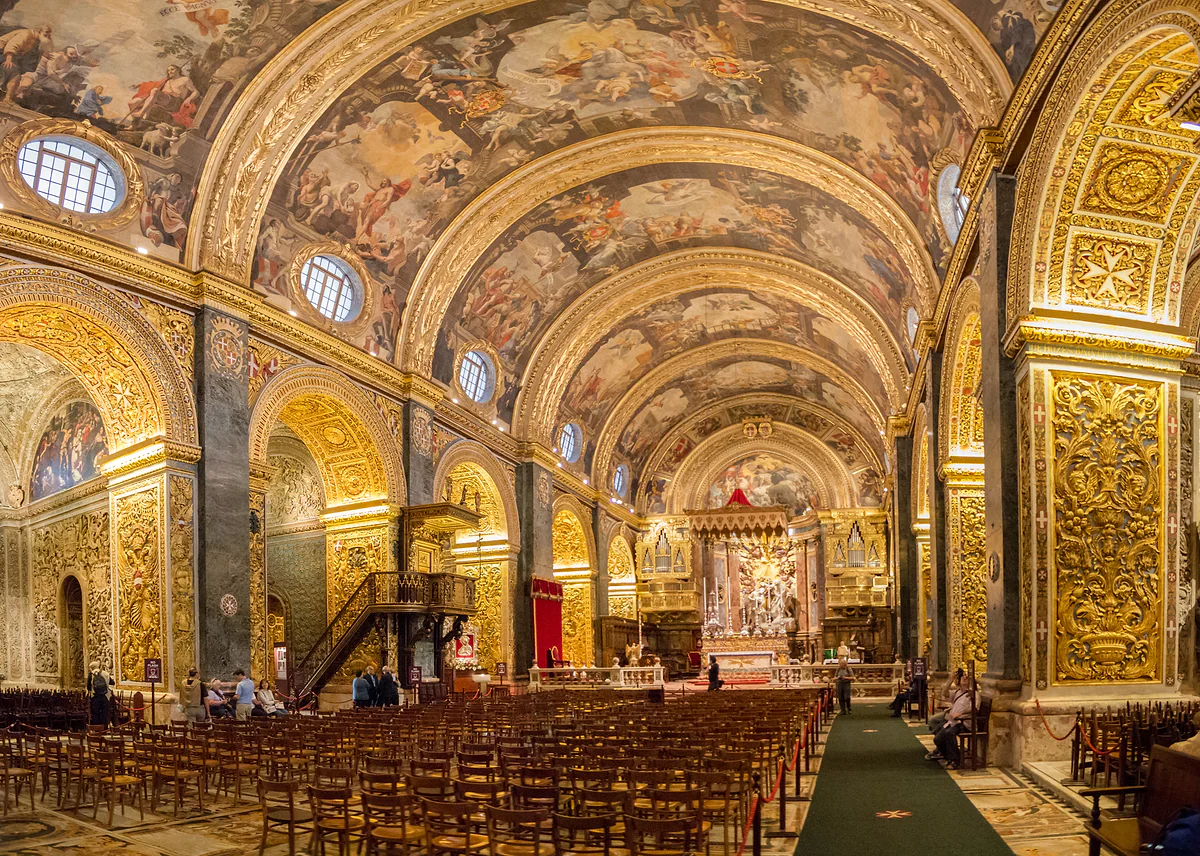
The Baroque nave of St John's Co-Cathedral in Valletta, with its carved and gilded stone walls and the vault painted by Mattia Preti.
Where the eight-pointed cross appears
| Where | How | Source |
|---|---|---|
| President of Malta's flag | A gold Maltese cross in each corner of a blue field | Government of Malta |
| Maltese merchant ensign | A white Maltese cross in the centre of a red field with a white border | Government of Malta |
| Naval jack | Four white Maltese crosses in the corners | Government of Malta |
| Maltese €1 and €2 coins | On the reverse, since 1-1-2008 | Order of Malta |
| Flag of the Order's works | White eight-pointed cross on red | Order of Malta |
| The Order's coat of arms | The eight-pointed cross beneath a red oval with a Latin cross | Order of Malta |
Malta's national flag does not carry the Maltese cross; it carries the George Cross.
Test yourself
True or false?
0/3 Pick before you peek.
-
Malta's national flag carries the Maltese cross.
See the answer
False. It carries the George Cross, edged in red, in the white canton. The eight-pointed cross is on the President's flag, the merchant ensign and the naval jack.
-
The eight-pointed cross is older than the Order's arrival in Malta.
See the answer
True. The Order has used it since its founding in Jerusalem and calls it Byzantine in origin. Amalfi was minting it on coins by 1080. In Malta it simply got a new name.
-
The famous Order of Malta keyhole is in Valletta.
See the answer
False. It's in Rome, on the gate of the Magistral Villa on the Aventine, at number 3 Piazza dei Cavalieri di Malta. Through it you see the dome of St Peter's.
- Points, virtues, Beatitudes and langues
- 8
- Amalfi is already minting it on coins
- 1080
- It becomes the Maltese cross
- 1530
- It appears on Malta's €1 and €2 coins
- 2008
0 of 279 Malta guides
Your next stamp
- Flag
- Coat of arms
- Malta facts
- Language
- Knights of Malta
- Where is Malta
- History
- Is Malta a country?
- Things to do in Malta
- Gozo
- Most beautiful places
- Comino
- Prettiest villages
- UNESCO World Heritage Sites
- The Maltese islands
- Towns and villages
- Island of Malta
- Blue Lagoon
- Fort Rinella
- Fort St Angelo
- Gardjola Gardens
- Ħal Saflieni Hypogeum
- Popeye Village
- Tarxien Temples
- Things to do in Gozo
- Valletta
- Esplora
- Golden Bay
- Gozo day trip
- Inquisitor's Palace
- Population
- St John's Co-Cathedral
- St Mary's Tower
- Grandmaster's Palace
- How big is Malta
- Maritime Museum
- Mellieħa Bay
- Fort St Elmo
- Malta at War Museum
- Paradise Bay
- Barrakka Gardens
- Red Tower
- Religion
- Malta government
- Saluting Battery
- MUŻA
- National Museum of Archaeology
- Underground Valletta
- Lascaris War Rooms
- Casa Rocca Piccola
- Malta in one day
- Three Cities
- Victoria
- Birgu
- Manoel Theatre
- Weekend in Malta
- Xagħra
- City Gate and Parliament
- Malta in three days
- Nadur
- Senglea
- Cospicua
- Malta in four days
- Qala
- Valletta Waterfront
- Għajnsielem
- Kalkara
- Malta in five days
- Malta in a week
- Paola
- Xewkija
- Sannat
- Tarxien
- Munxar
- Żabbar
- Fgura
- Fontana
- Kerċem
- Luqa
- Floriana
- Marsa
- Mellieħa
- The Citadel, Gozo
- Żebbuġ (Gozo)
- Ġgantija Temples
- Marsalforn
- Santa Luċija
- Ramla Bay
- San Lawrenz
- Xgħajra
- Xwejni salt pans
- Calypso's Cave
- Għarb
- Żejtun
- Għasri
- Gudja
- San Blas Bay
- Għaxaq
- Ħondoq Bay
- Marsaxlokk
- Kirkop
- Marsaxlokk Fish Market
- Mqabba
- St Peter's Pool
- Marsaskala
- Qrendi
- Żurrieq
- Beaches
- Comino ferry
- EU, Schengen and the euro
- Ħaġar Qim and Mnajdra
- Mdina
- Mġarr (Gozo)
- Blue Grotto
- Diving
- Entry requirements
- Mdina Cathedral
- Xewkija Rotunda
- Birżebbuġa
- Money and payments
- Palazzo Falson
- Safi
- Shipwrecks
- Ta' Ċenċ Cliffs
- Għar Dalam
- Mdina Dungeons
- Mġarr ix-Xini
- Prices and budget
- Snorkelling
- Boat trips
- Malta on a budget
- Playmobil FunPark
- Rabat (Malta)
- Xlendi
- Dwejra
- Gozo beaches
- Siġġiewi
- St Paul's Catacombs
- Tipping
- Azure Window
- Domvs Romana
- Għar Lapsi
- Great Siege of 1565
- Plugs
- Limestone Heritage Park
- Second World War
- St Paul's Grotto
- Ta' Pinu Basilica
- Time zone
- Buskett Gardens
- Mobile and roaming
- Wied il-Għasri
- Dingli
- Dingli Cliffs
- Żebbuġ
- Mtarfa
- Balzan
- National anthem
- Lija
- Game of Thrones
- Iklin
- Attard
- Film locations
- Forts and fortifications
- San Anton Gardens
- Ta' Qali Crafts Village
- Victoria Lines
- Megalithic temples
- Catacombs
- Museums
- Where to eat
- Where to stay
- Churches
- Hotels in Valletta
- Restaurants in Valletta
- Hotels in Sliema
- Maltese food
- Restaurants in Marsaxlokk
- Viewpoints
- Hotels in St Julian's
- Pastizzi
- Walking and hiking
- Hotels in Buġibba and Qawra
- Maltese rabbit stew
- Safety
- Hotels in Mellieħa
- Kinnie and Cisk
- Scams
- Gozo hotels
- Nightlife
- Tap water
- Boat parties
- Holiday packages
- Tourist tax
- All inclusive
- Gay Malta
- Sightseeing passes
- Apartments
- Malta with kids
- Public holidays
- How to get there
- Luxury
- Malta for couples
- Taxis and ride-hailing
- Weather
- Best time to visit
- Cycling
- English schools
- Flights
- Flights from Madrid
- Sea temperature
- Shopping and souvenirs
- Airport
- Free walking tours
- In winter
- Airport transfers
- Day trips and tours
- In summer
- Ferry from Sicily
- In January
- Cruise stop
- In February
- In March
- In April
- In May
- Getting around
- In June
- Buses
- July
- August
- Hop on hop off
- Gozo ferry
- September
- Gozo fast ferry
- October
- November
- Valletta ferries
- Car hire
- December
- Driving
- Events
- St Paul's Bay
- Village feasts
- Buġibba
- Christmas
- Easter
- Qawra
- Carnival
- Xemxija
- Fireworks festival
- Malta National Aquarium
- Isle of MTV
- St Paul's Islands
- Mosta
- Mosta Rotunda
- Naxxar
- Palazzo Parisio
- Għargħur
- Mġarr (Malta)
- Sliema
- Ta' Ħaġrat and Skorba Temples
- Għajn Tuffieħa Bay
- Tigné Point
- Ġnejna Bay
- St Julian's
- Paceville
- St George's Bay
- Gżira
- Msida
- Ta' Xbiex
- Pietà
- Pembroke
- Swieqi
- San Ġwann
- Birkirkara
- Ħamrun
- Santa Venera
- Qormi
Frequently asked questions
What does the Maltese cross mean?
According to the Order of Malta, the eight points symbolise the eight Beatitudes in St Matthew's Gospel and the eight virtues of a knight (loyalty, piety, honesty, courage, honour and glory, contempt for death, solidarity with the poor and sick, and respect for the Church). They also represent the Order's eight langues.
Why does the Maltese cross have eight points?
The Order gives three readings side by side, the eight Beatitudes, the eight knightly virtues and the eight langues its members were grouped into, from Auvergne to England.
Where does the Maltese cross come from?
It's Byzantine in origin and probably dates to the sixth century, according to the Order. Amalfi was already using it on coins by 1080, and it passed from there to the hospital in Jerusalem. It was called the cross of St John until the Order reached Malta in 1530.
Is the Maltese cross on the Maltese flag?
No. The national flag carries the George Cross, awarded by George VI in 1942. The Maltese cross appears on the President's flag, the merchant ensign and the naval jack.
Which coins have the Maltese cross on them?
Malta's €1 and €2 coins, which have carried it on the reverse since 1 January 2008, according to the Order of Malta.
Was England part of the Order of St John?
Yes. The Langue of England, together with Scotland and Ireland, was one of the eight langues the Order says the cross's points represent.
By
Tourism graduate with a master’s in Tourism Management and Planning from the University of Málaga, who has travelled across Europe. He writes every guide from official sources and his own judgement.
Published on . Facts checked on .
Sources
Photos: Jean-Christophe BENOIST (CC BY 2.5); Pedro J Pacheco (CC BY-SA 4.0), via Wikimedia Commons.