Guided tours on the hour, 10:00 to 16:00
Casa Rocca Piccola, a noble family home that still opens its doors
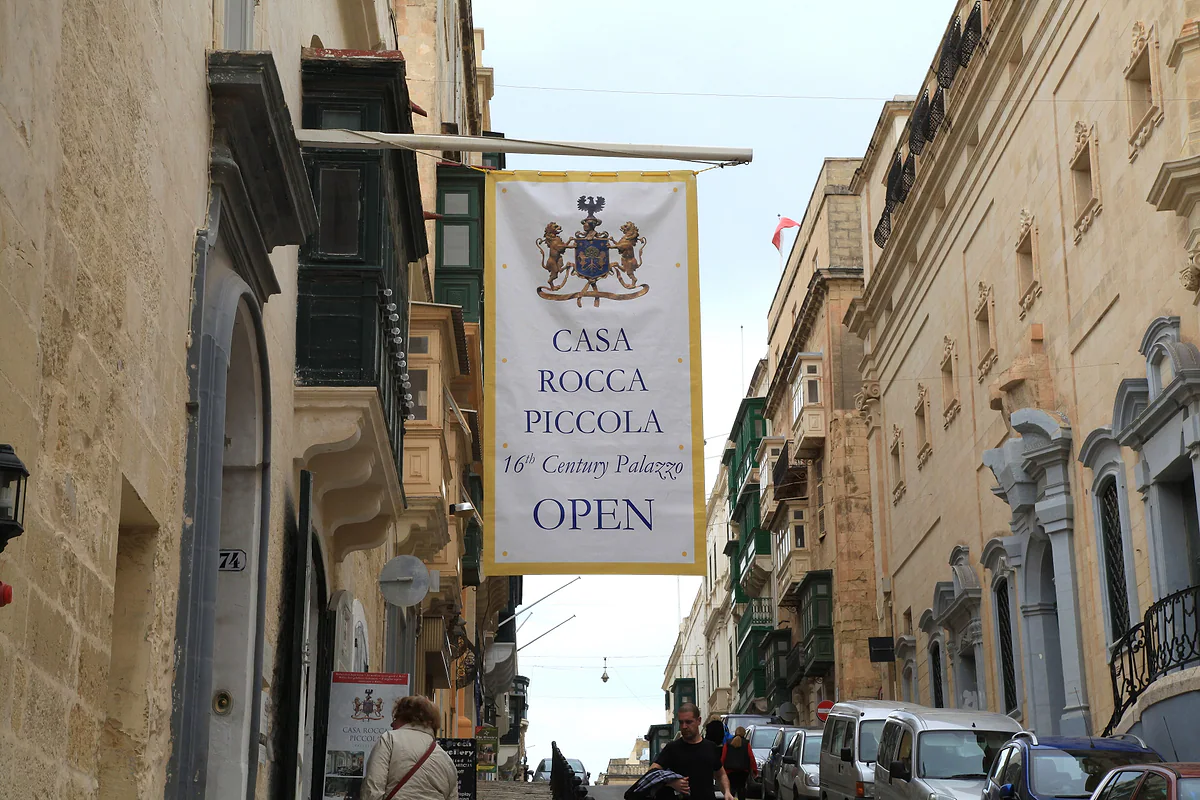
Casa Rocca Piccola is a palace of around 400 years at 74 Republic Street in Valletta, owned by the de Piro family, who have lived in the city for almost 350 years. It's shown by guided tour every day at 10:00, 11:00, 12:00, 13:00, 14:00, 15:00 and 16:00, covering the 12 rooms of the piano nobile and the air-raid shelters cut into the rock.
In 30 seconds
Full read: 3 min
- Casa Rocca Piccola is a noble palace of around 400 years at 74 Republic Street, Valletta.
- It still belongs to the de Piro family, in the city for almost 350 years.
- Guided tours run every day, on the hour from 10:00 to 16:00.
- They take in the 12 piano nobile rooms and the Second World War shelters.
- The official site doesn't publish the price openly.
I'd go after the Order's big palaces, because it tells you what they don't, how a Maltese noble family actually lived. And I'd book a slot, since every visit is guided and runs to set times.

Before you go
What I would keep in mind
-
01 Most beautiful
A palace that's still a home
What I like about Casa Rocca Piccola is that it isn't an empty museum. It still belongs to the de Piro family, the first members of the Maltese aristocracy to open their house to the public.
Valletta, Malta's capital -
02 My tip
Book, and don't expect a refund
Tickets are non-refundable and non-transferable, valid for the date and time shown. You can ask to change the date by email, subject to availability.
-
03 Worth the splurge
Coffee in the garden, Italian in the old kitchens
Inside there's a garden, Cafe Effervescence and an Italian restaurant in the house's former kitchens. For me it's the best mid-morning break on Republic Street.
best restaurants in Valletta -
04 Getting there
Downhill from the bus terminus
It's about 600 metres from the bus terminus, a gentle downhill walk along Republic Street. Taxis can pull up outside.
Malta buses
What I would book
My ranking, scored
What I'd look out for on the tour
My own scores out of 10, on what each part tells you about noble life in Malta and about the war. The guided tour sets the order.
0 of 5 seen
-
The air-raid shelters
Two of the house's wells, turned into shelters during the war. The larger one doubled as a chapel and held more than a hundred people.
9.0 out of 10
-
The 12 rooms of the piano nobile
Family furniture, silver and paintings, plus an explanation of the customs of the Maltese nobility.
8.6 out of 10
-
The de Piro family story
They came over with the Order in 1530 and were made marquises by Philip V of Spain in 1742.
8.2 out of 10
-
The costume and lace collection
Looked after by a dress historian who volunteers as its curator. Not something I'd expect in a private house.
7.6 out of 10
-
The garden and the café
A breather inside the house itself, right on Republic Street, with coffee and a restaurant.
7.2 out of 10
After the Co-Cathedral and the Palace of the Grand Masters, which show you Malta’s public face of power, Casa Rocca Piccola shows you the private one. It’s the home of a noble family who still own it, right on Republic Street, and you see it with someone who explains how life was lived there. For me it’s the visit that rounds Valletta off best.
A 400-year-old house that’s still a house
The house itself says it’s around 400 years old and was built by Don Pietro La Rocca, an admiral and Knight of Malta. It now belongs to the de Piro family, who have lived in Valletta for almost 350 years. There are more than 50 rooms, many of them open, filled with the furniture, silver and paintings the family has gathered over time.
What I find most interesting is who opened it up. Nicholas and Frances de Piro were the first members of the Maltese aristocracy to open their house to the public, and they still usually host the private tours themselves. You’re not in a palace the state has turned into a museum; you’re in somebody’s home.
The de Piros, the Order and a Spanish title
The family arrived in Malta in 1530 with the Order of St John, after the Knights had been driven from Rhodes by Suleiman the Magnificent. In 1716 Grand Master Perellos y Rocafull made them Barons of Budaq, and in 1742 Philip V of Spain created Giovanni Pio de Piro Marquis de Piro, in the Kingdom of Castile. For the bigger picture of the Order they arrived with, see the Knights of Malta.
The house’s website doesn’t hide the awkward parts. It notes that the family archives hold a bill for 1,500 scudi for the sale of Muslim slaves to a trader, one of that first marquis’s early deals. I think it’s to their credit that they say so, and it helps explain where fortunes came from at the time.
What the tour covers
The guided tour takes in the 12 rooms of the piano nobile, with an explanation of the customs and traditions of the Maltese nobility. There’s also a collection of costume and lace, looked after since 2011 by a dress historian who volunteers as its curator.
Then you go down to the shelters. The house had two wells, cut into the rock it stands on and part of the original quarry used to build it. In the Second World War they became shelters, and the larger one, also used as a chapel, held more than a hundred people at a time. The website recalls that in April 1942 there were days with as many as 15 air raids. For the public side of that underground story, see Underground Valletta.
Times, prices and what I can’t tell you
Guided tours run every day at 10:00, 11:00, 12:00, 13:00, 14:00, 15:00 and 16:00, and the house opens on most public holidays, though it asks you to check its social media. Tickets are non-refundable and non-transferable, and you can change the date by email if there’s space. Photos without flash are allowed in most rooms.
What I can’t give you is the price. It doesn’t appear on the pages of the official site I’ve read, and I won’t lift a figure from somewhere else. You’ll see it when you book. If it strikes you as steep, weigh it against the €12 Grandmaster’s Palace ticket and remember that here every visit is guided by the house’s own team and takes in the wartime shelters too. For me that guided element is exactly what sets it apart.
Nor is it fully accessible, which the family itself acknowledges given the age of the building. It’s about 600 metres from the bus terminus, downhill along Republic Street, and taxis can pull up outside. Inside there’s a garden, a café and an Italian restaurant in the old kitchens. The family also runs a B&B on the premises, so in theory you could sleep under the same roof as a Valletta noble family, although I haven’t found its rates on the pages I read. If you’re eating nearby, I have more ideas in the best restaurants in Valletta.
Casa Rocca Piccola guided tours
| Item | Detail |
|---|---|
| Days | Every day |
| Tour times | 10:00, 11:00, 12:00, 13:00, 14:00, 15:00 and 16:00 |
| Public holidays | Open on most; check their social media |
| Price | Not shown on the official pages read on 28-09-2026 |
| Date changes | By email, subject to availability |
Tickets are non-refundable and non-transferable. Photos without flash are allowed in most rooms. Being a historic building, some areas have limited accessibility.
Test yourself
True or false?
0/3 Pick before you peek.
-
Casa Rocca Piccola was built by a Knight of Malta.
See the answer
True. It was built around 400 years ago by Don Pietro La Rocca, an admiral and knight of the Order.
-
The de Piro family's title of marquis came from a king of Spain.
See the answer
True. Philip V of Spain made Giovanni Pio de Piro Marquis de Piro in 1742, within the Kingdom of Castile.
-
The house is now a state museum with no owners living there.
See the answer
False. It still belongs to the de Piro family, the first Maltese aristocrats to open their home to the public.
- Approximate age of the palace in years
- 400
- Years the de Piro family has lived in Valletta
- 350
- Piano nobile rooms on the tour
- 12
- People in the larger shelter during the war
- 100+
Map
Where Casa Rocca Piccola is
Gozo lies to the north-west, across the channel the ferry crosses from Ċirkewwa, with Comino between the two islands. Every number opens its guide.
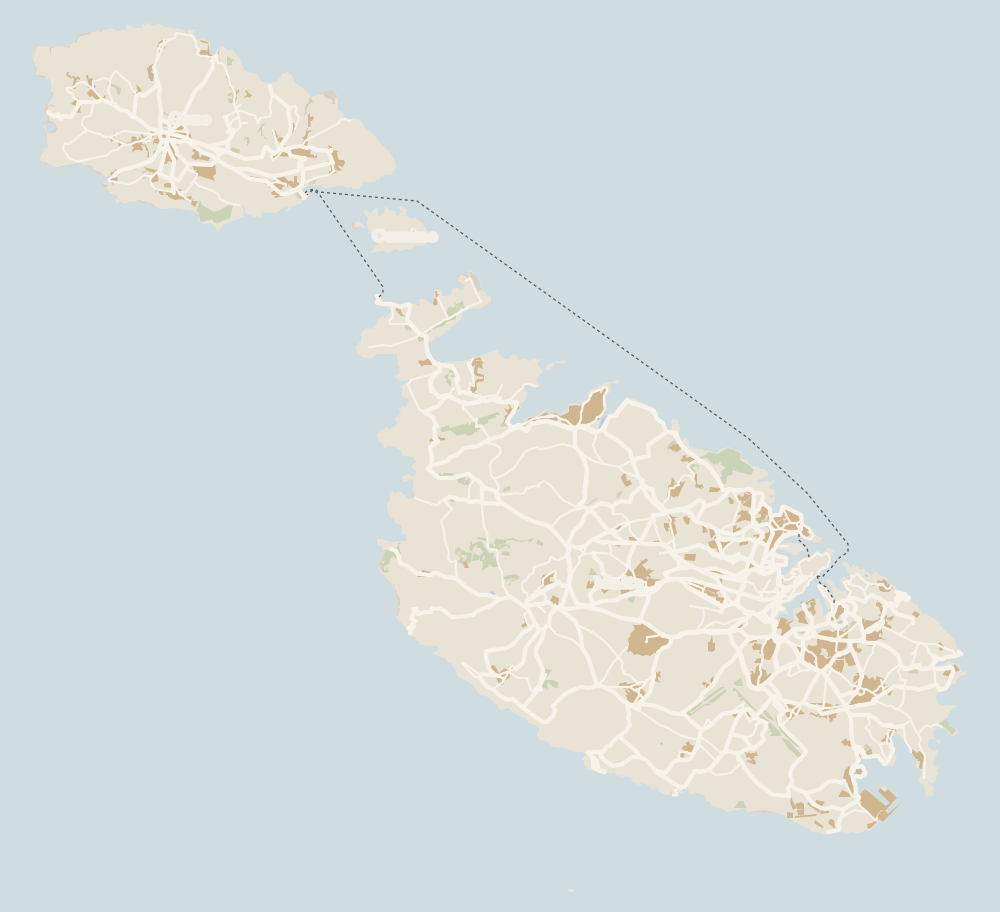 1Valletta 2St John's Co-Cathedral 3Grandmaster's Palace 4Fort St Elmo 5Barrakka Gardens 6Saluting Battery 7MUŻA 8National Museum of Archaeology 9Underground Valletta 10Lascaris War Rooms 11Casa Rocca Piccola 12Manoel Theatre 13City Gate and Parliament 14Valletta Waterfront
 Map data © OpenStreetMap contributors (ODbL)
- 1VallettaFounded 1566, on the UNESCO list since 1980
- 2St John's Co-CathedralFinished in 1577, closed on Sundays
- 3Grandmaster's PalaceHeritage Malta's most visited site
- 4Fort St ElmoFell on 23 June 1565
- 5Barrakka GardensGun salute at 12:00 and 16:00
- 6Saluting BatteryTwo firings a day, Monday to Saturday
- 7MUŻAOpened in late 2018
- 8National Museum of ArchaeologyNeolithic to Phoenician for €5
- 9Underground VallettaThree days a week, booking essential
- 10Lascaris War RoomsEisenhower's advance HQ in 1943
- 11Casa Rocca PiccolaGuided tours on the hour, 10:00 to 16:00
- 12Manoel TheatreOpened on 19 January 1732
- 13City Gate and ParliamentThe city's fifth gate, by Renzo Piano
- 14Valletta Waterfront19 Baroque warehouses from 1752
0 of 279 Malta guides
Your next stamp
- City Gate and Parliament
- Domvs Romana
- Palazzo Falson
- Grandmaster's Palace
- Naxxar
- Things to do in Malta
- Gozo
- Most beautiful places
- Comino
- Prettiest villages
- UNESCO World Heritage Sites
- Where is Malta
- The Maltese islands
- Towns and villages
- Island of Malta
- Blue Lagoon
- Fort Rinella
- Fort St Angelo
- Gardjola Gardens
- Ħal Saflieni Hypogeum
- Is Malta a country?
- Popeye Village
- Tarxien Temples
- Things to do in Gozo
- Valletta
- Esplora
- Golden Bay
- Gozo day trip
- Inquisitor's Palace
- Population
- St John's Co-Cathedral
- St Mary's Tower
- How big is Malta
- Maritime Museum
- Mellieħa Bay
- Fort St Elmo
- Language
- Malta at War Museum
- Paradise Bay
- Barrakka Gardens
- Red Tower
- Religion
- Malta government
- Saluting Battery
- MUŻA
- National Museum of Archaeology
- Underground Valletta
- Lascaris War Rooms
- Malta in one day
- Three Cities
- Victoria
- Birgu
- Manoel Theatre
- Weekend in Malta
- Xagħra
- Malta in three days
- Nadur
- Senglea
- Cospicua
- Malta in four days
- Qala
- Valletta Waterfront
- Għajnsielem
- Kalkara
- Malta in five days
- Malta in a week
- Paola
- Xewkija
- Sannat
- Tarxien
- Munxar
- Żabbar
- Fgura
- Fontana
- Kerċem
- Luqa
- Floriana
- Marsa
- Mellieħa
- The Citadel, Gozo
- Żebbuġ (Gozo)
- Ġgantija Temples
- Marsalforn
- Santa Luċija
- Ramla Bay
- San Lawrenz
- Xgħajra
- Xwejni salt pans
- Calypso's Cave
- Għarb
- Żejtun
- Għasri
- Gudja
- San Blas Bay
- Għaxaq
- Ħondoq Bay
- Marsaxlokk
- Kirkop
- Marsaxlokk Fish Market
- Mqabba
- St Peter's Pool
- Marsaskala
- Qrendi
- Żurrieq
- Beaches
- Comino ferry
- EU, Schengen and the euro
- Ħaġar Qim and Mnajdra
- Mdina
- Mġarr (Gozo)
- Blue Grotto
- Diving
- Entry requirements
- Mdina Cathedral
- Xewkija Rotunda
- Birżebbuġa
- Money and payments
- Safi
- Shipwrecks
- Ta' Ċenċ Cliffs
- Għar Dalam
- Mdina Dungeons
- Mġarr ix-Xini
- Prices and budget
- Snorkelling
- Boat trips
- Malta on a budget
- Playmobil FunPark
- Rabat (Malta)
- Xlendi
- Dwejra
- Gozo beaches
- History
- Siġġiewi
- St Paul's Catacombs
- Tipping
- Azure Window
- Għar Lapsi
- Great Siege of 1565
- Plugs
- Limestone Heritage Park
- Second World War
- St Paul's Grotto
- Ta' Pinu Basilica
- Time zone
- Buskett Gardens
- Knights of Malta
- Mobile and roaming
- Wied il-Għasri
- Dingli
- Maltese cross
- Dingli Cliffs
- Flag
- Żebbuġ
- Coat of arms
- Mtarfa
- Balzan
- National anthem
- Lija
- Malta facts
- Game of Thrones
- Iklin
- Attard
- Film locations
- Forts and fortifications
- San Anton Gardens
- Ta' Qali Crafts Village
- Victoria Lines
- Megalithic temples
- Catacombs
- Museums
- Where to eat
- Where to stay
- Churches
- Hotels in Valletta
- Restaurants in Valletta
- Hotels in Sliema
- Maltese food
- Restaurants in Marsaxlokk
- Viewpoints
- Hotels in St Julian's
- Pastizzi
- Walking and hiking
- Hotels in Buġibba and Qawra
- Maltese rabbit stew
- Safety
- Hotels in Mellieħa
- Kinnie and Cisk
- Scams
- Gozo hotels
- Nightlife
- Tap water
- Boat parties
- Holiday packages
- Tourist tax
- All inclusive
- Gay Malta
- Sightseeing passes
- Apartments
- Malta with kids
- Public holidays
- How to get there
- Luxury
- Malta for couples
- Taxis and ride-hailing
- Weather
- Best time to visit
- Cycling
- English schools
- Flights
- Flights from Madrid
- Sea temperature
- Shopping and souvenirs
- Airport
- Free walking tours
- In winter
- Airport transfers
- Day trips and tours
- In summer
- Ferry from Sicily
- In January
- Cruise stop
- In February
- In March
- In April
- In May
- Getting around
- In June
- Buses
- July
- August
- Hop on hop off
- Gozo ferry
- September
- Gozo fast ferry
- October
- November
- Valletta ferries
- Car hire
- December
- Driving
- Events
- St Paul's Bay
- Village feasts
- Buġibba
- Christmas
- Easter
- Qawra
- Carnival
- Xemxija
- Fireworks festival
- Malta National Aquarium
- Isle of MTV
- St Paul's Islands
- Mosta
- Mosta Rotunda
- Palazzo Parisio
- Għargħur
- Mġarr (Malta)
- Sliema
- Ta' Ħaġrat and Skorba Temples
- Għajn Tuffieħa Bay
- Tigné Point
- Ġnejna Bay
- St Julian's
- Paceville
- St George's Bay
- Gżira
- Msida
- Ta' Xbiex
- Pietà
- Pembroke
- Swieqi
- San Ġwann
- Birkirkara
- Ħamrun
- Santa Venera
- Qormi
Frequently asked questions
What is Casa Rocca Piccola?
A noble palace of around 400 years on Republic Street, Valletta, built by Don Pietro La Rocca, an admiral and Knight of Malta. Today it belongs to the de Piro family, who open it with guided tours.
What are Casa Rocca Piccola's opening hours?
Guided tours run every day at 10:00, 11:00, 12:00, 13:00, 14:00, 15:00 and 16:00. It opens on most public holidays, but the house asks you to check its social media first.
How much is Casa Rocca Piccola?
The official site doesn't show a price on the pages I've read. Booking is done through its website, so you'll see the price when you pick your tour.
Does Casa Rocca Piccola have wartime shelters?
Yes. The house had two wells that were turned into shelters during the war, cut into Valletta's bedrock. The larger one also served as a chapel and took in more than a hundred people.
How do I get to Casa Rocca Piccola?
It's at 74 Republic Street, about 600 metres from the bus terminus and slightly downhill. Taxis can stop outside; if you're driving, the house suggests parking on Valletta's ring road or at the MCP car park by the terminus.
By
Tourism graduate with a master’s in Tourism Management and Planning from the University of Málaga, who has travelled across Europe. He writes every guide from official sources and his own judgement.
Published on . Facts checked on .
Sources
Photos: Frank Vincentz (CC BY-SA 3.0), via Wikimedia Commons.