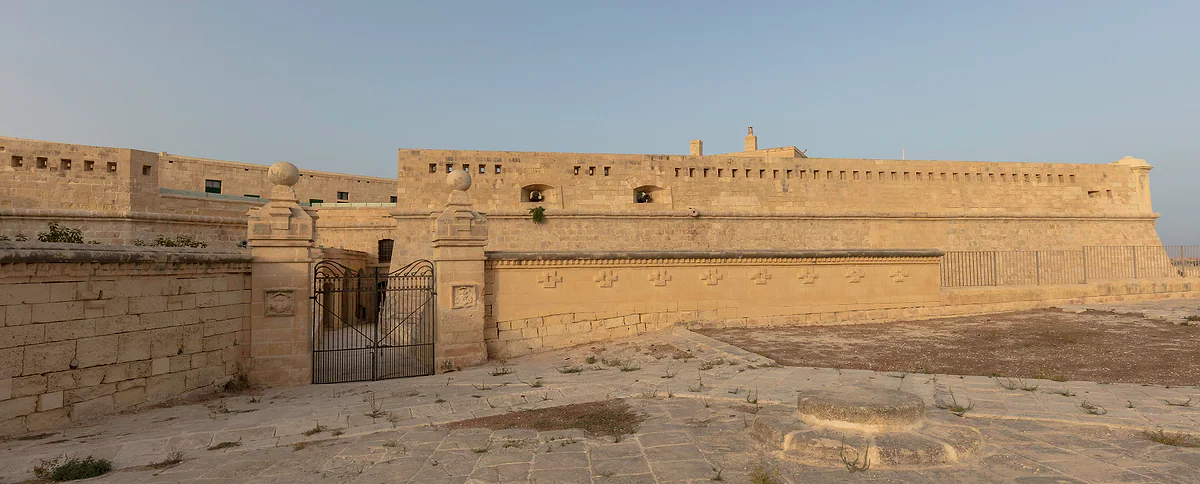
Some 25 km of walls around the harbours alone
The forts of Malta, an island fortress from the Knights to the Second World War
Malta has forts, bastions, watchtowers and bunkers spanning almost four centuries. The Knights fortified the Grand Harbour from 1530, and the British adapted it all for heavy artillery from 1800, adding up to some 25 km of fortifications around the harbours alone. The two I'd see first are Fort St Elmo and Fort St Angelo, €10 each.
In 30 seconds
Full read: 3 min
- UNESCO's Tentative List entry for the harbour forts speaks of some 25 km of fortifications.
- The Knights fortified from 1530, and the British adapted everything for heavy artillery from 1800.
- Fort St Elmo and Fort St Angelo, €10 each, are the two I'd see first.
- There are two separate passes, Heritage Malta's (€60) and Wirt Artna's (€50).
With just one day for forts, I'd do Fort St Elmo in the morning and Fort St Angelo in the afternoon, crossing by ferry. Between them they explain four centuries of defending the Grand Harbour, and both are on the same Multisite Pass.

Before you go
What I would keep in mind
-
01 To save money
Two passes that don't overlap
Heritage Malta's Multisite Pass (€60, 30 days) covers Fort St Elmo, Fort St Angelo and the Citadel in Gozo. Wirt Artna's Heritage Pass (€50, one week) covers Lascaris, the Saluting Battery and Fort Rinella.
Heritage Malta Multisite Pass -
02 My tip
The noon and 4pm gun
The Saluting Battery, next to Upper Barrakka, fires its gun at midday and at 16:00. Its website suggests arriving about 15 minutes early; entry is €3 and card-only.
Saluting Battery in Valletta -
03 Most beautiful
The world's last 38-ton guns in place
Fort Delimara, near Marsaxlokk, keeps four 38-ton RML guns, the last in the world still on their original carriages and platforms, according to Heritage Malta.
Marsaxlokk
What I would book
My ranking, scored
The forts of Malta I'd visit, in order
My score out of 10 weighs how much each site explains about Malta's defences, how impressive it is in person and how easy it is to visit. It's my opinion, with 2026 adult prices.
0 of 7 seen
-
Fort St Elmo, Valletta
The 1552 star fort that held for a month in 1565 and took the first air raid of 1940. With the National War Museum inside, it tells both wars.
9.3 out of 10
-
Fort St Angelo, Birgu
The medieval castle the Order made its headquarters in 1530, with the islands' first bastioned fortification and views across the Grand Harbour.
9.1 out of 10
-
The Citadel, Victoria, Gozo
A walled town on a hilltop and a UNESCO candidate. Heritage Malta's combo ticket for its museums is €5.
8.8 out of 10
-
Lascaris War Rooms, Valletta
Not a fort but the bunker the war was run from, 150 feet below Upper Barrakka. The best Second World War visit on the island.
8.2 out of 10
-
Fort Rinella, Kalkara
A British battery with the 100-ton gun. Its website bills it as the world's largest cannon, a claim of its own I can't verify.
7.9 out of 10
-
Red Tower, Mellieħa
Built in 1647 under Grand Master Lascaris on the Mellieħa ridge. VisitMalta says it was the furthest outpost from Valletta and signalled to Gozo.
7.6 out of 10
-
Victoria Lines
The British wall across the island along the Great Fault, named in 1897. Free and always open, for walking.
7.2 out of 10
Heritage Malta puts it in a line I love, few islands in the world can claim the title of island fortress. Malta can, because its position in the middle of the Mediterranean and the Grand Harbour filled it with forts, bastions, towers, batteries and bunkers over nearly four centuries. Here are the ones I’d visit, why, and in what order.
Why Malta became a fortress
The entry Malta submitted to UNESCO for its harbour fortifications explains it well. The Grand Harbour was a perfect anchorage for battle fleets, and whoever held the island had to protect it. So Spanish, Italian, French and British engineers all worked here, and the result, the entry says, is one of the finest collections of military architecture in the world, with some 25 km of fortifications around the harbours alone. It traces the whole evolution, from the 16th-century bastioned front through Dutch-style crownworks and the French systems of Vauban to iron-fronted defences and the concrete emplacements of the Second World War. To me, that makes Malta a textbook of gunpowder fortification you can walk through.
Heritage Malta dates the big investment from 1530, when the Knights made Malta a Christian frontline, and from 1800, when it became Britain’s naval base. For a British visitor that second half is part of your own story.
The Knights’ forts around the Grand Harbour
It all began in Birgu. In 1530 the Order renamed the harbour castle, already recorded in 1274, as Fort St Angelo and built the islands’ first bastioned fortification there. It now has an interpretation centre with dioramas, and its upper part opens by arrangement with the Sovereign Order of Malta. In 1552 the Order added St Elmo on the opposite point, the fort that held for a month in the Great Siege of 1565.
After the siege the Order built Valletta on the Sciberras peninsula, and UNESCO’s entry calls it the keep of the whole system. Around it grew Fort Ricasoli and Fort Tigné, the Carafa bastions and three great lines, the Floriana, Santa Margherita and Cottonera Lines. My favourite starting point is Fort St Elmo, because there you grasp 1565 and 1940 at the same time.
The British and the giant guns
When Britain inherited the complex in 1800, it adapted it for a new threat, the ironclad. UNESCO notes that by the late 19th century much of the old bastioned circuit had become heavy-gun fortifications, with armoured emplacements and even Brennan torpedo installations.
Two forts show this brilliantly. Fort Rinella in Kalkara keeps its 100-ton gun, and Fort Delimara near Marsaxlokk has the world’s last 38-ton RML guns on their original carriages. Delimara stayed in service until coastal defence was abolished across the British Empire in 1956 and passed to the Maltese government at independence in 1964. Heritage Malta warns that the nearest bus stop is a 30-minute walk away. Inland, the British sealed off the north with the Victoria Lines, a chain of forts and walls along the Great Fault.
Watchtowers all round the coast
The other side of the defences were the towers, which watched the coast and raised the alarm about landings. VisitMalta dates Wignacourt Tower at St Paul’s Bay to 1610; it was the island’s northernmost defensive outpost until the Mellieħa tower went up, and today it holds a small museum of military architecture. Then came St Mary’s Tower on Comino in 1618 and the Red Tower at Mellieħa in 1647, which takes its name from the red it was painted during restoration.
On Gozo, the Ministry for Gozo dates Xlendi Tower to 1650, Dwejra Tower to 1652 and Mġarr ix-Xini Tower to 1661. Several open only on certain days, so before going I’d check whether the flag is flying, which is usually the signal.
Mdina and the Citadel, walled towns
Not everything is a coastal fort. Mdina and the Citadel in Gozo are walled towns on hilltops, both on UNESCO’s Tentative List since 1998. The Citadel’s entry recalls that in 1551 a raid carried off Gozo’s entire population into slavery, after which the enclosure became a purely military outpost.
A practical warning. Valletta’s Fortress Builders Interpretation Centre, which explains the fortifications with large models, has been closed since 15 September 2026 until further notice, according to Heritage Malta. If it reopens, it would be my first stop.
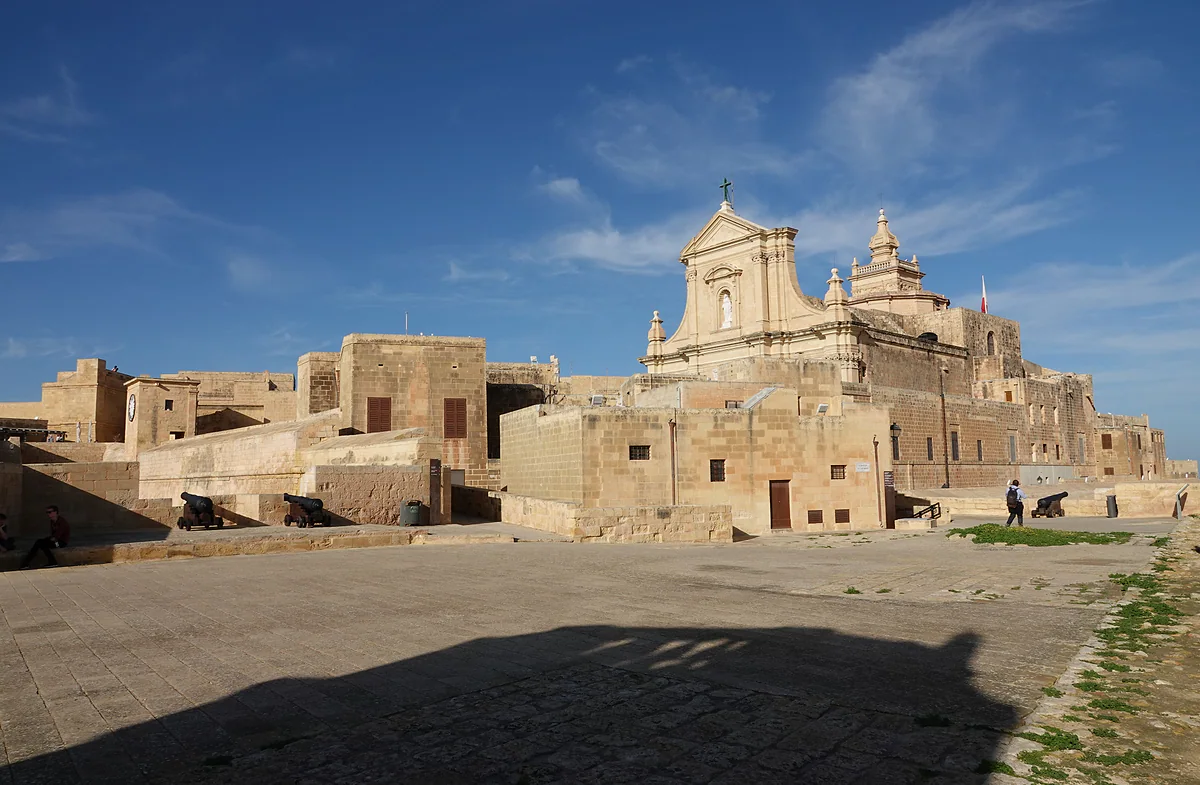
The Ċittadella in Victoria, Gozo, with the Cathedral of the Assumption rising above the stone walls and the cannons of St Michael's Bastion.
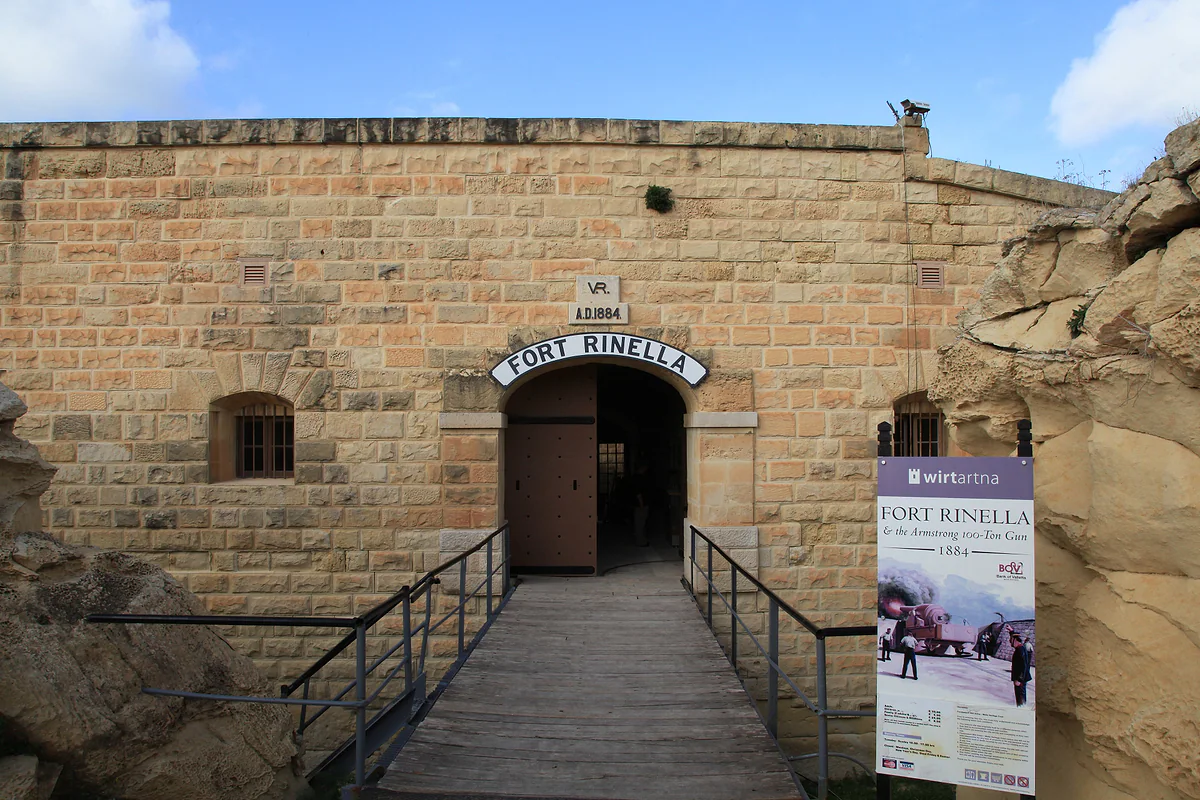
The entrance to Fort Rinella in Kalkara, a Victorian stone battery with a wooden bridge over the ditch and its name above.
Watchtowers with dates and sources
| Tower | Year | Where | Source |
|---|---|---|---|
| Wignacourt Tower | 1610 | St Paul's Bay | VisitMalta |
| St Mary's Tower | 1618 | Comino | VisitMalta and Ministry for Gozo |
| Red Tower (St Agatha's) | 1647 | Mellieħa | VisitMalta |
| Xlendi Tower | 1650 | Xlendi, Gozo | Ministry for Gozo |
| Dwejra Tower | 1652 | Dwejra, Gozo | Ministry for Gozo |
| Mġarr ix-Xini Tower | 1661 | Mġarr ix-Xini, Gozo | Ministry for Gozo |
Wignacourt Tower was Malta's northernmost defensive outpost until the Red Tower went up, according to VisitMalta, and Xlendi's is the oldest free-standing coastal watchtower on Gozo, according to the Ministry for Gozo.
Test yourself
True or false?
0/3 Pick before you peek.
-
Malta's fortifications are a UNESCO World Heritage Site.
See the answer
False. Valletta is, but the Knights' harbour fortifications and the Victoria Lines are only on the Tentative List, since 1998.
-
The British rebuilt the Knights' forts to defend against ironclad warships.
See the answer
True. UNESCO's entry explains that from 1800 the British adapted the complex, turning much of it into heavy-gun fortifications against armoured ironclads by the late 19th century.
-
The Red Tower at Mellieħa is older than Wignacourt Tower.
See the answer
False. According to VisitMalta, Wignacourt Tower at St Paul's Bay dates from 1610 and was the northernmost outpost until the Red Tower, from 1647, was built.
- Fortifications around the harbours
- 25 km
- The Order arrives and fortifies Birgu
- 1530
- Weight of Fort Rinella's gun
- 100 t
- Oldest surviving coastal tower
- 1610
0 of 279 Malta guides
Your next stamp
- Victoria Lines
- Fort St Angelo
- Fort Rinella
- History
- Great Siege of 1565
- Second World War
- Knights of Malta
- Malta in one day
- Things to do in Malta
- Gozo
- Most beautiful places
- Comino
- Prettiest villages
- UNESCO World Heritage Sites
- Where is Malta
- The Maltese islands
- Towns and villages
- Island of Malta
- Blue Lagoon
- Gardjola Gardens
- Ħal Saflieni Hypogeum
- Is Malta a country?
- Popeye Village
- Tarxien Temples
- Things to do in Gozo
- Valletta
- Esplora
- Golden Bay
- Gozo day trip
- Inquisitor's Palace
- Population
- St John's Co-Cathedral
- St Mary's Tower
- Grandmaster's Palace
- How big is Malta
- Maritime Museum
- Mellieħa Bay
- Fort St Elmo
- Language
- Malta at War Museum
- Paradise Bay
- Barrakka Gardens
- Red Tower
- Religion
- Malta government
- Saluting Battery
- MUŻA
- National Museum of Archaeology
- Underground Valletta
- Lascaris War Rooms
- Casa Rocca Piccola
- Three Cities
- Victoria
- Birgu
- Manoel Theatre
- Weekend in Malta
- Xagħra
- City Gate and Parliament
- Malta in three days
- Nadur
- Senglea
- Cospicua
- Malta in four days
- Qala
- Valletta Waterfront
- Għajnsielem
- Kalkara
- Malta in five days
- Malta in a week
- Paola
- Xewkija
- Sannat
- Tarxien
- Munxar
- Żabbar
- Fgura
- Fontana
- Kerċem
- Luqa
- Floriana
- Marsa
- Mellieħa
- The Citadel, Gozo
- Żebbuġ (Gozo)
- Ġgantija Temples
- Marsalforn
- Santa Luċija
- Ramla Bay
- San Lawrenz
- Xgħajra
- Xwejni salt pans
- Calypso's Cave
- Għarb
- Żejtun
- Għasri
- Gudja
- San Blas Bay
- Għaxaq
- Ħondoq Bay
- Marsaxlokk
- Kirkop
- Marsaxlokk Fish Market
- Mqabba
- St Peter's Pool
- Marsaskala
- Qrendi
- Żurrieq
- Beaches
- Comino ferry
- EU, Schengen and the euro
- Ħaġar Qim and Mnajdra
- Mdina
- Mġarr (Gozo)
- Blue Grotto
- Diving
- Entry requirements
- Mdina Cathedral
- Xewkija Rotunda
- Birżebbuġa
- Money and payments
- Palazzo Falson
- Safi
- Shipwrecks
- Ta' Ċenċ Cliffs
- Għar Dalam
- Mdina Dungeons
- Mġarr ix-Xini
- Prices and budget
- Snorkelling
- Boat trips
- Malta on a budget
- Playmobil FunPark
- Rabat (Malta)
- Xlendi
- Dwejra
- Gozo beaches
- Siġġiewi
- St Paul's Catacombs
- Tipping
- Azure Window
- Domvs Romana
- Għar Lapsi
- Plugs
- Limestone Heritage Park
- St Paul's Grotto
- Ta' Pinu Basilica
- Time zone
- Buskett Gardens
- Mobile and roaming
- Wied il-Għasri
- Dingli
- Maltese cross
- Dingli Cliffs
- Flag
- Żebbuġ
- Coat of arms
- Mtarfa
- Balzan
- National anthem
- Lija
- Malta facts
- Game of Thrones
- Iklin
- Attard
- Film locations
- San Anton Gardens
- Ta' Qali Crafts Village
- Megalithic temples
- Catacombs
- Museums
- Where to eat
- Where to stay
- Churches
- Hotels in Valletta
- Restaurants in Valletta
- Hotels in Sliema
- Maltese food
- Restaurants in Marsaxlokk
- Viewpoints
- Hotels in St Julian's
- Pastizzi
- Walking and hiking
- Hotels in Buġibba and Qawra
- Maltese rabbit stew
- Safety
- Hotels in Mellieħa
- Kinnie and Cisk
- Scams
- Gozo hotels
- Nightlife
- Tap water
- Boat parties
- Holiday packages
- Tourist tax
- All inclusive
- Gay Malta
- Sightseeing passes
- Apartments
- Malta with kids
- Public holidays
- How to get there
- Luxury
- Malta for couples
- Taxis and ride-hailing
- Weather
- Best time to visit
- Cycling
- English schools
- Flights
- Flights from Madrid
- Sea temperature
- Shopping and souvenirs
- Airport
- Free walking tours
- In winter
- Airport transfers
- Day trips and tours
- In summer
- Ferry from Sicily
- In January
- Cruise stop
- In February
- In March
- In April
- In May
- Getting around
- In June
- Buses
- July
- August
- Hop on hop off
- Gozo ferry
- September
- Gozo fast ferry
- October
- November
- Valletta ferries
- Car hire
- December
- Driving
- Events
- St Paul's Bay
- Village feasts
- Buġibba
- Christmas
- Easter
- Qawra
- Carnival
- Xemxija
- Fireworks festival
- Malta National Aquarium
- Isle of MTV
- St Paul's Islands
- Mosta
- Mosta Rotunda
- Naxxar
- Palazzo Parisio
- Għargħur
- Mġarr (Malta)
- Sliema
- Ta' Ħaġrat and Skorba Temples
- Għajn Tuffieħa Bay
- Tigné Point
- Ġnejna Bay
- St Julian's
- Paceville
- St George's Bay
- Gżira
- Msida
- Ta' Xbiex
- Pietà
- Pembroke
- Swieqi
- San Ġwann
- Birkirkara
- Ħamrun
- Santa Venera
- Qormi
Frequently asked questions
How many forts are there in Malta?
There's no single official count. The UNESCO Tentative List entry for the Knights' harbour fortifications speaks of some 25 km of walls around the harbours alone, and on top of that come watchtowers, the Victoria Lines and British batteries.
Which fort should I visit in Malta?
I'd start with Fort St Elmo in Valletta and Fort St Angelo in Birgu, €10 each, which between them cover the Great Siege of 1565 and the Second World War. After that, the Citadel on Gozo.
What is the oldest fort in Malta?
Fort St Angelo in Birgu. Heritage Malta records the harbour castle, the Castrum Maris, as early as 1274, and the Order made it its headquarters in 1530.
Can you visit Fort Manoel?
I wouldn't count on it, as I can't find official visitor information. Manoel Island is caught up in a planning dispute, and only Wikipedia describes the fort.
What is Fort Rinella?
A British battery in Kalkara run by the Fondazzjoni Wirt Artna, home to the 100-ton gun. It opens Monday to Saturday from 09:30 to 17:30 and entry is €14.
Is there a pass for Malta's forts?
Two. Heritage Malta's Multisite Pass, €60 for 30 days, covers Fort St Elmo, Fort St Angelo and the Citadel. Wirt Artna's Heritage Pass, €50 for a week, covers Lascaris, the Saluting Battery and Fort Rinella.
By
Tourism graduate with a master’s in Tourism Management and Planning from the University of Málaga, who has travelled across Europe. He writes every guide from official sources and his own judgement.
Published on . Facts checked on .
Sources
- UNESCO, Knights' Fortifications around the Harbours of Malta
- VisitMalta, St Paul's Bay (Wignacourt Tower)
- VisitMalta, St Agatha's Tower (Red Tower)
- VisitMalta, Santa Maria Tower Comino
- Heritage Malta, Fortress Builders Interpretation Centre
- Heritage Malta, Fort St Angelo
- Heritage Malta, Fort Delimara
- Lascaris War Rooms, tickets and prices
- UNESCO, Victoria Lines Fortifications
Photos: Diego Delso (CC BY-SA 4.0); Nenea hartia (CC BY-SA 4.0); Frank Vincentz (CC BY-SA 3.0), via Wikimedia Commons.