Roman Catholic, the state religion
Religion in Malta, from the catacombs to the festa
Malta is a Roman Catholic country. Catholicism is the state religion and 82.6% of the population declared themselves Catholic in the 2021 census, as quoted by Spain's foreign ministry. You see it in the calendar, with seven religious public holidays a year, in each parish's summer festa and in churches such as St John's Co-Cathedral and Ta' Pinu.
In 30 seconds
Full read: 3 min
- Malta's religion is Roman Catholic, and it's the state religion.
- 82.6% of the population declared themselves Catholic in the 2021 census.
- Seven of the year's fourteen public holidays are religious.
- From late May to September each parish holds its festa.
- St John's Co-Cathedral is closed to sightseers on Sundays.
If your trip falls between late May and September, I'd seek out a village festa, even for a single evening. It's the most direct way to see how faith is lived here, with a procession, brass bands and fireworks, and it costs nothing.

Before you go
What I would keep in mind
-
01 Most beautiful
A village festa, fireworks and all
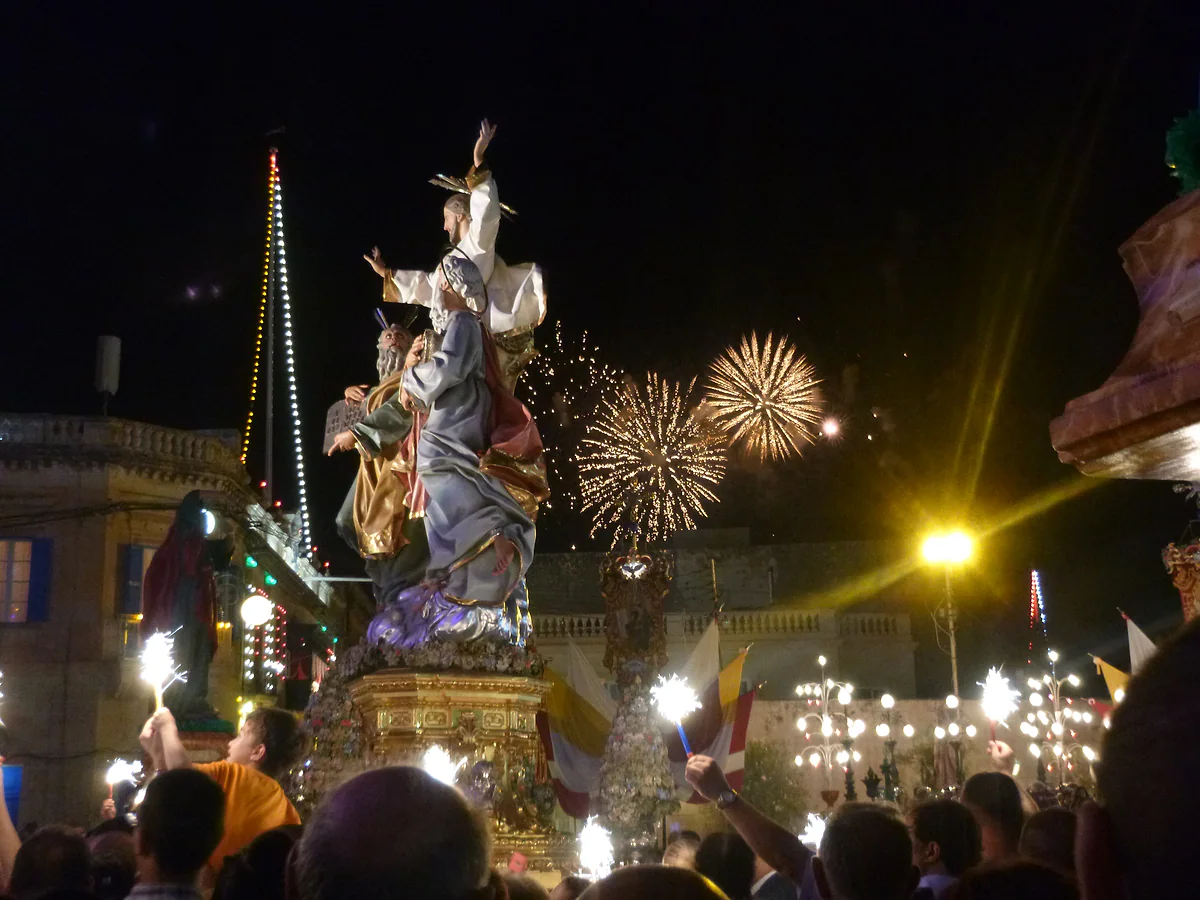
Each parish honours its patron saint over a long weekend of three days or more, with decorated streets, papier-mâché statues, nougat stalls and a fireworks finale.
Malta's village feasts -
02 My tip
Services can close a church to visitors
Mosta parish warns that on some days the Rotunda closes for religious services, and St John's Co-Cathedral doesn't open for sightseeing on Sundays or public holidays.
Mosta Rotunda -
03 Worth the splurge
Ta' Pinu, Gozo's national shrine
The Romanesque basilica went up between 1920 and 1932 in the fields near Għarb, and was visited by John Paul II in 1990 and Pope Francis in 2022. Opposite, 14 marble statues form the Stations of the Cross.
Ta' Pinu Basilica
What I would book
In Malta, religion isn’t a line on a fact sheet, it’s something you see as you walk around. To my eye the church is the building that rules every village, the calendar is marked by saints’ days, and summer nights smell of festa gunpowder. Coming from Britain, the intensity may surprise you, because faith here is public, loud and part of the social calendar in a way it rarely is at home.
A Catholic country, by law too
The Maltese government gives the country’s religion in two words, ‘Roman Catholic’. Spain’s foreign ministry goes further, explaining that Catholicism is the state religion and that 82.6% of the population declared themselves Catholic in the 2021 census. Even the Archbishop has his own flag, yellow and white stripes, listed by the government among the official flags. That hasn’t stopped same-sex marriage being legal, as I explain in gay Malta.
You feel it in the calendar. Of the year’s fourteen public holidays, seven are religious, from St Paul’s Shipwreck on 10 February to Christmas. And 8 September, Our Lady of Victories, blends faith and history, since Heritage Malta ties it to the end of the Great Siege in 1565 and the announcement of Italy’s surrender in 1943. The full list, and what it means for museums and shops, is in Malta public holidays.
St Paul and the first Christians
Malta’s religious story begins, according to the tradition the tourist board relates, with a shipwreck. St Paul is said to have landed on the island in AD 60, and Heritage Malta tells how Publius, the island’s chief official, welcomed him at San Pawl Milqi in Burmarrad. What followed is well documented. St Paul’s Catacombs in Rabat are, according to Heritage Malta, the earliest and largest archaeological evidence of Christianity in Malta, and were in use until the seventh and eighth centuries. I cover them all in the catacombs of Malta.
Churches worth visiting
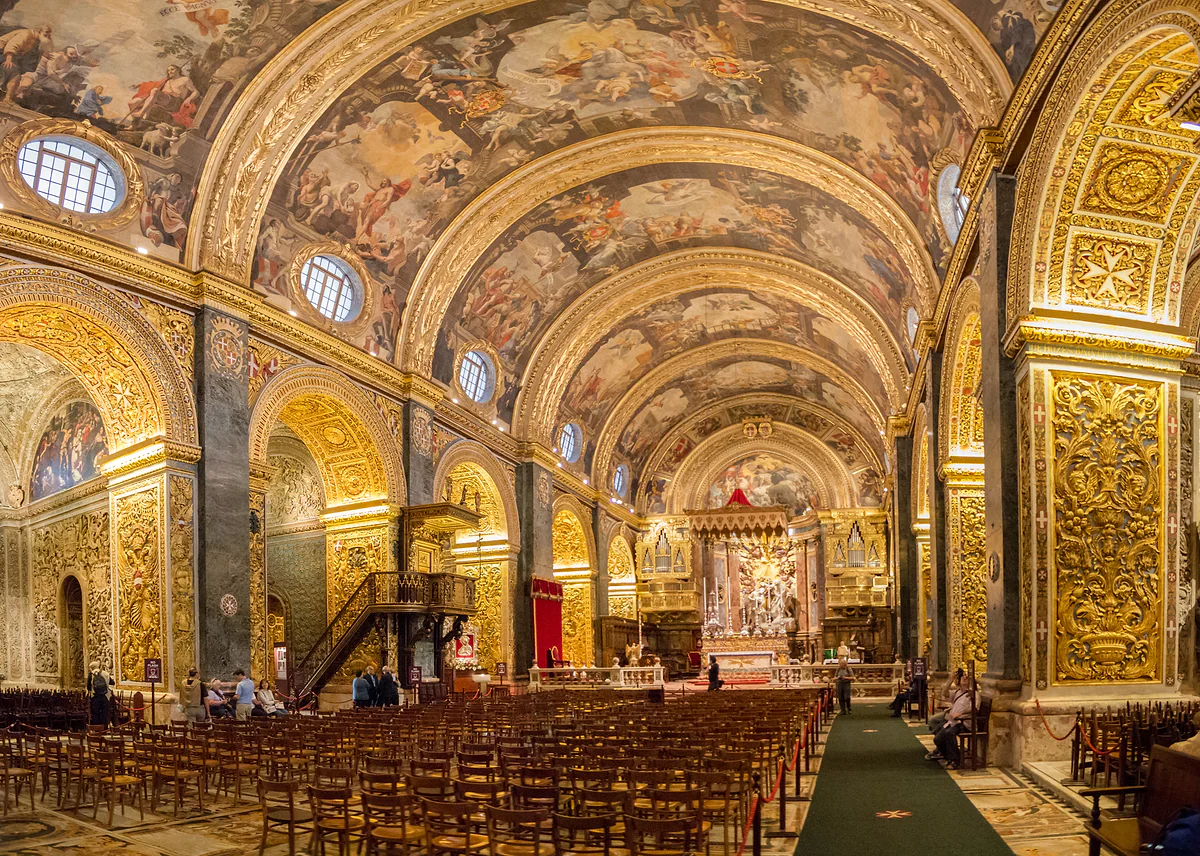
The Order of St John brought the great religious architecture. St John’s Co-Cathedral, completed in 1577, is the church I’d put first on any trip, gilded throughout and home to the two Caravaggios in the Oratory. It charges €15 and closes to sightseers on Sundays. Mosta Rotunda has a dome 39.6 m across inside and a replica of the bomb that pierced it in 1942 and never went off. On Gozo there’s the Xewkija Rotunda, consecrated in 1978, and the Ta’ Pinu shrine, built between 1920 and 1932 and a minor basilica since 1935.
My full selection, with opening times and prices, is in churches in Malta.
The festa, faith on the street
If anything explains religion in Malta better than a church, it’s a festa. The tourist board describes the season as a long series of extended weekends from late May well into September, when each parish celebrates its saint for three days or more. There’s a procession with the statue, band marches, decorated streets, papier-mâché figures, stalls selling Maltese nougat and, to finish, fireworks. On Gozo the ministry publishes the full 2026 order; on the island of Malta you’ll need each parish’s website. I go into detail in Malta village feasts.
What visitors should know
This is where people slip up. Churches open to visitors are also working places of worship, and that has consequences. Mosta parish warns that on some days the Rotunda closes for services. St John’s holds early Mass every day and on Sundays at 7:45, 9:30, 11:30 and 17:45, and, to protect the tombstones on the floor, the foundation staggers entry or caps numbers. On the beach, Spain’s foreign ministry points out that nudity and topless bathing aren’t allowed. None of this makes the trip harder, but it’s worth bearing in mind when you plan your day.
Ta’ Pinu, the shrine of papal visits
If I had to pick one place to understand Maltese devotion, it would be Ta’ Pinu on Gozo. According to the Gozo tourist board, in 1575 the apostolic visitor Pietro Duzina ordered the old chapel pulled down, and in 1858 it took the name of Pinu Gauci, the local man who paid for its restoration. In 1883 a village woman, Karmni Grima, said she heard the voice of the Virgin, and devotion grew until the present basilica went up between 1920 and 1932. John Paul II visited in 1990 and Pope Francis in 2022, bringing a golden rose, as Benedict XVI had in 2010. The full story is in Ta’ Pinu Basilica.
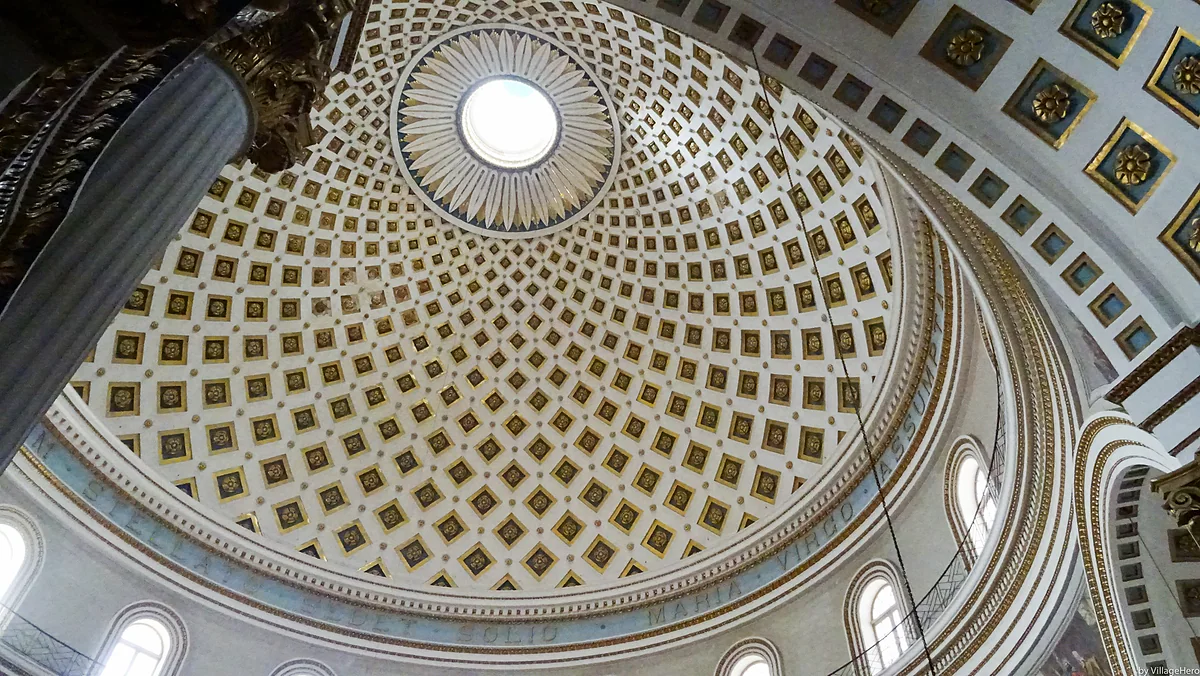
Inside the dome of the Rotunda of Mosta, its diamond-shaped coffers rising in rings towards the oculus of light at the centre.
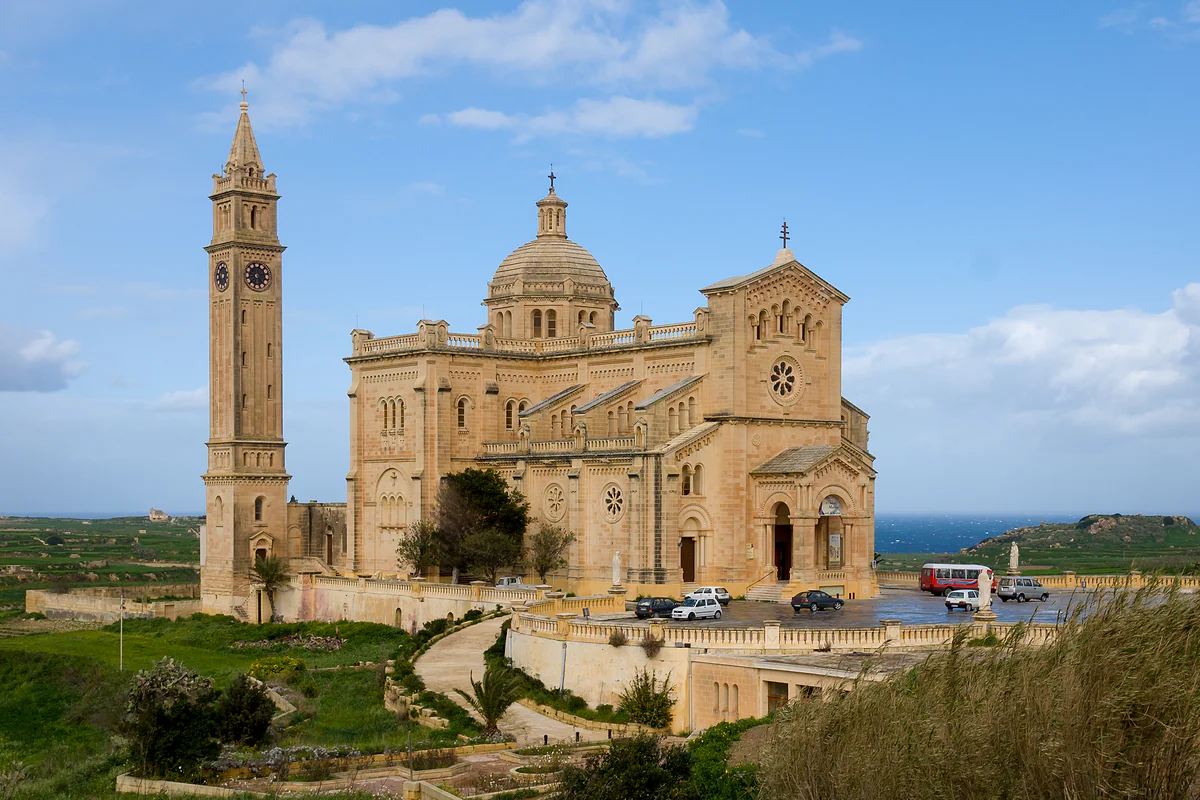
The Basilica of Ta' Pinu standing alone in the fields near Għarb, Gozo, with its free-standing bell tower, dome and pale stone façade.
Malta's religious public holidays (2026 and 2027)
| Holiday | 2026 | 2027 |
|---|---|---|
| St Paul's Shipwreck | Tuesday 10-2 | Wednesday 10-2 |
| St Joseph | Thursday 19-3 | Friday 19-3 |
| Good Friday | 3-4 | 26-3 |
| St Peter and St Paul (L-Imnarja) | Monday 29-6 | Tuesday 29-6 |
| Assumption (Santa Marija) | Saturday 15-8 | Sunday 15-8 |
| Our Lady of Victories | Tuesday 8-9 | Wednesday 8-9 |
| Immaculate Conception | Tuesday 8-12 | Wednesday 8-12 |
| Christmas Day | Friday 25-12 | Saturday 25-12 |
Holiday list from Malta's tourist board and government; weekdays are my own calculation. I haven't found whether holidays falling at weekends move to a weekday, so don't assume a Monday off as in the UK. 8 September is also a national day.
Test yourself
True or false?
0/4 Pick before you peek.
-
Catholicism is Malta's state religion.
See the answer
True. Spain's foreign ministry says so in its June 2026 country profile, with 82.6% Catholics according to the 2021 census.
-
You can tour St John's Co-Cathedral on a Sunday.
See the answer
False. It opens to visitors Monday to Saturday. On Sundays and public holidays it's closed to sightseers, though Masses are held at 7:45, 9:30, 11:30 and 17:45.
-
The Inquisition operated in Malta for more than two centuries.
See the answer
True. Heritage Malta says it held sway for over 224 years, from the arrival of the first inquisitor in 1574 until the French abolished it in 1798.
-
8 September in Malta is purely a religious holiday.
See the answer
False. It's a national day too. Heritage Malta links it to the end of the Great Siege in 1565 and the announcement of Italy's surrender in 1943, as well as the Virgin's birthday.
- Catholic population (2021 census)
- 82.6%
- Religious public holidays a year
- 7
- St Paul's shipwreck, according to tradition
- AD 60
- Year St John's Co-Cathedral was completed
- 1577
What to see
What to see in Religion
0 of 279 Malta guides
Your next stamp
- Churches
- Gay Malta
- Village feasts
- Malta for couples
- Is Malta a country?
- Malta facts
- Ta' Pinu Basilica
- Things to do in Malta
- Gozo
- Most beautiful places
- Comino
- Prettiest villages
- UNESCO World Heritage Sites
- Where is Malta
- The Maltese islands
- Towns and villages
- Island of Malta
- Blue Lagoon
- Fort Rinella
- Fort St Angelo
- Gardjola Gardens
- Ħal Saflieni Hypogeum
- Popeye Village
- Tarxien Temples
- Things to do in Gozo
- Valletta
- Esplora
- Golden Bay
- Gozo day trip
- Inquisitor's Palace
- Population
- St John's Co-Cathedral
- St Mary's Tower
- Grandmaster's Palace
- How big is Malta
- Maritime Museum
- Mellieħa Bay
- Fort St Elmo
- Language
- Malta at War Museum
- Paradise Bay
- Barrakka Gardens
- Red Tower
- Malta government
- Saluting Battery
- MUŻA
- National Museum of Archaeology
- Underground Valletta
- Lascaris War Rooms
- Casa Rocca Piccola
- Malta in one day
- Three Cities
- Victoria
- Birgu
- Manoel Theatre
- Weekend in Malta
- Xagħra
- City Gate and Parliament
- Malta in three days
- Nadur
- Senglea
- Cospicua
- Malta in four days
- Qala
- Valletta Waterfront
- Għajnsielem
- Kalkara
- Malta in five days
- Malta in a week
- Paola
- Xewkija
- Sannat
- Tarxien
- Munxar
- Żabbar
- Fgura
- Fontana
- Kerċem
- Luqa
- Floriana
- Marsa
- Mellieħa
- The Citadel, Gozo
- Żebbuġ (Gozo)
- Ġgantija Temples
- Marsalforn
- Santa Luċija
- Ramla Bay
- San Lawrenz
- Xgħajra
- Xwejni salt pans
- Calypso's Cave
- Għarb
- Żejtun
- Għasri
- Gudja
- San Blas Bay
- Għaxaq
- Ħondoq Bay
- Marsaxlokk
- Kirkop
- Marsaxlokk Fish Market
- Mqabba
- St Peter's Pool
- Marsaskala
- Qrendi
- Żurrieq
- Beaches
- Comino ferry
- EU, Schengen and the euro
- Ħaġar Qim and Mnajdra
- Mdina
- Mġarr (Gozo)
- Blue Grotto
- Diving
- Entry requirements
- Mdina Cathedral
- Xewkija Rotunda
- Birżebbuġa
- Money and payments
- Palazzo Falson
- Safi
- Shipwrecks
- Ta' Ċenċ Cliffs
- Għar Dalam
- Mdina Dungeons
- Mġarr ix-Xini
- Prices and budget
- Snorkelling
- Boat trips
- Malta on a budget
- Playmobil FunPark
- Rabat (Malta)
- Xlendi
- Dwejra
- Gozo beaches
- History
- Siġġiewi
- St Paul's Catacombs
- Tipping
- Azure Window
- Domvs Romana
- Għar Lapsi
- Great Siege of 1565
- Plugs
- Limestone Heritage Park
- Second World War
- St Paul's Grotto
- Time zone
- Buskett Gardens
- Knights of Malta
- Mobile and roaming
- Wied il-Għasri
- Dingli
- Maltese cross
- Dingli Cliffs
- Flag
- Żebbuġ
- Coat of arms
- Mtarfa
- Balzan
- National anthem
- Lija
- Game of Thrones
- Iklin
- Attard
- Film locations
- Forts and fortifications
- San Anton Gardens
- Ta' Qali Crafts Village
- Victoria Lines
- Megalithic temples
- Catacombs
- Museums
- Where to eat
- Where to stay
- Hotels in Valletta
- Restaurants in Valletta
- Hotels in Sliema
- Maltese food
- Restaurants in Marsaxlokk
- Viewpoints
- Hotels in St Julian's
- Pastizzi
- Walking and hiking
- Hotels in Buġibba and Qawra
- Maltese rabbit stew
- Safety
- Hotels in Mellieħa
- Kinnie and Cisk
- Scams
- Gozo hotels
- Nightlife
- Tap water
- Boat parties
- Holiday packages
- Tourist tax
- All inclusive
- Sightseeing passes
- Apartments
- Malta with kids
- Public holidays
- How to get there
- Luxury
- Taxis and ride-hailing
- Weather
- Best time to visit
- Cycling
- English schools
- Flights
- Flights from Madrid
- Sea temperature
- Shopping and souvenirs
- Airport
- Free walking tours
- In winter
- Airport transfers
- Day trips and tours
- In summer
- Ferry from Sicily
- In January
- Cruise stop
- In February
- In March
- In April
- In May
- Getting around
- In June
- Buses
- July
- August
- Hop on hop off
- Gozo ferry
- September
- Gozo fast ferry
- October
- November
- Valletta ferries
- Car hire
- December
- Driving
- Events
- St Paul's Bay
- Buġibba
- Christmas
- Easter
- Qawra
- Carnival
- Xemxija
- Fireworks festival
- Malta National Aquarium
- Isle of MTV
- St Paul's Islands
- Mosta
- Mosta Rotunda
- Naxxar
- Palazzo Parisio
- Għargħur
- Mġarr (Malta)
- Sliema
- Ta' Ħaġrat and Skorba Temples
- Għajn Tuffieħa Bay
- Tigné Point
- Ġnejna Bay
- St Julian's
- Paceville
- St George's Bay
- Gżira
- Msida
- Ta' Xbiex
- Pietà
- Pembroke
- Swieqi
- San Ġwann
- Birkirkara
- Ħamrun
- Santa Venera
- Qormi
Frequently asked questions
What is the main religion in Malta?
Roman Catholicism. The Maltese government lists it as the country's religion, and Spain's foreign ministry adds that it's the state religion, with 82.6% of the population declaring themselves Catholic in the 2021 census.
What percentage of Malta is Catholic?
82.6%, according to the NSO's 2021 census as quoted in Spain's foreign ministry country profile from June 2026.
What is a festa in Malta?
The feast of each parish's patron saint, lasting three days or more between late May and September. Expect a procession with the statue, band marches, street decorations, Maltese nougat stalls and fireworks.
Why is St Paul so important in Malta?
Tradition, as told by the tourist board, has him shipwrecked on the island in AD 60, and Heritage Malta says he was welcomed by Publius at San Pawl Milqi. St Paul's Shipwreck is a public holiday on 10 February.
Can you visit churches in Malta?
Yes, within opening hours. St John's Co-Cathedral opens Monday to Saturday for €15, and Mosta Rotunda charges €8 for the full visit but may close for services.
Are there any religious rules visitors should know?
Churches are working places of worship, so services can close them to visitors. On beaches, Spain's foreign ministry notes that nudity and topless bathing are not allowed.
By
Tourism graduate with a master’s in Tourism Management and Planning from the University of Málaga, who has travelled across Europe. He writes every guide from official sources and his own judgement.
Published on . Facts checked on .
Sources
Photos: SharonPisani (CC BY-SA 4.0); VillageHero from Ulm, Germany (CC BY-SA 2.0); CEphoto, Uwe Aranas (CC BY-SA 3.0), via Wikimedia Commons.