A Knights' fort from 1647
The Red Tower, St Agatha's fort above Mellieħa
The Red Tower (St Agatha's Tower) was built by Grand Master Lascaris in 1647 on the Mellieħa ridge, above Għadira Bay. It was the furthest outpost from Valletta, held a cannon and 30 men and signalled to Gozo. The British kept it manned through both world wars.
In 30 seconds
Full read: 3 min
- The Red Tower (St Agatha's) was built by Grand Master Lascaris in 1647 on the Mellieħa ridge.
- It was the furthest outpost from Valletta and signalled to Gozo.
- It held a cannon and 30 men, had walls about 4 metres thick and a drawbridge at the entrance.
- The only official hours date from 2021 (daily, 10:00 to 13:30) and no price is published.
I'd go up to the Red Tower in the morning, before the beach, because the only official opening hours I've found closed at half past one. You get why they built it on that ridge from down below, but it's worth the climb.

Before you go
What I would keep in mind
-
01 Most beautiful
Built to talk to Gozo
VisitMalta says that in 1647 it was the furthest outpost from Valletta and served as a signal post for communication with Gozo. That's why it faces the channel rather than inland.
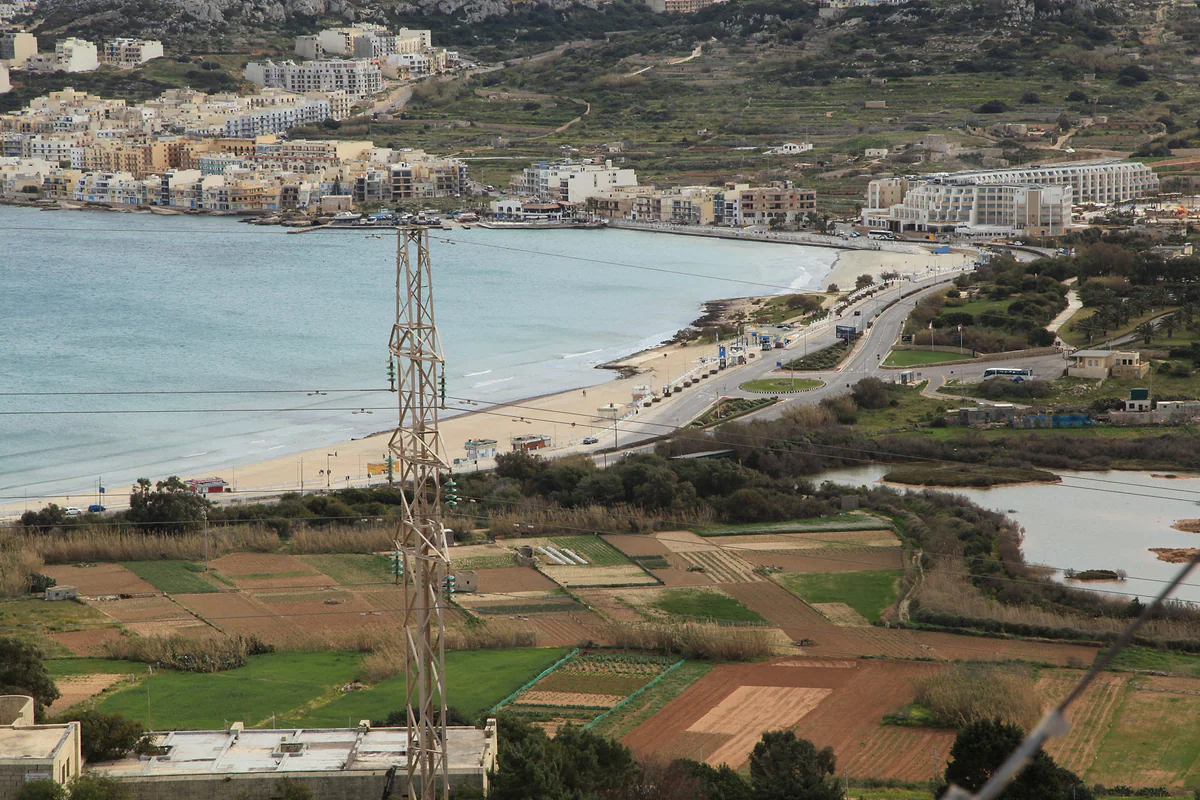
Mellieħa Bay (Għadira) -
02 My tip
Old opening hours, so check
VisitMalta's official listing, last updated in 2021, had it open every day from 10:00 to 13:30. There's no published price and nothing more recent, so I wouldn't make a special trip just to go inside without confirming.
-
03 Most beautiful
Partner to the Comino tower
Across the channel stands St Mary's Tower on Comino, from 1618, which the Ministry for Gozo says guarded the channel and signalled between the islands.
St Mary's Tower on Comino
The Red Tower can be seen from all over Mellieħa Bay, red against the ridge, and it’s one of those buildings that explains a landscape. If you’ve ever wondered why northern Malta is dotted with towers, this is the clearest answer.
Why the Knights built a tower here
To understand it, start with the town. VisitMalta explains that Mellieħa was an isolated 15th-century hamlet on the ridge above Għadira Bay, and that it was abandoned for a couple of centuries because it was so exposed to pirate and Saracen raids. People only moved back in the early 18th century.
Into that empty stretch of coast, in 1647, Grand Master Lascaris put St Agatha’s Tower. According to VisitMalta’s official listing, it was then the furthest outpost from Valletta and acted as a signal post for communication with Gozo. It was one of the main defensive positions of the Knights’ era, with a cannon and a garrison of 30 men. Put like that, it reads to me more like a small fort than a lookout.
Why is it red?
The official answer is refreshingly simple. VisitMalta says it’s known as the Red Tower because of the colour it was painted and restored in. Its real name is St Agatha’s Tower, and you’ll see both around Mellieħa and on maps. The colour does its job, too, since from the beach below or the Gozo ferry you can’t miss it.
What it looks like
It’s square in plan, with four corner towers rising from the base. The outer walls are about four metres thick, with small windows cut through them. You didn’t simply walk up to the door, either. The entrance was reached by a flight of steps separated from it by a drawbridge, which tells you what the builders were expecting.
In the 18th century a low star-shaped entrenchment was added around it, and that’s what gives it the fortress silhouette you notice from below. For the rest of the island’s defences, see my guide to forts in Malta.
From the Knights to radar
The tower never really retired. Under the British it was used for defence and was manned during both world wars. More recently, the Armed Forces of Malta fitted it out as a radar station. Few of the Order’s buildings have had such a long working life.
It had a partner across the water, too. St Mary’s Tower on Comino, put up in 1618, was there to guard, according to the Ministry for Gozo, the channel and signal between the islands. I like to picture the two as parts of one system, one on each shore.
Visiting, views and fitting it in
On visiting, I have less than I’d like. VisitMalta’s official listing, last updated in 2021, had it open every day from 10:00 to 13:30, with parking. It gives no price and I haven’t found anything more recent, so treat those hours as a guide and confirm them first if the tower is your only reason to go.
What’s guaranteed is the setting. Right below is Mellieħa Bay, which VisitMalta describes as the largest of the area’s thirteen sandy coves, and behind the beach lies the Għadira reserve, a 97.74-hectare wetland in the Natura 2000 network. My plan would be the tower first thing, the beach afterwards and, if you’re staying, a wander round the town, which I cover in Mellieħa.
The Red Tower through time
| Period | What happened |
|---|---|
| 15th century | Mellieħa is an isolated hamlet on the ridge, later abandoned because of pirate raids |
| 1647 | Grand Master Lascaris builds St Agatha's Tower |
| 18th century | A low star-shaped entrenchment is added |
| Early 18th century | Mellieħa is lived in again |
| British period | Used for defence and manned in both world wars |
| Recent times | Radar station of the Armed Forces of Malta |
From VisitMalta's (Malta Tourism Authority) official listings for the tower and for Mellieħa, last updated in 2021.
What's right below it
| Place | What it is | Sourced detail |
|---|---|---|
| Mellieħa Bay (Għadira) | The largest of Mellieħa's 13 sandy coves | VisitMalta |
| Għadira reserve | Protected wetland behind the beach | 97.74 ha in Natura 2000 |
| St Mary's Tower | The Knights' tower on Comino, 1618 | Ministry for Gozo |
Għadira's area is from the European Environment Agency's Natura 2000 database.
Test yourself
True or false?
0/4 Pick before you peek.
-
The Red Tower is named after the colour it was painted and restored in.
See the answer
True. That's the explanation in VisitMalta's official listing, which also calls it St Agatha's Tower.
-
Under the Knights it was defended by a cannon and 30 men.
See the answer
True. VisitMalta counts it among the Order's main defensive positions, with a cannon and a garrison of 30.
-
You walked straight in through a ground-level door.
See the answer
False. You climbed a flight of steps that was separated from the door by a drawbridge.
-
The British left it unused.
See the answer
False. They used it for defence and manned it in both world wars. Later the Armed Forces of Malta fitted it out as a radar station.
- Year it was built
- 1647
- Men in the Knights' garrison
- 30
- Approximate thickness of its walls
- 4 m
- World wars with a British garrison
- 2
Map
Where Red Tower is
Gozo lies to the north-west, across the channel the ferry crosses from Ċirkewwa, with Comino between the two islands. Every number opens its guide.
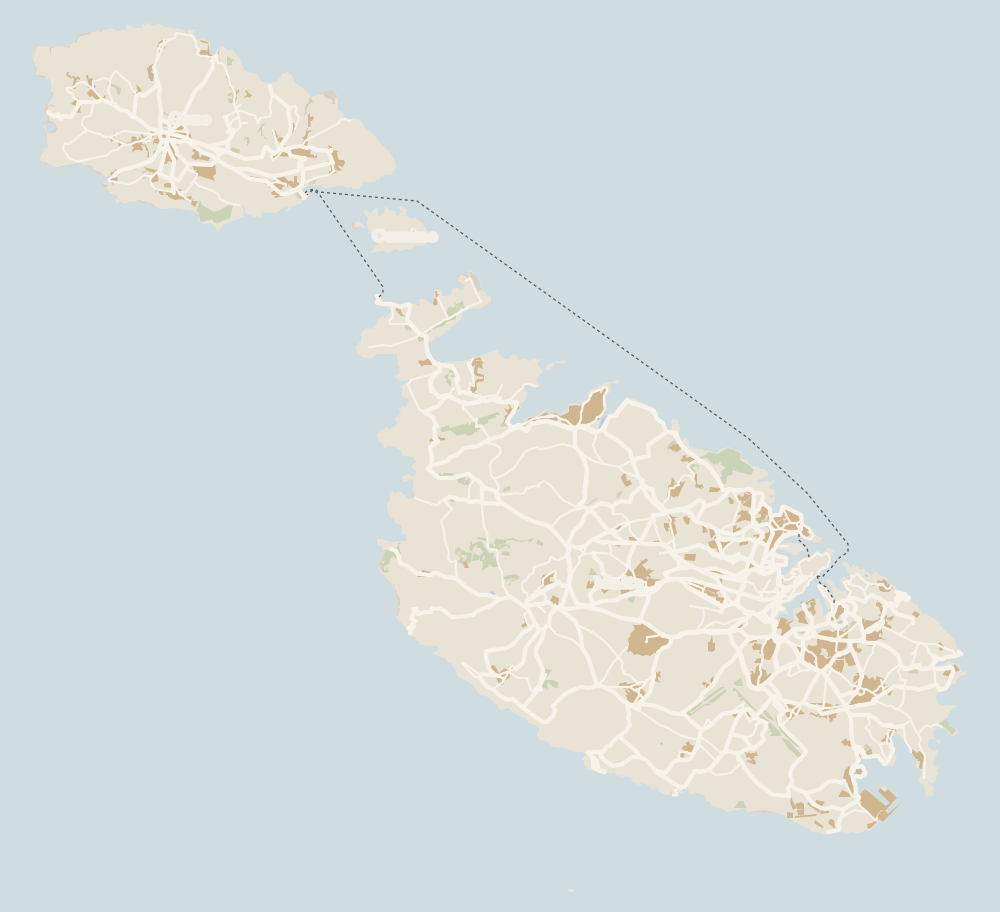 1Popeye Village 2Golden Bay 3Mellieħa Bay 4Paradise Bay 5Red Tower 6Mellieħa
 Map data © OpenStreetMap contributors (ODbL)
0 of 279 Malta guides
Your next stamp
- Mellieħa
- Flag
- Megalithic temples
- Hotels in Mellieħa
- Ta' Pinu Basilica
- Where to stay
- Ta' Ħaġrat and Skorba Temples
- Forts and fortifications
- Things to do in Malta
- Gozo
- Most beautiful places
- Comino
- Prettiest villages
- UNESCO World Heritage Sites
- Where is Malta
- The Maltese islands
- Towns and villages
- Island of Malta
- Blue Lagoon
- Fort Rinella
- Fort St Angelo
- Gardjola Gardens
- Ħal Saflieni Hypogeum
- Is Malta a country?
- Popeye Village
- Tarxien Temples
- Things to do in Gozo
- Valletta
- Esplora
- Golden Bay
- Gozo day trip
- Inquisitor's Palace
- Population
- St John's Co-Cathedral
- St Mary's Tower
- Grandmaster's Palace
- How big is Malta
- Maritime Museum
- Mellieħa Bay
- Fort St Elmo
- Language
- Malta at War Museum
- Paradise Bay
- Barrakka Gardens
- Religion
- Malta government
- Saluting Battery
- MUŻA
- National Museum of Archaeology
- Underground Valletta
- Lascaris War Rooms
- Casa Rocca Piccola
- Malta in one day
- Three Cities
- Victoria
- Birgu
- Manoel Theatre
- Weekend in Malta
- Xagħra
- City Gate and Parliament
- Malta in three days
- Nadur
- Senglea
- Cospicua
- Malta in four days
- Qala
- Valletta Waterfront
- Għajnsielem
- Kalkara
- Malta in five days
- Malta in a week
- Paola
- Xewkija
- Sannat
- Tarxien
- Munxar
- Żabbar
- Fgura
- Fontana
- Kerċem
- Luqa
- Floriana
- Marsa
- The Citadel, Gozo
- Żebbuġ (Gozo)
- Ġgantija Temples
- Marsalforn
- Santa Luċija
- Ramla Bay
- San Lawrenz
- Xgħajra
- Xwejni salt pans
- Calypso's Cave
- Għarb
- Żejtun
- Għasri
- Gudja
- San Blas Bay
- Għaxaq
- Ħondoq Bay
- Marsaxlokk
- Kirkop
- Marsaxlokk Fish Market
- Mqabba
- St Peter's Pool
- Marsaskala
- Qrendi
- Żurrieq
- Beaches
- Comino ferry
- EU, Schengen and the euro
- Ħaġar Qim and Mnajdra
- Mdina
- Mġarr (Gozo)
- Blue Grotto
- Diving
- Entry requirements
- Mdina Cathedral
- Xewkija Rotunda
- Birżebbuġa
- Money and payments
- Palazzo Falson
- Safi
- Shipwrecks
- Ta' Ċenċ Cliffs
- Għar Dalam
- Mdina Dungeons
- Mġarr ix-Xini
- Prices and budget
- Snorkelling
- Boat trips
- Malta on a budget
- Playmobil FunPark
- Rabat (Malta)
- Xlendi
- Dwejra
- Gozo beaches
- History
- Siġġiewi
- St Paul's Catacombs
- Tipping
- Azure Window
- Domvs Romana
- Għar Lapsi
- Great Siege of 1565
- Plugs
- Limestone Heritage Park
- Second World War
- St Paul's Grotto
- Time zone
- Buskett Gardens
- Knights of Malta
- Mobile and roaming
- Wied il-Għasri
- Dingli
- Maltese cross
- Dingli Cliffs
- Żebbuġ
- Coat of arms
- Mtarfa
- Balzan
- National anthem
- Lija
- Malta facts
- Game of Thrones
- Iklin
- Attard
- Film locations
- San Anton Gardens
- Ta' Qali Crafts Village
- Victoria Lines
- Catacombs
- Museums
- Where to eat
- Churches
- Hotels in Valletta
- Restaurants in Valletta
- Hotels in Sliema
- Maltese food
- Restaurants in Marsaxlokk
- Viewpoints
- Hotels in St Julian's
- Pastizzi
- Walking and hiking
- Hotels in Buġibba and Qawra
- Maltese rabbit stew
- Safety
- Kinnie and Cisk
- Scams
- Gozo hotels
- Nightlife
- Tap water
- Boat parties
- Holiday packages
- Tourist tax
- All inclusive
- Gay Malta
- Sightseeing passes
- Apartments
- Malta with kids
- Public holidays
- How to get there
- Luxury
- Malta for couples
- Taxis and ride-hailing
- Weather
- Best time to visit
- Cycling
- English schools
- Flights
- Flights from Madrid
- Sea temperature
- Shopping and souvenirs
- Airport
- Free walking tours
- In winter
- Airport transfers
- Day trips and tours
- In summer
- Ferry from Sicily
- In January
- Cruise stop
- In February
- In March
- In April
- In May
- Getting around
- In June
- Buses
- July
- August
- Hop on hop off
- Gozo ferry
- September
- Gozo fast ferry
- October
- November
- Valletta ferries
- Car hire
- December
- Driving
- Events
- St Paul's Bay
- Village feasts
- Buġibba
- Christmas
- Easter
- Qawra
- Carnival
- Xemxija
- Fireworks festival
- Malta National Aquarium
- Isle of MTV
- St Paul's Islands
- Mosta
- Mosta Rotunda
- Naxxar
- Palazzo Parisio
- Għargħur
- Mġarr (Malta)
- Sliema
- Għajn Tuffieħa Bay
- Tigné Point
- Ġnejna Bay
- St Julian's
- Paceville
- St George's Bay
- Gżira
- Msida
- Ta' Xbiex
- Pietà
- Pembroke
- Swieqi
- San Ġwann
- Birkirkara
- Ħamrun
- Santa Venera
- Qormi
Frequently asked questions
Can you visit the Red Tower in Malta?
VisitMalta's official listing, from 2021, had it open daily from 10:00 to 13:30. I haven't found more recent hours or a published price, so I'd confirm before going if the tower is your only reason to be there.
Why is the Red Tower red?
According to VisitMalta, because of the colour it was painted and restored in. Its proper name is St Agatha's Tower.
Where is the Red Tower?
On Triq tad-Dahar, on top of the Mellieħa ridge in the north of the island of Malta, above Għadira Bay and looking out over the channel to Comino and Gozo.
Who built the Red Tower?
Grand Master Lascaris of the Order of St John, in 1647. A low star-shaped entrenchment was added in the 18th century.
What was the Red Tower used for?
It was the furthest outpost from Valletta and a signal post for communicating with Gozo. It was one of the Knights' main defensive positions, with a cannon and 30 men.
By
Tourism graduate with a master’s in Tourism Management and Planning from the University of Málaga, who has travelled across Europe. He writes every guide from official sources and his own judgement.
Published on . Facts checked on .
Sources
Photos: Frank Vincentz (CC BY-SA 3.0), via Wikimedia Commons.