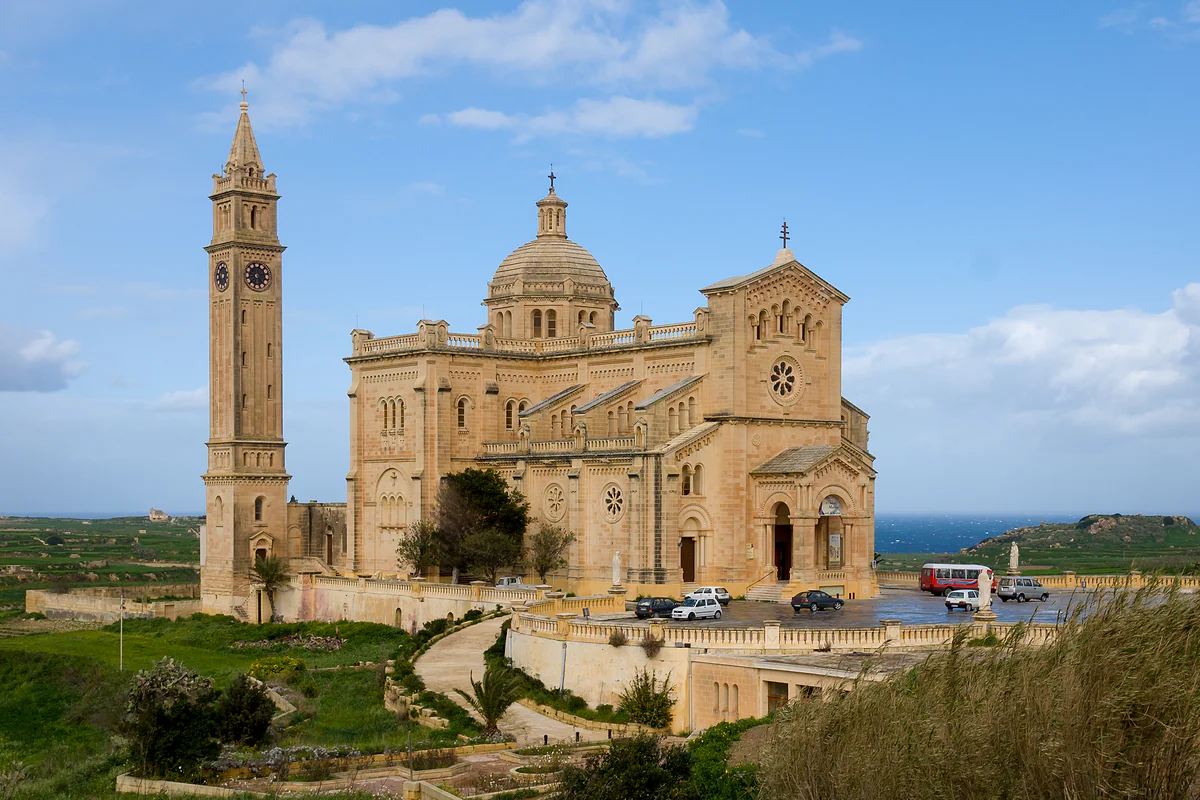
A shrine on Gozo
Ta' Pinu, the basilica in the fields that two popes came to see
Ta' Pinu is Malta's national shrine to Our Lady, a large Romanesque church standing alone in the fields on the edge of Għarb, Gozo. It was built between 1920 and 1932 beside an older chapel, has been a minor basilica since 1935 and has welcomed Pope John Paul II and Pope Francis. No official source I could read publishes its opening hours.
In 30 seconds
Full read: 3 min
- Ta' Pinu is Malta's national shrine to Our Lady, on the edge of Għarb in Gozo.
- The present Romanesque basilica was built between 1920 and 1932 and has been a minor basilica since 1935.
- In 1883 Karmela Grima said she heard the Virgin's voice there, and it has drawn pilgrims ever since.
- John Paul II (1990) and Francis (2022) have both visited.
- Its opening hours aren't published by any official source.
Even if you're not religious, Ta' Pinu is worth stopping for the setting alone, a huge basilica on its own in the middle of the fields. Afterwards I'd walk up Ta' Għammar hill along the Stations of the Cross, because from the top the whole of western Gozo makes sense.

Before you go
What I would keep in mind
-
01 Most beautiful
Marble Stations of the Cross on the hill opposite
On Ta' Għammar hill, facing the basilica, a steep path climbs past 14 white Carrara marble statues of the Stations of the Cross, put in place in the early 1980s.
-
02 My tip
Karmni Grima's house, with an audio guide
The house museum of the woman who heard the Virgin's voice in 1883 has an audio-visual show and audio guide in six languages, English among them.
-
03 Watch out
Don't trust opening times without a source
Neither the Ministry for Gozo nor any official source I've read publishes the shrine's hours. Avoid turning up mid-Mass and leave some slack.
-
04 Getting there
On the edge of Għarb
The shrine sits just outside Għarb. Routes 311 and 312 run from Victoria to the village.
Għarb
What I would book
Ta’ Pinu makes an impression before you’ve even gone in. It’s a vast basilica of pale stone with its bell tower, planted on its own in the fields of western Gozo with no village around it. The Ministry for Gozo calls it Malta’s most important shrine, and seeing how Gozitans look after it, I can well believe that.
From a country chapel to a national shrine
Its origins are hazy. The first record comes from Bishop Domenico Cubelles, who noted that the chapel had been rebuilt and belonged to the noble Gentile family. When the apostolic visitor Pietro Duzina came in 1575, he ordered it pulled down because it was falling apart, but tradition holds that a workman was injured as demolition began, which was taken as a sign to spare it.
In 1858 the chapel was renamed Ta’ Pinu after Pinu Gauci, who paid for its restoration. Fame arrived in 1883, when Karmela Grima, Karmni to those who knew her, a countrywoman from Għarb, said she had heard the Virgin’s voice there. Pilgrims began to pour in, and Bishop Pietru Pace confirmed the heavenly origin of the events.
The basilica of 1920 to 1932
With so many visitors the chapel soon proved too small. Between 1920 and 1932 the large Romanesque church you see today was built, and in 1935 Pope Pius XI made it a minor basilica. The old chapel survives within the complex, and the Ministry draws attention to the mosaics on the forecourt and the motifs carved into the stone.
Two popes have been. John Paul II came in 1990, prayed in the chapel and said Mass on the forecourt. Francis came in 2022, left a golden rose, like the one Benedict XVI had sent in 2010, and led a prayer meeting with around 3,000 representatives of the local Church.
What is there to see at Ta’ Pinu?
Besides the basilica, there are two things I wouldn’t miss. The first is Ta’ Għammar hill, directly opposite. A steep path climbs past 14 statues in white Carrara marble depicting the Stations of the Cross, from the Last Supper to the burial of Jesus, carved in Italy by Alfred Camilleri Cauchi and put in place in the early 1980s. From the top you get one of the finest views on Gozo.
The second is Karmni Grima’s house in Għarb, now a museum. The Ministry says it has reopened after restoration, is fully accessible and has an audio-visual presentation on her life plus an audio guide in six languages, English included. There’s no published opening time or price, but there is a phone number, +356 21556045, which I’d ring before going.
Opening hours, and visiting with respect
Here’s the crucial bit. The shrine’s opening hours don’t appear in any official page I’ve managed to check, and the website some places mention doesn’t load. So I won’t give you times. What I will say is that this is a working church and a genuine place of pilgrimage, so I’d go outside services, dress modestly, with shoulders and knees covered, and take my time.
The shrine is on the outskirts of Għarb, a few minutes’ drive from Victoria. By bus, routes 311 and 312 run from Victoria bus terminal towards Għarb.
Close by, Għasri and Ta’ Ġurdan lighthouse
Between Għammar hill and Żebbuġ hill lies Għasri, the least populated village on Gozo. The Ministry for Gozo maps out a bike route that starts in Victoria, calls at Ta’ Pinu and continues towards that village, always facing Ta’ Ġurdan lighthouse. Along the road, a string of niches decorated with religious mosaics tells you the shrine is close. If you’re driving, I’d follow the same route and then drop down to Wied il-Għasri for a swim.
Fitting it into a day in the west
Ta’ Pinu slots neatly into a day in western Gozo. I’d do Dwejra in the morning, Ta’ Pinu and the Stations of the Cross around midday, and the Wied il-Mielaħ rock window, also in Għarb, in the afternoon. And one nice detail for the trip home. On your crossing back, look at the ship’s name, because one of the Gozo Channel ferries is called Ta’ Pinu. For the rest of the island, my full ranking is in things to do in Gozo.
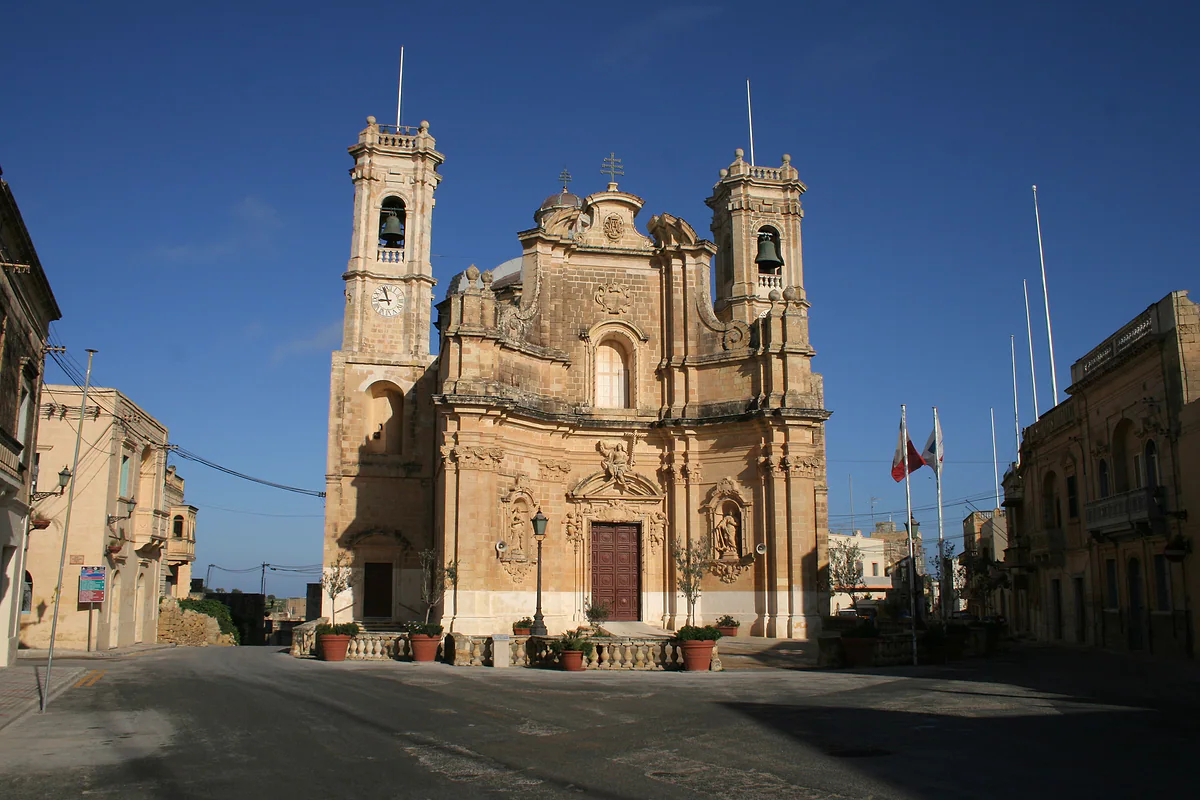
The Baroque church of the Visitation on the square in Għarb, Gozo, with its twin bell towers and curved façade of golden stone.
Ta' Pinu through the years (Ministry for Gozo)
| Year | What happened |
|---|---|
| Before 1575 | The chapel is recorded as rebuilt and owned by the Gentile family |
| 1575 | Apostolic visitor Pietro Duzina orders it demolished as unsafe |
| 1858 | It takes the name of Pinu Gauci, who paid for its restoration |
| 1883 | Karmela Grima reports hearing the Virgin's voice |
| 1920-1932 | The present Romanesque church is built |
| 1935 | Pius XI raises it to a minor basilica |
| 1990 | Visit by John Paul II |
| 2010 | Benedict XVI presents a golden rose |
| 2022 | Visit by Francis, with a second golden rose |
Before you go
| Topic | What's known |
|---|---|
| Opening hours | Not published in the official sources I read |
| Entry | A working church; no published charge |
| Karmni Grima's house | Reopened, fully accessible, audio in six languages; tel. +356 21556045 |
| Ta' Għammar Stations of the Cross | Steep path with 14 statues, opposite the basilica |
Test yourself
True or false?
0/4 Pick before you peek.
-
The church you see at Ta' Pinu today is medieval.
See the answer
False. The present basilica is Romanesque in style but modern, built between 1920 and 1932. The old part is the chapel it keeps, on record before 1575.
-
Two popes have visited Ta' Pinu.
See the answer
True. John Paul II in 1990 and Francis in 2022, according to the Ministry for Gozo. Benedict XVI didn't visit, but he sent a golden rose in 2010.
-
Ta' Pinu is named after a man who paid to restore the chapel.
See the answer
True. In 1858 the chapel took the name Ta' Pinu after Pinu Gauci, who funded its restoration.
-
One of the Gozo Channel ferries is called Ta' Pinu.
See the answer
True. The Gozo Channel fleet includes a ship of that name, alongside Nikolaos, Gaudos and Malita.
- Year Karmela Grima heard the voice
- 1883
- Basilica completed
- 1932
- Stations of the Cross on Ta' Għammar
- 14
- Popes who have visited
- 2
Map
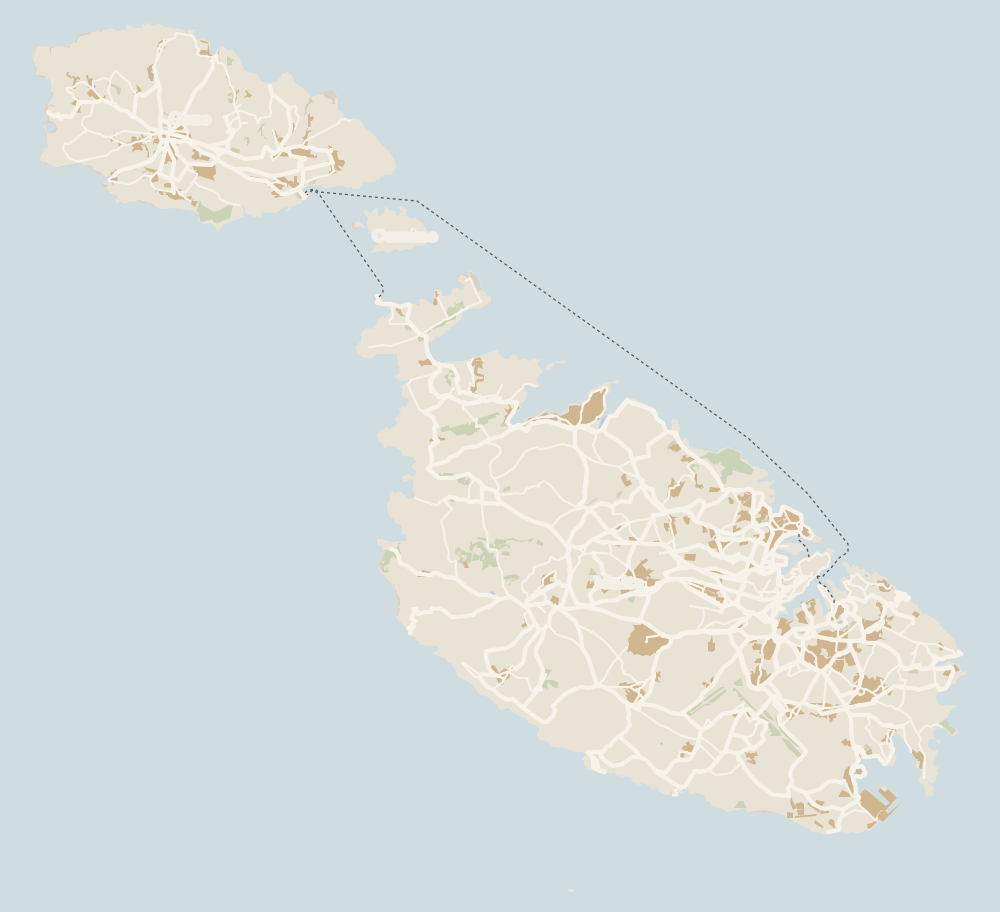
Where Ta' Pinu Basilica is
Gozo lies to the north-west, across the channel the ferry crosses from Ċirkewwa, with Comino between the two islands. Every number opens its guide.
0 of 279 Malta guides
Your next stamp
- Għarb
- Things to do in Gozo
- Viewpoints
- Most beautiful places
- Beaches
- Mġarr (Malta)
- Red Tower
- Churches
- Things to do in Malta
- Gozo
- Comino
- Prettiest villages
- UNESCO World Heritage Sites
- Where is Malta
- The Maltese islands
- Towns and villages
- Island of Malta
- Blue Lagoon
- Fort Rinella
- Fort St Angelo
- Gardjola Gardens
- Ħal Saflieni Hypogeum
- Is Malta a country?
- Popeye Village
- Tarxien Temples
- Valletta
- Esplora
- Golden Bay
- Gozo day trip
- Inquisitor's Palace
- Population
- St John's Co-Cathedral
- St Mary's Tower
- Grandmaster's Palace
- How big is Malta
- Maritime Museum
- Mellieħa Bay
- Fort St Elmo
- Language
- Malta at War Museum
- Paradise Bay
- Barrakka Gardens
- Religion
- Malta government
- Saluting Battery
- MUŻA
- National Museum of Archaeology
- Underground Valletta
- Lascaris War Rooms
- Casa Rocca Piccola
- Malta in one day
- Three Cities
- Victoria
- Birgu
- Manoel Theatre
- Weekend in Malta
- Xagħra
- City Gate and Parliament
- Malta in three days
- Nadur
- Senglea
- Cospicua
- Malta in four days
- Qala
- Valletta Waterfront
- Għajnsielem
- Kalkara
- Malta in five days
- Malta in a week
- Paola
- Xewkija
- Sannat
- Tarxien
- Munxar
- Żabbar
- Fgura
- Fontana
- Kerċem
- Luqa
- Floriana
- Marsa
- Mellieħa
- The Citadel, Gozo
- Żebbuġ (Gozo)
- Ġgantija Temples
- Marsalforn
- Santa Luċija
- Ramla Bay
- San Lawrenz
- Xgħajra
- Xwejni salt pans
- Calypso's Cave
- Żejtun
- Għasri
- Gudja
- San Blas Bay
- Għaxaq
- Ħondoq Bay
- Marsaxlokk
- Kirkop
- Marsaxlokk Fish Market
- Mqabba
- St Peter's Pool
- Marsaskala
- Qrendi
- Żurrieq
- Comino ferry
- EU, Schengen and the euro
- Ħaġar Qim and Mnajdra
- Mdina
- Mġarr (Gozo)
- Blue Grotto
- Diving
- Entry requirements
- Mdina Cathedral
- Xewkija Rotunda
- Birżebbuġa
- Money and payments
- Palazzo Falson
- Safi
- Shipwrecks
- Ta' Ċenċ Cliffs
- Għar Dalam
- Mdina Dungeons
- Mġarr ix-Xini
- Prices and budget
- Snorkelling
- Boat trips
- Malta on a budget
- Playmobil FunPark
- Rabat (Malta)
- Xlendi
- Dwejra
- Gozo beaches
- History
- Siġġiewi
- St Paul's Catacombs
- Tipping
- Azure Window
- Domvs Romana
- Għar Lapsi
- Great Siege of 1565
- Plugs
- Limestone Heritage Park
- Second World War
- St Paul's Grotto
- Time zone
- Buskett Gardens
- Knights of Malta
- Mobile and roaming
- Wied il-Għasri
- Dingli
- Maltese cross
- Dingli Cliffs
- Flag
- Żebbuġ
- Coat of arms
- Mtarfa
- Balzan
- National anthem
- Lija
- Malta facts
- Game of Thrones
- Iklin
- Attard
- Film locations
- Forts and fortifications
- San Anton Gardens
- Ta' Qali Crafts Village
- Victoria Lines
- Megalithic temples
- Catacombs
- Museums
- Where to eat
- Where to stay
- Hotels in Valletta
- Restaurants in Valletta
- Hotels in Sliema
- Maltese food
- Restaurants in Marsaxlokk
- Hotels in St Julian's
- Pastizzi
- Walking and hiking
- Hotels in Buġibba and Qawra
- Maltese rabbit stew
- Safety
- Hotels in Mellieħa
- Kinnie and Cisk
- Scams
- Gozo hotels
- Nightlife
- Tap water
- Boat parties
- Holiday packages
- Tourist tax
- All inclusive
- Gay Malta
- Sightseeing passes
- Apartments
- Malta with kids
- Public holidays
- How to get there
- Luxury
- Malta for couples
- Taxis and ride-hailing
- Weather
- Best time to visit
- Cycling
- English schools
- Flights
- Flights from Madrid
- Sea temperature
- Shopping and souvenirs
- Airport
- Free walking tours
- In winter
- Airport transfers
- Day trips and tours
- In summer
- Ferry from Sicily
- In January
- Cruise stop
- In February
- In March
- In April
- In May
- Getting around
- In June
- Buses
- July
- August
- Hop on hop off
- Gozo ferry
- September
- Gozo fast ferry
- October
- November
- Valletta ferries
- Car hire
- December
- Driving
- Events
- St Paul's Bay
- Village feasts
- Buġibba
- Christmas
- Easter
- Qawra
- Carnival
- Xemxija
- Fireworks festival
- Malta National Aquarium
- Isle of MTV
- St Paul's Islands
- Mosta
- Mosta Rotunda
- Naxxar
- Palazzo Parisio
- Għargħur
- Sliema
- Ta' Ħaġrat and Skorba Temples
- Għajn Tuffieħa Bay
- Tigné Point
- Ġnejna Bay
- St Julian's
- Paceville
- St George's Bay
- Gżira
- Msida
- Ta' Xbiex
- Pietà
- Pembroke
- Swieqi
- San Ġwann
- Birkirkara
- Ħamrun
- Santa Venera
- Qormi
Frequently asked questions
What is Ta' Pinu?
The national shrine of Our Lady of Ta' Pinu, a Romanesque minor basilica in the countryside on the edge of Għarb, Gozo. The Ministry for Gozo calls it Malta's most important shrine.
When was Ta' Pinu Basilica built?
The present church went up between 1920 and 1932 and was made a minor basilica by Pius XI in 1935. It keeps the old chapel, which is on record before 1575.
What happened at Ta' Pinu in 1883?
Karmela Grima, a countrywoman from Għarb, said she heard the Virgin's voice in the chapel. Pilgrimages grew from then on, and Bishop Pietru Pace confirmed the heavenly origin of the events.
What are Ta' Pinu's opening hours?
I haven't found them published by any official source. It's a working shrine, so I'd go outside service times and check the hours on the door when you arrive.
How do I get to Ta' Pinu?
It's a few minutes' drive from Victoria, or take bus route 311 or 312 towards Għarb, on whose outskirts the shrine stands.
Which popes have visited Ta' Pinu?
John Paul II in 1990, who prayed in the chapel and said Mass on the forecourt, and Francis in 2022, who left a golden rose. Benedict XVI sent one in 2010.
What's on the hill opposite the basilica?
Ta' Għammar hill, with a steep path and 14 white Carrara marble Stations of the Cross by Alfred Camilleri Cauchi, set out in the early 1980s.
By
Tourism graduate with a master’s in Tourism Management and Planning from the University of Málaga, who has travelled across Europe. He writes every guide from official sources and his own judgement.
Published on . Facts checked on .
Sources
Photos: CEphoto, Uwe Aranas (CC BY-SA 3.0); Myriam Thyes (Public domain), via Wikimedia Commons.