Sand in the north and on Gozo
The best beaches in Malta, Gozo and Comino
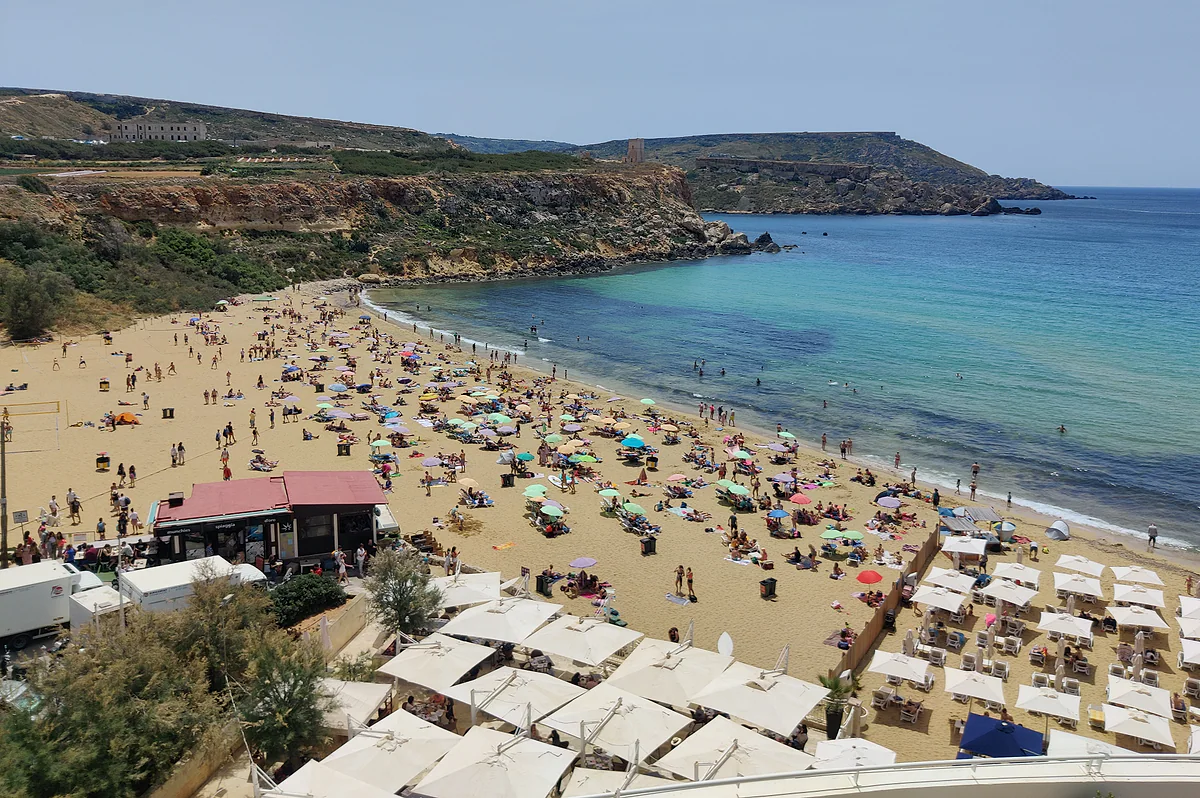
Most of Malta's beaches are rocky, and the sandy ones are mainly in the north of the island of Malta and on Gozo, according to the Spanish Foreign Ministry's travel advice. The best sandy beaches are Golden Bay, Għadira, Għajn Tuffieħa, Ramla and Comino's Blue Lagoon, which needs a free booking. Topless sunbathing isn't allowed.
In 30 seconds
Full read: 3 min
- Most Maltese beaches are rocky; the sandy ones are in the north of the island of Malta and on Gozo.
- The best sandy beaches are Ramla (Gozo), the Blue Lagoon (Comino), Għadira, Golden Bay and Għajn Tuffieħa.
- The Blue Lagoon has needed a free timed booking since 1 May 2025.
- Nudism and topless sunbathing aren't allowed, and a purple flag warns of jellyfish.
If I had to keep one sandy beach, it would be Ramla on Gozo. On the island of Malta, Għadira with small children and Golden Bay without a car. And the Blue Lagoon only with the morning slot booked, because by midday it becomes a different place.

Before you go
What I would keep in mind
-
01 My tip
Learn the MTA's flags
Red over yellow marks a lifeguarded zone; green, calm sea; yellow, medium hazard; red, high hazard; double red, no swimming. Purple, the one that catches people out, means jellyfish.
-
02 Watch out
Nobody can charge you for the Blue Lagoon
The pass to set foot on Comino's Blue Lagoon is free and booked on the MTA portal. You pay for the boat, not for access.
Blue Lagoon on Comino -
03 Most beautiful
Ramla, the red-sand beach
The Ministry for Gozo calls Ramla Gozo's finest beach and arguably Malta's. Reddish sand, protected dunes and no development, just a few cafés and a stall.
Ramla Bay -
04 To save money
Free beaches with a bus
Public beaches don't charge entry, and many have a direct bus. The 44 runs from Valletta to Golden Bay, the 49 to Għadira Bay, and the 101 links the northern beaches from Ċirkewwa.
Malta buses -
05 My tip
Watch out for falling rock
The Spanish Foreign Ministry urges caution over rockfalls at St Peter's Pool, Kalanka and Għar Lapsi, and advises against swimming near Magħtab because of the waste plant.
is Malta safe
What I would book
My ranking, scored
My favourite beaches across the three islands
My own scores out of 10. They weigh the swimming, the setting, how easy it is to get there without a car, and what official sources let me check about each one. Where information is thin, the score drops.
0 of 8 seen
-
Ramla Bay (Gozo)
Reddish sand, Natura 2000 dunes and no development. The Ministry for Gozo calls it Gozo's finest and arguably Malta's, and I won't argue.
9.3 out of 10
-
Blue Lagoon (Comino)
The most turquoise water in the archipelago, capped at 4,000 people with free timed booking since 2025. Early on it's a dream; at midday, a crowded pool.
9.0 out of 10
-
Għadira, Mellieħa Bay
Sand and shallow water, with a bird reserve behind. My pick with small children on the island of Malta.
8.7 out of 10
-
Golden Bay
The easiest sandy beach without a car, with the 44 direct from Valletta and the Majjistral park starting right there.
8.5 out of 10
-
Għajn Tuffieħa
Golden sand and fewer people than Golden Bay, according to Malta Public Transport, with clifftops to walk at sunset.
8.4 out of 10
-
St Peter's Pool
A natural rock pool near Marsaxlokk. Lovely, but the Spanish Foreign Ministry urges caution over rockfalls.
8.0 out of 10
-
Ħondoq ir-Rummien (Gozo)
Sand and pebbles facing Comino, with Blue Flag status according to the Ministry for Gozo, plus sunbeds, showers and toilets.
7.9 out of 10
-
St George's Bay
Malta's first Blue Flag, in 2009, kept ever since. Urban, in St Julian's, not wild but very handy.
7.4 out of 10
The first thing worth knowing about Malta’s beaches is something hardly any brochure tells you. Most of them are rock. The Spanish Foreign Ministry’s travel advice says so plainly, adding that you’ll find most of the sand in the north of the island of Malta and on Gozo. Keep that in mind and choosing gets much easier.
Sand in the north, rock elsewhere
If you want sand on the island of Malta, head north and west. That’s where you’ll find Golden Bay, with a direct bus from Valletta, Għajn Tuffieħa right next door, which Malta Public Transport describes as less crowded, Ġnejna, a little quieter still, and Għadira on Mellieħa Bay, with its shallow water. In the centre and south the coast is rocky, with swimming spots such as St Peter’s Pool near Marsaxlokk.
Gozo is a different story. There you have Ramla, with its reddish sand, San Blas Bay, a cove of around a hundred metres reached on foot from Nadur, and Ħondoq ir-Rummien, facing Comino. The detail is in my guide to Gozo beaches. And on Comino, the Blue Lagoon and Santa Marija Bay.
The best beaches in Malta, my way
My ranking is above, built on criteria I think are fair. It weighs the swimming and the setting, but also what I can check about each beach in official sources. That’s why Paradise Bay, lovely name and no readable official profile, doesn’t make the cut.
Top of the list is Ramla, on Gozo. The Ministry for Gozo calls it Gozo’s finest beach and arguably Malta’s, with reddish sand, dunes protected under Natura 2000 and no development, just a few cafés and a stall. That’s precisely what wins me over, it still has no buildings.
Next comes Comino’s Blue Lagoon, with a warning. It has the most spectacular water in the archipelago and also the worst crowds, so much so that the MTA ended up limiting numbers. Since 1 May 2025 you need a free timed booking to set foot there, with a maximum of 4,000 people at once. How the booking works is covered step by step in my page on the Blue Lagoon on Comino.
On the island of Malta, Għadira and Golden Bay share my vote. With small children, Mellieħa Bay (Għadira), for its shallow water. Without a car, Golden Bay, for the 44 bus.
Blue Flags and safety flags
The Blue Flag is awarded by the Foundation for Environmental Education, represented in Malta by Nature Trust Malta, and requires 32 criteria to be met. Malta won its first in 2009, for St George’s Bay, which has kept it ever since, and by 2019 there were twelve. The MTA hasn’t published the 2026 list, so I’d rather leave a gap than invent one. The 2026 Blue Flag season, on the other hand, is set from 29 May to 11 October.
More useful than the Blue Flag, to my mind, is the MTA’s safety flag code, set out in the table. Purple, which warns of jellyfish, is the one that surprises people who haven’t seen it before.
Behind the flags there’s a management system. The MTA says it manages nine beaches itself and supports eight more, including on Gozo and Comino, and that two further Blue Flag beaches belong to private resorts.
Rules worth knowing
The Spanish Foreign Ministry flags two things that save grief. Neither nudism nor topless sunbathing is allowed in Malta. Loose rock is a hazard at Kalanka, Għar Lapsi and St Peter’s Pool, so take care there, and don’t swim near Magħtab, where the waste plant is the problem. For wider safety advice, see my guide on whether Malta is safe.
The MTA, for its part, asks you to sort rubbish into the colour-coded beach bins (black organic, yellow metal, red glass, blue plastic) and is adding wooden walkways, beach carpets, sand buggies for wheelchair users and hoists to help more people into the water.
When to swim in Malta
The sea holds its warmth far longer than you’d think. The norms cited by the Met Office give 22°C in June, 26.1°C in September and 24°C in October. Visit Malta said in 2023 that the beach season can last until mid or late October. For me, September is Malta’s best beach month, with the warmest water of the year and the August crowds gone. For every month, check the Malta sea temperature.
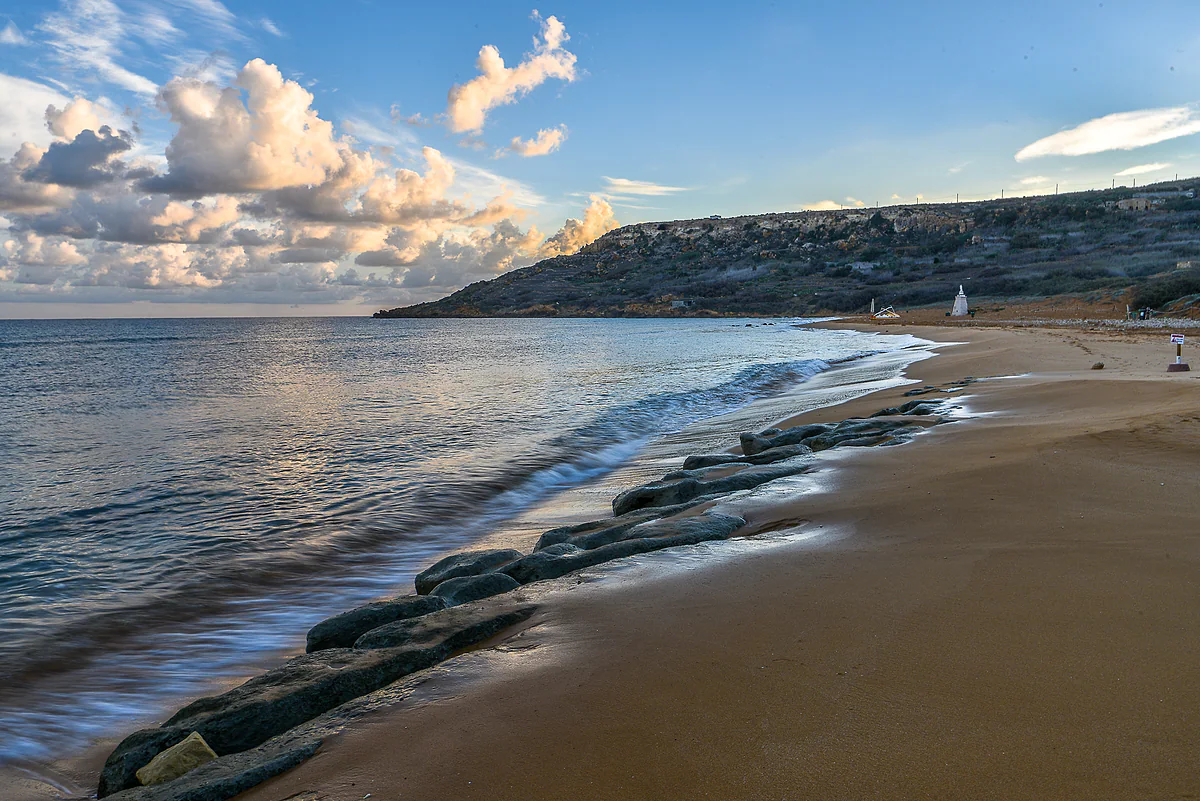
Ramla l-Ħamra beach in Gozo, with its reddish sand, gentle waves on the shore and the green hill that closes off the bay.
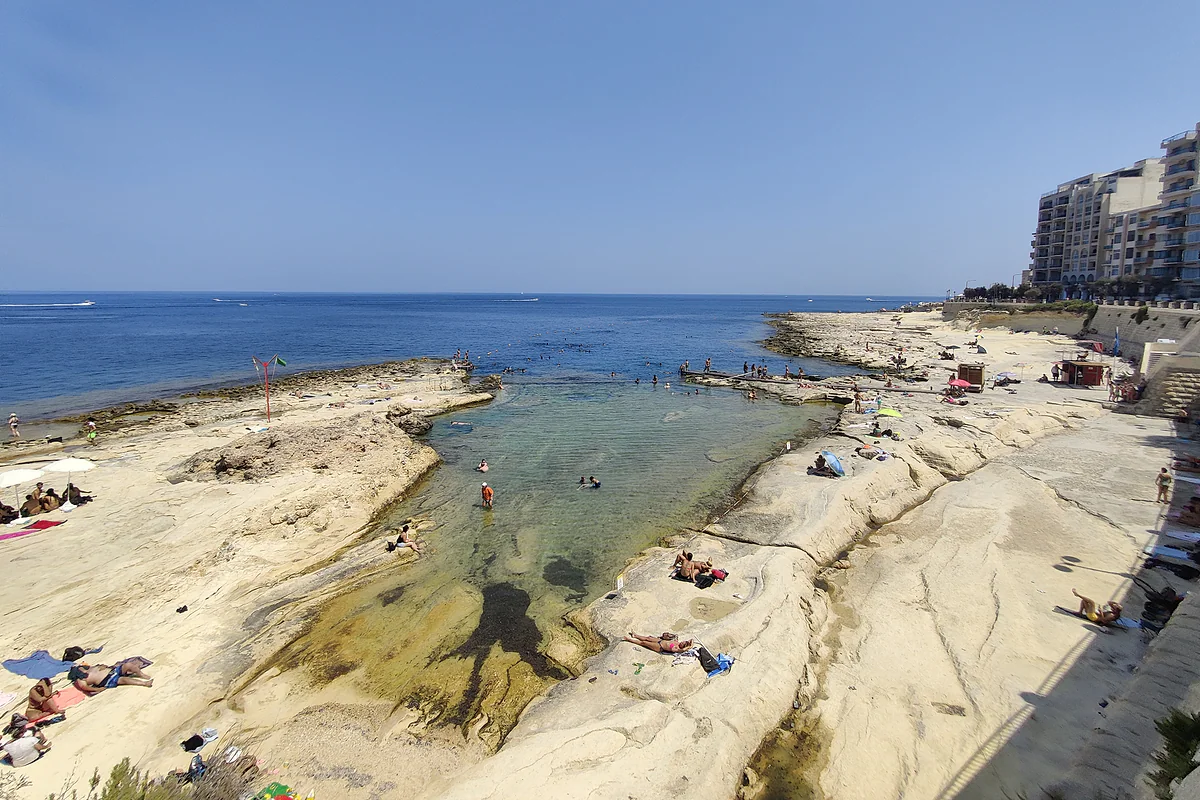
The flat rocks of Fond Għadir in Sliema, where people swim in clear rock pools right below the apartment blocks of the seafront.
Lifeguarded beach flags (MTA)
| Flag | Meaning |
|---|---|
| Red over yellow | Lifeguarded zone |
| Green | Calm sea |
| Yellow | Medium hazard |
| Purple | Jellyfish |
| Red | High hazard |
| Double red | No swimming |
Sea temperature (norms cited by the Met Office)
| Month | Average sea temperature |
|---|---|
| April | 16.3°C |
| June | 22°C |
| September | 26.1°C |
| October | 24°C |
Norms quoted in the Malta Meteorological Office's monthly notes (Luqa station). More months in my sea temperature guide.
Test yourself
True or false?
0/4 Pick before you peek.
-
Most of Malta's beaches are sandy.
See the answer
False. The Spanish Foreign Ministry says the opposite. Most are rocky, and the sandy ones are mainly in the north of Malta and on Gozo.
-
Malta's first Blue Flag went to St George's Bay in 2009.
See the answer
True. According to the Malta Tourism Authority, St George's Bay won it in 2009 and has kept it every year since.
-
The sea around Malta is warmer in September than in June.
See the answer
True. The Met Office gives a norm of 26.1°C for September and 22°C for June.
-
Topless sunbathing is allowed on Maltese beaches.
See the answer
False. The Spanish Foreign Ministry warns that neither nudism nor topless sunbathing is permitted in Malta.
- Malta's first Blue Flag, St George's Bay
- 2009
- Blue Flag beaches in 2019
- 12
- Average sea temperature in September
- 26.1°C
- Criteria in the Blue Flag programme
- 32
What to see
What to see in Beaches
0 of 279 Malta guides
Your next stamp
- Gozo beaches
- Snorkelling
- Most beautiful places
- Boat trips
- Ramla Bay
- Malta in a week
- Walking and hiking
- Viewpoints
- Things to do in Malta
- Gozo
- Comino
- Prettiest villages
- UNESCO World Heritage Sites
- Where is Malta
- The Maltese islands
- Towns and villages
- Island of Malta
- Blue Lagoon
- Fort Rinella
- Fort St Angelo
- Gardjola Gardens
- Ħal Saflieni Hypogeum
- Is Malta a country?
- Popeye Village
- Tarxien Temples
- Things to do in Gozo
- Valletta
- Esplora
- Golden Bay
- Gozo day trip
- Inquisitor's Palace
- Population
- St John's Co-Cathedral
- St Mary's Tower
- Grandmaster's Palace
- How big is Malta
- Maritime Museum
- Mellieħa Bay
- Fort St Elmo
- Language
- Malta at War Museum
- Paradise Bay
- Barrakka Gardens
- Red Tower
- Religion
- Malta government
- Saluting Battery
- MUŻA
- National Museum of Archaeology
- Underground Valletta
- Lascaris War Rooms
- Casa Rocca Piccola
- Malta in one day
- Three Cities
- Victoria
- Birgu
- Manoel Theatre
- Weekend in Malta
- Xagħra
- City Gate and Parliament
- Malta in three days
- Nadur
- Senglea
- Cospicua
- Malta in four days
- Qala
- Valletta Waterfront
- Għajnsielem
- Kalkara
- Malta in five days
- Paola
- Xewkija
- Sannat
- Tarxien
- Munxar
- Żabbar
- Fgura
- Fontana
- Kerċem
- Luqa
- Floriana
- Marsa
- Mellieħa
- The Citadel, Gozo
- Żebbuġ (Gozo)
- Ġgantija Temples
- Marsalforn
- Santa Luċija
- San Lawrenz
- Xgħajra
- Xwejni salt pans
- Calypso's Cave
- Għarb
- Żejtun
- Għasri
- Gudja
- San Blas Bay
- Għaxaq
- Ħondoq Bay
- Marsaxlokk
- Kirkop
- Marsaxlokk Fish Market
- Mqabba
- St Peter's Pool
- Marsaskala
- Qrendi
- Żurrieq
- Comino ferry
- EU, Schengen and the euro
- Ħaġar Qim and Mnajdra
- Mdina
- Mġarr (Gozo)
- Blue Grotto
- Diving
- Entry requirements
- Mdina Cathedral
- Xewkija Rotunda
- Birżebbuġa
- Money and payments
- Palazzo Falson
- Safi
- Shipwrecks
- Ta' Ċenċ Cliffs
- Għar Dalam
- Mdina Dungeons
- Mġarr ix-Xini
- Prices and budget
- Malta on a budget
- Playmobil FunPark
- Rabat (Malta)
- Xlendi
- Dwejra
- History
- Siġġiewi
- St Paul's Catacombs
- Tipping
- Azure Window
- Domvs Romana
- Għar Lapsi
- Great Siege of 1565
- Plugs
- Limestone Heritage Park
- Second World War
- St Paul's Grotto
- Ta' Pinu Basilica
- Time zone
- Buskett Gardens
- Knights of Malta
- Mobile and roaming
- Wied il-Għasri
- Dingli
- Maltese cross
- Dingli Cliffs
- Flag
- Żebbuġ
- Coat of arms
- Mtarfa
- Balzan
- National anthem
- Lija
- Malta facts
- Game of Thrones
- Iklin
- Attard
- Film locations
- Forts and fortifications
- San Anton Gardens
- Ta' Qali Crafts Village
- Victoria Lines
- Megalithic temples
- Catacombs
- Museums
- Where to eat
- Where to stay
- Churches
- Hotels in Valletta
- Restaurants in Valletta
- Hotels in Sliema
- Maltese food
- Restaurants in Marsaxlokk
- Hotels in St Julian's
- Pastizzi
- Hotels in Buġibba and Qawra
- Maltese rabbit stew
- Safety
- Hotels in Mellieħa
- Kinnie and Cisk
- Scams
- Gozo hotels
- Nightlife
- Tap water
- Boat parties
- Holiday packages
- Tourist tax
- All inclusive
- Gay Malta
- Sightseeing passes
- Apartments
- Malta with kids
- Public holidays
- How to get there
- Luxury
- Malta for couples
- Taxis and ride-hailing
- Weather
- Best time to visit
- Cycling
- English schools
- Flights
- Flights from Madrid
- Sea temperature
- Shopping and souvenirs
- Airport
- Free walking tours
- In winter
- Airport transfers
- Day trips and tours
- In summer
- Ferry from Sicily
- In January
- Cruise stop
- In February
- In March
- In April
- In May
- Getting around
- In June
- Buses
- July
- August
- Hop on hop off
- Gozo ferry
- September
- Gozo fast ferry
- October
- November
- Valletta ferries
- Car hire
- December
- Driving
- Events
- St Paul's Bay
- Village feasts
- Buġibba
- Christmas
- Easter
- Qawra
- Carnival
- Xemxija
- Fireworks festival
- Malta National Aquarium
- Isle of MTV
- St Paul's Islands
- Mosta
- Mosta Rotunda
- Naxxar
- Palazzo Parisio
- Għargħur
- Mġarr (Malta)
- Sliema
- Ta' Ħaġrat and Skorba Temples
- Għajn Tuffieħa Bay
- Tigné Point
- Ġnejna Bay
- St Julian's
- Paceville
- St George's Bay
- Gżira
- Msida
- Ta' Xbiex
- Pietà
- Pembroke
- Swieqi
- San Ġwann
- Birkirkara
- Ħamrun
- Santa Venera
- Qormi
Frequently asked questions
What is the best beach in Malta?
For me, Ramla Bay on Gozo, which the Ministry for Gozo calls the finest on Gozo and arguably in all of Malta. On the main island, Għadira with children and Golden Bay if you're without a car.
Are Malta's beaches sandy or rocky?
Mostly rocky, according to the Spanish Foreign Ministry. The sandy ones are mainly in the north of the island of Malta, such as Golden Bay, Għadira and Għajn Tuffieħa, and on Gozo, such as Ramla and San Blas.
Does Valletta have a beach?
The capital isn't a sandy-beach destination. Nearby is St George's Bay in St Julian's, Malta's first Blue Flag beach in 2009, which has kept the award ever since.
Which Malta beaches have a Blue Flag in 2026?
The MTA hasn't published the 2026 list, so I can't give it to you. I do know St George's Bay has held one every year since 2009 and that the 2026 Blue Flag season runs from 29 May to 11 October.
Can you sunbathe topless in Malta?
No. The Spanish Foreign Ministry's advice is clear that neither nudism nor topless sunbathing is permitted in Malta.
How late in the year can you swim in Malta?
The sea stays mild into autumn, averaging 26.1°C in September and 24°C in October according to the Met Office. Visit Malta said in 2023 that the beach season can run to mid or late October.
Which sandy beaches in Malta are best for children?
Għadira on Mellieħa Bay, for its shallow water, and Santa Marija Bay on Comino, which the Ministry for Gozo recommends for younger children. On Gozo, Ramla and San Blas have reddish sand.
By
Tourism graduate with a master’s in Tourism Management and Planning from the University of Málaga, who has travelled across Europe. He writes every guide from official sources and his own judgement.
Published on . Facts checked on .
Sources
Photos: Searching For Bliss (CC BY 4.0); Bellina 09 (CC BY-SA 4.0); Searching For Bliss (CC BY 4.0), via Wikimedia Commons.