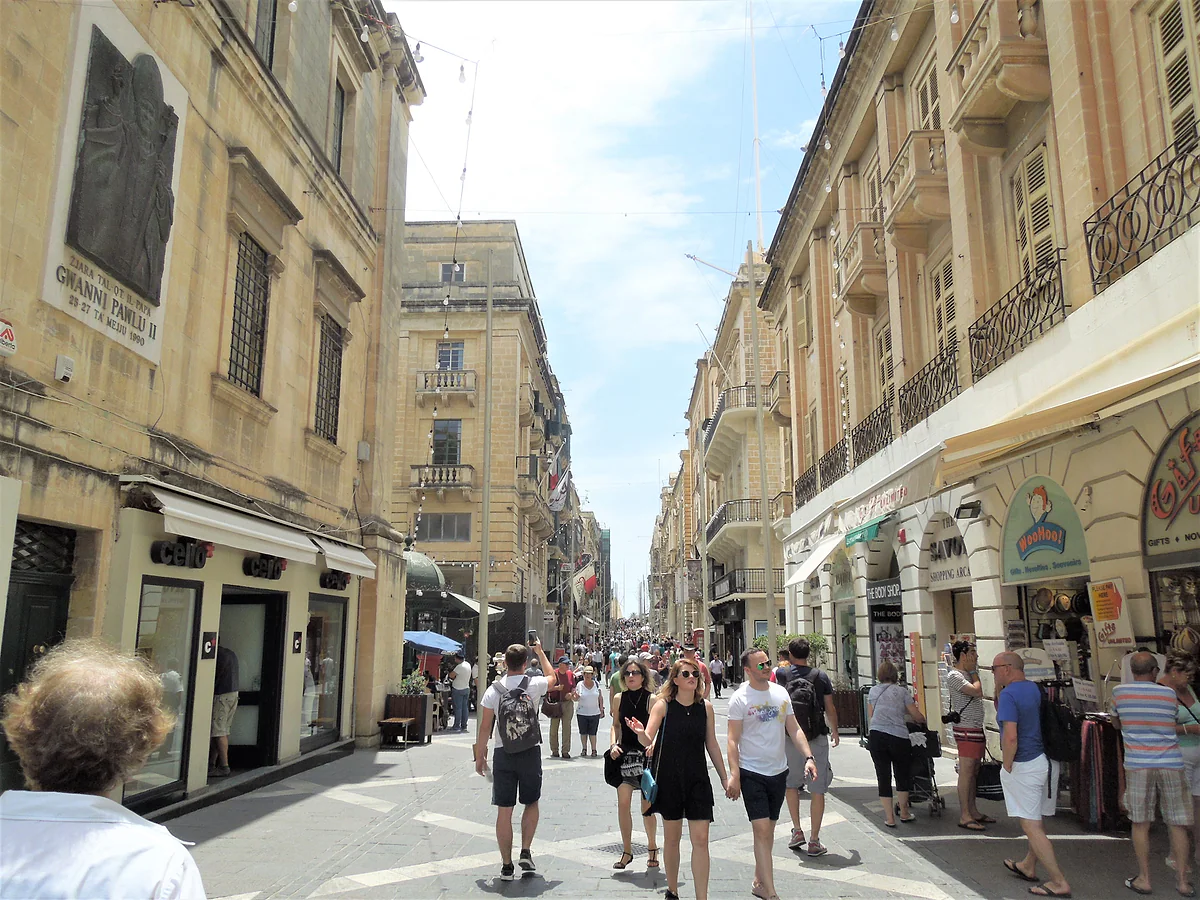
The city's fifth gate, by Renzo Piano
Valletta City Gate, the Parliament and the opera house left in ruins
The entrance to Valletta is a Renzo Piano scheme in three parts, City Gate itself, a cut through the walls just 8 metres wide; Malta's Parliament building, immediately inside; and Pjazza Teatru Rjal, an open-air theatre for around 900 people completed in 2013 within the ruins of the Royal Opera House, bombed in 1942.
In 30 seconds
Full read: 3 min
- Valletta's entrance is a Renzo Piano scheme joining City Gate, Parliament and an open-air theatre.
- Today's gate is an 8-metre cut through the walls; the previous one was demolished in 2011.
- Malta's Parliament sits in the new building just inside the gate.
- Pjazza Teatru Rjal fills the ruins of the Royal Opera House, bombed on 7 April 1942.
I wouldn't rush through on my way to St John's. I'd stop just inside, between the Parliament and the old Opera House columns, because in five minutes you can read the city's whole story there, from the Knights to the war to Malta in the EU.

Before you go
What I would keep in mind
-
01 Most beautiful
The Opera House columns with a theatre inside
Piano chose not to rebuild the Royal Opera House. He kept the columns and stone base that survived the 1942 bombing and put an open-air theatre inside. For me it's the best idea in the whole scheme.
Malta in the Second World War -
02 Getting there
The bus terminus is just outside
Routes from all over the island end at the Valletta terminus by the Triton Fountain, a few steps from the gate. Come in by bus and this is your way in.
Malta buses -
03 My tip
Don't bank on seeing inside Parliament
I haven't found an official source that publishes visits inside the Parliament building. What you can see is the exterior, from Republic Street.
how Malta is governed -
04 To save money
Everything outside is free
The gate, the Parliament façade and the Opera House ruins are all visible from the street at no cost. You only pay if there's a performance at Pjazza Teatru Rjal.
Valletta, Malta's capital
What I would book
My ranking, scored
Valletta's five city gates
This follows the historical sequence rather than ranking quality. My score reflects what each gate says about its era, in my view.
0 of 5 seen
-
Porta San Giorgio, later Porta Reale (1566-1569)
The first, built by the Order to a design by Francesco Laparelli or Girolamo Cassar. Enlarged in 1586, with a wooden drawbridge across the ditch.
8.5 out of 10
-
The 1633 gate
More ornate, with a central arch and two side arches, attributed to Tommaso Dingli under Grand Master Antoine de Paule.
8.0 out of 10
-
The British gate of 1853
Two large arches for traffic and two small ones for pedestrians, designed by Lieutenant-Colonel Francis Ringler Thomson.
7.8 out of 10
-
The Rationalist gate of 1964-1965
By Alziro Bergonzo and heavily criticised. It was meant to go with a new opera house that was never built.
6.5 out of 10
-
Renzo Piano's gate
An 8-metre breach in the walls, designed to compress movement as you pass through. The previous gate was demolished in 2011.
8.8 out of 10
If you come into Valletta by bus, this is where you walk in, and it’s easy to pass straight through. That would be a shame, because the first hundred metres of the city hold three things with more to say than you’d think, a gate that’s the fifth in its history, the Parliament of an EU member state, and the ruins of an opera house destroyed in the war. All three are one Renzo Piano scheme.
Five gates in four and a half centuries
The Grand Harbour Regeneration Corporation, the government agency behind these projects, tells the gate’s story in detail. The first, Porta San Giorgio, was begun in 1566 and finished in 1569, between St James’ and St John’s Bastions, to a design by Francesco Laparelli or Girolamo Cassar. In 1586 it was enlarged, renamed Porta Reale and given a wooden drawbridge across the ditch.
In 1633 it was pulled down and replaced by a more ornate gate attributed to Tommaso Dingli. In 1853 the British swapped it for one with two large arches and two small ones for pedestrians. The fourth, by Alziro Bergonzo in the Italian Rationalist style, was started in 1964 and finished a year later. It was widely criticised, which doesn’t surprise me, since it was meant to go with a new opera house that never happened.
Piano had put forward plans for the city entrance back in the 20th century, but they stalled. The project was revised in 2008 and Bergonzo’s gate came down in 2011. The new one isn’t an arch at all but a simple, narrow cut through the wall just 8 metres wide, designed, GHRC says, to compress movement as you pass. I think it works rather well, because it makes you feel you’re genuinely entering a fortress.
Malta’s Parliament, just inside
Once through, beside Republic Street, is the new Parliament building. Malta is a single-chamber parliamentary republic, with a largely ceremonial president and a prime minister heading the government, as the EU summarises it. I cover how the state works on Malta’s political system.
The House used to sit in the Grandmaster’s Palace, where Malta’s first constitutional parliament met in 1921, back when the building was the British Governor’s residence. In 1976 it took over the hall that had been the Armoury. Once the House relocated to this new building, that hall emptied and the arms returned to it. You can see the result at the Grandmaster’s Palace in Valletta. Beneath the new Parliament, an underground library and archive opened on 11 March 2022, holding records from 1845, on the spot where the old railway used to start.
What I can’t tell you, I’m afraid, is whether Parliament can be visited inside. Its website couldn’t be consulted, and I haven’t found another official source that says so, so I’d rather leave it there than guess at opening times.
What was the Royal Opera House?
By the mid-19th century the Manoel Theatre was too small for opera audiences, and in 1860 the Governor approved a new theatre at the entrance to Valletta. It was designed by the English architect Edward Middleton Barry, whose London work included Covent Garden, and built between 1862 and 1866. It opened on 9 October 1866 with Bellini’s I Puritani, seating 1,095 with room for 200 standing, more than double the Manoel Theatre in Valletta.
A fire gutted it in 1873 and it reopened in 1877 with Aida. On the evening of Tuesday 7 April 1942 an air raid destroyed it. Only the columns and the stone base survived, and for decades the interior served as a car park.
Piano didn’t rebuild it. He left the ruins standing and set Pjazza Teatru Rjal inside them, an open-air theatre of 2,800 m² with around 900 seats, completed in August 2013. The theatre’s own website calls it a monument to the heroism, tenacity and dignity of the Maltese in the war, and I see it the same way. If your trip coincides with a performance, watching one among those columns is, to my mind, one of the best evenings Valletta can offer, and the wider story of those years is on Malta in the Second World War.
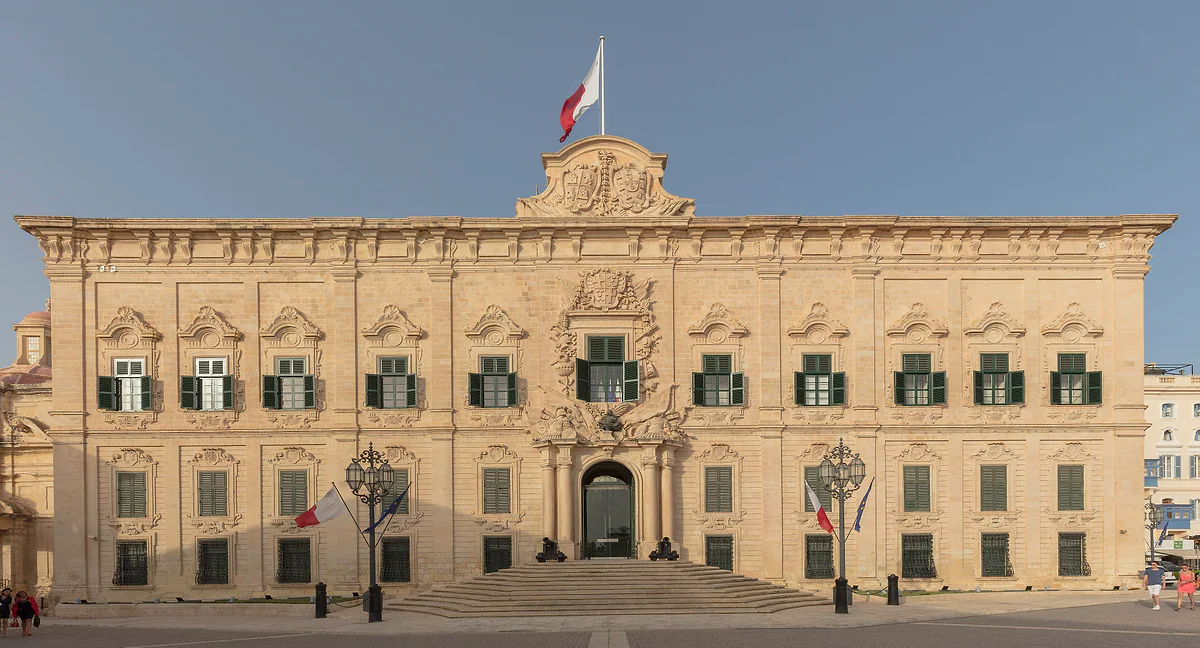
The baroque facade of the Auberge de Castille in Valletta, office of the Prime Minister, with the Maltese flag above.
Key dates at Valletta's entrance
| Year | What happened |
|---|---|
| 1566-1569 | First gate, Porta San Giorgio |
| 1862-1866 | Edward Middleton Barry's Royal Opera House is built |
| 1873 | Fire guts the Opera House; it reopens in 1877 |
| 7 April 1942 | An air raid destroys the Opera House |
| 1964-1965 | Fourth gate, by Alziro Bergonzo |
| 2011 | Bergonzo's gate is demolished |
| August 2013 | Pjazza Teatru Rjal is completed |
| 11 March 2022 | Parliament's underground library and archives open |
Test yourself
True or false?
0/4 Pick before you peek.
-
Valletta has had the same city gate since 1566.
See the answer
False. It has had five. The first went up between 1566 and 1569; Renzo Piano's replaced the 1965 gate, which was demolished in 2011.
-
Valletta's Royal Opera House was destroyed by bombing.
See the answer
True. An air raid hit it on the evening of Tuesday 7 April 1942.
-
Malta's Parliament still meets in the Grandmaster's Palace.
See the answer
False. It moved to the new building by City Gate, and its old chamber in the Palace went back to being the Armoury.
-
There's a library and archive underneath the Parliament building.
See the answer
True. They opened underground on 11 March 2022, with records going back to 1845.
- Width of the new City Gate opening
- 8 m
- Gates Valletta has had since 1566
- 5
- Approximate seats at Pjazza Teatru Rjal
- 900
- Year the Royal Opera House was bombed
- 1942
Map
Where City Gate and Parliament is
Gozo lies to the north-west, across the channel the ferry crosses from Ċirkewwa, with Comino between the two islands. Every number opens its guide.
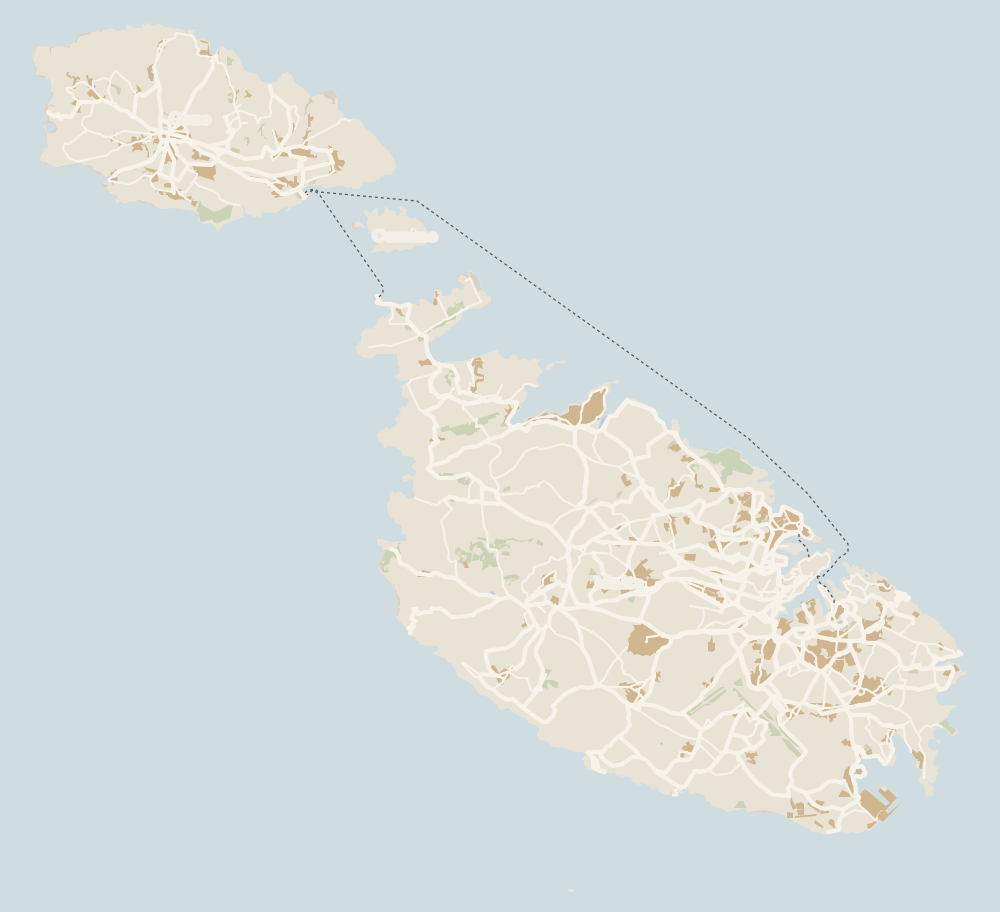 1Valletta 2St John's Co-Cathedral 3Grandmaster's Palace 4Fort St Elmo 5Barrakka Gardens 6Saluting Battery 7MUŻA 8National Museum of Archaeology 9Underground Valletta 10Lascaris War Rooms 11Casa Rocca Piccola 12Manoel Theatre 13City Gate and Parliament 14Valletta Waterfront
 Map data © OpenStreetMap contributors (ODbL)
- 1VallettaFounded 1566, on the UNESCO list since 1980
- 2St John's Co-CathedralFinished in 1577, closed on Sundays
- 3Grandmaster's PalaceHeritage Malta's most visited site
- 4Fort St ElmoFell on 23 June 1565
- 5Barrakka GardensGun salute at 12:00 and 16:00
- 6Saluting BatteryTwo firings a day, Monday to Saturday
- 7MUŻAOpened in late 2018
- 8National Museum of ArchaeologyNeolithic to Phoenician for €5
- 9Underground VallettaThree days a week, booking essential
- 10Lascaris War RoomsEisenhower's advance HQ in 1943
- 11Casa Rocca PiccolaGuided tours on the hour, 10:00 to 16:00
- 12Manoel TheatreOpened on 19 January 1732
- 13City Gate and ParliamentThe city's fifth gate, by Renzo Piano
- 14Valletta Waterfront19 Baroque warehouses from 1752
0 of 279 Malta guides
Your next stamp
- Valletta
- Malta government
- Underground Valletta
- Malta facts
- MUŻA
- Mosta Rotunda
- Valletta Waterfront
- Free walking tours
- Things to do in Malta
- Gozo
- Most beautiful places
- Comino
- Prettiest villages
- UNESCO World Heritage Sites
- Where is Malta
- The Maltese islands
- Towns and villages
- Island of Malta
- Blue Lagoon
- Fort Rinella
- Fort St Angelo
- Gardjola Gardens
- Ħal Saflieni Hypogeum
- Is Malta a country?
- Popeye Village
- Tarxien Temples
- Things to do in Gozo
- Esplora
- Golden Bay
- Gozo day trip
- Inquisitor's Palace
- Population
- St John's Co-Cathedral
- St Mary's Tower
- Grandmaster's Palace
- How big is Malta
- Maritime Museum
- Mellieħa Bay
- Fort St Elmo
- Language
- Malta at War Museum
- Paradise Bay
- Barrakka Gardens
- Red Tower
- Religion
- Saluting Battery
- National Museum of Archaeology
- Lascaris War Rooms
- Casa Rocca Piccola
- Malta in one day
- Three Cities
- Victoria
- Birgu
- Manoel Theatre
- Weekend in Malta
- Xagħra
- Malta in three days
- Nadur
- Senglea
- Cospicua
- Malta in four days
- Qala
- Għajnsielem
- Kalkara
- Malta in five days
- Malta in a week
- Paola
- Xewkija
- Sannat
- Tarxien
- Munxar
- Żabbar
- Fgura
- Fontana
- Kerċem
- Luqa
- Floriana
- Marsa
- Mellieħa
- The Citadel, Gozo
- Żebbuġ (Gozo)
- Ġgantija Temples
- Marsalforn
- Santa Luċija
- Ramla Bay
- San Lawrenz
- Xgħajra
- Xwejni salt pans
- Calypso's Cave
- Għarb
- Żejtun
- Għasri
- Gudja
- San Blas Bay
- Għaxaq
- Ħondoq Bay
- Marsaxlokk
- Kirkop
- Marsaxlokk Fish Market
- Mqabba
- St Peter's Pool
- Marsaskala
- Qrendi
- Żurrieq
- Beaches
- Comino ferry
- EU, Schengen and the euro
- Ħaġar Qim and Mnajdra
- Mdina
- Mġarr (Gozo)
- Blue Grotto
- Diving
- Entry requirements
- Mdina Cathedral
- Xewkija Rotunda
- Birżebbuġa
- Money and payments
- Palazzo Falson
- Safi
- Shipwrecks
- Ta' Ċenċ Cliffs
- Għar Dalam
- Mdina Dungeons
- Mġarr ix-Xini
- Prices and budget
- Snorkelling
- Boat trips
- Malta on a budget
- Playmobil FunPark
- Rabat (Malta)
- Xlendi
- Dwejra
- Gozo beaches
- History
- Siġġiewi
- St Paul's Catacombs
- Tipping
- Azure Window
- Domvs Romana
- Għar Lapsi
- Great Siege of 1565
- Plugs
- Limestone Heritage Park
- Second World War
- St Paul's Grotto
- Ta' Pinu Basilica
- Time zone
- Buskett Gardens
- Knights of Malta
- Mobile and roaming
- Wied il-Għasri
- Dingli
- Maltese cross
- Dingli Cliffs
- Flag
- Żebbuġ
- Coat of arms
- Mtarfa
- Balzan
- National anthem
- Lija
- Game of Thrones
- Iklin
- Attard
- Film locations
- Forts and fortifications
- San Anton Gardens
- Ta' Qali Crafts Village
- Victoria Lines
- Megalithic temples
- Catacombs
- Museums
- Where to eat
- Where to stay
- Churches
- Hotels in Valletta
- Restaurants in Valletta
- Hotels in Sliema
- Maltese food
- Restaurants in Marsaxlokk
- Viewpoints
- Hotels in St Julian's
- Pastizzi
- Walking and hiking
- Hotels in Buġibba and Qawra
- Maltese rabbit stew
- Safety
- Hotels in Mellieħa
- Kinnie and Cisk
- Scams
- Gozo hotels
- Nightlife
- Tap water
- Boat parties
- Holiday packages
- Tourist tax
- All inclusive
- Gay Malta
- Sightseeing passes
- Apartments
- Malta with kids
- Public holidays
- How to get there
- Luxury
- Malta for couples
- Taxis and ride-hailing
- Weather
- Best time to visit
- Cycling
- English schools
- Flights
- Flights from Madrid
- Sea temperature
- Shopping and souvenirs
- Airport
- In winter
- Airport transfers
- Day trips and tours
- In summer
- Ferry from Sicily
- In January
- Cruise stop
- In February
- In March
- In April
- In May
- Getting around
- In June
- Buses
- July
- August
- Hop on hop off
- Gozo ferry
- September
- Gozo fast ferry
- October
- November
- Valletta ferries
- Car hire
- December
- Driving
- Events
- St Paul's Bay
- Village feasts
- Buġibba
- Christmas
- Easter
- Qawra
- Carnival
- Xemxija
- Fireworks festival
- Malta National Aquarium
- Isle of MTV
- St Paul's Islands
- Mosta
- Naxxar
- Palazzo Parisio
- Għargħur
- Mġarr (Malta)
- Sliema
- Ta' Ħaġrat and Skorba Temples
- Għajn Tuffieħa Bay
- Tigné Point
- Ġnejna Bay
- St Julian's
- Paceville
- St George's Bay
- Gżira
- Msida
- Ta' Xbiex
- Pietà
- Pembroke
- Swieqi
- San Ġwann
- Birkirkara
- Ħamrun
- Santa Venera
- Qormi
Frequently asked questions
Who designed Valletta City Gate?
The current gate is part of Renzo Piano's scheme, which also includes the Parliament building and the open-air theatre in the Opera House ruins. The previous gate, by Alziro Bergonzo, was demolished in 2011.
Where is Malta's Parliament?
In Valletta, in the new building just inside City Gate at the top of Republic Street. The House used to sit in a chamber in the Grandmaster's Palace.
Can you visit Malta's Parliament House?
I haven't found an official source that publishes visits inside. Parliament's own website couldn't be consulted, so I won't give you times. The exterior is easy to see from the street.
What is Pjazza Teatru Rjal?
An open-air theatre of 2,800 m² with around 900 seats, completed in August 2013 inside the ruins of the Royal Opera House, which was destroyed in an air raid on 7 April 1942.
What happened to the Royal Opera House in Valletta?
It opened in 1866, survived a fire in 1873 and was destroyed in a bombing raid on 7 April 1942. For decades the site was a car park, until Piano turned the ruins into Pjazza Teatru Rjal.
By
Tourism graduate with a master’s in Tourism Management and Planning from the University of Málaga, who has travelled across Europe. He writes every guide from official sources and his own judgement.
Published on . Facts checked on .
Sources
Photos: Cosal (CC BY-SA 4.0); Diego Delso (CC BY-SA 4.0), via Wikimedia Commons.