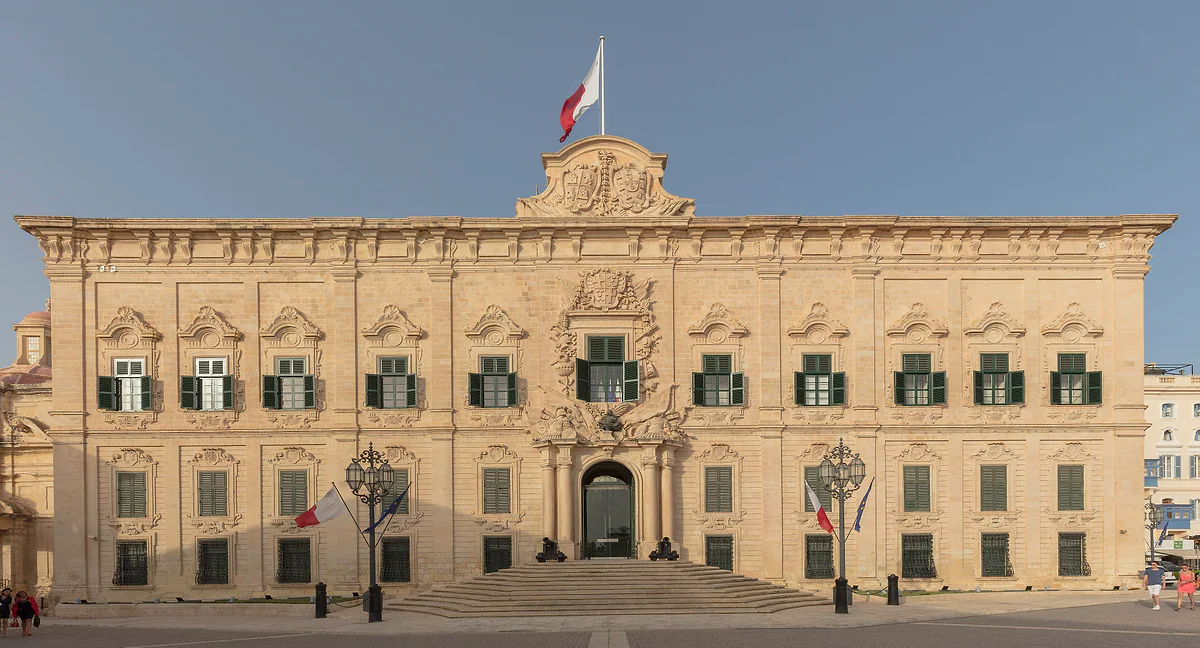
White, red and the George Cross
The Malta flag, white, red and carrying a British medal
The flag of Malta has two equal vertical stripes, white at the hoist and red in the fly, with a representation of the George Cross edged in red in the top corner of the white stripe. That's how the Constitution defines it. The cross is the gallantry award George VI gave Malta on 15 April 1942, and the flag is one and a half times as wide as it is high.
In 30 seconds
Full read: 3 min
- The Malta flag has two vertical stripes, white and red, with the George Cross in the white canton.
- George VI awarded Malta the George Cross on 15 April 1942, and it has been on the flag since 1943.
- The idea that the colours come from the Knights is tradition, which the Government doesn't present as proven.
- The eight-pointed Maltese cross isn't on the national flag but on the President's flag and the merchant ensign.
If you're in Malta on a national day, look at the government buildings, because the flag is supposed to fly on every public institution. And if you'd like to see the George Cross itself, it's in the National War Museum at Fort St Elmo.

Before you go
What I would keep in mind
-
01 My tip
The cross on the flag isn't the Maltese cross
It's the George Cross, a British gallantry award. The eight-pointed Maltese cross appears on the President's flag, the merchant ensign and the €1 and €2 coins instead.
the Maltese cross and its meaning -
02 Most beautiful
See the actual George Cross at Fort St Elmo
Heritage Malta displays Malta's George Cross in the National War Museum at Fort St Elmo, alongside the Gloster Gladiator 'Faith'. Entry is €10.
Fort St Elmo and the National War Museum -
03 My tip
No flags in advertising
The Government of Malta says the national flag must never be used for advertising, and the emblem law bans putting it in any design without the Prime Minister's written permission. Worth knowing if you make content for brands.
the Malta coat of arms
What I would book
The Malta flag looks simple, white and red, but it hides a little trap, and British visitors are better placed than most to spot it. The cross in the corner isn’t the Maltese cross. It’s the George Cross, a British gallantry award, and understanding why it’s there means understanding a good slice of Malta’s 20th century. Here’s what the flag looks like, where it comes from and the official flag rules that surprised me most. That mix-up of crosses is one of twenty I’ve gathered in my Malta facts.
What the Malta flag looks like
Article 3 of the Constitution defines it. Two equal vertical stripes, white at the hoist and red in the fly, with a representation of the George Cross edged in red in the canton of the white stripe. The Government adds that it’s one and a half times as wide as it is high, and points to the Malta Government Gazette of 25 July 1990 for the exact artwork.
What I like is that the Constitution doesn’t just describe the design. The article states outright that the cross was awarded to Malta by King George VI on 15 April 1942. That tells you how much 1942 still weighs in the national memory, because the law records not just what the cross looks like but where it came from and when.
Why is it white and red?
Here I’d tread carefully. The Government of Malta says it is alleged that the colours date back to the rule of the Knights of St John. That’s tradition, not proven fact, and I’ll leave it at that. The cross, on the other hand, is well documented. George VI awarded it to the island and its people for their bravery during the war, and the European Commission notes that Malta was the Commonwealth’s first recipient and that the cross joined the flag in 1943. The full story of the siege is in Malta in the Second World War.
One thing worth saying for British readers is that the George Cross on the flag is the medal, not the red cross of St George on England’s flag.
The cross that isn’t the Maltese cross
People ask about this constantly, so let’s be clear. The eight-pointed Maltese cross is the country’s national symbol, but it isn’t on its flag. It appears on other state flags instead. The President’s flag, introduced by proclamation on 12 December 1988, is blue, with the emblem in the middle and four gold Maltese crosses, one per corner. The merchant ensign is red with a white border and a white Maltese cross, and the naval jack combines the George Cross with four white Maltese crosses.
Nor should you confuse it with the Order of Malta’s flag, which is red with a white Latin cross. The national emblem, which contains the flag, is covered in the Malta coat of arms.
Flag rules that surprise visitors
The Government’s flag page has details I didn’t expect. It flies from sunrise to sunset, and at night only on special occasions and preferably floodlit. It goes up briskly and comes down ceremoniously. It’s never flown upside down, with the George Cross at the foot, except as a signal of dire distress, and never used for advertising in any way. It can’t be draped over a vehicle or used to cover a monument at an unveiling, and on a coffin the cross goes at the head, over the left shoulder.
The one that affects visitors is different. When the flag is raised or lowered, everyone present faces it and stands to attention, and the Government specifies that foreigners should too.
Days when the flags come out
The Government asks for the flag to fly by the main building of every public institution whenever the weather allows, and especially on national days. There are five, 31 March, 7 June, 8 September, 21 September and 13 December, and each marks a moment the flag itself tells the story of. If your trip coincides with one, Valletta is where you’ll notice it most, with the Grandmaster’s Palace, home of the President’s Office, and the rest of the capital’s public buildings flying it. The full calendar is in Malta’s public holidays, and the anthem played at those ceremonies in the Malta national anthem.
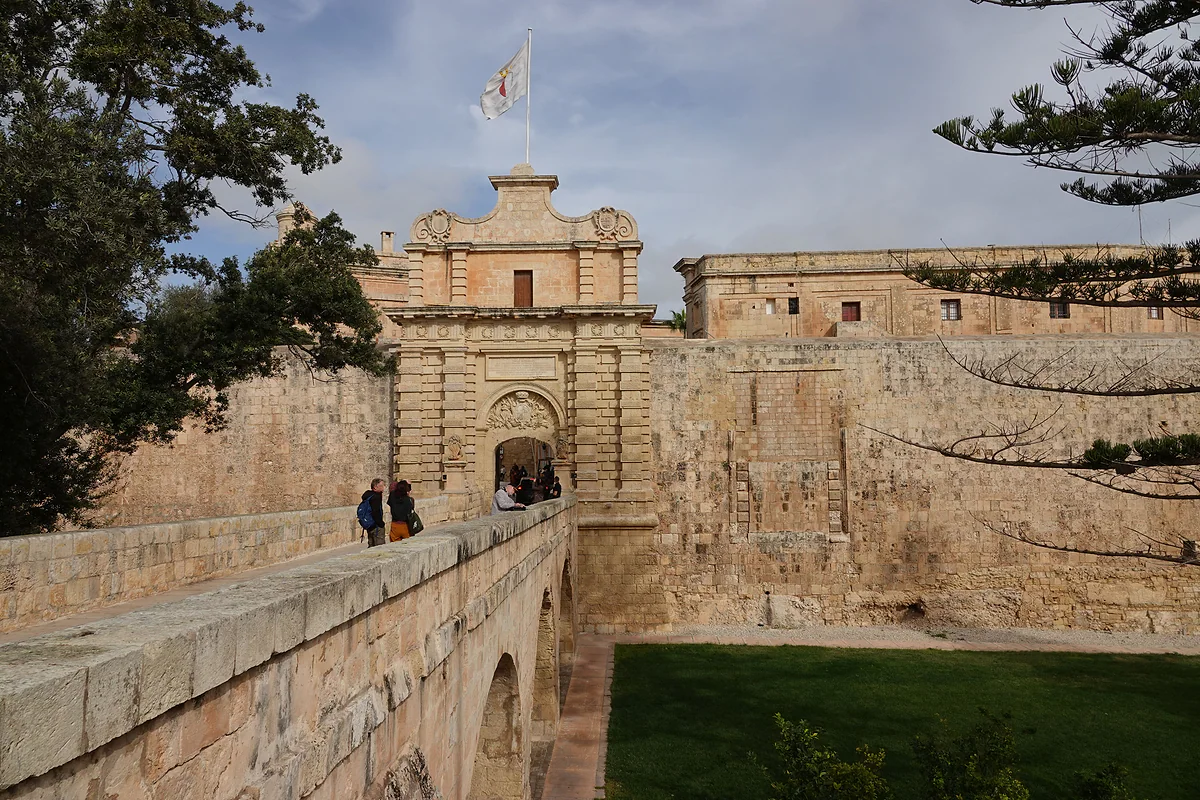
The Baroque main gate of Mdina at the end of the stone bridge over the grassed ditch, with a flag on top and the walls on either side.
Malta's official flags
| Flag | What it looks like | Used for |
|---|---|---|
| National flag | White and red stripes with the George Cross edged in red | The state, public buildings and warships |
| President's flag (1988) | Blue field with the emblem of Malta and a gold Maltese cross in each corner | The President's residences and presence |
| Merchant ensign | Red field with a white border and a white Maltese cross in the centre | Civilian ships |
| Naval jack | George Cross on white inside a red square, with four white Maltese crosses | Warships |
| Archbishop of Malta | Yellow and white vertical stripes | The Archbishop |
| Commander of the Armed Forces | Red pennant with the Armed Forces symbol in gold | The Commander |
| Commissioner of Police | Blue pennant with the Police symbol | The Commissioner |
Descriptions from the Government of Malta's flags and symbols page (archive.org copy of 21-06-2025).
National days, when the flags come out
| Date | Day |
|---|---|
| 31 March | Freedom Day (last British base closes, 1979) |
| 7 June | Sette Giugno (the 1919 riots) |
| 8 September | Our Lady of Victories (1565 and 1943) |
| 21 September | Independence Day (1964) |
| 13 December | Republic Day (1974) |
Test yourself
True or false?
0/3 Pick before you peek.
-
The Maltese flag carries the eight-pointed Maltese cross.
See the answer
False. It carries the George Cross, a British award from 1942. The eight-pointed cross is on the President's flag and the merchant ensign.
-
The Maltese flag must never be flown with the George Cross at the bottom, except as a distress signal.
See the answer
True. The Government of Malta's flag rules say so. Upside down is allowed only as a signal of dire distress.
-
Foreign visitors don't need to do anything when the flag is raised.
See the answer
False. The Government's rules ask everyone present, foreigners included, to face the flag and stand to attention when it's raised or lowered.
- The George Cross is awarded
- 1942
- The cross joins the flag
- 1943
- Flag proportions
- 3:2
- National days a year
- 5
0 of 279 Malta guides
Your next stamp
- Maltese cross
- Coat of arms
- Second World War
- Malta government
- Malta facts
- St George's Bay
- Red Tower
- Things to do in Malta
- Gozo
- Most beautiful places
- Comino
- Prettiest villages
- UNESCO World Heritage Sites
- Where is Malta
- The Maltese islands
- Towns and villages
- Island of Malta
- Blue Lagoon
- Fort Rinella
- Fort St Angelo
- Gardjola Gardens
- Ħal Saflieni Hypogeum
- Is Malta a country?
- Popeye Village
- Tarxien Temples
- Things to do in Gozo
- Valletta
- Esplora
- Golden Bay
- Gozo day trip
- Inquisitor's Palace
- Population
- St John's Co-Cathedral
- St Mary's Tower
- Grandmaster's Palace
- How big is Malta
- Maritime Museum
- Mellieħa Bay
- Fort St Elmo
- Language
- Malta at War Museum
- Paradise Bay
- Barrakka Gardens
- Religion
- Saluting Battery
- MUŻA
- National Museum of Archaeology
- Underground Valletta
- Lascaris War Rooms
- Casa Rocca Piccola
- Malta in one day
- Three Cities
- Victoria
- Birgu
- Manoel Theatre
- Weekend in Malta
- Xagħra
- City Gate and Parliament
- Malta in three days
- Nadur
- Senglea
- Cospicua
- Malta in four days
- Qala
- Valletta Waterfront
- Għajnsielem
- Kalkara
- Malta in five days
- Malta in a week
- Paola
- Xewkija
- Sannat
- Tarxien
- Munxar
- Żabbar
- Fgura
- Fontana
- Kerċem
- Luqa
- Floriana
- Marsa
- Mellieħa
- The Citadel, Gozo
- Żebbuġ (Gozo)
- Ġgantija Temples
- Marsalforn
- Santa Luċija
- Ramla Bay
- San Lawrenz
- Xgħajra
- Xwejni salt pans
- Calypso's Cave
- Għarb
- Żejtun
- Għasri
- Gudja
- San Blas Bay
- Għaxaq
- Ħondoq Bay
- Marsaxlokk
- Kirkop
- Marsaxlokk Fish Market
- Mqabba
- St Peter's Pool
- Marsaskala
- Qrendi
- Żurrieq
- Beaches
- Comino ferry
- EU, Schengen and the euro
- Ħaġar Qim and Mnajdra
- Mdina
- Mġarr (Gozo)
- Blue Grotto
- Diving
- Entry requirements
- Mdina Cathedral
- Xewkija Rotunda
- Birżebbuġa
- Money and payments
- Palazzo Falson
- Safi
- Shipwrecks
- Ta' Ċenċ Cliffs
- Għar Dalam
- Mdina Dungeons
- Mġarr ix-Xini
- Prices and budget
- Snorkelling
- Boat trips
- Malta on a budget
- Playmobil FunPark
- Rabat (Malta)
- Xlendi
- Dwejra
- Gozo beaches
- History
- Siġġiewi
- St Paul's Catacombs
- Tipping
- Azure Window
- Domvs Romana
- Għar Lapsi
- Great Siege of 1565
- Plugs
- Limestone Heritage Park
- St Paul's Grotto
- Ta' Pinu Basilica
- Time zone
- Buskett Gardens
- Knights of Malta
- Mobile and roaming
- Wied il-Għasri
- Dingli
- Dingli Cliffs
- Żebbuġ
- Mtarfa
- Balzan
- National anthem
- Lija
- Game of Thrones
- Iklin
- Attard
- Film locations
- Forts and fortifications
- San Anton Gardens
- Ta' Qali Crafts Village
- Victoria Lines
- Megalithic temples
- Catacombs
- Museums
- Where to eat
- Where to stay
- Churches
- Hotels in Valletta
- Restaurants in Valletta
- Hotels in Sliema
- Maltese food
- Restaurants in Marsaxlokk
- Viewpoints
- Hotels in St Julian's
- Pastizzi
- Walking and hiking
- Hotels in Buġibba and Qawra
- Maltese rabbit stew
- Safety
- Hotels in Mellieħa
- Kinnie and Cisk
- Scams
- Gozo hotels
- Nightlife
- Tap water
- Boat parties
- Holiday packages
- Tourist tax
- All inclusive
- Gay Malta
- Sightseeing passes
- Apartments
- Malta with kids
- Public holidays
- How to get there
- Luxury
- Malta for couples
- Taxis and ride-hailing
- Weather
- Best time to visit
- Cycling
- English schools
- Flights
- Flights from Madrid
- Sea temperature
- Shopping and souvenirs
- Airport
- Free walking tours
- In winter
- Airport transfers
- Day trips and tours
- In summer
- Ferry from Sicily
- In January
- Cruise stop
- In February
- In March
- In April
- In May
- Getting around
- In June
- Buses
- July
- August
- Hop on hop off
- Gozo ferry
- September
- Gozo fast ferry
- October
- November
- Valletta ferries
- Car hire
- December
- Driving
- Events
- St Paul's Bay
- Village feasts
- Buġibba
- Christmas
- Easter
- Qawra
- Carnival
- Xemxija
- Fireworks festival
- Malta National Aquarium
- Isle of MTV
- St Paul's Islands
- Mosta
- Mosta Rotunda
- Naxxar
- Palazzo Parisio
- Għargħur
- Mġarr (Malta)
- Sliema
- Ta' Ħaġrat and Skorba Temples
- Għajn Tuffieħa Bay
- Tigné Point
- Ġnejna Bay
- St Julian's
- Paceville
- Gżira
- Msida
- Ta' Xbiex
- Pietà
- Pembroke
- Swieqi
- San Ġwann
- Birkirkara
- Ħamrun
- Santa Venera
- Qormi
Frequently asked questions
What does the Malta flag look like?
Two equal vertical stripes, white at the hoist and red in the fly, with the George Cross edged in red in the canton of the white stripe. It's one and a half times as wide as it is high.
Why is the George Cross on the Maltese flag?
George VI awarded it to Malta on 15 April 1942 for its people's bravery in the Second World War. The European Commission notes it has been on the flag since 1943.
Is the George Cross the same as the cross of St George?
No. The George Cross is a gallantry award, and that medal is what appears on Malta's flag. The red cross of St George on England's flag is a different thing altogether.
Why is the Maltese flag red and white?
The Government of Malta says it is alleged that the colours date back to the Knights of St John. Note the wording, 'alleged', so it's tradition rather than proven fact.
Is the Malta flag the same as the Order of Malta flag?
No. The Order's state flag is red with a white Latin cross, and the flag of its works is red with the eight-pointed cross. The Republic of Malta's flag is white and red with the George Cross.
Can you use the Maltese flag in advertising?
No. The Government says it must never be used for advertising, and the emblem law requires the Prime Minister's written permission to include it in any design.
By
Tourism graduate with a master’s in Tourism Management and Planning from the University of Málaga, who has travelled across Europe. He writes every guide from official sources and his own judgement.
Published on . Facts checked on .
Sources
Photos: Diego Delso (CC BY-SA 4.0); Nenea hartia (CC BY-SA 4.0), via Wikimedia Commons.