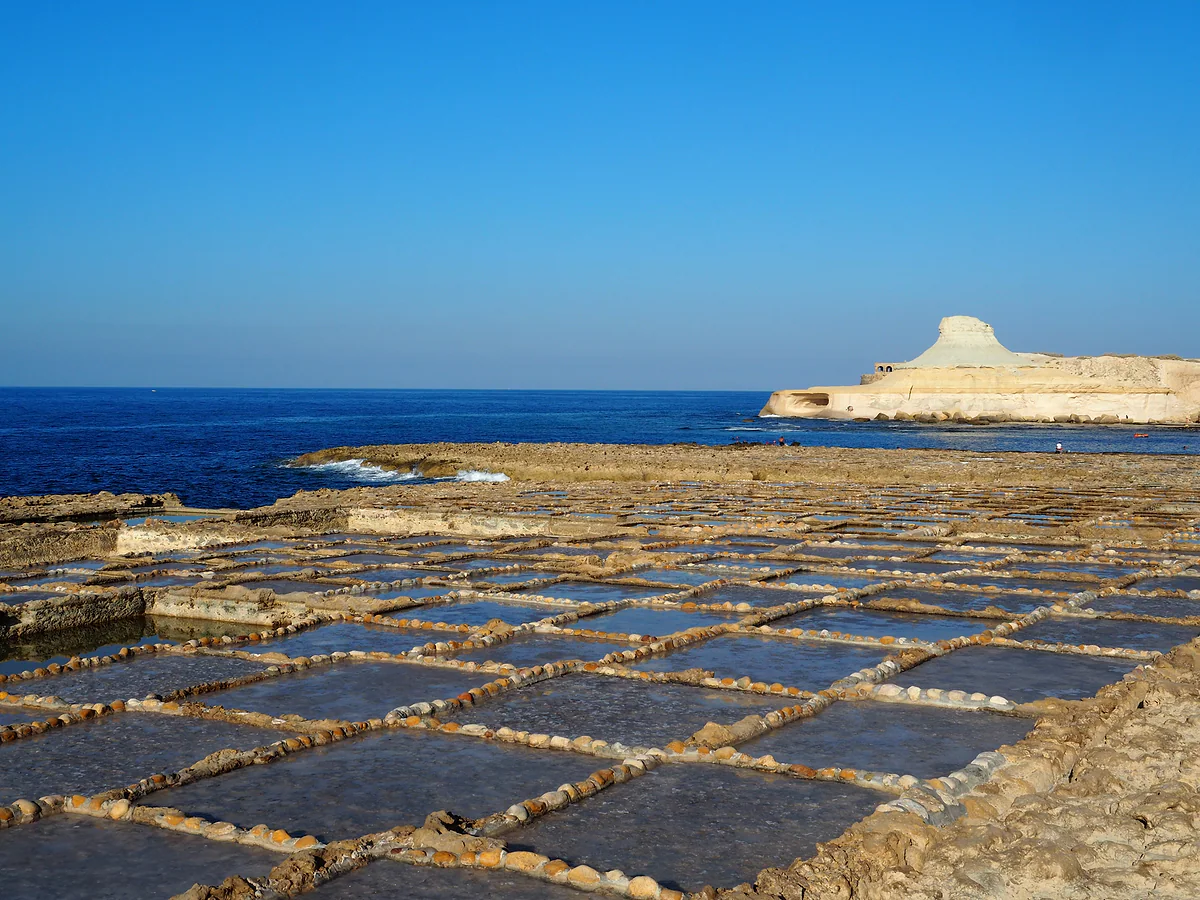
A local council in northern Gozo
Żebbuġ, Gozo's hilltop village above the salt pans
Iż-Żebbuġ is a village of 3,781 people on a hill in northern Gozo. Its name means olive trees, it became a parish in 1688, and its church, consecrated in 1726, is lined with honey-coloured stone found within the village limits. Paths lead down to Qbajjar, which the Ministry for Gozo counts as part of the locality, and to the Xwejni salt pans.
In 30 seconds
Full read: 3 min
- Żebbuġ is a hilltop village of 3,781 people in northern Gozo.
- Its Church of the Assumption, consecrated in 1726, is lined with stone from the village.
- Qbajjar is part of the locality, and the Xwejni salt pans lie below.
- The village feast, for Our Lady, is held in August.
Żebbuġ isn't somewhere I'd make a special trip to from Valletta, but it's well worth the climb from Marsalforn or the salt pans to see the church and carry on along the coast. It's the easiest way to get a feel for village Gozo without leaving the north-coast route.

Before you go
What I would keep in mind
-
01 Most beautiful
A church dressed in local stone
The high altar, choir and baptistery are carved from stone found in the village. The Ministry for Gozo calls it onyx on one page and honey-coloured travertine on another.
-
02 My tip
Follow the village heritage trail
The local council and St Mary's band club devised the Żebbuġ Heritage Trail, taking in hills, a Second World War air-raid shelter and the Riħ id-Deheb house, open by appointment.
-
03 Getting there
Walk down to the salt pans
A coastal path from the back of the village leads to the Xwejni salt pans, Qbajjar and Marsalforn, according to the Ministry for Gozo.
Gozo salt pans -
04 To save money
Stay in the village, not the bay
The MTA register lists no hotels in Żebbuġ, but it does list 76 licensed holiday lets, quieter than those down in the bay.
Gozo hotels
What I would book
Iż-Żebbuġ is one of those Gozo villages most people only glimpse from the road on their way to the salt pans or Marsalforn. It sits on a hill in the north of the island, looking out over fields and sea, and the Ministry for Gozo calls it one of the island’s more remote villages. That, to my mind, is exactly why it’s worth stopping.
Don’t confuse it with Żebbuġ on the main island, a council of 15,352 people. The NSO counted 3,781 people in Gozo’s Żebbuġ by the close of 2025, and nearly half of them, 1,792, were foreign nationals.
Olive trees and a church in local stone
Żebbuġ means olive trees in Maltese, and the Ministry for Gozo links the name to former olive groves or presses; the next village, Għasri, means olive press. The parish became independent in 1688, work on today’s church began in 1690 and it was consecrated in 1726, dedicated to the Assumption. The Ministry says that, the Cathedral apart, it’s the oldest consecrated parish church on Gozo.
What sets it apart is the stone. The high altar, choir and baptistery are carved from a deposit found in 1738 within the village limits, at is-Sagħtrija, facing the Ta’ Ġurdan lighthouse. The Ministry’s place page calls it onyx, while a 2025 article of its own calls it honey-coloured travertine that locals refer to as marble. Whatever the label, I’d go in just to see it. The central altar is the work of the Maltese sculptor Ronald Pisani.
Inside there’s also an altarpiece of the Immaculate Conception known as tal-Virtu, legend attached, and in the streets, carefully kept wayside shrines. The best known is the Madonna Omm tal-Ħniena, locally called taċ-Ċiċri.
The heritage trail
The local council and St Mary’s Philharmonic Society have mapped out the Żebbuġ Heritage Trail, which takes in Tad-Dabrani hill, Wied l-Infern, the parish priest’s house, the band club and a Second World War air-raid shelter at the entrance to the village. Within the limits you’ll also find Ta’ Kuljat, a flat-topped hill with a Bronze Age settlement, and the Punic tombs of Ta’ Tutiet.
The Riħ id-Deheb house, with a collection of 20th-century Maltese art and a natural grotto mentioned in a bishop’s pastoral visit of 1582, opens strictly by appointment.
Traditions of its own
The village feast, in honour of Our Lady, is held in August, according to the Ministry for Gozo’s 2026 calendar, which doesn’t give the exact day. There’s a Good Friday procession, and one custom that’s all Żebbuġ’s own, the għażżiela, an M-shaped pastry made as protection against lightning, a tradition of around 350 years. The village is known for lace, weaving and woollen blankets, and the Ministry says its sheep’s milk makes some of Gozo’s finest ġbejniet, the small local cheeses.
Getting there, and how I’d do it
The Ministry for Gozo suggests two routes from Victoria. One follows the road lined with aqueducts through Għasri; the other skirts behind the Citadel, drops to Wied Sara and climbs a country lane to the village square. It adds that the drive, walk or cycle up is part of the appeal, and I’d agree.
Here’s how I’d spend a half day. Head up mid-morning, wander past the shrines and round the square, and look into the church if the doors are open, then walk down towards Xwejni to reach the salt pans in the late-afternoon light. From there, Qbajjar and Marsalforn are an easy stroll along the shore, with plenty of places for dinner. You could squeeze it into a day trip from the Ċirkewwa ferry, but I’d save it for a stay of a few nights on the island.
Down to the sea
A coastal path from the back of the village drops down to the Xwejni salt pans, Qbajjar and Marsalforn. Qbajjar, with its waterfront restaurants, is part of the locality of Żebbuġ, according to the Ministry for Gozo. The village has a few places to eat, and the coast has more.
For somewhere to stay, the MTA register lists no hotels in Żebbuġ but does list 76 licensed holiday lets. If you’d rather have a hotel, the nearest are in Marsalforn, and I compare them in Gozo hotels.
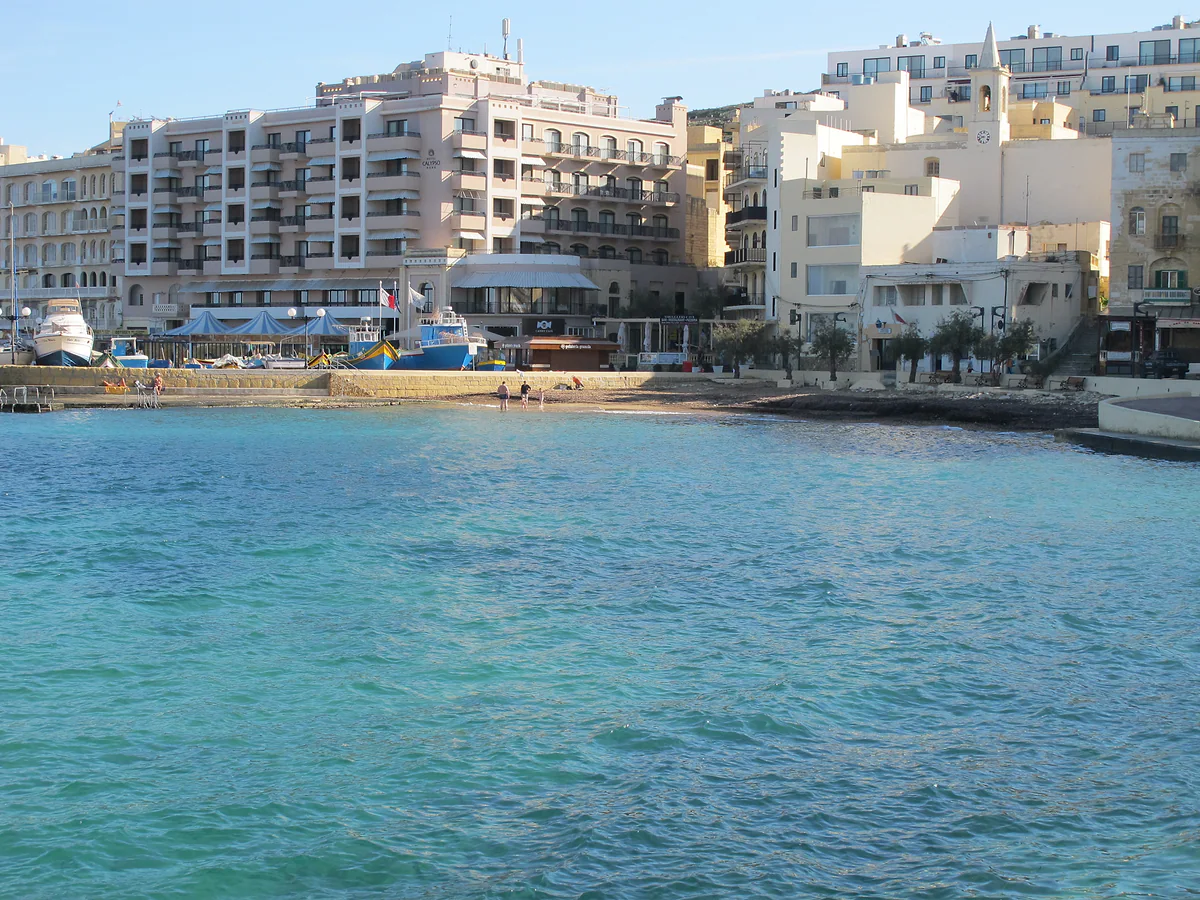
The seafront at Marsalforn on the north coast of Gozo, with the turquoise water of the bay in front of white hotels and apartment blocks.
Żebbuġ (Gozo) in figures
| Item | Figure | Source |
|---|---|---|
| Population, 31-12-2025 | 3,781 (1,989 Maltese, 1,792 foreign nationals) | NSO |
| Population, 31-12-2024 | 3,739 | NSO |
| Density | 500 per km² | NSO |
| Independent parish | 1688 | Ministry for Gozo |
| Church consecrated | 1726 | Ministry for Gozo |
| Licensed holiday lets | 76 | MTA, 28-09-2026 |
What to see in and around Żebbuġ
| Place | What it is |
|---|---|
| Church of the Assumption | Parish church consecrated in 1726, with altar, choir and baptistery in local stone |
| Taċ-Ċiċri niche | The finest of the village's street shrines, to the Madonna Omm tal-Ħniena |
| Ta' Kuljat | Flat-topped hill with a Bronze Age settlement |
| Ta' Tutiet | Punic tombs |
| Riħ id-Deheb | Historic house with a natural grotto, by appointment only |
| Qbajjar and Xwejni | Two pebbly, rocky bays by the salt pans |
Test yourself
True or false?
0/3 Pick before you peek.
-
Żebbuġ means olive trees in Maltese.
See the answer
True. So says the Ministry for Gozo, linking it to former olive groves or presses.
-
Żebbuġ's church is Gozo's oldest consecrated parish church after the Cathedral.
See the answer
True. The Ministry for Gozo says that, the Cathedral apart, it is the oldest parish church consecrated on Gozo, in 1726.
-
Gozo's Żebbuġ is a district of Żebbuġ on Malta.
See the answer
False. They are two separate local councils, one on each island, that share a name.
- Residents at the end of 2025
- 3,781
- Year it became a parish
- 1688
- Church consecrated
- 1726
Map
Where Żebbuġ (Gozo) is
Gozo lies to the north-west, across the channel the ferry crosses from Ċirkewwa, with Comino between the two islands. Every number opens its guide.
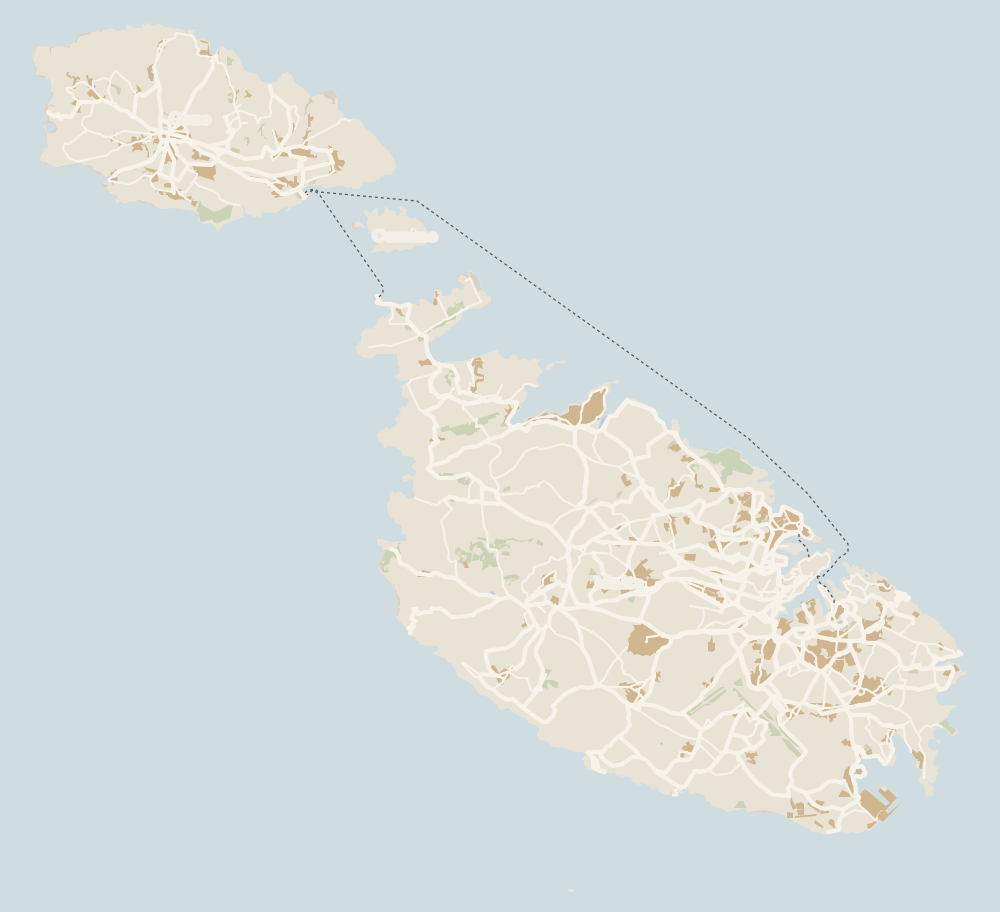 1Gozo 2Victoria 3Xagħra 4Nadur 5Qala 6Għajnsielem 7Xewkija 8Sannat 9Munxar 10Fontana 11Kerċem 12Żebbuġ (Gozo) 13San Lawrenz 14Għarb 15Għasri
 Map data © OpenStreetMap contributors (ODbL)
- 1GozoThe second island of the Maltese archipelago
- 2VictoriaThe capital of Gozo
- 3XagħraA village on Gozo
- 4NadurA village on Gozo
- 5QalaA village on Gozo
- 6GħajnsielemA village on Gozo
- 7XewkijaA village on Gozo
- 8SannatA village on Gozo
- 9MunxarA village on Gozo
- 10FontanaA village on Gozo
- 11KerċemA village on Gozo
- 12Żebbuġ (Gozo)A local council in northern Gozo
- 13San LawrenzA village on Gozo
- 14GħarbA village on Gozo
- 15Għasri519 residents between two hills
What to see
What to see in Żebbuġ (Gozo)
0 of 279 Malta guides
Your next stamp
- Xwejni salt pans
- Żebbuġ
- San Lawrenz
- Għasri
- Xewkija
- Sannat
- Qala
- Għarb
- Things to do in Malta
- Gozo
- Most beautiful places
- Comino
- Prettiest villages
- UNESCO World Heritage Sites
- Where is Malta
- The Maltese islands
- Towns and villages
- Island of Malta
- Blue Lagoon
- Fort Rinella
- Fort St Angelo
- Gardjola Gardens
- Ħal Saflieni Hypogeum
- Is Malta a country?
- Popeye Village
- Tarxien Temples
- Things to do in Gozo
- Valletta
- Esplora
- Golden Bay
- Gozo day trip
- Inquisitor's Palace
- Population
- St John's Co-Cathedral
- St Mary's Tower
- Grandmaster's Palace
- How big is Malta
- Maritime Museum
- Mellieħa Bay
- Fort St Elmo
- Language
- Malta at War Museum
- Paradise Bay
- Barrakka Gardens
- Red Tower
- Religion
- Malta government
- Saluting Battery
- MUŻA
- National Museum of Archaeology
- Underground Valletta
- Lascaris War Rooms
- Casa Rocca Piccola
- Malta in one day
- Three Cities
- Victoria
- Birgu
- Manoel Theatre
- Weekend in Malta
- Xagħra
- City Gate and Parliament
- Malta in three days
- Nadur
- Senglea
- Cospicua
- Malta in four days
- Valletta Waterfront
- Għajnsielem
- Kalkara
- Malta in five days
- Malta in a week
- Paola
- Tarxien
- Munxar
- Żabbar
- Fgura
- Fontana
- Kerċem
- Luqa
- Floriana
- Marsa
- Mellieħa
- The Citadel, Gozo
- Ġgantija Temples
- Marsalforn
- Santa Luċija
- Ramla Bay
- Xgħajra
- Calypso's Cave
- Żejtun
- Gudja
- San Blas Bay
- Għaxaq
- Ħondoq Bay
- Marsaxlokk
- Kirkop
- Marsaxlokk Fish Market
- Mqabba
- St Peter's Pool
- Marsaskala
- Qrendi
- Żurrieq
- Beaches
- Comino ferry
- EU, Schengen and the euro
- Ħaġar Qim and Mnajdra
- Mdina
- Mġarr (Gozo)
- Blue Grotto
- Diving
- Entry requirements
- Mdina Cathedral
- Xewkija Rotunda
- Birżebbuġa
- Money and payments
- Palazzo Falson
- Safi
- Shipwrecks
- Ta' Ċenċ Cliffs
- Għar Dalam
- Mdina Dungeons
- Mġarr ix-Xini
- Prices and budget
- Snorkelling
- Boat trips
- Malta on a budget
- Playmobil FunPark
- Rabat (Malta)
- Xlendi
- Dwejra
- Gozo beaches
- History
- Siġġiewi
- St Paul's Catacombs
- Tipping
- Azure Window
- Domvs Romana
- Għar Lapsi
- Great Siege of 1565
- Plugs
- Limestone Heritage Park
- Second World War
- St Paul's Grotto
- Ta' Pinu Basilica
- Time zone
- Buskett Gardens
- Knights of Malta
- Mobile and roaming
- Wied il-Għasri
- Dingli
- Maltese cross
- Dingli Cliffs
- Flag
- Coat of arms
- Mtarfa
- Balzan
- National anthem
- Lija
- Malta facts
- Game of Thrones
- Iklin
- Attard
- Film locations
- Forts and fortifications
- San Anton Gardens
- Ta' Qali Crafts Village
- Victoria Lines
- Megalithic temples
- Catacombs
- Museums
- Where to eat
- Where to stay
- Churches
- Hotels in Valletta
- Restaurants in Valletta
- Hotels in Sliema
- Maltese food
- Restaurants in Marsaxlokk
- Viewpoints
- Hotels in St Julian's
- Pastizzi
- Walking and hiking
- Hotels in Buġibba and Qawra
- Maltese rabbit stew
- Safety
- Hotels in Mellieħa
- Kinnie and Cisk
- Scams
- Gozo hotels
- Nightlife
- Tap water
- Boat parties
- Holiday packages
- Tourist tax
- All inclusive
- Gay Malta
- Sightseeing passes
- Apartments
- Malta with kids
- Public holidays
- How to get there
- Luxury
- Malta for couples
- Taxis and ride-hailing
- Weather
- Best time to visit
- Cycling
- English schools
- Flights
- Flights from Madrid
- Sea temperature
- Shopping and souvenirs
- Airport
- Free walking tours
- In winter
- Airport transfers
- Day trips and tours
- In summer
- Ferry from Sicily
- In January
- Cruise stop
- In February
- In March
- In April
- In May
- Getting around
- In June
- Buses
- July
- August
- Hop on hop off
- Gozo ferry
- September
- Gozo fast ferry
- October
- November
- Valletta ferries
- Car hire
- December
- Driving
- Events
- St Paul's Bay
- Village feasts
- Buġibba
- Christmas
- Easter
- Qawra
- Carnival
- Xemxija
- Fireworks festival
- Malta National Aquarium
- Isle of MTV
- St Paul's Islands
- Mosta
- Mosta Rotunda
- Naxxar
- Palazzo Parisio
- Għargħur
- Mġarr (Malta)
- Sliema
- Ta' Ħaġrat and Skorba Temples
- Għajn Tuffieħa Bay
- Tigné Point
- Ġnejna Bay
- St Julian's
- Paceville
- St George's Bay
- Gżira
- Msida
- Ta' Xbiex
- Pietà
- Pembroke
- Swieqi
- San Ġwann
- Birkirkara
- Ħamrun
- Santa Venera
- Qormi
Frequently asked questions
Where is Żebbuġ on Gozo?
On a hill in the north of the island. From Victoria you can go up the road lined with aqueducts through Għasri, or behind the Citadel via Wied Sara, according to the Ministry for Gozo.
What is there to see in Żebbuġ, Gozo?
The Church of the Assumption, lined with stone from the village, the street shrines, the heritage trail and, down on the coast, Qbajjar and the Xwejni salt pans.
What does Żebbuġ mean?
Olives or olive trees in Maltese, says the Ministry for Gozo. The neighbouring village, Għasri, means olive press.
When is the Żebbuġ village feast?
In August, in honour of Our Lady, according to the Ministry for Gozo's 2026 feast calendar. It doesn't give an exact date.
Is Żebbuġ on Gozo the same as Żebbuġ on Malta?
No. They're two separate councils with the same name. The one on the main island has 15,352 residents; Gozo's has 3,781.
Where can I stay near Żebbuġ?
There are no hotels on the MTA register in Żebbuġ, but there are 76 licensed holiday lets. The nearest hotels are in Marsalforn.
By
Tourism graduate with a master’s in Tourism Management and Planning from the University of Málaga, who has travelled across Europe. He writes every guide from official sources and his own judgement.
Published on . Facts checked on .
Sources
Photos: Corina Möller (CC BY-SA 4.0); Kritzolina (CC BY-SA 4.0), via Wikimedia Commons.