Baroque, domes and shrines
Churches in Malta: the ten I wouldn't skip
The churches most worth visiting in Malta are St John's Co-Cathedral in Valletta, home to two Caravaggios, St Paul's Cathedral in Mdina and the Mosta Rotunda, plus the Xewkija Rotunda and Ta' Pinu on Gozo. The first three charge between €8 and €15, and St John's is closed to visitors on Sundays.
In 30 seconds
Full read: 3 min
- St John's Co-Cathedral (€15) is the church most worth paying for, with two Caravaggios.
- Mdina Cathedral costs €15 including its museum; the Mosta Rotunda is €8 or €5.
- On Gozo, Ta' Pinu and the Xewkija Rotunda publish neither hours nor prices.
- There's no reliable dome ranking: each parish quotes its own measurements.
If I paid for just one church, it would be St John's, no contest. Second would be Mosta, where €8 gets you out onto the dome itself, something I haven't found at any other church on the island with a published price.

Before you go
What I would keep in mind
-
01 Most beautiful
Two Caravaggios in one oratory
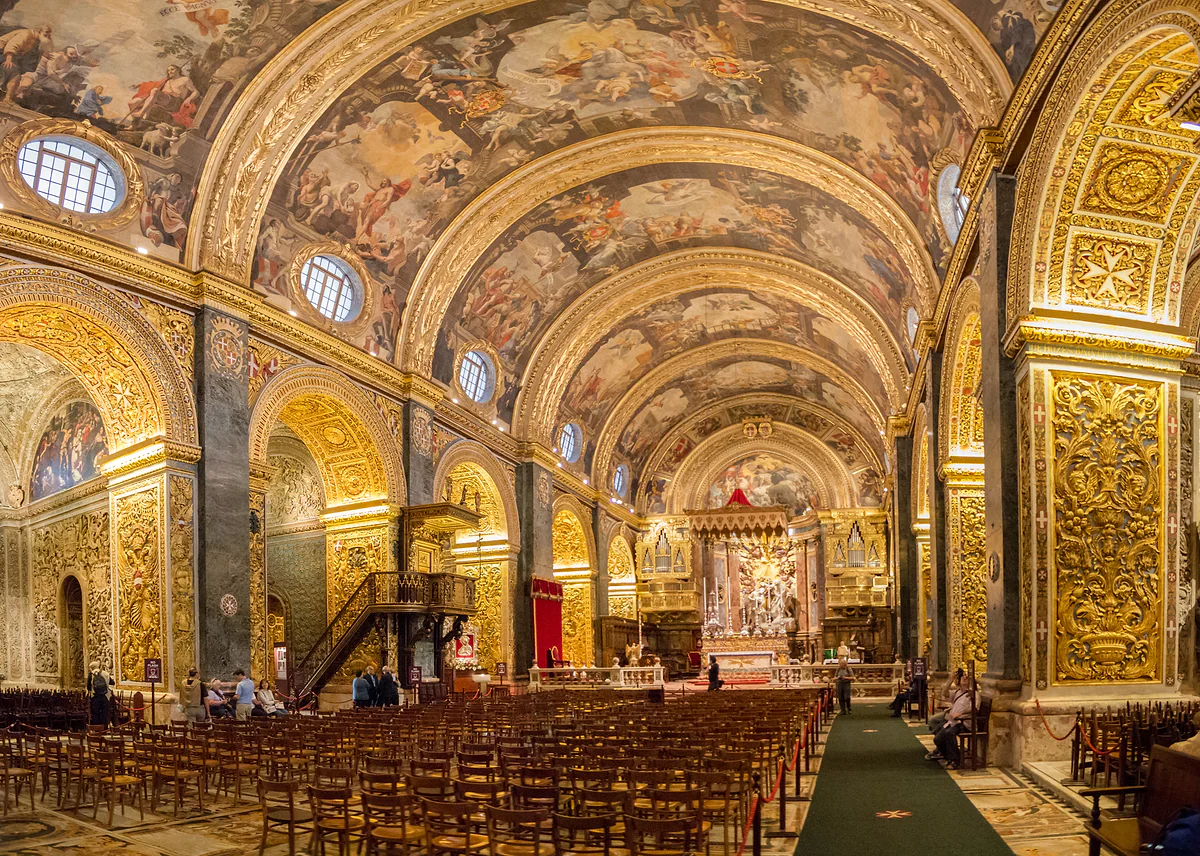
The Beheading of St John the Baptist, 520 by 360 cm, and St Jerome Writing both hang in the oratory of St John's Co-Cathedral. Caravaggio painted them during his stay in Malta in 1607 and 1608.
St John's Co-Cathedral in Valletta -
02 My tip
Dress modestly and leave the flash off
Mdina Cathedral asks visitors to be decently dressed and lends shawls at the door. Photos are fine without flash, and it advises against stiletto heels on the inlaid marble floor.
Mdina Cathedral -
03 Worth the splurge
The walk round the outside of Mosta's dome
The full Mosta Rotunda visit, at €8, takes in the crypt, museum, wartime shelter, inner balcony and a walk around the outside of the dome. The short visit, at €5, covers the basilica and the shelter.
Mosta Rotunda -
04 To save money
Under-12s free at both cathedrals
Both St John's Co-Cathedral and Mdina Cathedral let children under 12 in free with an adult. With a family, they're among the cheapest things you can do in Valletta and Mdina.
My ranking, scored
The churches in Malta I'd visit, in order
Scored out of 10 on my own judgement. I weigh what each church holds inside, what it tells you about the islands' history, and how easy it is to visit with published hours and prices. It isn't a size ranking, and I don't compare domes.
0 of 10 seen
-
St John's Co-Cathedral (Valletta)
The Knights' conventual church, completed in 1577 by Gironimo Cassar, with the two Caravaggios in the oratory. An audio guide is included in the ticket.
9.6 out of 10
-
St Paul's Cathedral (Mdina)
Rebuilt after the 1693 earthquake and consecrated in 1703, it's the archbishop's seat. The ticket includes the Cathedral Museum.
9.0 out of 10
-
Mosta Rotunda
A dome 39.6 m across inside, according to the parish, and the story of the 1942 bomb. The only one here with a walk outside the dome at a clear price.
8.7 out of 10
-
Ta' Pinu Shrine (Gozo)
A basilica standing alone in the fields by Għarb, with the marble Stations of the Cross on the hill opposite. It's the islands' great Marian shrine.
8.4 out of 10
-
Xewkija Rotunda (Gozo)
75 m high and some 45,000 tonnes, funded by the villagers around their old church and consecrated in 1978. There's a lift up to the dome.
8.2 out of 10
-
Cathedral of the Assumption (Citadel, Gozo)
Built from 1697 to 1711, its flat ceiling carries a 1739 painting that fakes a dome. You'll see it as part of a visit to the Citadel.
7.8 out of 10
-
St Paul's Grotto and St Paul's Church (Rabat)
The grotto where tradition places St Paul, beneath Rabat's parish church with its Mattia Preti altarpiece. You go in through the Wignacourt Museum.
7.6 out of 10
-
St George's Basilica (Victoria, Gozo)
Known as the Marble Basilica, with works by Mattia Preti and a statue of the saint from 1838.
7.3 out of 10
-
St Helen's Basilica (Birkirkara)
Frescoes by Virginio Monti from 1906 to 1910 across the dome and vaults, and a parish museum opened in 2023.
7.0 out of 10
-
Our Lady of the Pillar (Valletta)
The church of the Knights of the Langue of Aragon, from the 1670s, remodelled by Romano Carapecchia. A small Spanish chapter in the heart of the capital.
6.8 out of 10
It’s hard to find a Maltese village without a church far too big for it, which tells you a lot about a country where 82.6% of people call themselves Catholic. Seeing lots of churches isn’t the same as seeing the right ones, though. This is my pick of those that genuinely justify the detour or the ticket, with what they charge, when they open and what to know so you’re not turned away at the door. How faith shapes daily life here is covered in religion in Malta.
St John’s, the one I’d put ahead of everything
The Knights’ conventual church was finished in 1577, soon after the Great Siege, to a sober design by the Order’s engineer, Gironimo Cassar. What makes it extraordinary came later, as grand master after grand master, and many knights besides, donated works until a plain Mannerist church became the Baroque interior you see today. In the oratory hang the two Caravaggios he painted in Malta, the Beheading of St John the Baptist and St Jerome Writing.
Tickets are €15 with an audio guide, it opens Monday to Saturday and closes to visitors on Sundays and public holidays. The foundation that runs it protects the tombstones set into the floor by staggering or capping visitor numbers, so I’d go first thing. The full picture is in St John’s Co-Cathedral.
Mdina and Mosta, the other two I’d pay for
St Paul’s Cathedral in Mdina was rebuilt after the earthquake of 11 January 1693, which only the choir survived. It was consecrated in 1703 and the dome was finished in 1705. The €15 ticket includes the Cathedral Museum and is sold there, on the right. On Sunday afternoons visitors are kept behind a rope and can only look in.
The Mosta Rotunda is another story. The parish gives an inside diameter of 39.6 m and an internal height of 54.7 m, and keeps a replica of the bomb that pierced the dome in 1942 and hit the floor without exploding or killing anyone. What sells it to me is the €8 full visit, which includes the inner balcony and a walk right round the exterior of the dome.
Which churches should you see on Gozo?
Gozo has two churches that justify the ferry on their own. The Xewkija Rotunda was raised around the old church between the early 1950s and 1970, with money raised by the villagers, and consecrated on 17 June 1978. The Ministry for Gozo puts it at 75 m high and around 45,000 tonnes, and a lift runs from its sculpture museum up to the dome.
Ta’ Pinu Basilica, just outside Għarb, is the shrine tied to Karmni Grima, who by tradition heard the voice of the Virgin in 1883. John Paul II came in 1990 and Pope Francis in 2022. The present Romanesque church dates from 1920 to 1932, and on Ta’ Għammar hill opposite stand fourteen Carrara marble statues of the Stations of the Cross. It publishes no opening hours, so I’d steer clear of Mass times.
Inside the Citadel in Victoria is the Cathedral of the Assumption, built between 1697 and 1711, with a flat ceiling painted in 1739 to look like a dome. It’s a trompe l’oeil well worth a minute with your head tilted back.
A word about domes
Mosta and Xewkija have long claimed places in lists of the world’s biggest domes, and the figures they give don’t agree with each other or with other parishes. So you won’t find a size podium here, only the measurements each one publishes. That feels more honest to me, and frankly what impresses is walking in, not the ranking.
House rules worth knowing before you go in
These are working churches. Weddings, funerals and Mass can close or limit visits at short notice, as Mdina Cathedral did for two weddings at the end of September 2026. Covered shoulders, no food or drink and no flash are rules I’d take for granted in any of them. And if you’re on Gozo during a village festa, you’ll find the church dressed in red if the patron is a martyr or in blue if it’s the Virgin, with the square packed, which is another way of understanding these places.
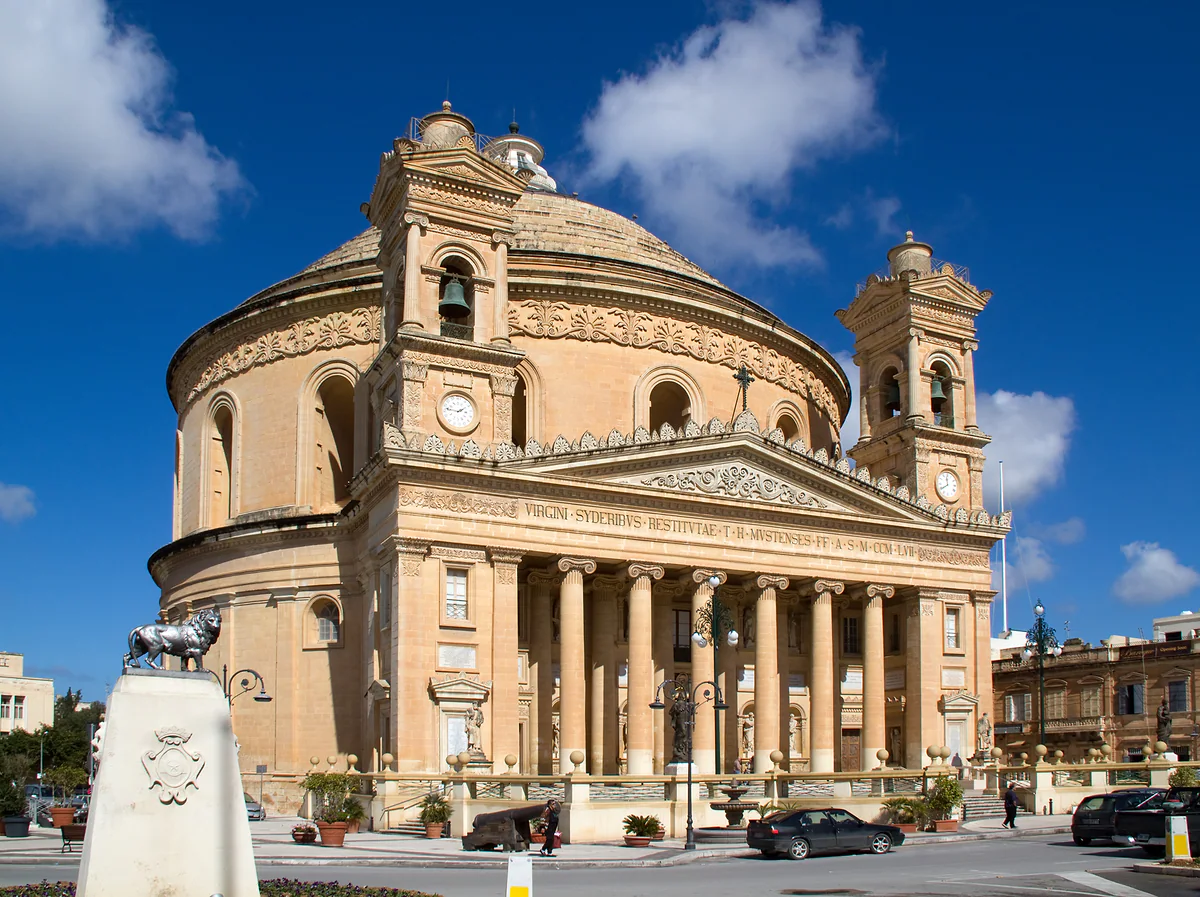
The Rotunda of Mosta, with its columned portico, twin bell towers and the vast dome standing out against a blue sky with clouds.
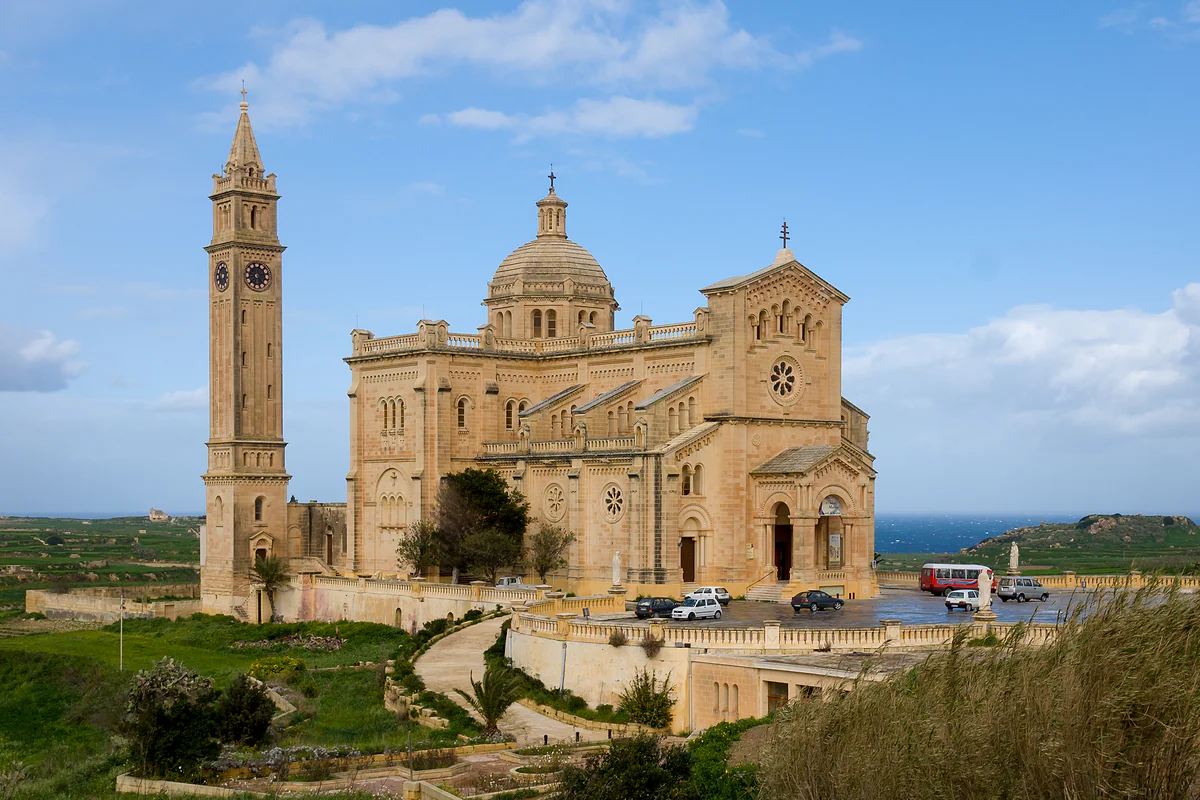
The Basilica of Ta' Pinu standing alone in the fields near Għarb, Gozo, with its free-standing bell tower, dome and pale stone façade.
Opening hours and prices at churches that charge
| Church | Visiting hours | Adult | Concessions |
|---|---|---|---|
| St John's Co-Cathedral | Monday to Saturday 09:00-16:45 (last entry 16:00) | €15 | €12 seniors and students; under-12s free |
| Mdina Cathedral and museum | Monday to Saturday 09:30-16:30; Sunday 15:00-17:00, from behind the rope | €15 | €10 over-60s and students; under-12s free |
| Mosta Rotunda | Monday to Friday 09:30-18:00; Saturday 09:30-16:30; Sunday 12:00-17:00 | €8 full visit | €5 short visit |
| Wignacourt Museum and St Paul's Grotto | Daily 09:30-17:00 (last entry 16:00) | €6 | €4.50 seniors and students; €3.50 ages 7-11 |
From the websites of the Co-Cathedral Foundation (archive.org copy, August 2026), the Mdina Metropolitan Chapter, Mosta parish and the Wignacourt Museum. St John's posted a September hours notice that couldn't be read. Ta' Pinu and Xewkija publish no opening hours.
Test yourself
True or false?
0/3 Pick before you peek.
-
St John's Co-Cathedral in Valletta is open to tourists on Sundays.
See the answer
False. It opens Monday to Saturday from 9:00 to 16:45, last entry 16:00, and is closed to visitors on Sundays and public holidays.
-
A bomb pierced the dome of the Mosta Rotunda in 1942 and failed to explode.
See the answer
True. The parish says it landed on the church floor without going off, nobody died, and a replica is on show in the sacristy.
-
The present church at Ta' Pinu was built in the 17th century.
See the answer
False. The Romanesque church you see today went up between 1920 and 1932, and Pius XI made it a minor basilica in 1935, according to the Ministry for Gozo.
- Year St John's Co-Cathedral was completed
- 1577
- Inside diameter of the Mosta dome
- 39.6 m
- Height of the Xewkija Rotunda
- 75 m
- Catholic population (NSO, 2021)
- 82.6%
0 of 279 Malta guides
Your next stamp
- Religion
- Things to do in Malta
- Viewpoints
- Prettiest villages
- Museums
- Christmas
- Malta for couples
- Megalithic temples
- Gozo
- Most beautiful places
- Comino
- UNESCO World Heritage Sites
- Where is Malta
- The Maltese islands
- Towns and villages
- Island of Malta
- Blue Lagoon
- Fort Rinella
- Fort St Angelo
- Gardjola Gardens
- Ħal Saflieni Hypogeum
- Is Malta a country?
- Popeye Village
- Tarxien Temples
- Things to do in Gozo
- Valletta
- Esplora
- Golden Bay
- Gozo day trip
- Inquisitor's Palace
- Population
- St John's Co-Cathedral
- St Mary's Tower
- Grandmaster's Palace
- How big is Malta
- Maritime Museum
- Mellieħa Bay
- Fort St Elmo
- Language
- Malta at War Museum
- Paradise Bay
- Barrakka Gardens
- Red Tower
- Malta government
- Saluting Battery
- MUŻA
- National Museum of Archaeology
- Underground Valletta
- Lascaris War Rooms
- Casa Rocca Piccola
- Malta in one day
- Three Cities
- Victoria
- Birgu
- Manoel Theatre
- Weekend in Malta
- Xagħra
- City Gate and Parliament
- Malta in three days
- Nadur
- Senglea
- Cospicua
- Malta in four days
- Qala
- Valletta Waterfront
- Għajnsielem
- Kalkara
- Malta in five days
- Malta in a week
- Paola
- Xewkija
- Sannat
- Tarxien
- Munxar
- Żabbar
- Fgura
- Fontana
- Kerċem
- Luqa
- Floriana
- Marsa
- Mellieħa
- The Citadel, Gozo
- Żebbuġ (Gozo)
- Ġgantija Temples
- Marsalforn
- Santa Luċija
- Ramla Bay
- San Lawrenz
- Xgħajra
- Xwejni salt pans
- Calypso's Cave
- Għarb
- Żejtun
- Għasri
- Gudja
- San Blas Bay
- Għaxaq
- Ħondoq Bay
- Marsaxlokk
- Kirkop
- Marsaxlokk Fish Market
- Mqabba
- St Peter's Pool
- Marsaskala
- Qrendi
- Żurrieq
- Beaches
- Comino ferry
- EU, Schengen and the euro
- Ħaġar Qim and Mnajdra
- Mdina
- Mġarr (Gozo)
- Blue Grotto
- Diving
- Entry requirements
- Mdina Cathedral
- Xewkija Rotunda
- Birżebbuġa
- Money and payments
- Palazzo Falson
- Safi
- Shipwrecks
- Ta' Ċenċ Cliffs
- Għar Dalam
- Mdina Dungeons
- Mġarr ix-Xini
- Prices and budget
- Snorkelling
- Boat trips
- Malta on a budget
- Playmobil FunPark
- Rabat (Malta)
- Xlendi
- Dwejra
- Gozo beaches
- History
- Siġġiewi
- St Paul's Catacombs
- Tipping
- Azure Window
- Domvs Romana
- Għar Lapsi
- Great Siege of 1565
- Plugs
- Limestone Heritage Park
- Second World War
- St Paul's Grotto
- Ta' Pinu Basilica
- Time zone
- Buskett Gardens
- Knights of Malta
- Mobile and roaming
- Wied il-Għasri
- Dingli
- Maltese cross
- Dingli Cliffs
- Flag
- Żebbuġ
- Coat of arms
- Mtarfa
- Balzan
- National anthem
- Lija
- Malta facts
- Game of Thrones
- Iklin
- Attard
- Film locations
- Forts and fortifications
- San Anton Gardens
- Ta' Qali Crafts Village
- Victoria Lines
- Catacombs
- Where to eat
- Where to stay
- Hotels in Valletta
- Restaurants in Valletta
- Hotels in Sliema
- Maltese food
- Restaurants in Marsaxlokk
- Hotels in St Julian's
- Pastizzi
- Walking and hiking
- Hotels in Buġibba and Qawra
- Maltese rabbit stew
- Safety
- Hotels in Mellieħa
- Kinnie and Cisk
- Scams
- Gozo hotels
- Nightlife
- Tap water
- Boat parties
- Holiday packages
- Tourist tax
- All inclusive
- Gay Malta
- Sightseeing passes
- Apartments
- Malta with kids
- Public holidays
- How to get there
- Luxury
- Taxis and ride-hailing
- Weather
- Best time to visit
- Cycling
- English schools
- Flights
- Flights from Madrid
- Sea temperature
- Shopping and souvenirs
- Airport
- Free walking tours
- In winter
- Airport transfers
- Day trips and tours
- In summer
- Ferry from Sicily
- In January
- Cruise stop
- In February
- In March
- In April
- In May
- Getting around
- In June
- Buses
- July
- August
- Hop on hop off
- Gozo ferry
- September
- Gozo fast ferry
- October
- November
- Valletta ferries
- Car hire
- December
- Driving
- Events
- St Paul's Bay
- Village feasts
- Buġibba
- Easter
- Qawra
- Carnival
- Xemxija
- Fireworks festival
- Malta National Aquarium
- Isle of MTV
- St Paul's Islands
- Mosta
- Mosta Rotunda
- Naxxar
- Palazzo Parisio
- Għargħur
- Mġarr (Malta)
- Sliema
- Ta' Ħaġrat and Skorba Temples
- Għajn Tuffieħa Bay
- Tigné Point
- Ġnejna Bay
- St Julian's
- Paceville
- St George's Bay
- Gżira
- Msida
- Ta' Xbiex
- Pietà
- Pembroke
- Swieqi
- San Ġwann
- Birkirkara
- Ħamrun
- Santa Venera
- Qormi
Frequently asked questions
What is the most beautiful church in Malta?
For me, St John's Co-Cathedral in Valletta, for its Baroque interior and the two Caravaggios in the oratory. On Gozo, I'd pick Ta' Pinu for its setting.
How much does it cost to visit St John's Co-Cathedral?
€15 for an adult and €12 for seniors and students; under-12s go free with an adult. An audio guide is included.
Can you go inside the Mosta Rotunda?
Yes. The parish sells an €8 full visit, with the crypt, museum, shelter and a walk around the outside of the dome, and a €5 short visit. It warns that the church may close on some days for religious services.
What should I wear to visit churches in Malta?
Mdina Cathedral asks for decent dress and lends shawls at the entrance. I'd always carry something to cover my shoulders, because in summer it's easy to drift from beach to church in the same clothes.
Which dome is bigger, Mosta or Xewkija?
Each parish gives its own figures and claims rankings that don't square with each other, so I don't publish one. Mosta gives 39.6 m inside diameter; Xewkija gives 75 m in height and 27 to 28 m across.
Is Malta a Catholic country?
Yes. Catholicism is the official state religion, and 82.6% of the population was Catholic in 2021, according to the National Statistics Office as quoted by the Spanish Foreign Ministry.
By
Tourism graduate with a master’s in Tourism Management and Planning from the University of Málaga, who has travelled across Europe. He writes every guide from official sources and his own judgement.
Published on . Facts checked on .
Sources
Photos: Pedro J Pacheco (CC BY-SA 4.0); Tony Hisgett from Birmingham, UK (CC BY 2.0); CEphoto, Uwe Aranas (CC BY-SA 3.0), via Wikimedia Commons.