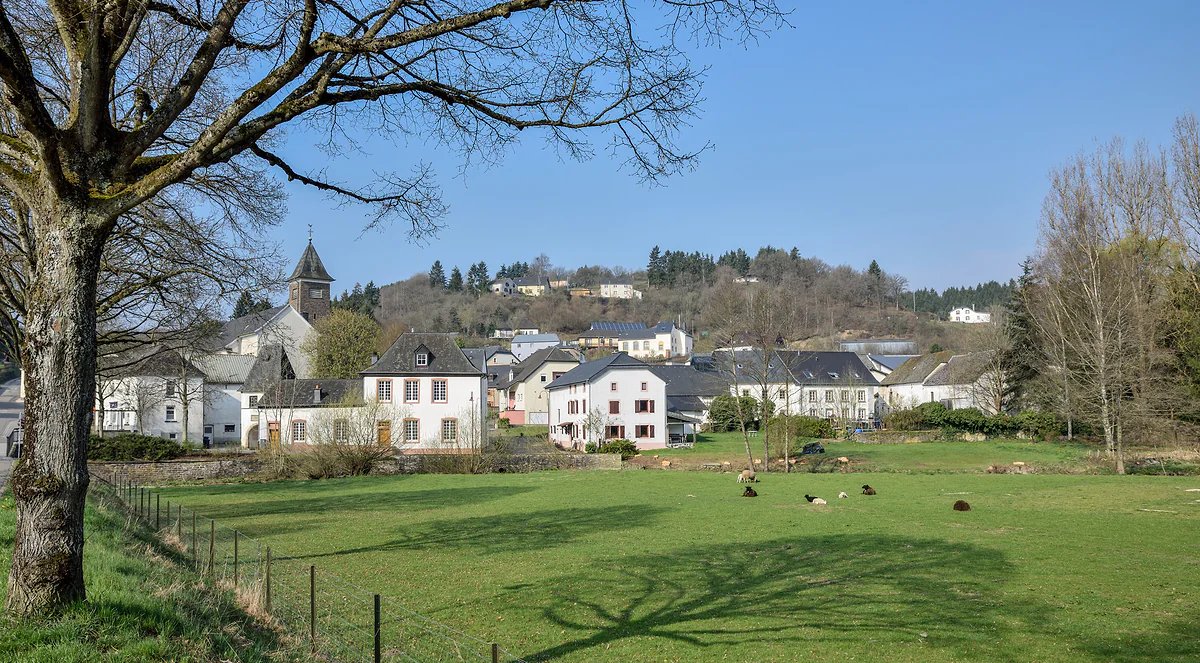
Kiischpelt commune, canton of Wiltz
Kautenbach, the railway village where the Wiltz meets the Clerve
Kautenbach is a village in the Kiischpelt commune at the confluence of the Wiltz and the Clerve. It grew between 1860 and 1880 with the Luxembourg-Liège railway and the Wiltz branch, and today lives from tourism, with hotels, restaurants and a large campsite. It's the start of the Éislek Trail and the finish of the Lee Trail on the Escapardenne.
In 30 seconds
Full read: 2 min
- Kautenbach sits where the Wiltz meets the Clerve, in the Kiischpelt commune.
- It grew with the railway between 1860 and 1880 and has a station with a Wiltz branch.
- The Éislek Trail starts here and the Lee Trail ends here.
- Schuttbourg Castle is private and seen from outside only.
Kautenbach is the village I'd pick as a car-free base for walking in the north. It has a station, two long-distance trails that start or finish here and a station-to-station walk from Drauffelt. Don't come for monuments; come with boots.

Before you go
What I would keep in mind
-
01 Getting there
Trains to Liège and to Wiltz
Kautenbach is on the northern line and the branch to Wiltz starts here. The commune points out that fast Liège-Luxembourg trains stop. In October 2026 two weekends have replacement buses.
Wiltz -
02 My tip
A station-to-station walk
CFL hiking trail 4 links Drauffelt and Kautenbach over 16.13 km, about 4 hours 50 minutes. Walk one way and ride back, free in second class.
-
03 Most beautiful
Schuttbourg above the Clerve
Upstream stands Schuttbourg Castle, on a slate spur. It's private and can't be visited, but you get a good view from the footpaths.
castles in Luxembourg
Kautenbach is a small village with a big advantage for car-free travellers. It sits exactly where the River Wiltz meets the Clerve, in the Kiischpelt commune, and it has a station on the northern line. That’s why two of the Ardennes’ great walking routes start or finish here.
A village the railway made
The commune says Kautenbach lived from farming and from bark-stripping hedges until the Luxembourg-Liège line and the Kautenbach-Wiltz branch arrived between 1860 and 1880. The station brought jobs and the population rose to around 300. In 1914 it replaced Alscheid as the commune’s seat. The Battle of the Bulge hit it hard, and the rebuilding pointed it towards tourism, with hotels, restaurants and a large campsite by the Clerve.
According to the commune, the fast Liège-Luxembourg trains still stop here, which matters if you’re arriving from Belgium rather than via Luxembourg City, and this is where the branch to Wiltz begins. Second-class travel is free within Luxembourg. Because of engineering works, CFL runs buses instead of trains between Ettelbruck, Kautenbach, Wiltz and Gouvy on Saturday 10 and Sunday 11 October 2026, and again on the 17th and 18th.
Mile zero of the Escapardenne
The Éislek Trail starts here, 106 km in five stages to La Roche-en-Ardenne in Belgium, about 50 of them in Luxembourg. The first stage runs 24 km to Clervaux. And the Lee Trail finishes here, arriving from Ettelbruck over about 55 km in three stages, the last one 15 km from Hoscheid. Together they make up the Escapardenne trail, and the government portal warns that both need hiking experience.
For something shorter, visitluxembourg suggests CFL trail 4, station to station between Drauffelt and Kautenbach, 16.13 km and about 4 hours 50 minutes. The commune also mentions cycle paths towards Wiltz and Wilwerwiltz.
Once your dates are set, check which hotels are still free in Clervaux before prices climb.
Schuttbourg, a castle to admire
Upstream, on a narrow slate spur above the Clerve, stands Schuttbourg Castle, a fortress plus a Renaissance house. visitluxembourg dates its origins to the 15th century, while the commune speaks of 13th-century foundations. It’s in private hands and closed to visitors, so enjoy it from the footpaths. For castles you can actually walk into, see the full list of castles in Luxembourg.
How I’d plan it
The idea behind the CFL trails is simple. You walk from one station to another and ride back, with no car to collect. I’d sleep in Kautenbach, walk the first Éislek Trail stage to Clervaux and take the train back the same afternoon. If you’ve done station-to-station walks in the Peak District or along the Settle-Carlisle line, it’s the same logic. The commune boasts of viewpoints along all its walks, and with two rivers and two deep valleys meeting here, the claim sounds believable.
Once your dates are set, check which hotels are still free in Clervaux before prices climb.
Where to stay
The commune mentions hotels and a large campsite in Kautenbach, and STATEC counted one hotel and three campsites across Kiischpelt in 2025. For a night with more options, Clervaux lies at the end of the Éislek Trail’s first stage.
If you would rather have a local show you round, book a guided tour in Clervaux and choose by the reviews.
A car frees you from timetables: search car hire in Luxembourg on DiscoverCars and compare companies.
So you do not pay over the odds, look at trains, coaches and flights to Luxembourg on Omio and pick the one that suits you.
Kautenbach for walkers
| Route | Distance | Note |
|---|---|---|
| Éislek Trail (Escapardenne) | 106 km in 5 stages | Leaves Kautenbach for Clervaux (24 km) |
| Lee Trail (Escapardenne) | About 55 km in 3 stages | Finishes in Kautenbach from Hoscheid (15 km) |
| CFL trail 4, Drauffelt-Kautenbach | 16.13 km | About 4h50, station to station |
visitluxembourg and luxembourg.public.lu, checked on 29 and 30 September 2026.
Test yourself
True or false?
0/3 Pick before you peek.
-
Kautenbach grew thanks to the railway.
See the answer
True. According to the commune it took off between 1860 and 1880 with the Luxembourg-Liège and Kautenbach-Wiltz lines, and the station pushed its population to around 300.
-
Schuttbourg Castle opens to visitors in summer.
See the answer
False. It's privately owned and can't be visited at any time of year. You can only see it from outside.
-
The Lee Trail finishes in Kautenbach.
See the answer
True. The Lee Trail runs from Ettelbruck to Kautenbach in three stages, the last one 15 km from Hoscheid.
- Became the commune's seat
- 1914
- Residents it reached thanks to the railway
- 300
- First Éislek Trail stage, to Clervaux
- 24 km
- CFL trail 4 from Drauffelt
- 16.13 km
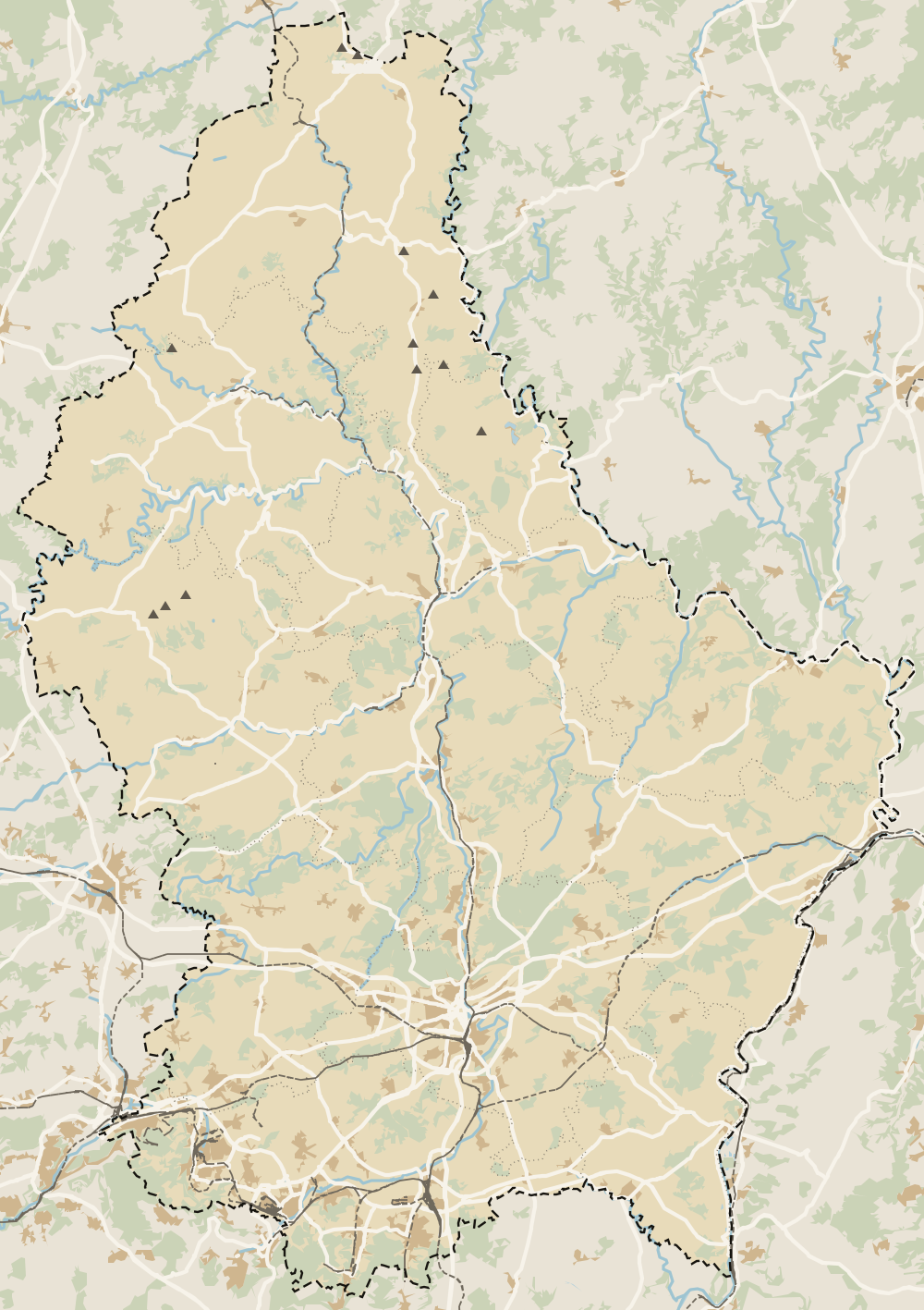
Map
Where Kautenbach is
The thick dashed line is the border with Belgium, France and Germany, and the fine ones divide the twelve cantons. The Éislek lies to the north and the Moselle to the east. Every number opens its guide.
0 of 425 Luxembourg guides
Your next stamp
- Escapardenne
- Kiischpelt
- Éislek
- Wiltz
- Hollenfels
- Ettelbruck
- A Possen Museum
- American Cemetery
- Ansembourg
- Ansembourg Castles
- Asselborn
- Bascharage
- Beaufort castles
- Belval
- Belval blast furnaces
- Berg Castle
- Bernard-Massard cellars
- Bourglinster Castle
- Bourscheid Castle
- Brandenbourg
- Brandenbourg Castle
- Caves St Martin
- Christmas
- Clervaux Castle
- Echternach
- Echternach Abbey
- Ehnen
- Ehnen Wine Museum
- Esch-sur-Alzette
- Esch-sur-Sûre Castle
- European Museum Schengen
- Fond-de-Gras
- General Patton Museum
- German war cemetery
- Haff Réimech
- Hohllay
- Hollenfels Castle
- Hosingen
- Kneiff
- Koerich Castle
- Larochette Castle
- Lasauvage
- Mersch Castle
- Military History Museum
- Moersdorf
- Mondorf Domaine Thermal
- Munsbach Castle
- National Mining Museum
- Parc Merveilleux
- Park Sënnesräich
- Places to visit
- Remich
- Rindschleiden
- Schiessentümpel
- Septfontaines Castle
- Slate Museum
- Stolzembourg
- Tudor Museum
- Useldange Castle
- Valley of the Seven Castles
- Vianden
- Vianden Castle
- Ville Haute
- Wasserbillig Aquarium
- Weiswampach lakes
- Wiltz Castle
- Ahn
- Berdorf
- Bourscheid-Plage
- Butterfly garden
- Clervaux
- Differdange
- Echternach lake
- Grevenmacher
- Heringer Millen
- Luxembourg City
- Luxembourg Science Center
- Meysembourg Castle
- Mullerthal
- National Day
- National Resistance Museum
- Perekop
- Remerschen
- Schoenfels Castle
- The Family of Man
- Things to do
- Upper Sûre Lake
- Vianden chairlift
- Wasserbillig
- Clervaux Abbey
- Echternach Roman villa
- Insenborn
- Kallektuffquell
- Machtum
- Most beautiful places
- Our Nature Park
- Pétange
- Pettingen Castle
- Schueberfouer
- Schwebsingen
- Victor Hugo House
- Waldbillig
- Dudelange
- Kuelscheier
- Lultzhausen
- Moselle Valley
- Octave
- Prettiest villages
- Sanem
- Schengen
- Wellenstein
- Wolfsschlucht
- Beaufort
- Bech-Kleinmacher
- Éimaischen
- Gaalgebierg
- Guttland
- Marnach
- Mondorf-les-Bains
- Putscheid
- Schifflange
- UNESCO World Heritage
- Carnival
- Consdorf
- Ellergronn
- Käerjeng
- Kayl
- Map
- Minett
- Munshausen
- Tandel
- Bech
- Buergbrennen
- Esch-sur-Sûre
- Rumelange
- Where is Luxembourg
- Is it a country?
- Lac de la Haute-Sûre (commune)
- Rosport-Mompach
- Wormeldange
- Larochette
- Mondercange
- Regions
- Bettembourg
- Bock Casemates
- Cantons
- Dancing procession
- Diekirch
- Fischbach
- Garnich
- Mersch
- Moselle wine route
- Grund
- Heffingen
- Kehlen
- Lintgen
- Moselle river cruises
- Pétrusse Casemates
- Towns and villages
- Chemin de la Corniche
- Erpeldange-sur-Sûre
- Junglinster
- Kopstal
- Lorentzweiler
- Nommern
- Pfaffenthal
- Population
- Bissen
- Clausen
- Grand Ducal Palace
- Koerich
- Schieren
- Size
- Vallée de l'Ernz
- Feulen
- Kirchberg
- Languages
- Notre-Dame Cathedral
- Reisdorf
- Steinfort
- Bettendorf
- Habscht
- St Michael's Church
- Helperknapp
- Luxembourgish
- Place Guillaume II
- Name
- Place d'Armes
- History
- Place de la Constitution
- Grand Duke
- Colmar-Berg
- Flaxweiler
- Gare
- Hamm
- Kirchberg funicular
- Luxembourg fortress
- Mamer
- Mertert
- Minett Trail
- Mullerthal Trail
- Neumünster Abbey
- Parc Hosingen
- Pfaffenthal lift
- Political system
- Redange
- The Passerelle
- Wine festivals
- Winseler
- Beckerich
- Biwer
- EU institutions
- Goesdorf
- Limpertsberg
- Mudam
- Natur Musée
- Pulvermühl
- Stadtbredimus
- Troisvierges
- Wenzel walk
- Bonnevoie
- Bous-Waldbredimus
- Ell
- Flag
- Manternach
- Philharmonie
- Vauban circuit
- Weiswampach
- Betzdorf
- Boulaide
- Dräi Eechelen Museum
- Facts
- Hollerich
- Lenningen
- Useldange
- Wincrange
- Bourscheid
- Dalheim
- Gasperich
- Public holidays
- Red Bridge
- Saeul
- Belair
- Second World War
- Vichten
- Battle of the Bulge
- Merl
- Préizerdaul
- Cents
- EU and Schengen
- Groussbus-Wal
- Entry requirements
- Neudorf
- Rambrouch
- Currency and payments
- Mertzig
- Weimerskirch
- Adolphe Bridge
- Beggen
- How to get there
- International March of Diekirch
- MNHA (National Museum)
- Rock climbing
- Sandweiler
- Bridges
- Eich
- Flights
- Golf
- Hesperange
- Lëtzebuerg City Museum
- Canoeing and kayaking
- Dommeldange
- Luxembourg airport
- Strassen
- Villa Vauban
- Airport to city centre
- Bertrange
- Casino Luxembourg
- Mühlenbach
- Swimming pools
- From Brussels
- Pétrusse Valley
- Rollingergrund
- Walferdange
- Cessange
- Day trip from Brussels
- Municipal Park
- Steinsel
- Free walking tours
- From Paris
- Niederanven
- From Frankfurt
- Schuttrange
- Sightseeing train and bus
- By train
- Contern
- By coach
- Weiler-la-Tour
- Driving
- Luxembourg in one day
- Pretzel Sunday
- Rham Plateau
- Tour de Luxembourg
- Candlemas (Liichtmëssdag)
- Car hire
- Luxembourg in two days
- Saint-Esprit Plateau
- Luxembourg in three days
- Melusina statue
- Parking
- St Nicholas Day (Kleeschen)
- Fête de la Musique
- Luxembourg in four days
- Museums in Luxembourg
- Petrol
- Place de Clairefontaine
- A week in Luxembourg
- Getting around
- Luxembourg Marathon
- Tram and Bus Museum
- Free public transport
- Parks in Luxembourg City
- Road trip
- Belgium and Luxembourg
- Tram
- Buses
- Viewpoints
- Trains
- Luxembourg station
- Cycling
- LuxembourgPass
- Prices and budget
- On a budget
- Free things to do
- Mobile and roaming
- Healthcare
- Safety
- Scams
- Tourist information
- Packing list
- Swimming lakes
- With a dog
- Markets
- Tipping
- Shopping
- What to buy
- Shopping centres
- With kids
- For couples
- Playgrounds
- Adventure parks
- Nightlife
- Castles
- Theatres and concert venues
- Leudelange
- Nature parks
- Where to stay
- City-centre hotels
- Hiking
- Nature reserves
- Reckange-sur-Mess
- Hotels near the station
- Roeser
- Frisange
- Hotels in Kirchberg
- Airport hotels
- Dippach
- Hotels in Vianden
- Hotels in Echternach
- Hotels in Clervaux
- Hotels in Mondorf-les-Bains
- Hotels in Esch-sur-Alzette
- Hotels on the Moselle
- Mullerthal hotels
- Upper Sûre lake hotels
- Hotels in Diekirch and Ettelbruck
- Cheap hotels
- Luxury hotels
- Boutique hotels
- Spa hotels
- Family hotels
- Apartments
- Weather
- Youth hostels
- Best time to visit
- Campsites
- Holiday cottages
- In winter
- Castle hotels
- In spring
- Day trips
- In summer
- Around Luxembourg
- In autumn
- Ice skating
- Trier day trip
- Metz day trip
- Arlon day trip
- In January
- In February
- In March
- In April
- In May
- In June
- In July
- In August
- In September
- Food
- In October
- In November
- Where to eat
- In December
- Michelin restaurants
- Cheap eats
- Judd mat Gaardebounen
- Bouneschlupp
- Gromperekichelcher
- Kniddelen
- Quetschentaart
- Rieslingspaschtéit
- Events
- Wine
- Crémant
- Beer
Frequently asked questions
Where is Kautenbach?
In northern Luxembourg, in the Kiischpelt commune in the canton of Wiltz, right where the River Wiltz joins the Clerve.
How do I get to Kautenbach by train?
It has a station on CFL's northern line, and the Wiltz branch starts here. Second-class travel inside Luxembourg is free. On 10-11 and 17-18 October 2026 buses replace trains.
Which trail starts in Kautenbach?
The Escapardenne Éislek Trail, 106 km in five stages to La Roche-en-Ardenne in Belgium. The first stage runs 24 km to Clervaux. The Lee Trail from Ettelbruck also finishes here.
Can you visit Schuttbourg Castle?
No. It's privately owned and can only be seen from outside. It combines a fortress and a Renaissance house on a slate spur above the Clerve.
Is there a campsite in Kautenbach?
Yes. The Kiischpelt commune mentions a large campsite on the banks of the Clerve, plus hotels and restaurants. STATEC counted three campsites and one hotel across the whole commune in 2025.
By
Tourism graduate with a master’s in Tourism Management and Planning from the University of Málaga, who has travelled across Europe. He writes every guide from official sources and his own judgement.
Published on . Facts checked on .
Sources
Some links in this guide are affiliate links: if you book through them, the site earns a commission at no extra cost to you. Affiliate disclosure
Photos: Cayambe (CC BY-SA 4.0), via Wikimedia Commons.