Luxembourgish food
Bouneschlupp, the green bean soup that sees Luxembourg through winter
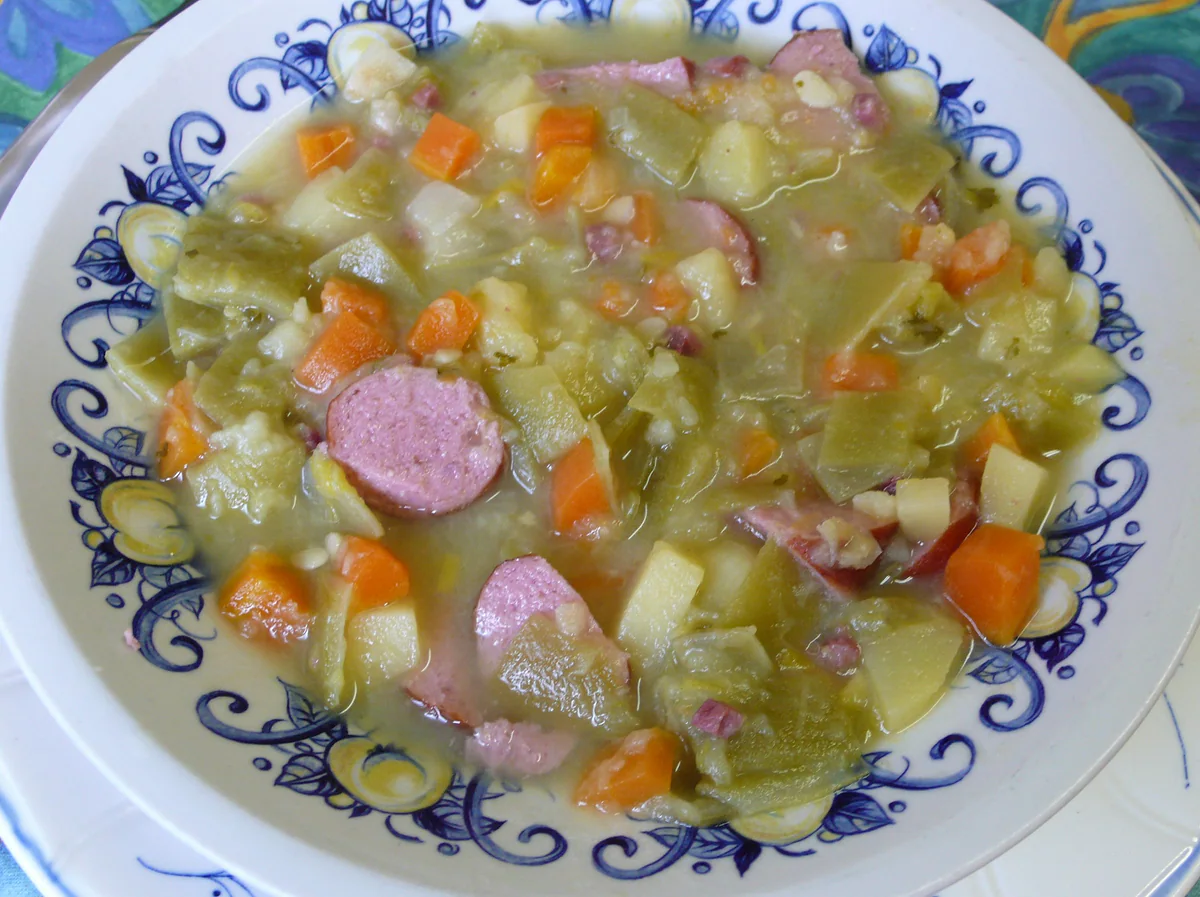
Bouneschlupp is Luxembourg's green bean soup. The country's official portal describes it with carrots, onions, leeks, celery, potatoes, milk or cream and smoked bacon, and many cooks add slices of Mettwurscht, a smoked sausage. It's a winter dish and is also served at the Buergbrennen bonfires at the end of carnival.
In 30 seconds
Full read: 3 min
- Bouneschlupp is Luxembourg's green bean soup.
- It contains potato, vegetables and smoked bacon, and often slices of Mettwurscht.
- It's a winter dish and is served at the Buergbrennen bonfires.
- It goes with a Moselle white or a local beer.
I'd order it on a cold winter day as a starter, without worrying that it'll fill me up, because it's a spoon-and-bread sort of soup. And if my dates matched the Buergbrennen, I'd have it there by the bonfire, which is where it makes the most sense to me.

Before you go
What I would keep in mind
-
01 Most beautiful
A farmhouse soup
Luxembourg's youth hostels describe it as a farmers' dish, simple and nourishing, made from whatever the vegetable patch and larder provided.
Luxembourg food -
02 My tip
Have it by the bonfire
At the Buergbrennen, on the first Sunday after carnival, Bouneschlupp, pea soup and mulled wine are served to warm the crowds watching the bonfires burn.
Buergbrennen -
03 Worth the splurge
With Mettwurscht
The youth hostels' recipe adds slices of Mettwurscht, a smoked sausage, for the last five minutes and finishes each bowl with a spoonful of crème fraîche.
-
04 Getting there
The natural partner to Judd
It shares Judd mat Gaardebounen's mix of garden beans and smoked pork. If you like one, you'll almost certainly like the other.
Judd mat Gaardebounen
What I would book
Bouneschlupp is one of those dishes that looks like very little on a menu and turns into the best thing you eat all day once the weather turns cold. It’s a green bean soup, nothing grander, and it has everything I like about Luxembourgish cooking, garden produce, a bit of smoked pork and no interest whatsoever in showing off. Here’s what goes in it, when it makes sense and where I’d have it.
What is Bouneschlupp?
The country’s official portal includes it in its list of typical dishes and describes it as a green bean soup to which carrots, onions, leeks, celery, potatoes, milk or cream and smoked bacon can be added. That list of optional extras says a lot, because there’s no single version. Every household makes it with what’s to hand, and the recipe shifts from kitchen to kitchen.
The recipe on the Luxembourg Youth Hostels blog, which I’m using as a secondary reference, starts with 500 grams of green beans, or half green and half flat beans, plus diced potato, onion, bacon and vegetable stock, and finishes with slices of Mettwurscht, a smoked sausage, and a spoonful of crème fraîche. Think of a thick, smoky bean broth rather than a smooth soup.
A soup with farmhouse roots
The youth hostels present it as a farmers’ dish, simple and nourishing, made with local ingredients. That fits what the official portal says about Luxembourgish cooking in general, food tied to the land, hearty and designed to feed a mostly rural population for centuries. It also features in Ketty Thull’s recipe book, whose 2011 edition lists it with Judd mat Gaardebounen and Kniddelen among the classics worth rediscovering season by season.
For me the appeal lies in the balance. The green beans bring freshness, the potato thickens, the bacon and sausage add smokiness and the cream rounds it off. It isn’t a refined velouté, it’s a chunky soup you eat with bread.
If you are staying the night, see the best hotel deals in Luxembourg for your dates: the well-placed rooms go fast.
When do people eat it?
Mostly in winter. The youth hostels call it the perfect dish for frosty days, and the official portal lists it among the food served at the Buergbrennen, the bonfire festival held on the first Sunday after carnival, alongside Ierzebulli, a pea soup, and mulled wine. If you’re travelling then, having it by the fire is the best way to try it.
The official portal paints the scene well. Every village builds its own Buerg, a huge pyre of straw, branches and last Christmas’s trees, usually put together by youth associations, and lights it at nightfall to drive the winter away, often after a torchlit procession. In some villages, the portal adds, the honour of lighting it goes to the most recently married couple or to a local figure. Around it there’s food on the grill, the soup and the mulled wine, and the party carries on long after the fire has burnt down to embers. More on the festival in Buergbrennen.
Where I’d order it
In a traditional bistro, in winter, as a starter. I can’t give you a list of restaurants with Bouneschlupp on the menu because no official source publishes one, and the offer changes with the season. What I’d do is look for it on the board or the menu by the door and ask whether it’s made in-house. For choosing an area and a type of place, see where to eat in Luxembourg.
To drink, the youth hostels suggest a Luxembourg white or a local beer, and both work for me. A Moselle Riesling or Auxerrois in a bistro, a local beer if it’s a quick winter lunch.
If you are staying the night, see the best hotel deals in Luxembourg for your dates: the well-placed rooms go fast.
Making it at home
Few Luxembourg recipes travel as easily to a British kitchen. Green beans and flat beans are in every supermarket, and a good smoked sausage will stand in for Mettwurscht. Fry onion and bacon, add the beans and potato to soak up the flavour, cover with vegetable stock and simmer until everything is tender. Five minutes before the end, in go the sausage slices, and a spoonful of crème fraîche on top when you serve. That gives you a winter supper that explains the country it comes from rather well, alongside the other dishes I gather in Luxembourg food.
So you do not lose the morning at the ticket office, browse tickets and tours in Luxembourg on GetYourGuide.
If you would rather go at your own pace, see the car hire deals in Luxembourg: the earlier you book, the more cars are left to choose from.
Before you fix your dates, compare tickets to Luxembourg: the same journey can cost very different amounts from one day to the next.
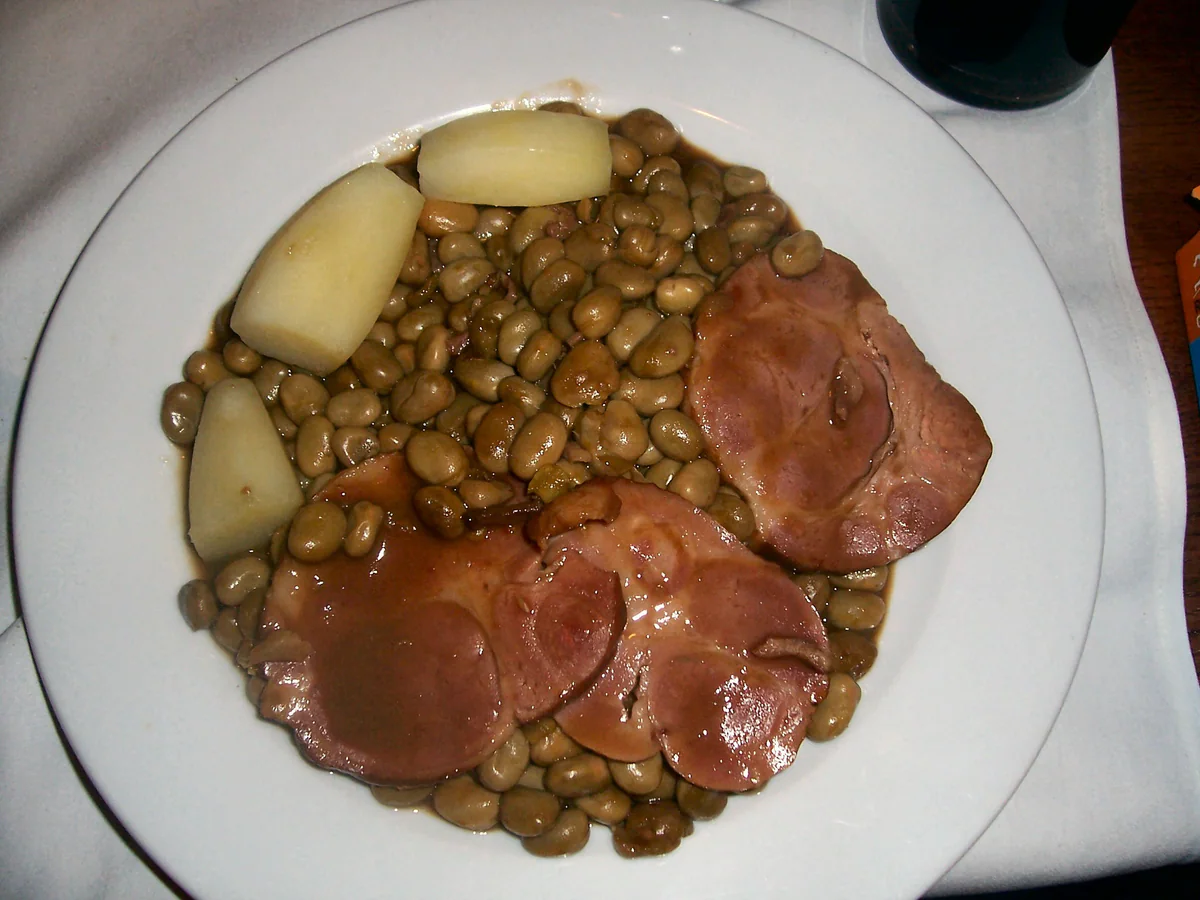
A plate of Judd mat Gaardebounen, sliced smoked pork collar with broad beans in sauce and boiled potatoes
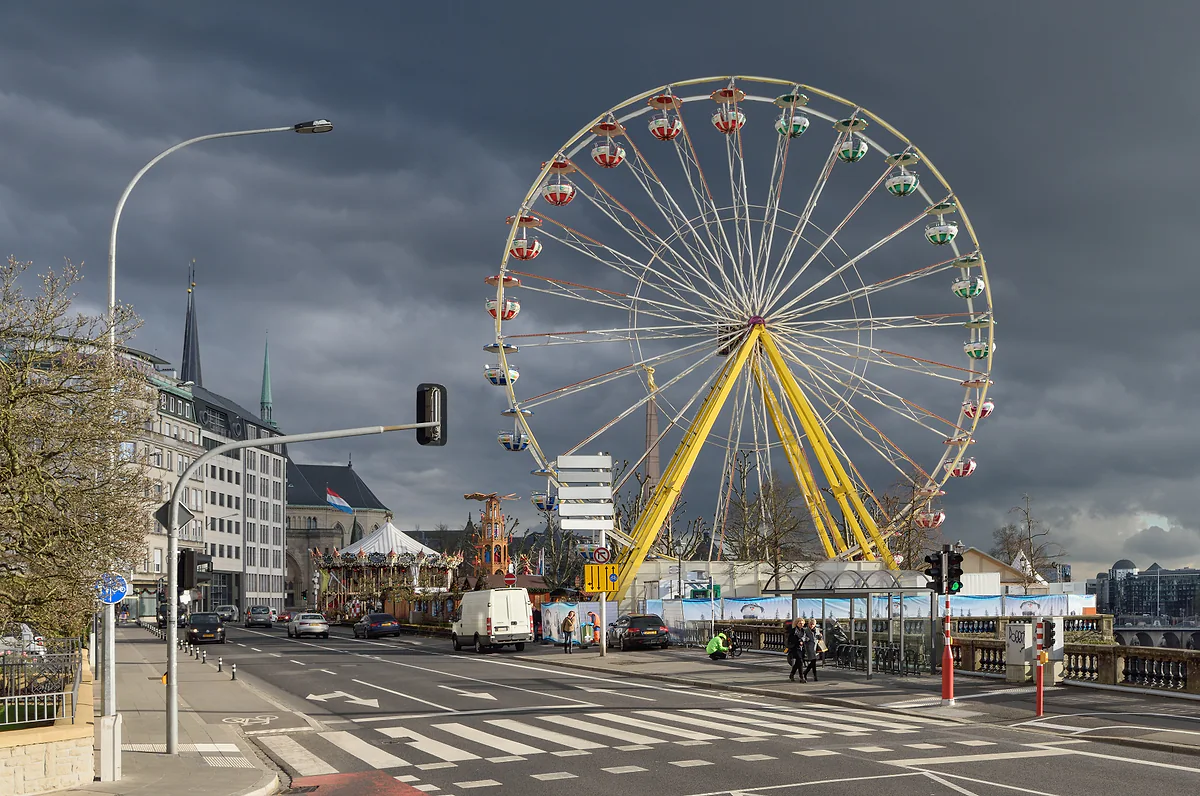
The Christmas market Ferris wheel on Place de la Constitution, with stalls and a grey late-November sky
What goes into Bouneschlupp
| Ingredient | What the sources say |
|---|---|
| Green beans | The base; 500 g, or 250 g green and 250 g flat (runner-style) beans |
| Potato | Diced, gives the soup body |
| Carrot, onion, leek and celery | Optional, according to the official portal |
| Smoked bacon | Fried with the onion at the start |
| Milk, cream or crème fraîche | To finish and soften |
| Mettwurscht | Smoked sausage, sliced, added near the end |
luxembourg.public.lu (definition) and the recipe on the Luxembourg Youth Hostels blog, a secondary source. Checked on 29-09-2026.
How it's made, step by step
| Step | What to do |
|---|---|
| 1 | Chop the onion, cut the beans into pieces and dice the potatoes |
| 2 | Fry the onion with the bacon |
| 3 | Add the beans and potatoes and let them take on the flavour |
| 4 | Cover with vegetable stock and simmer until everything is tender |
| 5 | Add the sliced Mettwurscht and cook for about 5 more minutes |
| 6 | Season and serve hot with a spoonful of crème fraîche |
Recipe from the Luxembourg Youth Hostels blog (youthhostels.lu), a secondary source.
Test yourself
True or false?
0/3 Pick before you peek.
-
Bouneschlupp is a green bean soup.
See the answer
True. Luxembourg's official portal defines it that way, with vegetables, potatoes and smoked bacon as possible additions.
-
Bouneschlupp is served at the Buergbrennen.
See the answer
True. The official portal says Bouneschlupp, Ierzebulli (pea soup) and mulled wine are served at the bonfires.
-
Bouneschlupp is a cold summer dish.
See the answer
False. It's a hot winter soup. The youth hostels suggest it for frosty days.
0 of 425 Luxembourg guides
Your next stamp
- Judd mat Gaardebounen
- Food
- Kniddelen
- Gromperekichelcher
- Buergbrennen
- Rieslingspaschtéit
- In winter
- Crémant
- A Possen Museum
- American Cemetery
- Ansembourg
- Ansembourg Castles
- Asselborn
- Bascharage
- Beaufort castles
- Belval
- Belval blast furnaces
- Berg Castle
- Bernard-Massard cellars
- Bourglinster Castle
- Bourscheid Castle
- Brandenbourg
- Brandenbourg Castle
- Caves St Martin
- Christmas
- Clervaux Castle
- Echternach
- Echternach Abbey
- Ehnen
- Ehnen Wine Museum
- Esch-sur-Alzette
- Esch-sur-Sûre Castle
- European Museum Schengen
- Fond-de-Gras
- General Patton Museum
- German war cemetery
- Haff Réimech
- Hohllay
- Hollenfels Castle
- Hosingen
- Kautenbach
- Kneiff
- Koerich Castle
- Larochette Castle
- Lasauvage
- Mersch Castle
- Military History Museum
- Moersdorf
- Mondorf Domaine Thermal
- Munsbach Castle
- National Mining Museum
- Parc Merveilleux
- Park Sënnesräich
- Places to visit
- Remich
- Rindschleiden
- Schiessentümpel
- Septfontaines Castle
- Slate Museum
- Stolzembourg
- Tudor Museum
- Useldange Castle
- Valley of the Seven Castles
- Vianden
- Vianden Castle
- Ville Haute
- Wasserbillig Aquarium
- Weiswampach lakes
- Wiltz Castle
- Ahn
- Berdorf
- Bourscheid-Plage
- Butterfly garden
- Clervaux
- Differdange
- Echternach lake
- Grevenmacher
- Heringer Millen
- Hollenfels
- Luxembourg City
- Luxembourg Science Center
- Meysembourg Castle
- Mullerthal
- National Day
- National Resistance Museum
- Perekop
- Remerschen
- Schoenfels Castle
- The Family of Man
- Things to do
- Upper Sûre Lake
- Vianden chairlift
- Wasserbillig
- Clervaux Abbey
- Echternach Roman villa
- Éislek
- Insenborn
- Kallektuffquell
- Machtum
- Most beautiful places
- Our Nature Park
- Pétange
- Pettingen Castle
- Schueberfouer
- Schwebsingen
- Victor Hugo House
- Waldbillig
- Dudelange
- Kuelscheier
- Lultzhausen
- Moselle Valley
- Octave
- Prettiest villages
- Sanem
- Schengen
- Wellenstein
- Wiltz
- Wolfsschlucht
- Beaufort
- Bech-Kleinmacher
- Éimaischen
- Gaalgebierg
- Guttland
- Marnach
- Mondorf-les-Bains
- Putscheid
- Schifflange
- UNESCO World Heritage
- Carnival
- Consdorf
- Ellergronn
- Käerjeng
- Kayl
- Map
- Minett
- Munshausen
- Tandel
- Bech
- Esch-sur-Sûre
- Rumelange
- Where is Luxembourg
- Is it a country?
- Lac de la Haute-Sûre (commune)
- Rosport-Mompach
- Wormeldange
- Larochette
- Mondercange
- Regions
- Bettembourg
- Bock Casemates
- Cantons
- Dancing procession
- Diekirch
- Fischbach
- Garnich
- Mersch
- Moselle wine route
- Ettelbruck
- Grund
- Heffingen
- Kehlen
- Lintgen
- Moselle river cruises
- Pétrusse Casemates
- Towns and villages
- Chemin de la Corniche
- Erpeldange-sur-Sûre
- Junglinster
- Kopstal
- Lorentzweiler
- Nommern
- Pfaffenthal
- Population
- Bissen
- Clausen
- Grand Ducal Palace
- Koerich
- Schieren
- Size
- Vallée de l'Ernz
- Feulen
- Kirchberg
- Languages
- Notre-Dame Cathedral
- Reisdorf
- Steinfort
- Bettendorf
- Habscht
- St Michael's Church
- Helperknapp
- Luxembourgish
- Place Guillaume II
- Name
- Place d'Armes
- History
- Place de la Constitution
- Grand Duke
- Colmar-Berg
- Flaxweiler
- Gare
- Hamm
- Kirchberg funicular
- Luxembourg fortress
- Mamer
- Mertert
- Minett Trail
- Mullerthal Trail
- Neumünster Abbey
- Parc Hosingen
- Pfaffenthal lift
- Political system
- Redange
- The Passerelle
- Wine festivals
- Winseler
- Beckerich
- Biwer
- EU institutions
- Goesdorf
- Limpertsberg
- Mudam
- Natur Musée
- Pulvermühl
- Stadtbredimus
- Troisvierges
- Wenzel walk
- Bonnevoie
- Bous-Waldbredimus
- Ell
- Flag
- Kiischpelt
- Manternach
- Philharmonie
- Vauban circuit
- Weiswampach
- Betzdorf
- Boulaide
- Dräi Eechelen Museum
- Facts
- Hollerich
- Lenningen
- Useldange
- Wincrange
- Bourscheid
- Dalheim
- Gasperich
- Public holidays
- Red Bridge
- Saeul
- Belair
- Second World War
- Vichten
- Battle of the Bulge
- Merl
- Préizerdaul
- Cents
- EU and Schengen
- Groussbus-Wal
- Entry requirements
- Neudorf
- Rambrouch
- Currency and payments
- Mertzig
- Weimerskirch
- Adolphe Bridge
- Beggen
- Escapardenne
- How to get there
- International March of Diekirch
- MNHA (National Museum)
- Rock climbing
- Sandweiler
- Bridges
- Eich
- Flights
- Golf
- Hesperange
- Lëtzebuerg City Museum
- Canoeing and kayaking
- Dommeldange
- Luxembourg airport
- Strassen
- Villa Vauban
- Airport to city centre
- Bertrange
- Casino Luxembourg
- Mühlenbach
- Swimming pools
- From Brussels
- Pétrusse Valley
- Rollingergrund
- Walferdange
- Cessange
- Day trip from Brussels
- Municipal Park
- Steinsel
- Free walking tours
- From Paris
- Niederanven
- From Frankfurt
- Schuttrange
- Sightseeing train and bus
- By train
- Contern
- By coach
- Weiler-la-Tour
- Driving
- Luxembourg in one day
- Pretzel Sunday
- Rham Plateau
- Tour de Luxembourg
- Candlemas (Liichtmëssdag)
- Car hire
- Luxembourg in two days
- Saint-Esprit Plateau
- Luxembourg in three days
- Melusina statue
- Parking
- St Nicholas Day (Kleeschen)
- Fête de la Musique
- Luxembourg in four days
- Museums in Luxembourg
- Petrol
- Place de Clairefontaine
- A week in Luxembourg
- Getting around
- Luxembourg Marathon
- Tram and Bus Museum
- Free public transport
- Parks in Luxembourg City
- Road trip
- Belgium and Luxembourg
- Tram
- Buses
- Viewpoints
- Trains
- Luxembourg station
- Cycling
- LuxembourgPass
- Prices and budget
- On a budget
- Free things to do
- Mobile and roaming
- Healthcare
- Safety
- Scams
- Tourist information
- Packing list
- Swimming lakes
- With a dog
- Markets
- Tipping
- Shopping
- What to buy
- Shopping centres
- With kids
- For couples
- Playgrounds
- Adventure parks
- Nightlife
- Castles
- Theatres and concert venues
- Leudelange
- Nature parks
- Where to stay
- City-centre hotels
- Hiking
- Nature reserves
- Reckange-sur-Mess
- Hotels near the station
- Roeser
- Frisange
- Hotels in Kirchberg
- Airport hotels
- Dippach
- Hotels in Vianden
- Hotels in Echternach
- Hotels in Clervaux
- Hotels in Mondorf-les-Bains
- Hotels in Esch-sur-Alzette
- Hotels on the Moselle
- Mullerthal hotels
- Upper Sûre lake hotels
- Hotels in Diekirch and Ettelbruck
- Cheap hotels
- Luxury hotels
- Boutique hotels
- Spa hotels
- Family hotels
- Apartments
- Weather
- Youth hostels
- Best time to visit
- Campsites
- Holiday cottages
- Castle hotels
- In spring
- Day trips
- In summer
- Around Luxembourg
- In autumn
- Ice skating
- Trier day trip
- Metz day trip
- Arlon day trip
- In January
- In February
- In March
- In April
- In May
- In June
- In July
- In August
- In September
- In October
- In November
- Where to eat
- In December
- Michelin restaurants
- Cheap eats
- Quetschentaart
- Events
- Wine
- Beer
Frequently asked questions
What is Bouneschlupp?
A green bean soup typical of Luxembourg. The official portal says carrots, onions, leeks, celery, potatoes, milk or cream and smoked bacon can all be added.
When do people eat Bouneschlupp?
Mainly in winter. The youth hostels suggest it for frosty days, and the official portal lists it among the food served at the Buergbrennen bonfires at the end of winter.
What's the difference between Bouneschlupp and Judd mat Gaardebounen?
Bouneschlupp is a green bean soup with bacon; Judd mat Gaardebounen is smoked pork collar with broad beans in sauce. Both combine beans and smoked pork, but one is a soup and the other a main course.
What is the Mettwurscht in the soup?
A smoked sausage that many recipes add in slices at the end. The youth hostels' version cooks it in the soup for about five minutes before serving.
Where can I try Bouneschlupp in Luxembourg?
In traditional bistros in winter and at the season's local festivals, especially the Buergbrennen bonfires, where the official portal says it's served to warm people up.
Is Bouneschlupp easy to make in the UK?
Very. Green beans and runner-style flat beans are easy to find, and a good smoked sausage will stand in for Mettwurscht if you can't get the real thing.
By
Tourism graduate with a master’s in Tourism Management and Planning from the University of Málaga, who has travelled across Europe. He writes every guide from official sources and his own judgement.
Published on . Facts checked on .
Sources
Some links in this guide are affiliate links: if you book through them, the site earns a commission at no extra cost to you. Affiliate disclosure
Photos: SITCK (CC BY-SA 3.0); UnorthodoxY (CC BY-SA 2.0); Cayambe (CC BY-SA 4.0), via Wikimedia Commons.