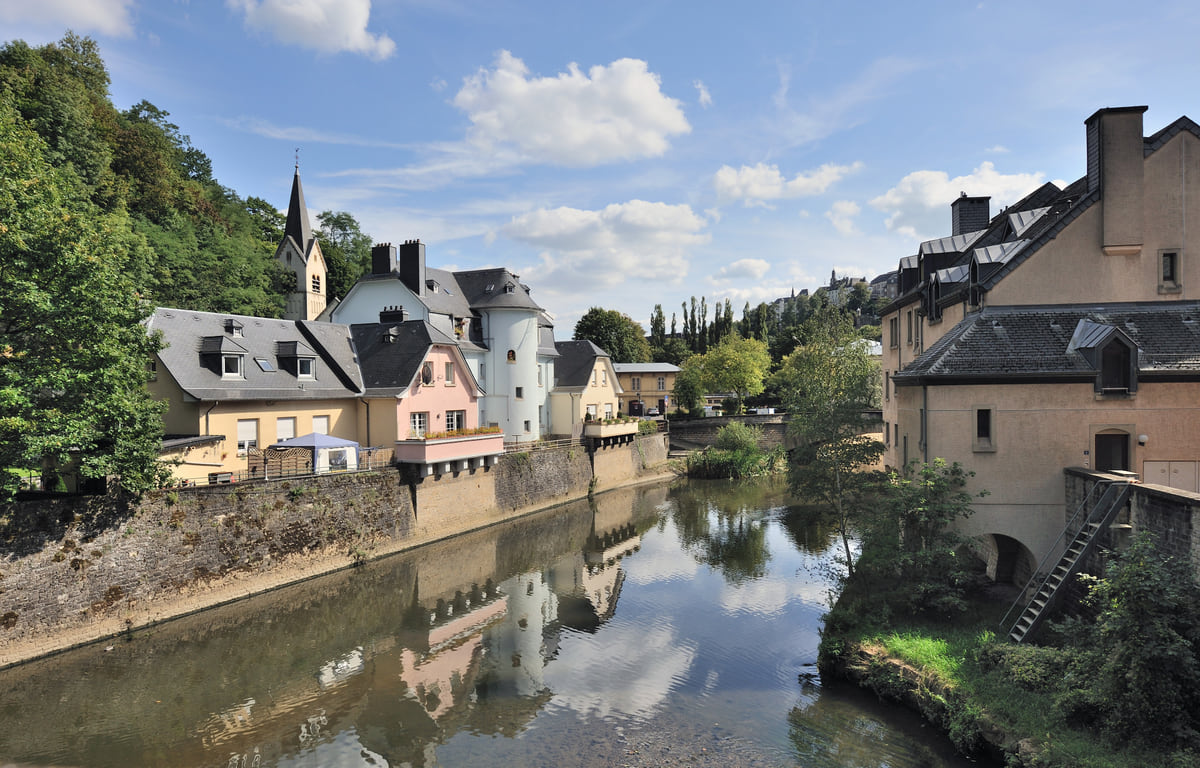
Luxembourg City district in the Alzette valley
Pfaffenthal, the old trades valley under the Red Bridge

- Area
- 37.52 ha
- Residents
- 1,330 (31-12-2023)
Map
Where Pfaffenthal is
The thick dashed line is the border with Belgium, France and Germany, and the fine ones divide the twelve cantons. The Éislek lies to the north and the Moselle to the east. Every number opens its guide.
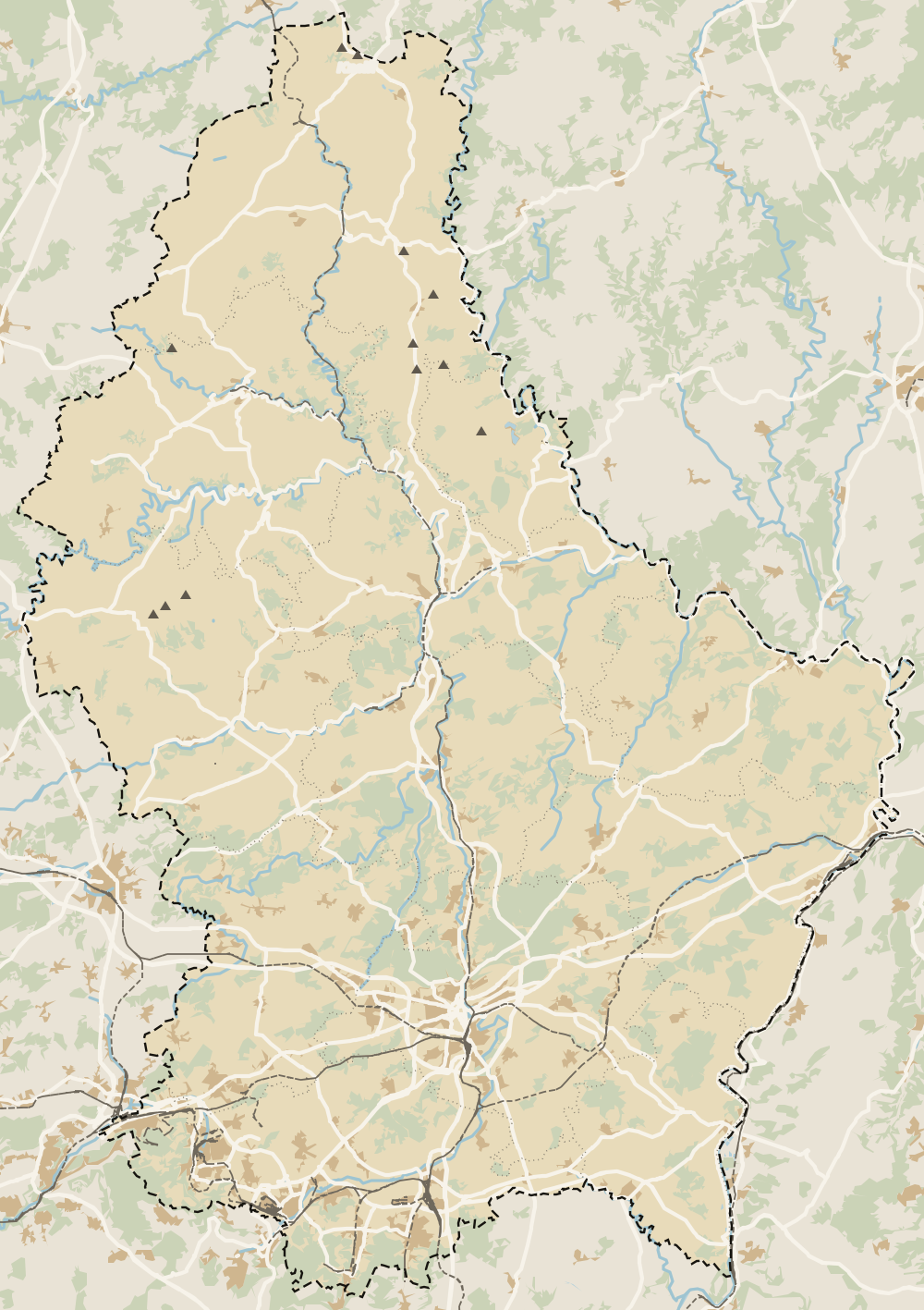 1Ville Haute 2Luxembourg City 3Grund 4Pfaffenthal 5Clausen 6Kirchberg 7Gare 8Hamm 9Luxembourg fortress 10Limpertsberg 11Pulvermühl 12Bonnevoie 13Hollerich 14Gasperich 15Belair 16Merl 17Cents 18Neudorf 19Weimerskirch 20Beggen 21Eich 22Dommeldange 23Mühlenbach 24Pétrusse Valley 25Rollingergrund 26Cessange 27Rham Plateau 28Tram and Bus Museum
Map data © OpenStreetMap contributors (ODbL)
- 1Ville HauteA district of Luxembourg City
- 2Luxembourg CityCapital of the Grand Duchy
- 3GrundLuxembourg City district on the Alzette
- 4PfaffenthalLuxembourg City district in the Alzette valley
- 5ClausenLuxembourg City district in the Alzette valley
- 6KirchbergLuxembourg City's European and business district
- 7GareLuxembourg City district south of the Pétrusse
- 8HammDistrict on the eastern side of Luxembourg City
- 9Luxembourg fortressUNESCO World Heritage since 1994
- 10LimpertsbergLuxembourg City district north of the Ville Haute
- 11PulvermühlLuxembourg City's smallest district
- 12BonnevoieBonnevoie-Nord / Verlorenkost and Bonnevoie-Sud
- 13HollerichLuxembourg City district west of the Gare
- 14GasperichDistrict in the south of Luxembourg City
- 15BelairResidential district west of the Ville Haute
- 16MerlResidential district on the capital's west side
- 17CentsResidential district east of the city centre
- 18NeudorfAlzette valley district below Kirchberg
- 19WeimerskirchNorthern district on the Alzette valley slope
- 20BeggenDistrict at the northern tip of the capital
- 21EichNorthern district in the Alzette valley
- 22DommeldangeNorthern district with a village centre
- 23MühlenbachNorthern district on the edge of the Bambësch
- 24Pétrusse ValleyPark and walk between the old town and the Gare
- 25RollingergrundNorth-west district, including Belair-Nord
- 26CessangeSouth-west district of the capital
- 27Rham PlateauLuxembourg City fortifications
- 28Tram and Bus MuseumMuseum in Hollerich
Pfaffenthal is the Luxembourg City district on the floor of the Alzette valley, about 60 metres below the upper town and north of the Grund. The free panoramic lift from Pescatore Park drops you in, running 5:45 to 1:00, and a funicular climbs to Kirchberg on the far side. Down there are the Vauban towers, the Muerbelsmillen mill and the Red Bridge overhead.
I'd go down to Pfaffenthal in the glass lift and leave by the funicular, never retracing a step. It's the cheapest way to see three levels of the city, and it's done in half an hour.
Before you go
Before you go to Pfaffenthal, this
-
01 To save money
A free lift with a view
The panoramic lift links Pescatore Park in the upper town with rue du Pont in 30 seconds. It runs daily from 05:45 to 01:00 and is free for walkers and cyclists.
Pfaffenthal lift -
02 Most beautiful
The Vauban towers and the Béinchen
Two sturdy towers close off the valley, joined by a small three-arched bridge, the Béinchen, built in 1684-1685 to Vauban's design. Both are part of the World Heritage Site.
-
03 My tip
A free cinema inside a tower
The Bons-Malades gate houses a tiny screening room showing a free film on the district's history, every day from 10:00 to 18:00, according to the tourist office.
-
04 Getting there
Valley to Kirchberg in 63 seconds
Pfaffenthal-Kirchberg railway station sits at the foot of the Red Bridge, and from there the funicular climbs 40 m to the Kirchberg tram. All of it free.
Kirchberg funicular -
05 My tip
The lift shuts one Monday a month
On the first Monday of each month the lift is out of service from 09:00 until 05:45 the next day. For the rest of 2026 the city lists 7 December.
What to see in Pfaffenthal in an hour
The most striking view in the district, according to the tourist office, is of the rock stage the upper town stands on, seen from the youth hostel terrace near Clausen. Down below, the Pfaffenthal railway viaduct, at 260 metres, is the longest of the four that cross the valley. The tourist office also suggests two walking routes, one heading north outside the old walls and one heading south within them.
For a sit-down, the city’s listing picks out Odendahl Park and the Spidolsgaart garden. They’re small neighbourhood spaces, but with the Red Bridge above them they take on an odd, almost model-village scale. If you walk the full Vauban circuit, 5.16 km according to the government’s portal, these gardens make a handy halfway stop.
Follow the river and you’re in Clausen within minutes. I’d do Pfaffenthal in the morning, with the lift and the towers, and save Clausen for the afternoon and dinner.
Getting down to Pfaffenthal and back up
Going down, the Pfaffenthal lift leaves from Pescatore Park in the upper town and reaches rue du Pont in 30 seconds. It’s free and runs daily from 05:45 to 01:00, except on the first Monday of each month from 09:00. The one closure left in 2026 falls on 7 December, according to the city.
Heading up the other side, Pfaffenthal-Kirchberg railway station sits at the foot of the Red Bridge, and from there the funicular lifts you to Kirchberg in just over a minute, with the tram waiting at the top. It’s the combination I’d use to get from the old town to Kirchberg’s museums without doubling back. Arriving by train from the central station, you can also simply get off at Pfaffenthal-Kirchberg, which is a regular CFL stop, and start the day in the valley rather than on the plateau. In second class that hop costs nothing, as with every domestic journey.
The Vauban towers and the Béinchen
When the French besieged the city, Vauban spotted that Pfaffenthal and the surrounding heights were the fortress’s weak point. In 1685 he pulled them inside the defences, strengthened the heights with two forts and sealed the valley with a wall running from Fort Berlaimont on the town side to the new Grünewald forts opposite. What survives are the two Vauban towers, named after the medieval gates they replaced, the Eich gate and the Bons-Malades gate. Further north, on the valley slope, Weimerskirch has traces the city dates back to 723.
Between them runs the Béinchen, a three-arched bridge from 1684-1685. The Bons-Malades gate also hides a tiny room showing a free film on the district’s history, open daily between 10:00 and 18:00. If this chapter grabs you, the Vauban circuit walks the whole of it.
Once your dates are set, check which hotels are still free in Luxembourg before prices climb.
One of the country’s oldest mills
The Muerbelsmillen on rue Mohrfels is recorded as early as 1083 and ranks among the oldest mills in the country. It made mustard until 1985, and today it keeps the big paddle wheel in its channel and the upstairs room where the grinding happened, gears and millstones included, with a film explaining the process. The same building houses the local residents’ association and student flats. A short visit, and unlike anything else in the capital.
The valley of water trades
Locals call it D’Dällchen, the little valley. The city’s first hospital and first maternity ward stood here, and so did the trades that needed the river, weavers, dyers, tanners, millers and laundresses. There were water carriers too, who hauled drinking water up to the upper town in wooden buckets from the Théiwesbuer spring. Back-breaking work, as the tourist office points out.
That wash-house is still there, and since 2016 it has had a Kneipp foot bath anyone can use. I like that the district has kept that thread to its past without turning it into stage scenery.
So you do not pay over the odds, look at trains, coaches and flights to Luxembourg on Omio and pick the one that suits you.
If you would rather have a local show you round, book a guided tour in Luxembourg and choose by the reviews.
A car frees you from timetables: search car hire in Luxembourg on DiscoverCars and compare companies.
Once your dates are set, check which hotels are still free in Luxembourg before prices climb.
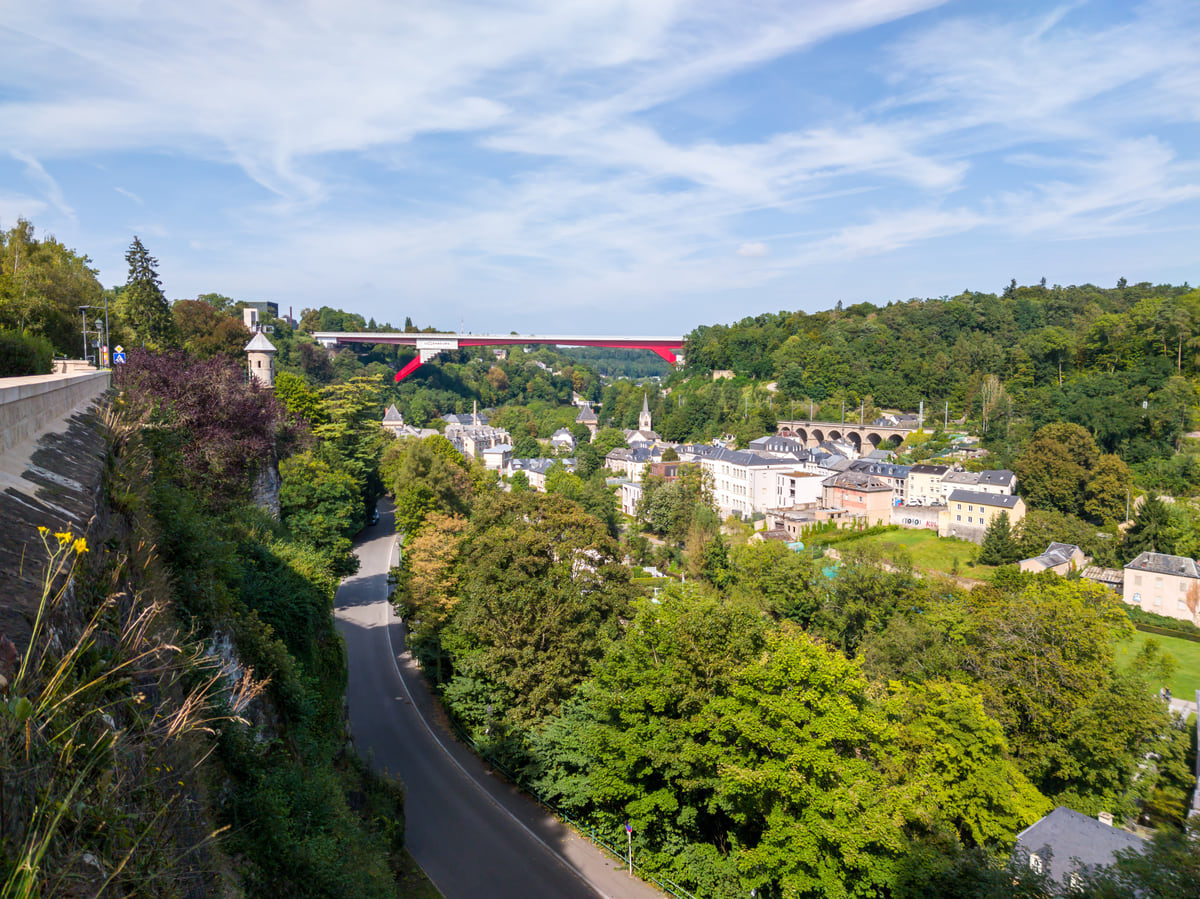
The Alzette valley at Pfaffenthal seen from the ramparts, with the red Grand Duchess Charlotte Bridge beyond
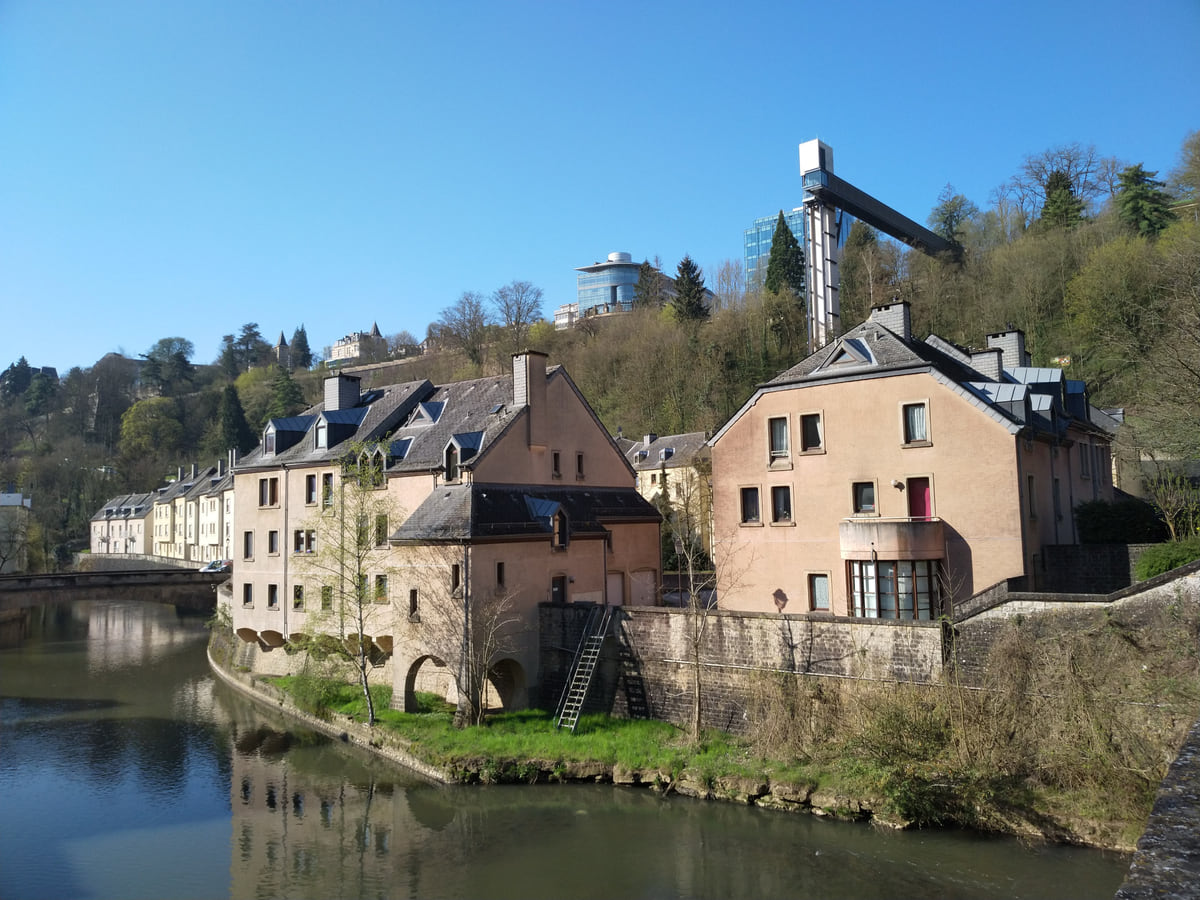
The Pfaffenthal panoramic lift on the hillside, with old houses of the quarter reflected in the Alzette
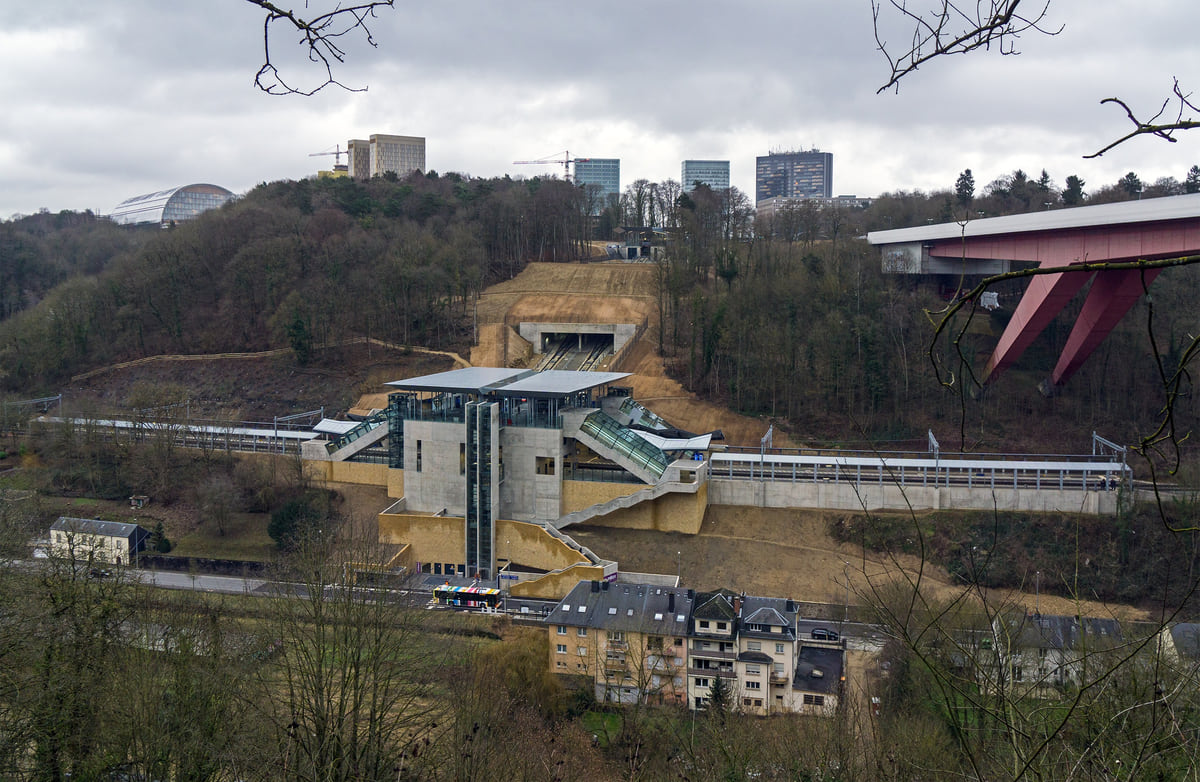
Pfaffenthal-Kirchberg station on the valley side, with the funicular track climbing towards the Kirchberg towers
What's in Pfaffenthal
| Place | What it is | Detail |
|---|---|---|
| Panoramic lift | Glass cabin from Pescatore Park | Free, 05:45 to 01:00 |
| Vauban towers | Eich and Bons-Malades gates | Brought into the fortress in 1685 |
| Béinchen | Three-arched bridge between the towers | 1684-1685 |
| Muerbelsmillen | Mill with a mustard museum | Recorded in 1083; mustard until 1985 |
| Théiwesbuer | Old wash-house | Kneipp foot bath since 2016 |
| Funicular | Pfaffenthal-Kirchberg station to Kirchberg | 63 s, 40 m climb |
Sources: City of Luxembourg and LCTO listings, checked on 29-09-2026.
Test yourself
How much do you know about Pfaffenthal?
0/3 Pick before you peek.
-
You have to pay to use the Pfaffenthal panoramic lift.
See the answer
False. It's free for walkers and cyclists, like the rest of Luxembourg's local transport, according to the tourist office and the city.
-
The Muerbelsmillen mill once made mustard.
See the answer
True. It worked as a mustard mill until 1985 and now keeps the milling machinery alongside an exhibition.
-
The Vauban towers are medieval.
See the answer
False. They're named after the medieval gates they replaced, but were brought into the fortress when Vauban strengthened it in 1685.
What to see
The Pfaffenthal guides
0 of 425 Luxembourg guides
Your next stamp
- Pfaffenthal lift
- Red Bridge
- Vauban circuit
- Rham Plateau
- Kirchberg funicular
- Habscht
- Pulvermühl
- Tram
- A Possen Museum
- American Cemetery
- Ansembourg
- Ansembourg Castles
- Asselborn
- Bascharage
- Beaufort castles
- Belval
- Belval blast furnaces
- Berg Castle
- Bernard-Massard cellars
- Bourglinster Castle
- Bourscheid Castle
- Brandenbourg
- Brandenbourg Castle
- Caves St Martin
- Christmas
- Clervaux Castle
- Echternach
- Echternach Abbey
- Ehnen
- Ehnen Wine Museum
- Esch-sur-Alzette
- Esch-sur-Sûre Castle
- European Museum Schengen
- Fond-de-Gras
- General Patton Museum
- German war cemetery
- Haff Réimech
- Hohllay
- Hollenfels Castle
- Hosingen
- Kautenbach
- Kneiff
- Koerich Castle
- Larochette Castle
- Lasauvage
- Mersch Castle
- Military History Museum
- Moersdorf
- Mondorf Domaine Thermal
- Munsbach Castle
- National Mining Museum
- Parc Merveilleux
- Park Sënnesräich
- Places to visit
- Remich
- Rindschleiden
- Schiessentümpel
- Septfontaines Castle
- Slate Museum
- Stolzembourg
- Tudor Museum
- Useldange Castle
- Valley of the Seven Castles
- Vianden
- Vianden Castle
- Ville Haute
- Wasserbillig Aquarium
- Weiswampach lakes
- Wiltz Castle
- Ahn
- Berdorf
- Bourscheid-Plage
- Butterfly garden
- Clervaux
- Differdange
- Echternach lake
- Grevenmacher
- Heringer Millen
- Hollenfels
- Luxembourg City
- Luxembourg Science Center
- Meysembourg Castle
- Mullerthal
- National Day
- National Resistance Museum
- Perekop
- Remerschen
- Schoenfels Castle
- The Family of Man
- Things to do
- Upper Sûre Lake
- Vianden chairlift
- Wasserbillig
- Clervaux Abbey
- Echternach Roman villa
- Éislek
- Insenborn
- Kallektuffquell
- Machtum
- Most beautiful places
- Our Nature Park
- Pétange
- Pettingen Castle
- Schueberfouer
- Schwebsingen
- Victor Hugo House
- Waldbillig
- Dudelange
- Kuelscheier
- Lultzhausen
- Moselle Valley
- Octave
- Prettiest villages
- Sanem
- Schengen
- Wellenstein
- Wiltz
- Wolfsschlucht
- Beaufort
- Bech-Kleinmacher
- Éimaischen
- Gaalgebierg
- Guttland
- Marnach
- Mondorf-les-Bains
- Putscheid
- Schifflange
- UNESCO World Heritage
- Carnival
- Consdorf
- Ellergronn
- Käerjeng
- Kayl
- Map
- Minett
- Munshausen
- Tandel
- Bech
- Buergbrennen
- Esch-sur-Sûre
- Rumelange
- Where is Luxembourg
- Is it a country?
- Lac de la Haute-Sûre (commune)
- Rosport-Mompach
- Wormeldange
- Larochette
- Mondercange
- Regions
- Bettembourg
- Bock Casemates
- Cantons
- Dancing procession
- Diekirch
- Fischbach
- Garnich
- Mersch
- Moselle wine route
- Ettelbruck
- Grund
- Heffingen
- Kehlen
- Lintgen
- Moselle river cruises
- Pétrusse Casemates
- Towns and villages
- Chemin de la Corniche
- Erpeldange-sur-Sûre
- Junglinster
- Kopstal
- Lorentzweiler
- Nommern
- Population
- Bissen
- Clausen
- Grand Ducal Palace
- Koerich
- Schieren
- Size
- Vallée de l'Ernz
- Feulen
- Kirchberg
- Languages
- Notre-Dame Cathedral
- Reisdorf
- Steinfort
- Bettendorf
- St Michael's Church
- Helperknapp
- Luxembourgish
- Place Guillaume II
- Name
- Place d'Armes
- History
- Place de la Constitution
- Grand Duke
- Colmar-Berg
- Flaxweiler
- Gare
- Hamm
- Luxembourg fortress
- Mamer
- Mertert
- Minett Trail
- Mullerthal Trail
- Neumünster Abbey
- Parc Hosingen
- Political system
- Redange
- The Passerelle
- Wine festivals
- Winseler
- Beckerich
- Biwer
- EU institutions
- Goesdorf
- Limpertsberg
- Mudam
- Natur Musée
- Stadtbredimus
- Troisvierges
- Wenzel walk
- Bonnevoie
- Bous-Waldbredimus
- Ell
- Flag
- Kiischpelt
- Manternach
- Philharmonie
- Weiswampach
- Betzdorf
- Boulaide
- Dräi Eechelen Museum
- Facts
- Hollerich
- Lenningen
- Useldange
- Wincrange
- Bourscheid
- Dalheim
- Gasperich
- Public holidays
- Saeul
- Belair
- Second World War
- Vichten
- Battle of the Bulge
- Merl
- Préizerdaul
- Cents
- EU and Schengen
- Groussbus-Wal
- Entry requirements
- Neudorf
- Rambrouch
- Currency and payments
- Mertzig
- Weimerskirch
- Adolphe Bridge
- Beggen
- Escapardenne
- How to get there
- International March of Diekirch
- MNHA (National Museum)
- Rock climbing
- Sandweiler
- Bridges
- Eich
- Flights
- Golf
- Hesperange
- Lëtzebuerg City Museum
- Canoeing and kayaking
- Dommeldange
- Luxembourg airport
- Strassen
- Villa Vauban
- Airport to city centre
- Bertrange
- Casino Luxembourg
- Mühlenbach
- Swimming pools
- From Brussels
- Pétrusse Valley
- Rollingergrund
- Walferdange
- Cessange
- Day trip from Brussels
- Municipal Park
- Steinsel
- Free walking tours
- From Paris
- Niederanven
- From Frankfurt
- Schuttrange
- Sightseeing train and bus
- By train
- Contern
- By coach
- Weiler-la-Tour
- Driving
- Luxembourg in one day
- Pretzel Sunday
- Tour de Luxembourg
- Candlemas (Liichtmëssdag)
- Car hire
- Luxembourg in two days
- Saint-Esprit Plateau
- Luxembourg in three days
- Melusina statue
- Parking
- St Nicholas Day (Kleeschen)
- Fête de la Musique
- Luxembourg in four days
- Museums in Luxembourg
- Petrol
- Place de Clairefontaine
- A week in Luxembourg
- Getting around
- Luxembourg Marathon
- Tram and Bus Museum
- Free public transport
- Parks in Luxembourg City
- Road trip
- Belgium and Luxembourg
- Buses
- Viewpoints
- Trains
- Luxembourg station
- Cycling
- LuxembourgPass
- Prices and budget
- On a budget
- Free things to do
- Mobile and roaming
- Healthcare
- Safety
- Scams
- Tourist information
- Packing list
- Swimming lakes
- With a dog
- Markets
- Tipping
- Shopping
- What to buy
- Shopping centres
- With kids
- For couples
- Playgrounds
- Adventure parks
- Nightlife
- Castles
- Theatres and concert venues
- Leudelange
- Nature parks
- Where to stay
- City-centre hotels
- Hiking
- Nature reserves
- Reckange-sur-Mess
- Hotels near the station
- Roeser
- Frisange
- Hotels in Kirchberg
- Airport hotels
- Dippach
- Hotels in Vianden
- Hotels in Echternach
- Hotels in Clervaux
- Hotels in Mondorf-les-Bains
- Hotels in Esch-sur-Alzette
- Hotels on the Moselle
- Mullerthal hotels
- Upper Sûre lake hotels
- Hotels in Diekirch and Ettelbruck
- Cheap hotels
- Luxury hotels
- Boutique hotels
- Spa hotels
- Family hotels
- Apartments
- Weather
- Youth hostels
- Best time to visit
- Campsites
- Holiday cottages
- In winter
- Castle hotels
- In spring
- Day trips
- In summer
- Around Luxembourg
- In autumn
- Ice skating
- Trier day trip
- Metz day trip
- Arlon day trip
- In January
- In February
- In March
- In April
- In May
- In June
- In July
- In August
- In September
- Food
- In October
- In November
- Where to eat
- In December
- Michelin restaurants
- Cheap eats
- Judd mat Gaardebounen
- Bouneschlupp
- Gromperekichelcher
- Kniddelen
- Quetschentaart
- Rieslingspaschtéit
- Events
- Wine
- Crémant
- Beer
What people ask most about Pfaffenthal
What is Pfaffenthal?
One of Luxembourg City's 24 official districts, in the Alzette valley north of the Grund. It had 1,330 residents on 31-12-2023, covers 37.52 hectares and lies in the buffer zone of the UNESCO World Heritage Site.
How do you get down to Pfaffenthal?
Take the panoramic lift, which drops from Pescatore Park in the upper town to rue du Pont in 30 seconds, free, from 05:45 to 01:00. You can also walk down the Côte d'Eich.
What is there to see in Pfaffenthal?
The Vauban towers and the Béinchen bridge, the Muerbelsmillen mill with its paddle wheel, the Théiwesbuer and the view of the Red Bridge overhead. The Vauban circuit walk runs through the district.
How far below the upper town is Pfaffenthal?
The tourist office puts it about sixty metres below the upper town. The lift covers a 60 m drop, according to the city, and the cabin gives views from 71 m up, according to the tourist office.
What do locals call Pfaffenthal?
D'Dällchen, the little valley, according to the capital's tourist office. It's an affectionate nickname for a district that has always lived from the river running through it.
Is the Pfaffenthal lift open at night?
Yes, until 01:00. It only closes on the first Monday of each month, from 09:00 until 05:45 the next day, for maintenance.

Questions about Pfaffenthal? Write to me
If you need something else to finish planning, write to me. I answer myself, no templates.
My email sergiolepone@gmail.com
By
Tourism graduate with a master’s in Tourism Management and Planning from the University of Málaga, who has travelled across Europe. He writes every guide from official sources and his own judgement.
Published on . Updated on . Facts checked on .
Sources
Some links in this guide are affiliate links: if you book through them, the site earns a commission at no extra cost to you. Affiliate disclosure
Photos: Cayambe (CC BY-SA 3.0); Matti Blume (CC BY-SA 4.0); Paul Braun (CC BY 4.0); MMFE (CC BY-SA 4.0), via Wikimedia Commons.