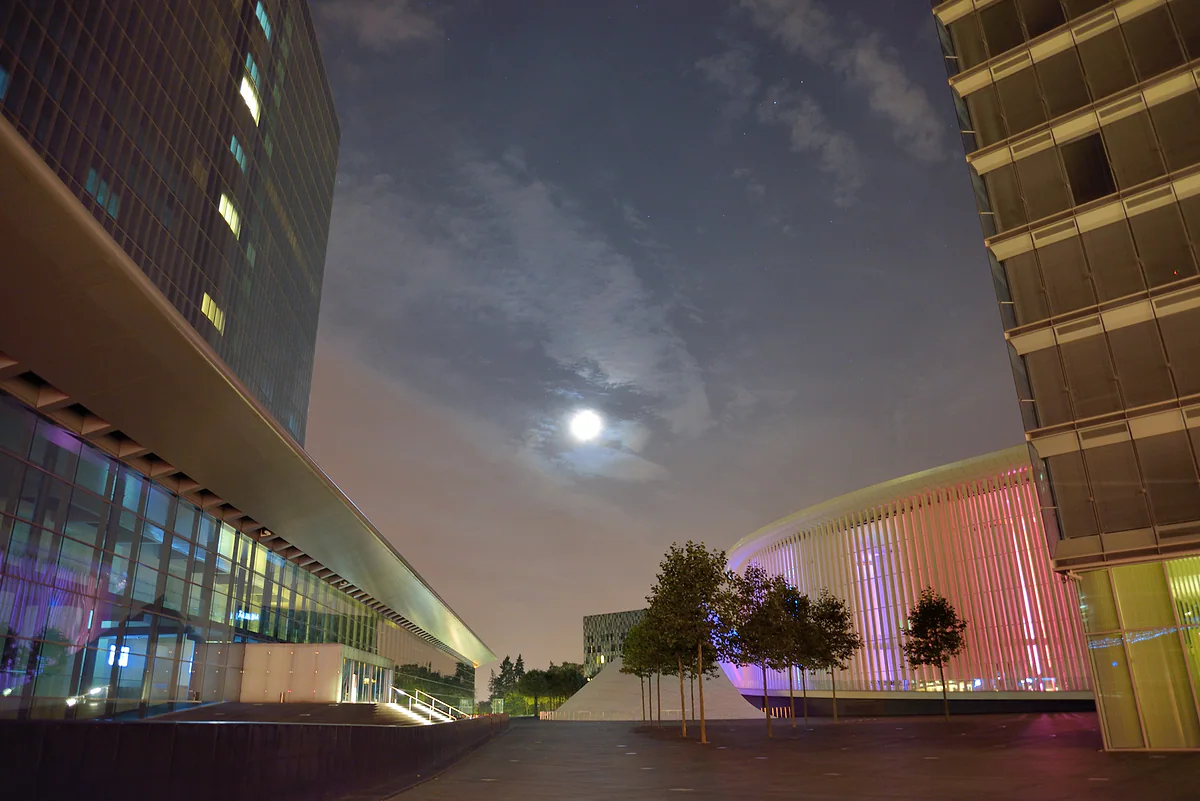
Kirchberg, the EU's third capital
Luxembourg's EU institutions, and how to get inside
Luxembourg City is one of the EU's three seats, with Brussels and Strasbourg. The Kirchberg district holds the Court of Justice, the Court of Auditors, the European Investment Bank, the European Parliament's Secretariat-General and Eurostat, among others. Anyone can sit in on a Court of Justice hearing or visit the Europa Experience, both free.
If Europe interests you, go on a Tuesday, Wednesday or Thursday and sit in on a public hearing at the Court of Justice. It's free, there's nothing to book, and you just need to turn up 15 minutes early with your passport. Then walk over to the Europa Experience, also free.

Before you go
What I would keep in mind
-
01 To save money
Watch an EU court at work, free
Court of Justice hearings are public. They're usually on Tuesdays, Wednesdays and Thursdays from 9:30, and you go in by rue Charles Léon Hammes with a passport, ID card or driving licence.
-
02 My tip
A free tour of the Court's art
The Court runs free guided tours of its art collection in English, French or German, for up to 20 people. Register at least two working days ahead through its online form.
-
03 Getting there
Free tram to the door
Tram T1 stops at Europaparlament, Philharmonie / Mudam and Coque in the heart of Kirchberg, and like all public transport in the country, it's free.
Kirchberg -
04 Worth the splurge
An after-hours guided tour
The Luxembourg City Tourist Office runs guided tours of the Court for groups of up to 20, on weekdays from 17:30 and at weekends. Book at least four weeks ahead.
What I would book
Brussels, Strasbourg and Luxembourg share the role of EU capital, and you feel it the moment you reach Kirchberg. On a plateau that was farmland barely sixty years ago now stand the Court of Justice, the European Investment Bank and a long list of offices employing more than 14,000 people. For a visitor the interesting part is that two of these places are free to visit, and one of them is a working court.
What exactly is based there
The government’s official portal lists the institutions and bodies based in the country. Top of the list come the EU’s Court of Justice and its Court of Auditors, followed by the European Investment Bank, together with its European Investment Fund and the European Parliament’s Secretariat-General. The Commission has several directorates-general there, among them Eurostat and the Publications Office, and the European Public Prosecutor’s Office has operated from Luxembourg since 1 June 2021. The Translation Centre, EuroHPC, the European Stability Mechanism and the Euratom Supply Agency complete the list, plus the EFTA Court and the Court of Appeal of the Unified Patent Court.
One detail surprises almost everyone. EU ministers don’t only meet in Brussels. The Council of the EU holds its sessions in Luxembourg in April, June and October.
Why Luxembourg of all places?
It goes back to 1952. On the night of 24 to 25 July that year it was decided to place the ECSC High Authority, the coal and steel body from which the EU grew, in Luxembourg on a provisional basis. That provisional seat was the start of everything now found in Kirchberg. There’s a neat logic to it, since Robert Schuman, whose plan led to the ECSC, was born in 1886 in the capital’s Clausen district. Where that fits in the country’s story is in history of Luxembourg.
Once your dates are set, check which hotels are still free in Luxembourg before prices climb.
Can you get into the Court of Justice?
Yes, and it’s what I’d do. Oral hearings are public. They’re generally held on Tuesdays, Wednesdays and Thursdays during the Court’s working periods, usually start at 9:30 and need no registration. Turn up at least 15 minutes early at the entrance on rue Charles Léon Hammes, go through security and show a passport, ID card or driving licence to get a visitor badge. Seating is limited and can’t be reserved. The Court’s judicial calendar online shows which cases are heard each week. Many hearings are also streamed on the Curia website and stay online for 30 days, handy if your trip doesn’t include a Tuesday to Thursday. Visitors with reduced mobility are advised to use the entrance on rue Fort Niedergrünewald, and the Court asks you to contact it in advance if you need assistance.
There are two other ways in. The Court’s visits service runs free tours of its art collection, built from works donated or lent by member states and displayed in buildings designed by Dominique Perrault. Tours run in English, French or German, for up to 20 people, and you register two working days ahead. And the Luxembourg City Tourist Office runs guided tours outside court hours, on weekdays from 17:30 and at weekends, which need booking four weeks in advance.
The Europa Experience and a walk round Kirchberg
The other place open to everyone is the Europa Experience on avenue J. F. Kennedy. It’s a free visitor centre about the EU, open six days a week, Sundays excepted, between 10:00 and 18:00, and it asks for ID. Over Christmas it shuts between 24 December 2026 and 2 January 2027.
Inside, according to visitluxembourg, there’s 2,000 m² of multimedia space, with a 360-degree cinema screening a film about Europe on a loop, interactive stations, virtual reality and a role-play in which you act as an MEP for a few hours, the last one by booking only. Everything is available in the EU’s 24 official languages, with subtitles, audio description in the cinema and step-free access. Groups of more than 16 book separately. I’d give it an hour and do it before the Court, because it hands you the map of what you’ll see outside.
Outside, Place de l’Europe is the stage for all of this. Ricardo Bofill laid it out in 2004 over what had been a car park, paved it in black and conceived it as a tribute to the institutions’ presence in the city. And at the Schuman roundabout, Robert Lentz’s 1966 monument honours the man behind the plan with three steel girders topped by six spikes, the six founding states of the Coal and Steel Community, and an excerpt from his speech of 9 May 1950 cut into the stone.
That fills a morning, and the district does the rest. The official portal notes that the country’s tallest building is the Court’s third tower, opened in September 2019, that its first skyscraper was the Alcide de Gasperi tower, in 1966, and that the Robert Schuman building’s hemicycle housed the first directly elected European Parliament in 1979. The rest of the district, with the Philharmonie and Mudam, is in Kirchberg.
Once your dates are set, check which hotels are still free in Luxembourg before prices climb.
Getting there, and what to bring
From the old town the easiest way up is tram T1, which crosses the Red Bridge and stops at Europaparlament, Philharmonie / Mudam and Coque, or the Kirchberg funicular from the Pfaffenthal. Neither costs a cent. Bring your passport, because both the Court and the Europa Experience will ask for ID. What it means for a British visitor that Luxembourg is in the EU, Schengen and the euro is summed up in is Luxembourg in the EU.
If you would rather have a local show you round, book a guided tour in Luxembourg and choose by the reviews.
A car frees you from timetables: search car hire in Luxembourg on DiscoverCars and compare companies.
So you do not pay over the odds, look at trains, coaches and flights to Luxembourg on Omio and pick the one that suits you.
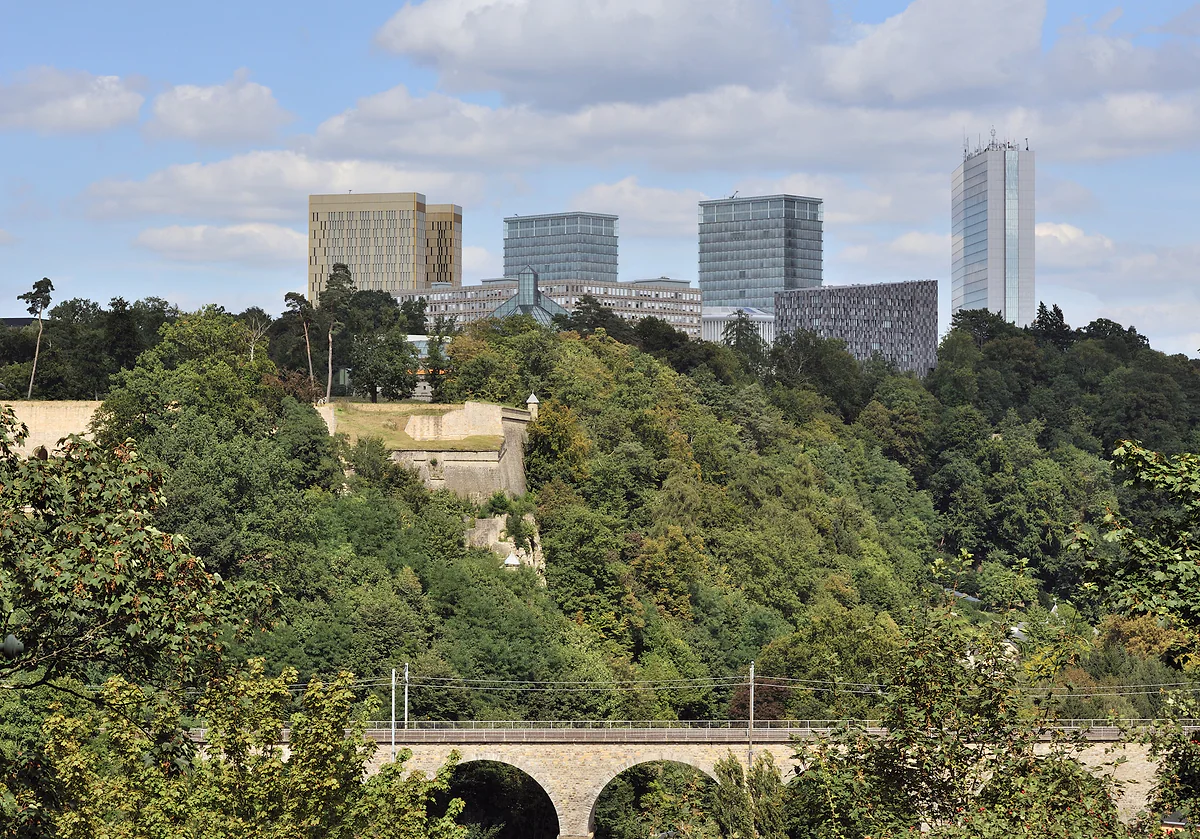
The office towers of Kirchberg above a wooded slope, with a stone railway viaduct in the foreground
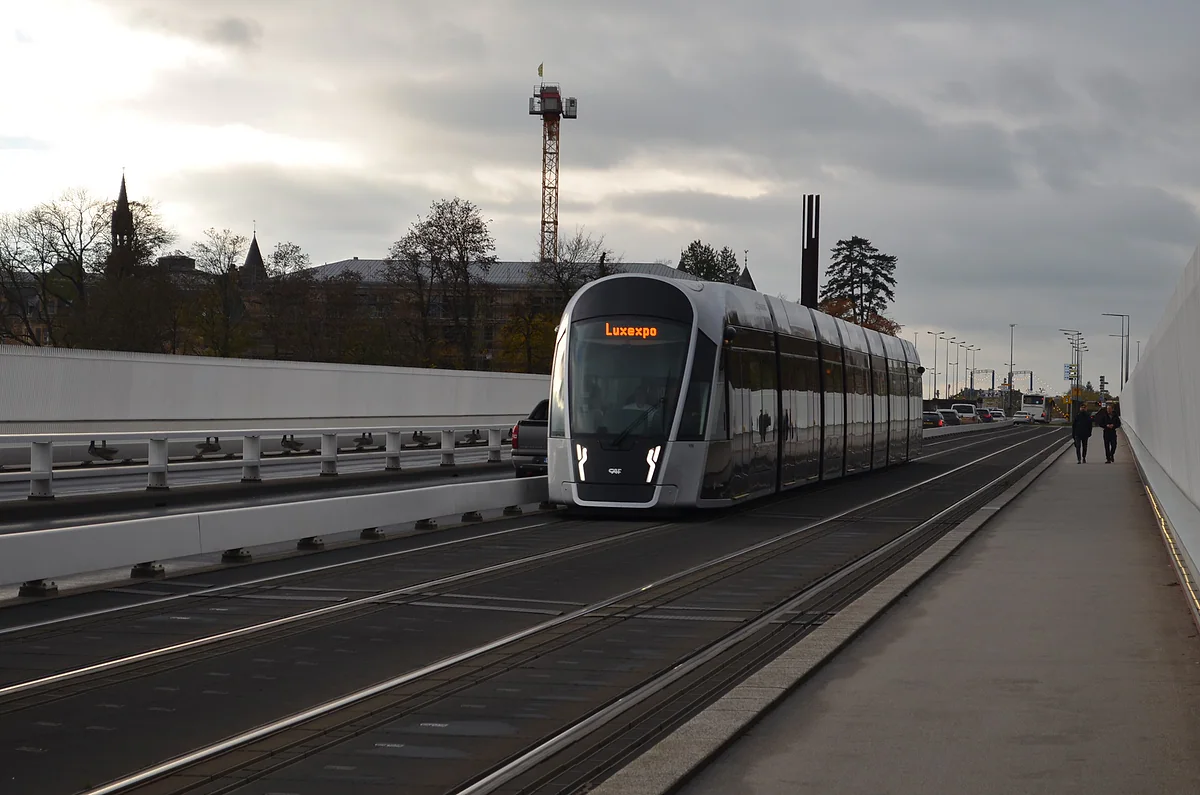
A line T1 tram bound for Luxexpo crossing the Grand Duchess Charlotte Bridge under a grey sky
Which EU bodies are in Luxembourg
| Institution or body | Role | Can you visit? |
|---|---|---|
| Court of Justice of the EU | Interprets EU law | Yes, public hearings and guided tours |
| European Court of Auditors | Audits EU finances | No public visits listed |
| European Investment Bank and European Investment Fund | Project finance | No public visits listed |
| European Parliament Secretariat-General | Parliament's administration | No public visits listed |
| European Commission (Eurostat, Publications Office and others) | Statistics, publishing and services | No public visits listed |
| European Public Prosecutor's Office | EU prosecutor, based there since 1-6-2021 | No public visits listed |
| Europa Experience | Visitor centre about the EU | Yes, free, Monday to Saturday 10:00-18:00 |
List from luxembourg.public.lu; visits according to curia.europa.eu and the Luxembourg City Tourist Office, checked on 29-09-2026. The Translation Centre, EuroHPC, the European Stability Mechanism and the Euratom Supply Agency are also there.
How to visit the Court of Justice
| Option | When | Conditions |
|---|---|---|
| Public hearing | Tuesday to Thursday, from 9:30 | No booking; arrive 15 min early with ID |
| Art and buildings tour | Set calendar | Free, up to 20 people, register 2 working days ahead |
| Tourist office tour | Weekdays from 17:30, weekends and judicial vacations | Up to 20 people, book 4 weeks ahead |
Test yourself
True or false?
0/3 Pick before you peek.
-
You have to book weeks ahead to watch a hearing at the EU Court of Justice.
See the answer
False. Public hearings need no registration. Just turn up 15 minutes early with ID, though seating is limited.
-
Luxembourg's tallest building belongs to the Court of Justice.
See the answer
True. The Court's third tower, opened in September 2019, is the tallest building in the country, according to the official portal.
-
European Parliament plenary sessions are held in Luxembourg.
See the answer
False. Luxembourg hosts its Secretariat-General. The Kirchberg hemicycle housed the first elected Parliament in 1979, but plenaries aren't held there today.
0 of 425 Luxembourg guides
Your next stamp
- Kirchberg
- Hotels in Kirchberg
- EU and Schengen
- Shopping centres
- Philharmonie
- Museums in Luxembourg
- Luxembourg in two days
- A Possen Museum
- American Cemetery
- Ansembourg
- Ansembourg Castles
- Asselborn
- Bascharage
- Beaufort castles
- Belval
- Belval blast furnaces
- Berg Castle
- Bernard-Massard cellars
- Bourglinster Castle
- Bourscheid Castle
- Brandenbourg
- Brandenbourg Castle
- Caves St Martin
- Christmas
- Clervaux Castle
- Echternach
- Echternach Abbey
- Ehnen
- Ehnen Wine Museum
- Esch-sur-Alzette
- Esch-sur-Sûre Castle
- European Museum Schengen
- Fond-de-Gras
- General Patton Museum
- German war cemetery
- Haff Réimech
- Hohllay
- Hollenfels Castle
- Hosingen
- Kautenbach
- Kneiff
- Koerich Castle
- Larochette Castle
- Lasauvage
- Mersch Castle
- Military History Museum
- Moersdorf
- Mondorf Domaine Thermal
- Munsbach Castle
- National Mining Museum
- Parc Merveilleux
- Park Sënnesräich
- Places to visit
- Remich
- Rindschleiden
- Schiessentümpel
- Septfontaines Castle
- Slate Museum
- Stolzembourg
- Tudor Museum
- Useldange Castle
- Valley of the Seven Castles
- Vianden
- Vianden Castle
- Ville Haute
- Wasserbillig Aquarium
- Weiswampach lakes
- Wiltz Castle
- Ahn
- Berdorf
- Bourscheid-Plage
- Butterfly garden
- Clervaux
- Differdange
- Echternach lake
- Grevenmacher
- Heringer Millen
- Hollenfels
- Luxembourg City
- Luxembourg Science Center
- Meysembourg Castle
- Mullerthal
- National Day
- National Resistance Museum
- Perekop
- Remerschen
- Schoenfels Castle
- The Family of Man
- Things to do
- Upper Sûre Lake
- Vianden chairlift
- Wasserbillig
- Clervaux Abbey
- Echternach Roman villa
- Éislek
- Insenborn
- Kallektuffquell
- Machtum
- Most beautiful places
- Our Nature Park
- Pétange
- Pettingen Castle
- Schueberfouer
- Schwebsingen
- Victor Hugo House
- Waldbillig
- Dudelange
- Kuelscheier
- Lultzhausen
- Moselle Valley
- Octave
- Prettiest villages
- Sanem
- Schengen
- Wellenstein
- Wiltz
- Wolfsschlucht
- Beaufort
- Bech-Kleinmacher
- Éimaischen
- Gaalgebierg
- Guttland
- Marnach
- Mondorf-les-Bains
- Putscheid
- Schifflange
- UNESCO World Heritage
- Carnival
- Consdorf
- Ellergronn
- Käerjeng
- Kayl
- Map
- Minett
- Munshausen
- Tandel
- Bech
- Buergbrennen
- Esch-sur-Sûre
- Rumelange
- Where is Luxembourg
- Is it a country?
- Lac de la Haute-Sûre (commune)
- Rosport-Mompach
- Wormeldange
- Larochette
- Mondercange
- Regions
- Bettembourg
- Bock Casemates
- Cantons
- Dancing procession
- Diekirch
- Fischbach
- Garnich
- Mersch
- Moselle wine route
- Ettelbruck
- Grund
- Heffingen
- Kehlen
- Lintgen
- Moselle river cruises
- Pétrusse Casemates
- Towns and villages
- Chemin de la Corniche
- Erpeldange-sur-Sûre
- Junglinster
- Kopstal
- Lorentzweiler
- Nommern
- Pfaffenthal
- Population
- Bissen
- Clausen
- Grand Ducal Palace
- Koerich
- Schieren
- Size
- Vallée de l'Ernz
- Feulen
- Languages
- Notre-Dame Cathedral
- Reisdorf
- Steinfort
- Bettendorf
- Habscht
- St Michael's Church
- Helperknapp
- Luxembourgish
- Place Guillaume II
- Name
- Place d'Armes
- History
- Place de la Constitution
- Grand Duke
- Colmar-Berg
- Flaxweiler
- Gare
- Hamm
- Kirchberg funicular
- Luxembourg fortress
- Mamer
- Mertert
- Minett Trail
- Mullerthal Trail
- Neumünster Abbey
- Parc Hosingen
- Pfaffenthal lift
- Political system
- Redange
- The Passerelle
- Wine festivals
- Winseler
- Beckerich
- Biwer
- Goesdorf
- Limpertsberg
- Mudam
- Natur Musée
- Pulvermühl
- Stadtbredimus
- Troisvierges
- Wenzel walk
- Bonnevoie
- Bous-Waldbredimus
- Ell
- Flag
- Kiischpelt
- Manternach
- Vauban circuit
- Weiswampach
- Betzdorf
- Boulaide
- Dräi Eechelen Museum
- Facts
- Hollerich
- Lenningen
- Useldange
- Wincrange
- Bourscheid
- Dalheim
- Gasperich
- Public holidays
- Red Bridge
- Saeul
- Belair
- Second World War
- Vichten
- Battle of the Bulge
- Merl
- Préizerdaul
- Cents
- Groussbus-Wal
- Entry requirements
- Neudorf
- Rambrouch
- Currency and payments
- Mertzig
- Weimerskirch
- Adolphe Bridge
- Beggen
- Escapardenne
- How to get there
- International March of Diekirch
- MNHA (National Museum)
- Rock climbing
- Sandweiler
- Bridges
- Eich
- Flights
- Golf
- Hesperange
- Lëtzebuerg City Museum
- Canoeing and kayaking
- Dommeldange
- Luxembourg airport
- Strassen
- Villa Vauban
- Airport to city centre
- Bertrange
- Casino Luxembourg
- Mühlenbach
- Swimming pools
- From Brussels
- Pétrusse Valley
- Rollingergrund
- Walferdange
- Cessange
- Day trip from Brussels
- Municipal Park
- Steinsel
- Free walking tours
- From Paris
- Niederanven
- From Frankfurt
- Schuttrange
- Sightseeing train and bus
- By train
- Contern
- By coach
- Weiler-la-Tour
- Driving
- Luxembourg in one day
- Pretzel Sunday
- Rham Plateau
- Tour de Luxembourg
- Candlemas (Liichtmëssdag)
- Car hire
- Saint-Esprit Plateau
- Luxembourg in three days
- Melusina statue
- Parking
- St Nicholas Day (Kleeschen)
- Fête de la Musique
- Luxembourg in four days
- Petrol
- Place de Clairefontaine
- A week in Luxembourg
- Getting around
- Luxembourg Marathon
- Tram and Bus Museum
- Free public transport
- Parks in Luxembourg City
- Road trip
- Belgium and Luxembourg
- Tram
- Buses
- Viewpoints
- Trains
- Luxembourg station
- Cycling
- LuxembourgPass
- Prices and budget
- On a budget
- Free things to do
- Mobile and roaming
- Healthcare
- Safety
- Scams
- Tourist information
- Packing list
- Swimming lakes
- With a dog
- Markets
- Tipping
- Shopping
- What to buy
- With kids
- For couples
- Playgrounds
- Adventure parks
- Nightlife
- Castles
- Theatres and concert venues
- Leudelange
- Nature parks
- Where to stay
- City-centre hotels
- Hiking
- Nature reserves
- Reckange-sur-Mess
- Hotels near the station
- Roeser
- Frisange
- Airport hotels
- Dippach
- Hotels in Vianden
- Hotels in Echternach
- Hotels in Clervaux
- Hotels in Mondorf-les-Bains
- Hotels in Esch-sur-Alzette
- Hotels on the Moselle
- Mullerthal hotels
- Upper Sûre lake hotels
- Hotels in Diekirch and Ettelbruck
- Cheap hotels
- Luxury hotels
- Boutique hotels
- Spa hotels
- Family hotels
- Apartments
- Weather
- Youth hostels
- Best time to visit
- Campsites
- Holiday cottages
- In winter
- Castle hotels
- In spring
- Day trips
- In summer
- Around Luxembourg
- In autumn
- Ice skating
- Trier day trip
- Metz day trip
- Arlon day trip
- In January
- In February
- In March
- In April
- In May
- In June
- In July
- In August
- In September
- Food
- In October
- In November
- Where to eat
- In December
- Michelin restaurants
- Cheap eats
- Judd mat Gaardebounen
- Bouneschlupp
- Gromperekichelcher
- Kniddelen
- Quetschentaart
- Rieslingspaschtéit
- Events
- Wine
- Crémant
- Beer
Frequently asked questions
Which EU institutions are in Luxembourg?
The Court of Justice of the EU, the European Court of Auditors, the European Investment Bank and Fund, the European Parliament's Secretariat-General, Commission services such as Eurostat, and the European Public Prosecutor's Office, among others.
Does the European Parliament sit in Luxembourg?
Its Secretariat-General, the administration, is there. Plenary sessions take place in Strasbourg and Brussels. The hemicycle of the Robert Schuman building in Kirchberg hosted the first directly elected Parliament in 1979.
Can you visit the European Court of Justice?
Yes. Anyone can attend a public hearing without booking, arriving 15 minutes early with a passport, ID card or driving licence. There are also free guided tours of the Court's art collection.
Why is Luxembourg an EU capital?
Because the High Authority of the European Coal and Steel Community, the EU's forerunner, was set up there in 1952. Since then the city has been one of the EU's three seats, with Brussels and Strasbourg.
Where are the EU institutions in Luxembourg City?
Almost all are in Kirchberg, on the plateau across the Red Bridge. The free T1 tram links it with the central station and the airport.
What is the Europa Experience in Luxembourg?
A free visitor centre about the European Union on avenue J. F. Kennedy in Kirchberg. It opens Monday to Saturday from 10:00 to 18:00 and asks for ID.
By
Tourism graduate with a master’s in Tourism Management and Planning from the University of Málaga, who has travelled across Europe. He writes every guide from official sources and his own judgement.
Published on . Updated on . Facts checked on .
Sources
- Luxembourg.public.lu, the European institutions
- Court of Justice of the EU, types of visit
- Court of Justice of the EU, attending hearings
- Court of Justice of the EU, art tours
- LCTO, Europa Experience
- visitluxembourg, Europa Experience
- LCTO, Place de l'Europe
- LCTO, Robert Schuman monument
- Transports.public.lu, the tram
Some links in this guide are affiliate links: if you book through them, the site earns a commission at no extra cost to you. Affiliate disclosure
Photos: Tristan Schmurr from Luxembourg, Luxembourg (CC BY 2.0); Cayambe (CC BY-SA 3.0); Procrastineur49 (CC0), via Wikimedia Commons.