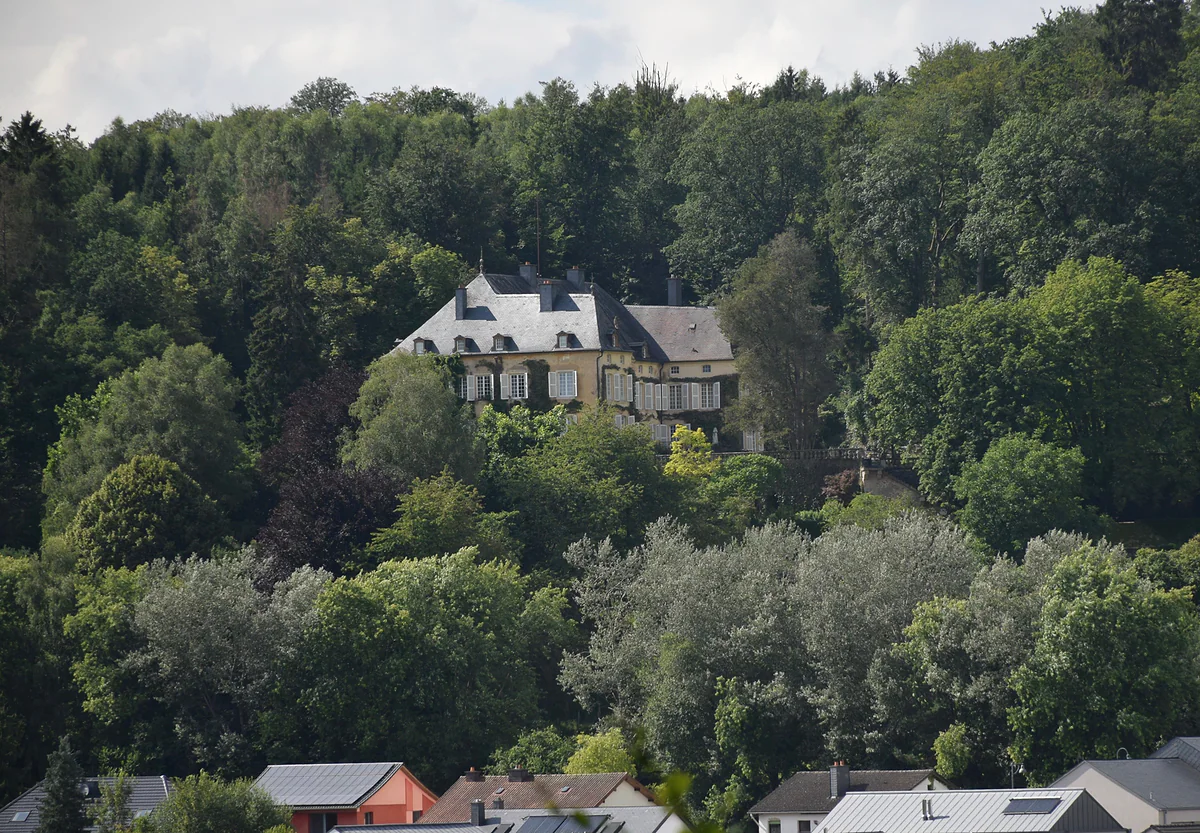
Commune in the canton of Mersch, Mullerthal region
Fischbach, home of a Grand Ducal castle and an old ironworks
Fischbach is a commune of 1,344 people between Mersch and Larochette, with seven localities including Angelsberg, Schoos and Koedange. Its castle has belonged to the Grand Ducal family since 1891 and isn't state property. In the 19th century it was an ironmaking centre, and Al Schmelz, an old blast furnace site with ponds on ExtraTour E of the Mullerthal Trail, survives from that era.
In 30 seconds
Full read: 2 min
- Fischbach is a commune of 1,344 people between Mersch and Larochette.
- Its castle has belonged to the Grand Ducal family since 1891 and isn't open to visitors.
- Al Schmelz, an old blast furnace site with ponds, is a geopark site on ExtraTour E.
You can't go inside the castle, so I'd come for Al Schmelz and the Napoleonshutt circuit instead. It's one of the few walks in the Mullerthal that tells an industrial story rather than a geological one, and it fits into a morning.

Before you go
What I would keep in mind
-
01 Most beautiful
A blast furnace turned wildlife haven
Iron was made at Al Schmelz in the 18th and 19th centuries. The ponds that powered and supplied the furnace remain, and it's now an open-access geopark site.
-
02 My tip
The Napoleon's hat walk
Fischbach's 11.1 km Auto-Pédestre passes Al Schmelz, climbs steps to the Napoleonshutt, a rock shaped like a bicorne hat, and drops to Koedange.
-
03 Getting there
A family castle, not a state one
Unlike the Grand Ducal Palace and Berg Castle, Fischbach isn't owned by the state. It belongs to the Grand Ducal family itself.
Grand Duke of Luxembourg
Fischbach sits between Mersch and Larochette, straddling the Alzette and White Ernz valleys on the western edge of the Mullerthal. It has two stories that don’t obviously belong together, a castle owned by the Grand Ducal family and a 19th-century past that, according to the regional tourist office, made it one of the country’s industrial centres through mining and ironmaking.
Seven localities, few residents
Just 1,344 people lived here at the start of 2026, by STATEC’s count, one of the five lowest totals of any commune, in the same group as Bech. The national register lists seven localities, Angelsberg, Fischbach, Koedange, Schiltzberg, Schoos, Stuppicht and Weyer. It’s in the canton of Mersch for administration and in the Mullerthal for tourism.
Whose castle is it?
The Grand Ducal family’s, since 1891, and not the state’s, a point the Court itself makes by comparing it with the palace in the capital and Berg Castle. Its roots are early medieval, with a castle lord recorded in the mid-11th century, and the original core stands on a rocky spur above the Wisebaach valley. In 1686 the de Cassal family bought it and remodelled it in a Rococo style influenced by Echternach Abbey, adding terraced gardens. It later passed through the Collart family and the Luxembourg Ironworks, Forges and Factories Company.
Under the Grand Ducal family it started as a summer residence. During the First World War, Grand Duchess Marie-Adélaïde lent it to house poor schoolchildren from the mining district, and between 1923 and 1931 it became a permanent home. In the Second World War it was requisitioned by the Dr. Joseph Goebbels Foundation for Artists. From 1945 it was Grand Duchess Charlotte’s main residence, and later Prince Henri, Grand Duke Jean and, from 2019, the then heir Guillaume and Stéphanie lived there. There’s more on the monarchy in my guide to the Grand Duke of Luxembourg.
If you are staying the night, see the best hotel deals in Luxemburgo for your dates: the well-placed rooms go fast.
Al Schmelz and the Napoleonshutt
The part of Fischbach you can actually explore is in the woods. At Al Schmelz iron was made in the 18th and 19th centuries, and the ponds that supplied the furnace with water and power are still there. It’s now a wildlife habitat and a Mëllerdall geopark site, open to the public, with a digital reconstruction of how the iron was made. The 11.1 km Auto-Pédestre circuit starts at the rue du Moulin car park, reaches Al Schmelz along a sunken lane, climbs steps to the Napoleonshutt, a rock that looks like Napoleon’s hat, and drops to Koedange before returning with views over the village. ExtraTour E of the Mullerthal Trail also crosses the commune.
Nearby
The lords of Fischbach once owned Meysembourg Castle, next door, and Larochette lies to the north-east. There was a single hotel in 2025, says STATEC, and buses are free across Luxembourg, so a day trip from the capital or from Findel works without a car.
If you are staying the night, see the best hotel deals in Luxemburgo for your dates: the well-placed rooms go fast.
So you do not lose the morning at the ticket office, browse tickets and tours in Luxemburgo on GetYourGuide.
If you would rather go at your own pace, see the car hire deals in Luxembourg: the earlier you book, the more cars are left to choose from.
Before you fix your dates, compare tickets to Luxembourg: the same journey can cost very different amounts from one day to the next.
Fischbach in figures
| Item | Figure |
|---|---|
| Residents on 1-1-2026 | 1,344 |
| Residents on 1-1-2025 | 1,306 |
| Official localities | Angelsberg, Fischbach, Koedange, Schiltzberg, Schoos, Stuppicht and Weyer |
| Area (own calculation) | About 19.6 km² |
| Hotels in 2025 | 1 |
STATEC (population and accommodation) and the national CACLR register. Area worked out from population and density.
Fischbach Castle through time
| Date | Event |
|---|---|
| Mid-11th century | First mention of a castle lord |
| 1686 | Bought by the de Cassal family and remodelled in Rococo style |
| 1891 | Becomes part of the Grand Ducal family's heritage |
| 1923-1931 | Turned into a permanent residence |
| 1945 | Main residence of Grand Duchess Charlotte |
| 2019 | Hereditary Grand Duke Guillaume and Stéphanie move in |
| 2022 | Listed as national cultural heritage |
Cour grand-ducale (monarchie.lu), checked on 30-09-2026.
Test yourself
True or false?
0/3 Pick before you peek.
-
Fischbach Castle is state property, like Berg Castle.
See the answer
False. The Grand Ducal Court points out that, unlike the palace and Berg, Fischbach isn't owned by the state.
-
A Nazi foundation requisitioned the castle during the Second World War.
See the answer
True. After briefly serving as a children's rest home, it was taken over by the Dr. Joseph Goebbels Foundation for Artists, according to monarchie.lu.
-
Fischbach once had an iron industry.
See the answer
True. The regional tourist office says mining and ironmaking made Fischbach one of the country's industrial centres in the 19th century.
- Residents on 1-1-2026
- 1,344
- Castle passes to the Grand Ducal family
- 1891
- Auto-Pédestre circuit
- 11.1 km
Map
Where Fischbach is
The thick dashed line is the border with Belgium, France and Germany, and the fine ones divide the twelve cantons. The Éislek lies to the north and the Moselle to the east. Every number opens its guide.
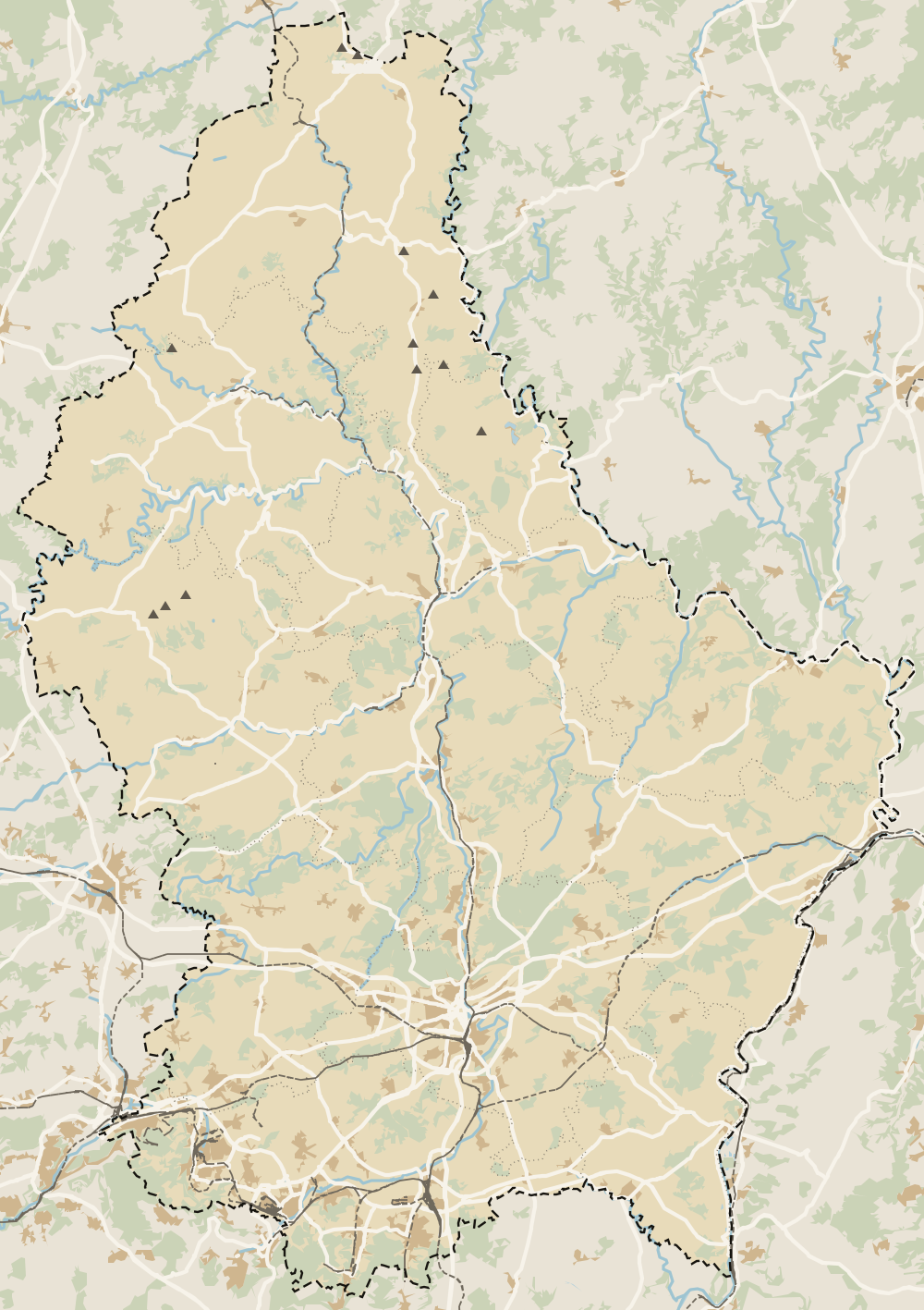 1Echternach 2Berdorf 3Mullerthal 4Waldbillig 5Beaufort 6Consdorf 7Bech 8Rosport-Mompach 9Larochette 10Fischbach 11Heffingen 12Junglinster 13Nommern 14Vallée de l'Ernz 15Reisdorf
 Map data © OpenStreetMap contributors (ODbL)
- 1EchternachMain town of the Mullerthal region
- 2BerdorfCommune in the canton of Echternach
- 3MullerthalTourist region in eastern Luxembourg
- 4WaldbilligCommune in the canton of Echternach
- 5BeaufortCommune in the canton of Echternach
- 6ConsdorfCommune in the canton of Echternach
- 7BechCommune in the canton of Echternach
- 8Rosport-MompachCommune in the canton of Echternach
- 9LarochetteCommune in the canton of Mersch, Mullerthal region
- 10FischbachCommune in the canton of Mersch, Mullerthal region
- 11HeffingenCommune in the canton of Mersch, Mullerthal region
- 12JunglinsterMullerthal municipality, canton of Grevenmacher
- 13NommernCommune in the canton of Mersch, Mullerthal region
- 14Vallée de l'ErnzCommune in the canton of Diekirch, Mullerthal region
- 15ReisdorfCommune in the canton of Diekirch, Mullerthal region
0 of 425 Luxembourg guides
Your next stamp
- Larochette
- Larochette Castle
- Meysembourg Castle
- Heffingen
- Hotels in Echternach
- Bourscheid
- Mullerthal hotels
- Mullerthal
- A Possen Museum
- American Cemetery
- Ansembourg
- Ansembourg Castles
- Asselborn
- Bascharage
- Beaufort castles
- Belval
- Belval blast furnaces
- Berg Castle
- Bernard-Massard cellars
- Bourglinster Castle
- Bourscheid Castle
- Brandenbourg
- Brandenbourg Castle
- Caves St Martin
- Christmas
- Clervaux Castle
- Echternach
- Echternach Abbey
- Ehnen
- Ehnen Wine Museum
- Esch-sur-Alzette
- Esch-sur-Sûre Castle
- European Museum Schengen
- Fond-de-Gras
- General Patton Museum
- German war cemetery
- Haff Réimech
- Hohllay
- Hollenfels Castle
- Hosingen
- Kautenbach
- Kneiff
- Koerich Castle
- Lasauvage
- Mersch Castle
- Military History Museum
- Moersdorf
- Mondorf Domaine Thermal
- Munsbach Castle
- National Mining Museum
- Parc Merveilleux
- Park Sënnesräich
- Places to visit
- Remich
- Rindschleiden
- Schiessentümpel
- Septfontaines Castle
- Slate Museum
- Stolzembourg
- Tudor Museum
- Useldange Castle
- Valley of the Seven Castles
- Vianden
- Vianden Castle
- Ville Haute
- Wasserbillig Aquarium
- Weiswampach lakes
- Wiltz Castle
- Ahn
- Berdorf
- Bourscheid-Plage
- Butterfly garden
- Clervaux
- Differdange
- Echternach lake
- Grevenmacher
- Heringer Millen
- Hollenfels
- Luxembourg City
- Luxembourg Science Center
- National Day
- National Resistance Museum
- Perekop
- Remerschen
- Schoenfels Castle
- The Family of Man
- Things to do
- Upper Sûre Lake
- Vianden chairlift
- Wasserbillig
- Clervaux Abbey
- Echternach Roman villa
- Éislek
- Insenborn
- Kallektuffquell
- Machtum
- Most beautiful places
- Our Nature Park
- Pétange
- Pettingen Castle
- Schueberfouer
- Schwebsingen
- Victor Hugo House
- Waldbillig
- Dudelange
- Kuelscheier
- Lultzhausen
- Moselle Valley
- Octave
- Prettiest villages
- Sanem
- Schengen
- Wellenstein
- Wiltz
- Wolfsschlucht
- Beaufort
- Bech-Kleinmacher
- Éimaischen
- Gaalgebierg
- Guttland
- Marnach
- Mondorf-les-Bains
- Putscheid
- Schifflange
- UNESCO World Heritage
- Carnival
- Consdorf
- Ellergronn
- Käerjeng
- Kayl
- Map
- Minett
- Munshausen
- Tandel
- Bech
- Buergbrennen
- Esch-sur-Sûre
- Rumelange
- Where is Luxembourg
- Is it a country?
- Lac de la Haute-Sûre (commune)
- Rosport-Mompach
- Wormeldange
- Mondercange
- Regions
- Bettembourg
- Bock Casemates
- Cantons
- Dancing procession
- Diekirch
- Garnich
- Mersch
- Moselle wine route
- Ettelbruck
- Grund
- Kehlen
- Lintgen
- Moselle river cruises
- Pétrusse Casemates
- Towns and villages
- Chemin de la Corniche
- Erpeldange-sur-Sûre
- Junglinster
- Kopstal
- Lorentzweiler
- Nommern
- Pfaffenthal
- Population
- Bissen
- Clausen
- Grand Ducal Palace
- Koerich
- Schieren
- Size
- Vallée de l'Ernz
- Feulen
- Kirchberg
- Languages
- Notre-Dame Cathedral
- Reisdorf
- Steinfort
- Bettendorf
- Habscht
- St Michael's Church
- Helperknapp
- Luxembourgish
- Place Guillaume II
- Name
- Place d'Armes
- History
- Place de la Constitution
- Grand Duke
- Colmar-Berg
- Flaxweiler
- Gare
- Hamm
- Kirchberg funicular
- Luxembourg fortress
- Mamer
- Mertert
- Minett Trail
- Mullerthal Trail
- Neumünster Abbey
- Parc Hosingen
- Pfaffenthal lift
- Political system
- Redange
- The Passerelle
- Wine festivals
- Winseler
- Beckerich
- Biwer
- EU institutions
- Goesdorf
- Limpertsberg
- Mudam
- Natur Musée
- Pulvermühl
- Stadtbredimus
- Troisvierges
- Wenzel walk
- Bonnevoie
- Bous-Waldbredimus
- Ell
- Flag
- Kiischpelt
- Manternach
- Philharmonie
- Vauban circuit
- Weiswampach
- Betzdorf
- Boulaide
- Dräi Eechelen Museum
- Facts
- Hollerich
- Lenningen
- Useldange
- Wincrange
- Dalheim
- Gasperich
- Public holidays
- Red Bridge
- Saeul
- Belair
- Second World War
- Vichten
- Battle of the Bulge
- Merl
- Préizerdaul
- Cents
- EU and Schengen
- Groussbus-Wal
- Entry requirements
- Neudorf
- Rambrouch
- Currency and payments
- Mertzig
- Weimerskirch
- Adolphe Bridge
- Beggen
- Escapardenne
- How to get there
- International March of Diekirch
- MNHA (National Museum)
- Rock climbing
- Sandweiler
- Bridges
- Eich
- Flights
- Golf
- Hesperange
- Lëtzebuerg City Museum
- Canoeing and kayaking
- Dommeldange
- Luxembourg airport
- Strassen
- Villa Vauban
- Airport to city centre
- Bertrange
- Casino Luxembourg
- Mühlenbach
- Swimming pools
- From Brussels
- Pétrusse Valley
- Rollingergrund
- Walferdange
- Cessange
- Day trip from Brussels
- Municipal Park
- Steinsel
- Free walking tours
- From Paris
- Niederanven
- From Frankfurt
- Schuttrange
- Sightseeing train and bus
- By train
- Contern
- By coach
- Weiler-la-Tour
- Driving
- Luxembourg in one day
- Pretzel Sunday
- Rham Plateau
- Tour de Luxembourg
- Candlemas (Liichtmëssdag)
- Car hire
- Luxembourg in two days
- Saint-Esprit Plateau
- Luxembourg in three days
- Melusina statue
- Parking
- St Nicholas Day (Kleeschen)
- Fête de la Musique
- Luxembourg in four days
- Museums in Luxembourg
- Petrol
- Place de Clairefontaine
- A week in Luxembourg
- Getting around
- Luxembourg Marathon
- Tram and Bus Museum
- Free public transport
- Parks in Luxembourg City
- Road trip
- Belgium and Luxembourg
- Tram
- Buses
- Viewpoints
- Trains
- Luxembourg station
- Cycling
- LuxembourgPass
- Prices and budget
- On a budget
- Free things to do
- Mobile and roaming
- Healthcare
- Safety
- Scams
- Tourist information
- Packing list
- Swimming lakes
- With a dog
- Markets
- Tipping
- Shopping
- What to buy
- Shopping centres
- With kids
- For couples
- Playgrounds
- Adventure parks
- Nightlife
- Castles
- Theatres and concert venues
- Leudelange
- Nature parks
- Where to stay
- City-centre hotels
- Hiking
- Nature reserves
- Reckange-sur-Mess
- Hotels near the station
- Roeser
- Frisange
- Hotels in Kirchberg
- Airport hotels
- Dippach
- Hotels in Vianden
- Hotels in Clervaux
- Hotels in Mondorf-les-Bains
- Hotels in Esch-sur-Alzette
- Hotels on the Moselle
- Upper Sûre lake hotels
- Hotels in Diekirch and Ettelbruck
- Cheap hotels
- Luxury hotels
- Boutique hotels
- Spa hotels
- Family hotels
- Apartments
- Weather
- Youth hostels
- Best time to visit
- Campsites
- Holiday cottages
- In winter
- Castle hotels
- In spring
- Day trips
- In summer
- Around Luxembourg
- In autumn
- Ice skating
- Trier day trip
- Metz day trip
- Arlon day trip
- In January
- In February
- In March
- In April
- In May
- In June
- In July
- In August
- In September
- Food
- In October
- In November
- Where to eat
- In December
- Michelin restaurants
- Cheap eats
- Judd mat Gaardebounen
- Bouneschlupp
- Gromperekichelcher
- Kniddelen
- Quetschentaart
- Rieslingspaschtéit
- Events
- Wine
- Crémant
- Beer
Frequently asked questions
Can you visit Fischbach Castle?
The Grand Ducal Court presents it as a family residence and advertises no visits, unlike the Grand Ducal Palace in the capital. You see it from outside.
Who owns Fischbach Castle?
The Grand Ducal family, since 1891. It isn't state property, though the state maintains it when it's used as a residence by the heir, the Lieutenant-Representative or the former Grand Duke, according to monarchie.lu.
What is Al Schmelz?
The site of an 18th and 19th-century blast furnace in Fischbach. The ponds that fed it with water and power survive, and it's now a wildlife habitat and a Mëllerdall geopark site open to the public.
Where is Fischbach?
In the canton of Mersch, between Mersch and Larochette and between the Alzette and White Ernz valleys. For tourism it belongs to the Mullerthal region.
What walks are there around Fischbach?
The 11.1 km Auto-Pédestre circuit via Al Schmelz and the Napoleonshutt, local trail F1 and ExtraTour E of the Mullerthal Trail, 25.5 km long.
By
Tourism graduate with a master’s in Tourism Management and Planning from the University of Málaga, who has travelled across Europe. He writes every guide from official sources and his own judgement.
Published on . Facts checked on .
Sources
Some links in this guide are affiliate links: if you book through them, the site earns a commission at no extra cost to you. Affiliate disclosure
Photos: Zinneke (CC BY-SA 3.0), via Wikimedia Commons.