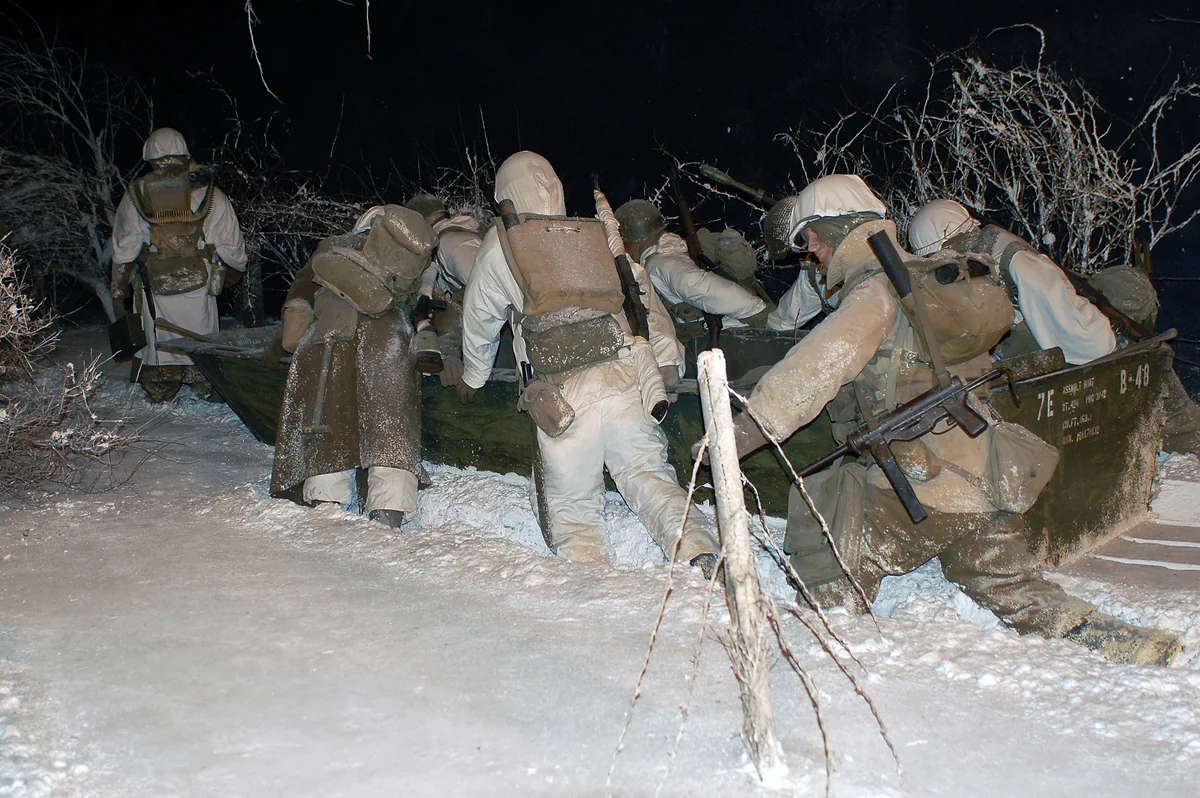
Winter 1944-1945 in the Éislek
The Battle of the Bulge in Luxembourg, site by site
The Battle of the Bulge began on 16 December 1944 with a surprise German attack on the American front line across northern Luxembourg and eastern Belgium. Wiltz, Clervaux, Diekirch, Ettelbruck, Beaufort and Echternach saw house-to-house fighting. Patton's forces retook the area by late January 1945, and Vianden was liberated in February.
I'd do it as a driving day from south to north. The American Cemetery first thing, the Diekirch military museum mid-morning, the Patton museum in Ettelbruck after lunch and, if the light holds, the Schumannseck memorial trail. The museums close on Mondays.

Before you go
What I would keep in mind
-
01 Most beautiful
The most complete museum is in Diekirch
The National Museum of Military History has dioramas and more than 100,000 artefacts. In September 2026 it opened Tuesday to Sunday, 10:00 to 18:00, at €5 for adults and €3 for young people and students.
Diekirch military museum -
02 My tip
The battle museums shut on Mondays
Diekirch and the General Patton museum in Ettelbruck open Tuesday to Sunday. The American Cemetery at Hamm opens every day from 9:00 to 17:00, except 25 December and 1 January.
General Patton museum in Ettelbruck -
03 Most beautiful
A trail through the old foxholes
Schumannseck, near Nothum, has a 2.8 km memorial trail with 20 stations, about two hours on foot, and the National Liberation Museum.
Lac de la Haute-Sûre commune -
04 Getting there
Trains run to Ettelbruck and Diekirch
CFL line 10 serves Ettelbruck and Diekirch, and public transport is free nationwide. Wiltz and Clervaux have stations too; for Schumannseck you're better off driving.
trains in Luxembourg
What I would book
Most people link the Battle of the Bulge with Belgium and Bastogne. In Luxembourg it was just as brutal. The front ran across the north of the country, and towns that are now peaceful weekend destinations, Wiltz, Clervaux, Diekirch, Ettelbruck, Beaufort and Echternach, saw house-to-house fighting in one of the harshest winters on record. Here’s what happened and, above all, where to see it.
The attack of 16 December
On 16 December 1944 German units struck the American front line in the Ardennes, which covered northern Luxembourg and eastern Belgium. The surprise was total. The government’s official portal explains that the cold had brought a lull in the fighting, and the advance through snowy valleys and ridges caught the American troops off guard, pushing them west with heavy losses. Clervaux castle was destroyed the next day.
Civilians were caught in the middle. During the worst of it many fled as refugees, and those who stayed spent nights shut in cellars not knowing whether they’d see the morning. By January 1945 much of the Éislek was in ruins. For how the country got to that point, start with Luxembourg in the Second World War.
Patton, Christmas 1944 and the end
The American counter-offensive was led by General George S. Patton. His troops liberated Ettelbruck on 25 December 1944, and by late January 1945 they had retaken the area. The last place in the country to be freed was Vianden, in February 1945. The government’s two official pages give different days, so I’ll stick to the month.
Patton never went home. He died after a car accident in Germany and, as he had asked, was buried among his men at the Luxembourg American Cemetery in Hamm on 24 December 1945. More than 5,073 American soldiers killed in Luxembourg lie there, including two Medal of Honor recipients and five members of «Easy Company», 506th Regiment, 101st Airborne Division, the unit made famous by Band of Brothers. Its gates open daily between 9:00 and 17:00.
Once your dates are set, check which hotels are still free in Diekirch before prices climb.
The museums worth the drive
The one I wouldn’t miss is the Diekirch military museum, the National Museum of Military History, with its dioramas and more than 100,000 artefacts. Its September 2026 hours were 10:00 to 18:00, closed on Mondays, with entry at €5 (€3 for young people and students). In neighbouring Ettelbruck, liberated by Patton’s troops on Christmas Day 1944, the General Patton Memorial Museum kept September 2026 hours of 10:00 to 17:00, Mondays excepted, for €5. There’s more on it in General Patton Museum Ettelbruck.
Further north, the castles of Wiltz and Clervaux each have a Battle of the Bulge museum. The official visitluxembourg listing doesn’t publish their hours or prices, so I won’t guess them; at Clervaux, the same castle houses The Family of Man. And near Nothum, in the Upper Sûre nature park, Schumannseck combines the National Liberation Museum with a 2.8 km memorial trail of 20 stations, about two hours through woods where the fighting took place.
What’s left in the villages
You don’t need a museum to see the battle. The official portal notes that many older façades in the Éislek still carry shrapnel scars, and that more than 80 years on, munitions and equipment still turn up. Wiltz keeps a tradition born in those weeks too. On 5 December 1944, soldiers of the US 28th Infantry Division threw a St Nicholas party for the town’s children, and an American «Saint Nick» has come back every year since.
Once your dates are set, check which hotels are still free in Diekirch before prices climb.
Planning the route
I’d drive it south to north, in one long day or, better, two. Start at Hamm in the capital and, for the contrast, the 10,913 graves of the German war cemetery at Sandweiler, close by. Then Ettelbruck and Diekirch, both with direct trains to the capital, and finally Wiltz, Clervaux and Schumannseck. For a bed halfway along, Diekirch or Ettelbruck are the most practical.
If you’d rather follow a marked route, the Liberation Route Europe crosses Luxembourg for about 253 km, linking many of these places. And bear in mind that museum hours shrink in winter, the very season of the battle, so if you’re planning a December trip for the anniversary, check each museum’s own website before setting off. Echternach and Beaufort, also named by the government among the towns that saw the heaviest fighting, fit easily into a second day in the Mullerthal.
If you would rather have a local show you round, book a guided tour in Diekirch and choose by the reviews.
A car frees you from timetables: search car hire in Luxembourg on DiscoverCars and compare companies.
So you do not pay over the odds, look at trains, coaches and flights to Luxembourg on Omio and pick the one that suits you.
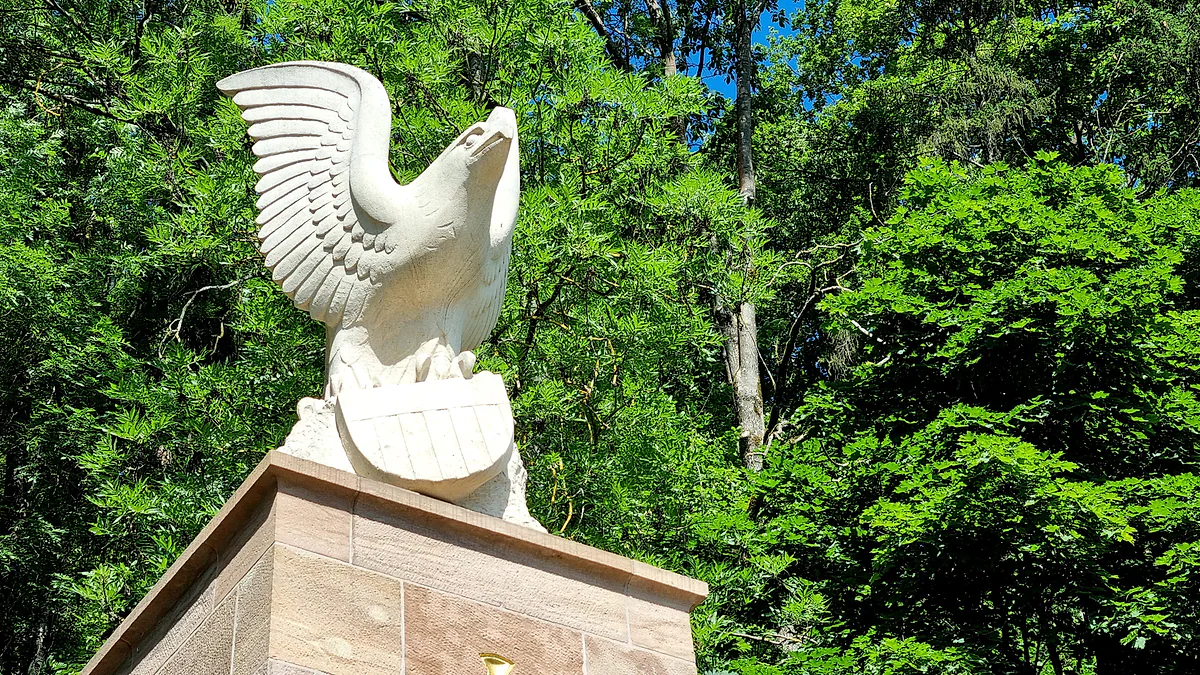
The white stone eagle of the General Patton memorial in Ettelbruck, on a plinth in front of green woodland
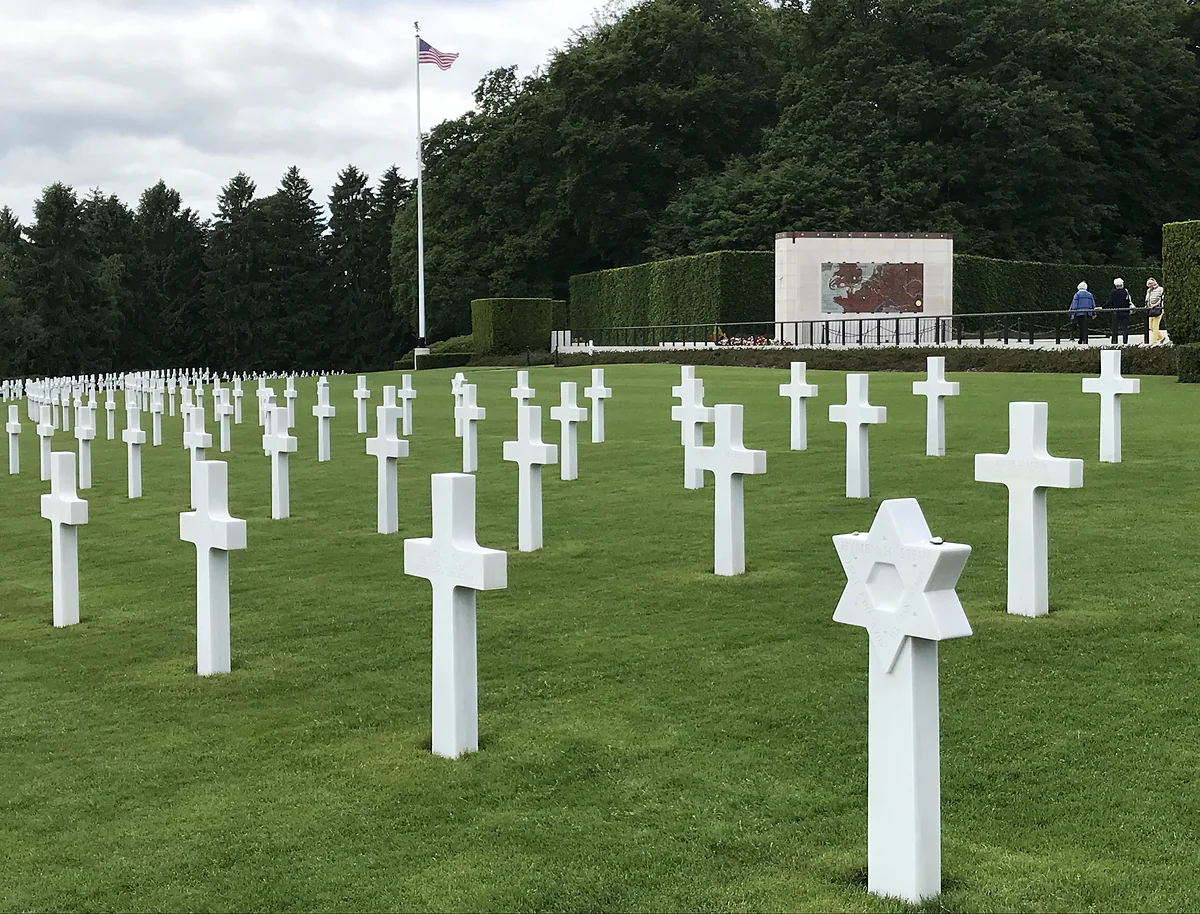
Rows of white crosses and a Star of David at the American cemetery in Hamm, with the flag and woodland behind
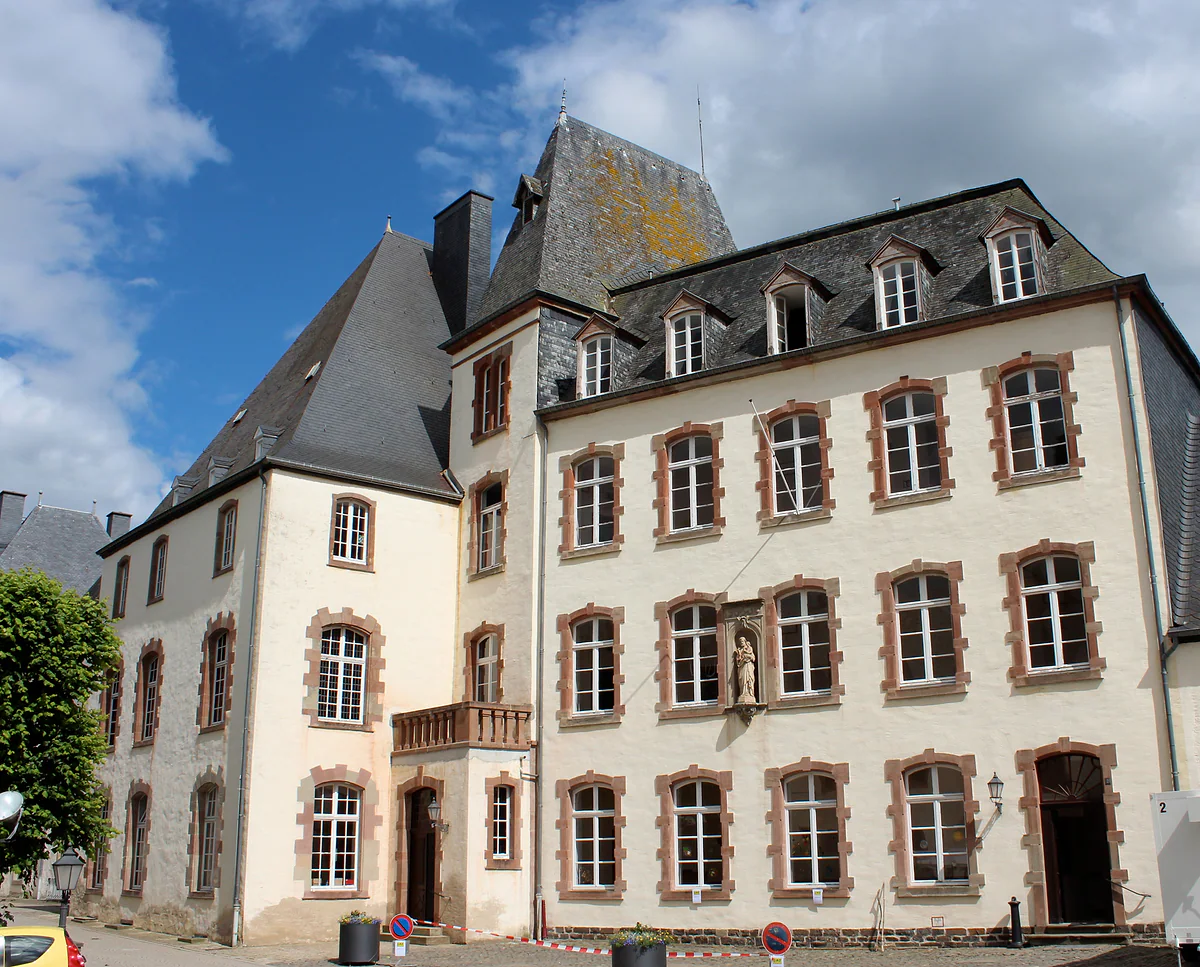
Wiltz Castle, with a pale façade, red stone window frames and a slate roof with dormer windows
Battle of the Bulge sites in Luxembourg
| Place | What to see | Practical details |
|---|---|---|
| Hamm (Luxembourg City) | American Cemetery, over 5,073 soldiers and Patton's grave | Daily, 9:00-17:00; closed 25-12 and 1-1 |
| Sandweiler | German war cemetery, 10,913 graves | Rue d'Itzig |
| Ettelbruck | General Patton Memorial Museum; town liberated 25-12-1944 | Tuesday to Sunday, 10:00-17:00; €5 |
| Diekirch | National Museum of Military History, dioramas and 100,000+ artefacts | Tuesday to Sunday, 10:00-18:00; €5 |
| Wiltz | Battle of the Bulge Museum in the castle; the «Saint Nick» tradition | Hours and prices not published on the official listing |
| Clervaux | Battle of the Bulge Museum in the castle, destroyed on 17-12-1944 | Hours and prices not published on the official listing |
| Schumannseck (Nothum) | 2.8 km memorial trail, 20 stations; National Liberation Museum | About 2 hours on foot |
Hours from visitluxembourg (week of 29-09 to 05-10-2026) and the Luxembourg City Tourist Office. They change in winter, so check before you go.
The battle in dates
| Date | What happened |
|---|---|
| 16-12-1944 | Surprise German attack in the Ardennes |
| 17-12-1944 | Clervaux castle destroyed |
| 25-12-1944 | Patton's troops liberate Ettelbruck |
| Late January 1945 | Patton's Americans retake the area |
| February 1945 | Vianden, the last town, is liberated |
| 24-12-1945 | Patton buried at Hamm, among his men |
Test yourself
True or false?
0/3 Pick before you peek.
-
General Patton is buried in the United States.
See the answer
False. He's buried at the American Cemetery at Hamm in Luxembourg, laid to rest on 24 December 1945 at his own wish among his soldiers.
-
Clervaux castle was destroyed during the Battle of the Bulge.
See the answer
True. It was destroyed on 17 December 1944 and later restored. Today it houses The Family of Man and a battle museum.
-
The Battle of the Bulge was fought only in Belgium.
See the answer
False. The front covered northern Luxembourg and eastern Belgium, and Luxembourg towns such as Wiltz, Clervaux and Diekirch saw house-to-house fighting.
0 of 425 Luxembourg guides
Your next stamp
- American Cemetery
- Diekirch
- General Patton Museum
- Military History Museum
- Wiltz Castle
- Clervaux Castle
- Ettelbruck
- Wiltz
- A Possen Museum
- Ansembourg
- Ansembourg Castles
- Asselborn
- Bascharage
- Beaufort castles
- Belval
- Belval blast furnaces
- Berg Castle
- Bernard-Massard cellars
- Bourglinster Castle
- Bourscheid Castle
- Brandenbourg
- Brandenbourg Castle
- Caves St Martin
- Christmas
- Echternach
- Echternach Abbey
- Ehnen
- Ehnen Wine Museum
- Esch-sur-Alzette
- Esch-sur-Sûre Castle
- European Museum Schengen
- Fond-de-Gras
- German war cemetery
- Haff Réimech
- Hohllay
- Hollenfels Castle
- Hosingen
- Kautenbach
- Kneiff
- Koerich Castle
- Larochette Castle
- Lasauvage
- Mersch Castle
- Moersdorf
- Mondorf Domaine Thermal
- Munsbach Castle
- National Mining Museum
- Parc Merveilleux
- Park Sënnesräich
- Places to visit
- Remich
- Rindschleiden
- Schiessentümpel
- Septfontaines Castle
- Slate Museum
- Stolzembourg
- Tudor Museum
- Useldange Castle
- Valley of the Seven Castles
- Vianden
- Vianden Castle
- Ville Haute
- Wasserbillig Aquarium
- Weiswampach lakes
- Ahn
- Berdorf
- Bourscheid-Plage
- Butterfly garden
- Clervaux
- Differdange
- Echternach lake
- Grevenmacher
- Heringer Millen
- Hollenfels
- Luxembourg City
- Luxembourg Science Center
- Meysembourg Castle
- Mullerthal
- National Day
- National Resistance Museum
- Perekop
- Remerschen
- Schoenfels Castle
- The Family of Man
- Things to do
- Upper Sûre Lake
- Vianden chairlift
- Wasserbillig
- Clervaux Abbey
- Echternach Roman villa
- Éislek
- Insenborn
- Kallektuffquell
- Machtum
- Most beautiful places
- Our Nature Park
- Pétange
- Pettingen Castle
- Schueberfouer
- Schwebsingen
- Victor Hugo House
- Waldbillig
- Dudelange
- Kuelscheier
- Lultzhausen
- Moselle Valley
- Octave
- Prettiest villages
- Sanem
- Schengen
- Wellenstein
- Wolfsschlucht
- Beaufort
- Bech-Kleinmacher
- Éimaischen
- Gaalgebierg
- Guttland
- Marnach
- Mondorf-les-Bains
- Putscheid
- Schifflange
- UNESCO World Heritage
- Carnival
- Consdorf
- Ellergronn
- Käerjeng
- Kayl
- Map
- Minett
- Munshausen
- Tandel
- Bech
- Buergbrennen
- Esch-sur-Sûre
- Rumelange
- Where is Luxembourg
- Is it a country?
- Lac de la Haute-Sûre (commune)
- Rosport-Mompach
- Wormeldange
- Larochette
- Mondercange
- Regions
- Bettembourg
- Bock Casemates
- Cantons
- Dancing procession
- Fischbach
- Garnich
- Mersch
- Moselle wine route
- Grund
- Heffingen
- Kehlen
- Lintgen
- Moselle river cruises
- Pétrusse Casemates
- Towns and villages
- Chemin de la Corniche
- Erpeldange-sur-Sûre
- Junglinster
- Kopstal
- Lorentzweiler
- Nommern
- Pfaffenthal
- Population
- Bissen
- Clausen
- Grand Ducal Palace
- Koerich
- Schieren
- Size
- Vallée de l'Ernz
- Feulen
- Kirchberg
- Languages
- Notre-Dame Cathedral
- Reisdorf
- Steinfort
- Bettendorf
- Habscht
- St Michael's Church
- Helperknapp
- Luxembourgish
- Place Guillaume II
- Name
- Place d'Armes
- History
- Place de la Constitution
- Grand Duke
- Colmar-Berg
- Flaxweiler
- Gare
- Hamm
- Kirchberg funicular
- Luxembourg fortress
- Mamer
- Mertert
- Minett Trail
- Mullerthal Trail
- Neumünster Abbey
- Parc Hosingen
- Pfaffenthal lift
- Political system
- Redange
- The Passerelle
- Wine festivals
- Winseler
- Beckerich
- Biwer
- EU institutions
- Goesdorf
- Limpertsberg
- Mudam
- Natur Musée
- Pulvermühl
- Stadtbredimus
- Troisvierges
- Wenzel walk
- Bonnevoie
- Bous-Waldbredimus
- Ell
- Flag
- Kiischpelt
- Manternach
- Philharmonie
- Vauban circuit
- Weiswampach
- Betzdorf
- Boulaide
- Dräi Eechelen Museum
- Facts
- Hollerich
- Lenningen
- Useldange
- Wincrange
- Bourscheid
- Dalheim
- Gasperich
- Public holidays
- Red Bridge
- Saeul
- Belair
- Second World War
- Vichten
- Merl
- Préizerdaul
- Cents
- EU and Schengen
- Groussbus-Wal
- Entry requirements
- Neudorf
- Rambrouch
- Currency and payments
- Mertzig
- Weimerskirch
- Adolphe Bridge
- Beggen
- Escapardenne
- How to get there
- International March of Diekirch
- MNHA (National Museum)
- Rock climbing
- Sandweiler
- Bridges
- Eich
- Flights
- Golf
- Hesperange
- Lëtzebuerg City Museum
- Canoeing and kayaking
- Dommeldange
- Luxembourg airport
- Strassen
- Villa Vauban
- Airport to city centre
- Bertrange
- Casino Luxembourg
- Mühlenbach
- Swimming pools
- From Brussels
- Pétrusse Valley
- Rollingergrund
- Walferdange
- Cessange
- Day trip from Brussels
- Municipal Park
- Steinsel
- Free walking tours
- From Paris
- Niederanven
- From Frankfurt
- Schuttrange
- Sightseeing train and bus
- By train
- Contern
- By coach
- Weiler-la-Tour
- Driving
- Luxembourg in one day
- Pretzel Sunday
- Rham Plateau
- Tour de Luxembourg
- Candlemas (Liichtmëssdag)
- Car hire
- Luxembourg in two days
- Saint-Esprit Plateau
- Luxembourg in three days
- Melusina statue
- Parking
- St Nicholas Day (Kleeschen)
- Fête de la Musique
- Luxembourg in four days
- Museums in Luxembourg
- Petrol
- Place de Clairefontaine
- A week in Luxembourg
- Getting around
- Luxembourg Marathon
- Tram and Bus Museum
- Free public transport
- Parks in Luxembourg City
- Road trip
- Belgium and Luxembourg
- Tram
- Buses
- Viewpoints
- Trains
- Luxembourg station
- Cycling
- LuxembourgPass
- Prices and budget
- On a budget
- Free things to do
- Mobile and roaming
- Healthcare
- Safety
- Scams
- Tourist information
- Packing list
- Swimming lakes
- With a dog
- Markets
- Tipping
- Shopping
- What to buy
- Shopping centres
- With kids
- For couples
- Playgrounds
- Adventure parks
- Nightlife
- Castles
- Theatres and concert venues
- Leudelange
- Nature parks
- Where to stay
- City-centre hotels
- Hiking
- Nature reserves
- Reckange-sur-Mess
- Hotels near the station
- Roeser
- Frisange
- Hotels in Kirchberg
- Airport hotels
- Dippach
- Hotels in Vianden
- Hotels in Echternach
- Hotels in Clervaux
- Hotels in Mondorf-les-Bains
- Hotels in Esch-sur-Alzette
- Hotels on the Moselle
- Mullerthal hotels
- Upper Sûre lake hotels
- Hotels in Diekirch and Ettelbruck
- Cheap hotels
- Luxury hotels
- Boutique hotels
- Spa hotels
- Family hotels
- Apartments
- Weather
- Youth hostels
- Best time to visit
- Campsites
- Holiday cottages
- In winter
- Castle hotels
- In spring
- Day trips
- In summer
- Around Luxembourg
- In autumn
- Ice skating
- Trier day trip
- Metz day trip
- Arlon day trip
- In January
- In February
- In March
- In April
- In May
- In June
- In July
- In August
- In September
- Food
- In October
- In November
- Where to eat
- In December
- Michelin restaurants
- Cheap eats
- Judd mat Gaardebounen
- Bouneschlupp
- Gromperekichelcher
- Kniddelen
- Quetschentaart
- Rieslingspaschtéit
- Events
- Wine
- Crémant
- Beer
Frequently asked questions
What happened in Luxembourg during the Battle of the Bulge?
On 16 December 1944 German forces launched a surprise attack on the American front in the north of the country. Wiltz, Clervaux, Diekirch, Ettelbruck, Beaufort and Echternach saw house-to-house fighting, and by January 1945 much of the Éislek lay in ruins.
Where is General Patton buried?
At the Luxembourg American Cemetery in Hamm, in Luxembourg City. He died after a car accident in Germany and was buried there on 24 December 1945, at his own request, alongside his men.
Which Battle of the Bulge museum is best in Luxembourg?
The most complete is the National Museum of Military History in Diekirch. There's also the General Patton Memorial Museum in Ettelbruck, battle museums in Wiltz and Clervaux castles and the National Liberation Museum at Schumannseck.
When did the Battle of the Bulge end in Luxembourg?
By late January 1945 Patton's troops had retaken the area, and the last town liberated was Vianden, in February 1945. The government's two official pages give different days for Vianden.
Are any Band of Brothers soldiers buried in Luxembourg?
Yes. Five members of «Easy Company», 506th Regiment, 101st Airborne Division, lie in the American Cemetery at Hamm, along with two Medal of Honor recipients.
Can you still see signs of the battle in the villages?
According to the official portal, older façades in the Éislek still bear shrapnel marks, and more than 80 years on, munitions and wartime equipment still turn up.
By
Tourism graduate with a master’s in Tourism Management and Planning from the University of Málaga, who has travelled across Europe. He writes every guide from official sources and his own judgement.
Published on . Facts checked on .
Sources
Some links in this guide are affiliate links: if you book through them, the site earns a commission at no extra cost to you. Affiliate disclosure
Photos: U.S. Air Force photo by Iris Reiff (Public domain); GilPe (CC BY-SA 3.0); Dudva (CC BY-SA 4.0); Zinneke (CC BY-SA 3.0), via Wikimedia Commons.