Walking route through the Pfaffenthal and the forts
The Vauban circuit, Louis XIV's fortress on foot
The Vauban circuit is a 5.16 km walk of about three hours through Luxembourg's old fortress, according to the government's portal. It starts at the Bock rock, drops into the Pfaffenthal through the Three Towers gate, crosses the Alzette between the Vauban towers, climbs to the Grünewald forts and Fort Thüngen and returns via Clausen. It's free.
In 30 seconds
Full read: 4 min
- The Vauban circuit is a 5.16 km, three-hour walk through Luxembourg's old fortress.
- It starts and ends at the Bock, taking in the Three Towers, the Pfaffenthal, the Vauban towers, the Grünewald forts, Fort Thüngen and Clausen.
- It's free; the Dräi Eechelen museum, halfway round, costs €7.
- Expect steps and slippery ground, though there are step-free options and buses to cut it short.
This is the walk I'd save for a second day, once you know the Corniche and the Grund. It's hillier than the Wenzel walk, but it shows you the part of the fortress hardly anyone sees, and halfway round the Dräi Eechelen museum gives you a rest under a roof.

Before you go
What I would keep in mind
-
01 Most beautiful
Walk over the river on the «Béinchen»
Between the two Vauban towers a defensive wall crosses the Alzette like a narrow bridge, the «Béinchen». You walk along its parapet path to the far bank, past loopholes partly rebuilt in recent years.
-
02 Worth the splurge
A 169-metre gallery underground
From Fort Thüngen you can walk underground to Fort Obergrünewald through a gallery cut into the rock. visitluxembourg says you do it with museum staff, during opening hours.
Dräi Eechelen Museum -
03 My tip
Steps or a step-free path
From the Bons Malades gate you can climb a long flight of steps or follow rue Vauban and rue des Trois Glands, a gentler way without steps. Watch out for slippery ground.
-
04 Getting there
A bus at every turn
Lines 9 and 14 stop at Pfaffenthal Um Bock and Clausen Plateau Altmünster, so you can cut the walk short whenever you like. Public transport is free.
Luxembourg free public transport
What I would book
My ranking, scored
The stops on the Vauban circuit I rate most
My own marks out of 10, weighing what each stop reveals of Vauban's fortress and what you see from it, based on the official route description.
0 of 6 seen
-
The Vauban towers and the «Béinchen»
Two towers that closed the Alzette valley, joined by a wall that crosses the river and can be walked along the top.
9.2 out of 10
-
Fort Thüngen and the Dräi Eechelen museum
The keep with its three golden acorns, and inside, the fortress story told through more than 600 objects.
9.0 out of 10
-
The view from Fort Obergrünewald
From its edge you see the upper town and the Bock with its shattered gun ports, put out of use after 1867.
8.8 out of 10
-
The Three Towers gate
The way out of the medieval town, with a square tower from around 1200 and two round ones from the 14th century.
8.2 out of 10
-
The Grünewald gate or «Höhlentor»
Built by Vauban in 1684 and 1685 to close the small side valley, with three flour stores still almost intact.
7.8 out of 10
-
The Mansfeld gate in Clausen
Older than 1600 and strengthened by Vauban in 1684 and 1685. It shut the fortress off to the north-east.
7.4 out of 10
The Wenzel walk tells you about the medieval wall. The Vauban circuit tells you about the fortress that turned Luxembourg into the Gibraltar of the North. It’s longer, hillier and passes places most visitors never set foot in, from the Pfaffenthal to the forts across the valley. This is how I’d walk it.
Who was Vauban and what did he do here?
Sébastien Le Prestre de Vauban (1633-1707) was Louis XIV’s great military engineer. visitluxembourg says he was made commissioner of fortifications at just twenty-two and went on to build or enlarge more than 160 fortresses. He arrived in Luxembourg with the French army while the city was still Spanish, and after the conquest of 1684 he set about strengthening it.
During the siege he had spotted the weak points. The Pfaffenthal, largely unfortified, and the heights opposite. In 1685 he brought them into the fortress, reinforced the heights with two forts and closed off the valley with a wall between Fort Berlaimont, on the city side, and the new Grünewald forts. The circuit follows those works.
From the Bock to the Pfaffenthal
The start is the Bock promontory, where the Spanish Habsburgs completed a first fort in 1620 that was destroyed in 1684. The route takes the castle bridge past the Council of State building, continues behind the houses of the national museum of history and art and leaves the medieval town through the Three Towers gate. Then it drops down the Montée de Pfaffenthal into the river quarter, which visitluxembourg says, together with the Grund, is the oldest part of the city.
On rue Laurent Menager you pass the Pfaffenthal lift, which visitluxembourg dates to 2016 and which comes down from the upper town. It’s free, so it makes a handy shortcut if you’d rather start or finish the walk here.
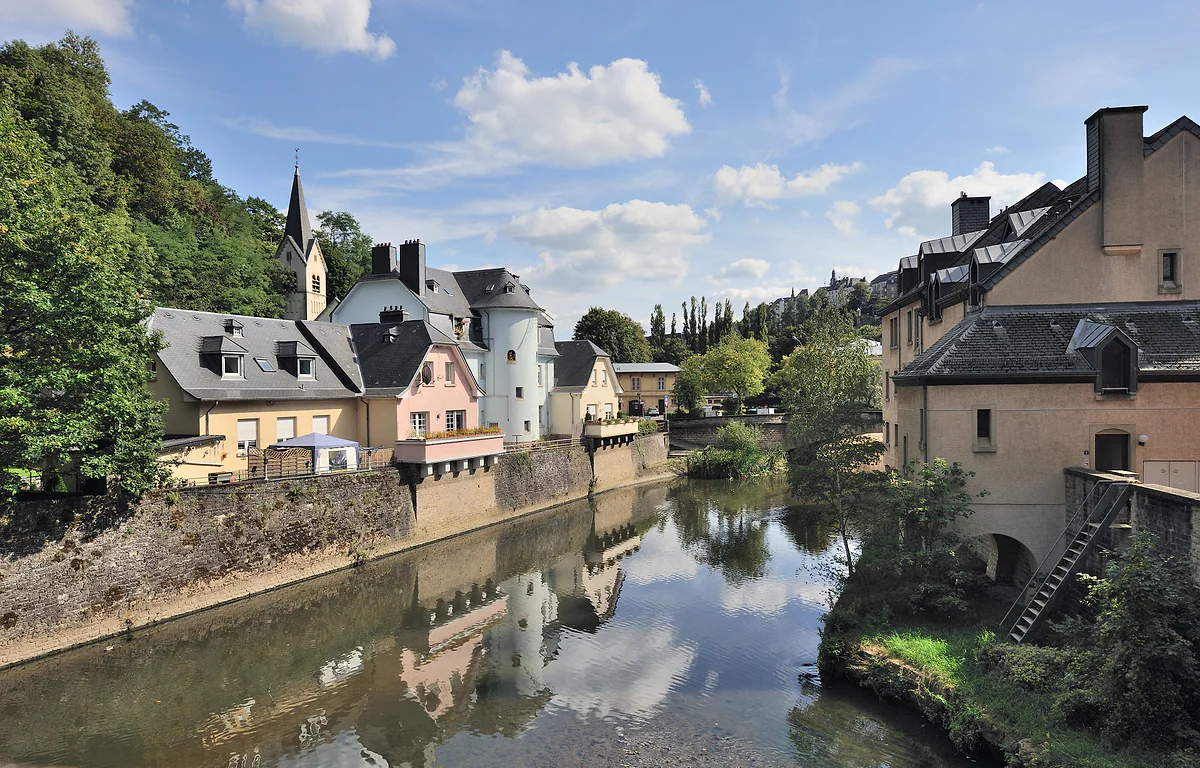
In the Pfaffenthal comes the piece I like most. The Vauban towers, which replaced the medieval Eich and Bons Malades gates, are joined by a wall that crosses the Alzette like a narrow bridge, the «Béinchen». You walk along its parapet path to the far bank. In front of the Eich gate a ravelin has recently been rebuilt, and on the riverbank stands the chimney of an 1876 pumping station that sent water up to the old town. In the tourist season a film on the city’s history is shown inside the Bons Malades gate.
Why are the Vauban towers here at all? The tourist office’s answer is the best summary I know. During the French siege, Vauban saw that the barely fortified Pfaffenthal and the heights opposite were the fortress’s weak spots, so in 1685 he brought them inside the defences. He put two forts up top and threw a wall across the valley floor from Fort Berlaymont on the city side to the new Grünewald forts, and doors on the first floor of the towers opened on to its wall-walk. One tower now holds a small cinema with a free documentary on the Pfaffenthal, open from 10:00 to 18:00 according to the same listing.
If you are staying the night, see the best hotel deals in Luxembourg for your dates: the well-placed rooms go fast.
The Grünewald forts
From the Bons Malades gate you have two choices. A long modern staircase following the old wall, or a gentler, step-free path along rue Vauban and rue des Trois Glands. At the top is Fort Niedergrünewald, from 1684 and 1685, of which part of one bastion survives. Then you drop into the small valley called the «Hiel», where Vauban built the Grünewald gate, with three flour stores still almost intact.
A narrow woodland path climbs to Fort Thüngen, whose keep with three towers crowned by golden acorns gives the Dräi Eechelen museum its name. It costs €7 and closes on Mondays. From the museum, accompanied by its staff and during opening hours, you can walk through a 169 m gallery cut into the rock to Fort Obergrünewald, uncovered and partly rebuilt in 2009. Its edge has, to my mind, the best view of the whole route, with the upper town opposite and the Bock with its shattered gun ports.
Back via Clausen
The circuit leaves the heights and drops to Clausen, where the Mansfeld gate, older than 1600 and strengthened by Vauban in 1684 and 1685, closed the fortress to the north-east. You cross the Alzette, pass beneath the arches of the 1858 to 1861 viaduct and, past the youth hostel on rue du Fort Olizy, return to the foot of the Bock.
If you are staying the night, see the best hotel deals in Luxembourg for your dates: the well-placed rooms go fast.
Practical tips
visitluxembourg says no special kit is needed but warns about slippery ground, so I’d wear shoes with a decent grip, the sort you’d pack for a coastal path at home. Buses 9 and 14 stop at Pfaffenthal Um Bock and Clausen Plateau Altmünster, so you can split the route in two if you tire. And if it’s your first day in the capital, I’d start with the Wenzel walk and leave this one for the next. If you’d rather have someone tell you the story in person, look at the options for a free walking tour in Luxembourg. I give the background to both routes in my guide to Luxembourg fortress.
The whole circuit lies within or beside the area UNESCO listed in 1994, so every gate, tower and fort you pass is part of the same World Heritage Site as the upper town.
So you do not lose the morning at the ticket office, browse tickets and tours in Luxembourg on GetYourGuide.
If you would rather go at your own pace, see the car hire deals in Luxembourg: the earlier you book, the more cars are left to choose from.
Before you fix your dates, compare tickets to Luxembourg: the same journey can cost very different amounts from one day to the next.
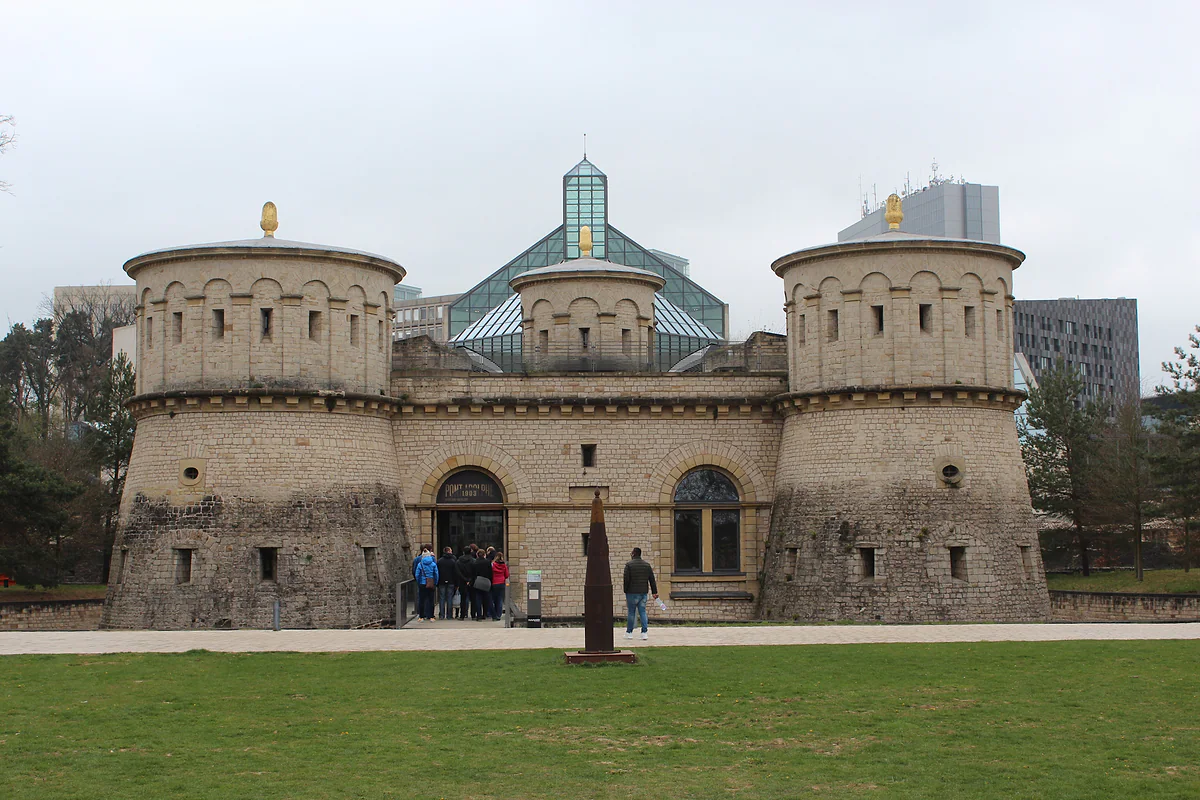
Fort Thüngen with its two round towers and golden acorns, home of the Dräi Eechelen museum in Kirchberg
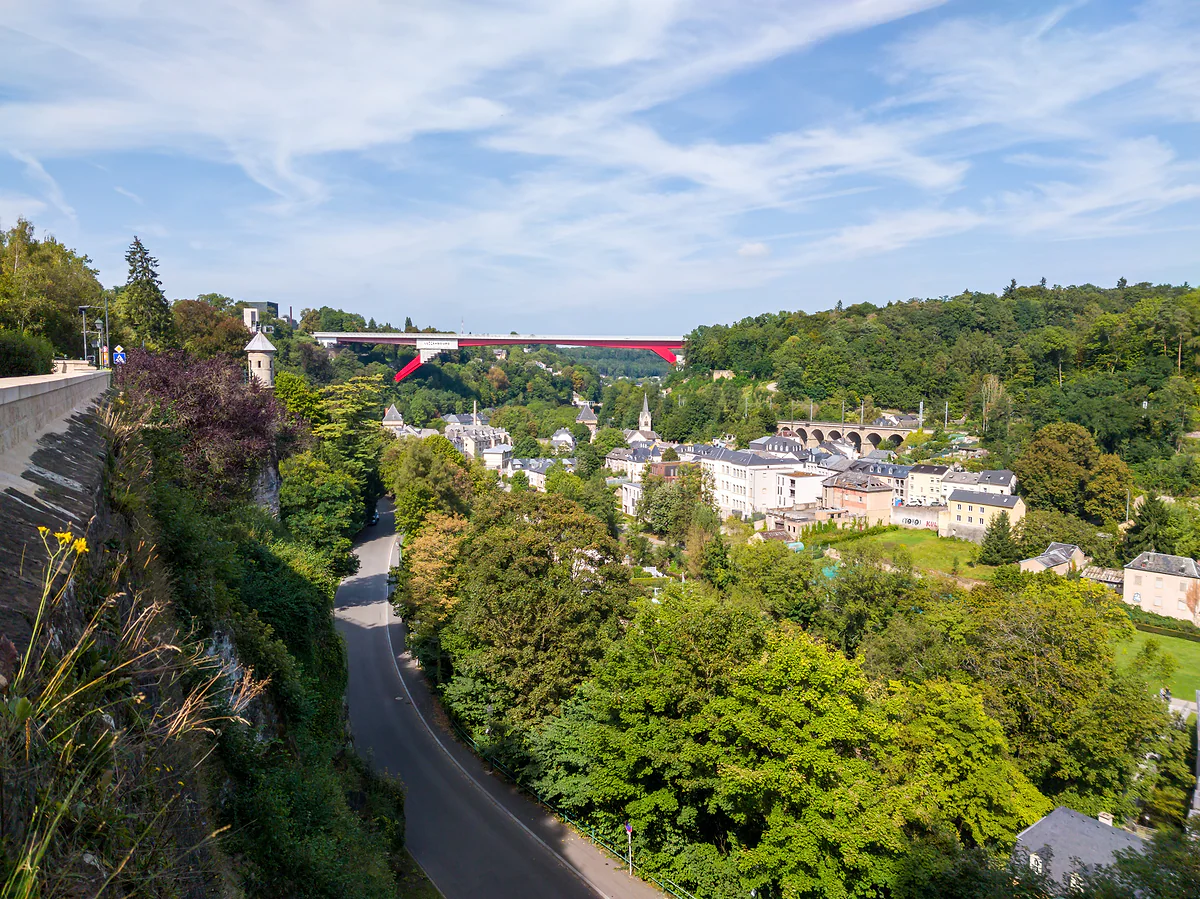
The Alzette valley at Pfaffenthal seen from the ramparts, with the red Grand Duchess Charlotte Bridge beyond
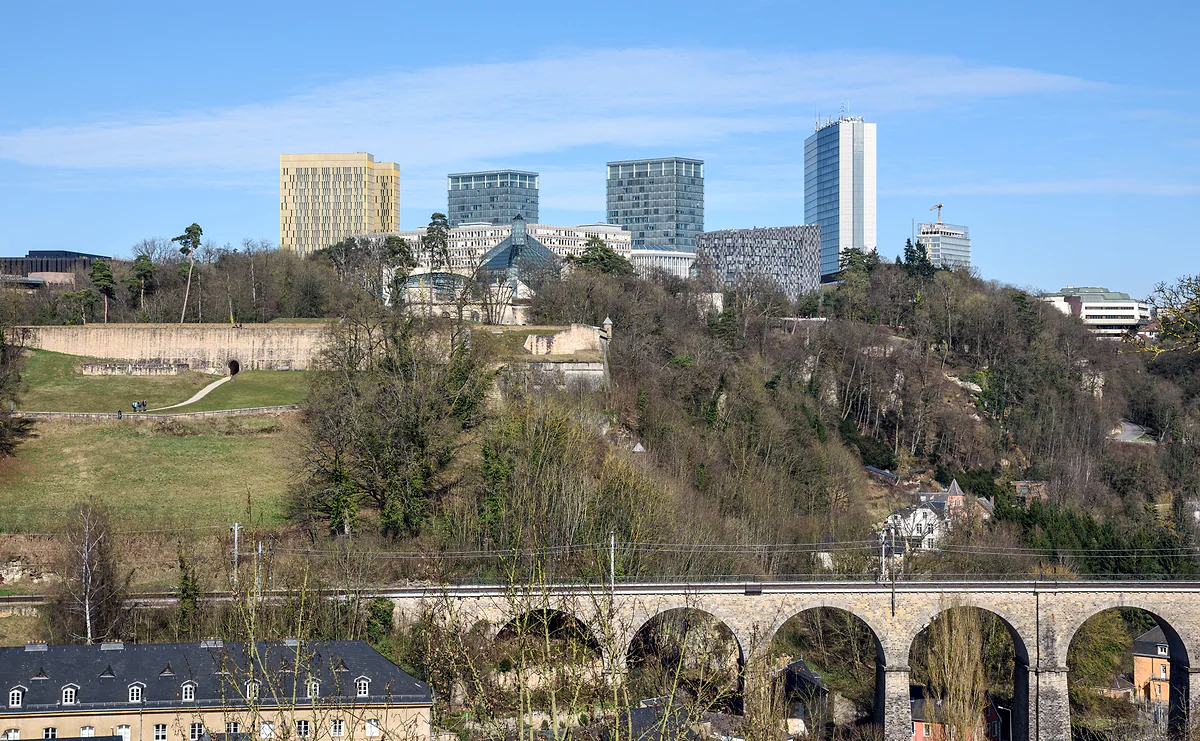
The towers of Kirchberg above the slopes of Fort Obergrünewald and a stone viaduct, seen from the ramparts
The Vauban circuit section by section
| Section | What you see |
|---|---|
| The Bock rock | Start; first Spanish fort, finished in 1620 and destroyed in 1684 |
| Castle bridge and Three Towers | Council of State, the MNHA houses, the Gouvernement inférieur bastion (1606) |
| Pfaffenthal | Panoramic lift, Vauban towers, the «Béinchen» |
| Grünewald | Fort Niedergrünewald (1684-85) and the Grünewald gate |
| Kirchberg | Fort Thüngen, Dräi Eechelen museum, 169 m gallery, Fort Obergrünewald |
| Clausen | Mansfeld gate, the 1858-61 viaduct and back to the Bock |
visitluxembourg, Vauban circuit page, checked on 29-09-2026. Distance and time from luxembourg.public.lu.
Wenzel or Vauban
| Wenzel walk | Vauban circuit | |
|---|---|---|
| Distance | 2.5 km | 5.16 km |
| Time | About 3 hours | About 3 hours |
| What it follows | The medieval wall of Wenceslas II | Vauban's works and the Grünewald forts |
| Districts | Bock, Corniche, Grund, Rham | Bock, Pfaffenthal, Kirchberg, Clausen |
luxembourg.public.lu and visitluxembourg, checked on 29-09-2026.
Test yourself
True or false?
0/3 Pick before you peek.
-
The Vauban circuit crosses the Alzette on top of a fortress wall.
See the answer
True. Between the two Vauban towers a defensive wall spans the river like a narrow bridge, the «Béinchen», and you walk along its parapet path.
-
Vauban fortified the Pfaffenthal because it was already the city's strongest point.
See the answer
False. Quite the reverse. During the French siege he saw the largely unfortified Pfaffenthal and the heights opposite as weak spots, and in 1685 he brought them into the fortress.
-
There's a tunnel you can walk through on the Vauban circuit.
See the answer
True. A 169 m gallery cut into the rock links Fort Thüngen with Fort Obergrünewald, and you can walk it with museum staff during opening hours.
- Length of the circuit
- 5.16 km
- Approximate time
- 3 h
- Fortresses Vauban built or enlarged, over
- 160
- Gallery between Thüngen and Obergrünewald
- 169 m
Map
Where Vauban circuit is
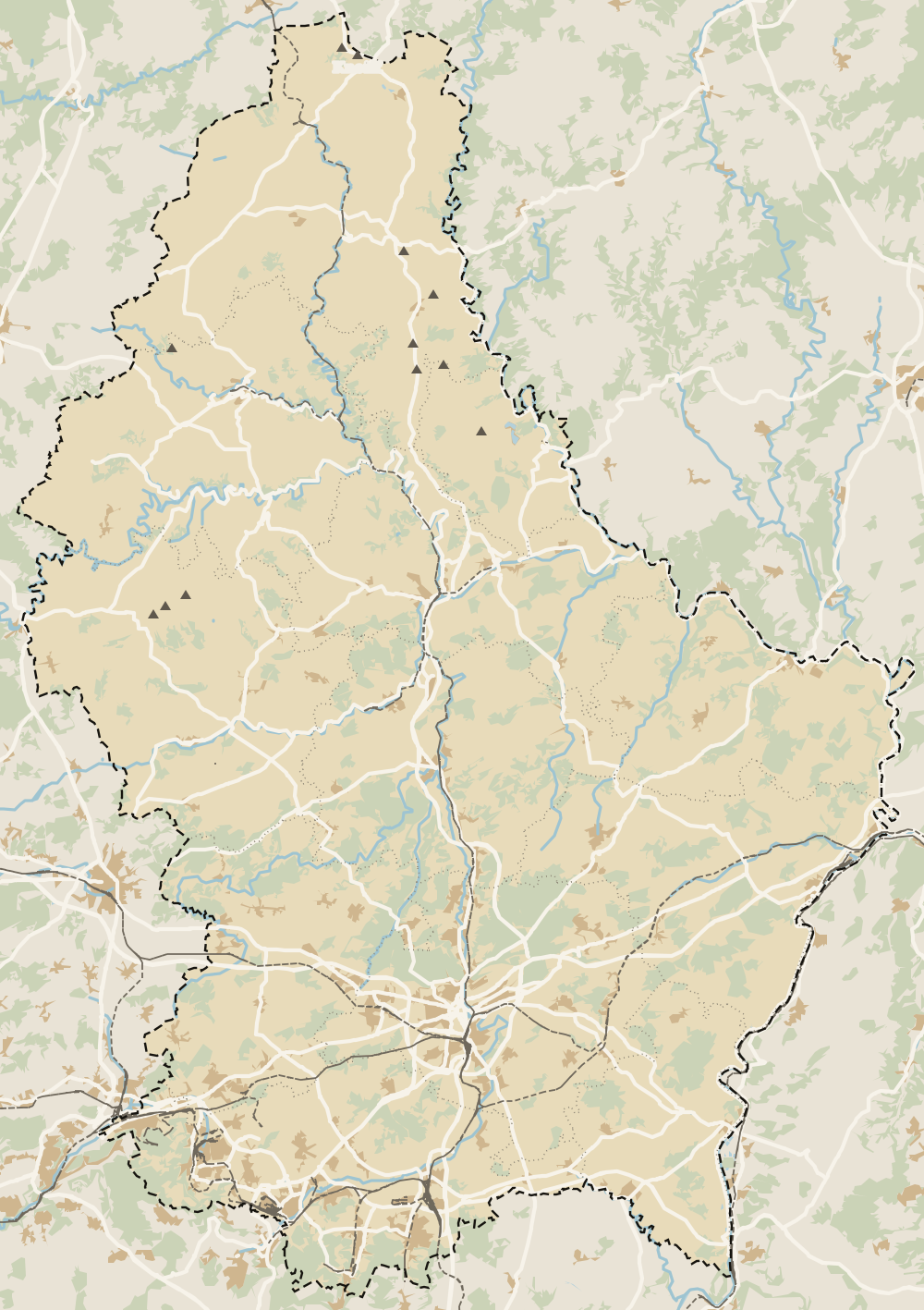
The thick dashed line is the border with Belgium, France and Germany, and the fine ones divide the twelve cantons. The Éislek lies to the north and the Moselle to the east. Every number opens its guide.
0 of 425 Luxembourg guides
Your next stamp
- Wenzel walk
- Pfaffenthal
- Luxembourg fortress
- Hiking
- Kirchberg funicular
- Rham Plateau
- Places to visit
- Sightseeing train and bus
- A Possen Museum
- American Cemetery
- Ansembourg
- Ansembourg Castles
- Asselborn
- Bascharage
- Beaufort castles
- Belval
- Belval blast furnaces
- Berg Castle
- Bernard-Massard cellars
- Bourglinster Castle
- Bourscheid Castle
- Brandenbourg
- Brandenbourg Castle
- Caves St Martin
- Christmas
- Clervaux Castle
- Echternach
- Echternach Abbey
- Ehnen
- Ehnen Wine Museum
- Esch-sur-Alzette
- Esch-sur-Sûre Castle
- European Museum Schengen
- Fond-de-Gras
- General Patton Museum
- German war cemetery
- Haff Réimech
- Hohllay
- Hollenfels Castle
- Hosingen
- Kautenbach
- Kneiff
- Koerich Castle
- Larochette Castle
- Lasauvage
- Mersch Castle
- Military History Museum
- Moersdorf
- Mondorf Domaine Thermal
- Munsbach Castle
- National Mining Museum
- Parc Merveilleux
- Park Sënnesräich
- Remich
- Rindschleiden
- Schiessentümpel
- Septfontaines Castle
- Slate Museum
- Stolzembourg
- Tudor Museum
- Useldange Castle
- Valley of the Seven Castles
- Vianden
- Vianden Castle
- Ville Haute
- Wasserbillig Aquarium
- Weiswampach lakes
- Wiltz Castle
- Ahn
- Berdorf
- Bourscheid-Plage
- Butterfly garden
- Clervaux
- Differdange
- Echternach lake
- Grevenmacher
- Heringer Millen
- Hollenfels
- Luxembourg City
- Luxembourg Science Center
- Meysembourg Castle
- Mullerthal
- National Day
- National Resistance Museum
- Perekop
- Remerschen
- Schoenfels Castle
- The Family of Man
- Things to do
- Upper Sûre Lake
- Vianden chairlift
- Wasserbillig
- Clervaux Abbey
- Echternach Roman villa
- Éislek
- Insenborn
- Kallektuffquell
- Machtum
- Most beautiful places
- Our Nature Park
- Pétange
- Pettingen Castle
- Schueberfouer
- Schwebsingen
- Victor Hugo House
- Waldbillig
- Dudelange
- Kuelscheier
- Lultzhausen
- Moselle Valley
- Octave
- Prettiest villages
- Sanem
- Schengen
- Wellenstein
- Wiltz
- Wolfsschlucht
- Beaufort
- Bech-Kleinmacher
- Éimaischen
- Gaalgebierg
- Guttland
- Marnach
- Mondorf-les-Bains
- Putscheid
- Schifflange
- UNESCO World Heritage
- Carnival
- Consdorf
- Ellergronn
- Käerjeng
- Kayl
- Map
- Minett
- Munshausen
- Tandel
- Bech
- Buergbrennen
- Esch-sur-Sûre
- Rumelange
- Where is Luxembourg
- Is it a country?
- Lac de la Haute-Sûre (commune)
- Rosport-Mompach
- Wormeldange
- Larochette
- Mondercange
- Regions
- Bettembourg
- Bock Casemates
- Cantons
- Dancing procession
- Diekirch
- Fischbach
- Garnich
- Mersch
- Moselle wine route
- Ettelbruck
- Grund
- Heffingen
- Kehlen
- Lintgen
- Moselle river cruises
- Pétrusse Casemates
- Towns and villages
- Chemin de la Corniche
- Erpeldange-sur-Sûre
- Junglinster
- Kopstal
- Lorentzweiler
- Nommern
- Population
- Bissen
- Clausen
- Grand Ducal Palace
- Koerich
- Schieren
- Size
- Vallée de l'Ernz
- Feulen
- Kirchberg
- Languages
- Notre-Dame Cathedral
- Reisdorf
- Steinfort
- Bettendorf
- Habscht
- St Michael's Church
- Helperknapp
- Luxembourgish
- Place Guillaume II
- Name
- Place d'Armes
- History
- Place de la Constitution
- Grand Duke
- Colmar-Berg
- Flaxweiler
- Gare
- Hamm
- Mamer
- Mertert
- Minett Trail
- Mullerthal Trail
- Neumünster Abbey
- Parc Hosingen
- Pfaffenthal lift
- Political system
- Redange
- The Passerelle
- Wine festivals
- Winseler
- Beckerich
- Biwer
- EU institutions
- Goesdorf
- Limpertsberg
- Mudam
- Natur Musée
- Pulvermühl
- Stadtbredimus
- Troisvierges
- Bonnevoie
- Bous-Waldbredimus
- Ell
- Flag
- Kiischpelt
- Manternach
- Philharmonie
- Weiswampach
- Betzdorf
- Boulaide
- Dräi Eechelen Museum
- Facts
- Hollerich
- Lenningen
- Useldange
- Wincrange
- Bourscheid
- Dalheim
- Gasperich
- Public holidays
- Red Bridge
- Saeul
- Belair
- Second World War
- Vichten
- Battle of the Bulge
- Merl
- Préizerdaul
- Cents
- EU and Schengen
- Groussbus-Wal
- Entry requirements
- Neudorf
- Rambrouch
- Currency and payments
- Mertzig
- Weimerskirch
- Adolphe Bridge
- Beggen
- Escapardenne
- How to get there
- International March of Diekirch
- MNHA (National Museum)
- Rock climbing
- Sandweiler
- Bridges
- Eich
- Flights
- Golf
- Hesperange
- Lëtzebuerg City Museum
- Canoeing and kayaking
- Dommeldange
- Luxembourg airport
- Strassen
- Villa Vauban
- Airport to city centre
- Bertrange
- Casino Luxembourg
- Mühlenbach
- Swimming pools
- From Brussels
- Pétrusse Valley
- Rollingergrund
- Walferdange
- Cessange
- Day trip from Brussels
- Municipal Park
- Steinsel
- Free walking tours
- From Paris
- Niederanven
- From Frankfurt
- Schuttrange
- By train
- Contern
- By coach
- Weiler-la-Tour
- Driving
- Luxembourg in one day
- Pretzel Sunday
- Tour de Luxembourg
- Candlemas (Liichtmëssdag)
- Car hire
- Luxembourg in two days
- Saint-Esprit Plateau
- Luxembourg in three days
- Melusina statue
- Parking
- St Nicholas Day (Kleeschen)
- Fête de la Musique
- Luxembourg in four days
- Museums in Luxembourg
- Petrol
- Place de Clairefontaine
- A week in Luxembourg
- Getting around
- Luxembourg Marathon
- Tram and Bus Museum
- Free public transport
- Parks in Luxembourg City
- Road trip
- Belgium and Luxembourg
- Tram
- Buses
- Viewpoints
- Trains
- Luxembourg station
- Cycling
- LuxembourgPass
- Prices and budget
- On a budget
- Free things to do
- Mobile and roaming
- Healthcare
- Safety
- Scams
- Tourist information
- Packing list
- Swimming lakes
- With a dog
- Markets
- Tipping
- Shopping
- What to buy
- Shopping centres
- With kids
- For couples
- Playgrounds
- Adventure parks
- Nightlife
- Castles
- Theatres and concert venues
- Leudelange
- Nature parks
- Where to stay
- City-centre hotels
- Nature reserves
- Reckange-sur-Mess
- Hotels near the station
- Roeser
- Frisange
- Hotels in Kirchberg
- Airport hotels
- Dippach
- Hotels in Vianden
- Hotels in Echternach
- Hotels in Clervaux
- Hotels in Mondorf-les-Bains
- Hotels in Esch-sur-Alzette
- Hotels on the Moselle
- Mullerthal hotels
- Upper Sûre lake hotels
- Hotels in Diekirch and Ettelbruck
- Cheap hotels
- Luxury hotels
- Boutique hotels
- Spa hotels
- Family hotels
- Apartments
- Weather
- Youth hostels
- Best time to visit
- Campsites
- Holiday cottages
- In winter
- Castle hotels
- In spring
- Day trips
- In summer
- Around Luxembourg
- In autumn
- Ice skating
- Trier day trip
- Metz day trip
- Arlon day trip
- In January
- In February
- In March
- In April
- In May
- In June
- In July
- In August
- In September
- Food
- In October
- In November
- Where to eat
- In December
- Michelin restaurants
- Cheap eats
- Judd mat Gaardebounen
- Bouneschlupp
- Gromperekichelcher
- Kniddelen
- Quetschentaart
- Rieslingspaschtéit
- Events
- Wine
- Crémant
- Beer
Frequently asked questions
What is the Vauban circuit in Luxembourg?
A walking route in the footsteps of the military engineer Vauban, taking in the strategic points of the old fortress with panoramic views. It passes the Bock, the Pfaffenthal, the Grünewald forts, Fort Thüngen and Clausen.
How long is the Vauban circuit?
5.16 km, taking about three hours according to the government's portal. There's plenty of up and down between the Alzette valley and the Kirchberg plateau.
Where does the Vauban circuit start?
On the Bock promontory, on the Montée de Clausen, and it finishes there too. Buses 9 and 14 stop at Pfaffenthal Um Bock and Clausen Plateau Altmünster.
Who was Vauban?
Sébastien Le Prestre de Vauban (1633-1707), Louis XIV's military engineer, who built or enlarged more than 160 fortresses. In 1685 he brought the Pfaffenthal and the heights opposite into Luxembourg's fortress.
Do you have to pay for anything on the Vauban circuit?
The walk is free. You only pay if you go into the Dräi Eechelen museum, €7, halfway round at Fort Thüngen.
Which is better, the Wenzel walk or the Vauban circuit?
For a first visit, the Wenzel walk, which is shorter and includes the Corniche. The Vauban circuit is longer, hillier and shows the forts across the valley; I'd keep it for a second day.
By
Tourism graduate with a master’s in Tourism Management and Planning from the University of Málaga, who has travelled across Europe. He writes every guide from official sources and his own judgement.
Published on . Updated on . Facts checked on .
Sources
Some links in this guide are affiliate links: if you book through them, the site earns a commission at no extra cost to you. Affiliate disclosure
Photos: Cayambe (CC BY-SA 3.0); Zinneke (CC BY-SA 3.0); Matti Blume (CC BY-SA 4.0); Cayambe (CC BY-SA 4.0), via Wikimedia Commons.