Valley of the Seven Castles, gardens open
Ansembourg's castles and the finest Baroque garden on the Eisch
Ansembourg has two castles. The new one, the Grand-Château, was built between 1639 and 1647 by ironmaster Thomas Bidart; a religious community has owned it since 1987 and it isn't open, but its Baroque gardens of 1750, with fountains, roses and ten mythological statues, open daily from 10am to 6pm. The old one, from the 12th century, belongs privately to the Count of Ansembourg.
In 30 seconds
Full read: 3 min
- Ansembourg has two castles, the old 12th-century one and the new one of 1639-1647.
- The 1750 Baroque gardens open 10am to 6pm; the buildings don't.
- The mythological avenue has ten Greek and Roman statues.
- The gardens close for private events, so check the calendar first.
If you only have time for one stop in the Eisch valley, make it this one. I'd arrive at 10am when the gates open, allow an hour for the terraces and the statue avenue, and check the calendar first, because the gardens close for private events.

Before you go
What I would keep in mind
-
01 Most beautiful
Ten gods in a row
The mythological avenue brings together ten sculptures from Greek and Roman mythology in the terraced gardens, according to visitluxembourg.
-
02 Watch out
You can't tour the castle
The Grand-Château has belonged to the Sukyo Mahikari community since 1987 and its buildings aren't generally open. You visit the gardens; the interior only on a pre-arranged guided tour.
-
03 My tip
Check for closures
The castle's website warns that the gardens close for private events; in autumn 2026 it announced a closure on 4 and 5 October.
-
04 Getting there
Kapell bus stop, five minutes away
The castle recommends free public transport, with the Kapell stop five minutes' walk away. Hollenfels is 1.5 km on along the valley route.
Hollenfels Castle
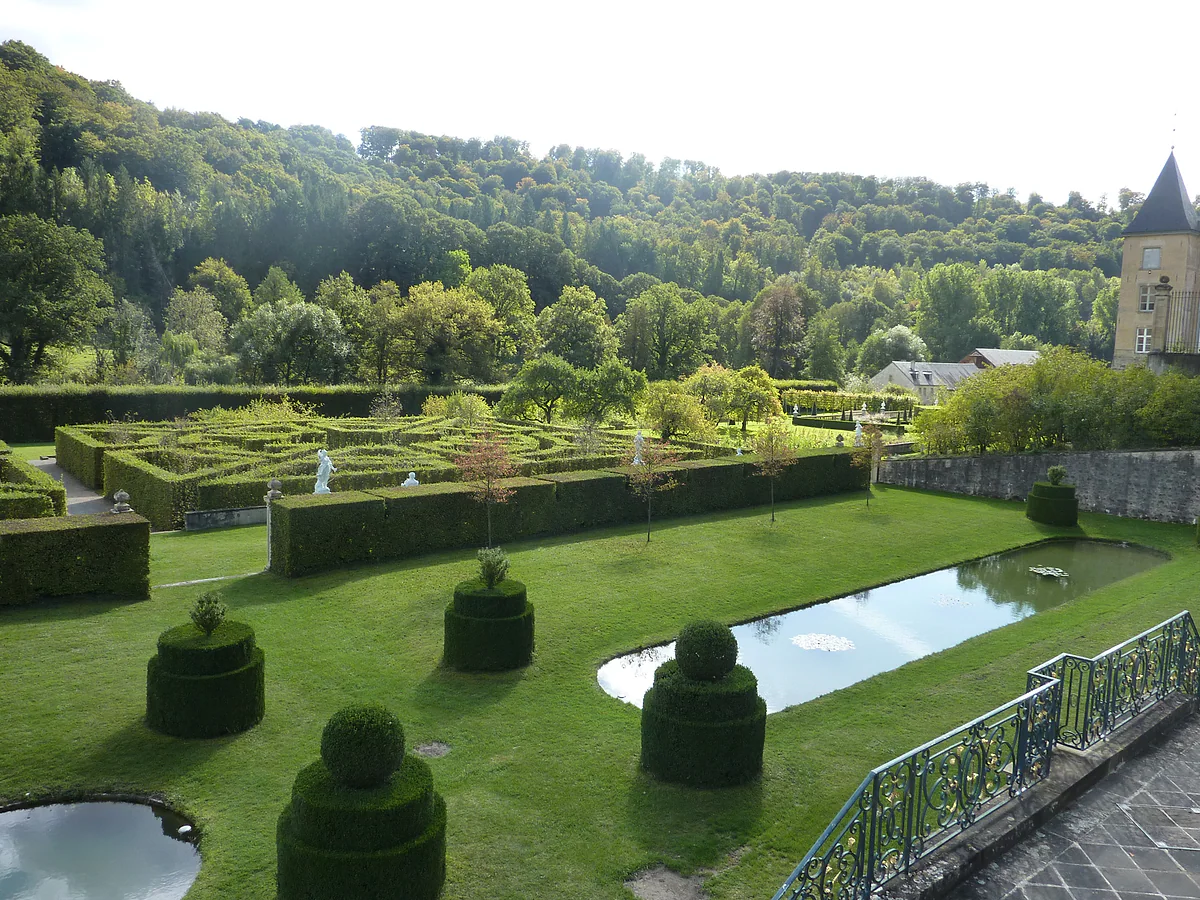
When people search for Ansembourg Castle, they nearly always mean the gardens, and that makes sense, because the gardens are all you can visit. The village has a medieval castle and a 17th-century one, and neither opens its doors. But the newer one has a set of Baroque terraces behind it that I rate as the loveliest thing in the whole Valley of the Seven Castles.
An ironmaster’s mansion
The Grand-Château, the new castle, was built between 1639 and 1647 by Thomas Bidart, whom Visit Guttland describes as a pioneer of the iron industry. So this isn’t a medieval fortress but the home of an Eisch valley entrepreneur who did well out of the local forges. In the 18th century the family climbed the social ladder, as his heirs became barons in 1728 and then counts, and it was then, in 1750, that the gardens were laid out with statues, steps and decorative fountains in the taste of the time. visitluxembourg also singles out its Baroque gateway.
Since 1987 the house has belonged to the Japanese religious community Sukyo Mahikari and isn’t open to the public, according to Visit Guttland. visitluxembourg adds that guided tours of the house can sometimes be organised if you ask ahead.
The gardens, terrace by terrace
These are terraced gardens with a wide variety of plants, fruit trees and large fountains. The eye-catcher is the mythological avenue, a walk lined with ten sculptures from Greek and Roman mythology. The castle’s website explains that the statues revolve around the return of the Golden Age, and adds a rose garden that revives Luxembourg’s old reputation as a land of roses. It also notes that the gardens have been brought back after years of careful restoration.
Families can print visitluxembourg’s Enigma in Ansembourg sheet, whose clues run from the courtyard through a maze to a plane tree hidden down a green tunnel, then on to the fountains. It’s a good way to keep youngsters happy in a formal garden.
Once your dates are set, check which hotels are still free in Luxembourg before prices climb.
Hours, rules and closures
The castle’s website gives the gardens as open every day from 10am to 6pm, and visitluxembourg lists the same hours for the week of 30 September to 6 October 2026. Two things to watch. First, it’s private property and hours are cut back for private events; the castle announced a closure on 4 and 5 October 2026, which makes its online calendar essential reading. Second, wedding, rally and professional photography requires permission and a fee, requested by email in advance.
As for price, I couldn’t find one on any official website, and I won’t make one up. If you’re used to National Trust gardens back home, adjust your expectations on facilities, too; neither official source mentions a café or shop on site, so I’d bring a flask and a snack.
When to go
I’d choose late spring or early summer, when the roses and fruit trees are at their best, and arrive at the 10am opening to have the terraces to myself. The gardens also host public events; on 2 August 2026, for instance, they held a day called the Festival du Vivant, with guided walks, workshops and food from several countries. The castle’s website posts its programme. It publishes no separate winter timetable, but in winter the garden naturally loses its colour.
Once your dates are set, check which hotels are still free in Luxembourg before prices climb.
The old castle
Ansembourg’s other castle, from the 12th century, is 2.7 km from Hollenfels on Visit Guttland’s route, which treats it as a stop in its own right. It belongs outright to the Count of Ansembourg and admits no visitors. The only way in, says the regional office, is to book accommodation there. You can see its outline from the road and the route’s viewpoints.
Getting there and what’s nearby
The castle suggests leaving the car behind and taking the free bus to Kapell, five minutes from the gate; by car, exits are Mamer-Capellen on the A6 or Mersch on the A7. Just 1.5 km on is Hollenfels Castle, with its keep above the Eisch, and all seven stops, in order, are in my Valley of the Seven Castles route. The village and its medieval link with Keispelt are covered in Ansembourg, and the rest of the country’s castles in castles in Luxembourg.
If you would rather have a local show you round, book a guided tour in Ansembourg Castles and choose by the reviews.
A car frees you from timetables: search car hire in Luxembourg on DiscoverCars and compare companies.
So you do not pay over the odds, look at trains, coaches and flights to Luxembourg on Omio and pick the one that suits you.
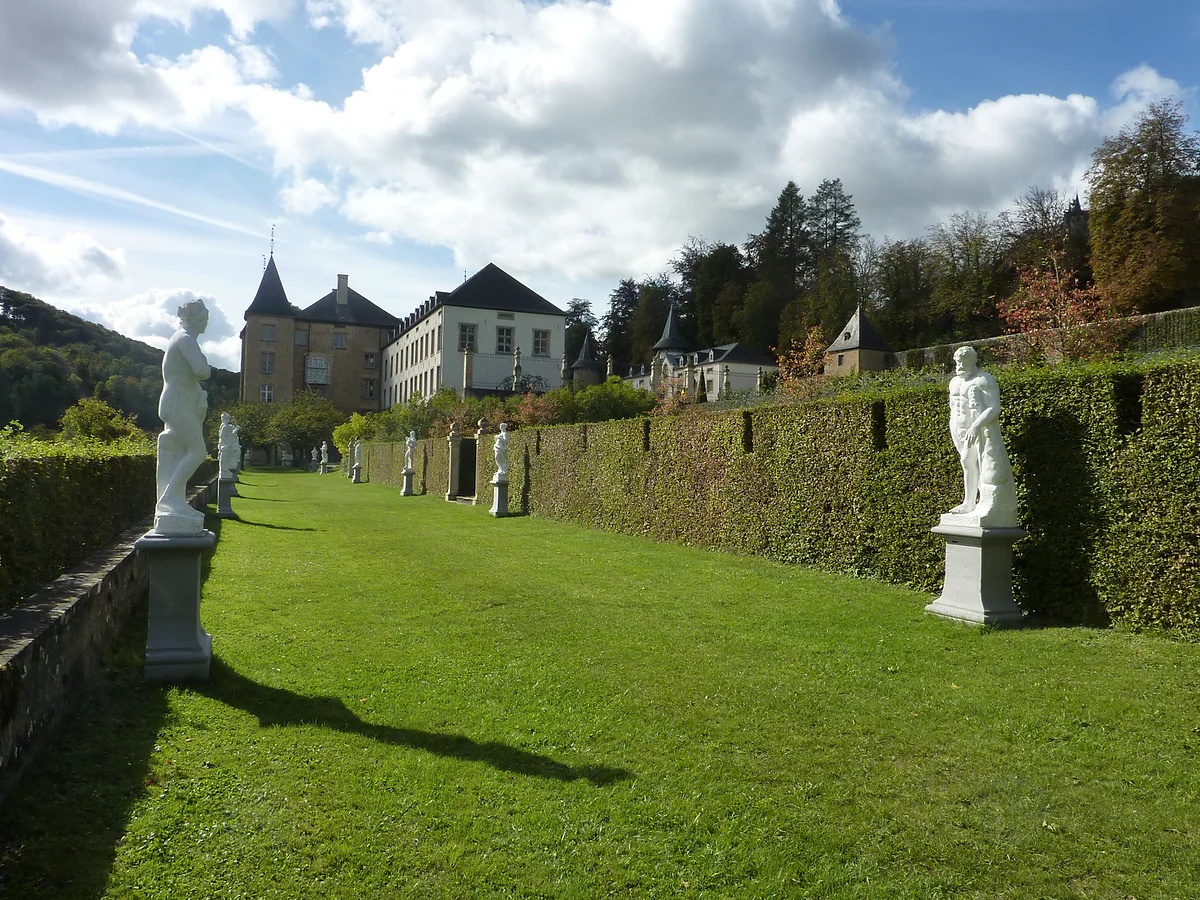
A grassy walk lined with white statues in the gardens at Ansembourg, with the new castle and hills behind
Visiting the gardens (2026)
| Item | Detail |
|---|---|
| Opening | 10am-6pm, every day |
| Closures | For private events (4 and 5 October 2026) |
| Price | Not published by any official source |
| Buildings | Not open; guided tours on request |
| Event or professional photos | Prior permission and a fee |
| Bus | Kapell stop, 5 minutes' walk |
gcansembourg.eu and visitluxembourg, checked on 30 September 2026. visitluxembourg's hours are for the week of 30 Sept to 6 Oct 2026.
The two castles
| Item | Old castle | New castle (Grand-Château) |
|---|---|---|
| Period | 12th century | 1639-1647 |
| Builder | Not published | Thomas Bidart, iron pioneer |
| Owner | Count of Ansembourg | Sukyo Mahikari, since 1987 |
| What you can visit | Nothing, unless you book accommodation | The 1750 gardens |
Visit Guttland and visitluxembourg.
Test yourself
True or false?
0/3 Pick before you peek.
-
Ansembourg's new castle was built by an iron industrialist.
See the answer
True. Thomas Bidart, a pioneer of the iron industry, built it between 1639 and 1647.
-
The Ansembourg gardens date from the 17th century, like the castle.
See the answer
False. The castle is from the first half of the 17th century, but the gardens were laid out in 1750.
-
You can get into the old Ansembourg castle by booking accommodation.
See the answer
True. Visit Guttland says it's strictly private and access is only possible with an accommodation booking.
- New castle completed
- 1647
- Gardens laid out
- 1750
- Statues on the mythological avenue
- 10
- Passed to Sukyo Mahikari
- 1987
Map
Where Ansembourg Castles is
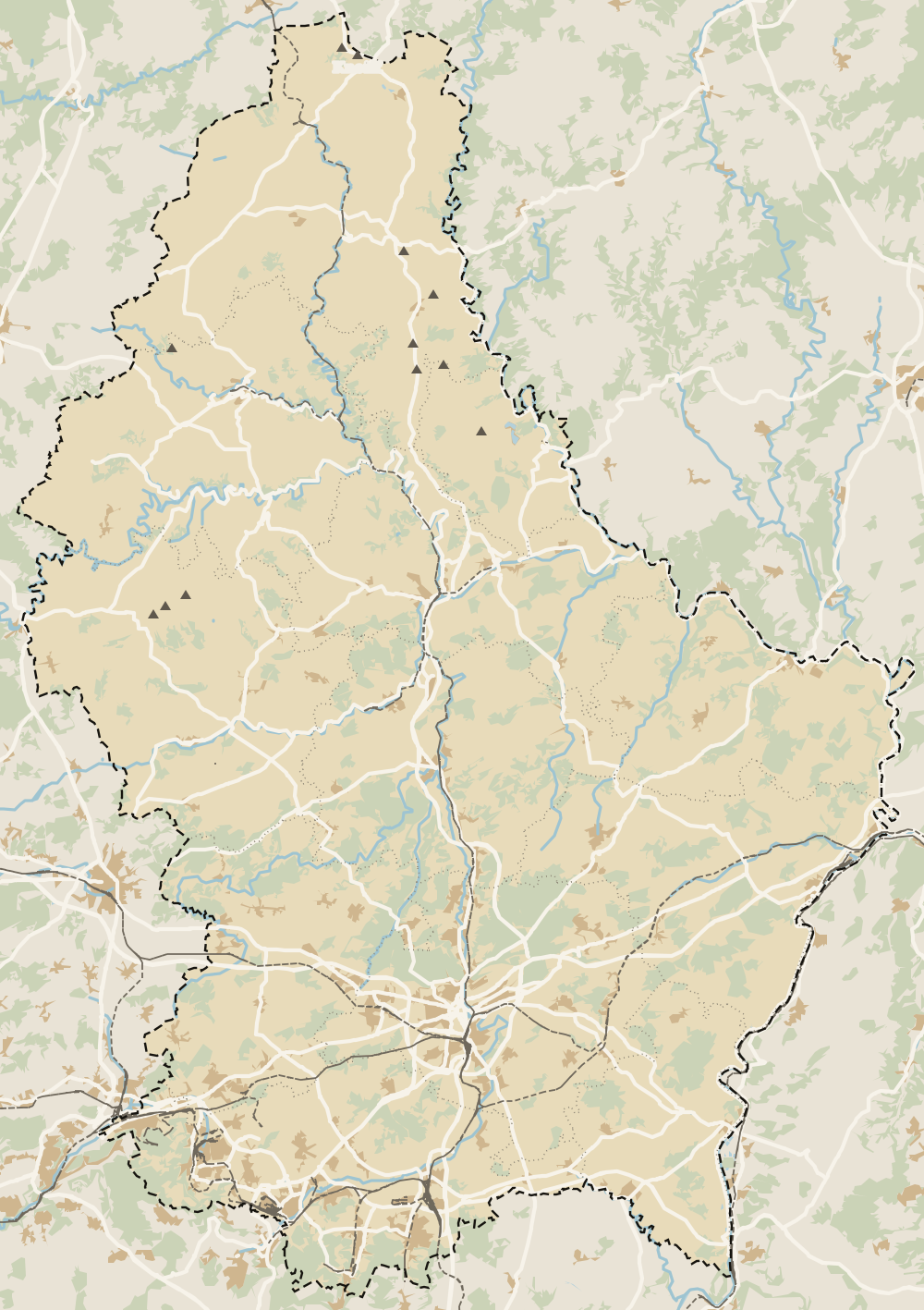
The thick dashed line is the border with Belgium, France and Germany, and the fine ones divide the twelve cantons. The Éislek lies to the north and the Moselle to the east. Every number opens its guide.
0 of 425 Luxembourg guides
Your next stamp
- Ansembourg
- Meysembourg Castle
- Munsbach Castle
- Larochette Castle
- Beaufort castles
- A Possen Museum
- American Cemetery
- Asselborn
- Bascharage
- Belval
- Belval blast furnaces
- Berg Castle
- Bernard-Massard cellars
- Bourglinster Castle
- Bourscheid Castle
- Brandenbourg
- Brandenbourg Castle
- Caves St Martin
- Christmas
- Clervaux Castle
- Echternach
- Echternach Abbey
- Ehnen
- Ehnen Wine Museum
- Esch-sur-Alzette
- Esch-sur-Sûre Castle
- European Museum Schengen
- Fond-de-Gras
- General Patton Museum
- German war cemetery
- Haff Réimech
- Hohllay
- Hollenfels Castle
- Hosingen
- Kautenbach
- Kneiff
- Koerich Castle
- Lasauvage
- Mersch Castle
- Military History Museum
- Moersdorf
- Mondorf Domaine Thermal
- National Mining Museum
- Parc Merveilleux
- Park Sënnesräich
- Places to visit
- Remich
- Rindschleiden
- Schiessentümpel
- Septfontaines Castle
- Slate Museum
- Stolzembourg
- Tudor Museum
- Useldange Castle
- Valley of the Seven Castles
- Vianden
- Vianden Castle
- Ville Haute
- Wasserbillig Aquarium
- Weiswampach lakes
- Wiltz Castle
- Ahn
- Berdorf
- Bourscheid-Plage
- Butterfly garden
- Clervaux
- Differdange
- Echternach lake
- Grevenmacher
- Heringer Millen
- Hollenfels
- Luxembourg City
- Luxembourg Science Center
- Mullerthal
- National Day
- National Resistance Museum
- Perekop
- Remerschen
- Schoenfels Castle
- The Family of Man
- Things to do
- Upper Sûre Lake
- Vianden chairlift
- Wasserbillig
- Clervaux Abbey
- Echternach Roman villa
- Éislek
- Insenborn
- Kallektuffquell
- Machtum
- Most beautiful places
- Our Nature Park
- Pétange
- Pettingen Castle
- Schueberfouer
- Schwebsingen
- Victor Hugo House
- Waldbillig
- Dudelange
- Kuelscheier
- Lultzhausen
- Moselle Valley
- Octave
- Prettiest villages
- Sanem
- Schengen
- Wellenstein
- Wiltz
- Wolfsschlucht
- Beaufort
- Bech-Kleinmacher
- Éimaischen
- Gaalgebierg
- Guttland
- Marnach
- Mondorf-les-Bains
- Putscheid
- Schifflange
- UNESCO World Heritage
- Carnival
- Consdorf
- Ellergronn
- Käerjeng
- Kayl
- Map
- Minett
- Munshausen
- Tandel
- Bech
- Buergbrennen
- Esch-sur-Sûre
- Rumelange
- Where is Luxembourg
- Is it a country?
- Lac de la Haute-Sûre (commune)
- Rosport-Mompach
- Wormeldange
- Larochette
- Mondercange
- Regions
- Bettembourg
- Bock Casemates
- Cantons
- Dancing procession
- Diekirch
- Fischbach
- Garnich
- Mersch
- Moselle wine route
- Ettelbruck
- Grund
- Heffingen
- Kehlen
- Lintgen
- Moselle river cruises
- Pétrusse Casemates
- Towns and villages
- Chemin de la Corniche
- Erpeldange-sur-Sûre
- Junglinster
- Kopstal
- Lorentzweiler
- Nommern
- Pfaffenthal
- Population
- Bissen
- Clausen
- Grand Ducal Palace
- Koerich
- Schieren
- Size
- Vallée de l'Ernz
- Feulen
- Kirchberg
- Languages
- Notre-Dame Cathedral
- Reisdorf
- Steinfort
- Bettendorf
- Habscht
- St Michael's Church
- Helperknapp
- Luxembourgish
- Place Guillaume II
- Name
- Place d'Armes
- History
- Place de la Constitution
- Grand Duke
- Colmar-Berg
- Flaxweiler
- Gare
- Hamm
- Kirchberg funicular
- Luxembourg fortress
- Mamer
- Mertert
- Minett Trail
- Mullerthal Trail
- Neumünster Abbey
- Parc Hosingen
- Pfaffenthal lift
- Political system
- Redange
- The Passerelle
- Wine festivals
- Winseler
- Beckerich
- Biwer
- EU institutions
- Goesdorf
- Limpertsberg
- Mudam
- Natur Musée
- Pulvermühl
- Stadtbredimus
- Troisvierges
- Wenzel walk
- Bonnevoie
- Bous-Waldbredimus
- Ell
- Flag
- Kiischpelt
- Manternach
- Philharmonie
- Vauban circuit
- Weiswampach
- Betzdorf
- Boulaide
- Dräi Eechelen Museum
- Facts
- Hollerich
- Lenningen
- Useldange
- Wincrange
- Bourscheid
- Dalheim
- Gasperich
- Public holidays
- Red Bridge
- Saeul
- Belair
- Second World War
- Vichten
- Battle of the Bulge
- Merl
- Préizerdaul
- Cents
- EU and Schengen
- Groussbus-Wal
- Entry requirements
- Neudorf
- Rambrouch
- Currency and payments
- Mertzig
- Weimerskirch
- Adolphe Bridge
- Beggen
- Escapardenne
- How to get there
- International March of Diekirch
- MNHA (National Museum)
- Rock climbing
- Sandweiler
- Bridges
- Eich
- Flights
- Golf
- Hesperange
- Lëtzebuerg City Museum
- Canoeing and kayaking
- Dommeldange
- Luxembourg airport
- Strassen
- Villa Vauban
- Airport to city centre
- Bertrange
- Casino Luxembourg
- Mühlenbach
- Swimming pools
- From Brussels
- Pétrusse Valley
- Rollingergrund
- Walferdange
- Cessange
- Day trip from Brussels
- Municipal Park
- Steinsel
- Free walking tours
- From Paris
- Niederanven
- From Frankfurt
- Schuttrange
- Sightseeing train and bus
- By train
- Contern
- By coach
- Weiler-la-Tour
- Driving
- Luxembourg in one day
- Pretzel Sunday
- Rham Plateau
- Tour de Luxembourg
- Candlemas (Liichtmëssdag)
- Car hire
- Luxembourg in two days
- Saint-Esprit Plateau
- Luxembourg in three days
- Melusina statue
- Parking
- St Nicholas Day (Kleeschen)
- Fête de la Musique
- Luxembourg in four days
- Museums in Luxembourg
- Petrol
- Place de Clairefontaine
- A week in Luxembourg
- Getting around
- Luxembourg Marathon
- Tram and Bus Museum
- Free public transport
- Parks in Luxembourg City
- Road trip
- Belgium and Luxembourg
- Tram
- Buses
- Viewpoints
- Trains
- Luxembourg station
- Cycling
- LuxembourgPass
- Prices and budget
- On a budget
- Free things to do
- Mobile and roaming
- Healthcare
- Safety
- Scams
- Tourist information
- Packing list
- Swimming lakes
- With a dog
- Markets
- Tipping
- Shopping
- What to buy
- Shopping centres
- With kids
- For couples
- Playgrounds
- Adventure parks
- Nightlife
- Castles
- Theatres and concert venues
- Leudelange
- Nature parks
- Where to stay
- City-centre hotels
- Hiking
- Nature reserves
- Reckange-sur-Mess
- Hotels near the station
- Roeser
- Frisange
- Hotels in Kirchberg
- Airport hotels
- Dippach
- Hotels in Vianden
- Hotels in Echternach
- Hotels in Clervaux
- Hotels in Mondorf-les-Bains
- Hotels in Esch-sur-Alzette
- Hotels on the Moselle
- Mullerthal hotels
- Upper Sûre lake hotels
- Hotels in Diekirch and Ettelbruck
- Cheap hotels
- Luxury hotels
- Boutique hotels
- Spa hotels
- Family hotels
- Apartments
- Weather
- Youth hostels
- Best time to visit
- Campsites
- Holiday cottages
- In winter
- Castle hotels
- In spring
- Day trips
- In summer
- Around Luxembourg
- In autumn
- Ice skating
- Trier day trip
- Metz day trip
- Arlon day trip
- In January
- In February
- In March
- In April
- In May
- In June
- In July
- In August
- In September
- Food
- In October
- In November
- Where to eat
- In December
- Michelin restaurants
- Cheap eats
- Judd mat Gaardebounen
- Bouneschlupp
- Gromperekichelcher
- Kniddelen
- Quetschentaart
- Rieslingspaschtéit
- Events
- Wine
- Crémant
- Beer
Frequently asked questions
Can you visit Ansembourg Castle?
The gardens of the new castle, yes, 10am to 6pm daily except during private events. The buildings aren't generally open, though visitluxembourg says guided tours can be arranged on request. The old castle is private.
How much does it cost to visit the Ansembourg gardens?
Neither visitluxembourg nor the castle's website publishes a price. What they do ask is that you respect the hours and rules, and they charge a fee for wedding, rally or professional photography.
Who built Ansembourg Castle?
The new castle was built between 1639 and 1647 by Thomas Bidart, a pioneer of the iron industry. His heirs became barons in 1728 and later counts. The old castle dates from the 12th century.
Who owns Ansembourg Castle?
The new castle has belonged to the Japanese religious community Sukyo Mahikari since 1987, says Visit Guttland. The old one is strictly private, owned by the Count of Ansembourg.
How do I get to the Ansembourg gardens?
By bus to the Kapell stop, five minutes' walk away, free like all public transport in Luxembourg. By car, via the A6 (Mamer-Capellen exit) or A7 (Mersch exit), following signs to the car park.
What's in the Ansembourg gardens?
Terraces with a wide range of plants, fruit trees, fountains, steps, a rose garden and sculptures, including the ten-statue mythological avenue. The castle's website says the statues follow the theme of the return of the Golden Age.
By
Tourism graduate with a master’s in Tourism Management and Planning from the University of Málaga, who has travelled across Europe. He writes every guide from official sources and his own judgement.
Published on . Facts checked on .
Sources
Some links in this guide are affiliate links: if you book through them, the site earns a commission at no extra cost to you. Affiliate disclosure
Photos: Zinneke (CC BY-SA 3.0); Zinneke (CC BY-SA 3.0), via Wikimedia Commons.