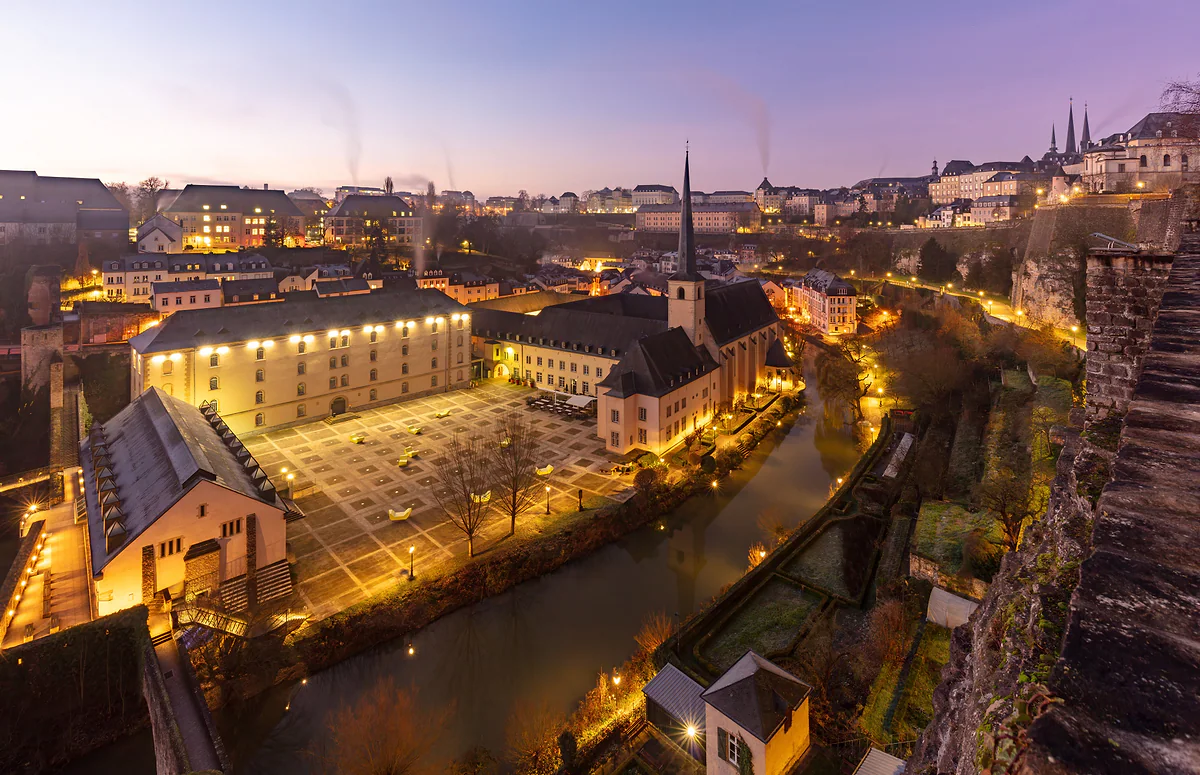
Cultural centre in the Grund, by the Alzette
Neumünster Abbey, from cloister to prison to stage
Neumünster Abbey is a Benedictine complex in Luxembourg City's Grund district, built after the older Altmünster Abbey was destroyed in 1542. It served as a military hospital until 1867 and a men's prison until 1980, and since 2004 it has been the Neimënster cultural centre. As of September 2026 it opens 08:00-19:00 on weekdays and 10:00-18:00 at weekends.
To me Neumünster is the single building that tells Luxembourg's story best. I'd walk into the courtyard, look up at the Bock rock from below, then step into St John's for the Black Madonna, which a lot of visitors miss entirely.

Before you go
What I would keep in mind
-
01 Most beautiful
A courtyard with the upper town overhead
The complex is built as four wings around an inner courtyard. From there you see the bell tower of St John's and, behind it, the cliff carrying the upper town. It's the defining view of the Grund.
-
02 My tip
It opens early on weekdays
Monday to Friday the centre opens at 08:00, earlier than almost any museum in the capital. If you want the courtyard quiet and in soft light, that first hour is the one.
-
03 To save money
Grounds and church at no charge
The tourist office lists no admission price for the Neimënster grounds, and none is given for St John's Church either. You only pay for the shows and exhibitions on its programme.
-
04 Getting there
Take the lift down from Saint-Esprit
The city runs a free public lift between the Plateau du Saint-Esprit and the Grund. From the bottom, the abbey is a short riverside stroll away.
the Grund
It’s rare for one building to explain a whole city. Neumünster has been a monastery, a military hospital, a prison and an arts centre, and each phase lines up with a chapter of Luxembourg’s history. It sits at the bottom of the valley in the Grund, with the cliff of the upper town rising straight up behind it. If you come away with one picture of the district, odds are this bell tower is in it.
Why it’s the “new” abbey
There was an older one. The Benedictines had Altmünster Abbey, and in 1542 it was destroyed. The monks moved down to the Grund and built afresh, with a church and four wings set around an inner courtyard. In 1606 the abbey and St John’s Church were rebuilt together, and the church as you see it dates from 1688 to 1705.
That cycle of destruction and rebuilding is the history of the Luxembourg fortress in miniature. A city that changed hands that many times ended up with buildings that changed job just as often.
From hospital to prison
In the late 18th century the French revolutionary authorities seized the church, and the complex became a military hospital. It stayed one until 1867, the year of the Treaty of London, when the fortress was dismantled and the garrison left. The Luxembourg state then took it over and turned it into a men’s prison, which ran until 1980.
This is the chapter I find most interesting, because it sets the mood of the place. It isn’t a chocolate-box monastery. It’s a thick-walled building that locked people up for more than a century, and you can feel that in the architecture even now it’s full of exhibitions.
To sleep close to everything, search places to stay in Luxembourg on Booking.com and filter by area before price.
What Neimënster is today
After a thorough restoration, the complex reopened in 2004 as the Neumünster Abbey Cultural Meeting Centre, Neimënster in Luxembourgish. It stages theatre, dance, music, exhibitions, courses and talks, and houses the Council of Europe’s European Institute of Cultural Routes and the Pierre Werner Institute. There’s also a brasserie, artists’ accommodation and a shop.
According to the tourist office it opens Monday to Friday from 08:00 to 19:00 and on Saturday and Sunday from 10:00 to 18:00, as of September 2026. No price is published for wandering the grounds; you pay for individual shows. The tourist office’s listing links to the monthly programme if you want to catch something on.
What to look for in St John’s Church
It adjoins the abbey, and for me it’s the one part you shouldn’t miss. It’s already named in the founding charter of Count Henry VII, dated 1309. Inside you’ll find a Renaissance doorway, lavish Baroque furnishings, an organ from 1710 and the piece that makes the visit, a 14th-century Black Madonna attributed to the Parler school of Cologne.
To sleep close to everything, search places to stay in Luxembourg on Expedia and filter by area before price.
Fitting it into your day
Neumünster is a stone’s throw from the Natural History Museum and from the mid-15th-century Stierchen Bridge. Across the Alzette you can see the rock face of the Bock Casemates, which look quite different from the courtyard than from above. I’d make it part of a two- to three-hour loop of the Grund, walking down from the Corniche and riding the Saint-Esprit lift back up.
The best moments, to my mind, are first thing on a weekday, when it opens at 08:00 and the courtyard is empty, or at dusk, when floodlights pick out the abbey against the rock. Around lunchtime you’ll share it with groups coming down from the upper town.
It’s worth knowing what you’re standing in, too. The Grund lies within the buffer zone of the UNESCO site covering the old quarters and fortifications of Luxembourg City, inscribed in 1994, and Neumünster is one of the buildings that make sense of that landscape of rock, river and ramparts. That’s why the shot from the rue Münster bridge, abbey below and upper town above, turns up on so many postcards.
Set your expectations
Neumünster isn’t a museum with a set route and labels in every room. Anyone expecting a guided cloister tour may leave underwhelmed. What it offers is the setting, the courtyard, the church and, if your timing’s right, a concert or an exhibition. For me, that’s more than enough.
If you are short on time, see the best tours in Neumünster Abbey and pick one that fits your day.
Where the bus does not go, a car does: compare car hire in Luxembourg before you arrive rather than at the desk.
If you still need a way in, check the best ticket deals to Luxembourg from where you are.
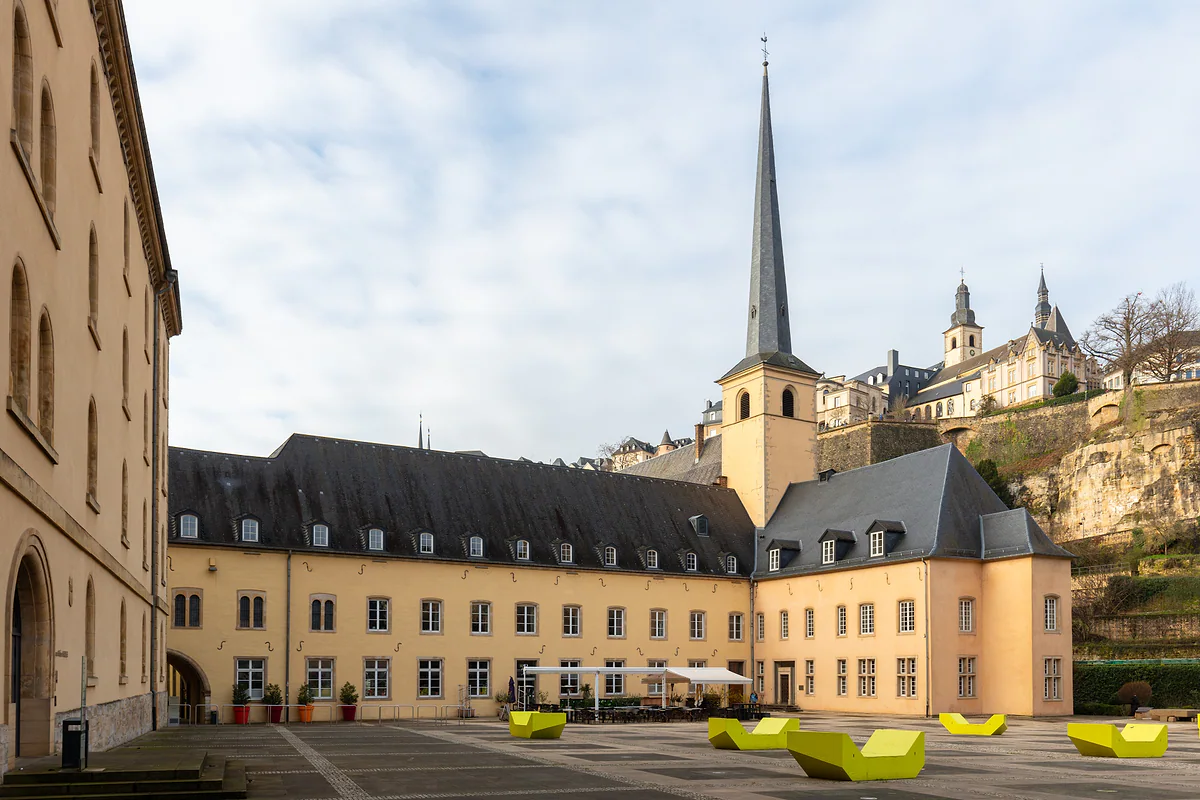
The courtyard of Neumünster Abbey with the bell tower of St John's and the upper town on the rock behind
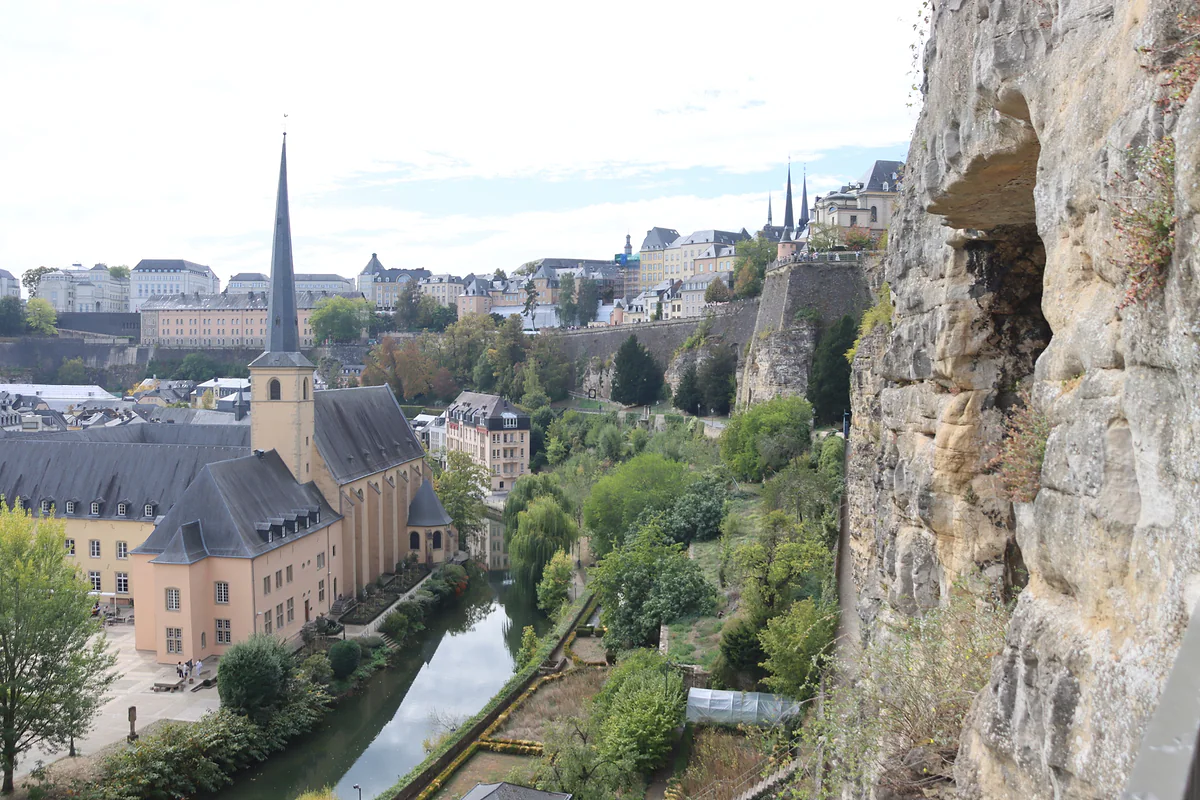
The rock face of the Bock Casemates beside Neumünster Abbey and the Alzette, with the upper town in the background
Neimënster opening hours (September 2026)
| Days | Hours |
|---|---|
| Monday to Friday | 08:00 to 19:00 |
| Saturday and Sunday | 10:00 to 18:00 |
Hours published by the Luxembourg City Tourist Office, checked on 29-09-2026. Performances and events keep their own times.
The abbey through the years
| Year | What happened |
|---|---|
| 1309 | First mention of St John's Church |
| 1542 | Altmünster Abbey destroyed; the monks rebuild in the Grund |
| 1606 | Neumünster and St John's rebuilt together |
| Late 1700s | Revolutionary expropriation; becomes a military hospital |
| 1867 | Stops being a military hospital |
| 1980 | Men's prison closes |
| 2004 | Cultural centre opens |
Source: LCTO listings for Neimënster and St John's Church.
Test yourself
True or false?
0/3 Pick before you peek.
-
Neumünster Abbey was used as a prison until 1980.
See the answer
True. After serving as a military hospital until 1867, the state ran it as a men's prison until 1980, according to the tourist office.
-
Neumünster was the city's first Benedictine abbey.
See the answer
False. The first was Altmünster, destroyed in 1542. Neumünster, the 'new minster', was built afterwards down in the Grund.
-
St John's Church holds a 14th-century Black Madonna.
See the answer
True. The tourist office attributes it to the Parler school of Cologne, alongside an organ from 1710 and a Renaissance doorway.
Map
Where Neumünster Abbey is
The thick dashed line is the border with Belgium, France and Germany, and the fine ones divide the twelve cantons. The Éislek lies to the north and the Moselle to the east. Every number opens its guide.
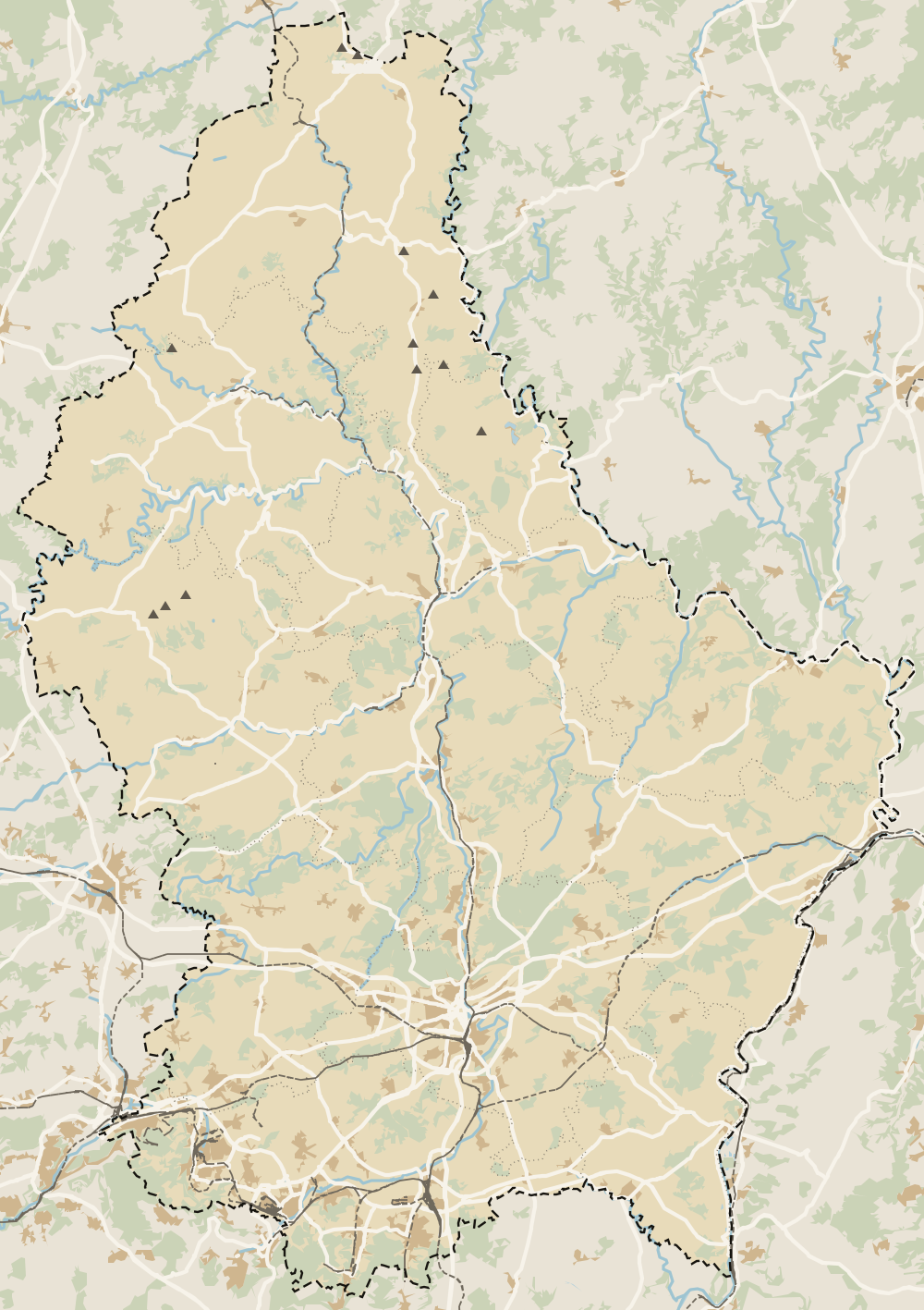
0 of 425 Luxembourg guides
Your next stamp
- Grund
- Natur Musée
- City-centre hotels
- Notre-Dame Cathedral
- Wiltz Castle
- Brandenbourg Castle
- Dräi Eechelen Museum
- Meysembourg Castle
- A Possen Museum
- American Cemetery
- Ansembourg
- Ansembourg Castles
- Asselborn
- Bascharage
- Beaufort castles
- Belval
- Belval blast furnaces
- Berg Castle
- Bernard-Massard cellars
- Bourglinster Castle
- Bourscheid Castle
- Brandenbourg
- Caves St Martin
- Christmas
- Clervaux Castle
- Echternach
- Echternach Abbey
- Ehnen
- Ehnen Wine Museum
- Esch-sur-Alzette
- Esch-sur-Sûre Castle
- European Museum Schengen
- Fond-de-Gras
- General Patton Museum
- German war cemetery
- Haff Réimech
- Hohllay
- Hollenfels Castle
- Hosingen
- Kautenbach
- Kneiff
- Koerich Castle
- Larochette Castle
- Lasauvage
- Mersch Castle
- Military History Museum
- Moersdorf
- Mondorf Domaine Thermal
- Munsbach Castle
- National Mining Museum
- Parc Merveilleux
- Park Sënnesräich
- Places to visit
- Remich
- Rindschleiden
- Schiessentümpel
- Septfontaines Castle
- Slate Museum
- Stolzembourg
- Tudor Museum
- Useldange Castle
- Valley of the Seven Castles
- Vianden
- Vianden Castle
- Ville Haute
- Wasserbillig Aquarium
- Weiswampach lakes
- Ahn
- Berdorf
- Bourscheid-Plage
- Butterfly garden
- Clervaux
- Differdange
- Echternach lake
- Grevenmacher
- Heringer Millen
- Hollenfels
- Luxembourg City
- Luxembourg Science Center
- Mullerthal
- National Day
- National Resistance Museum
- Perekop
- Remerschen
- Schoenfels Castle
- The Family of Man
- Things to do
- Upper Sûre Lake
- Vianden chairlift
- Wasserbillig
- Clervaux Abbey
- Echternach Roman villa
- Éislek
- Insenborn
- Kallektuffquell
- Machtum
- Most beautiful places
- Our Nature Park
- Pétange
- Pettingen Castle
- Schueberfouer
- Schwebsingen
- Victor Hugo House
- Waldbillig
- Dudelange
- Kuelscheier
- Lultzhausen
- Moselle Valley
- Octave
- Prettiest villages
- Sanem
- Schengen
- Wellenstein
- Wiltz
- Wolfsschlucht
- Beaufort
- Bech-Kleinmacher
- Éimaischen
- Gaalgebierg
- Guttland
- Marnach
- Mondorf-les-Bains
- Putscheid
- Schifflange
- UNESCO World Heritage
- Carnival
- Consdorf
- Ellergronn
- Käerjeng
- Kayl
- Map
- Minett
- Munshausen
- Tandel
- Bech
- Buergbrennen
- Esch-sur-Sûre
- Rumelange
- Where is Luxembourg
- Is it a country?
- Lac de la Haute-Sûre (commune)
- Rosport-Mompach
- Wormeldange
- Larochette
- Mondercange
- Regions
- Bettembourg
- Bock Casemates
- Cantons
- Dancing procession
- Diekirch
- Fischbach
- Garnich
- Mersch
- Moselle wine route
- Ettelbruck
- Heffingen
- Kehlen
- Lintgen
- Moselle river cruises
- Pétrusse Casemates
- Towns and villages
- Chemin de la Corniche
- Erpeldange-sur-Sûre
- Junglinster
- Kopstal
- Lorentzweiler
- Nommern
- Pfaffenthal
- Population
- Bissen
- Clausen
- Grand Ducal Palace
- Koerich
- Schieren
- Size
- Vallée de l'Ernz
- Feulen
- Kirchberg
- Languages
- Reisdorf
- Steinfort
- Bettendorf
- Habscht
- St Michael's Church
- Helperknapp
- Luxembourgish
- Place Guillaume II
- Name
- Place d'Armes
- History
- Place de la Constitution
- Grand Duke
- Colmar-Berg
- Flaxweiler
- Gare
- Hamm
- Kirchberg funicular
- Luxembourg fortress
- Mamer
- Mertert
- Minett Trail
- Mullerthal Trail
- Parc Hosingen
- Pfaffenthal lift
- Political system
- Redange
- The Passerelle
- Wine festivals
- Winseler
- Beckerich
- Biwer
- EU institutions
- Goesdorf
- Limpertsberg
- Mudam
- Pulvermühl
- Stadtbredimus
- Troisvierges
- Wenzel walk
- Bonnevoie
- Bous-Waldbredimus
- Ell
- Flag
- Kiischpelt
- Manternach
- Philharmonie
- Vauban circuit
- Weiswampach
- Betzdorf
- Boulaide
- Facts
- Hollerich
- Lenningen
- Useldange
- Wincrange
- Bourscheid
- Dalheim
- Gasperich
- Public holidays
- Red Bridge
- Saeul
- Belair
- Second World War
- Vichten
- Battle of the Bulge
- Merl
- Préizerdaul
- Cents
- EU and Schengen
- Groussbus-Wal
- Entry requirements
- Neudorf
- Rambrouch
- Currency and payments
- Mertzig
- Weimerskirch
- Adolphe Bridge
- Beggen
- Escapardenne
- How to get there
- International March of Diekirch
- MNHA (National Museum)
- Rock climbing
- Sandweiler
- Bridges
- Eich
- Flights
- Golf
- Hesperange
- Lëtzebuerg City Museum
- Canoeing and kayaking
- Dommeldange
- Luxembourg airport
- Strassen
- Villa Vauban
- Airport to city centre
- Bertrange
- Casino Luxembourg
- Mühlenbach
- Swimming pools
- From Brussels
- Pétrusse Valley
- Rollingergrund
- Walferdange
- Cessange
- Day trip from Brussels
- Municipal Park
- Steinsel
- Free walking tours
- From Paris
- Niederanven
- From Frankfurt
- Schuttrange
- Sightseeing train and bus
- By train
- Contern
- By coach
- Weiler-la-Tour
- Driving
- Luxembourg in one day
- Pretzel Sunday
- Rham Plateau
- Tour de Luxembourg
- Candlemas (Liichtmëssdag)
- Car hire
- Luxembourg in two days
- Saint-Esprit Plateau
- Luxembourg in three days
- Melusina statue
- Parking
- St Nicholas Day (Kleeschen)
- Fête de la Musique
- Luxembourg in four days
- Museums in Luxembourg
- Petrol
- Place de Clairefontaine
- A week in Luxembourg
- Getting around
- Luxembourg Marathon
- Tram and Bus Museum
- Free public transport
- Parks in Luxembourg City
- Road trip
- Belgium and Luxembourg
- Tram
- Buses
- Viewpoints
- Trains
- Luxembourg station
- Cycling
- LuxembourgPass
- Prices and budget
- On a budget
- Free things to do
- Mobile and roaming
- Healthcare
- Safety
- Scams
- Tourist information
- Packing list
- Swimming lakes
- With a dog
- Markets
- Tipping
- Shopping
- What to buy
- Shopping centres
- With kids
- For couples
- Playgrounds
- Adventure parks
- Nightlife
- Castles
- Theatres and concert venues
- Leudelange
- Nature parks
- Where to stay
- Hiking
- Nature reserves
- Reckange-sur-Mess
- Hotels near the station
- Roeser
- Frisange
- Hotels in Kirchberg
- Airport hotels
- Dippach
- Hotels in Vianden
- Hotels in Echternach
- Hotels in Clervaux
- Hotels in Mondorf-les-Bains
- Hotels in Esch-sur-Alzette
- Hotels on the Moselle
- Mullerthal hotels
- Upper Sûre lake hotels
- Hotels in Diekirch and Ettelbruck
- Cheap hotels
- Luxury hotels
- Boutique hotels
- Spa hotels
- Family hotels
- Apartments
- Weather
- Youth hostels
- Best time to visit
- Campsites
- Holiday cottages
- In winter
- Castle hotels
- In spring
- Day trips
- In summer
- Around Luxembourg
- In autumn
- Ice skating
- Trier day trip
- Metz day trip
- Arlon day trip
- In January
- In February
- In March
- In April
- In May
- In June
- In July
- In August
- In September
- Food
- In October
- In November
- Where to eat
- In December
- Michelin restaurants
- Cheap eats
- Judd mat Gaardebounen
- Bouneschlupp
- Gromperekichelcher
- Kniddelen
- Quetschentaart
- Rieslingspaschtéit
- Events
- Wine
- Crémant
- Beer
Frequently asked questions
What is Neumünster Abbey?
It's the former Benedictine abbey in the Grund, built after Altmünster Abbey was destroyed in 1542. After centuries as an abbey, military hospital and prison, it has been the Neumünster Abbey Cultural Meeting Centre, known as Neimënster, since 2004.
What are Neumünster Abbey's opening hours?
As of September 2026, the Luxembourg City Tourist Office gives Monday to Friday 08:00-19:00 and Saturday and Sunday 10:00-18:00. Concerts and events on the programme run to their own times.
Do you pay to get into Neumünster?
The tourist office publishes no charge for entering the grounds. You pay for tickets to performances, courses and some exhibitions on the cultural programme.
Why was Neumünster Abbey a prison?
After the revolutionary expropriation of the late 18th century it served as a military hospital until 1867. The Luxembourg state then took it over and ran it as a men's prison until 1980.
What's inside Neimënster today?
Performances, exhibitions, courses and talks, plus the Council of Europe's European Institute of Cultural Routes, the Pierre Werner Institute, a brasserie, artists' accommodation and a shop.
How do I get to Neumünster Abbey?
It's at 28 rue Münster in the Grund. Walk down from the Corniche or take the free public lift from the Plateau du Saint-Esprit.
By
Tourism graduate with a master’s in Tourism Management and Planning from the University of Málaga, who has travelled across Europe. He writes every guide from official sources and his own judgement.
Published on . Facts checked on .
Sources
Some links in this guide are affiliate links: if you book through them, the site earns a commission at no extra cost to you. Affiliate disclosure
Photos: Diego Delso (CC BY-SA 4.0); Diego Delso (CC BY-SA 4.0); FrDr (CC BY-SA 4.0), via Wikimedia Commons.