The first Sunday after carnival
Buergbrennen, the night Luxembourg burns the winter away
Buergbrennen is the festival when almost every village in Luxembourg lights a huge bonfire, the Buerg, to drive out winter. It takes place on the first Sunday after carnival, the Buergsonndeg, and in the capital on the Saturday or Sunday after carnival Sunday. Expect a torchlight procession, pea or green bean soup and mulled wine.
In 30 seconds
Full read: 3 min
- Buergbrennen is the bonfire festival that sees off winter in Luxembourg.
- It's held on the first Sunday after carnival in almost every village.
- The bonfire, usually built around a cross, is lit at nightfall after a torchlight procession.
- It comes with Ierzebulli, Bouneschlupp and Glühwäin, and it's free.
For me the best Buergbrennen is an ordinary village one, not the biggest you can find. Turn up mid-afternoon, watch them finish the build, get a bowl of soup and wait for dark. It's the easiest night of the year to mix with locals without a word of Luxembourgish.

Before you go
What I would keep in mind
-
01 Most beautiful
A castle or a cross of fire
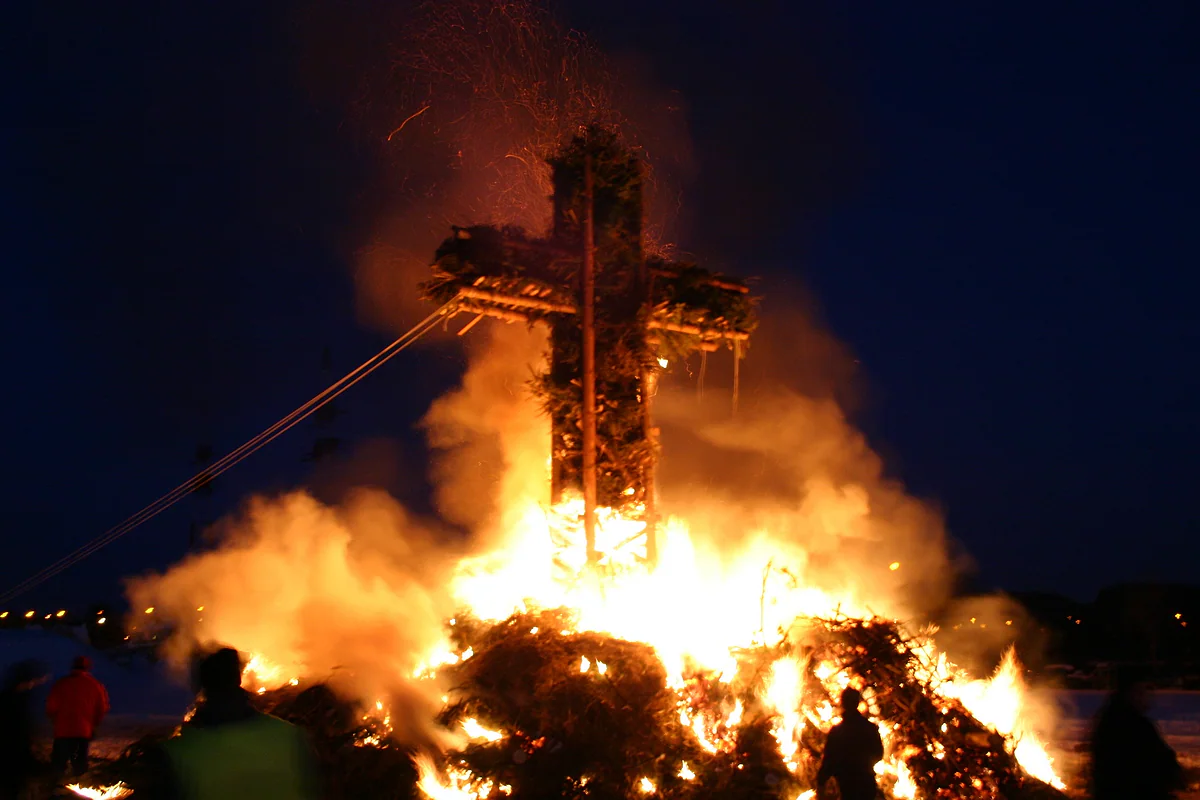
Most Buergen are a giant pyre with a cross in the middle, though some villages build a small castle instead. It goes up in flames at nightfall.
-
02 My tip
Where the Christmas trees end up
Local clubs collect old Christmas trees in January and keep them for the bonfire, along with straw, branches and logs. Its size depends on how much they've gathered.
-
03 To save money
Hot soup for pocket money
Entry is free and supper is laid on by the village clubs, with a barbecue, Ierzebulli, Bouneschlupp and mulled wine. It's one of the cheapest nights out you'll have in Luxembourg.
Bouneschlupp -
04 Getting there
Arrive in daylight, leave in the dark
It starts in the afternoon and the fire burns after dark. If you're heading to a village by bus, check the last one back before you set off.
Luxembourg buses
What I would book
If you grew up with Bonfire Night, Buergbrennen will feel oddly familiar, with a village crowd, a torch procession and a big fire at the end of it. The difference is the reason. On a late-winter evening every village in Luxembourg gathers round an enormous pyre, waits for dark and sets it ablaze to see off the winter. There’s no stage and no ticket, just neighbours, hot soup and the heat on your face.
What is a Buerg?
The Buerg is the thing that burns. According to the government portal its shape varies. Now and then it’s built as a small castle, but mostly it’s a towering pyre with a cross in the middle, like the one in the photo. It’s made of straw, branches and logs, plus the previous Christmas’s trees, which local clubs collect in January. The more they gather, the bigger it gets.
The builders are usually the village youth clubs. Every village has its own, some bigger and some smaller, and the portal mentions those burning on the high ground of the country.
When is Buergbrennen?
The rule is the first Sunday after carnival, Buergsonndeg or bonfire Sunday. In the capital, the City of Luxembourg says it can be the Saturday or Sunday after carnival Sunday. Communes and clubs announce times and places a few weeks ahead, and the 2027 date hadn’t been published by the end of September 2026, so I won’t guess it.
The practical move is to check when Luxembourg carnival falls that year, since Buergbrennen follows it. In 2027 Luxembourg’s carnival school holidays run from 6 to 14 February. The carnival season itself runs from Candlemas on 2 February to Ash Wednesday, and Easter always falls between 22 March and 25 April, so the bonfires land in February or March depending on the year. If you’re booking flights early, keep both months in mind until the communes post their dates.
Once your dates are set, check which hotels are still free in Luxemburgo before prices climb.
How the evening goes
It kicks off in the afternoon with the building of the Buerg, moves on to a torchlight procession and ends with the lighting at nightfall. Who puts the torch to it depends on the village, sometimes the newest married couple, sometimes a well-known local. The party then carries on long after the pyre has burnt down to embers.
Supper is barbecue and hot food. The classics are Ierzebulli, a pea soup, Bouneschlupp, a green bean soup, and Glühwäin, mulled wine. The capital’s tourist office is clear that no Buergbrennen is complete without them.
Where it comes from
It began as a pagan custom, also known as Faaschtefeier, the Lent festival. Its purpose hasn’t changed, which is to chase winter out with fire. That’s why it lands right as carnival ends and Lent begins.
Once your dates are set, check which hotels are still free in Luxemburgo before prices climb.
Remich’s own farewell
The same government page that explains Buergbrennen gives space to Remich, which sees off the season its own way a few days earlier. On Ash Wednesday evening a straw figure in old clothes, the Stréimännchen, is carried through the streets with an empty wine bottle and an empty wallet, then burnt on the Moselle bridge and dropped into the river. Catch both in the same week and you’ll have seen how the country closes carnival with fire.
My plan for the night
I’d pick a small village over the capital’s bonfire. I’d arrive mid-afternoon to watch the final touches, stay for the torch procession and have supper there. Wear warm layers and boots that can cope with mud, and keep well back from the flames. February averages 2.2°C (36°F) at Findel and March 5.7°C (42°F), and next to the fire at night you feel the contrast.
Getting over from the UK is straightforward. Fly into Findel or take the train via Brussels or Paris, allow for the EES check as you enter Schengen, and use Luxembourg’s free public transport once you’re there. Just check the last bus home, because the fire only gets going after dark. For more reasons to visit in the cold months, see Luxembourg in winter, and every other date in the calendar is in Luxembourg events.
If you would rather have a local show you round, book a guided tour in Luxemburgo and choose by the reviews.
A car frees you from timetables: search car hire in Luxembourg on DiscoverCars and compare companies.
So you do not pay over the odds, look at trains, coaches and flights to Luxembourg on Omio and pick the one that suits you.
How a Buergbrennen unfolds
| When | What happens |
|---|---|
| January | Local clubs collect old Christmas trees |
| Afternoon | The village youth finish building the Buerg |
| Dusk | Torchlight procession |
| After dark | The fire is lit, sometimes by the most recently married couple or a local figure |
| Later | Barbecue, soups and Glühwäin until only embers are left |
From the government portal (luxembourg.public.lu), checked on 30 September 2026.
When it falls
| Where | Rule | Source |
|---|---|---|
| Nationwide | First Sunday after carnival (Buergsonndeg) | Government portal and LCTO |
| Luxembourg City | Saturday or Sunday after carnival Sunday | vdl.lu |
| 2027 date | Not yet published on 30 September 2026 | Communes and LCTO |
Each commune or club announces its time and place a few weeks ahead.
Test yourself
True or false?
0/3 Pick before you peek.
-
Buergbrennen takes place in just one spot in Luxembourg.
See the answer
False. Every village has its own, some big and some small, according to the government portal.
-
Old Christmas trees go on the bonfires.
See the answer
True. Local clubs collect them in January and add them to the straw, branches and logs.
-
The bonfire is lit at midday.
See the answer
False. It's built in the afternoon and lit at nightfall, after a torchlight procession.
- Bonfire per village, each its own
- 1
- February average at Findel
- 2.2°C
- March average at Findel
- 5.7°C
0 of 425 Luxembourg guides
Your next stamp
- In winter
- In February
- Events
- National Day
- In November
- Carnival
- Christmas
- A Possen Museum
- American Cemetery
- Ansembourg
- Ansembourg Castles
- Asselborn
- Bascharage
- Beaufort castles
- Belval
- Belval blast furnaces
- Berg Castle
- Bernard-Massard cellars
- Bourglinster Castle
- Bourscheid Castle
- Brandenbourg
- Brandenbourg Castle
- Caves St Martin
- Clervaux Castle
- Echternach
- Echternach Abbey
- Ehnen
- Ehnen Wine Museum
- Esch-sur-Alzette
- Esch-sur-Sûre Castle
- European Museum Schengen
- Fond-de-Gras
- General Patton Museum
- German war cemetery
- Haff Réimech
- Hohllay
- Hollenfels Castle
- Hosingen
- Kautenbach
- Kneiff
- Koerich Castle
- Larochette Castle
- Lasauvage
- Mersch Castle
- Military History Museum
- Moersdorf
- Mondorf Domaine Thermal
- Munsbach Castle
- National Mining Museum
- Parc Merveilleux
- Park Sënnesräich
- Places to visit
- Remich
- Rindschleiden
- Schiessentümpel
- Septfontaines Castle
- Slate Museum
- Stolzembourg
- Tudor Museum
- Useldange Castle
- Valley of the Seven Castles
- Vianden
- Vianden Castle
- Ville Haute
- Wasserbillig Aquarium
- Weiswampach lakes
- Wiltz Castle
- Ahn
- Berdorf
- Bourscheid-Plage
- Butterfly garden
- Clervaux
- Differdange
- Echternach lake
- Grevenmacher
- Heringer Millen
- Hollenfels
- Luxembourg City
- Luxembourg Science Center
- Meysembourg Castle
- Mullerthal
- National Resistance Museum
- Perekop
- Remerschen
- Schoenfels Castle
- The Family of Man
- Things to do
- Upper Sûre Lake
- Vianden chairlift
- Wasserbillig
- Clervaux Abbey
- Echternach Roman villa
- Éislek
- Insenborn
- Kallektuffquell
- Machtum
- Most beautiful places
- Our Nature Park
- Pétange
- Pettingen Castle
- Schueberfouer
- Schwebsingen
- Victor Hugo House
- Waldbillig
- Dudelange
- Kuelscheier
- Lultzhausen
- Moselle Valley
- Octave
- Prettiest villages
- Sanem
- Schengen
- Wellenstein
- Wiltz
- Wolfsschlucht
- Beaufort
- Bech-Kleinmacher
- Éimaischen
- Gaalgebierg
- Guttland
- Marnach
- Mondorf-les-Bains
- Putscheid
- Schifflange
- UNESCO World Heritage
- Consdorf
- Ellergronn
- Käerjeng
- Kayl
- Map
- Minett
- Munshausen
- Tandel
- Bech
- Esch-sur-Sûre
- Rumelange
- Where is Luxembourg
- Is it a country?
- Lac de la Haute-Sûre (commune)
- Rosport-Mompach
- Wormeldange
- Larochette
- Mondercange
- Regions
- Bettembourg
- Bock Casemates
- Cantons
- Dancing procession
- Diekirch
- Fischbach
- Garnich
- Mersch
- Moselle wine route
- Ettelbruck
- Grund
- Heffingen
- Kehlen
- Lintgen
- Moselle river cruises
- Pétrusse Casemates
- Towns and villages
- Chemin de la Corniche
- Erpeldange-sur-Sûre
- Junglinster
- Kopstal
- Lorentzweiler
- Nommern
- Pfaffenthal
- Population
- Bissen
- Clausen
- Grand Ducal Palace
- Koerich
- Schieren
- Size
- Vallée de l'Ernz
- Feulen
- Kirchberg
- Languages
- Notre-Dame Cathedral
- Reisdorf
- Steinfort
- Bettendorf
- Habscht
- St Michael's Church
- Helperknapp
- Luxembourgish
- Place Guillaume II
- Name
- Place d'Armes
- History
- Place de la Constitution
- Grand Duke
- Colmar-Berg
- Flaxweiler
- Gare
- Hamm
- Kirchberg funicular
- Luxembourg fortress
- Mamer
- Mertert
- Minett Trail
- Mullerthal Trail
- Neumünster Abbey
- Parc Hosingen
- Pfaffenthal lift
- Political system
- Redange
- The Passerelle
- Wine festivals
- Winseler
- Beckerich
- Biwer
- EU institutions
- Goesdorf
- Limpertsberg
- Mudam
- Natur Musée
- Pulvermühl
- Stadtbredimus
- Troisvierges
- Wenzel walk
- Bonnevoie
- Bous-Waldbredimus
- Ell
- Flag
- Kiischpelt
- Manternach
- Philharmonie
- Vauban circuit
- Weiswampach
- Betzdorf
- Boulaide
- Dräi Eechelen Museum
- Facts
- Hollerich
- Lenningen
- Useldange
- Wincrange
- Bourscheid
- Dalheim
- Gasperich
- Public holidays
- Red Bridge
- Saeul
- Belair
- Second World War
- Vichten
- Battle of the Bulge
- Merl
- Préizerdaul
- Cents
- EU and Schengen
- Groussbus-Wal
- Entry requirements
- Neudorf
- Rambrouch
- Currency and payments
- Mertzig
- Weimerskirch
- Adolphe Bridge
- Beggen
- Escapardenne
- How to get there
- International March of Diekirch
- MNHA (National Museum)
- Rock climbing
- Sandweiler
- Bridges
- Eich
- Flights
- Golf
- Hesperange
- Lëtzebuerg City Museum
- Canoeing and kayaking
- Dommeldange
- Luxembourg airport
- Strassen
- Villa Vauban
- Airport to city centre
- Bertrange
- Casino Luxembourg
- Mühlenbach
- Swimming pools
- From Brussels
- Pétrusse Valley
- Rollingergrund
- Walferdange
- Cessange
- Day trip from Brussels
- Municipal Park
- Steinsel
- Free walking tours
- From Paris
- Niederanven
- From Frankfurt
- Schuttrange
- Sightseeing train and bus
- By train
- Contern
- By coach
- Weiler-la-Tour
- Driving
- Luxembourg in one day
- Pretzel Sunday
- Rham Plateau
- Tour de Luxembourg
- Candlemas (Liichtmëssdag)
- Car hire
- Luxembourg in two days
- Saint-Esprit Plateau
- Luxembourg in three days
- Melusina statue
- Parking
- St Nicholas Day (Kleeschen)
- Fête de la Musique
- Luxembourg in four days
- Museums in Luxembourg
- Petrol
- Place de Clairefontaine
- A week in Luxembourg
- Getting around
- Luxembourg Marathon
- Tram and Bus Museum
- Free public transport
- Parks in Luxembourg City
- Road trip
- Belgium and Luxembourg
- Tram
- Buses
- Viewpoints
- Trains
- Luxembourg station
- Cycling
- LuxembourgPass
- Prices and budget
- On a budget
- Free things to do
- Mobile and roaming
- Healthcare
- Safety
- Scams
- Tourist information
- Packing list
- Swimming lakes
- With a dog
- Markets
- Tipping
- Shopping
- What to buy
- Shopping centres
- With kids
- For couples
- Playgrounds
- Adventure parks
- Nightlife
- Castles
- Theatres and concert venues
- Leudelange
- Nature parks
- Where to stay
- City-centre hotels
- Hiking
- Nature reserves
- Reckange-sur-Mess
- Hotels near the station
- Roeser
- Frisange
- Hotels in Kirchberg
- Airport hotels
- Dippach
- Hotels in Vianden
- Hotels in Echternach
- Hotels in Clervaux
- Hotels in Mondorf-les-Bains
- Hotels in Esch-sur-Alzette
- Hotels on the Moselle
- Mullerthal hotels
- Upper Sûre lake hotels
- Hotels in Diekirch and Ettelbruck
- Cheap hotels
- Luxury hotels
- Boutique hotels
- Spa hotels
- Family hotels
- Apartments
- Weather
- Youth hostels
- Best time to visit
- Campsites
- Holiday cottages
- Castle hotels
- In spring
- Day trips
- In summer
- Around Luxembourg
- In autumn
- Ice skating
- Trier day trip
- Metz day trip
- Arlon day trip
- In January
- In March
- In April
- In May
- In June
- In July
- In August
- In September
- Food
- In October
- Where to eat
- In December
- Michelin restaurants
- Cheap eats
- Judd mat Gaardebounen
- Bouneschlupp
- Gromperekichelcher
- Kniddelen
- Quetschentaart
- Rieslingspaschtéit
- Wine
- Crémant
- Beer
Frequently asked questions
What is Buergbrennen in Luxembourg?
It's the bonfire festival that sees off winter. Each village builds a Buerg, a huge pyre that usually has a cross in the middle, and sets it alight at nightfall.
When is Buergbrennen?
On the first Sunday after carnival, known as Buergsonndeg. In Luxembourg City it can be the Saturday or Sunday after carnival Sunday. The 2027 date hadn't been published by the end of September 2026.
Where does Buergbrennen come from?
The government portal describes it as a pagan custom, also called Faaschtefeier, the Lent festival, meant to drive winter away.
What do people eat at Buergbrennen?
Barbecued meat and hot dishes such as Ierzebulli (pea soup), Bouneschlupp (green bean soup) and Glühwäin, mulled wine.
Who lights the bonfire?
It depends on the village. In some the honour goes to the most recently married couple, in others to a local personality.
Can tourists go to Buergbrennen?
Yes, it's open and free. Just head to the village, keep a sensible distance from the fire and stay for supper with the locals.
By
Tourism graduate with a master’s in Tourism Management and Planning from the University of Málaga, who has travelled across Europe. He writes every guide from official sources and his own judgement.
Published on . Facts checked on .
Sources
Some links in this guide are affiliate links: if you book through them, the site earns a commission at no extra cost to you. Affiliate disclosure
Photos: Fred (CC BY-SA 3.0), via Wikimedia Commons.