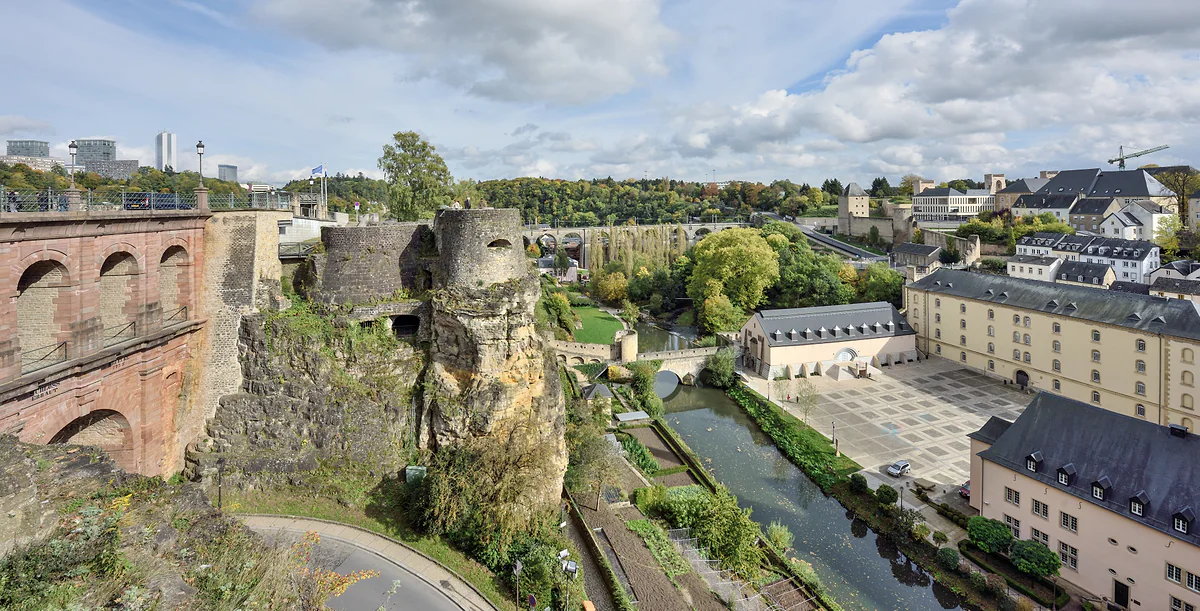
Luxembourg, Luxemburg, Lëtzebuerg
What does Luxembourg mean? A little castle on a rock
The name Luxembourg comes from Lucilinburhuc, which the government's official portal translates as «little castle», the fort on the Bock rock first recorded in 963. In Luxembourgish the country is Lëtzebuerg and in German Luxemburg; English uses the French spelling, and the official name is the Grand Duchy of Luxembourg.
When you book trains, museums or hotels on Luxembourg's own websites, search in English or French and use the local name for each town. Vianden is also Veianen and Clervaux is Klierf, and knowing both saves a lot of head-scratching.

Before you go
What I would keep in mind
-
01 Most beautiful
You can stand where the name was born
Lucilinburhuc was the castle on the Bock rock above the Alzette. Today that rock is the way into the Bock Casemates, right in the capital's old town.
Bock Casemates -
02 My tip
Lëtzebuerg is on your change
According to the European Central Bank, Luxembourg's euro coins carry the country's name in Luxembourgish, «Lëtzebuerg». Check the coins you're given in the capital.
Luxembourg currency -
03 My tip
Three Luxembourgs to keep apart
The country, its capital, Luxembourg City, and the Belgian province of the same name, created when the territory was split in 1839. Check which one is on your train ticket.
is Luxembourg a country
Luxembourg is one of those names people say every day without wondering where it comes from. The answer is refreshingly concrete. It was a little castle on a rock above a river, and you can still walk out onto that rock today. Everything else, the French, German and Luxembourgish versions, the grand duchy and even a Belgian province, grew from there.
A little castle called Lucilinburhuc
The government’s official portal puts it plainly. At the origin of Luxembourg is Lucilinburhuc, the «little castle» first mentioned in a document of 963. That year Count Sigefroi, the younger son of a count of the Ardennes with no great estate of his own, received a castellum on a rocky spur from the monks of St Maximin’s abbey at Trier, in exchange for other land. The spur is the Bock.
There’s a footnote I rather like, because it shows round dates come with small print. The portal notes that the charter formalising the swap actually dates from 987. The site sat close to the old Roman road from Reims to Trier, surrounded by good farmland, and a small fortified town grew up around it. By the 12th century it was a proper city. The rest of the story, century by century, is in history of Luxembourg.
The rock comes with a legend too. Sigefroi married Melusina, who asked for one day a week when no one, not even her husband, could see her. When curiosity got the better of him and he peeped through the keyhole, he found she had a fish’s tail. She leapt from the window, down onto the Bock rock, and disappeared amid a crash of thunder. The government presents it for what it is, a medieval myth found in many parts of Europe.
Luxembourg, Luxemburg or Lëtzebuerg?
Three administrative languages live side by side in the country, and each has its own version of the name. In French it’s Luxembourg and the state is the Grand-Duché de Luxembourg. In German it’s Luxemburg, and the state is the Großherzogtum Luxemburg. In Luxembourgish, the national language, the country is Lëtzebuerg and the language Lëtzebuergesch.
English borrows the French spelling, and the official portal’s English pages use Grand Duchy of Luxembourg. For a British visitor that’s all you need, Luxembourg for the country and Luxembourg City for the capital. The other identifier worth knowing is the international dialling code, +352, which you’ll see on every hotel, museum and restaurant number. When to expect each language depends on where you are, and the page what language do they speak in Luxembourg sets it out.
If you are staying the night, see the best hotel deals in Luxembourg for your dates: the well-placed rooms go fast.
One country, one capital and a Belgian province
Most mix-ups with the name are about geography. Luxembourg is the country, a grand duchy of 2,586 km². Luxembourg City is its capital, with 137,700 residents in 2026. And the Province of Luxembourg is Belgian. It came out of the 1839 Treaty of London, signed on 19 April, which divided the old territory and handed the western part to Belgium. The country’s borders haven’t moved since.
To keep things clear, throughout this guide I use Luxembourg for the country and Luxembourg City, or the capital, for the city. Why it’s a country in its own right and not part of Belgium is explained in is Luxembourg a country.
Where you’ll see the local name
You’ll meet the Luxembourgish form more often than you’d expect. According to the European Central Bank, every Luxembourg euro coin carries its year of issue and the word «Lëtzebuerg». Towns have two names as well, the official French or German one and a Luxembourgish one. Vianden is Veianen, Clervaux is Klierf and Esch-sur-Alzette is Esch-Uelzecht, after the Luxembourgish name of the Alzette.
The national anthem plays with the same names. Its opening line calls the Alzette «d’Uelzecht», and later it asks for protection for «d’Lëtzebuerger Land». I cover it with the other national symbols under the Luxembourg flag.
If you are staying the night, see the best hotel deals in Luxembourg for your dates: the well-placed rooms go fast.
A practical tip for booking
This has a use beyond pub-quiz trivia. Transport, museum and hotel websites in the country are in French, English or German, and their search boxes work best with the local spellings. I’d type Luxembourg for the capital and each town’s official name for everything else. And if you’re wondering what the people are called, that’s with the rest of the figures in Luxembourg population.
So you do not lose the morning at the ticket office, browse tickets and tours in Luxembourg on GetYourGuide.
If you would rather go at your own pace, see the car hire deals in Luxembourg: the earlier you book, the more cars are left to choose from.
Before you fix your dates, compare tickets to Luxembourg: the same journey can cost very different amounts from one day to the next.
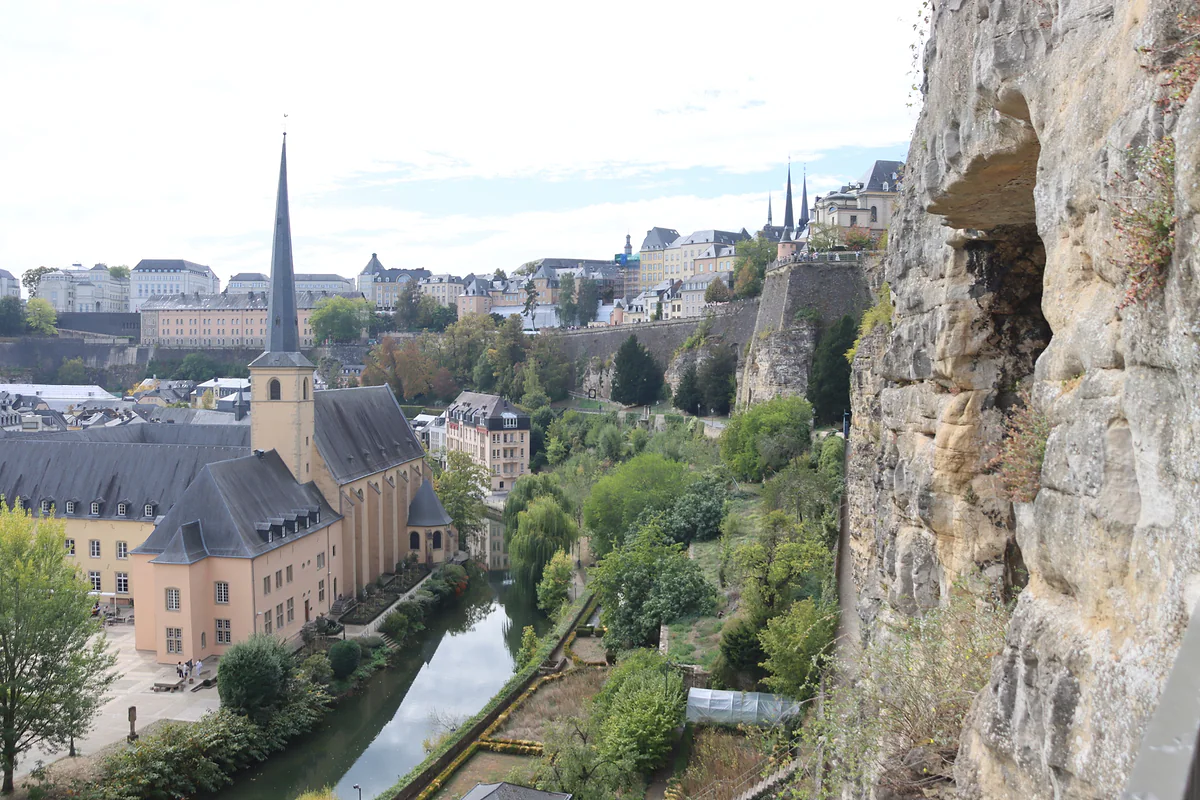
The rock face of the Bock Casemates beside Neumünster Abbey and the Alzette, with the upper town in the background
Luxembourg in each language
| Language | The country | Official name |
|---|---|---|
| English | Luxembourg | Grand Duchy of Luxembourg |
| French | Luxembourg | Grand-Duché de Luxembourg |
| German | Luxemburg | Großherzogtum Luxemburg |
| Luxembourgish | Lëtzebuerg | The language itself is Lëtzebuergesch |
| Spanish | Luxemburgo | Gran Ducado de Luxemburgo |
Official forms from luxembourg.public.lu (French, German and English versions), Spain's Foreign Ministry and the European Central Bank, checked on 29-09-2026.
Three places with the same name
| Name | What it is | Fact |
|---|---|---|
| Luxembourg | The country, a grand duchy | 2,586 km², 690,959 residents on 1-1-2026 |
| Luxembourg City | The country's capital | 137,700 residents in 2026 |
| Province of Luxembourg | A province of Belgium | Created by the 1839 Treaty of London split |
Test yourself
True or false?
0/3 Pick before you peek.
-
Luxembourg means «city of light».
See the answer
False. The name comes from Lucilinburhuc, which the government's official portal translates as «little castle», the fort on the Bock rock.
-
English and French spell Luxembourg the same way.
See the answer
True. Both use Luxembourg. German writes Luxemburg and Luxembourgish, Lëtzebuerg.
-
The charter behind the 963 date was actually drawn up later.
See the answer
True. The official portal notes the exchange was formalised in a charter of 987, even though 963 is the date used for the city's beginnings.
0 of 425 Luxembourg guides
Your next stamp
- History
- Where is Luxembourg
- Mullerthal
- Is it a country?
- Map
- Beer
- EU and Schengen
- A Possen Museum
- American Cemetery
- Ansembourg
- Ansembourg Castles
- Asselborn
- Bascharage
- Beaufort castles
- Belval
- Belval blast furnaces
- Berg Castle
- Bernard-Massard cellars
- Bourglinster Castle
- Bourscheid Castle
- Brandenbourg
- Brandenbourg Castle
- Caves St Martin
- Christmas
- Clervaux Castle
- Echternach
- Echternach Abbey
- Ehnen
- Ehnen Wine Museum
- Esch-sur-Alzette
- Esch-sur-Sûre Castle
- European Museum Schengen
- Fond-de-Gras
- General Patton Museum
- German war cemetery
- Haff Réimech
- Hohllay
- Hollenfels Castle
- Hosingen
- Kautenbach
- Kneiff
- Koerich Castle
- Larochette Castle
- Lasauvage
- Mersch Castle
- Military History Museum
- Moersdorf
- Mondorf Domaine Thermal
- Munsbach Castle
- National Mining Museum
- Parc Merveilleux
- Park Sënnesräich
- Places to visit
- Remich
- Rindschleiden
- Schiessentümpel
- Septfontaines Castle
- Slate Museum
- Stolzembourg
- Tudor Museum
- Useldange Castle
- Valley of the Seven Castles
- Vianden
- Vianden Castle
- Ville Haute
- Wasserbillig Aquarium
- Weiswampach lakes
- Wiltz Castle
- Ahn
- Berdorf
- Bourscheid-Plage
- Butterfly garden
- Clervaux
- Differdange
- Echternach lake
- Grevenmacher
- Heringer Millen
- Hollenfels
- Luxembourg City
- Luxembourg Science Center
- Meysembourg Castle
- National Day
- National Resistance Museum
- Perekop
- Remerschen
- Schoenfels Castle
- The Family of Man
- Things to do
- Upper Sûre Lake
- Vianden chairlift
- Wasserbillig
- Clervaux Abbey
- Echternach Roman villa
- Éislek
- Insenborn
- Kallektuffquell
- Machtum
- Most beautiful places
- Our Nature Park
- Pétange
- Pettingen Castle
- Schueberfouer
- Schwebsingen
- Victor Hugo House
- Waldbillig
- Dudelange
- Kuelscheier
- Lultzhausen
- Moselle Valley
- Octave
- Prettiest villages
- Sanem
- Schengen
- Wellenstein
- Wiltz
- Wolfsschlucht
- Beaufort
- Bech-Kleinmacher
- Éimaischen
- Gaalgebierg
- Guttland
- Marnach
- Mondorf-les-Bains
- Putscheid
- Schifflange
- UNESCO World Heritage
- Carnival
- Consdorf
- Ellergronn
- Käerjeng
- Kayl
- Minett
- Munshausen
- Tandel
- Bech
- Buergbrennen
- Esch-sur-Sûre
- Rumelange
- Lac de la Haute-Sûre (commune)
- Rosport-Mompach
- Wormeldange
- Larochette
- Mondercange
- Regions
- Bettembourg
- Bock Casemates
- Cantons
- Dancing procession
- Diekirch
- Fischbach
- Garnich
- Mersch
- Moselle wine route
- Ettelbruck
- Grund
- Heffingen
- Kehlen
- Lintgen
- Moselle river cruises
- Pétrusse Casemates
- Towns and villages
- Chemin de la Corniche
- Erpeldange-sur-Sûre
- Junglinster
- Kopstal
- Lorentzweiler
- Nommern
- Pfaffenthal
- Population
- Bissen
- Clausen
- Grand Ducal Palace
- Koerich
- Schieren
- Size
- Vallée de l'Ernz
- Feulen
- Kirchberg
- Languages
- Notre-Dame Cathedral
- Reisdorf
- Steinfort
- Bettendorf
- Habscht
- St Michael's Church
- Helperknapp
- Luxembourgish
- Place Guillaume II
- Place d'Armes
- Place de la Constitution
- Grand Duke
- Colmar-Berg
- Flaxweiler
- Gare
- Hamm
- Kirchberg funicular
- Luxembourg fortress
- Mamer
- Mertert
- Minett Trail
- Mullerthal Trail
- Neumünster Abbey
- Parc Hosingen
- Pfaffenthal lift
- Political system
- Redange
- The Passerelle
- Wine festivals
- Winseler
- Beckerich
- Biwer
- EU institutions
- Goesdorf
- Limpertsberg
- Mudam
- Natur Musée
- Pulvermühl
- Stadtbredimus
- Troisvierges
- Wenzel walk
- Bonnevoie
- Bous-Waldbredimus
- Ell
- Flag
- Kiischpelt
- Manternach
- Philharmonie
- Vauban circuit
- Weiswampach
- Betzdorf
- Boulaide
- Dräi Eechelen Museum
- Facts
- Hollerich
- Lenningen
- Useldange
- Wincrange
- Bourscheid
- Dalheim
- Gasperich
- Public holidays
- Red Bridge
- Saeul
- Belair
- Second World War
- Vichten
- Battle of the Bulge
- Merl
- Préizerdaul
- Cents
- Groussbus-Wal
- Entry requirements
- Neudorf
- Rambrouch
- Currency and payments
- Mertzig
- Weimerskirch
- Adolphe Bridge
- Beggen
- Escapardenne
- How to get there
- International March of Diekirch
- MNHA (National Museum)
- Rock climbing
- Sandweiler
- Bridges
- Eich
- Flights
- Golf
- Hesperange
- Lëtzebuerg City Museum
- Canoeing and kayaking
- Dommeldange
- Luxembourg airport
- Strassen
- Villa Vauban
- Airport to city centre
- Bertrange
- Casino Luxembourg
- Mühlenbach
- Swimming pools
- From Brussels
- Pétrusse Valley
- Rollingergrund
- Walferdange
- Cessange
- Day trip from Brussels
- Municipal Park
- Steinsel
- Free walking tours
- From Paris
- Niederanven
- From Frankfurt
- Schuttrange
- Sightseeing train and bus
- By train
- Contern
- By coach
- Weiler-la-Tour
- Driving
- Luxembourg in one day
- Pretzel Sunday
- Rham Plateau
- Tour de Luxembourg
- Candlemas (Liichtmëssdag)
- Car hire
- Luxembourg in two days
- Saint-Esprit Plateau
- Luxembourg in three days
- Melusina statue
- Parking
- St Nicholas Day (Kleeschen)
- Fête de la Musique
- Luxembourg in four days
- Museums in Luxembourg
- Petrol
- Place de Clairefontaine
- A week in Luxembourg
- Getting around
- Luxembourg Marathon
- Tram and Bus Museum
- Free public transport
- Parks in Luxembourg City
- Road trip
- Belgium and Luxembourg
- Tram
- Buses
- Viewpoints
- Trains
- Luxembourg station
- Cycling
- LuxembourgPass
- Prices and budget
- On a budget
- Free things to do
- Mobile and roaming
- Healthcare
- Safety
- Scams
- Tourist information
- Packing list
- Swimming lakes
- With a dog
- Markets
- Tipping
- Shopping
- What to buy
- Shopping centres
- With kids
- For couples
- Playgrounds
- Adventure parks
- Nightlife
- Castles
- Theatres and concert venues
- Leudelange
- Nature parks
- Where to stay
- City-centre hotels
- Hiking
- Nature reserves
- Reckange-sur-Mess
- Hotels near the station
- Roeser
- Frisange
- Hotels in Kirchberg
- Airport hotels
- Dippach
- Hotels in Vianden
- Hotels in Echternach
- Hotels in Clervaux
- Hotels in Mondorf-les-Bains
- Hotels in Esch-sur-Alzette
- Hotels on the Moselle
- Mullerthal hotels
- Upper Sûre lake hotels
- Hotels in Diekirch and Ettelbruck
- Cheap hotels
- Luxury hotels
- Boutique hotels
- Spa hotels
- Family hotels
- Apartments
- Weather
- Youth hostels
- Best time to visit
- Campsites
- Holiday cottages
- In winter
- Castle hotels
- In spring
- Day trips
- In summer
- Around Luxembourg
- In autumn
- Ice skating
- Trier day trip
- Metz day trip
- Arlon day trip
- In January
- In February
- In March
- In April
- In May
- In June
- In July
- In August
- In September
- Food
- In October
- In November
- Where to eat
- In December
- Michelin restaurants
- Cheap eats
- Judd mat Gaardebounen
- Bouneschlupp
- Gromperekichelcher
- Kniddelen
- Quetschentaart
- Rieslingspaschtéit
- Events
- Wine
- Crémant
Frequently asked questions
What does the name Luxembourg mean?
It comes from Lucilinburhuc, which the government's official portal translates as «little castle». It was the fort Count Sigefroi acquired on the Bock rock in 963, where the city and the country began.
What is Luxembourg called in Luxembourgish?
Lëtzebuerg, and the language is Lëtzebuergesch. The same word, Lëtzebuerg, appears on the country's euro coins, according to the European Central Bank.
What is Luxembourg's official name?
The Grand Duchy of Luxembourg, Grand-Duché de Luxembourg in French and Großherzogtum Luxemburg in German. The government's portal points out it's the only grand duchy left in the world.
Why is it spelt Luxemburg in German?
German simply has its own form, Luxemburg, while English follows the French spelling, Luxembourg. Both are official in the country, since French and German are administrative languages alongside Luxembourgish.
Is Luxembourg named after a person?
No, after a place. Lucilinburhuc was a small fortified castle on a rocky spur, today the Bock, which Count Sigefroi obtained from the abbey of St Maximin in Trier in exchange for other land.
Why does Belgium have a province called Luxembourg?
Because the Treaty of London of 1839 split the old territory. The western part went to Belgium and became its Province of Luxembourg; the eastern part is today's Grand Duchy.
By
Tourism graduate with a master’s in Tourism Management and Planning from the University of Málaga, who has travelled across Europe. He writes every guide from official sources and his own judgement.
Published on . Facts checked on .
Sources
Some links in this guide are affiliate links: if you book through them, the site earns a commission at no extra cost to you. Affiliate disclosure
Photos: Cayambe (CC BY-SA 4.0); FrDr (CC BY-SA 4.0), via Wikimedia Commons.