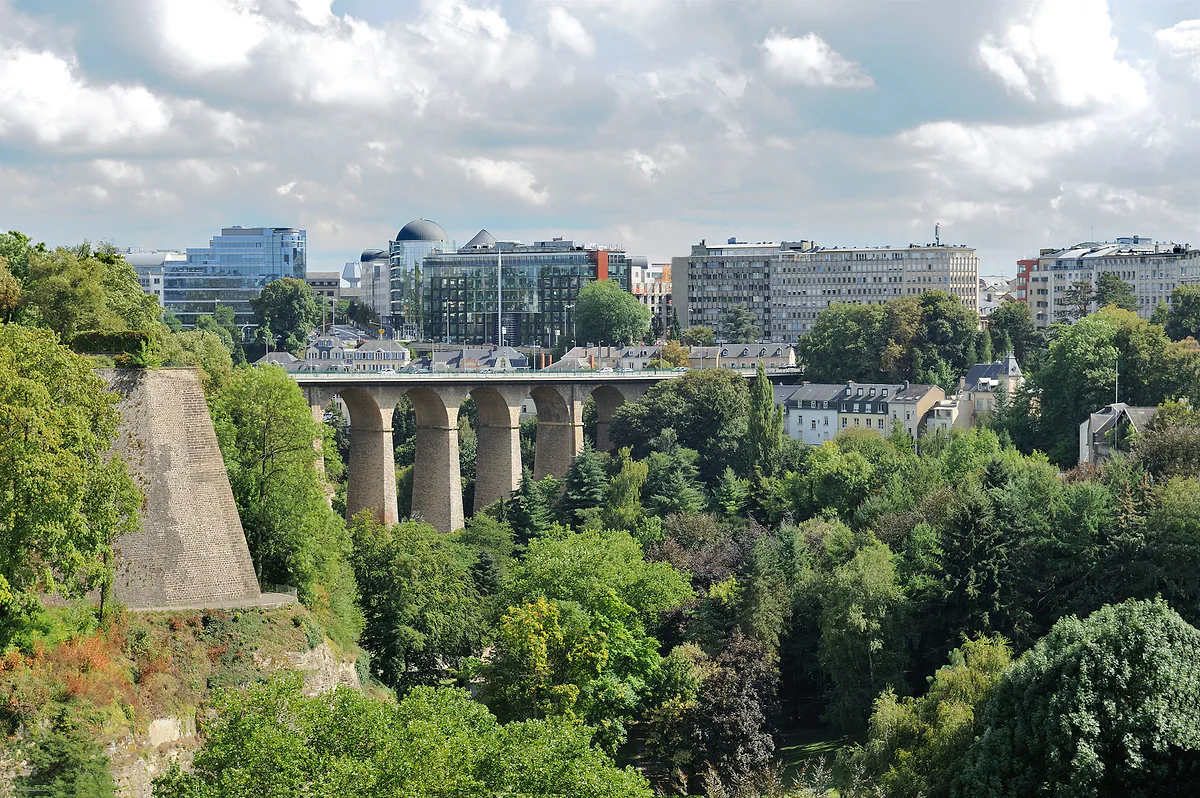
Viaduct over the Pétrusse valley, Gare to Ville Haute
The Passerelle, the old bridge with a strategic bend
The Passerelle, also called the Viaduc or the old bridge, is the stone viaduct spanning the Pétrusse valley between the Gare district and Luxembourg's Ville Haute. Built between 1859 and 1861, it's 290 metres long, 45 metres high and has 24 arches. The slight bend in the middle was put there for military reasons.
I'd walk across it coming from the station, as it's the most direct way into the upper town, then drop into the valley to see it from below. The tall arches, with the Pétrusse trees turning in autumn, are some of the most photogenic sights in the capital.

Before you go
What I would keep in mind
-
01 My tip
The bend isn't a mistake
The slight curve in the middle of the bridge is deliberate. In a siege, a straight bridge could have been raked by cannon fire in a straight line from the Plateau du Saint-Esprit, according to the government portal.
-
02 Most beautiful
From the valley floor
Seen from below, with its 24 arches and piers up to 30 metres tall, the Passerelle is far more impressive. Pétrusse Park and its skatepark sit right underneath.
Pétrusse Valley -
03 Getting there
The walk from the station to the old town
It links the Gare district with the Ville Haute. Since the 2018 works it has a wider pavement, a cycle lane and a bus lane, so it's easy on foot or by bike.
Gare district -
04 My tip
Don't confuse it with the other passerelles
Luxembourg City has two more named footbridges, the cycle bridge hung under Adolphe Bridge and Kirchberg's Passerelle des Arts from 2024. 'The Passerelle' on its own means this viaduct.
Adolphe Bridge
Arrive in Luxembourg by train, walk towards the old town, and you’ll almost certainly end up crossing the Passerelle without thinking about it. It’s the 24-arch stone viaduct over the Pétrusse valley between the Gare district and the Ville Haute, and it’s far older and more interesting than it looks from the pavement. For me it’s the bridge with the best story in the capital, precisely because of a detail hardly anyone spots, its bend.
A bridge with three names
Before it existed, you reached the upper town from this side over a wooden footbridge, which is where the name everyone uses, the Passerelle, comes from. Officially it’s the Viaduc. And in the early 20th century it picked up a third name, the old bridge, when Adolphe Bridge was finished nearby in 1903 and became the new one.
It was built between 1859 and 1861, designed by engineers Édouard Grenier and Auguste Letellier and built by a British firm. The tourist office names it as Waring Brothers, the same company that put up the four stone railway viaducts across the Alzette valley.
The bend that isn’t a mistake
Look from below or from the park and you’ll notice the deck isn’t quite straight. There’s a gentle curve in the middle, and it’s no accident. According to the government portal, it reflects the defensive thinking of a city that in 1861 was still a fortress. In a siege, guns on the Plateau du Saint-Esprit would have had a straight bridge squarely in their sights. The Viaduc never had to prove the point, as the fortress was dismantled a few years later after the Treaty of London in 1867, and the bridge came through intact.
If you are staying the night, see the best hotel deals in Luxembourg for your dates: the well-placed rooms go fast.
The numbers
The tourist office provides the measurements. 290 metres long, 45 metres above the valley, 24 arches with spans of 8 to 15 metres and piers up to 30 metres tall. Thousands of cars cross it every day, according to the government portal, and from spring 2018 major works widened it by several metres. The aim was a broader pavement, a cycle lane, two traffic lanes and a bus lane linking the centre with the southern districts.
Where’s the best view of the Passerelle?
From below. The Pétrusse valley has a park with footpaths, the stream in its re-naturalised bed and the Péitruss skatepark right beneath the arches. From there the 24 arches and 30-metre piers show their full scale. In autumn, with the valley’s trees gone yellow and red, it’s one of the loveliest sights in the capital to my eye.
Up top, from the bridge itself, the valley opens out in front of you, with Adolphe Bridge to one side and the Luxembourg old town and its ramparts to the other.
If you are staying the night, see the best hotel deals in Luxembourg for your dates: the well-placed rooms go fast.
Fitting it into your visit
If you’re staying in the Gare district, the Passerelle is your natural route into the old town. I’d make my first entrance on foot this way, unhurried, and save Adolphe Bridge for viewing from the park. The one exception is if you’re dragging a suitcase straight off the train from Brussels. In that case I’d hop on the free T1 tram, which crosses the valley on Adolphe Bridge, drop the bags at the hotel and come back to walk the Passerelle properly later.
The city itself lists it among the district’s highlights under its Luxembourgish name, Al Bréck, alongside the Plateau Bourbon, which lies in the UNESCO buffer zone, Place de Paris and the Rousegärtchen on Place des Martyrs. In other words, the Passerelle is the hinge between the station district across the valley and the fortified city. Crossing it on foot takes you from one world to the other in a few minutes, with the green valley below, and to my mind there’s no better way to start a trip to Luxembourg.
One last practical note, because the name trips people up. Search for “Passerelle Luxembourg” and you’ll find two others. One is the 154-metre cycle bridge hung beneath Adolphe Bridge; the other is the Passerelle des Arts, a polished-steel footbridge and cycle bridge opened in Kirchberg in 2024, next to Mudam. All three, with the rest of the valley crossings, are in bridges in Luxembourg City.
So you do not lose the morning at the ticket office, browse tickets and tours in The Passerelle on GetYourGuide.
If you would rather go at your own pace, see the car hire deals in Luxembourg: the earlier you book, the more cars are left to choose from.
Before you fix your dates, compare tickets to Luxembourg: the same journey can cost very different amounts from one day to the next.
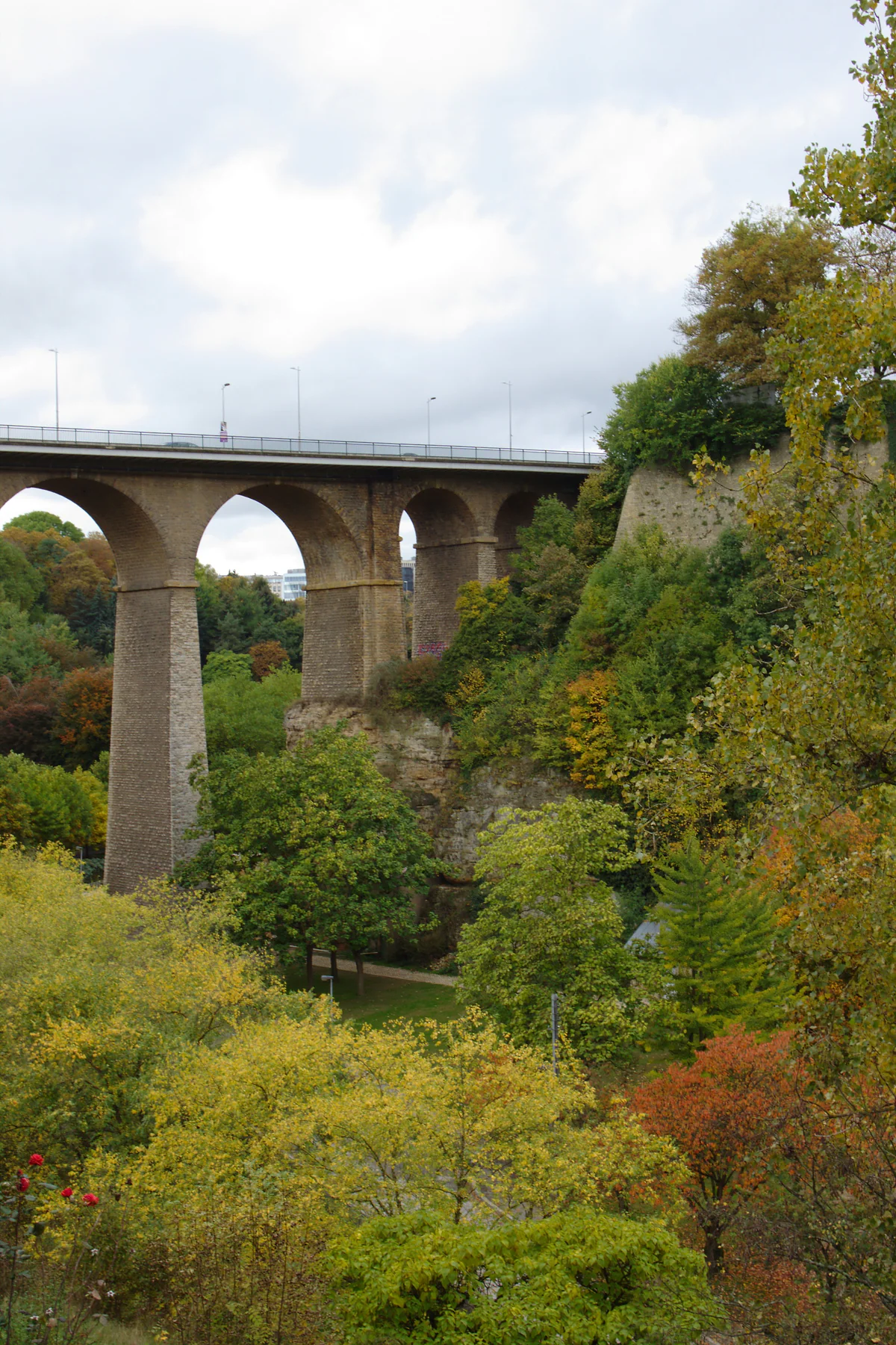
The tall arches of the Passerelle above the Pétrusse valley, with trees in yellow and russet autumn leaves
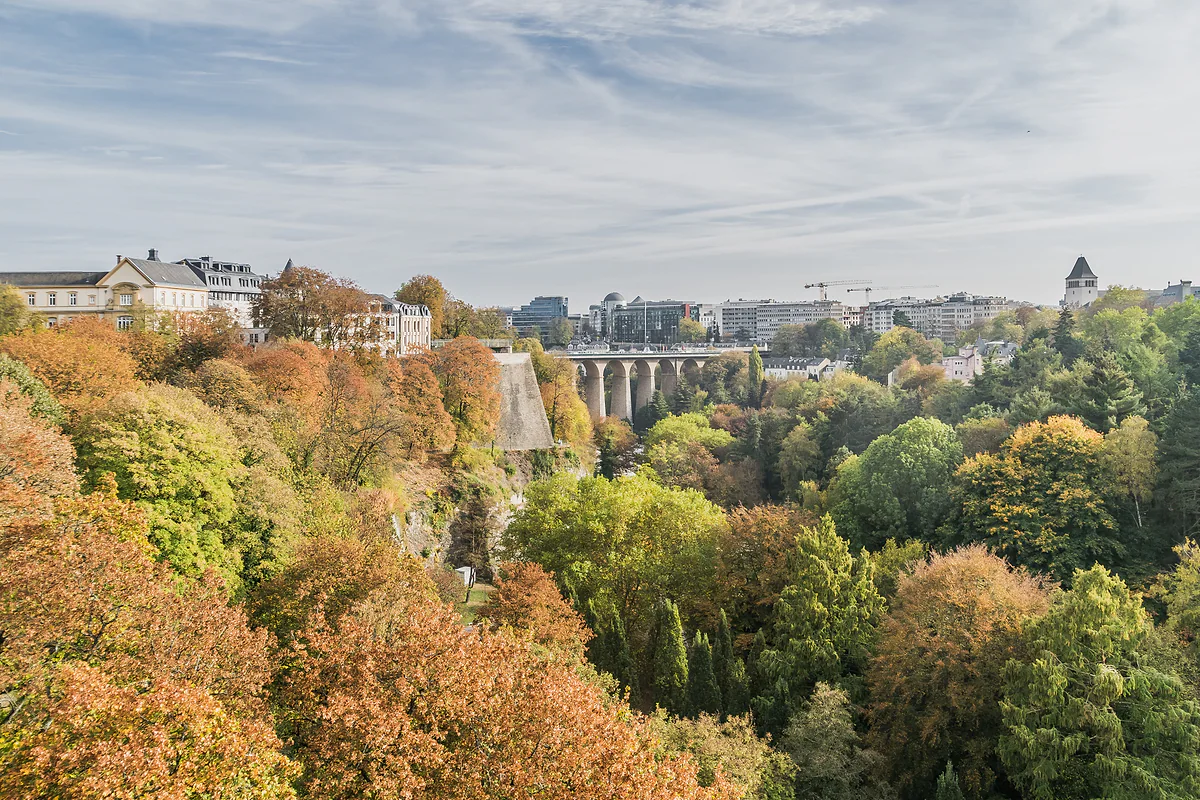
The Pétrusse valley covered in trees with autumn leaves, with the Passerelle and the upper town beyond
The Passerelle in numbers
| Fact | Figure |
|---|---|
| Construction | 1859 to 1861 |
| Engineers | Édouard Grenier and Auguste Letellier |
| Builder | A British firm (Waring Brothers, according to the LCTO) |
| Length | 290 m |
| Height | 45 m |
| Arches | 24, spans of 8 to 15 m |
| Piers | Up to 30 m |
| Renovation | From spring 2018: pavement, cycle lane, two traffic lanes and a bus lane |
Sources: LCTO and luxembourg.public.lu, checked on 29-09-2026.
The capital's three 'passerelles'
| Name | What it is | Where |
|---|---|---|
| Passerelle or Viaduc | Stone viaduct from 1859-1861 | Pétrusse valley, Gare to Ville Haute |
| Adolphe Bridge cycle bridge | Suspended cycle and footbridge, 154 m | Under Adolphe Bridge |
| Passerelle des Arts | Foot and cycle bridge from 2024 | Kirchberg, Avenue Kennedy to Trois Glands Park |
Test yourself
True or false?
0/3 Pick before you peek.
-
The bend in the middle of the Passerelle is a building fault.
See the answer
False. It's deliberate, so the bridge couldn't be raked by cannon fire in a straight line from the Plateau du Saint-Esprit.
-
The Passerelle is older than Adolphe Bridge.
See the answer
True. It was built in 1859-1861; Adolphe Bridge in 1900-1903. That's why it's also called the old bridge.
-
The Passerelle has 24 arches.
See the answer
True. Twenty-four arches with spans of 8 to 15 metres, on piers up to 30 metres tall, according to the tourist office.
Map
Where The Passerelle is
The thick dashed line is the border with Belgium, France and Germany, and the fine ones divide the twelve cantons. The Éislek lies to the north and the Moselle to the east. Every number opens its guide.
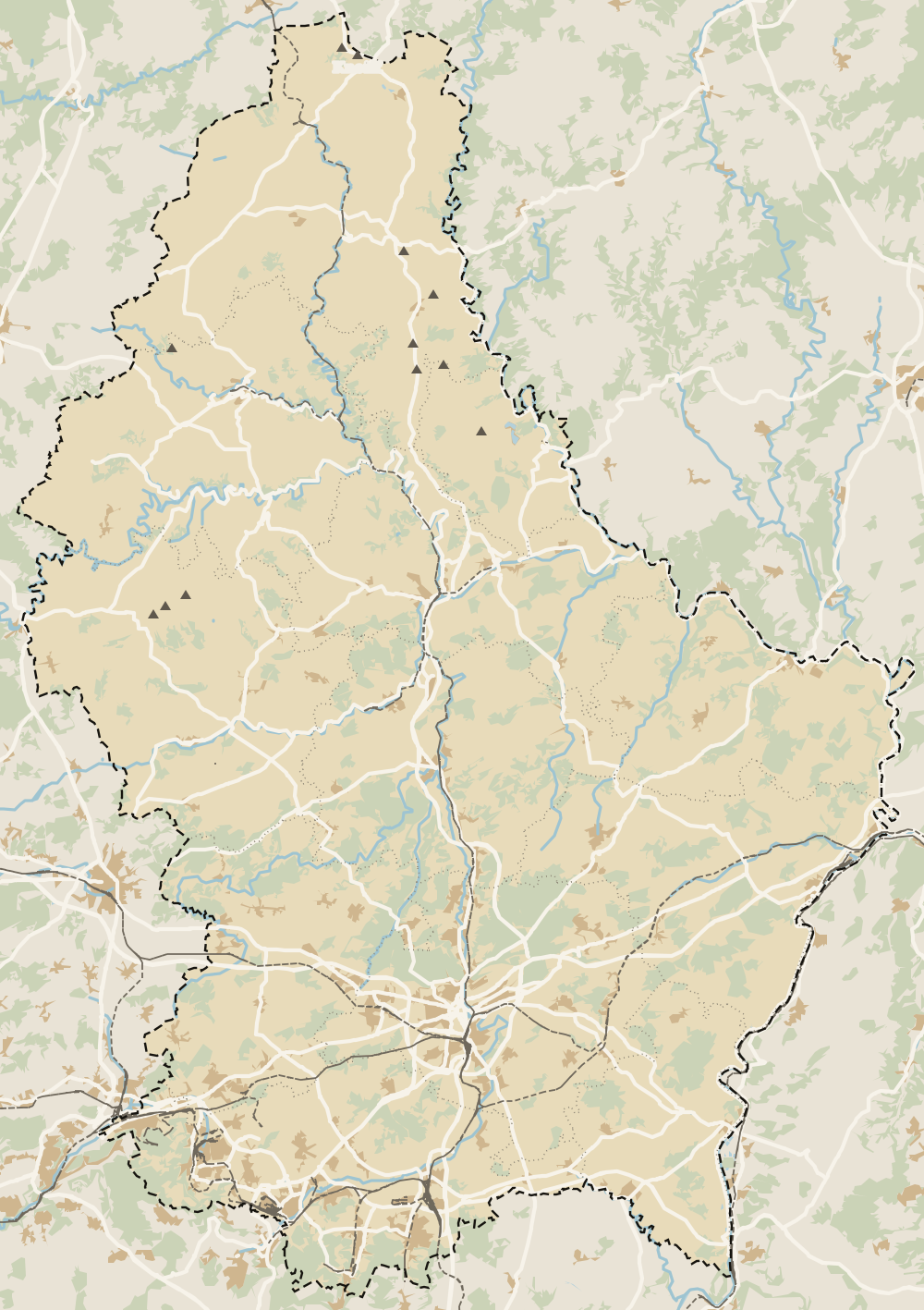
0 of 425 Luxembourg guides
Your next stamp
- Bridges
- Adolphe Bridge
- Pétrusse Valley
- Ville Haute
- Éislek
- Luxembourg fortress
- Vianden
- Red Bridge
- A Possen Museum
- American Cemetery
- Ansembourg
- Ansembourg Castles
- Asselborn
- Bascharage
- Beaufort castles
- Belval
- Belval blast furnaces
- Berg Castle
- Bernard-Massard cellars
- Bourglinster Castle
- Bourscheid Castle
- Brandenbourg
- Brandenbourg Castle
- Caves St Martin
- Christmas
- Clervaux Castle
- Echternach
- Echternach Abbey
- Ehnen
- Ehnen Wine Museum
- Esch-sur-Alzette
- Esch-sur-Sûre Castle
- European Museum Schengen
- Fond-de-Gras
- General Patton Museum
- German war cemetery
- Haff Réimech
- Hohllay
- Hollenfels Castle
- Hosingen
- Kautenbach
- Kneiff
- Koerich Castle
- Larochette Castle
- Lasauvage
- Mersch Castle
- Military History Museum
- Moersdorf
- Mondorf Domaine Thermal
- Munsbach Castle
- National Mining Museum
- Parc Merveilleux
- Park Sënnesräich
- Places to visit
- Remich
- Rindschleiden
- Schiessentümpel
- Septfontaines Castle
- Slate Museum
- Stolzembourg
- Tudor Museum
- Useldange Castle
- Valley of the Seven Castles
- Vianden Castle
- Wasserbillig Aquarium
- Weiswampach lakes
- Wiltz Castle
- Ahn
- Berdorf
- Bourscheid-Plage
- Butterfly garden
- Clervaux
- Differdange
- Echternach lake
- Grevenmacher
- Heringer Millen
- Hollenfels
- Luxembourg City
- Luxembourg Science Center
- Meysembourg Castle
- Mullerthal
- National Day
- National Resistance Museum
- Perekop
- Remerschen
- Schoenfels Castle
- The Family of Man
- Things to do
- Upper Sûre Lake
- Vianden chairlift
- Wasserbillig
- Clervaux Abbey
- Echternach Roman villa
- Insenborn
- Kallektuffquell
- Machtum
- Most beautiful places
- Our Nature Park
- Pétange
- Pettingen Castle
- Schueberfouer
- Schwebsingen
- Victor Hugo House
- Waldbillig
- Dudelange
- Kuelscheier
- Lultzhausen
- Moselle Valley
- Octave
- Prettiest villages
- Sanem
- Schengen
- Wellenstein
- Wiltz
- Wolfsschlucht
- Beaufort
- Bech-Kleinmacher
- Éimaischen
- Gaalgebierg
- Guttland
- Marnach
- Mondorf-les-Bains
- Putscheid
- Schifflange
- UNESCO World Heritage
- Carnival
- Consdorf
- Ellergronn
- Käerjeng
- Kayl
- Map
- Minett
- Munshausen
- Tandel
- Bech
- Buergbrennen
- Esch-sur-Sûre
- Rumelange
- Where is Luxembourg
- Is it a country?
- Lac de la Haute-Sûre (commune)
- Rosport-Mompach
- Wormeldange
- Larochette
- Mondercange
- Regions
- Bettembourg
- Bock Casemates
- Cantons
- Dancing procession
- Diekirch
- Fischbach
- Garnich
- Mersch
- Moselle wine route
- Ettelbruck
- Grund
- Heffingen
- Kehlen
- Lintgen
- Moselle river cruises
- Pétrusse Casemates
- Towns and villages
- Chemin de la Corniche
- Erpeldange-sur-Sûre
- Junglinster
- Kopstal
- Lorentzweiler
- Nommern
- Pfaffenthal
- Population
- Bissen
- Clausen
- Grand Ducal Palace
- Koerich
- Schieren
- Size
- Vallée de l'Ernz
- Feulen
- Kirchberg
- Languages
- Notre-Dame Cathedral
- Reisdorf
- Steinfort
- Bettendorf
- Habscht
- St Michael's Church
- Helperknapp
- Luxembourgish
- Place Guillaume II
- Name
- Place d'Armes
- History
- Place de la Constitution
- Grand Duke
- Colmar-Berg
- Flaxweiler
- Gare
- Hamm
- Kirchberg funicular
- Mamer
- Mertert
- Minett Trail
- Mullerthal Trail
- Neumünster Abbey
- Parc Hosingen
- Pfaffenthal lift
- Political system
- Redange
- Wine festivals
- Winseler
- Beckerich
- Biwer
- EU institutions
- Goesdorf
- Limpertsberg
- Mudam
- Natur Musée
- Pulvermühl
- Stadtbredimus
- Troisvierges
- Wenzel walk
- Bonnevoie
- Bous-Waldbredimus
- Ell
- Flag
- Kiischpelt
- Manternach
- Philharmonie
- Vauban circuit
- Weiswampach
- Betzdorf
- Boulaide
- Dräi Eechelen Museum
- Facts
- Hollerich
- Lenningen
- Useldange
- Wincrange
- Bourscheid
- Dalheim
- Gasperich
- Public holidays
- Saeul
- Belair
- Second World War
- Vichten
- Battle of the Bulge
- Merl
- Préizerdaul
- Cents
- EU and Schengen
- Groussbus-Wal
- Entry requirements
- Neudorf
- Rambrouch
- Currency and payments
- Mertzig
- Weimerskirch
- Beggen
- Escapardenne
- How to get there
- International March of Diekirch
- MNHA (National Museum)
- Rock climbing
- Sandweiler
- Eich
- Flights
- Golf
- Hesperange
- Lëtzebuerg City Museum
- Canoeing and kayaking
- Dommeldange
- Luxembourg airport
- Strassen
- Villa Vauban
- Airport to city centre
- Bertrange
- Casino Luxembourg
- Mühlenbach
- Swimming pools
- From Brussels
- Rollingergrund
- Walferdange
- Cessange
- Day trip from Brussels
- Municipal Park
- Steinsel
- Free walking tours
- From Paris
- Niederanven
- From Frankfurt
- Schuttrange
- Sightseeing train and bus
- By train
- Contern
- By coach
- Weiler-la-Tour
- Driving
- Luxembourg in one day
- Pretzel Sunday
- Rham Plateau
- Tour de Luxembourg
- Candlemas (Liichtmëssdag)
- Car hire
- Luxembourg in two days
- Saint-Esprit Plateau
- Luxembourg in three days
- Melusina statue
- Parking
- St Nicholas Day (Kleeschen)
- Fête de la Musique
- Luxembourg in four days
- Museums in Luxembourg
- Petrol
- Place de Clairefontaine
- A week in Luxembourg
- Getting around
- Luxembourg Marathon
- Tram and Bus Museum
- Free public transport
- Parks in Luxembourg City
- Road trip
- Belgium and Luxembourg
- Tram
- Buses
- Viewpoints
- Trains
- Luxembourg station
- Cycling
- LuxembourgPass
- Prices and budget
- On a budget
- Free things to do
- Mobile and roaming
- Healthcare
- Safety
- Scams
- Tourist information
- Packing list
- Swimming lakes
- With a dog
- Markets
- Tipping
- Shopping
- What to buy
- Shopping centres
- With kids
- For couples
- Playgrounds
- Adventure parks
- Nightlife
- Castles
- Theatres and concert venues
- Leudelange
- Nature parks
- Where to stay
- City-centre hotels
- Hiking
- Nature reserves
- Reckange-sur-Mess
- Hotels near the station
- Roeser
- Frisange
- Hotels in Kirchberg
- Airport hotels
- Dippach
- Hotels in Vianden
- Hotels in Echternach
- Hotels in Clervaux
- Hotels in Mondorf-les-Bains
- Hotels in Esch-sur-Alzette
- Hotels on the Moselle
- Mullerthal hotels
- Upper Sûre lake hotels
- Hotels in Diekirch and Ettelbruck
- Cheap hotels
- Luxury hotels
- Boutique hotels
- Spa hotels
- Family hotels
- Apartments
- Weather
- Youth hostels
- Best time to visit
- Campsites
- Holiday cottages
- In winter
- Castle hotels
- In spring
- Day trips
- In summer
- Around Luxembourg
- In autumn
- Ice skating
- Trier day trip
- Metz day trip
- Arlon day trip
- In January
- In February
- In March
- In April
- In May
- In June
- In July
- In August
- In September
- Food
- In October
- In November
- Where to eat
- In December
- Michelin restaurants
- Cheap eats
- Judd mat Gaardebounen
- Bouneschlupp
- Gromperekichelcher
- Kniddelen
- Quetschentaart
- Rieslingspaschtéit
- Events
- Wine
- Crémant
- Beer
Frequently asked questions
What is the Passerelle in Luxembourg?
The stone viaduct spanning the Pétrusse valley between the Gare and the Ville Haute. Built between 1859 and 1861, it's 290 metres long, has 24 arches and stands 45 metres above the valley.
Why is it called the Passerelle?
Before it was built, the upper town was reached from this side by a wooden footbridge, and the name stuck. It's also known as the Viaduc and, since Adolphe Bridge opened in 1903, as the old bridge.
Why does the Passerelle bend?
For military reasons. With the fortress still active, a straight bridge could have been bombarded in a straight line from the Plateau du Saint-Esprit, according to the Luxembourg government's portal.
Who built the Passerelle?
It was designed by engineers Édouard Grenier and Auguste Letellier and built by a British company, which the tourist office names as Waring Brothers, the same firm behind the four railway viaducts over the Alzette.
Can you walk across the Passerelle?
Yes. Works that began in spring 2018 widened it by several metres to fit a broader pavement, a cycle lane, two traffic lanes and a bus lane.
Where's the best view of the Passerelle?
From the Pétrusse valley and its park, where you can take in all 24 arches and the piers of up to 30 metres. The Péitruss skatepark sits right beneath it.
By
Tourism graduate with a master’s in Tourism Management and Planning from the University of Málaga, who has travelled across Europe. He writes every guide from official sources and his own judgement.
Published on . Facts checked on .
Sources
Some links in this guide are affiliate links: if you book through them, the site earns a commission at no extra cost to you. Affiliate disclosure
Photos: Cayambe (CC BY-SA 3.0); Aktron (CC BY 3.0); Krzysztof Golik (CC BY-SA 4.0), via Wikimedia Commons.