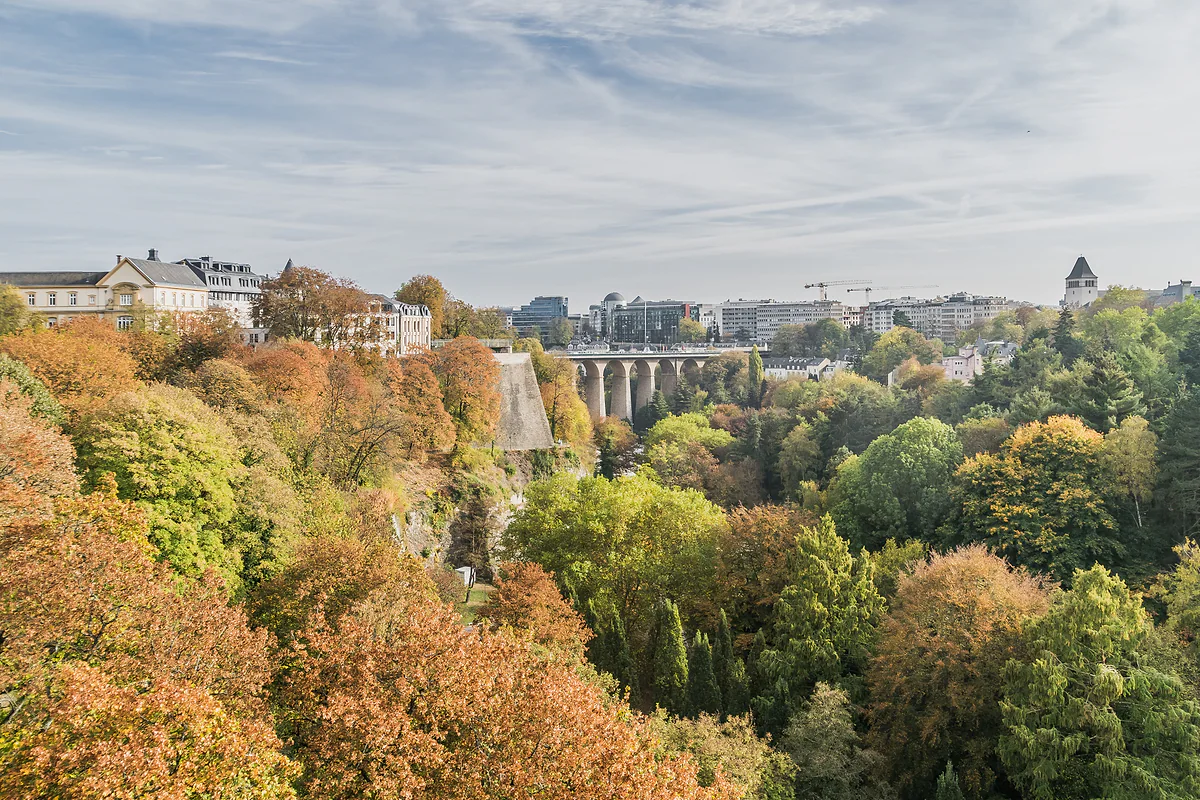
Mild weather, rain all year and continental sockets
Packing for Luxembourg, month by month
For Luxembourg, pack a proper coat from October to March (January averages 1.4°C at Findel), something waterproof whatever the month, as 831 mm of rain falls across all twelve, and shoes with grip for the old town and the Mullerthal. Sockets are type F at 230 V, so you need a UK adaptor, and your passport must meet Schengen rules.
In 30 seconds
Full read: 3 min
- Findel averages 1.4°C in January and 18.7°C in July, and it rains every month.
- Sockets are type F at 230 V, so bring a UK adaptor.
- Your passport must be under 10 years old and valid 3 months beyond your departure.
- Carry a GHIC or EHIC and travel insurance.
- Left luggage is at the central station; the airport has none.
I'd pack in layers rather than by season, because it rains every month and the old town is all slopes and steps. The two things I'd never leave behind are a packable waterproof and a pair of trainers that grip on wet stone.

Before you go
What I would keep in mind
-
01 My tip
Bring a UK adaptor
Visit Luxembourg lists type F sockets, the Schuko kind, at 230 V and 50 Hz. A British three-pin plug won't fit, so pack an adaptor or a charger with a European plug.
-
02 To save money
Refill a bottle, skip the bottled water
Tap water is generally drinkable in Luxembourg, says the national tourist board, and there are public drinking fountains. A refillable bottle does the job.
-
03 Getting there
Leave bags at the station, not Findel
The airport has no left-luggage service for security reasons and points you to the central station, where CFL stores bags for a fee. Handy on an evening flight day.
Luxembourg railway station -
04 My tip
Three days a year with no shops
By law, shops can't open on 1 January, 1 May or 25 December, apart from some bakeries and patisseries. Anything you forget on those days waits until tomorrow.
shopping in Luxembourg
What I would book
Packing for Luxembourg isn’t complicated, but it has a catch or two. The climate is mild without extremes, the rain is spread through the year, and on top of that the capital is built on hills while the north is forest and rock that wants different shoes. Here’s what I’d take for each season, and the things you can’t leave at home whatever the month.
What weather should I expect?
MeteoLux averages for 1991-2020, measured at Findel, give a yearly mean of 9.8°C. The thermometer bottoms out in January (1.4°C) and peaks in July (18.7°C). For the capital, STATEC puts the January average high at 4.7°C and low at about minus 1°C, and July at 24.9°C and 12.4°C. In other words, winter is properly cold and summer nights cool off.
Rain is what really shapes the suitcase. Around 831 mm falls each year, no month gets less than 49 mm, December is the wettest, and fog turns up on more than ten days a month from November to January. Month by month it’s all in Luxembourg weather, and if you’re still picking dates, see best time to visit Luxembourg.
Clothes, in layers
I wouldn’t think winter wardrobe versus summer wardrobe, I’d think layers you can peel off and put back on. December to February, a warm coat, hat, gloves and shoes that keep water out, since averages hover around two degrees and the icy days bunch up in those months. In spring and autumn, a jumper, a light jacket and something waterproof. In summer, T-shirts, a thin layer for the evening and a folding umbrella, because June and July bring the most thunderstorms. If you’re coming for the Winterlights markets, from 20 November 2026 until 3 January 2027, you’ll be standing outside for hours, and thick socks make all the difference.
Footwear deserves its own paragraph. The old town sits on a rocky outcrop, and heading down to the Grund or the Pfaffenthal means steps and cobbles both ways. If you’re walking the Mullerthal Trail, it’s sandstone, roots and narrow passages between rocks that turn slippery in the rain. One pair of trainers with a good sole covers both.
If you are staying the night, see the best hotel deals in Luxemburgo for your dates: the well-placed rooms go fast.
Plugs, water and your phone
Sockets are type F, the Schuko type, at 230 V and 50 Hz. From the UK you need an adaptor, or a charger with a two-pin European plug. Tap water is generally drinkable, according to Visit Luxembourg, and there are public fountains, so a refillable bottle saves money and plastic.
Your phone is the one thing to check before you fly. UK networks no longer have to offer EU roaming without extra charges, so look up your own network’s policy before you go. The government notes a £45 monthly cap on mobile data charges abroad unless you choose to keep spending. The details are in Luxembourg roaming. I’d also download the mobiliteit.lu app for bus and train times, and the VisitLuxembourg app if you’re using the LuxembourgPass, which works as a QR code.
Papers and health
Luxembourg follows Schengen rules. On arrival, your passport’s issue date has to fall within the last 10 years, and it must still have 3 months left after your planned exit from Schengen. Without a visa, the limit is 90 days in each rolling 180. The EU’s Entry/Exit System registers your fingerprints and photo at the border. The full picture is in Luxembourg entry requirements.
Pack your GHIC or EHIC. It covers medically necessary state healthcare, but gov.uk stresses that you still need proper travel insurance on top. Pharmacies are marked with a green cross and take turns to open out of hours. In an emergency, dial 112 for an ambulance or 113 for the police, and keep the insurer’s helpline number somewhere other than your phone.
If you are staying the night, see the best hotel deals in Luxemburgo for your dates: the well-placed rooms go fast.
What people tend to forget
Three things are easy to miss. First, Findel has no left luggage and sends you to the central station, where you can leave bags for a fee, so plan your last day around that if you fly in the evening. Second, if you’re driving in winter, winter tyres are compulsory in icy, snowy or frosty conditions. And third, shops are closed by law on the first day of the year, on 1 May and on Christmas Day, so whatever you forget on those days will have to wait.
So you do not lose the morning at the ticket office, browse tickets and tours in Luxemburgo on GetYourGuide.
If you would rather go at your own pace, see the car hire deals in Luxembourg: the earlier you book, the more cars are left to choose from.
Before you fix your dates, compare tickets to Luxembourg: the same journey can cost very different amounts from one day to the next.
What to wear by month (Findel, 1991-2020 averages)
| Months | Average temperature | Rain per month | What I'd pack |
|---|---|---|---|
| December to February | 1.4 to 2.3°C | 59.5 to 89.5 mm | Warm coat, hat, gloves, waterproof shoes |
| March and April | 5.7 and 9.6°C | 56.6 and 49.4 mm | Light jacket, jumper and a waterproof |
| May and June | 13.5 and 16.7°C | 73.3 and 73.0 mm | Light layers and a jacket for the evening |
| July and August | 18.7 and 18.4°C | 72.1 and 71.9 mm | T-shirts, a light layer and a folding umbrella |
| September and October | 14.3 and 9.9°C | 66.6 and 76.2 mm | Jumper, waterproof jacket and closed shoes |
| November | 5.2°C | 71.7 mm | Coat and clothes that cope with damp |
MeteoLux, 1991-2020 averages at Findel, checked on 29-09-2026. The clothing column is my own view.
Things you can't forget
| What | Why |
|---|---|
| Passport under 10 years old | Schengen rule on entry, with at least 3 months left after you leave |
| GHIC or EHIC | Covers medically necessary state healthcare, not a substitute for insurance |
| Travel insurance | The UK government advises it alongside the GHIC |
| Plug adaptor | Type F sockets, 230 V |
| Winter tyres if driving | Required in wintry conditions such as ice, snow or frost |
gov.uk Luxembourg travel advice (updated 11-08-2026) and Visit Luxembourg, checked on 29-09-2026.
Test yourself
True or false?
0/3 Pick before you peek.
-
A British plug fits Luxembourg sockets without an adaptor.
See the answer
False. Luxembourg uses type F sockets at 230 V and 50 Hz. A UK three-pin plug needs an adaptor.
-
July is the wettest month of the year at Findel.
See the answer
False. December is the wettest, averaging 89.5 mm. July gets 72.1 mm, although it has more thunderstorms.
-
Luxembourg airport has a left-luggage office.
See the answer
False. lux-Airport says there's no left-luggage service for security reasons and refers you to the central station, which charges for it.
0 of 425 Luxembourg guides
Your next stamp
- Weather
- In December
- In January
- In July
- In winter
- In summer
- A Possen Museum
- American Cemetery
- Ansembourg
- Ansembourg Castles
- Asselborn
- Bascharage
- Beaufort castles
- Belval
- Belval blast furnaces
- Berg Castle
- Bernard-Massard cellars
- Bourglinster Castle
- Bourscheid Castle
- Brandenbourg
- Brandenbourg Castle
- Caves St Martin
- Christmas
- Clervaux Castle
- Echternach
- Echternach Abbey
- Ehnen
- Ehnen Wine Museum
- Esch-sur-Alzette
- Esch-sur-Sûre Castle
- European Museum Schengen
- Fond-de-Gras
- General Patton Museum
- German war cemetery
- Haff Réimech
- Hohllay
- Hollenfels Castle
- Hosingen
- Kautenbach
- Kneiff
- Koerich Castle
- Larochette Castle
- Lasauvage
- Mersch Castle
- Military History Museum
- Moersdorf
- Mondorf Domaine Thermal
- Munsbach Castle
- National Mining Museum
- Parc Merveilleux
- Park Sënnesräich
- Places to visit
- Remich
- Rindschleiden
- Schiessentümpel
- Septfontaines Castle
- Slate Museum
- Stolzembourg
- Tudor Museum
- Useldange Castle
- Valley of the Seven Castles
- Vianden
- Vianden Castle
- Ville Haute
- Wasserbillig Aquarium
- Weiswampach lakes
- Wiltz Castle
- Ahn
- Berdorf
- Bourscheid-Plage
- Butterfly garden
- Clervaux
- Differdange
- Echternach lake
- Grevenmacher
- Heringer Millen
- Hollenfels
- Luxembourg City
- Luxembourg Science Center
- Meysembourg Castle
- Mullerthal
- National Day
- National Resistance Museum
- Perekop
- Remerschen
- Schoenfels Castle
- The Family of Man
- Things to do
- Upper Sûre Lake
- Vianden chairlift
- Wasserbillig
- Clervaux Abbey
- Echternach Roman villa
- Éislek
- Insenborn
- Kallektuffquell
- Machtum
- Most beautiful places
- Our Nature Park
- Pétange
- Pettingen Castle
- Schueberfouer
- Schwebsingen
- Victor Hugo House
- Waldbillig
- Dudelange
- Kuelscheier
- Lultzhausen
- Moselle Valley
- Octave
- Prettiest villages
- Sanem
- Schengen
- Wellenstein
- Wiltz
- Wolfsschlucht
- Beaufort
- Bech-Kleinmacher
- Éimaischen
- Gaalgebierg
- Guttland
- Marnach
- Mondorf-les-Bains
- Putscheid
- Schifflange
- UNESCO World Heritage
- Carnival
- Consdorf
- Ellergronn
- Käerjeng
- Kayl
- Map
- Minett
- Munshausen
- Tandel
- Bech
- Buergbrennen
- Esch-sur-Sûre
- Rumelange
- Where is Luxembourg
- Is it a country?
- Lac de la Haute-Sûre (commune)
- Rosport-Mompach
- Wormeldange
- Larochette
- Mondercange
- Regions
- Bettembourg
- Bock Casemates
- Cantons
- Dancing procession
- Diekirch
- Fischbach
- Garnich
- Mersch
- Moselle wine route
- Ettelbruck
- Grund
- Heffingen
- Kehlen
- Lintgen
- Moselle river cruises
- Pétrusse Casemates
- Towns and villages
- Chemin de la Corniche
- Erpeldange-sur-Sûre
- Junglinster
- Kopstal
- Lorentzweiler
- Nommern
- Pfaffenthal
- Population
- Bissen
- Clausen
- Grand Ducal Palace
- Koerich
- Schieren
- Size
- Vallée de l'Ernz
- Feulen
- Kirchberg
- Languages
- Notre-Dame Cathedral
- Reisdorf
- Steinfort
- Bettendorf
- Habscht
- St Michael's Church
- Helperknapp
- Luxembourgish
- Place Guillaume II
- Name
- Place d'Armes
- History
- Place de la Constitution
- Grand Duke
- Colmar-Berg
- Flaxweiler
- Gare
- Hamm
- Kirchberg funicular
- Luxembourg fortress
- Mamer
- Mertert
- Minett Trail
- Mullerthal Trail
- Neumünster Abbey
- Parc Hosingen
- Pfaffenthal lift
- Political system
- Redange
- The Passerelle
- Wine festivals
- Winseler
- Beckerich
- Biwer
- EU institutions
- Goesdorf
- Limpertsberg
- Mudam
- Natur Musée
- Pulvermühl
- Stadtbredimus
- Troisvierges
- Wenzel walk
- Bonnevoie
- Bous-Waldbredimus
- Ell
- Flag
- Kiischpelt
- Manternach
- Philharmonie
- Vauban circuit
- Weiswampach
- Betzdorf
- Boulaide
- Dräi Eechelen Museum
- Facts
- Hollerich
- Lenningen
- Useldange
- Wincrange
- Bourscheid
- Dalheim
- Gasperich
- Public holidays
- Red Bridge
- Saeul
- Belair
- Second World War
- Vichten
- Battle of the Bulge
- Merl
- Préizerdaul
- Cents
- EU and Schengen
- Groussbus-Wal
- Entry requirements
- Neudorf
- Rambrouch
- Currency and payments
- Mertzig
- Weimerskirch
- Adolphe Bridge
- Beggen
- Escapardenne
- How to get there
- International March of Diekirch
- MNHA (National Museum)
- Rock climbing
- Sandweiler
- Bridges
- Eich
- Flights
- Golf
- Hesperange
- Lëtzebuerg City Museum
- Canoeing and kayaking
- Dommeldange
- Luxembourg airport
- Strassen
- Villa Vauban
- Airport to city centre
- Bertrange
- Casino Luxembourg
- Mühlenbach
- Swimming pools
- From Brussels
- Pétrusse Valley
- Rollingergrund
- Walferdange
- Cessange
- Day trip from Brussels
- Municipal Park
- Steinsel
- Free walking tours
- From Paris
- Niederanven
- From Frankfurt
- Schuttrange
- Sightseeing train and bus
- By train
- Contern
- By coach
- Weiler-la-Tour
- Driving
- Luxembourg in one day
- Pretzel Sunday
- Rham Plateau
- Tour de Luxembourg
- Candlemas (Liichtmëssdag)
- Car hire
- Luxembourg in two days
- Saint-Esprit Plateau
- Luxembourg in three days
- Melusina statue
- Parking
- St Nicholas Day (Kleeschen)
- Fête de la Musique
- Luxembourg in four days
- Museums in Luxembourg
- Petrol
- Place de Clairefontaine
- A week in Luxembourg
- Getting around
- Luxembourg Marathon
- Tram and Bus Museum
- Free public transport
- Parks in Luxembourg City
- Road trip
- Belgium and Luxembourg
- Tram
- Buses
- Viewpoints
- Trains
- Luxembourg station
- Cycling
- LuxembourgPass
- Prices and budget
- On a budget
- Free things to do
- Mobile and roaming
- Healthcare
- Safety
- Scams
- Tourist information
- Swimming lakes
- With a dog
- Markets
- Tipping
- Shopping
- What to buy
- Shopping centres
- With kids
- For couples
- Playgrounds
- Adventure parks
- Nightlife
- Castles
- Theatres and concert venues
- Leudelange
- Nature parks
- Where to stay
- City-centre hotels
- Hiking
- Nature reserves
- Reckange-sur-Mess
- Hotels near the station
- Roeser
- Frisange
- Hotels in Kirchberg
- Airport hotels
- Dippach
- Hotels in Vianden
- Hotels in Echternach
- Hotels in Clervaux
- Hotels in Mondorf-les-Bains
- Hotels in Esch-sur-Alzette
- Hotels on the Moselle
- Mullerthal hotels
- Upper Sûre lake hotels
- Hotels in Diekirch and Ettelbruck
- Cheap hotels
- Luxury hotels
- Boutique hotels
- Spa hotels
- Family hotels
- Apartments
- Youth hostels
- Best time to visit
- Campsites
- Holiday cottages
- Castle hotels
- In spring
- Day trips
- Around Luxembourg
- In autumn
- Ice skating
- Trier day trip
- Metz day trip
- Arlon day trip
- In February
- In March
- In April
- In May
- In June
- In August
- In September
- Food
- In October
- In November
- Where to eat
- Michelin restaurants
- Cheap eats
- Judd mat Gaardebounen
- Bouneschlupp
- Gromperekichelcher
- Kniddelen
- Quetschentaart
- Rieslingspaschtéit
- Events
- Wine
- Crémant
- Beer
Frequently asked questions
What should I wear in Luxembourg in winter?
A real winter coat, a hat and gloves. Findel averages 1.4°C in January and 2.3°C in December, with ten or eleven foggy days a month, and STATEC puts the average January low in the capital at about minus 1°C.
Do I need a plug adaptor for Luxembourg?
Yes, coming from the UK. Luxembourg uses type F sockets at 230 V and 50 Hz, so a British three-pin plug needs an adaptor.
Does it rain a lot in Luxembourg?
About 831 mm a year, spread across every month, from 49.4 mm in April to 89.5 mm in December, according to MeteoLux. No month is truly dry, so a waterproof always earns its place.
Where can I leave my luggage in Luxembourg?
At the central railway station, where CFL runs a paid left-luggage service. Luxembourg airport has no left luggage for security reasons and sends travellers to the station.
What documents do I need to visit Luxembourg from the UK?
A passport issued less than 10 years before you enter and valid for at least 3 months after you leave the Schengen area. You can stay up to 90 days in any 180 without a visa, and you'll be registered in the EU's Entry/Exit System.
Is tap water safe to drink in Luxembourg?
Yes. The national tourist board says tap water is generally drinkable, and there are public drinking fountains, so a refillable bottle is enough.
By
Tourism graduate with a master’s in Tourism Management and Planning from the University of Málaga, who has travelled across Europe. He writes every guide from official sources and his own judgement.
Published on . Facts checked on .
Sources
Some links in this guide are affiliate links: if you book through them, the site earns a commission at no extra cost to you. Affiliate disclosure
Photos: Krzysztof Golik (CC BY-SA 4.0), via Wikimedia Commons.