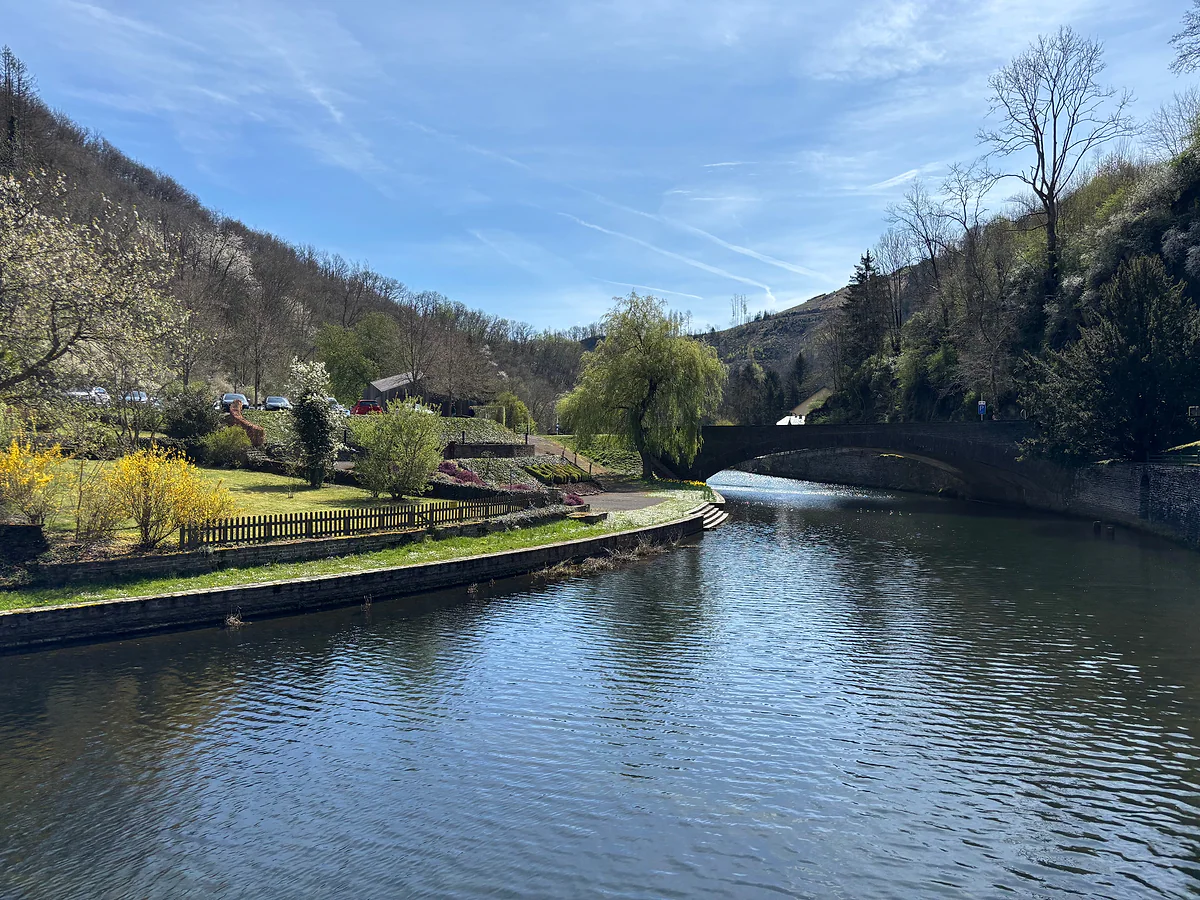
Three parks, one of them a UNESCO geopark
Luxembourg's three nature parks, and which to choose
Luxembourg has three nature parks. The Our (420 km², 2005) covers the north of the Ardennes; the Upper Sûre (200 km², 2005) wraps around the country's big reservoir; and the Natur- & Geopark Mëllerdall (256 km², 2016) is the sandstone Mullerthal, a UNESCO Global Geopark since April 2022. The first two are in the Éislek, the third in the east.
In 30 seconds
Full read: 3 min
- Luxembourg has three nature parks, the Our, the Upper Sûre and the Mëllerdall, covering 876 km² between them.
- The Mëllerdall has been a UNESCO Global Geopark since April 2022, with 22 geosites.
- The 380-hectare Upper Sûre reservoir supplies drinking water to around 70% of the country.
- There's no entry fee, and free public transport reaches many of the trailheads.
With a single day, I'd head for the Mëllerdall, because its rock formations look like nothing else in the country and free public transport gets you there from the capital. With two, I'd add the Upper Sûre in summer for the lake, or the Our if you're after castles and deep valleys.

Before you go
What I would keep in mind
-
01 Most beautiful
Rocks from a sea over 200 million years old
The national portal explains that more than 200 million years ago the Mëllerdall lay under the sea. Rivers later carved the sandstone that the Mullerthal Trail now winds through.
Mullerthal Trail -
02 My tip
The lake supplies seven in ten homes
The Upper Sûre reservoir provides drinking water to around 70% of Luxembourg's population, which is why swimming and water sports are limited to approved areas, from May to September.
Upper Sûre lake -
03 To save money
Free to enter, free to reach
A Luxembourg nature park has no ticket office. It's lived-in countryside, and national trains and buses, free in second class, reach many of the trailheads.
Luxembourg free public transport -
04 Getting there
The Our has its own guide
Vianden, Clervaux, the Ourdall walk and the smugglers' trail at Troisvierges are all in the Our Nature Park guide, in more detail than here.
Our Nature Park
What I would book
- Places to stayBooking.com Stay by the Upper Sûre lake The village sits a kilometre from the dam in the heart of the park, ideal if you're paddling or swimming in summer.
- Places to stayBooking.com A base in the Mëllerdall Berdorf is right among the rocks and on Route 2 of the Mullerthal Trail, so you can walk straight out of the door.
My ranking, scored
The nature parks, and where I'd start
My own view for a traveller with a day or two, weighing how distinctive the landscape is, how easy it is to reach without a car from the capital and what you can do on foot. Score out of 10.
0 of 4 seen
-
Natur- & Geopark Mëllerdall
Sandstone and dolomite gorges and narrow passages, a UNESCO Geopark since 2022, and the 112 km Mullerthal Trail. The most distinctive corner of the country.
9.4 out of 10
-
Naturpark Our
A high plateau cut by the Our and Clerve valleys, with Vianden and Clervaux inside. The one with the most heritage.
8.9 out of 10
-
Naturpark Öewersauer
The 380-hectare lake is the star. Hard to beat in summer for swimming and paddling; out of season, better for quiet walks.
8.6 out of 10
-
German-Luxembourg Nature Park
Europe's first cross-border nature park, from 1964. Worth it if you're crossing into the German Eifel; on the Luxembourg side it overlaps the Our and the Mëllerdall.
7.4 out of 10
Luxembourg is small, but its three nature parks cover 876 km² between them, around a third of the country, and each has its own character. One is about rock, one about water and one about high plateaus and deep valleys. Here I compare them so you can pick the one that suits your trip, and point you to each park’s own guide where there is one.
What a nature park means here
Worth knowing before you go, because the word park can mislead. The national portal sets the bar at 5,000 hectares or more, with natural and cultural heritage of high value, run to protect it while also giving residents sustainable economic development. In practice these are whole districts with villages, farms, roads and castles, managed by a syndicate of communes together with the state. No fences, no opening hours, no entry fee.
Visit Luxembourg counts three nature parks, and these are they. The two in the north were created in 2005 and the eastern one in 2016. Above them sits the German-Luxembourg Nature Park, a 1964 agreement with Rhineland-Palatinate linking the Our and the Mëllerdall with the German parks of the Eifel. Its 24 Premium-rated walking circuits go under the NaturWanderPark delux name; one of them, the 19.6 km Eifelgold Route on the German side, is at its best in spring, when the broom turns the hillsides yellow.
The Mëllerdall, rocks from under an ancient sea
The Natur- & Geopark Mëllerdall covers 256 km² of the Mullerthal region, with about 25,800 residents in 11 communes from Echternach to Larochette. Its trademark is sandstone and dolomite rock along the valleys of the Black Ernz, the White Ernz and the Lower Sûre. Over 200 million years ago the whole area lay beneath the sea, and rivers later carved the gorges and narrow passages you now walk through. Since April 2022 it has been a UNESCO Global Geopark, with 22 geosites.
For me it’s the most special of the three. The classic way in is the Mullerthal Trail, whose 112 km split into three loops, but if a full stage is too much there are short geology walks such as the 4 km Geo Pad Hëlt. Cyclists get five mountain-bike routes, 16 road circuits and, for families, five national cycle paths that are almost flat.
Once your dates are set, check which hotels are still free in Esch-sur-Sûre before prices climb.
The Upper Sûre, the park built around water
Naturpark Öewersauer covers 200 km², with about 15,500 residents in five communes in the north-west of the Éislek. Everything revolves around the lake, a 380-hectare reservoir created in 1961 by the Esch-sur-Sûre dam, which provides the drinking water for roughly 70% of Luxembourg’s residents. That explains the rules. You can kayak, canoe or paddleboard (with hire at Lultzhausen), take the solar boat on a guided trip or combine it with an 8 km walk, even dive with your own kit, but swimming is limited to approved spots and, according to the national portal, usually runs from 1 May to 30 September.
I’d save it for summer. Out of season it’s still lovely for walking, with the region’s 18 Éislek Pied trails and the 2.8 km Schumannseck remembrance trail on the Battle of the Bulge. There’s more in the Upper Sûre lake guide.
The Our, plateaus, valleys and castles
Naturpark Our is the largest, with 420 km² and about 24,000 residents in eight communes in the far north, between Belgium and Germany. It’s a broad high plateau sliced by narrow valleys cut by the Our, the Clerve and their tributaries. Vianden and Clervaux are inside it, so it’s also the park with the most heritage. Everything you need, from its walks to its museums, is in the Our Nature Park guide.
Once your dates are set, check which hotels are still free in Esch-sur-Sûre before prices climb.
Only got one day?
Coming by public transport from the capital, go for the Mëllerdall, because its rocks are the most unusual thing you’ll see in Luxembourg. Travelling in summer and after water, the Upper Sûre. Keen on castles and northern valleys, the Our. And if long-distance paths are your thing, all three have sections of the network covered in hiking in Luxembourg.
Outside the three parks there are other places worth the trip, such as the Haff Réimech bird reserve by the Moselle, or the Minett in the south, a UNESCO biosphere reserve since 2020. The smaller ones, from the old open-cast mines of the Minett such as Haard-Hesselsbierg-Staebierg to the Schlammwiss reed bed, are sorted into a separate page on nature reserves in Luxembourg, and I find them the ideal add-on to a park when you want something shorter.
If you would rather have a local show you round, book a guided tour in Esch-sur-Sûre and choose by the reviews.
A car frees you from timetables: search car hire in Luxembourg on DiscoverCars and compare companies.
So you do not pay over the odds, look at trains, coaches and flights to Luxembourg on Omio and pick the one that suits you.
Luxembourg's nature parks side by side
| Park | Created | Area | Residents | Communes |
|---|---|---|---|---|
| Naturpark Our | 2005 | 420 km² | about 24,000 | Clervaux, Kiischpelt, Parc Hosingen, Putscheid, Tandel, Troisvierges, Vianden and Wincrange |
| Naturpark Öewersauer (Upper Sûre) | 2005 | 200 km² | about 15,500 | Boulaide, Esch-sur-Sûre, Lac de la Haute-Sûre, Wiltz and Winseler |
| Natur- & Geopark Mëllerdall | 2016 | 256 km² | about 25,800 | Beaufort, Bech, Berdorf, Consdorf, Echternach, Fischbach, Heffingen, Larochette, Nommern, Rosport-Mompach and Waldbillig |
| German-Luxembourg Nature Park | 1964 | about 800 km² (with Germany) | no figure | Links the Our and the Mëllerdall with the Eifel |
luxembourg.public.lu, each park's page, checked on 30 September 2026. Joining in future: Weiswampach (Our), Goesdorf (Upper Sûre) and Reisdorf (Mëllerdall).
What to do in each
| Park | What I'd do | Official figure |
|---|---|---|
| Mëllerdall | The Mullerthal Trail or a Geo Pad walk | 22 geosites; Geo Pad Hëlt, 4 km |
| Upper Sûre | Kayaking, the solar boat and the lawn beaches | 380 ha lake; swimming 1 May to 30 Sep |
| Our | The Ourdall walk from Vianden to Stolzembourg | 8.5 km and 10 themed stops |
| German-Luxembourg | A NaturWanderPark delux circuit | 24 Premium-rated circuits |
luxembourg.public.lu, checked on 30 September 2026. The middle column is my opinion.
Test yourself
True or false?
0/4 Pick before you peek.
-
You need a ticket to enter a Luxembourg nature park.
See the answer
False. They're lived-in areas with no ticket office. You pay only for some activities, such as the solar boat or kayak hire on the Upper Sûre lake.
-
The Mëllerdall is a UNESCO Global Geopark.
See the answer
True. It joined UNESCO's Global Geoparks network in April 2022, according to the national portal.
-
The Upper Sûre lake is a natural Ardennes lake.
See the answer
False. It's a reservoir, created by the Esch-sur-Sûre dam in 1961, and it's the country's main source of drinking water.
-
The German-Luxembourg Nature Park was Europe's first cross-border nature park.
See the answer
True. It was set up in 1964 with Rhineland-Palatinate, and the national portal describes it as the first of its kind.
- Nature parks
- 3
- Combined area (420 + 200 + 256)
- 876 km²
- Geosites in the Mëllerdall
- 22
- German-Luxembourg park, the first cross-border one
- 1964
What to see
What to see in Nature parks
0 of 425 Luxembourg guides
Your next stamp
- Our Nature Park
- Upper Sûre Lake
- Parks in Luxembourg City
- Upper Sûre lake hotels
- Mullerthal
- Canoeing and kayaking
- Éislek
- Merl
- A Possen Museum
- American Cemetery
- Ansembourg
- Ansembourg Castles
- Asselborn
- Bascharage
- Beaufort castles
- Belval
- Belval blast furnaces
- Berg Castle
- Bernard-Massard cellars
- Bourglinster Castle
- Bourscheid Castle
- Brandenbourg
- Brandenbourg Castle
- Caves St Martin
- Christmas
- Clervaux Castle
- Echternach
- Echternach Abbey
- Ehnen
- Ehnen Wine Museum
- Esch-sur-Alzette
- Esch-sur-Sûre Castle
- European Museum Schengen
- Fond-de-Gras
- General Patton Museum
- German war cemetery
- Haff Réimech
- Hohllay
- Hollenfels Castle
- Hosingen
- Kautenbach
- Kneiff
- Koerich Castle
- Larochette Castle
- Lasauvage
- Mersch Castle
- Military History Museum
- Moersdorf
- Mondorf Domaine Thermal
- Munsbach Castle
- National Mining Museum
- Parc Merveilleux
- Park Sënnesräich
- Places to visit
- Remich
- Rindschleiden
- Schiessentümpel
- Septfontaines Castle
- Slate Museum
- Stolzembourg
- Tudor Museum
- Useldange Castle
- Valley of the Seven Castles
- Vianden
- Vianden Castle
- Ville Haute
- Wasserbillig Aquarium
- Weiswampach lakes
- Wiltz Castle
- Ahn
- Berdorf
- Bourscheid-Plage
- Butterfly garden
- Clervaux
- Differdange
- Echternach lake
- Grevenmacher
- Heringer Millen
- Hollenfels
- Luxembourg City
- Luxembourg Science Center
- Meysembourg Castle
- National Day
- National Resistance Museum
- Perekop
- Remerschen
- Schoenfels Castle
- The Family of Man
- Things to do
- Vianden chairlift
- Wasserbillig
- Clervaux Abbey
- Echternach Roman villa
- Insenborn
- Kallektuffquell
- Machtum
- Most beautiful places
- Pétange
- Pettingen Castle
- Schueberfouer
- Schwebsingen
- Victor Hugo House
- Waldbillig
- Dudelange
- Kuelscheier
- Lultzhausen
- Moselle Valley
- Octave
- Prettiest villages
- Sanem
- Schengen
- Wellenstein
- Wiltz
- Wolfsschlucht
- Beaufort
- Bech-Kleinmacher
- Éimaischen
- Gaalgebierg
- Guttland
- Marnach
- Mondorf-les-Bains
- Putscheid
- Schifflange
- UNESCO World Heritage
- Carnival
- Consdorf
- Ellergronn
- Käerjeng
- Kayl
- Map
- Minett
- Munshausen
- Tandel
- Bech
- Buergbrennen
- Esch-sur-Sûre
- Rumelange
- Where is Luxembourg
- Is it a country?
- Lac de la Haute-Sûre (commune)
- Rosport-Mompach
- Wormeldange
- Larochette
- Mondercange
- Regions
- Bettembourg
- Bock Casemates
- Cantons
- Dancing procession
- Diekirch
- Fischbach
- Garnich
- Mersch
- Moselle wine route
- Ettelbruck
- Grund
- Heffingen
- Kehlen
- Lintgen
- Moselle river cruises
- Pétrusse Casemates
- Towns and villages
- Chemin de la Corniche
- Erpeldange-sur-Sûre
- Junglinster
- Kopstal
- Lorentzweiler
- Nommern
- Pfaffenthal
- Population
- Bissen
- Clausen
- Grand Ducal Palace
- Koerich
- Schieren
- Size
- Vallée de l'Ernz
- Feulen
- Kirchberg
- Languages
- Notre-Dame Cathedral
- Reisdorf
- Steinfort
- Bettendorf
- Habscht
- St Michael's Church
- Helperknapp
- Luxembourgish
- Place Guillaume II
- Name
- Place d'Armes
- History
- Place de la Constitution
- Grand Duke
- Colmar-Berg
- Flaxweiler
- Gare
- Hamm
- Kirchberg funicular
- Luxembourg fortress
- Mamer
- Mertert
- Minett Trail
- Mullerthal Trail
- Neumünster Abbey
- Parc Hosingen
- Pfaffenthal lift
- Political system
- Redange
- The Passerelle
- Wine festivals
- Winseler
- Beckerich
- Biwer
- EU institutions
- Goesdorf
- Limpertsberg
- Mudam
- Natur Musée
- Pulvermühl
- Stadtbredimus
- Troisvierges
- Wenzel walk
- Bonnevoie
- Bous-Waldbredimus
- Ell
- Flag
- Kiischpelt
- Manternach
- Philharmonie
- Vauban circuit
- Weiswampach
- Betzdorf
- Boulaide
- Dräi Eechelen Museum
- Facts
- Hollerich
- Lenningen
- Useldange
- Wincrange
- Bourscheid
- Dalheim
- Gasperich
- Public holidays
- Red Bridge
- Saeul
- Belair
- Second World War
- Vichten
- Battle of the Bulge
- Préizerdaul
- Cents
- EU and Schengen
- Groussbus-Wal
- Entry requirements
- Neudorf
- Rambrouch
- Currency and payments
- Mertzig
- Weimerskirch
- Adolphe Bridge
- Beggen
- Escapardenne
- How to get there
- International March of Diekirch
- MNHA (National Museum)
- Rock climbing
- Sandweiler
- Bridges
- Eich
- Flights
- Golf
- Hesperange
- Lëtzebuerg City Museum
- Dommeldange
- Luxembourg airport
- Strassen
- Villa Vauban
- Airport to city centre
- Bertrange
- Casino Luxembourg
- Mühlenbach
- Swimming pools
- From Brussels
- Pétrusse Valley
- Rollingergrund
- Walferdange
- Cessange
- Day trip from Brussels
- Municipal Park
- Steinsel
- Free walking tours
- From Paris
- Niederanven
- From Frankfurt
- Schuttrange
- Sightseeing train and bus
- By train
- Contern
- By coach
- Weiler-la-Tour
- Driving
- Luxembourg in one day
- Pretzel Sunday
- Rham Plateau
- Tour de Luxembourg
- Candlemas (Liichtmëssdag)
- Car hire
- Luxembourg in two days
- Saint-Esprit Plateau
- Luxembourg in three days
- Melusina statue
- Parking
- St Nicholas Day (Kleeschen)
- Fête de la Musique
- Luxembourg in four days
- Museums in Luxembourg
- Petrol
- Place de Clairefontaine
- A week in Luxembourg
- Getting around
- Luxembourg Marathon
- Tram and Bus Museum
- Free public transport
- Road trip
- Belgium and Luxembourg
- Tram
- Buses
- Viewpoints
- Trains
- Luxembourg station
- Cycling
- LuxembourgPass
- Prices and budget
- On a budget
- Free things to do
- Mobile and roaming
- Healthcare
- Safety
- Scams
- Tourist information
- Packing list
- Swimming lakes
- With a dog
- Markets
- Tipping
- Shopping
- What to buy
- Shopping centres
- With kids
- For couples
- Playgrounds
- Adventure parks
- Nightlife
- Castles
- Theatres and concert venues
- Leudelange
- Where to stay
- City-centre hotels
- Hiking
- Nature reserves
- Reckange-sur-Mess
- Hotels near the station
- Roeser
- Frisange
- Hotels in Kirchberg
- Airport hotels
- Dippach
- Hotels in Vianden
- Hotels in Echternach
- Hotels in Clervaux
- Hotels in Mondorf-les-Bains
- Hotels in Esch-sur-Alzette
- Hotels on the Moselle
- Mullerthal hotels
- Hotels in Diekirch and Ettelbruck
- Cheap hotels
- Luxury hotels
- Boutique hotels
- Spa hotels
- Family hotels
- Apartments
- Weather
- Youth hostels
- Best time to visit
- Campsites
- Holiday cottages
- In winter
- Castle hotels
- In spring
- Day trips
- In summer
- Around Luxembourg
- In autumn
- Ice skating
- Trier day trip
- Metz day trip
- Arlon day trip
- In January
- In February
- In March
- In April
- In May
- In June
- In July
- In August
- In September
- Food
- In October
- In November
- Where to eat
- In December
- Michelin restaurants
- Cheap eats
- Judd mat Gaardebounen
- Bouneschlupp
- Gromperekichelcher
- Kniddelen
- Quetschentaart
- Rieslingspaschtéit
- Events
- Wine
- Crémant
- Beer
Frequently asked questions
How many nature parks are there in Luxembourg?
Three, according to Visit Luxembourg and the national portal: Naturpark Our, Naturpark Öewersauer (Upper Sûre) and the Natur- & Geopark Mëllerdall. The Our and the Mëllerdall are also part of the German-Luxembourg Nature Park, set up in 1964 with Rhineland-Palatinate.
What is a nature park in Luxembourg?
An area of at least 5,000 hectares with valuable natural and cultural heritage, managed to protect the landscape while giving residents sustainable economic development. It isn't a fenced national park but lived-in countryside with villages and farms.
Do you pay to enter Luxembourg's nature parks?
No. There's no gate or ticket. You only pay for specific activities, such as the solar boat on the Upper Sûre lake or kayak hire.
Which is the biggest nature park in Luxembourg?
The Our, with 420 km² and about 24,000 residents in eight communes. The Mëllerdall covers 256 km² and the Upper Sûre 200 km².
Can you reach the nature parks without a car?
Yes. Public transport is free across the country in second class, and the capital's tourist office notes that many Éislek trailheads have a train or bus. For the Mullerthal, bus 201 runs from the capital to Echternach every half hour.
Is the Mullerthal a UNESCO site?
The Natur- & Geopark Mëllerdall joined UNESCO's network of Global Geoparks in April 2022, with 22 geosites. It isn't a World Heritage Site; in Luxembourg that title belongs to the capital's old quarters and fortifications.
By
Tourism graduate with a master’s in Tourism Management and Planning from the University of Málaga, who has travelled across Europe. He writes every guide from official sources and his own judgement.
Published on . Updated on . Facts checked on .
Sources
Some links in this guide are affiliate links: if you book through them, the site earns a commission at no extra cost to you. Affiliate disclosure
Photos: Atreides83 (CC BY 4.0), via Wikimedia Commons.