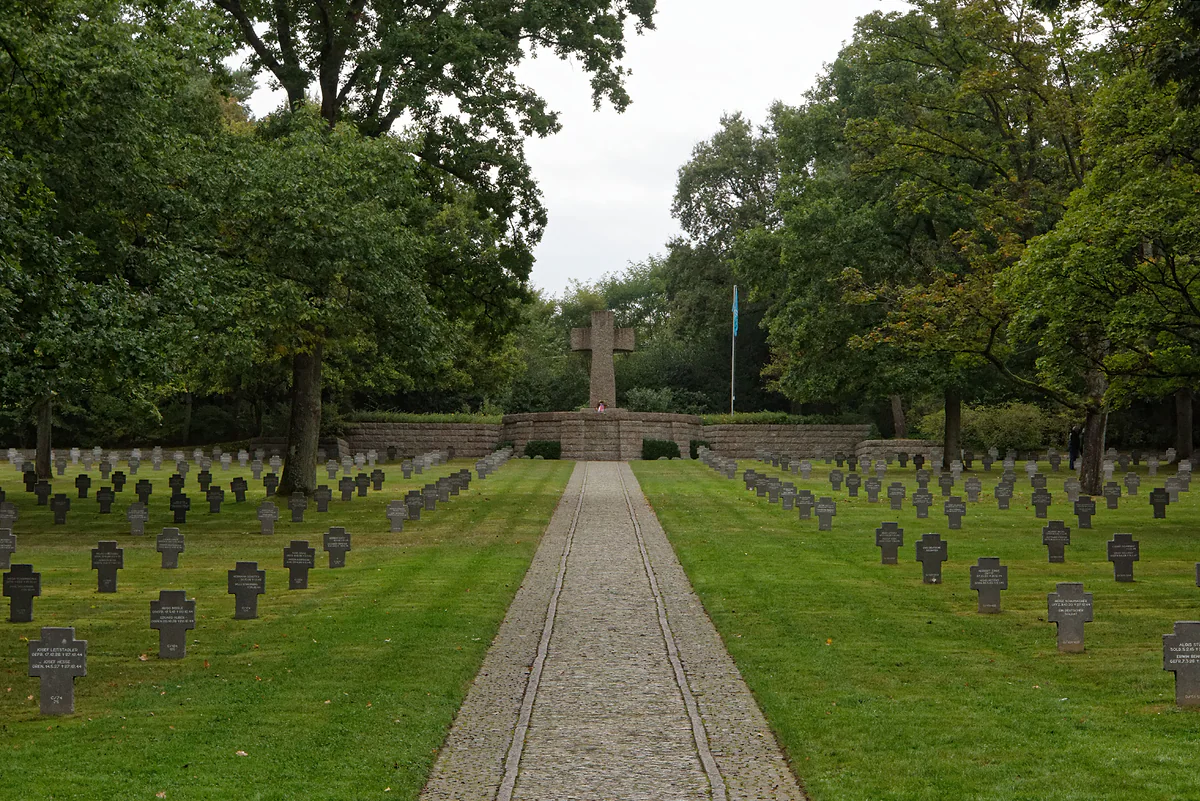
War cemetery in the commune of Sandweiler
Sandweiler German war cemetery, the other side of the story
Sandweiler German war cemetery, on Rue d'Itzig, holds 10,913 German soldiers killed in the winter of 1944-45 along the borders of Luxembourg, Belgium and Germany. The German war graves association, the Volksbund, laid it out after the war, and it was the first German war cemetery outside Germany. It's a few minutes from the American cemetery at Hamm.
I'd come here straight after the American cemetery, the same morning. They are two very different ways of burying the dead of the same battle, and seeing them back to back stays with you longer than any museum.

Before you go
What I would keep in mind
-
01 Most beautiful
The avenue to the cross
The picture most people know is a central path between rows of headstones leading to a tall cross. It's a plain, sober site with no terraces or fountains, and that contrast with Hamm is what strikes you.
-
02 Getting there
Both cemeteries in one trip
The «cimetières militaires» signs from exit 7 of the E25/E44 lead to both. The American cemetery opens daily from 9am to 5pm, so starting there and coming on here works well.
Luxembourg American Cemetery -
03 My tip
One soldier from another war
Among the 10,913 buried here is a soldier who fell in the First World War, says the Luxembourg City Tourist Office. Everyone else died in the fighting of winter 1944-45.
Most people who come to Luxembourg for its war history head straight for Patton’s grave. To my mind the visit is only half done if you don’t then cross to Sandweiler. There, on Rue d’Itzig, the German military cemetery holds 10,913 soldiers from the same winter, more than twice as many as its American neighbour.
Who lies here
According to the Luxembourg City Tourist Office, these are German soldiers killed in the hard fighting of winter 1944-45 in the border country of Luxembourg, Belgium and Germany, which means the Ardennes offensive and its aftermath. There’s one odd exception too, since a soldier who fell in the First World War also lies here among them.
My Battle of the Bulge in Luxembourg page tells those months village by village. Here the focus is the place and how it feels.
Germany’s first war cemetery abroad
The Volksbund Deutsche Kriegsgräberfürsorge, the association that looks after German war graves, laid the site out in the post-war years, and it was the first German cemetery outside Germany. That detail, which the tourist office highlights, says a lot about reconciliation in a country that had been annexed in all but name during the occupation. The wider story is in Luxembourg in the Second World War.
Once your dates are set, check which hotels are still free in Luxembourg before prices climb.
How does it compare with the American cemetery?
In almost every way except the date. Hamm is a memorial with a chapel, fountains, bronze maps and white crosses laid out in a fan, run by a US government agency with staff who greet families. Sandweiler is a sober enclosure, a central avenue between rows of headstones leading to a tall cross, and the tourist office doesn’t even list opening hours. The American cemetery holds 5,070 service members according to the ABMC; this one, 10,913.
For a British visitor, used to the Commonwealth cemeteries of Flanders and Normandy, the contrast is worth the short drive. You don’t have to take sides to feel the weight of the two numbers together, and seeing them the same morning drives home that the Ardennes were a slaughter for both armies.
Getting there and combining the two
The cemetery lies in the commune of Sandweiler, close to Luxembourg airport. Drivers come off the motorway at exit 7 of the E25/E44, where the «cimetières militaires» signs begin; they also point to Luxembourg American Cemetery. Public transport is free; check the exact bus on mobiliteit.lu first.
Since no opening hours are published, only a contact number in Germany, I’d come mid-morning, after the American cemetery opens at 9am, rather than late in the afternoon, which leaves time for both of them before lunch.
Once your dates are set, check which hotels are still free in Luxembourg before prices climb.
If you would rather have a local show you round, book a guided tour in German war cemetery and choose by the reviews.
A car frees you from timetables: search car hire in Luxembourg on DiscoverCars and compare companies.
So you do not pay over the odds, look at trains, coaches and flights to Luxembourg on Omio and pick the one that suits you.
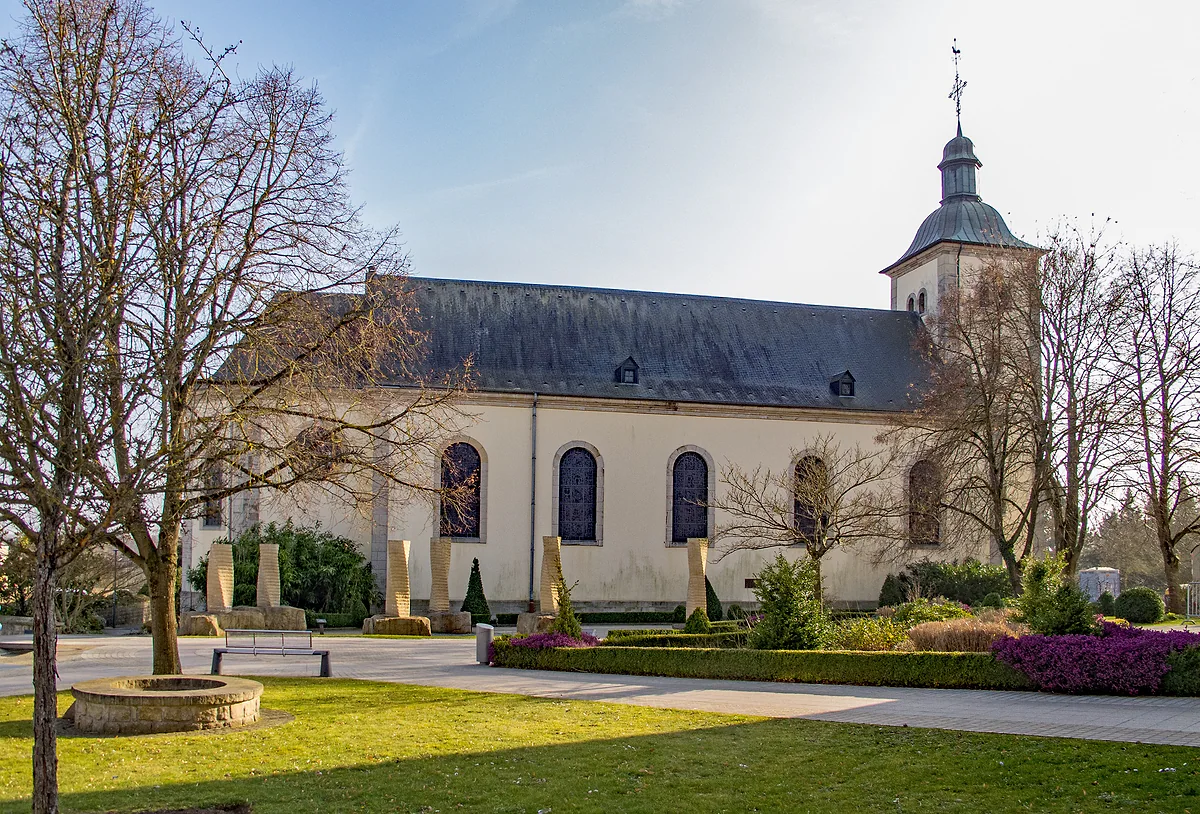
Sandweiler church, white with a slate bell tower, surrounded by lawn, bare trees and flower beds
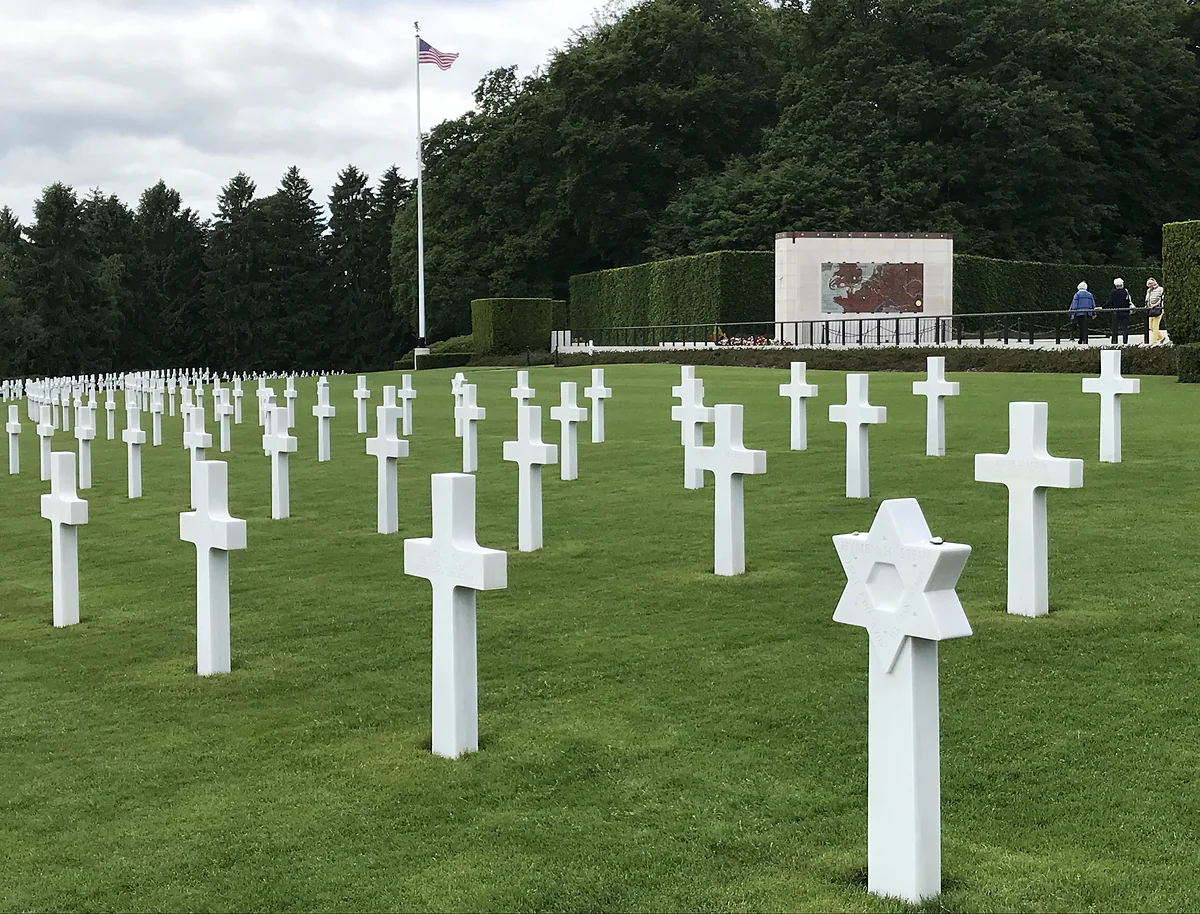
Rows of white crosses and a Star of David at the American cemetery in Hamm, with the flag and woodland behind
Luxembourg's two military cemeteries compared
| German cemetery | American cemetery | |
|---|---|---|
| Commune | Sandweiler | Luxembourg City (Hamm) |
| Buried | 10,913 | 5,070 (ABMC) |
| War | Winter 1944-45 (plus one soldier from 1914-18) | Battle of the Bulge and the advance to the Rhine |
| Run by | Volksbund Deutsche Kriegsgräberfürsorge | American Battle Monuments Commission |
| Hours | Not published in what we read | 9am-5pm daily, except 25 December and 1 January |
LCTO and ABMC, checked 29-09-2026. Visit Guttland rounds the German figure to about 10,900.
Test yourself
True or false?
0/3 Pick before you peek.
-
Sandweiler holds more graves than the American cemetery at Hamm.
See the answer
True. It has 10,913, against the 5,070 burials the ABMC gives for the American cemetery.
-
Everyone buried at Sandweiler died in the Second World War.
See the answer
False. The tourist office notes that one soldier from the First World War also rests there.
-
It was the first German military cemetery built outside Germany.
See the answer
True. The Volksbund laid it out after the war, and the tourist office describes it as the first of its kind abroad.
Map
Where German war cemetery is
The thick dashed line is the border with Belgium, France and Germany, and the fine ones divide the twelve cantons. The Éislek lies to the north and the Moselle to the east. Every number opens its guide.
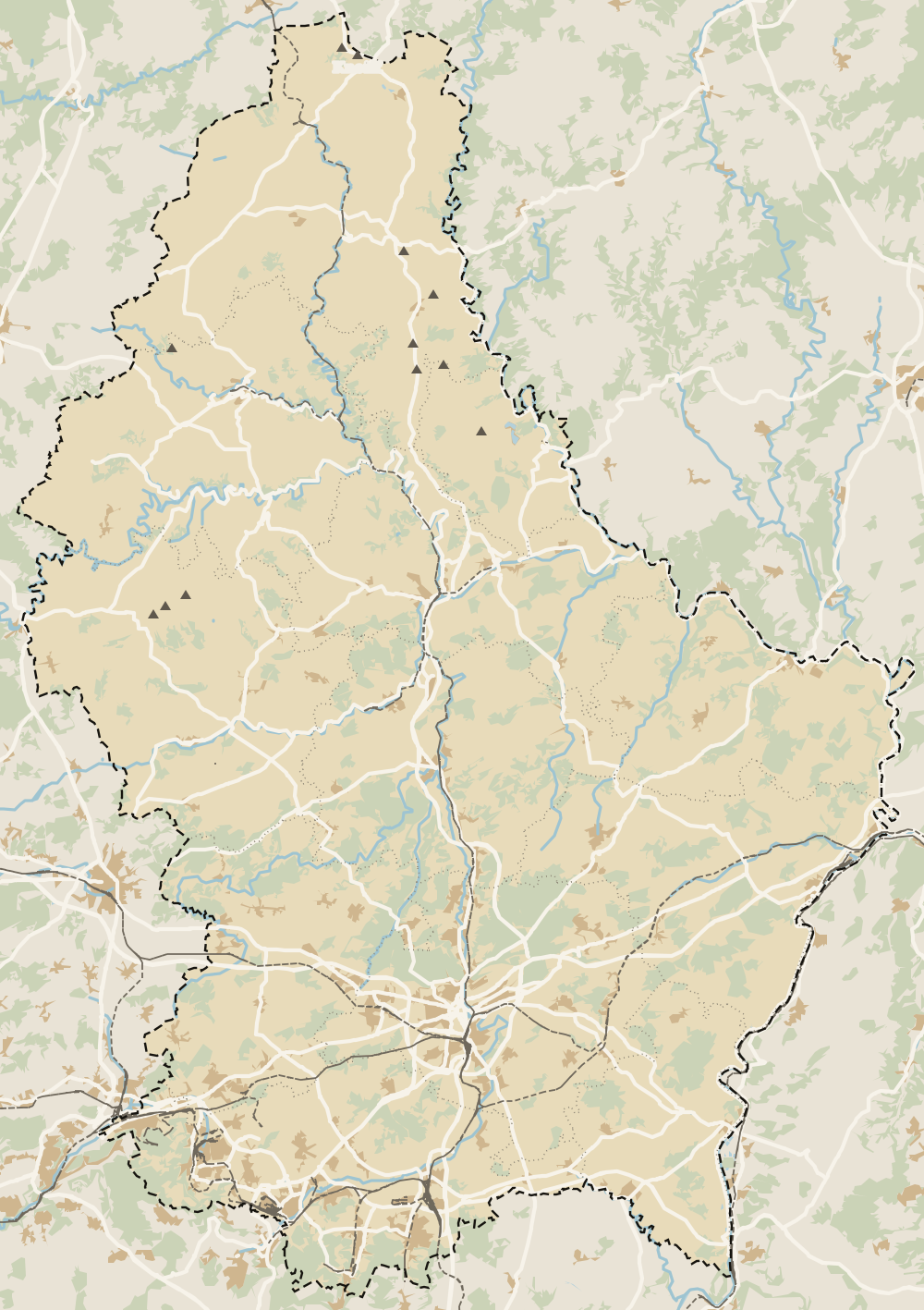
0 of 425 Luxembourg guides
Your next stamp
- Sandweiler
- American Cemetery
- Hamm
- Battle of the Bulge
- Stolzembourg
- Gare
- General Patton Museum
- A Possen Museum
- Ansembourg
- Ansembourg Castles
- Asselborn
- Bascharage
- Beaufort castles
- Belval
- Belval blast furnaces
- Berg Castle
- Bernard-Massard cellars
- Bourglinster Castle
- Bourscheid Castle
- Brandenbourg
- Brandenbourg Castle
- Caves St Martin
- Christmas
- Clervaux Castle
- Echternach
- Echternach Abbey
- Ehnen
- Ehnen Wine Museum
- Esch-sur-Alzette
- Esch-sur-Sûre Castle
- European Museum Schengen
- Fond-de-Gras
- Haff Réimech
- Hohllay
- Hollenfels Castle
- Hosingen
- Kautenbach
- Kneiff
- Koerich Castle
- Larochette Castle
- Lasauvage
- Mersch Castle
- Military History Museum
- Moersdorf
- Mondorf Domaine Thermal
- Munsbach Castle
- National Mining Museum
- Parc Merveilleux
- Park Sënnesräich
- Places to visit
- Remich
- Rindschleiden
- Schiessentümpel
- Septfontaines Castle
- Slate Museum
- Tudor Museum
- Useldange Castle
- Valley of the Seven Castles
- Vianden
- Vianden Castle
- Ville Haute
- Wasserbillig Aquarium
- Weiswampach lakes
- Wiltz Castle
- Ahn
- Berdorf
- Bourscheid-Plage
- Butterfly garden
- Clervaux
- Differdange
- Echternach lake
- Grevenmacher
- Heringer Millen
- Hollenfels
- Luxembourg City
- Luxembourg Science Center
- Meysembourg Castle
- Mullerthal
- National Day
- National Resistance Museum
- Perekop
- Remerschen
- Schoenfels Castle
- The Family of Man
- Things to do
- Upper Sûre Lake
- Vianden chairlift
- Wasserbillig
- Clervaux Abbey
- Echternach Roman villa
- Éislek
- Insenborn
- Kallektuffquell
- Machtum
- Most beautiful places
- Our Nature Park
- Pétange
- Pettingen Castle
- Schueberfouer
- Schwebsingen
- Victor Hugo House
- Waldbillig
- Dudelange
- Kuelscheier
- Lultzhausen
- Moselle Valley
- Octave
- Prettiest villages
- Sanem
- Schengen
- Wellenstein
- Wiltz
- Wolfsschlucht
- Beaufort
- Bech-Kleinmacher
- Éimaischen
- Gaalgebierg
- Guttland
- Marnach
- Mondorf-les-Bains
- Putscheid
- Schifflange
- UNESCO World Heritage
- Carnival
- Consdorf
- Ellergronn
- Käerjeng
- Kayl
- Map
- Minett
- Munshausen
- Tandel
- Bech
- Buergbrennen
- Esch-sur-Sûre
- Rumelange
- Where is Luxembourg
- Is it a country?
- Lac de la Haute-Sûre (commune)
- Rosport-Mompach
- Wormeldange
- Larochette
- Mondercange
- Regions
- Bettembourg
- Bock Casemates
- Cantons
- Dancing procession
- Diekirch
- Fischbach
- Garnich
- Mersch
- Moselle wine route
- Ettelbruck
- Grund
- Heffingen
- Kehlen
- Lintgen
- Moselle river cruises
- Pétrusse Casemates
- Towns and villages
- Chemin de la Corniche
- Erpeldange-sur-Sûre
- Junglinster
- Kopstal
- Lorentzweiler
- Nommern
- Pfaffenthal
- Population
- Bissen
- Clausen
- Grand Ducal Palace
- Koerich
- Schieren
- Size
- Vallée de l'Ernz
- Feulen
- Kirchberg
- Languages
- Notre-Dame Cathedral
- Reisdorf
- Steinfort
- Bettendorf
- Habscht
- St Michael's Church
- Helperknapp
- Luxembourgish
- Place Guillaume II
- Name
- Place d'Armes
- History
- Place de la Constitution
- Grand Duke
- Colmar-Berg
- Flaxweiler
- Kirchberg funicular
- Luxembourg fortress
- Mamer
- Mertert
- Minett Trail
- Mullerthal Trail
- Neumünster Abbey
- Parc Hosingen
- Pfaffenthal lift
- Political system
- Redange
- The Passerelle
- Wine festivals
- Winseler
- Beckerich
- Biwer
- EU institutions
- Goesdorf
- Limpertsberg
- Mudam
- Natur Musée
- Pulvermühl
- Stadtbredimus
- Troisvierges
- Wenzel walk
- Bonnevoie
- Bous-Waldbredimus
- Ell
- Flag
- Kiischpelt
- Manternach
- Philharmonie
- Vauban circuit
- Weiswampach
- Betzdorf
- Boulaide
- Dräi Eechelen Museum
- Facts
- Hollerich
- Lenningen
- Useldange
- Wincrange
- Bourscheid
- Dalheim
- Gasperich
- Public holidays
- Red Bridge
- Saeul
- Belair
- Second World War
- Vichten
- Merl
- Préizerdaul
- Cents
- EU and Schengen
- Groussbus-Wal
- Entry requirements
- Neudorf
- Rambrouch
- Currency and payments
- Mertzig
- Weimerskirch
- Adolphe Bridge
- Beggen
- Escapardenne
- How to get there
- International March of Diekirch
- MNHA (National Museum)
- Rock climbing
- Bridges
- Eich
- Flights
- Golf
- Hesperange
- Lëtzebuerg City Museum
- Canoeing and kayaking
- Dommeldange
- Luxembourg airport
- Strassen
- Villa Vauban
- Airport to city centre
- Bertrange
- Casino Luxembourg
- Mühlenbach
- Swimming pools
- From Brussels
- Pétrusse Valley
- Rollingergrund
- Walferdange
- Cessange
- Day trip from Brussels
- Municipal Park
- Steinsel
- Free walking tours
- From Paris
- Niederanven
- From Frankfurt
- Schuttrange
- Sightseeing train and bus
- By train
- Contern
- By coach
- Weiler-la-Tour
- Driving
- Luxembourg in one day
- Pretzel Sunday
- Rham Plateau
- Tour de Luxembourg
- Candlemas (Liichtmëssdag)
- Car hire
- Luxembourg in two days
- Saint-Esprit Plateau
- Luxembourg in three days
- Melusina statue
- Parking
- St Nicholas Day (Kleeschen)
- Fête de la Musique
- Luxembourg in four days
- Museums in Luxembourg
- Petrol
- Place de Clairefontaine
- A week in Luxembourg
- Getting around
- Luxembourg Marathon
- Tram and Bus Museum
- Free public transport
- Parks in Luxembourg City
- Road trip
- Belgium and Luxembourg
- Tram
- Buses
- Viewpoints
- Trains
- Luxembourg station
- Cycling
- LuxembourgPass
- Prices and budget
- On a budget
- Free things to do
- Mobile and roaming
- Healthcare
- Safety
- Scams
- Tourist information
- Packing list
- Swimming lakes
- With a dog
- Markets
- Tipping
- Shopping
- What to buy
- Shopping centres
- With kids
- For couples
- Playgrounds
- Adventure parks
- Nightlife
- Castles
- Theatres and concert venues
- Leudelange
- Nature parks
- Where to stay
- City-centre hotels
- Hiking
- Nature reserves
- Reckange-sur-Mess
- Hotels near the station
- Roeser
- Frisange
- Hotels in Kirchberg
- Airport hotels
- Dippach
- Hotels in Vianden
- Hotels in Echternach
- Hotels in Clervaux
- Hotels in Mondorf-les-Bains
- Hotels in Esch-sur-Alzette
- Hotels on the Moselle
- Mullerthal hotels
- Upper Sûre lake hotels
- Hotels in Diekirch and Ettelbruck
- Cheap hotels
- Luxury hotels
- Boutique hotels
- Spa hotels
- Family hotels
- Apartments
- Weather
- Youth hostels
- Best time to visit
- Campsites
- Holiday cottages
- In winter
- Castle hotels
- In spring
- Day trips
- In summer
- Around Luxembourg
- In autumn
- Ice skating
- Trier day trip
- Metz day trip
- Arlon day trip
- In January
- In February
- In March
- In April
- In May
- In June
- In July
- In August
- In September
- Food
- In October
- In November
- Where to eat
- In December
- Michelin restaurants
- Cheap eats
- Judd mat Gaardebounen
- Bouneschlupp
- Gromperekichelcher
- Kniddelen
- Quetschentaart
- Rieslingspaschtéit
- Events
- Wine
- Crémant
- Beer
Frequently asked questions
Where is the German war cemetery in Luxembourg?
In the commune of Sandweiler, on Rue d'Itzig (L-5974), close to the American cemetery at Hamm and to Luxembourg airport. It's outside Luxembourg City proper, but only a few kilometres from the centre.
How many soldiers are buried at Sandweiler?
10,913, according to the Luxembourg City Tourist Office, almost all killed in the fierce fighting of winter 1944-45 in the border areas of Luxembourg, Belgium and Germany, plus one from the First World War.
Who looks after Sandweiler German war cemetery?
The Volksbund Deutsche Kriegsgräberfürsorge, the German war graves association, which laid it out in the post-war years. It was the first German cemetery outside Germany.
How do I get there from Luxembourg City?
By car, take exit 7 of the E25/E44 and follow the «cimetières militaires» signs, which also lead to the American cemetery. Buses are free nationwide; check the route on mobiliteit.lu before you set off.
Is it worth visiting both the American and German cemeteries?
I think so. They're minutes apart, the American one opens at 9am every day, and together they show the scale of the Ardennes fighting on both sides far better than either does alone.
By
Tourism graduate with a master’s in Tourism Management and Planning from the University of Málaga, who has travelled across Europe. He writes every guide from official sources and his own judgement.
Published on . Facts checked on .
Sources
Some links in this guide are affiliate links: if you book through them, the site earns a commission at no extra cost to you. Affiliate disclosure
Photos: Petra Klawikowski (CC BY-SA 3.0); MMFE (CC BY-SA 4.0); Dudva (CC BY-SA 4.0), via Wikimedia Commons.