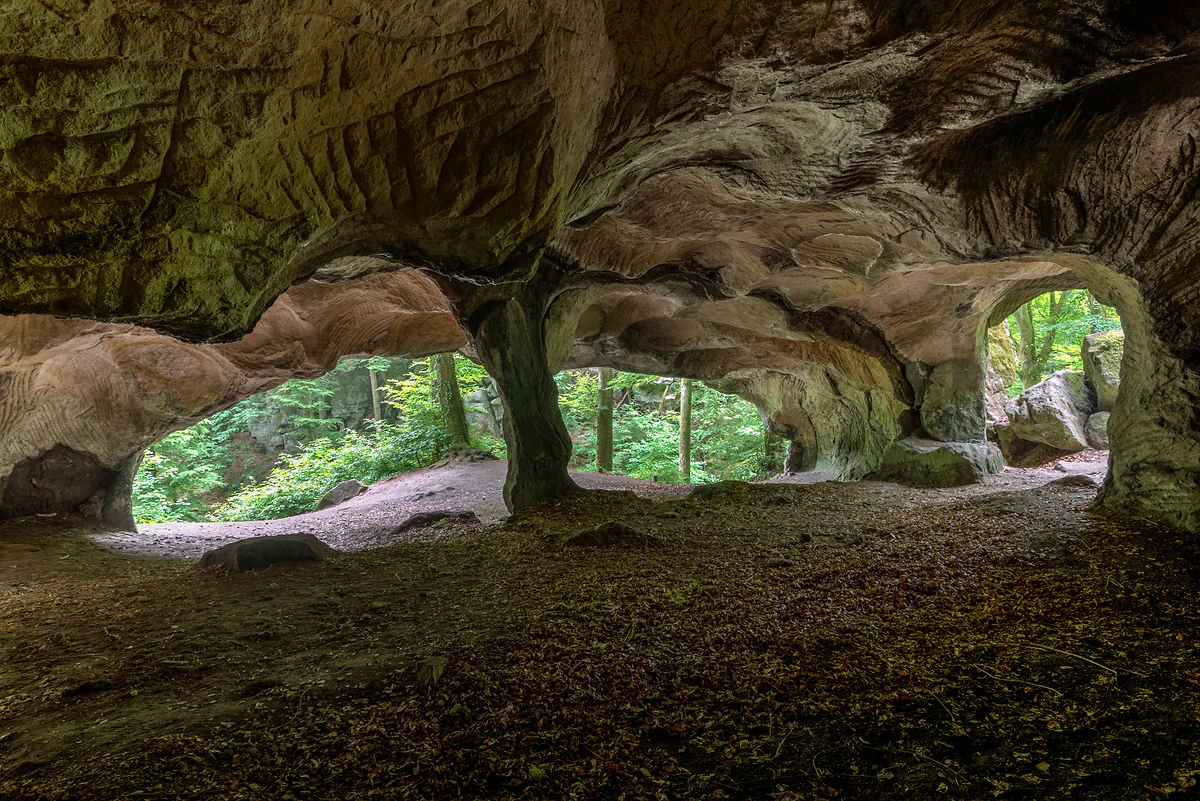
Rock formation in Berdorf
The Hohllay, a two-thousand-year-old quarry turned cave
The Hohllay (Huel Lee, hollow rock) is a large sandstone cavern in Berdorf, in Luxembourg's Mullerthal. Nature didn't make it alone: the Romans took building stone from it and medieval masons cut millstones there, leaving circular marks you can still see. It's on Route 2 of the Mullerthal Trail, 50 m from the Breechkaul amphitheatre, and free to visit.
In 30 seconds
Full read: 3 min
- The Hohllay (Huel Lee) is a large sandstone cavern in Berdorf, in the Mullerthal.
- It's a quarry used by the Romans and, in the Middle Ages, for cutting millstones.
- The circular scars left by the millstones are still visible on the walls.
- It's on Route 2 of the Mullerthal Trail, 50 m from the Breechkaul amphitheatre, and free.
It's my favourite rock in the Mullerthal, precisely because it tells a human story rather than just a geological one. Look for the round scars on the walls, which are where the millstones came out, and then pop over to the amphitheatre next door.

Before you go
What I would keep in mind
-
01 Most beautiful
The millstone scars
The walls still carry the circular hollows left where millstones were cut. The Mullerthal Trail website says they remain clearly recognisable.
-
02 My tip
Parking 200 m away
The Huel Lee/Amphitheater car park is about 200 m away and the Berdorf, Hôtel Pérékop bus stop about 500 m, according to visitluxembourg.
-
03 Getting there
On Route 2 of the Trail
The Hohllay is on the 6.8 km stretch from Echternach to Berdorf, after the Perekop and the Chipkapass and just before the amphitheatre and the village.
Mullerthal Trail -
04 Most beautiful
The amphitheatre next door
Fifty metres away is the Breechkaul amphitheatre, another medieval quarry hollow, turned into an open-air stage in 1979 with concerts in summer.
Berdorf
What I would book
Most of the Mullerthal’s rocks are geology’s work. The Hohllay is largely people’s. It’s a huge cavern in Berdorf’s sandstone, with a rippling roof and openings that let in green light from the woods, and what makes it special isn’t its size but the round marks on the walls. They’re the hollows left behind as millstones were cut out of the rock.
A quarry two thousand years old
visitluxembourg sums it up in one line, calling the imposing cavern a quarry two millennia old. The Romans took building stone from here. In the Middle Ages, like the amphitheatre nearby, it was worked for millstones, and the official listing adds a detail I love. Every mill in the lordship of the convent of Oeren, near Trier, was fitted with millstones from this very spot.
Oeren is the same name borne by Irmina of Oeren, the woman from Trier who in 698 gave Willibrord the estate at Echternach where the abbey grew. The region is called Mëllerdall, the valley of the millers, after the many mills on its streams, and the Hohllay was one of the workshops that kept them turning. Seen that way, it’s a slice of the area’s economic history tucked inside a cave.
What you’ll see inside
A wide space, cut into the Luxembourg sandstone that shapes all of Berdorf’s landscape. On the walls, the circular millstone scars are easy to spot, as the Mullerthal Trail website points out. The official listing gives no measurements or opening times, because it’s an open hollow in the woods rather than a deep cave with guided visits.
Facing it, some 50 m away, is the Breechkaul amphitheatre, likewise a hollow left by medieval millstone quarrying, which became an open-air theatre in 1979 and stages concerts in summer. Every year, on the first Sunday after 2 November at 10:45, a St Hubert mass is said there to the sound of hunting horns, famous across the region and over the border, according to visitluxembourg.
If you are staying the night, see the best hotel deals in Berdorf for your dates: the well-placed rooms go fast.
The stone that made the millstones
The Luxembourg sandstone you see in the Hohllay is the same rock as the rest of the Mullerthal. The government portal explains that it formed on the floor of a sea more than 200 million years ago and plays a key role in the region’s drinking water today. If that side interests you, Berdorf’s Aquatower, a 55 m water tower, has an interactive exhibition on water and geology and a viewing platform at 50 m, free with the LuxembourgPass. The Mëllerdall geopark, which Berdorf belongs to, joined UNESCO’s global network in 2022, and the Hohllay is a good way to see how that geology turned into a trade.
Think of it as a quarry that became a landmark rather than a cave you explore. It suits a half-hour stop on a longer walk, not a destination in itself, and it’s at its best when you arrive on foot from the gorge side.
How do you get there?
The Hohllay sits on Route 2 of the Mullerthal Trail, on the 6.8 km stretch from Echternach to Berdorf. Coming from town, you first pass the Wolfsschlucht, then follow the Aesbach stream, go by the Perekop rock, cross the Chipkapass on a footbridge and reach the cave. The amphitheatre and the village follow straight after.
By car, the official listing gives the Huel Lee/Amphitheater car park about 200 m away. If you’d rather take the bus, which costs nothing in Luxembourg, get off at Berdorf, Hôtel Pérékop, about 500 m off. Local route E1, 13.5 km, and Berdorf’s 6.6 km Auto-Pédestre circuit also pass it, two good options for a shorter loop without the full Trail.
If you are staying the night, see the best hotel deals in Berdorf for your dates: the well-placed rooms go fast.
How I’d do it
I’d see it as part of the walk from Echternach to Berdorf rather than as a quick stop by car. Arriving on foot, after the gorge and the Perekop, gives it context. And I’d spend a few minutes hunting for the millstone marks, because it’s easy to walk in, photograph the ceiling and leave without spotting them.
There are no opening hours or tickets. The sandstone can be damp and the floor is uneven, so wear shoes with good grip. It works very well with children, as it’s big, open and easy to explain.
So you do not lose the morning at the ticket office, browse tickets and tours in Hohllay on GetYourGuide.
If you would rather go at your own pace, see the car hire deals in Luxembourg: the earlier you book, the more cars are left to choose from.
Before you fix your dates, compare tickets to Luxembourg: the same journey can cost very different amounts from one day to the next.
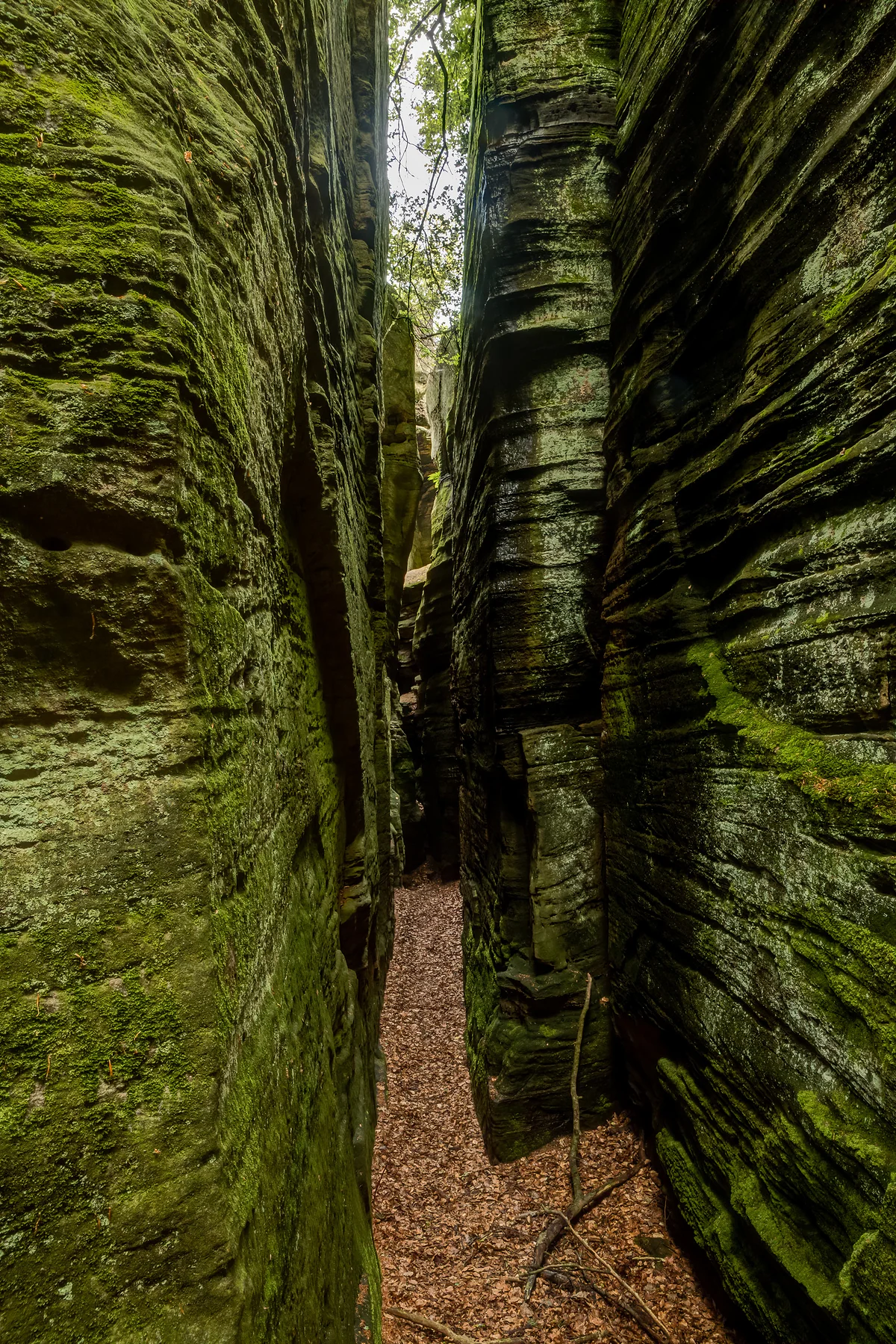
A tight passage between two moss-covered rock walls in the Werschrummschlëff labyrinth at Berdorf
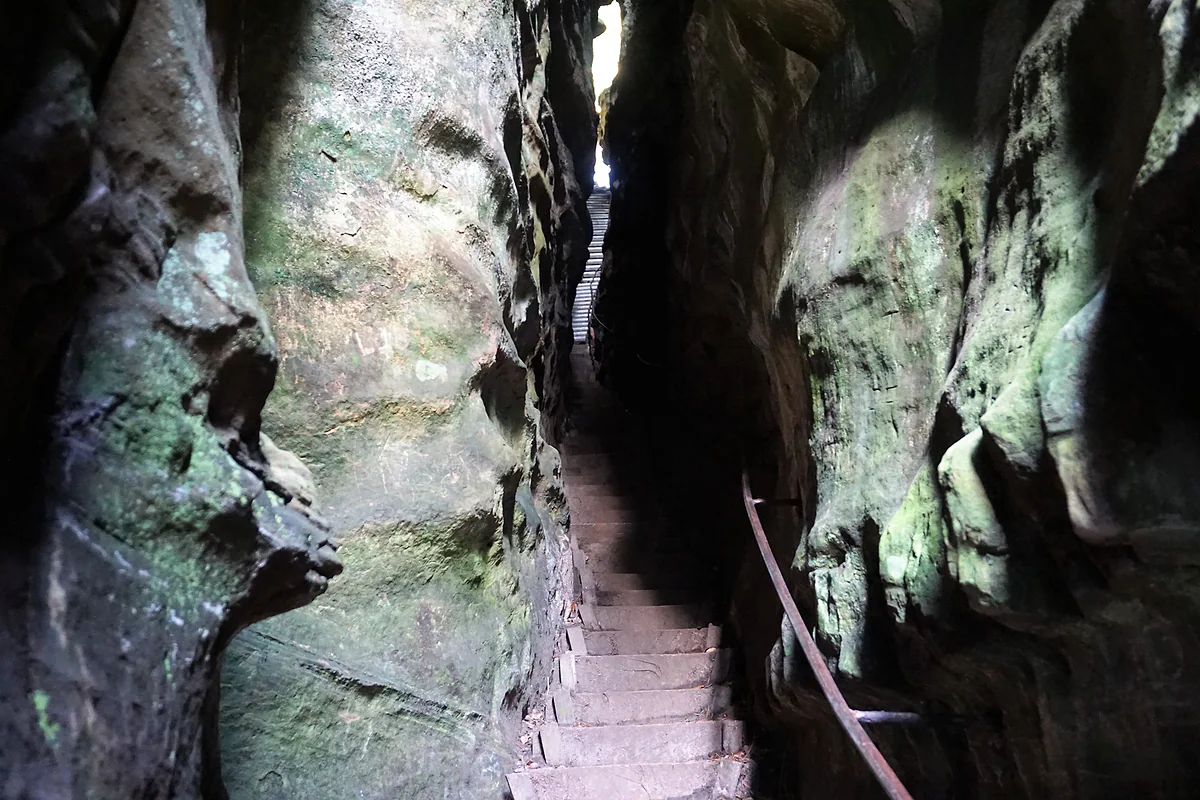
The staircase climbing through the narrow cleft of the Perekop at Berdorf, between greenish sandstone walls
Getting to the Hohllay
| From | How | Details |
|---|---|---|
| Huel Lee/Amphitheater car park | On foot | About 200 m |
| Berdorf, Hôtel Pérékop bus stop | On foot | About 500 m |
| Echternach | Route 2 of the Mullerthal Trail | Part of the 6.8 km stretch to Berdorf |
| Berdorf | Local route E1 or the Auto-Pédestre circuit | 13.5 km and 6.6 km |
visitluxembourg.com and mullerthal-trail.lu, checked on 29-09-2026. Official address: rue d'Echternach, Berdorf.
Test yourself
True or false?
0/3 Pick before you peek.
-
Water carved out the Hohllay.
See the answer
False. People did. visitluxembourg describes it as a two-thousand-year-old quarry, Roman first and then for millstones.
-
Millstones from the Hohllay supplied the mills of a convent near Trier.
See the answer
True. According to visitluxembourg, every mill in the lordship of the convent of Oeren, near Trier, used millstones from here.
-
The Breechkaul amphitheatre next to the Hohllay was also a quarry.
See the answer
True. It was a hollow where millstones were cut in the Middle Ages, fitted out as an amphitheatre in 1979.
- To the Breechkaul amphitheatre
- 50 m
- From the nearest car park
- 200 m
- Local route E1, which passes it
- 13.5 km
Map
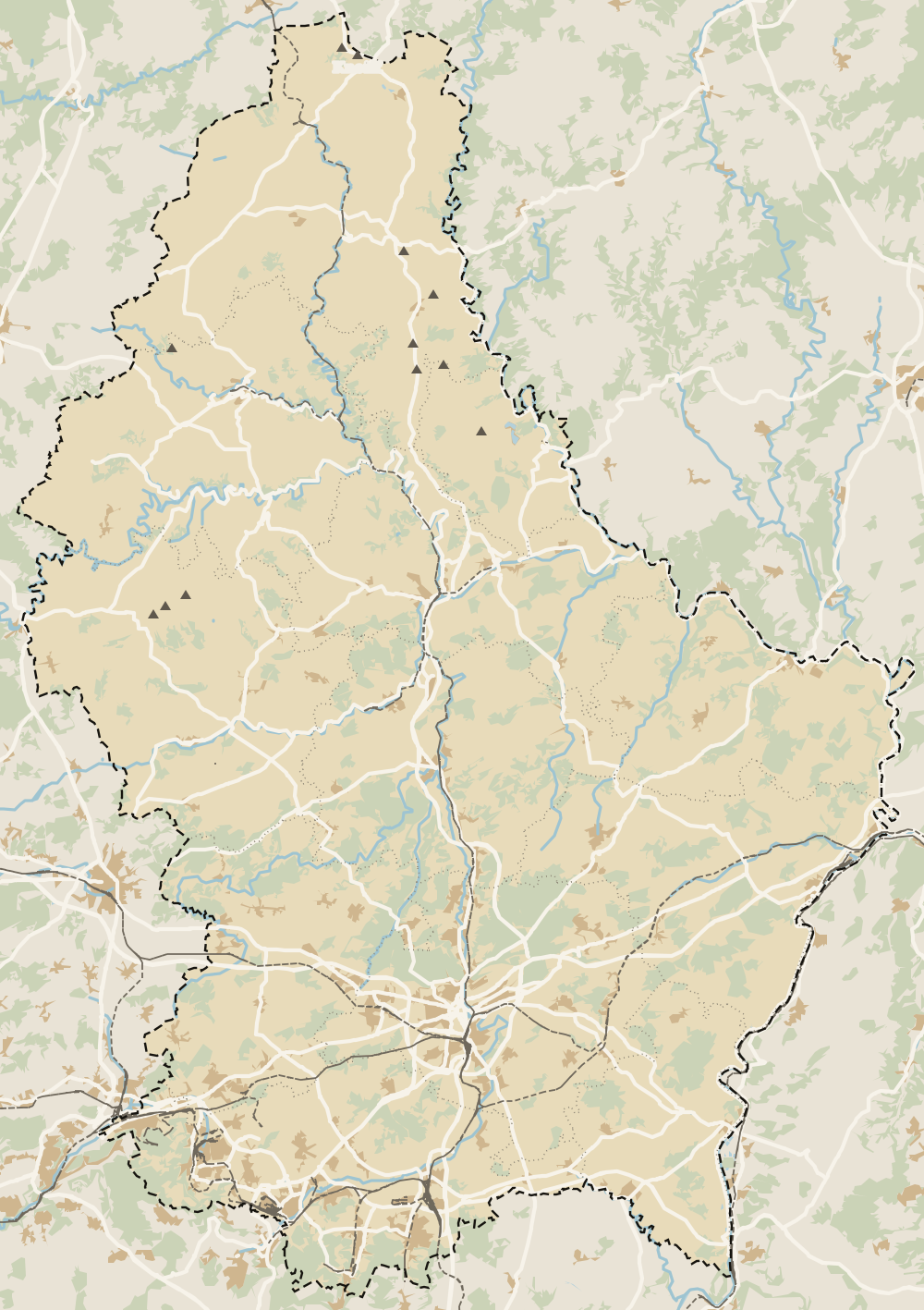
Where Hohllay is
The thick dashed line is the border with Belgium, France and Germany, and the fine ones divide the twelve cantons. The Éislek lies to the north and the Moselle to the east. Every number opens its guide.
0 of 425 Luxembourg guides
Your next stamp
- Berdorf
- Perekop
- Mullerthal Trail
- Kuelscheier
- Heringer Millen
- Beaufort
- Mullerthal
- Mullerthal hotels
- A Possen Museum
- American Cemetery
- Ansembourg
- Ansembourg Castles
- Asselborn
- Bascharage
- Beaufort castles
- Belval
- Belval blast furnaces
- Berg Castle
- Bernard-Massard cellars
- Bourglinster Castle
- Bourscheid Castle
- Brandenbourg
- Brandenbourg Castle
- Caves St Martin
- Christmas
- Clervaux Castle
- Echternach
- Echternach Abbey
- Ehnen
- Ehnen Wine Museum
- Esch-sur-Alzette
- Esch-sur-Sûre Castle
- European Museum Schengen
- Fond-de-Gras
- General Patton Museum
- German war cemetery
- Haff Réimech
- Hollenfels Castle
- Hosingen
- Kautenbach
- Kneiff
- Koerich Castle
- Larochette Castle
- Lasauvage
- Mersch Castle
- Military History Museum
- Moersdorf
- Mondorf Domaine Thermal
- Munsbach Castle
- National Mining Museum
- Parc Merveilleux
- Park Sënnesräich
- Places to visit
- Remich
- Rindschleiden
- Schiessentümpel
- Septfontaines Castle
- Slate Museum
- Stolzembourg
- Tudor Museum
- Useldange Castle
- Valley of the Seven Castles
- Vianden
- Vianden Castle
- Ville Haute
- Wasserbillig Aquarium
- Weiswampach lakes
- Wiltz Castle
- Ahn
- Bourscheid-Plage
- Butterfly garden
- Clervaux
- Differdange
- Echternach lake
- Grevenmacher
- Hollenfels
- Luxembourg City
- Luxembourg Science Center
- Meysembourg Castle
- National Day
- National Resistance Museum
- Remerschen
- Schoenfels Castle
- The Family of Man
- Things to do
- Upper Sûre Lake
- Vianden chairlift
- Wasserbillig
- Clervaux Abbey
- Echternach Roman villa
- Éislek
- Insenborn
- Kallektuffquell
- Machtum
- Most beautiful places
- Our Nature Park
- Pétange
- Pettingen Castle
- Schueberfouer
- Schwebsingen
- Victor Hugo House
- Waldbillig
- Dudelange
- Lultzhausen
- Moselle Valley
- Octave
- Prettiest villages
- Sanem
- Schengen
- Wellenstein
- Wiltz
- Wolfsschlucht
- Bech-Kleinmacher
- Éimaischen
- Gaalgebierg
- Guttland
- Marnach
- Mondorf-les-Bains
- Putscheid
- Schifflange
- UNESCO World Heritage
- Carnival
- Consdorf
- Ellergronn
- Käerjeng
- Kayl
- Map
- Minett
- Munshausen
- Tandel
- Bech
- Buergbrennen
- Esch-sur-Sûre
- Rumelange
- Where is Luxembourg
- Is it a country?
- Lac de la Haute-Sûre (commune)
- Rosport-Mompach
- Wormeldange
- Larochette
- Mondercange
- Regions
- Bettembourg
- Bock Casemates
- Cantons
- Dancing procession
- Diekirch
- Fischbach
- Garnich
- Mersch
- Moselle wine route
- Ettelbruck
- Grund
- Heffingen
- Kehlen
- Lintgen
- Moselle river cruises
- Pétrusse Casemates
- Towns and villages
- Chemin de la Corniche
- Erpeldange-sur-Sûre
- Junglinster
- Kopstal
- Lorentzweiler
- Nommern
- Pfaffenthal
- Population
- Bissen
- Clausen
- Grand Ducal Palace
- Koerich
- Schieren
- Size
- Vallée de l'Ernz
- Feulen
- Kirchberg
- Languages
- Notre-Dame Cathedral
- Reisdorf
- Steinfort
- Bettendorf
- Habscht
- St Michael's Church
- Helperknapp
- Luxembourgish
- Place Guillaume II
- Name
- Place d'Armes
- History
- Place de la Constitution
- Grand Duke
- Colmar-Berg
- Flaxweiler
- Gare
- Hamm
- Kirchberg funicular
- Luxembourg fortress
- Mamer
- Mertert
- Minett Trail
- Neumünster Abbey
- Parc Hosingen
- Pfaffenthal lift
- Political system
- Redange
- The Passerelle
- Wine festivals
- Winseler
- Beckerich
- Biwer
- EU institutions
- Goesdorf
- Limpertsberg
- Mudam
- Natur Musée
- Pulvermühl
- Stadtbredimus
- Troisvierges
- Wenzel walk
- Bonnevoie
- Bous-Waldbredimus
- Ell
- Flag
- Kiischpelt
- Manternach
- Philharmonie
- Vauban circuit
- Weiswampach
- Betzdorf
- Boulaide
- Dräi Eechelen Museum
- Facts
- Hollerich
- Lenningen
- Useldange
- Wincrange
- Bourscheid
- Dalheim
- Gasperich
- Public holidays
- Red Bridge
- Saeul
- Belair
- Second World War
- Vichten
- Battle of the Bulge
- Merl
- Préizerdaul
- Cents
- EU and Schengen
- Groussbus-Wal
- Entry requirements
- Neudorf
- Rambrouch
- Currency and payments
- Mertzig
- Weimerskirch
- Adolphe Bridge
- Beggen
- Escapardenne
- How to get there
- International March of Diekirch
- MNHA (National Museum)
- Rock climbing
- Sandweiler
- Bridges
- Eich
- Flights
- Golf
- Hesperange
- Lëtzebuerg City Museum
- Canoeing and kayaking
- Dommeldange
- Luxembourg airport
- Strassen
- Villa Vauban
- Airport to city centre
- Bertrange
- Casino Luxembourg
- Mühlenbach
- Swimming pools
- From Brussels
- Pétrusse Valley
- Rollingergrund
- Walferdange
- Cessange
- Day trip from Brussels
- Municipal Park
- Steinsel
- Free walking tours
- From Paris
- Niederanven
- From Frankfurt
- Schuttrange
- Sightseeing train and bus
- By train
- Contern
- By coach
- Weiler-la-Tour
- Driving
- Luxembourg in one day
- Pretzel Sunday
- Rham Plateau
- Tour de Luxembourg
- Candlemas (Liichtmëssdag)
- Car hire
- Luxembourg in two days
- Saint-Esprit Plateau
- Luxembourg in three days
- Melusina statue
- Parking
- St Nicholas Day (Kleeschen)
- Fête de la Musique
- Luxembourg in four days
- Museums in Luxembourg
- Petrol
- Place de Clairefontaine
- A week in Luxembourg
- Getting around
- Luxembourg Marathon
- Tram and Bus Museum
- Free public transport
- Parks in Luxembourg City
- Road trip
- Belgium and Luxembourg
- Tram
- Buses
- Viewpoints
- Trains
- Luxembourg station
- Cycling
- LuxembourgPass
- Prices and budget
- On a budget
- Free things to do
- Mobile and roaming
- Healthcare
- Safety
- Scams
- Tourist information
- Packing list
- Swimming lakes
- With a dog
- Markets
- Tipping
- Shopping
- What to buy
- Shopping centres
- With kids
- For couples
- Playgrounds
- Adventure parks
- Nightlife
- Castles
- Theatres and concert venues
- Leudelange
- Nature parks
- Where to stay
- City-centre hotels
- Hiking
- Nature reserves
- Reckange-sur-Mess
- Hotels near the station
- Roeser
- Frisange
- Hotels in Kirchberg
- Airport hotels
- Dippach
- Hotels in Vianden
- Hotels in Echternach
- Hotels in Clervaux
- Hotels in Mondorf-les-Bains
- Hotels in Esch-sur-Alzette
- Hotels on the Moselle
- Upper Sûre lake hotels
- Hotels in Diekirch and Ettelbruck
- Cheap hotels
- Luxury hotels
- Boutique hotels
- Spa hotels
- Family hotels
- Apartments
- Weather
- Youth hostels
- Best time to visit
- Campsites
- Holiday cottages
- In winter
- Castle hotels
- In spring
- Day trips
- In summer
- Around Luxembourg
- In autumn
- Ice skating
- Trier day trip
- Metz day trip
- Arlon day trip
- In January
- In February
- In March
- In April
- In May
- In June
- In July
- In August
- In September
- Food
- In October
- In November
- Where to eat
- In December
- Michelin restaurants
- Cheap eats
- Judd mat Gaardebounen
- Bouneschlupp
- Gromperekichelcher
- Kniddelen
- Quetschentaart
- Rieslingspaschtéit
- Events
- Wine
- Crémant
- Beer
Frequently asked questions
What is the Hohllay?
A large sandstone cavern in Berdorf, in the Mullerthal. The name means hollow rock, and it's an old quarry worked by the Romans and later for millstones.
Is the Hohllay a natural cave?
Not entirely. visitluxembourg calls it a two-thousand-year-old quarry. The Romans took stone for their buildings, and in the Middle Ages it was worked for millstones, like the amphitheatre next door.
Where is the Hohllay?
On rue d'Echternach in Berdorf, 50 m from the Breechkaul amphitheatre. Route 2 of the Mullerthal Trail passes it between the Perekop and the village.
How do I get to the Hohllay?
By car, to the Huel Lee/Amphitheater car park about 200 m away. By bus, to the Berdorf, Hôtel Pérékop stop about 500 m away. On foot, via Route 2 of the Trail from Echternach or local route E1.
Does it cost anything to visit?
No. It's an open natural passage in the woods, with no ticket office.
By
Tourism graduate with a master’s in Tourism Management and Planning from the University of Málaga, who has travelled across Europe. He writes every guide from official sources and his own judgement.
Published on . Facts checked on .
Sources
Some links in this guide are affiliate links: if you book through them, the site earns a commission at no extra cost to you. Affiliate disclosure
Photos: Dietmar Rabich (CC BY-SA 4.0); Dietmar Rabich (CC BY-SA 4.0); GilPe (CC BY-SA 4.0), via Wikimedia Commons.