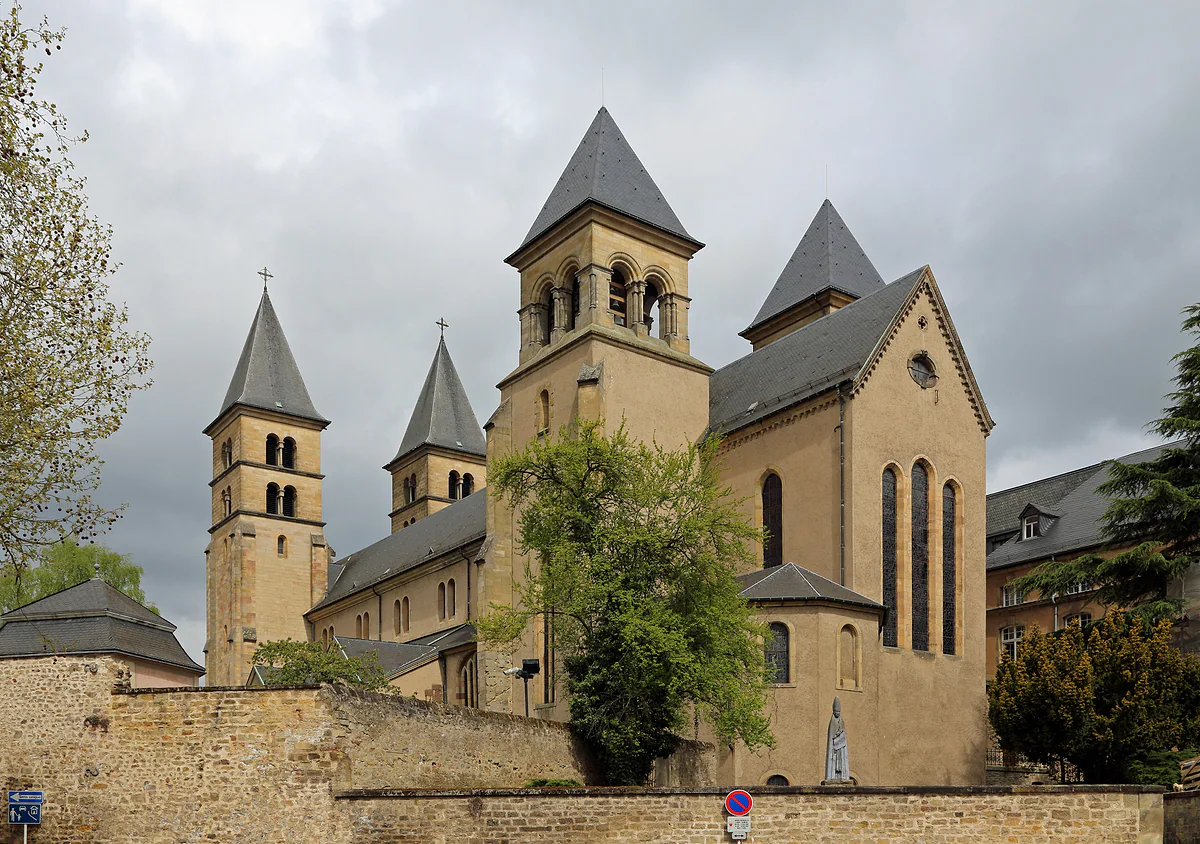
UNESCO Intangible Cultural Heritage
The Echternach dancing procession, a prayer on the hop
The Echternach dancing procession, or hopping procession (Sprangpressessioun in Luxembourgish, Springprozession in German), takes place every year on Whit Tuesday in honour of St Willibrord. Some 8,000 dancers in 45 groups hop through the town centre, linked by white handkerchiefs, from the old abbey courtyard to the saint's tomb in the basilica. It has been UNESCO Intangible Cultural Heritage since 2010.
In 30 seconds
Full read: 3 min
- The Echternach dancing procession takes place every Whit Tuesday in honour of St Willibrord.
- About 8,000 dancers in 45 groups hop forward in rows linked by white handkerchiefs.
- It sets off from the old abbey courtyard and ends at the saint's tomb in the basilica.
- It has been UNESCO Intangible Cultural Heritage since 2010 and is recorded from the year 1100.
If you can make your dates fit, it's one of the most extraordinary things you'll see in Luxembourg. Just don't treat it as a show. It's a religious procession, it lasts about an hour and the town fills up, so I'd book a bed as soon as the date is known and get there early.

Before you go
What I would keep in mind
-
01 Most beautiful
One step left, one step right
Dancers in rows of five or six, joined by a white handkerchief, move forward in small hops to a tune of their own, which the bands repeat for the whole route.
-
02 My tip
The date moves every year
It's held on Whit Tuesday, which follows Easter. The 2027 date hadn't been published by the end of September 2026; the parish and the government portal give the rule, not the day.
-
03 Worth the splurge
Stay in Echternach that night
With some 10,000 pilgrims and spectators, according to the government portal, the town runs short of beds. If you want to be there from the start, sleep there.
hotels in Echternach -
04 To save money
The rest of the year, the documentation centre
Inside the basilica, the documentation centre tells the procession's story with paintings, films and maps. From April to October it opens daily 10:00 to 12:00 and 14:00 to 17:00.
Echternach Abbey
What I would book
- Places to stayBooking.com A bed in Echternach for Whit Tuesday The procession starts early in the abbey courtyard; sleep next door and you're in place before the coaches arrive.
- Places to stayBooking.com If Echternach is full, Berdorf STATEC counts more hotels there than anywhere else in the canton after Echternach, and the Trail links the two on foot.
Some traditions make sense when you read about them; others only make sense when you see them. Echternach’s dancing procession is one of the second kind. Thousands of people in white with blue or black hop through the streets of a small town, one step to the left and one to the right, to a tune the bands play over and over. It isn’t folk dancing and it isn’t a parade. It’s a prayer, and you can tell.
What it is and why they dance
The procession honours St Willibrord, the monk born in Northumbria in 658 who founded Echternach Abbey in 698 and died in 739. In his lifetime he already had a reputation for healing, and pilgrims kept coming to his tomb after his death. UNESCO records the procession from the year 1100.
The dancing came later. The basilica parish explains that dancing saints appear in the late 15th century, people who vowed to dance in the procession to cure or prevent conditions such as epilepsy, chorea or ergotism, on the principle that like cures like. The parish itself admits nobody knows for sure whether these were medieval dances or whether pre-Christian elements crept in. UNESCO notes that the Church tried more than once to ban it for those pagan traces and never succeeded.
A saint from Northumbria
British visitors may be surprised to learn that the man at the centre of all this was English. According to the government portal, Willibrord was born in Northumbria to parents who had converted to Christianity, went as a missionary to Frisia in 690, and in 695 was consecrated bishop in Rome by Pope Sergius I, becoming archbishop of the Frisians with his seat at Utrecht. The parish calls him the Apostle of the Benelux, or even of Europe, and it keeps a record of pilgrims arriving from further afield, such as the sixty or so from Carlow who joined the procession in 2017.
Once your dates are set, check which hotels are still free in Echternach before prices climb.
How the day unfolds
It all starts early in the courtyard of the old abbey. First there’s mass in the basilica, after which the Archbishop of Luxembourg gives a greeting. Singers recite litanies and then the dancers take over, about 8,000 of them according to UNESCO, split into 45 groups, in rows of five or six joined by a white handkerchief. The parish counts around forty bands.
The route through the centre usually takes about an hour, says the government portal. At the end, dancers and spectators gather again in front of the basilica and, by tradition, file one at a time past Willibrord’s tomb in the crypt. A thanksgiving service closes the day. For people from Echternach, the proper dress is blue trousers or skirt with a white top.
When is the next one?
Every year on Whit Tuesday. Because Whitsun moves with Easter, the date changes from year to year. By the end of September 2026, neither the parish nor the government portal had published the 2027 date, so I won’t hand you a calculated one. What I can tell you is that Whit Monday is a public holiday in Luxembourg and the procession is the day after. When the parish announces it on basilika.lu, that’s the moment to book.
Once your dates are set, check which hotels are still free in Echternach before prices climb.
Getting a good view
Three things I’d do. Sleep in Echternach the night before, because with around 10,000 pilgrims and spectators according to the government portal, and 13,000 participants on average according to UNESCO, the town fills and the hotels in Echternach are few. Get to the abbey courtyard or the route early. And remember it’s a religious act, with people fulfilling vows, so go easy with the phone.
If there’s no bed left, Berdorf, up on the plateau, is linked to Echternach by Route 2 of the Mullerthal Trail, and that week I’d look there too.
If you miss the date
You can still get to grips with the procession the rest of the year. In the basilica, the documentation centre gathers paintings, texts, photos, films and maps on its history and route, with a plaque marking UNESCO’s inscription on 16 November 2010 and a large painting Lucien Simon made in 1937 for the Paris World’s Fair. In the north chapel, Anton Stevens’s triptych of 1604-05 shows pilgrims dancing with musicians in one corner, the oldest known depiction.
Up on the hill, St Peter and Paul’s Church holds another clue. The saint’s relics rested there for almost a hundred years, which is why the procession ended there until the early 20th century. In 1906 the bones went back to the basilica, where the procession finishes today.
If you would rather have a local show you round, book a guided tour in Echternach and choose by the reviews.
A car frees you from timetables: search car hire in Luxembourg on DiscoverCars and compare companies.
So you do not pay over the odds, look at trains, coaches and flights to Luxembourg on Omio and pick the one that suits you.
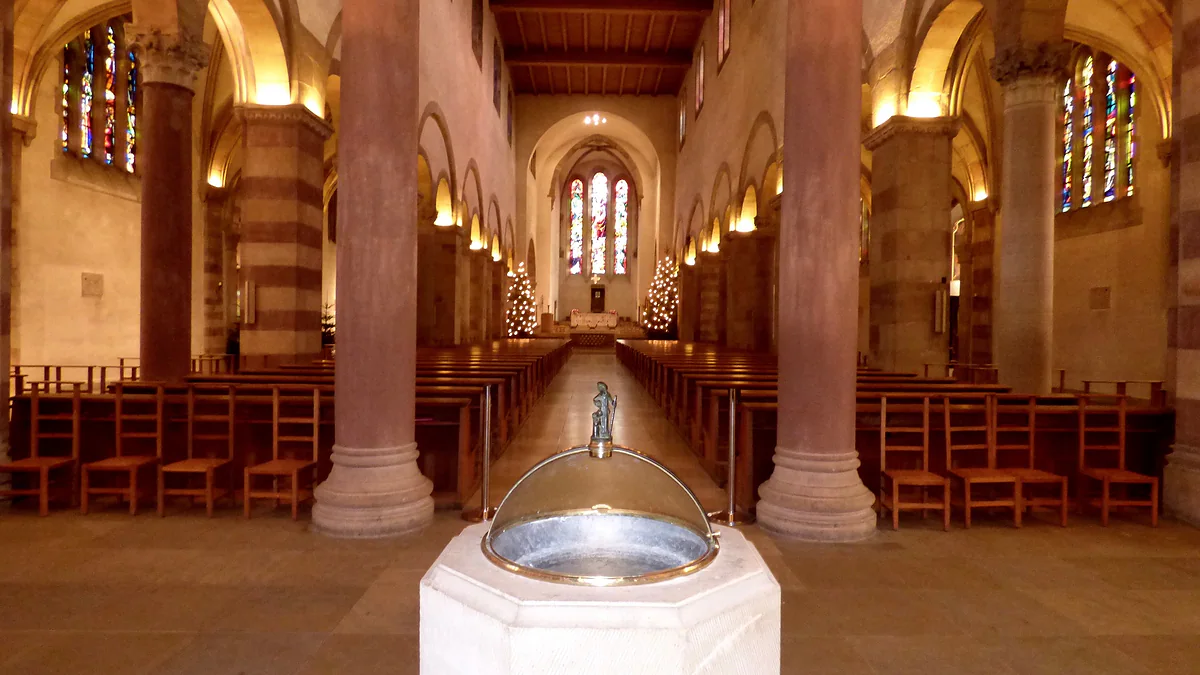
The nave of St Willibrord's Basilica in Echternach, with reddish columns, wooden pews and the font
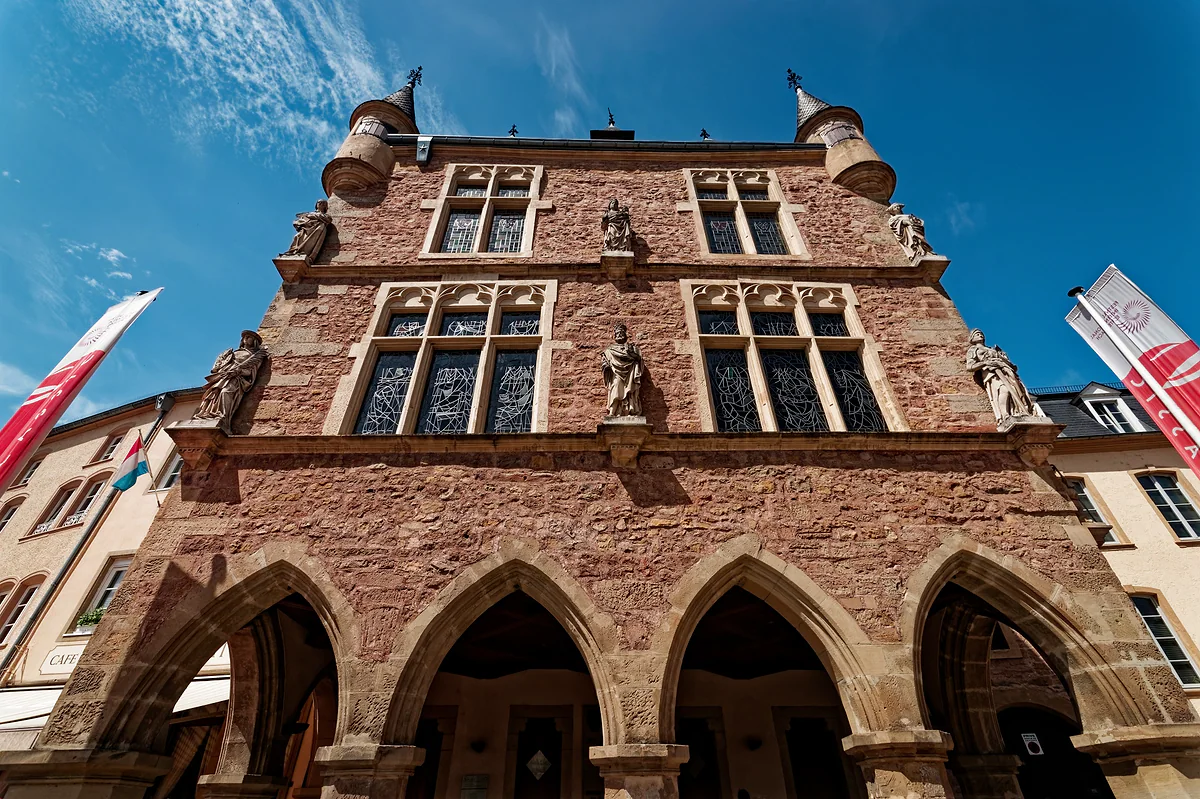
The Dënzelt, the old Gothic courthouse on Echternach's market square, with arcades, statues and turrets
The procession in numbers
| Item | Figure | Source |
|---|---|---|
| Dancers | About 8,000, in 45 groups | UNESCO |
| Average participants per year | 13,000 | UNESCO |
| Pilgrims and spectators | About 10,000 | Government portal |
| Bands | Around forty | Basilica parish |
| Length of the procession | Usually about an hour | Government portal |
ich.unesco.org, luxembourg.public.lu and basilika.lu, checked on 29-09-2026. Attendance figures vary depending on who is counting what.
Procession documentation centre (basilica)
| Season | Hours |
|---|---|
| April to October | Daily, 10:00-12:00 and 14:00-17:00 |
| November to March | Weekends only, 14:00-16:00 |
basilika.lu, checked on 29-09-2026. Entrance via the left-hand aisle of the basilica.
Test yourself
True or false?
0/3 Pick before you peek.
-
The procession is held on Whit Monday, a public holiday in Luxembourg.
See the answer
False. It's on Whit Tuesday. Whit Monday is the public holiday; the procession is the day after.
-
The dancers hold on to white handkerchiefs.
See the answer
True. They line up in rows of five or six linked by a white handkerchief, according to the government portal.
-
Until the early 20th century the procession ended at a different church.
See the answer
True. It finished at St Peter and Paul's, where Willibrord's relics lay for almost a century. In 1906 they returned to the basilica.
- Dancers, approximately
- 8,000
- Groups of dancers
- 45
- First recorded
- 1100
- UNESCO inscription
- 2010
0 of 425 Luxembourg guides
Your next stamp
- Echternach Abbey
- Echternach
- UNESCO World Heritage
- Echternach lake
- A Possen Museum
- American Cemetery
- Ansembourg
- Ansembourg Castles
- Asselborn
- Bascharage
- Beaufort castles
- Belval
- Belval blast furnaces
- Berg Castle
- Bernard-Massard cellars
- Bourglinster Castle
- Bourscheid Castle
- Brandenbourg
- Brandenbourg Castle
- Caves St Martin
- Christmas
- Clervaux Castle
- Ehnen
- Ehnen Wine Museum
- Esch-sur-Alzette
- Esch-sur-Sûre Castle
- European Museum Schengen
- Fond-de-Gras
- General Patton Museum
- German war cemetery
- Haff Réimech
- Hohllay
- Hollenfels Castle
- Hosingen
- Kautenbach
- Kneiff
- Koerich Castle
- Larochette Castle
- Lasauvage
- Mersch Castle
- Military History Museum
- Moersdorf
- Mondorf Domaine Thermal
- Munsbach Castle
- National Mining Museum
- Parc Merveilleux
- Park Sënnesräich
- Places to visit
- Remich
- Rindschleiden
- Schiessentümpel
- Septfontaines Castle
- Slate Museum
- Stolzembourg
- Tudor Museum
- Useldange Castle
- Valley of the Seven Castles
- Vianden
- Vianden Castle
- Ville Haute
- Wasserbillig Aquarium
- Weiswampach lakes
- Wiltz Castle
- Ahn
- Berdorf
- Bourscheid-Plage
- Butterfly garden
- Clervaux
- Differdange
- Grevenmacher
- Heringer Millen
- Hollenfels
- Luxembourg City
- Luxembourg Science Center
- Meysembourg Castle
- Mullerthal
- National Day
- National Resistance Museum
- Perekop
- Remerschen
- Schoenfels Castle
- The Family of Man
- Things to do
- Upper Sûre Lake
- Vianden chairlift
- Wasserbillig
- Clervaux Abbey
- Echternach Roman villa
- Éislek
- Insenborn
- Kallektuffquell
- Machtum
- Most beautiful places
- Our Nature Park
- Pétange
- Pettingen Castle
- Schueberfouer
- Schwebsingen
- Victor Hugo House
- Waldbillig
- Dudelange
- Kuelscheier
- Lultzhausen
- Moselle Valley
- Octave
- Prettiest villages
- Sanem
- Schengen
- Wellenstein
- Wiltz
- Wolfsschlucht
- Beaufort
- Bech-Kleinmacher
- Éimaischen
- Gaalgebierg
- Guttland
- Marnach
- Mondorf-les-Bains
- Putscheid
- Schifflange
- Carnival
- Consdorf
- Ellergronn
- Käerjeng
- Kayl
- Map
- Minett
- Munshausen
- Tandel
- Bech
- Buergbrennen
- Esch-sur-Sûre
- Rumelange
- Where is Luxembourg
- Is it a country?
- Lac de la Haute-Sûre (commune)
- Rosport-Mompach
- Wormeldange
- Larochette
- Mondercange
- Regions
- Bettembourg
- Bock Casemates
- Cantons
- Diekirch
- Fischbach
- Garnich
- Mersch
- Moselle wine route
- Ettelbruck
- Grund
- Heffingen
- Kehlen
- Lintgen
- Moselle river cruises
- Pétrusse Casemates
- Towns and villages
- Chemin de la Corniche
- Erpeldange-sur-Sûre
- Junglinster
- Kopstal
- Lorentzweiler
- Nommern
- Pfaffenthal
- Population
- Bissen
- Clausen
- Grand Ducal Palace
- Koerich
- Schieren
- Size
- Vallée de l'Ernz
- Feulen
- Kirchberg
- Languages
- Notre-Dame Cathedral
- Reisdorf
- Steinfort
- Bettendorf
- Habscht
- St Michael's Church
- Helperknapp
- Luxembourgish
- Place Guillaume II
- Name
- Place d'Armes
- History
- Place de la Constitution
- Grand Duke
- Colmar-Berg
- Flaxweiler
- Gare
- Hamm
- Kirchberg funicular
- Luxembourg fortress
- Mamer
- Mertert
- Minett Trail
- Mullerthal Trail
- Neumünster Abbey
- Parc Hosingen
- Pfaffenthal lift
- Political system
- Redange
- The Passerelle
- Wine festivals
- Winseler
- Beckerich
- Biwer
- EU institutions
- Goesdorf
- Limpertsberg
- Mudam
- Natur Musée
- Pulvermühl
- Stadtbredimus
- Troisvierges
- Wenzel walk
- Bonnevoie
- Bous-Waldbredimus
- Ell
- Flag
- Kiischpelt
- Manternach
- Philharmonie
- Vauban circuit
- Weiswampach
- Betzdorf
- Boulaide
- Dräi Eechelen Museum
- Facts
- Hollerich
- Lenningen
- Useldange
- Wincrange
- Bourscheid
- Dalheim
- Gasperich
- Public holidays
- Red Bridge
- Saeul
- Belair
- Second World War
- Vichten
- Battle of the Bulge
- Merl
- Préizerdaul
- Cents
- EU and Schengen
- Groussbus-Wal
- Entry requirements
- Neudorf
- Rambrouch
- Currency and payments
- Mertzig
- Weimerskirch
- Adolphe Bridge
- Beggen
- Escapardenne
- How to get there
- International March of Diekirch
- MNHA (National Museum)
- Rock climbing
- Sandweiler
- Bridges
- Eich
- Flights
- Golf
- Hesperange
- Lëtzebuerg City Museum
- Canoeing and kayaking
- Dommeldange
- Luxembourg airport
- Strassen
- Villa Vauban
- Airport to city centre
- Bertrange
- Casino Luxembourg
- Mühlenbach
- Swimming pools
- From Brussels
- Pétrusse Valley
- Rollingergrund
- Walferdange
- Cessange
- Day trip from Brussels
- Municipal Park
- Steinsel
- Free walking tours
- From Paris
- Niederanven
- From Frankfurt
- Schuttrange
- Sightseeing train and bus
- By train
- Contern
- By coach
- Weiler-la-Tour
- Driving
- Luxembourg in one day
- Pretzel Sunday
- Rham Plateau
- Tour de Luxembourg
- Candlemas (Liichtmëssdag)
- Car hire
- Luxembourg in two days
- Saint-Esprit Plateau
- Luxembourg in three days
- Melusina statue
- Parking
- St Nicholas Day (Kleeschen)
- Fête de la Musique
- Luxembourg in four days
- Museums in Luxembourg
- Petrol
- Place de Clairefontaine
- A week in Luxembourg
- Getting around
- Luxembourg Marathon
- Tram and Bus Museum
- Free public transport
- Parks in Luxembourg City
- Road trip
- Belgium and Luxembourg
- Tram
- Buses
- Viewpoints
- Trains
- Luxembourg station
- Cycling
- LuxembourgPass
- Prices and budget
- On a budget
- Free things to do
- Mobile and roaming
- Healthcare
- Safety
- Scams
- Tourist information
- Packing list
- Swimming lakes
- With a dog
- Markets
- Tipping
- Shopping
- What to buy
- Shopping centres
- With kids
- For couples
- Playgrounds
- Adventure parks
- Nightlife
- Castles
- Theatres and concert venues
- Leudelange
- Nature parks
- Where to stay
- City-centre hotels
- Hiking
- Nature reserves
- Reckange-sur-Mess
- Hotels near the station
- Roeser
- Frisange
- Hotels in Kirchberg
- Airport hotels
- Dippach
- Hotels in Vianden
- Hotels in Echternach
- Hotels in Clervaux
- Hotels in Mondorf-les-Bains
- Hotels in Esch-sur-Alzette
- Hotels on the Moselle
- Mullerthal hotels
- Upper Sûre lake hotels
- Hotels in Diekirch and Ettelbruck
- Cheap hotels
- Luxury hotels
- Boutique hotels
- Spa hotels
- Family hotels
- Apartments
- Weather
- Youth hostels
- Best time to visit
- Campsites
- Holiday cottages
- In winter
- Castle hotels
- In spring
- Day trips
- In summer
- Around Luxembourg
- In autumn
- Ice skating
- Trier day trip
- Metz day trip
- Arlon day trip
- In January
- In February
- In March
- In April
- In May
- In June
- In July
- In August
- In September
- Food
- In October
- In November
- Where to eat
- In December
- Michelin restaurants
- Cheap eats
- Judd mat Gaardebounen
- Bouneschlupp
- Gromperekichelcher
- Kniddelen
- Quetschentaart
- Rieslingspaschtéit
- Events
- Wine
- Crémant
- Beer
Frequently asked questions
When is the Echternach dancing procession?
Every year on Whit Tuesday. Because Whitsun follows Easter, the date changes; at the end of September 2026 the parish had not yet announced the 2027 date.
What is the Echternach dancing procession?
A pilgrimage in honour of St Willibrord, founder of the abbey, in which the faithful move through Echternach's centre in small hops to music. UNESCO inscribed it as Intangible Cultural Heritage in 2010.
Why do they dance?
The parish explains that from the late 15th century there are records of dancing saints, people who vowed to dance in the procession to cure or ward off illnesses such as epilepsy, chorea or ergotism. The government portal describes it as praying with the whole body.
How long does the procession last?
The procession itself usually takes about an hour. There's a mass in the basilica beforehand, and at the end dancers and spectators file one by one past Willibrord's tomb before a service of thanksgiving.
Who takes part?
People from Luxembourg and neighbouring countries, according to the government portal and UNESCO. For Echternach locals the proper dress is blue trousers or skirt with a white top.
What can I see if I miss the date?
The documentation centre in the basilica, with paintings, films and maps, and in the north chapel Anton Stevens's triptych of 1604-05, the oldest known depiction of the procession.
By
Tourism graduate with a master’s in Tourism Management and Planning from the University of Málaga, who has travelled across Europe. He writes every guide from official sources and his own judgement.
Published on . Updated on . Facts checked on .
Sources
Some links in this guide are affiliate links: if you book through them, the site earns a commission at no extra cost to you. Affiliate disclosure
Photos: Marc Ryckaert (CC BY 3.0); Denise Hastert (CC BY-SA 4.0); Txllxt TxllxT (CC BY-SA 4.0), via Wikimedia Commons.