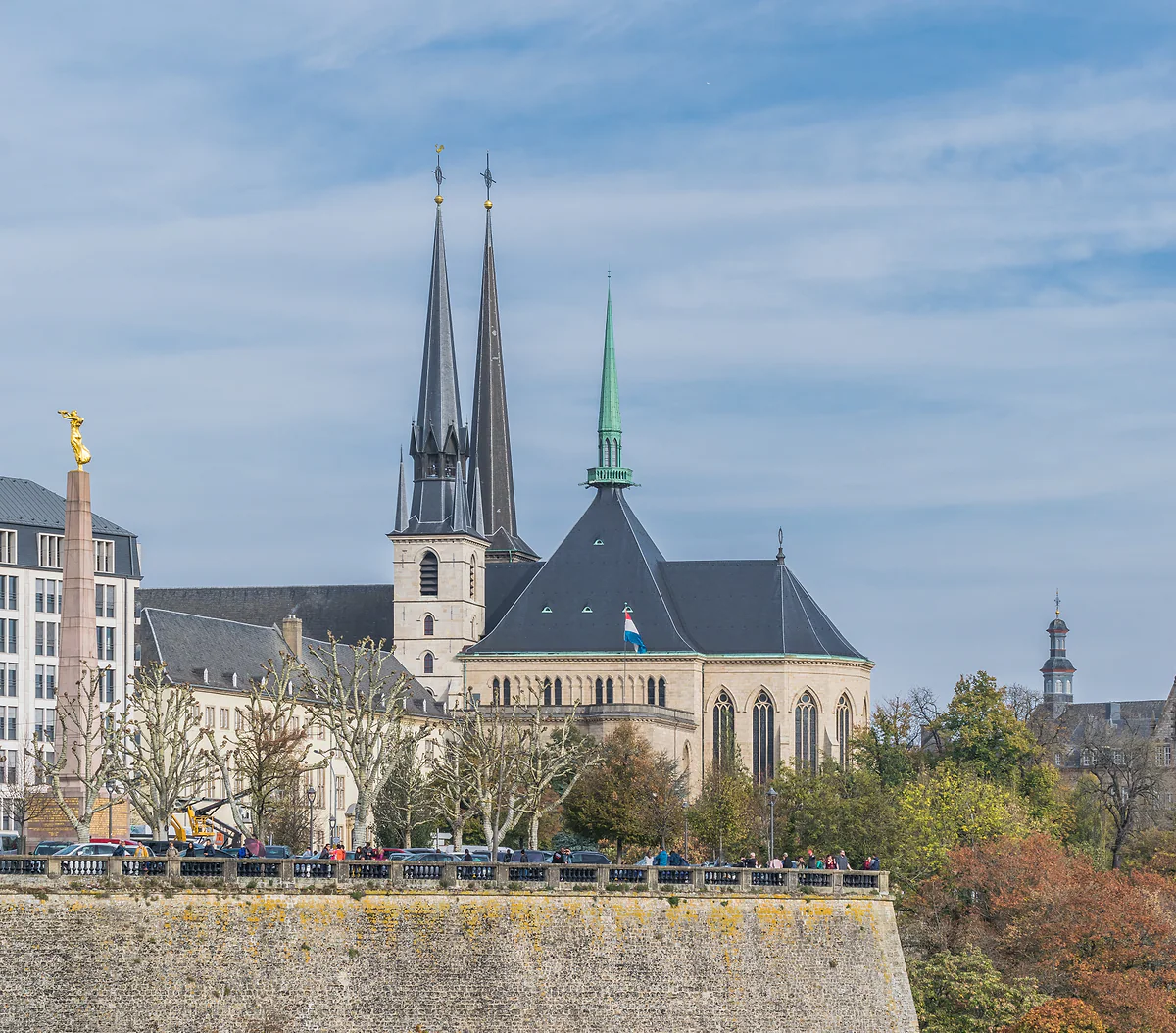
Monument of Remembrance on the Beck bastion
Place de la Constitution and the Gëlle Fra, the golden lady who came back
The Gëlle Fra, the «golden lady», tops the Monument of Remembrance on Place de la Constitution in Luxembourg City. It was unveiled in 1923 to honour Luxembourg volunteers killed in the First World War, pulled down by the Nazis in 1940 and returned to its 21 m obelisk in 1985. The square, on the Beck bastion, overlooks the Pétrusse valley.
In 30 seconds
Full read: 3 min
- The Gëlle Fra is the gilded statue on the Monument of Remembrance, on Place de la Constitution in Luxembourg City.
- Unveiled in 1923 in memory of Luxembourg's First World War volunteers, it's the work of Claus Cito.
- The Nazis tore it down in 1940; it was found under a stadium in 1981 and returned to its obelisk in 1985.
- The square, on the Beck bastion, is free and looks over the Pétrusse valley and the Adolphe Bridge.
Everyone takes the photo, but hardly anyone knows the story, and the story is what makes this memorial. I'd read what happened to her between 1940 and 1985 before going, then cross the Adolphe Bridge to see her from a distance, rising above the walls.

Before you go
What I would keep in mind
-
01 Most beautiful
The best view of the Pétrusse valley
The city tourist office singles out the view from here over the Pétrusse valley and the Adolphe Bridge. It's the old town's southern balcony, as the Corniche is its eastern one, and it's free at any hour.
Adolphe Bridge -
02 Worth the splurge
Underfoot, the Pétrusse Casemates
Beneath the square lie the Pétrusse Casemates, which the city tourist office shows on a one-hour light-and-sound tour for €24 as of September 2026. Tours leave from the square itself, Friday to Sunday.
Pétrusse Casemates -
03 My tip
Look at her head
Today's Gëlle Fra doesn't gaze the way the 1923 original did. After her fall in 1940 she was rebuilt with her head tilted downwards, whereas the original looked straight ahead. The feet are new too.
-
04 Getting there
The cathedral is on the same boulevard
Notre-Dame Cathedral stands on the same boulevard Roosevelt, a few steps away. From the Adolphe Bridge you see its spires and the obelisk together.
Notre-Dame Cathedral
What I would book
Almost everyone who visits Luxembourg City takes a photo of the Gëlle Fra, the golden lady gleaming on top of an obelisk at the southern tip of the old town. Few realise that the statue was torn down by the Nazis, vanished for decades and turned up under the stands of a football ground. For me it’s the memorial with the best story in the capital. Here it is.
A bastion turned into a viewpoint
The square stands on the old Beck bastion, from 1644 and 1685 according to the city’s tourist office. That projecting corner of the defences kept watch on the Pétrusse valley, and today it’s the best viewpoint on that side, with the Adolphe Bridge spanning the valley. Below, in the rock, are the galleries of the Pétrusse Casemates, visited with a guide.
A memorial the country paid for
The story begins in December 1918, when a committee formed to build a national memorial to the Luxembourgers who had volunteered with the Allied forces in the First World War. Money was raised across the country, including through two series of charity postage stamps, according to the government’s portal.
In 1920 the Luxembourgish sculptor Claus Cito won the competition, from 18 entries, with his design «À nos braves». He modelled the figures in his Bascharage studio, first in clay and then in plaster, and they were cast in bronze in Brussels. The memorial was unveiled in 1923. A 21 m obelisk on a plinth with two bronzes, a fallen soldier and his comrade, and on top the 3.30 m gilded statue, an angel of peace holding a laurel wreath. Who sat for her remains a mystery.
Once your dates are set, check which hotels are still free in Luxembourg before prices climb.
The fall of 1940 and the return
On 10 May 1940 Germany invaded Luxembourg. As part of its drive to strip the country of anything French, Gauleiter Gustav Simon ordered the Gëlle Fra taken down. The government’s portal tells how local firms made excuses to avoid the job, claiming they lacked the equipment or that their workers refused, until council labourers did it under threat of dismissal. In October 1940, after several attempts, the statue fell and smashed against the obelisk. The two soldiers and the documents in the foundations were saved.
After liberation the plinth was rebuilt, and in 1950 the soldiers returned. The statue was another matter. Its remains were shown in 1955 and then disappeared, until in 1981 they were found under the stands of the old Josy Barthel stadium. She was rebuilt in December 1984 and went back on the obelisk in May 1985. She isn’t quite the same, though. The feet had to be remade and her head, which in 1923 looked straight ahead, now looks down because of the fall. I find that detail the most eloquent thing about the monument.
Why do people call it the Statue of Liberty?
Because that’s what it became. The city tourist office says it’s now a symbol of the freedom and resistance of the Luxembourg people, and alongside the dead of 1914 to 1918 the memorial now honours those of the Second World War, the Luxembourgers killed in Korea and the volunteers of the Spanish Civil War. For more on that period, see Luxembourg WW2.
Controversy has always followed her. In 1923 the clergy objected to her sensuality and her closeness to the cathedral. In 2001 «Lady Rosa of Luxembourg», a pregnant Gëlle Fra by the artist Sanja Iveković, caused uproar. And in 2010 she travelled to the Shanghai World Expo to stand at the Luxembourg pavilion, with criticism of her removal. On her return she spent six months at ground level in Bascharage, Cito’s home town.
Once your dates are set, check which hotels are still free in Luxembourg before prices climb.
How to see her
The square is public and free. I’d do two things. Walk up to the plinth to see the bronze soldiers close up, then cross the Adolphe Bridge to look back at the obelisk from across the valley, with the spires of Notre-Dame Cathedral behind. That’s the picture that sums up the old town best. And on an autumn weekend, I’d finish by going down into the Pétrusse Casemates, whose guided tour starts from this very square.
One more reason to linger. The monument’s story is written up in detail on the government’s portal, which marked her 100th anniversary in 2023, and it’s well worth reading on your phone while you stand under the obelisk.
If you would rather have a local show you round, book a guided tour in Place de la Constitution and choose by the reviews.
A car frees you from timetables: search car hire in Luxembourg on DiscoverCars and compare companies.
So you do not pay over the odds, look at trains, coaches and flights to Luxembourg on Omio and pick the one that suits you.
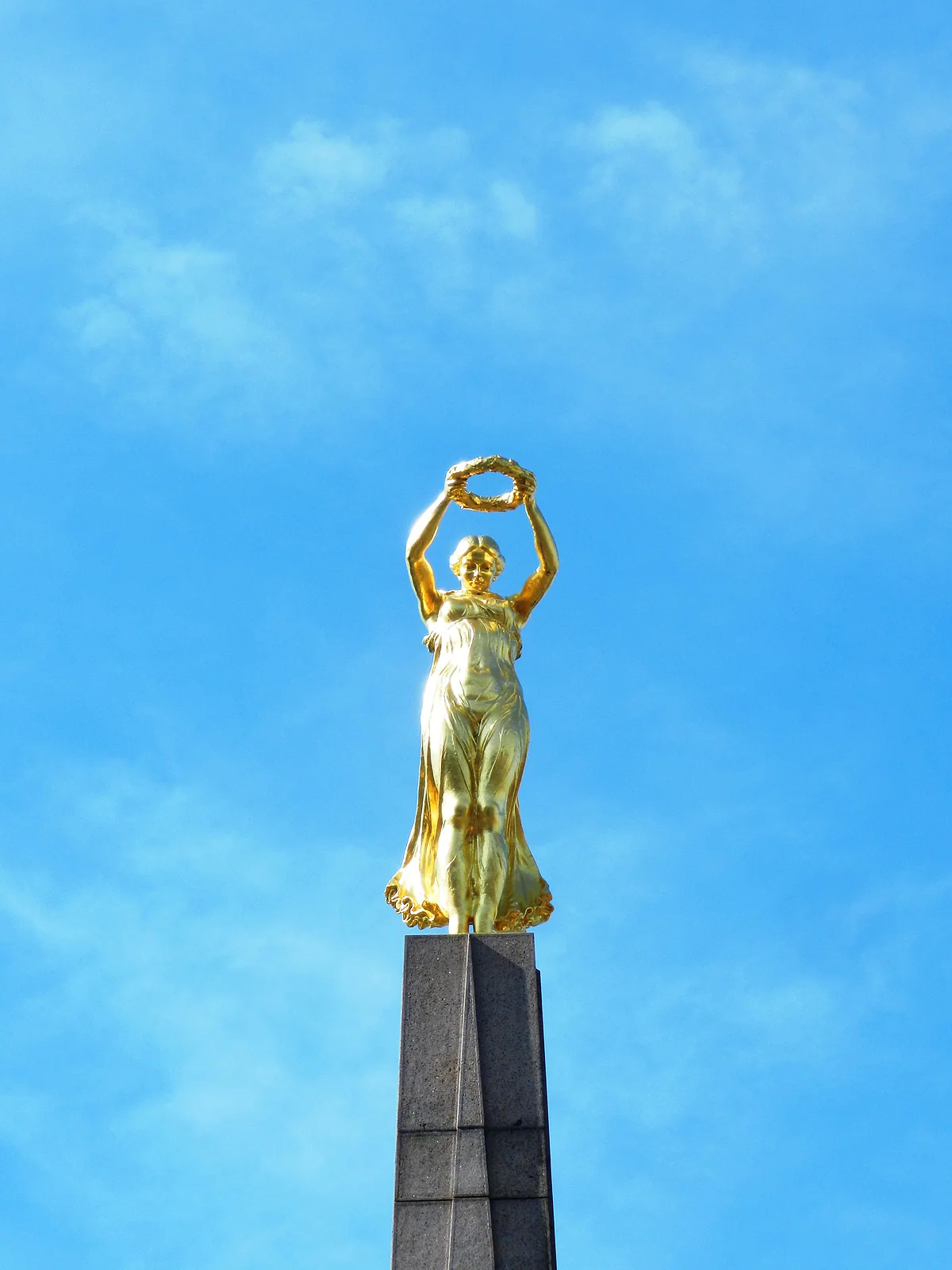
The Gëlle Fra, a golden figure holding up a laurel wreath, atop the obelisk of the Monument of Remembrance
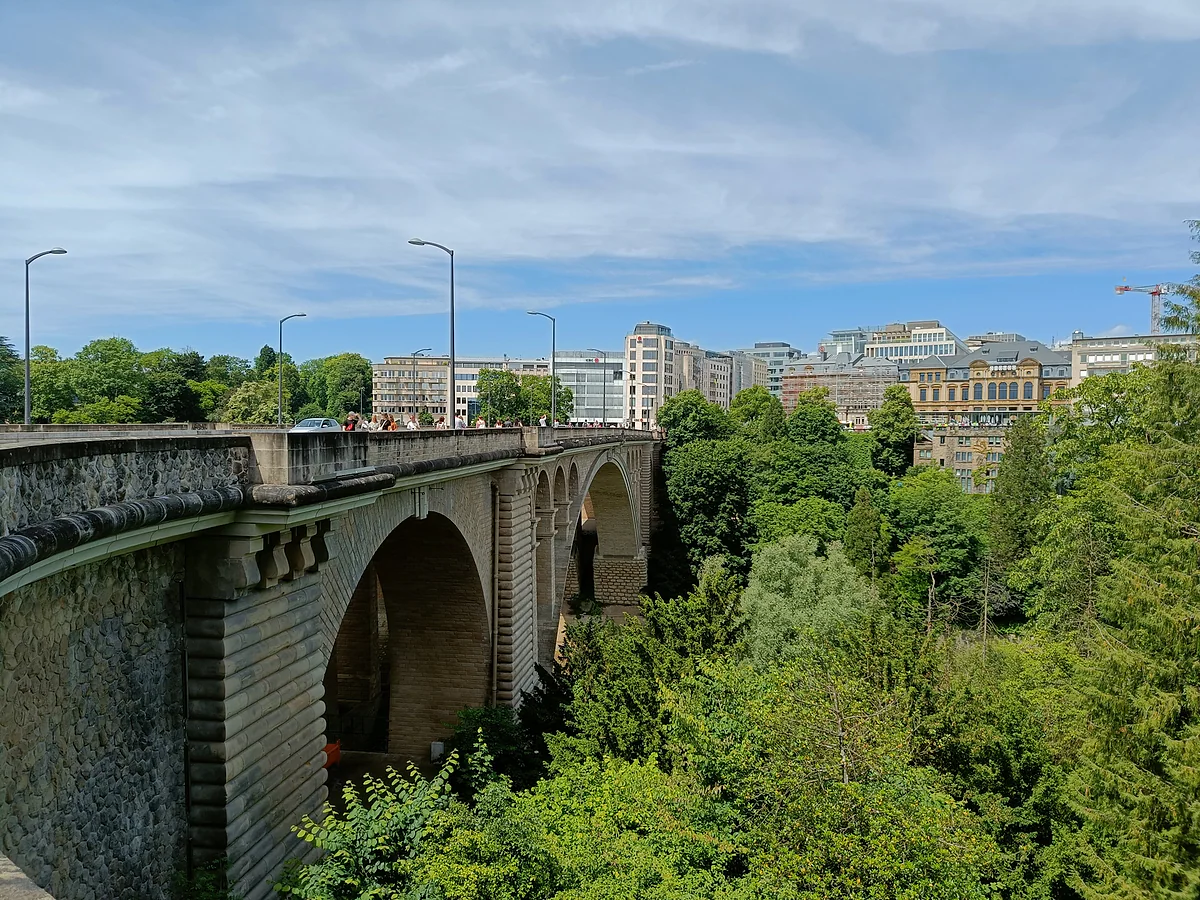
The Adolphe Bridge with its great stone arch over the wooded Pétrusse valley and the city on the far side
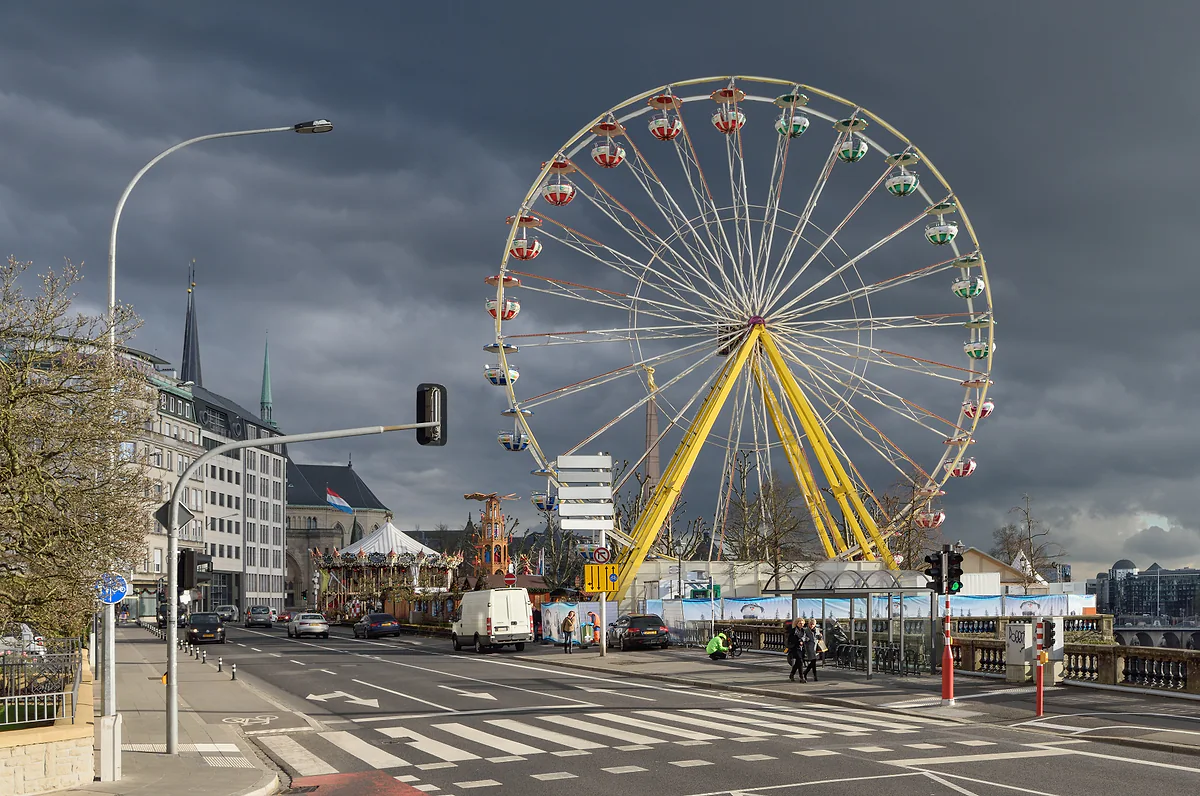
The Christmas market Ferris wheel on Place de la Constitution, with stalls and a grey late-November sky
The Gëlle Fra through time
| Year | What happened |
|---|---|
| 1918 | In December a committee forms to build the memorial |
| 1920 | Claus Cito wins the competition from 18 entries |
| 1923 | Unveiled on Place de la Constitution |
| 1940 | From October, torn down on the orders of Gauleiter Gustav Simon |
| 1950 | The two bronze soldiers return to the base |
| 1981 | Found under the stands of the old Josy Barthel stadium |
| 1985 | In May, back on top of the obelisk |
| 2010 | Travels to the Shanghai World Expo |
luxembourg.public.lu, Gëlle Fra, checked on 29-09-2026.
The Monument of Remembrance in figures
| Element | Detail |
|---|---|
| Obelisk | 21 m on a plinth |
| Gilded statue | 3.30 m, an angel of peace holding a laurel wreath |
| Plinth | Two bronzes, a fallen soldier and his comrade |
| Square | On the Beck bastion of 1644 and 1685 |
luxembourg.public.lu and the Luxembourg City Tourist Office, checked on 29-09-2026.
Test yourself
True or false?
0/4 Pick before you peek.
-
The Gëlle Fra was built to remember the dead of the Second World War.
See the answer
False. It was unveiled in 1923 for Luxembourg's First World War volunteers. Today it also honours those killed in the Second World War and in Korea, and the volunteers of the Spanish Civil War.
-
The Gëlle Fra went missing for decades.
See the answer
True. Its remains were shown in 1955 and then vanished. It turned up in 1981 under the stands of the old Josy Barthel stadium.
-
Today's statue looks exactly like the 1923 original.
See the answer
False. In 1923 she looked straight ahead; today her head is tilted downwards, a result of her fall in 1940.
-
The Gëlle Fra has left Luxembourg for a world expo.
See the answer
True. In 2010 she stood at the entrance of the Luxembourg pavilion at the Shanghai World Expo, a move that caused a heated row at home.
- Memorial unveiled
- 1923
- Height of the obelisk
- 21 m
- Height of the gilded statue
- 3.30 m
- Year it returned
- 1985
Map
Where Place de la Constitution is
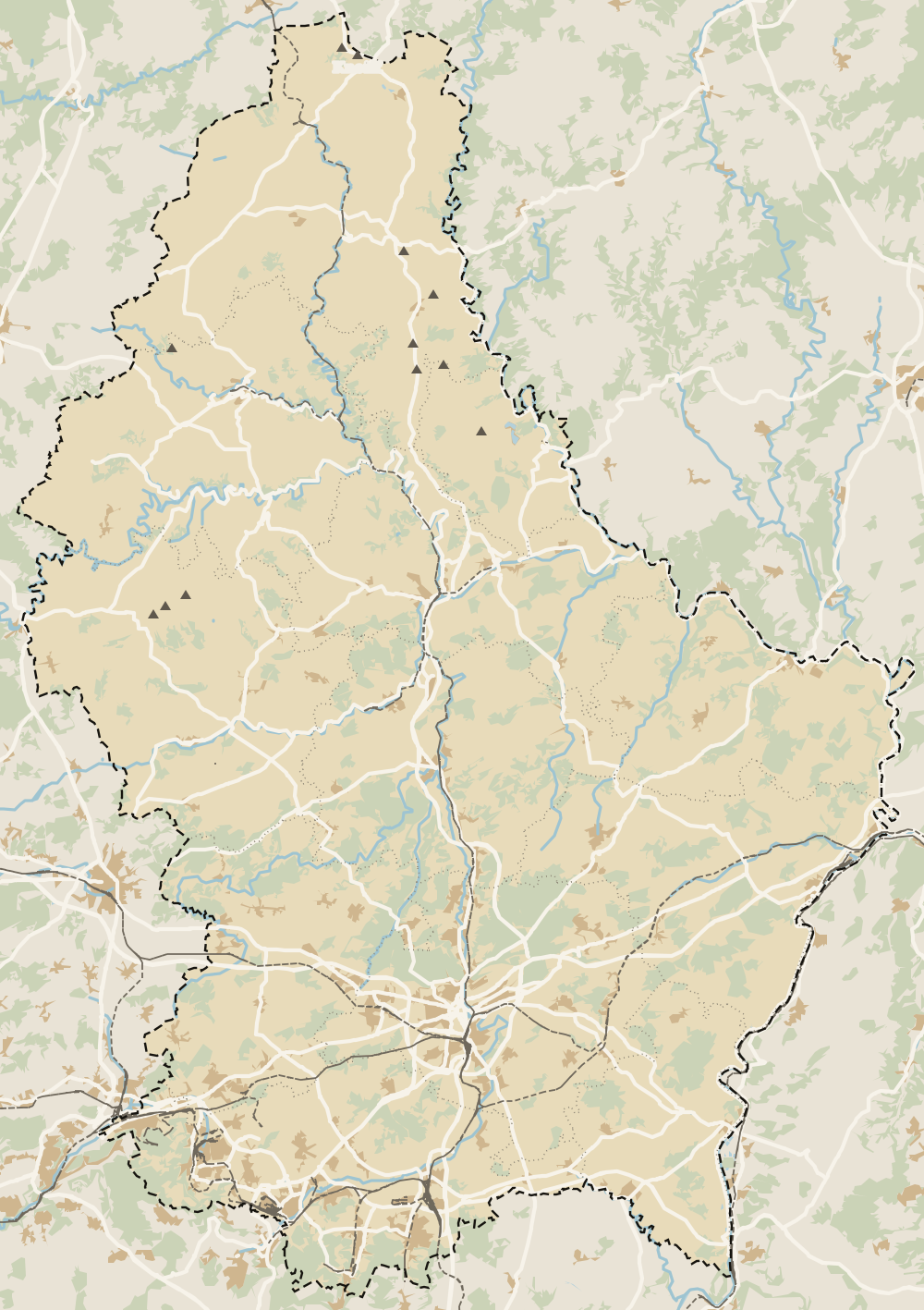
The thick dashed line is the border with Belgium, France and Germany, and the fine ones divide the twelve cantons. The Éislek lies to the north and the Moselle to the east. Every number opens its guide.
 1Ville Haute 2Bock Casemates 3Pétrusse Casemates 4Chemin de la Corniche 5Grand Ducal Palace 6Notre-Dame Cathedral 7St Michael's Church 8Place Guillaume II 9Place d'Armes 10Place de la Constitution 11Adolphe Bridge 12MNHA (National Museum) 13Lëtzebuerg City Museum 14Villa Vauban 15Casino Luxembourg 16Municipal Park 17Saint-Esprit Plateau 18Place de Clairefontaine
 Map data © OpenStreetMap contributors (ODbL)
- 1Ville HauteA district of Luxembourg City
- 2Bock CasematesTunnels in a World Heritage Site
- 3Pétrusse CasematesSandstone galleries by the Gëlle Fra
- 4Chemin de la CornicheThe rampart walk of the old town
- 5Grand Ducal PalaceOfficial seat in the old town
- 6Notre-Dame CathedralThe country's only cathedral
- 7St Michael's ChurchOne of the capital's oldest places of worship
- 8Place Guillaume IITown hall square and William II
- 9Place d'ArmesPedestrian square in the old town
- 10Place de la ConstitutionMonument of Remembrance on the Beck bastion
- 11Adolphe BridgeThe capital's emblem, between the Ville Haute and the Gare
- 12MNHA (National Museum)National museum on the Marché-aux-Poissons, old town
- 13Lëtzebuerg City MuseumThe capital's history museum, old town
- 14Villa VaubanThe city's art museum, in the municipal park
- 15Casino LuxembourgForum d'art contemporain, old town
- 16Municipal ParkParc municipal Édouard André, old town
- 17Saint-Esprit PlateauCitadel in the Ville Haute
- 18Place de ClairefontaineSquare in the Ville Haute
0 of 425 Luxembourg guides
Your next stamp
- Belair
- Saint-Esprit Plateau
- Luxembourg fortress
- Second World War
- Luxembourg in one day
- Place Guillaume II
- Grund
- Gare
- A Possen Museum
- American Cemetery
- Ansembourg
- Ansembourg Castles
- Asselborn
- Bascharage
- Beaufort castles
- Belval
- Belval blast furnaces
- Berg Castle
- Bernard-Massard cellars
- Bourglinster Castle
- Bourscheid Castle
- Brandenbourg
- Brandenbourg Castle
- Caves St Martin
- Christmas
- Clervaux Castle
- Echternach
- Echternach Abbey
- Ehnen
- Ehnen Wine Museum
- Esch-sur-Alzette
- Esch-sur-Sûre Castle
- European Museum Schengen
- Fond-de-Gras
- General Patton Museum
- German war cemetery
- Haff Réimech
- Hohllay
- Hollenfels Castle
- Hosingen
- Kautenbach
- Kneiff
- Koerich Castle
- Larochette Castle
- Lasauvage
- Mersch Castle
- Military History Museum
- Moersdorf
- Mondorf Domaine Thermal
- Munsbach Castle
- National Mining Museum
- Parc Merveilleux
- Park Sënnesräich
- Places to visit
- Remich
- Rindschleiden
- Schiessentümpel
- Septfontaines Castle
- Slate Museum
- Stolzembourg
- Tudor Museum
- Useldange Castle
- Valley of the Seven Castles
- Vianden
- Vianden Castle
- Ville Haute
- Wasserbillig Aquarium
- Weiswampach lakes
- Wiltz Castle
- Ahn
- Berdorf
- Bourscheid-Plage
- Butterfly garden
- Clervaux
- Differdange
- Echternach lake
- Grevenmacher
- Heringer Millen
- Hollenfels
- Luxembourg City
- Luxembourg Science Center
- Meysembourg Castle
- Mullerthal
- National Day
- National Resistance Museum
- Perekop
- Remerschen
- Schoenfels Castle
- The Family of Man
- Things to do
- Upper Sûre Lake
- Vianden chairlift
- Wasserbillig
- Clervaux Abbey
- Echternach Roman villa
- Éislek
- Insenborn
- Kallektuffquell
- Machtum
- Most beautiful places
- Our Nature Park
- Pétange
- Pettingen Castle
- Schueberfouer
- Schwebsingen
- Victor Hugo House
- Waldbillig
- Dudelange
- Kuelscheier
- Lultzhausen
- Moselle Valley
- Octave
- Prettiest villages
- Sanem
- Schengen
- Wellenstein
- Wiltz
- Wolfsschlucht
- Beaufort
- Bech-Kleinmacher
- Éimaischen
- Gaalgebierg
- Guttland
- Marnach
- Mondorf-les-Bains
- Putscheid
- Schifflange
- UNESCO World Heritage
- Carnival
- Consdorf
- Ellergronn
- Käerjeng
- Kayl
- Map
- Minett
- Munshausen
- Tandel
- Bech
- Buergbrennen
- Esch-sur-Sûre
- Rumelange
- Where is Luxembourg
- Is it a country?
- Lac de la Haute-Sûre (commune)
- Rosport-Mompach
- Wormeldange
- Larochette
- Mondercange
- Regions
- Bettembourg
- Bock Casemates
- Cantons
- Dancing procession
- Diekirch
- Fischbach
- Garnich
- Mersch
- Moselle wine route
- Ettelbruck
- Heffingen
- Kehlen
- Lintgen
- Moselle river cruises
- Pétrusse Casemates
- Towns and villages
- Chemin de la Corniche
- Erpeldange-sur-Sûre
- Junglinster
- Kopstal
- Lorentzweiler
- Nommern
- Pfaffenthal
- Population
- Bissen
- Clausen
- Grand Ducal Palace
- Koerich
- Schieren
- Size
- Vallée de l'Ernz
- Feulen
- Kirchberg
- Languages
- Notre-Dame Cathedral
- Reisdorf
- Steinfort
- Bettendorf
- Habscht
- St Michael's Church
- Helperknapp
- Luxembourgish
- Name
- Place d'Armes
- History
- Grand Duke
- Colmar-Berg
- Flaxweiler
- Hamm
- Kirchberg funicular
- Mamer
- Mertert
- Minett Trail
- Mullerthal Trail
- Neumünster Abbey
- Parc Hosingen
- Pfaffenthal lift
- Political system
- Redange
- The Passerelle
- Wine festivals
- Winseler
- Beckerich
- Biwer
- EU institutions
- Goesdorf
- Limpertsberg
- Mudam
- Natur Musée
- Pulvermühl
- Stadtbredimus
- Troisvierges
- Wenzel walk
- Bonnevoie
- Bous-Waldbredimus
- Ell
- Flag
- Kiischpelt
- Manternach
- Philharmonie
- Vauban circuit
- Weiswampach
- Betzdorf
- Boulaide
- Dräi Eechelen Museum
- Facts
- Hollerich
- Lenningen
- Useldange
- Wincrange
- Bourscheid
- Dalheim
- Gasperich
- Public holidays
- Red Bridge
- Saeul
- Vichten
- Battle of the Bulge
- Merl
- Préizerdaul
- Cents
- EU and Schengen
- Groussbus-Wal
- Entry requirements
- Neudorf
- Rambrouch
- Currency and payments
- Mertzig
- Weimerskirch
- Adolphe Bridge
- Beggen
- Escapardenne
- How to get there
- International March of Diekirch
- MNHA (National Museum)
- Rock climbing
- Sandweiler
- Bridges
- Eich
- Flights
- Golf
- Hesperange
- Lëtzebuerg City Museum
- Canoeing and kayaking
- Dommeldange
- Luxembourg airport
- Strassen
- Villa Vauban
- Airport to city centre
- Bertrange
- Casino Luxembourg
- Mühlenbach
- Swimming pools
- From Brussels
- Pétrusse Valley
- Rollingergrund
- Walferdange
- Cessange
- Day trip from Brussels
- Municipal Park
- Steinsel
- Free walking tours
- From Paris
- Niederanven
- From Frankfurt
- Schuttrange
- Sightseeing train and bus
- By train
- Contern
- By coach
- Weiler-la-Tour
- Driving
- Pretzel Sunday
- Rham Plateau
- Tour de Luxembourg
- Candlemas (Liichtmëssdag)
- Car hire
- Luxembourg in two days
- Luxembourg in three days
- Melusina statue
- Parking
- St Nicholas Day (Kleeschen)
- Fête de la Musique
- Luxembourg in four days
- Museums in Luxembourg
- Petrol
- Place de Clairefontaine
- A week in Luxembourg
- Getting around
- Luxembourg Marathon
- Tram and Bus Museum
- Free public transport
- Parks in Luxembourg City
- Road trip
- Belgium and Luxembourg
- Tram
- Buses
- Viewpoints
- Trains
- Luxembourg station
- Cycling
- LuxembourgPass
- Prices and budget
- On a budget
- Free things to do
- Mobile and roaming
- Healthcare
- Safety
- Scams
- Tourist information
- Packing list
- Swimming lakes
- With a dog
- Markets
- Tipping
- Shopping
- What to buy
- Shopping centres
- With kids
- For couples
- Playgrounds
- Adventure parks
- Nightlife
- Castles
- Theatres and concert venues
- Leudelange
- Nature parks
- Where to stay
- City-centre hotels
- Hiking
- Nature reserves
- Reckange-sur-Mess
- Hotels near the station
- Roeser
- Frisange
- Hotels in Kirchberg
- Airport hotels
- Dippach
- Hotels in Vianden
- Hotels in Echternach
- Hotels in Clervaux
- Hotels in Mondorf-les-Bains
- Hotels in Esch-sur-Alzette
- Hotels on the Moselle
- Mullerthal hotels
- Upper Sûre lake hotels
- Hotels in Diekirch and Ettelbruck
- Cheap hotels
- Luxury hotels
- Boutique hotels
- Spa hotels
- Family hotels
- Apartments
- Weather
- Youth hostels
- Best time to visit
- Campsites
- Holiday cottages
- In winter
- Castle hotels
- In spring
- Day trips
- In summer
- Around Luxembourg
- In autumn
- Ice skating
- Trier day trip
- Metz day trip
- Arlon day trip
- In January
- In February
- In March
- In April
- In May
- In June
- In July
- In August
- In September
- Food
- In October
- In November
- Where to eat
- In December
- Michelin restaurants
- Cheap eats
- Judd mat Gaardebounen
- Bouneschlupp
- Gromperekichelcher
- Kniddelen
- Quetschentaart
- Rieslingspaschtéit
- Events
- Wine
- Crémant
- Beer
Frequently asked questions
What is the Gëlle Fra in Luxembourg?
The gilded statue on top of the Monument of Remembrance on Place de la Constitution. It depicts an angel of peace holding a laurel wreath and honours the Luxembourg volunteers killed in the First World War.
Why is it called Luxembourg's Statue of Liberty?
The city tourist office explains that it's now a symbol of the freedom and resistance of the Luxembourg people. That reading comes from its history, since the Nazis tore it down in 1940 and it only returned in 1985.
How tall is the Gëlle Fra?
The gilded statue is 3.30 m tall and stands on a 21 m obelisk, according to the government's official portal.
Who made the Gëlle Fra?
The Luxembourgish sculptor Claus Cito, who won the 1920 competition with his design «À nos braves». The figures were cast in bronze in Brussels, and the identity of the model remains a mystery.
What happened to the Gëlle Fra in the Second World War?
After the German invasion of 10 May 1940, Gauleiter Gustav Simon ordered its removal. The statue fell and broke in October 1940. It turned up in 1981 under the stands of the old Josy Barthel stadium and went back on the obelisk in May 1985.
Does it cost anything to see the Gëlle Fra?
No. The square is public and always open. The only paid thing here is the Pétrusse Casemates tour, beneath the square.
By
Tourism graduate with a master’s in Tourism Management and Planning from the University of Málaga, who has travelled across Europe. He writes every guide from official sources and his own judgement.
Published on . Facts checked on .
Sources
Some links in this guide are affiliate links: if you book through them, the site earns a commission at no extra cost to you. Affiliate disclosure
Photos: Krzysztof Golik (CC BY-SA 4.0); Simo.Albo80 (CC BY-SA 4.0); Tunegravity (CC0); Cayambe (CC BY-SA 4.0), via Wikimedia Commons.