Flag, coat of arms, anthem and motto
The Luxembourg flag, and why it isn't the Dutch one
Luxembourg's flag has three horizontal stripes, red, white and sky blue. It looks like the Dutch flag, but its blue is lighter (Pantone 299C) precisely to tell them apart. Since 2007 the red lion from the coat of arms, the «Roude Léiw», has also been accepted as a civil flag within the country, and the anthem, Ons Heemecht, is in Luxembourgish.
For a photo with the flag, head to the one flying in front of the Gëlle Fra on Place de la Constitution. It's the shot the government itself uses to illustrate its national symbols, with the Pétrusse valley and the Adolphe Bridge behind.

Before you go
What I would keep in mind
-
01 My tip
Check the shade of blue
The Dutch flag uses ultramarine and Luxembourg's uses sky blue, Pantone 299C. The official portal calls it a pragmatic solution to stop the two being confused.
-
02 Most beautiful
The lion, a civil flag since 2007
The «Roude Léiw», the crowned red lion from the coat of arms on white and blue stripes, has been accepted since 2007 as a civil flag within Luxembourg. It sits alongside the tricolour rather than replacing it.
Luxembourg National Day -
03 Most beautiful
The flag photo, at the Gëlle Fra
The picture the government uses to present the flag shows it beside the Monument of Remembrance, the Gëlle Fra, above the Pétrusse valley.
Gëlle Fra
Luxembourg’s flag is a pub-quiz trap. Red, white and blue in three horizontal stripes, just like the Netherlands at first glance. The difference is the shade of blue, and there’s an official reason for it. Here’s the flag, the lion that sometimes keeps it company, the coat of arms the lion comes from, the anthem and the motto, all symbols the country protects by law.
Red, white and sky blue
Today’s flag has three horizontal stripes, red, white and sky blue. The government’s official portal admits quite openly that there was a resemblance problem with the Dutch flag and that it was solved pragmatically. The Dutch blue is ultramarine; Luxembourg’s is sky blue, Pantone 299C. Put them side by side and Luxembourg’s looks lighter and brighter.
The cloth itself is far older than the modern country. The first known flag was carried by Count William of Luxembourg in 1123, striped horizontally and probably yellow and red. The coat of arms, the flag and the anthem are all protected by law today, the arms and flag by a law of 1972 and the anthem by one of 1993.
The Roude Léiw, the other flag
There’s a second flag worth recognising, a red lion on white and blue stripes. This is the «Roude Léiw», the red lion from the coat of arms. According to the official portal, since 2007 the government has accepted it as a civil flag within Luxembourg. It doesn’t replace the national flag, which remains the tricolour. The day the country brings its symbols out in force, with a parade and a Te Deum, is covered in Luxembourg National Day.
To sleep close to everything, search places to stay in Luxembourg on Booking.com and filter by area before price.
A 13th-century coat of arms
The lion comes from the coat of arms, fixed by Count Henry V between 1235 and 1239. The official heraldic description is ten stripes of silver and azure with a red lion, armed, tongued and crowned in gold, its forked tail crossed in saltire. There are three versions, lesser, middle and greater arms, and the dynasty’s greater arms, revised in 2001, carry the Bourbon-Parma shield at the centre. Who that family is today is in Grand Duke of Luxembourg.
Ons Heemecht, an anthem in Luxembourgish
The anthem is Ons Heemecht, «Our Homeland». It’s made up of the first and last verses of a Luxembourgish poem by Michel Lentz, written in 1859 and set to music by Jean-Antoine Zinnen, and it was first performed in public at a large ceremony in Ettelbruck in 1864. I like the way it opens with the landscape rather than the nation. It names the Alzette winding through meadows, the Sûre breaking through rocks and the vines along the Moselle. The last verse asks God to protect the country from a foreign yoke. The official portal describes it as a stirring appeal for peace and freedom that expresses the country’s joy at having found its independence in calm and prosperity. The government also publishes a French translation, «Le Sol natal», by the Alliance pour la propagation de la langue française, which is what my rough English version in the table is based on. The anthem, the flag and the arms are also the three symbols the state itself lists, in that order, as the emblems of its identity and sovereignty.
It’s also one of the first literary texts in Luxembourgish, alongside De Feierwon and De Reenert. What sort of language that is, and how to say hello in it, is in Luxembourgish language.
To sleep close to everything, search places to stay in Luxembourg on Expedia and filter by area before price.
«We want to remain what we are»
The motto associated with the country is «Mir wölle bleiwe wat mir sin», which the government translates as «we want to remain what we are». Its pages show it as an inscription, and that’s how I quote it, and I won’t invent an origin that no official source I’ve read provides. To see why a line like that carries so much weight in a country that spent four centuries under foreign rulers, read the history of Luxembourg.
Where to see the flag
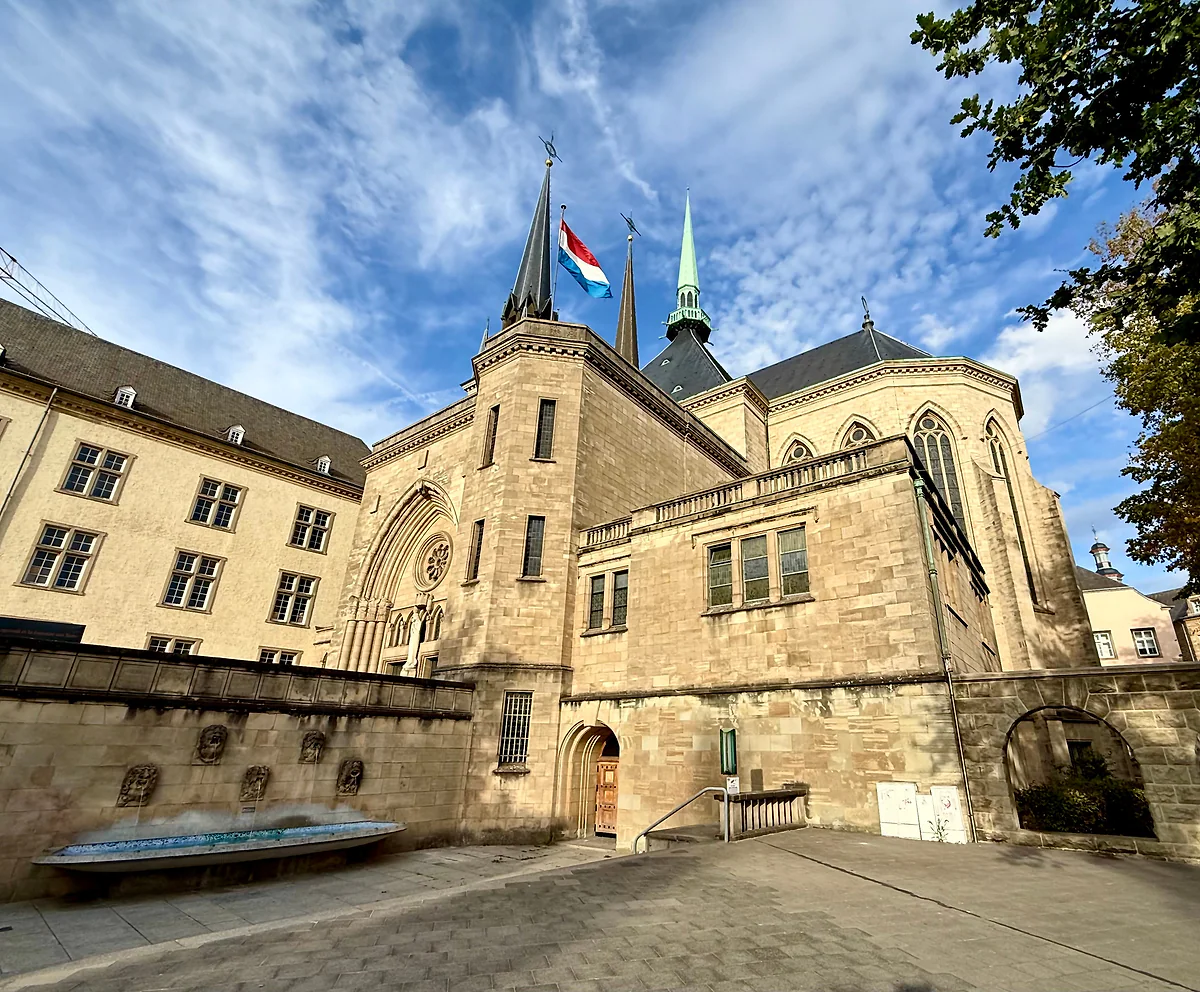
In the capital you’ll see it on the front of the Chamber of Deputies and inside the cathedral, beside the altar. The photo the government uses to present the flag was taken in front of the Gëlle Fra on Place de la Constitution, and that’s the spot I’d pick for yours.
If you are short on time, see the best tours in Luxembourg and pick one that fits your day.
Where the bus does not go, a car does: compare car hire in Luxembourg before you arrive rather than at the desk.
If you still need a way in, check the best ticket deals to Luxembourg from where you are.
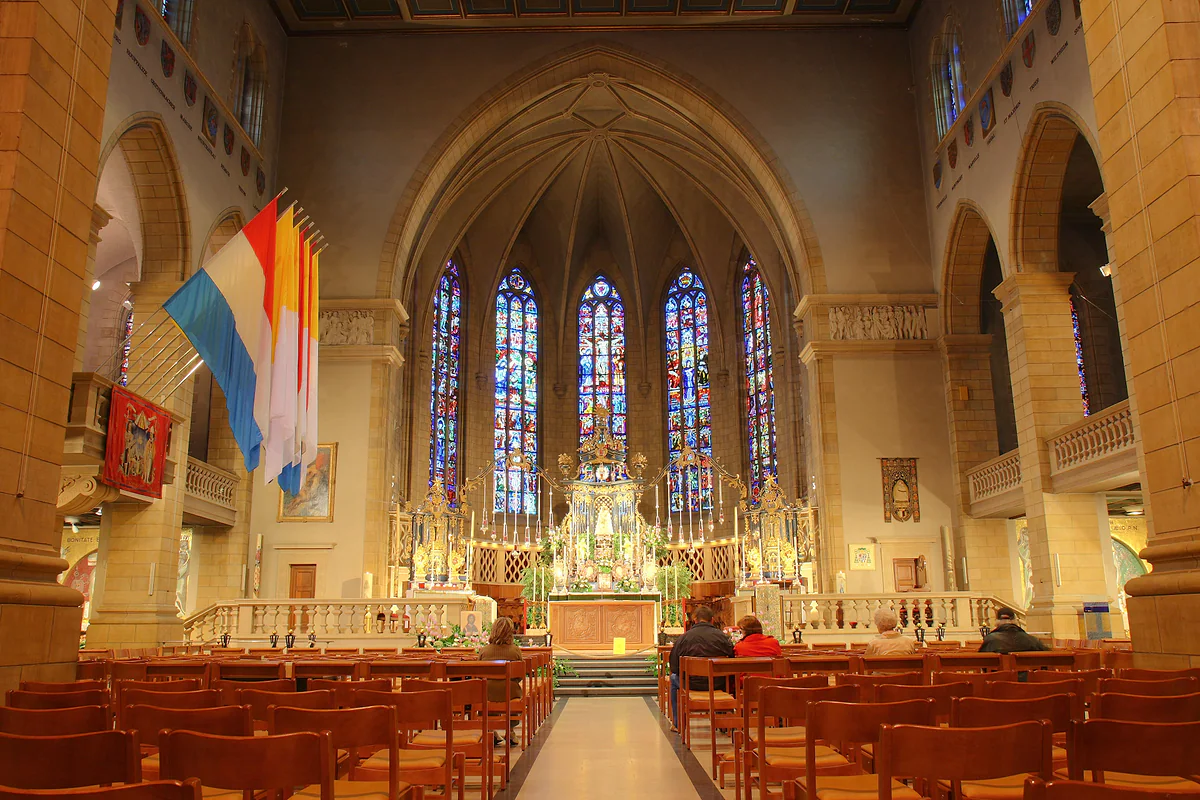
The choir of Notre-Dame Cathedral with its altar, stained-glass windows and Luxembourg flags hanging in the nave
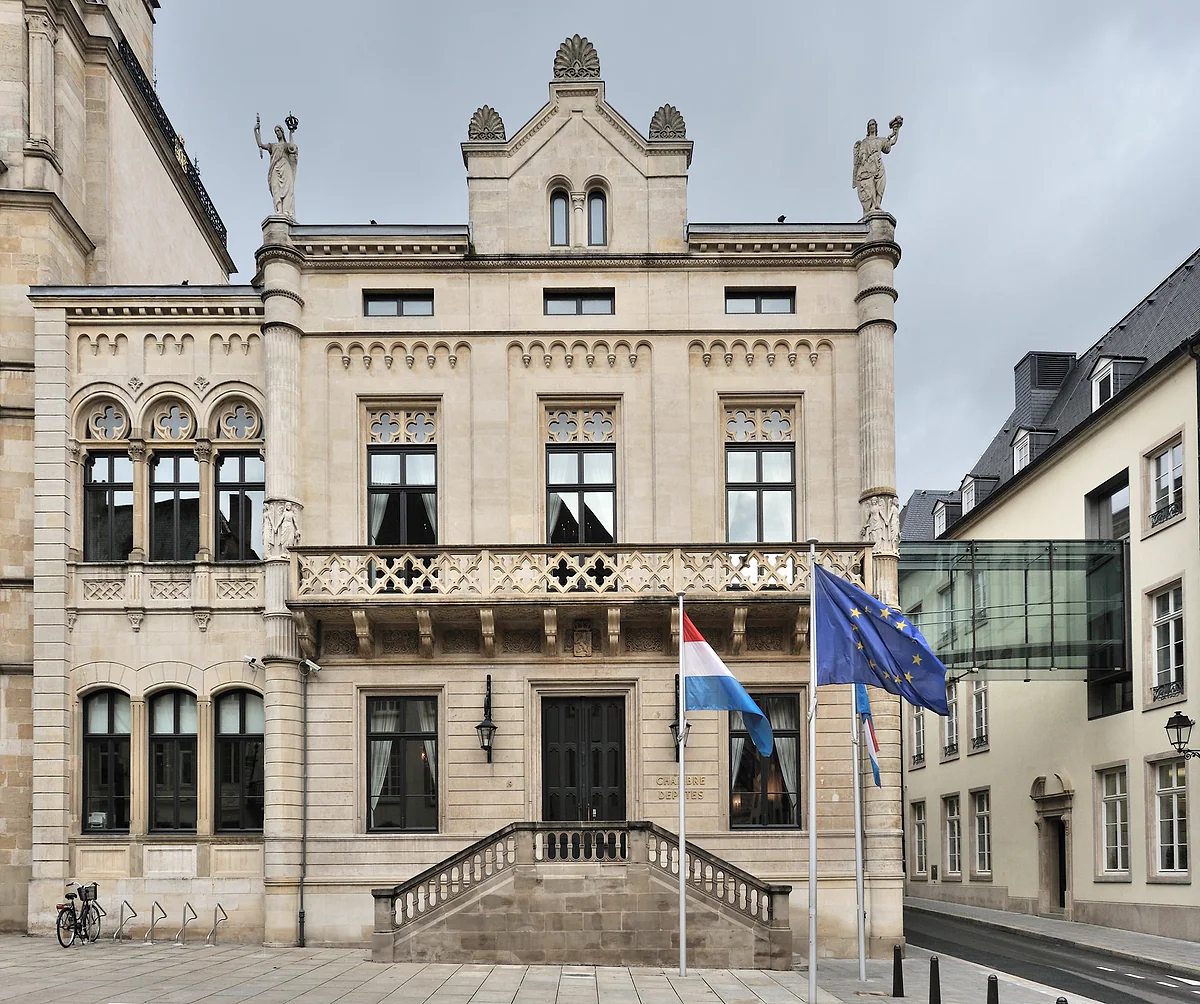
The Hôtel de la Chambre des Députés, seat of Luxembourg's Parliament, with a neo-Renaissance façade and flags
Luxembourg's national symbols
| Symbol | What it looks like | Since |
|---|---|---|
| Flag | Horizontal stripes of red, white and sky blue | First known flag, 1123 |
| Coat of arms | Ten stripes of silver and azure with a red lion crowned in gold, forked tail | 1235-1239, Henry V |
| Civil flag | The red lion of the arms, «Roude Léiw» | 2007 |
| Anthem | Ons Heemecht, first and last verses of Michel Lentz's poem | Poem of 1859; first performed in Ettelbruck in 1864 |
| Motto | «Mir wölle bleiwe wat mir sin» (we want to remain what we are) | An inscription quoted by the government |
| Legal protection | Arms and flag, 1972 law; anthem, 1993 law |
Details from luxembourg.public.lu (national symbols) and monarchie.lu, checked on 29-09-2026.
The anthem's opening lines
| In Luxembourgish | In English |
|---|---|
| Wou d'Uelzecht durech d'Wisen zéit, | Where the Alzette flows through the meadows |
| Duerch d'Fielsen d'Sauer brëcht. | and the Sûre breaks through the rocks |
| Wou d'Rief laanscht d'Musel dofteg bléit, | where the vine blooms along the Moselle |
| Den Himmel Wäin ons mëcht. | and heaven makes us wine |
Original text from luxembourg.public.lu; the English is my own rough rendering, based on the official French translation.
Test yourself
True or false?
0/3 Pick before you peek.
-
Luxembourg's flag is identical to the Dutch flag.
See the answer
False. Same colours and layout, but Luxembourg's blue is sky blue (Pantone 299C) while the Dutch is ultramarine.
-
Luxembourg's first known flag was red, white and blue.
See the answer
False. The one carried by Count William in 1123 was striped horizontally, probably in yellow and red, according to the official portal.
-
Luxembourg's anthem was first performed in Ettelbruck.
See the answer
True. It was first played in public at a large ceremony in Ettelbruck in 1864. Michel Lentz's poem dates from 1859.
0 of 425 Luxembourg guides
Your next stamp
- National Day
- Second World War
- Is it a country?
- Where is Luxembourg
- Map
- A Possen Museum
- American Cemetery
- Ansembourg
- Ansembourg Castles
- Asselborn
- Bascharage
- Beaufort castles
- Belval
- Belval blast furnaces
- Berg Castle
- Bernard-Massard cellars
- Bourglinster Castle
- Bourscheid Castle
- Brandenbourg
- Brandenbourg Castle
- Caves St Martin
- Christmas
- Clervaux Castle
- Echternach
- Echternach Abbey
- Ehnen
- Ehnen Wine Museum
- Esch-sur-Alzette
- Esch-sur-Sûre Castle
- European Museum Schengen
- Fond-de-Gras
- General Patton Museum
- German war cemetery
- Haff Réimech
- Hohllay
- Hollenfels Castle
- Hosingen
- Kautenbach
- Kneiff
- Koerich Castle
- Larochette Castle
- Lasauvage
- Mersch Castle
- Military History Museum
- Moersdorf
- Mondorf Domaine Thermal
- Munsbach Castle
- National Mining Museum
- Parc Merveilleux
- Park Sënnesräich
- Places to visit
- Remich
- Rindschleiden
- Schiessentümpel
- Septfontaines Castle
- Slate Museum
- Stolzembourg
- Tudor Museum
- Useldange Castle
- Valley of the Seven Castles
- Vianden
- Vianden Castle
- Ville Haute
- Wasserbillig Aquarium
- Weiswampach lakes
- Wiltz Castle
- Ahn
- Berdorf
- Bourscheid-Plage
- Butterfly garden
- Clervaux
- Differdange
- Echternach lake
- Grevenmacher
- Heringer Millen
- Hollenfels
- Luxembourg City
- Luxembourg Science Center
- Meysembourg Castle
- Mullerthal
- National Resistance Museum
- Perekop
- Remerschen
- Schoenfels Castle
- The Family of Man
- Things to do
- Upper Sûre Lake
- Vianden chairlift
- Wasserbillig
- Clervaux Abbey
- Echternach Roman villa
- Éislek
- Insenborn
- Kallektuffquell
- Machtum
- Most beautiful places
- Our Nature Park
- Pétange
- Pettingen Castle
- Schueberfouer
- Schwebsingen
- Victor Hugo House
- Waldbillig
- Dudelange
- Kuelscheier
- Lultzhausen
- Moselle Valley
- Octave
- Prettiest villages
- Sanem
- Schengen
- Wellenstein
- Wiltz
- Wolfsschlucht
- Beaufort
- Bech-Kleinmacher
- Éimaischen
- Gaalgebierg
- Guttland
- Marnach
- Mondorf-les-Bains
- Putscheid
- Schifflange
- UNESCO World Heritage
- Carnival
- Consdorf
- Ellergronn
- Käerjeng
- Kayl
- Minett
- Munshausen
- Tandel
- Bech
- Buergbrennen
- Esch-sur-Sûre
- Rumelange
- Lac de la Haute-Sûre (commune)
- Rosport-Mompach
- Wormeldange
- Larochette
- Mondercange
- Regions
- Bettembourg
- Bock Casemates
- Cantons
- Dancing procession
- Diekirch
- Fischbach
- Garnich
- Mersch
- Moselle wine route
- Ettelbruck
- Grund
- Heffingen
- Kehlen
- Lintgen
- Moselle river cruises
- Pétrusse Casemates
- Towns and villages
- Chemin de la Corniche
- Erpeldange-sur-Sûre
- Junglinster
- Kopstal
- Lorentzweiler
- Nommern
- Pfaffenthal
- Population
- Bissen
- Clausen
- Grand Ducal Palace
- Koerich
- Schieren
- Size
- Vallée de l'Ernz
- Feulen
- Kirchberg
- Languages
- Notre-Dame Cathedral
- Reisdorf
- Steinfort
- Bettendorf
- Habscht
- St Michael's Church
- Helperknapp
- Luxembourgish
- Place Guillaume II
- Name
- Place d'Armes
- History
- Place de la Constitution
- Grand Duke
- Colmar-Berg
- Flaxweiler
- Gare
- Hamm
- Kirchberg funicular
- Luxembourg fortress
- Mamer
- Mertert
- Minett Trail
- Mullerthal Trail
- Neumünster Abbey
- Parc Hosingen
- Pfaffenthal lift
- Political system
- Redange
- The Passerelle
- Wine festivals
- Winseler
- Beckerich
- Biwer
- EU institutions
- Goesdorf
- Limpertsberg
- Mudam
- Natur Musée
- Pulvermühl
- Stadtbredimus
- Troisvierges
- Wenzel walk
- Bonnevoie
- Bous-Waldbredimus
- Ell
- Kiischpelt
- Manternach
- Philharmonie
- Vauban circuit
- Weiswampach
- Betzdorf
- Boulaide
- Dräi Eechelen Museum
- Facts
- Hollerich
- Lenningen
- Useldange
- Wincrange
- Bourscheid
- Dalheim
- Gasperich
- Public holidays
- Red Bridge
- Saeul
- Belair
- Vichten
- Battle of the Bulge
- Merl
- Préizerdaul
- Cents
- EU and Schengen
- Groussbus-Wal
- Entry requirements
- Neudorf
- Rambrouch
- Currency and payments
- Mertzig
- Weimerskirch
- Adolphe Bridge
- Beggen
- Escapardenne
- How to get there
- International March of Diekirch
- MNHA (National Museum)
- Rock climbing
- Sandweiler
- Bridges
- Eich
- Flights
- Golf
- Hesperange
- Lëtzebuerg City Museum
- Canoeing and kayaking
- Dommeldange
- Luxembourg airport
- Strassen
- Villa Vauban
- Airport to city centre
- Bertrange
- Casino Luxembourg
- Mühlenbach
- Swimming pools
- From Brussels
- Pétrusse Valley
- Rollingergrund
- Walferdange
- Cessange
- Day trip from Brussels
- Municipal Park
- Steinsel
- Free walking tours
- From Paris
- Niederanven
- From Frankfurt
- Schuttrange
- Sightseeing train and bus
- By train
- Contern
- By coach
- Weiler-la-Tour
- Driving
- Luxembourg in one day
- Pretzel Sunday
- Rham Plateau
- Tour de Luxembourg
- Candlemas (Liichtmëssdag)
- Car hire
- Luxembourg in two days
- Saint-Esprit Plateau
- Luxembourg in three days
- Melusina statue
- Parking
- St Nicholas Day (Kleeschen)
- Fête de la Musique
- Luxembourg in four days
- Museums in Luxembourg
- Petrol
- Place de Clairefontaine
- A week in Luxembourg
- Getting around
- Luxembourg Marathon
- Tram and Bus Museum
- Free public transport
- Parks in Luxembourg City
- Road trip
- Belgium and Luxembourg
- Tram
- Buses
- Viewpoints
- Trains
- Luxembourg station
- Cycling
- LuxembourgPass
- Prices and budget
- On a budget
- Free things to do
- Mobile and roaming
- Healthcare
- Safety
- Scams
- Tourist information
- Packing list
- Swimming lakes
- With a dog
- Markets
- Tipping
- Shopping
- What to buy
- Shopping centres
- With kids
- For couples
- Playgrounds
- Adventure parks
- Nightlife
- Castles
- Theatres and concert venues
- Leudelange
- Nature parks
- Where to stay
- City-centre hotels
- Hiking
- Nature reserves
- Reckange-sur-Mess
- Hotels near the station
- Roeser
- Frisange
- Hotels in Kirchberg
- Airport hotels
- Dippach
- Hotels in Vianden
- Hotels in Echternach
- Hotels in Clervaux
- Hotels in Mondorf-les-Bains
- Hotels in Esch-sur-Alzette
- Hotels on the Moselle
- Mullerthal hotels
- Upper Sûre lake hotels
- Hotels in Diekirch and Ettelbruck
- Cheap hotels
- Luxury hotels
- Boutique hotels
- Spa hotels
- Family hotels
- Apartments
- Weather
- Youth hostels
- Best time to visit
- Campsites
- Holiday cottages
- In winter
- Castle hotels
- In spring
- Day trips
- In summer
- Around Luxembourg
- In autumn
- Ice skating
- Trier day trip
- Metz day trip
- Arlon day trip
- In January
- In February
- In March
- In April
- In May
- In June
- In July
- In August
- In September
- Food
- In October
- In November
- Where to eat
- In December
- Michelin restaurants
- Cheap eats
- Judd mat Gaardebounen
- Bouneschlupp
- Gromperekichelcher
- Kniddelen
- Quetschentaart
- Rieslingspaschtéit
- Events
- Wine
- Crémant
- Beer
Frequently asked questions
What does the Luxembourg flag look like?
Three equal horizontal stripes, red at the top, white in the middle and sky blue at the bottom. The blue is Pantone 299C, lighter than the ultramarine of the Netherlands flag.
Why is the Luxembourg flag like the Dutch flag?
Both use red, white and blue horizontal stripes. To tell them apart, Luxembourg uses sky blue (Pantone 299C) rather than the Dutch ultramarine, a fix the official portal describes as pragmatic.
Why does Luxembourg have a lion flag?
The red lion comes from the coat of arms set by Count Henry V between 1235 and 1239. Since 2007 the government has accepted this «Roude Léiw» as a civil flag within Luxembourg, alongside the national tricolour.
What language is the Luxembourg national anthem in?
Luxembourgish. It's called Ons Heemecht («Our Homeland») and consists of the first and last verses of an 1859 poem by Michel Lentz, set to music by Jean-Antoine Zinnen.
What is Luxembourg's national motto?
The government quotes the inscription «Mir wölle bleiwe wat mir sin», translated as «we want to remain what we are». It appears in official material on the country's history and language.
When was the Luxembourg flag first used?
The first known flag was carried by Count William of Luxembourg in 1123, striped horizontally and probably yellow and red. Today's red, white and sky-blue flag has had legal protection since 1972.
By
Tourism graduate with a master’s in Tourism Management and Planning from the University of Málaga, who has travelled across Europe. He writes every guide from official sources and his own judgement.
Published on . Facts checked on .
Sources
Some links in this guide are affiliate links: if you book through them, the site earns a commission at no extra cost to you. Affiliate disclosure
Photos: Yuliia Koval (CC BY-SA 4.0); Benh LIEU SONG (CC BY 3.0); Cayambe (CC BY-SA 3.0), via Wikimedia Commons.